REVIEW 3 major objections 5 minor 33 references
On the Role of Model Prior in Real-World Inductive Reasoning
T0 review · 3 major / 5 minor · reviewed 2026-08-11 · deepseek-v4-flash
Pith's one-line read LLMs generate hypotheses from prior knowledge, not examples, on real-world inductive reasoning tasks, so removing demonstrations costs little accuracy.
desk verdict Systematic study of LLM hypothesis generation with a plausible central claim, but the main accuracy metric is confounded by the LLM evaluator's own priors, so the strong quantitative conclusion is not fully supported. read the letter →
The pith
A machine-rendered reading of the paper's core claim, the machinery that carries it, and where it could break.
The reading
What carries the argument
The central mechanism investigated is the task-specific model prior, operationalized as the hypotheses an LLM produces from task instructions alone, compared against hypotheses produced when demonstrations with ground-truth labels are added. The comparison runs through three baselines—input-output prompting, iterative refinement with ranking, and HypoGeniC-style update from mistakes—and is evaluated by hypothesis-based classification, LLM scoring and pairwise comparison, and human pairwise comparison. Removing demonstrations isolates the prior's contribution; flipping, randomizing, or reformatting labels tests whether demonstrations can override it.
What would settle it
Give the LLM evaluator a deliberately wrong hypothesis (for example, 'hallucinations happen only for blue objects') on one of these datasets and measure test accuracy; if accuracy stays high, the evaluator is supplying the task knowledge itself, which would break the inference that generation relies on priors.
Extended reading notes
Core claim
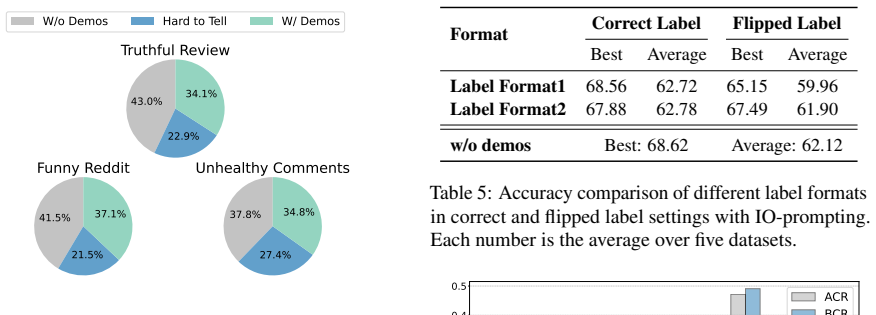
The paper's central claim is that in real-world inductive reasoning, LLM hypothesis generation is primarily driven by task-specific model prior, not by the provided input-label mappings. Concretely, for the best single hypothesis averaged over five datasets and three baselines, accuracy without demonstrations is 68.62% versus 68.56% with demonstrations; for multiple-hypothesis classification, it is 66.32% versus 65.74%. The invariance persists when demonstration labels are flipped or randomized, when the label format changes, and when hypotheses are scored by LLMs or humans. The paper therefore characterizes LLMs as zero-shot hypothesis generators on tasks where pretraining has supplied strong priors, with demonstrations acting as weak guidance that cannot override those priors.
Load-bearing premise
The conclusion assumes that the LLM used to apply a hypothesis to new examples judges the hypothesis's pattern rather than relying on its own task knowledge when labeling.
Editorial extensions
If this is right
- In knowledge-rich real-world classification tasks, labeled demonstrations are not necessary for LLMs to propose usable hypotheses; zero-shot generation with task instructions alone yields comparable downstream accuracy.
- Data still helps for hypothesis selection: iterative refinement with validation-set ranking consistently outperforms the other baselines, indicating that the useful role of data is choosing among hypotheses rather than shaping their content.
- Flipped or random label demonstrations barely change predictions, so the hypotheses LLMs produce on familiar tasks reflect pretrained knowledge more than the supplied label mapping; example labels are weak steering signals.
- The conclusion holds across GPT-4o, Qwen2-VL, and Gemini-1.5-pro and across single- and multiple-hypothesis evaluation, so it is not tied to one model or evaluation mode.
- LLM-based scoring and human pairwise comparisons also fail to prefer hypotheses generated with demonstrations, and in some cases slightly prefer zero-shot hypotheses.
Reading between the lines
- The paper leaves implicit a caution for scientific-discovery workflows: when models generate hypotheses from familiar datasets, those hypotheses may recycle pretraining knowledge, so novelty should be tested against evidence that the hypothesis is not already in the training distribution.
- One testable extension is to repeat the with/without-demonstrations comparison on a non-public dataset from a domain with no relevant prior; the paper's account predicts demonstrations would then matter, while a null result would point to a different mechanism.
- Another extension is to probe the evaluator directly by supplying a deliberately wrong hypothesis; if test accuracy barely moves, the invariance would be located in the evaluation model's prior rather than in the generator.
- The findings suggest prompt design may be better spent eliciting and constraining priors, for example by requesting several divergent hypotheses, than by adding more labeled examples.
Editorial analysis
A structured set of objections, weighed in public.
Referee Report
Summary. This paper asks whether LLM-generated natural-language hypotheses for real-world classification tasks are driven primarily by task-specific model priors or by in-context demonstrations. The authors compare three hypothesis-generation baselines (IO-prompting, iterative refinement, and HypoGeniC) with and without demonstrations on five datasets across three LLMs, measuring hypothesis quality via LLM-based inference, LLM-based scoring, human pairwise comparison, and a case study with flipped labels. They report that removing demonstrations causes minimal loss in downstream accuracy, that label flipping in demonstrations rarely changes predictions, and that a sentiment case study shows the model continues to generate hypotheses consistent with its prior. They conclude that task-specific model prior dominates hypothesis generation in real-world inductive reasoning.
Significance. If the central empirical claim holds, the paper makes a valuable contribution: it challenges the common assumption that labeled demonstrations are the primary driver of in-context inductive reasoning, and it offers a practical message about when prompt-data curation may be unnecessary. The study is reasonably broad in design (three baselines, three LLMs, multiple modalities, human evaluation) and is transparent about its limitations (classification only, limited case study). The case study in Section 6.3 provides direct process-level evidence that the model can ignore flipped-label demonstrations. However, the main accuracy result depends on an LLM-based evaluator that may share the generator's priors, so the central quantitative claim needs a control before it can be accepted.
major comments (3)
- [4.2, Appendix C.1, Appendix F] The hypothesis-based inference metric used for the headline result in Table 1 is vulnerable to a prior-confounding: the evaluator LLM is given the task name and the hypothesis text, which itself contains domain vocabulary (e.g., 'pleural effusion' in Table 10), so GPT-4o can answer from its own task knowledge even if it ignores the provided pattern. The near-identical w/ and w/o demo accuracies (68.62 vs 68.56) are therefore consistent with an evaluator that is invariant to the hypothesis. Appendix C.1 replaces the task framing with a generic alignment question but still uses an LLM judge on the pattern text, so the confound persists. I request a control condition that uses a pattern from a different task or a scrambled pattern, or a non-LLM pattern matcher; without such a control, the claim that removing demonstrations does not degrade hypothesis quality is not established.
- [4.1, 5.1] The 'w/o demos' conditions for iterative refinement and HypoGeniC are not 'model prior only' conditions. In iterative refinement without demonstrations, the model receives ranked hypotheses with their validation accuracies; in HypoGeniC without demonstrations, it receives reward-score rankings computed from the validation set. These are data-derived feedback signals that can shape the generated hypotheses. Hence the comparison in Table 1 for these two baselines conflates the absence of in-context demonstrations with the presence of validation-set feedback, and the overall averages do not isolate the role of model prior. The zero-shot interpretation is clean only for IO-prompting; please either remove the validation feedback in the w/o demos arms or restrict the prior-dominance conclusion to the IO-prompting baseline.
- [6.3, 7] The case study in Section 6.3 is the only direct, generation-level evidence that the model ignores flipped-label demonstrations, and it is limited to a single synthetic sentiment task with IO-prompting. This evidence, together with the human preference results (Section 5.4), supports a qualitative version of the claim, but it does not by itself carry the dataset-level and model-level quantitative generalization in Sections 5.1 and 7. Please either add generation-level analyses for additional datasets/baselines or soften the conclusion accordingly.
minor comments (5)
- [Tables 1, 2, 7, 8, 9] The word 'Accuraccy' should be 'Accuracy' throughout the table captions, and Table 9 contains the typo 'satefy' for 'safety'.
- [6.1, 6.2] Section 6.1 refers to 'Figure 5' when presenting accuracy differences between label formats, which appears to be Table 5; Section 6.2 refers to 'Table 5' for the ACR/BCR results, which appears to be Figure 5. The cross-references should be corrected.
- [Table 5] The last row of Table 5 ('w/o demos Best: 68.62 Average: 62.12') is ambiguous because it mixes reference values from Table 1 without explaining that these are the no-demonstration baselines; please clarify its meaning.
- [5.4] The human evaluation reports nine participants but gives no inter-annotator agreement or participant background information; adding these details would strengthen the reliability assessment.
- [4.1, Table 4] The method name is spelled inconsistently as 'HypoGeniC' and 'HypoGenic' in different places; please standardize.
Circularity Check
No derivation-reducing circularity found; the core invariance claim rests on independent experiments, including human evaluation, not on a fitted parameter or self-citation chain.
full rationale
The paper's central claim is an empirical comparison of hypothesis generation with and without demonstrations, measured by downstream classification accuracy on held-out test data. This is an operational measure, not a quantity defined in terms of the conclusion. No parameter is fitted to the test set and then reported as a prediction; the only validation-based selection occurs in iterative refinement and HypoGeniC, with test accuracy reported separately. The paper does not invoke a uniqueness theorem or a load-bearing result from prior work by the same authors; the cited hypothesis-generation baselines are by different author groups and are used to define methods, not to force the empirical outcome. The fact that an LLM is used both to generate and to apply hypotheses is a potential measurement confound: if the evaluator answered from its own prior knowledge rather than the supplied pattern, the with-versus-without-demonstration invariance would not isolate generator behavior. However, this is an empirical validity threat about whether the evaluator follows the prompt, not a definitional reduction of the paper's output to its input. The paper also provides an external check in the human pairwise evaluation (Figure 4), which shows a slight preference for hypotheses generated without demonstrations, and the main result is replicated across three LLMs and multiple label manipulations. No equation in the paper equates the claimed result to its own premise, and no fitted parameter is renamed as a prediction. Therefore no circular step meeting the stated evidence bar is present.
Assumptions & free parameters
free parameters (4)
- Number of in-context demonstrations =
30 for IO-prompting and iterative refinement; 50 for HypoGeniC
- Number of generated hypotheses =
5 per condition
- Iterative refinement iterations =
3
- HypoGeniC reward mixing coefficient alpha =
0.5
assumptions (3)
- domain assumption LLM-based hypothesis application measures hypothesis quality rather than the evaluator's own prior knowledge.
- domain assumption The five selected datasets are representative of real-world inductive reasoning.
- domain assumption Task-specific instructions and demonstrations are separable sources of information for the model.
Cite this review
Pith. "Pith review of On the Role of Model Prior in Real-World Inductive Reasoning." pith.science (2026). https://pith.science/paper/XDK2JMZK
@misc{pith2026241213645,
  author       = {Pith},
  title        = {Pith review of: On the Role of Model Prior in Real-World Inductive Reasoning},
  year         = {2026},
  howpublished = {\url{https://pith.science/paper/XDK2JMZK}},
  note         = {Machine review of arXiv:2412.13645}
}
read the original abstract
Large Language Models (LLMs) show impressive inductive reasoning capabilities, enabling them to generate hypotheses that could generalize effectively to new instances when guided by in-context demonstrations. However, in real-world applications, LLMs' hypothesis generation is not solely determined by these demonstrations but is significantly shaped by task-specific model priors. Despite their critical influence, the distinct contributions of model priors versus demonstrations to hypothesis generation have been underexplored. This study bridges this gap by systematically evaluating three inductive reasoning strategies across five real-world tasks with three LLMs. Our empirical findings reveal that, hypothesis generation is primarily driven by the model's inherent priors; removing demonstrations results in minimal loss of hypothesis quality and downstream usage. Further analysis shows the result is consistent across various label formats with different label configurations, and prior is hard to override, even under flipped labeling. These insights advance our understanding of the dynamics of hypothesis generation in LLMs and highlight the potential for better utilizing model priors in real-world inductive reasoning tasks.
Figures


Figures from the paper (4 more)


Reference graph
Works this paper leans on
-
[1]
Jinheon Baek, Sujay Kumar Jauhar, Silviu Cucerzan, and Sung Ju Hwang. 2024. Researchagent: Iterative research idea generation over scientific literature with large language models. arXiv preprint arXiv:2404.07738
arXiv 2024
-
[2]
Tom B Brown. 2020. Language models are few-shot learners. arXiv preprint arXiv:2005.14165
arXiv 2020
-
[3]
Kewei Cheng, Jingfeng Yang, Haoming Jiang, Zhengyang Wang, Binxuan Huang, Ruirui Li, Shiyang Li, Zheng Li, Yifan Gao, Xian Li, et al. 2024. Inductive or deductive? rethinking the fundamental reasoning abilities of llms. arXiv preprint arXiv:2408.00114
arXiv 2024
-
[4]
Lisa Dunlap, Yuhui Zhang, Xiaohan Wang, Ruiqi Zhong, Trevor Darrell, Jacob Steinhardt, Joseph E Gonzalez, and Serena Yeung-Levy. 2024. Describing differences in image sets with natural language. In Proceedings of the IEEE/CVF Conference on Computer Vision and Pattern Recognition, pages 24199--24208
work page 2024
-
[5]
Evan Heit. 2000. Properties of inductive reasoning. Psychonomic bulletin & review, 7:569--592
work page 2000
-
[6]
Or Honovich, Uri Shaham, Samuel R Bowman, and Omer Levy. 2022. Instruction induction: From few examples to natural language task descriptions. arXiv preprint arXiv:2205.10782
arXiv 2022
-
[7]
Younghyun Kim, Sangwoo Mo, Minkyu Kim, Kyungmin Lee, Jaeho Lee, and Jinwoo Shin. 2024. Discovering and mitigating visual biases through keyword explanation. In Proceedings of the IEEE/CVF Conference on Computer Vision and Pattern Recognition, pages 11082--11092
work page 2024
-
[8]
Takeshi Kojima, Shixiang Shane Gu, Machel Reid, Yutaka Matsuo, and Yusuke Iwasawa. 2022. Large language models are zero-shot reasoners. Advances in neural information processing systems, 35:22199--22213
2022
Show all 33 references
-
[9]
Jiachun Li, Pengfei Cao, Zhuoran Jin, Yubo Chen, Kang Liu, and Jun Zhao. 2024. Mirage: Evaluating and explaining inductive reasoning process in language models. arXiv preprint arXiv:2410.09542
2024 arXiv
-
[10]
Yifan Li, Yifan Du, Kun Zhou, Jinpeng Wang, Wayne Xin Zhao, and Ji-Rong Wen. 2023. Evaluating object hallucination in large vision-language models. arXiv preprint arXiv:2305.10355
2023 arXiv
-
[11]
Haokun Liu, Yangqiaoyu Zhou, Mingxuan Li, Chenfei Yuan, and Chenhao Tan. 2024. Literature meets data: A synergistic approach to hypothesis generation. arXiv preprint arXiv:2410.17309
2024 arXiv
-
[12]
Bodhisattwa Prasad Majumder, Harshit Surana, Dhruv Agarwal, Sanchaita Hazra, Ashish Sabharwal, and Peter Clark. 2024 a . Data-driven discovery with large generative models. arXiv preprint arXiv:2402.13610
2024 arXiv
-
[13]
Bodhisattwa Prasad Majumder, Harshit Surana, Dhruv Agarwal, Bhavana Dalvi Mishra, Abhijeetsingh Meena, Aryan Prakhar, Tirth Vora, Tushar Khot, Ashish Sabharwal, and Peter Clark. 2024 b . Discoverybench: Towards data-driven discovery with large language models. arXiv preprint a...
2024 arXiv
-
[14]
Sewon Min, Xinxi Lyu, Ari Holtzman, Mikel Artetxe, Mike Lewis, Hannaneh Hajishirzi, and Luke Zettlemoyer. 2022. Rethinking the role of demonstrations: What makes in-context learning work? arXiv preprint arXiv:2202.12837
2022 arXiv
-
[15]
Chau Minh Pham, Alexander Hoyle, Simeng Sun, Philip Resnik, and Mohit Iyyer. 2023. Topicgpt: A prompt-based topic modeling framework. arXiv preprint arXiv:2311.01449
2023 arXiv
-
[16]
Ilan Price, Jordan Gifford-Moore, Jory Fleming, Saul Musker, Maayan Roichman, Guillaume Sylvain, Nithum Thain, Lucas Dixon, and Jeffrey Sorensen. 2020. Six attributes of unhealthy conversation. arXiv preprint arXiv:2010.07410
2020 arXiv
-
[17]
Biqing Qi, Kaiyan Zhang, Haoxiang Li, Kai Tian, Sihang Zeng, Zhang-Ren Chen, and Bowen Zhou. 2023. Large language models are zero shot hypothesis proposers. arXiv preprint arXiv:2311.05965
2023 arXiv
-
[18]
Linlu Qiu, Liwei Jiang, Ximing Lu, Melanie Sclar, Valentina Pyatkin, Chandra Bhagavatula, Bailin Wang, Yoon Kim, Yejin Choi, Nouha Dziri, et al. 2023. Phenomenal yet puzzling: Testing inductive reasoning capabilities of language models with hypothesis refinement. arXiv preprin...
2023 arXiv
-
[19]
Parshin Shojaee, Kazem Meidani, Shashank Gupta, Amir Barati Farimani, and Chandan K Reddy. 2024. Llm-sr: Scientific equation discovery via programming with large language models. arXiv preprint arXiv:2404.18400
2024 arXiv
-
[20]
Chenglei Si, Diyi Yang, and Tatsunori Hashimoto. 2024. Can llms generate novel research ideas? a large-scale human study with 100+ nlp researchers. arXiv preprint arXiv:2409.04109
2024 arXiv
-
[21]
Chandan Singh, John X Morris, Jyoti Aneja, Alexander M Rush, and Jianfeng Gao. 2022. iprompt: Explaining data patterns in natural language via interpretable autoprompting. ArXiv preprint, 2210
2022
-
[22]
Ruocheng Wang, Eric Zelikman, Gabriel Poesia, Yewen Pu, Nick Haber, and Noah D Goodman. 2023. Hypothesis search: Inductive reasoning with language models. arXiv preprint arXiv:2309.05660
2023 arXiv
-
[23]
Yurong Wu, Yan Gao, Bin Benjamin Zhu, Zineng Zhou, Xiaodi Sun, Sheng Yang, Jian-Guang Lou, Zhiming Ding, and Linjun Yang. 2024. Strago: Harnessing strategic guidance for prompt optimization. arXiv preprint arXiv:2410.08601
2024 arXiv
-
[24]
Tim Z Xiao, Robert Bamler, Bernhard Sch \"o lkopf, and Weiyang Liu. 2024. Verbalized machine learning: Revisiting machine learning with language models. arXiv preprint arXiv:2406.04344
2024 arXiv
-
[25]
Jiancheng Yang, Rui Shi, Donglai Wei, Zequan Liu, Lin Zhao, Bilian Ke, Hanspeter Pfister, and Bingbing Ni. 2023 a . Medmnist v2-a large-scale lightweight benchmark for 2d and 3d biomedical image classification. Scientific Data, 10(1):41
2023
-
[26]
Zonglin Yang, Li Dong, Xinya Du, Hao Cheng, Erik Cambria, Xiaodong Liu, Jianfeng Gao, and Furu Wei. 2022. Language models as inductive reasoners. arXiv preprint arXiv:2212.10923
2022 arXiv
-
[27]
Zonglin Yang, Xinya Du, Junxian Li, Jie Zheng, Soujanya Poria, and Erik Cambria. 2023 b . Large language models for automated open-domain scientific hypotheses discovery. arXiv preprint arXiv:2309.02726
2023 arXiv
-
[28]
Ruiqi Zhong, Charlie Snell, Dan Klein, and Jacob Steinhardt. 2022. Describing differences between text distributions with natural language. In International Conference on Machine Learning, pages 27099--27116. PMLR
2022
-
[29]
Ruiqi Zhong, Peter Zhang, Steve Li, Jinwoo Ahn, Dan Klein, and Jacob Steinhardt. 2023. Goal driven discovery of distributional differences via language descriptions. Advances in Neural Information Processing Systems, 36:40204--40237
2023
-
[30]
Yangqiaoyu Zhou, Haokun Liu, Tejes Srivastava, Hongyuan Mei, and Chenhao Tan. 2024. Hypothesis generation with large language models. arXiv preprint arXiv:2404.04326
2024 arXiv
-
[31]
Zhaocheng Zhu, Yuan Xue, Xinyun Chen, Denny Zhou, Jian Tang, Dale Schuurmans, and Hanjun Dai. 2023. Large language models can learn rules. arXiv preprint arXiv:2310.07064
2023 arXiv
-
[32]
URL: " 'urlintro :=
ENTRY address author booktitle chapter edition editor howpublished institution journal key month note number organization pages publisher school series title type volume year eprint doi pubmed url lastchecked label extra.label sort.label short.list INTEGERS output.state before...
-
[33]
write newline
" write newline "" before.all 'output.state := FUNCTION n.dashify 't := "" t empty not t #1 #1 substring "-" = t #1 #2 substring "--" = not "--" * t #2 global.max substring 't := t #1 #1 substring "-" = "-" * t #2 global.max substring 't := while if t #1 #1 substring * t #2 gl...
Reviewed August 11, 2026 · model on record in the stance chip above.
Discussion (0). Continue with ORCID to comment.