REVIEW 1 major objections 5 minor 21 references
Graded Frobenius Algebras
T0 review · 1 major / 5 minor · reviewed 2026-08-11 · deepseek-v4-flash
Pith's one-line read This paper constructs determinant-twisted graph cobordism PROPs and proves that (c,d)-graded Frobenius algebras are exactly the map data satisfying five explicit sign-bearing relations, with suspension shifting (c,d) to (c−1,d+1).
desk verdict A careful, mostly rigorous construction of a graded Frobenius PROP with explicit signs; the main weakness is an unproved normal-form assertion in the sufficiency proof of Theorem 5.1. read the letter →
The pith
A machine-rendered reading of the paper's core claim, the machinery that carries it, and where it could break.
The reading
What carries the argument
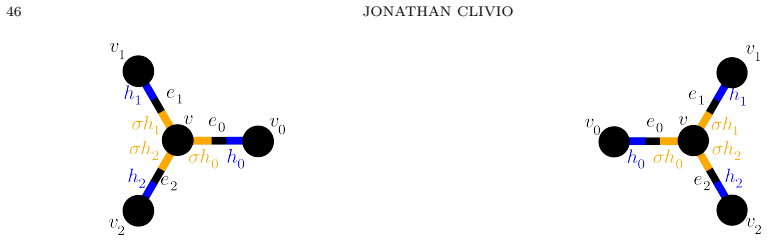
The load-bearing object is a family of PROPs—symmetric monoidal categories whose objects are finite sets and whose morphisms are operations with multiple inputs and outputs—built from graph cobordisms. For a graph $G$ from $X$ to $Y$, the morphism space uses $\det_{c,d}(G)=\det(G,\partial_{\mathrm{in}})^{\otimes c}\otimes\det(G,\partial_{\mathrm{out}})^{\otimes d}$, where $\det$ is the determinant (top exterior power) of relative homology, concentrated in degree minus the Euler characteristic; this twist places the multiplication generator in degree $c$ and the comultiplication generator in degree $d$. The determinant isomorphisms—additivity over short exact sequences and the identification of the determinant of a chain complex with the determinant of its homology—allow the paper to compute how edge collapses and gluings act on orientations, which yields the explicit signs in Theorem 5.1. The suspension PROP $\Sigma=\mathrm{End}_{\Sigma 1}$ supplies the universal shifting property, and the isomorphisms $\Sigma\otimes GCob_{c,d}\cong GCob_{c-1,d+1}$ (and the analogues for $fGCob$ and $pGCob$) transfer suspension to algebras.
What would settle it
The simplest check is Example 5.8: suspend the explicit rank-two $(c,d)$-graded algebra $R_{c,d}$ and verify with the paper's formulas that it satisfies the $(c-1,d+1)$ relations; any extra sign in the suspended associativity or Frobenius relation would disprove suspension stability.
Extended reading notes
Core claim
The paper's central claim is Theorem 5.1: for integers $c,d$ and a monoidal category $C$ enriched over graded abelian groups, the data $(A,\mu,\eta,\nu,\varepsilon)$ with $A\in C$, $\mu\in C_c(A\otimes A,A)$, $\eta\in C_{-c}(1,A)$, $\nu\in C_d(A,A\otimes A)$, $\varepsilon\in C_{-d}(A,1)$ defines a monoidal functor $pGCob_{c,d}\to C$ uniquely up to isomorphism if and only if the graded associativity, unitality, coassociativity, counitality, and Frobenius relations hold, namely $\mu\circ(\mu\otimes\mathrm{id})=(-1)^c\mu\circ(\mathrm{id}\otimes\mu)$, $(-1)^c\mu\circ(\eta\otimes\mathrm{id})=(-1)^{c(c-1)/2}\mathrm{id}=\mu\circ(\mathrm{id}\otimes\eta)$, the dual relations with $d$, and $(\mu\otimes\mathrm{id})\circ(\mathrm{id}\otimes\nu)=(-1)^{cd}\nu\circ\mu=(\mathrm{id}\otimes\mu)\circ(\nu\otimes\mathrm{id})$. In a symmetric category, adding $\mu\circ\tau=(-1)^c\mu$ characterizes symmetric monoidal functors out of $GCob_{c,d}$, while adding $\varepsilon\circ\mu\circ\tau=(-1)^c\varepsilon\circ\mu$ characterizes functors out of $fGCob_{c,d}$. The paper further establishes that these signs are not an artifact: no choice of orientations removes them, and with the chosen orientations they are preserved under suspension, which shifts $(c,d)$ to $(c-1,d+1)$.
Load-bearing premise
The load-bearing premise is that the graph categories faithfully encode the geometric cobordism categories, so that no relations are lost or added when surfaces are replaced by graphs; if two graphs represented the same surface without being connected by graph morphisms, the twisted morphism spaces would not describe 2D TQFTs.
Editorial extensions
If this is right
- For a closed oriented $d$-manifold, the cup product and the Thom intersection coproduct give $H^*(M)$ a $(0,d)$-graded commutative Frobenius algebra, and the Poincaré coproduct is the suspended Thom coproduct on $\Sigma^{-d}H^*(M)$, which explains the sign difference between the two conventions.
- For a $(0,d)$-graded symmetric Frobenius algebra $A$, the normalized Hochschild homology $HH_*(A)$ carries a $(d,d)$-graded structure with the explicit operations of Example 6.3, matching the determinant-twisted open-closed TQFT description.
- Suspension gives an equivalence between $(c,d)$-graded and $(c-1,d+1)$-graded algebras over the PROPs, so $c+d$ is a suspension invariant; every non-trivial algebra with $c+d\neq0$ contains the rank-two example $\Sigma^{-c}R\oplus\Sigma^d R$ as a subobject.
- When $c$ and $d$ have opposite parity, the forest subdioperad of $GCob_{c,d}$ has the same operations as the full PROP up to $\mathbb{Z}/2$ cokernel, which is what allows the infinite-dimensional Rabinowitz loop homology example to be described by the dioperad.
- The signs in Theorem 5.1 coincide, up to a uniform regrading of the multiplication and comultiplication, with the biunital coFrobenius convention, so the two frameworks describe the same finite-dimensional structures.
Reading between the lines
- One extension the author leaves implicit is that the determinant-twisting calculus should transfer to other graph-indexed PROPs, such as the open-closed TQFTs with zippers sketched in Remark 6.9; forcing the zipper relations in a two-vertex-type dioperad is a concrete next step.
- Because suspension shifts $(c,d)$ to $(c-1,d+1)$ while preserving $c+d$, I would expect any complete invariant of graded Frobenius algebras to respect this suspension class; the paper does not pursue such invariants.
- The triviality result for odd $c-d$ in the naive graded setting suggests a useful diagnostic for the literature: any published non-trivial graded Frobenius structure with operations of odd relative degree must be hiding either signs or a suspension, and Theorem 5.1 gives the dictionary for finding them.
Editorial analysis
A structured set of objections, weighed in public.
Referee Report
Summary. The paper constructs PROPs GCob_{c,d}, fGCob_{c,d}, and pGCob_{c,d} from graphs with determinant twistings, defining (c,d)-graded (commutative/symmetric) Frobenius algebras as algebras over these PROPs. Theorem 5.1 then gives an equivalent description in terms of an object A with a multiplication µ of degree c, a unit η of degree −c, a comultiplication ν of degree d, and a counit ε of degree −d, subject to graded associativity, unitality, coassociativity, counitality, and a graded Frobenius relation with signs depending on c and d; in the symmetric cases, graded commutativity or graded symmetry is added. The paper also proves stability under suspension, establishing isomorphisms Σ⊗GCob_{c,d} ≅ GCob_{c−1,d+1} and the corresponding behavior of the maps, and it discusses examples from cohomology of manifolds, Hochschild homology, and loop homology.
Significance. If the main theorem is correct, the paper provides a useful unifying framework for graded Frobenius algebras: the PROP definition gives a canonical sign convention for arbitrary degrees (c,d), and Theorem 5.1 is the first systematic map-and-relations description in this setting. The signs are derived from determinant twistings and orientation choices, not fitted to examples, which gives the computation of Koszul signs in Lemma 7.6 a high degree of reliability. The suspension-stability result (Proposition 5.11) and the examples from manifold cohomology, Hochschild homology, and loop homology provide nontrivial external benchmarks. The paper is clearly written and the technical core is carried out in considerable detail. However, the sufficiency direction of Theorem 5.1 contains a significant gap that needs to be addressed before the result can be considered established.
major comments (1)
- [Section 7.2] The 'if' direction of Theorem 5.1 rests on the assertion: 'An analogous argument for (fat) graphs shows that any two decompositions into the four graphs are related by a sequence of those six relations.' This is not demonstrated. The cited normal-form theorems of Kock [Koc04] and Lauda–Pfeiffer [LP08] are for closed and open surfaces, not for the graph categories GCob_{c,d}, fGCob_{c,d}, and pGCob_{c,d}. Proposition 2.13 establishes an equivalence of 1-categories, but it does not by itself provide a presentation of the morphism categories by the four elementary graphs and the six relations. If the graph categories admit relations among decompositions beyond those generated by Lemma 7.6, the sufficiency direction fails and Theorem 5.1 would overcount graded Frobenius algebras. The subsequent π1-invariance argument inherits the same weakness: the reduction of arbitrary zig-zags to the relations in Lemma 7.6 depends on the same unproved normal-form assertion. A proof, or a precise reference showing that the graph decomposition relations are generated by the six surface relations, is needed.
minor comments (5)
- [Definition 4.3] The third displayed definition repeats 'fGCob_{c,d}' instead of 'pGCob_{c,d}' for the planar case.
- [Lemma 7.6, Graded unitality] The line beginning 'comp2(ωin() ⊗ ωin()) = −(e2 ∧ comp2(ωin() ⊗ ωin()) = ...' appears garbled; it should read 'comp2(ωin() ⊗ ωin()) = −(e2 ∧ e1 ∧ e0 ∧ e′2 ∧ e′1 ∧ e′0)−1 ...'.
- [Proposition 6.4] The two displayed isomorphisms in the statement are both labeled (10); the second should be renumbered.
- [Proposition 2.13] The faithfulness argument for fCob invokes [ES15, Theorem A] and says that 'restricting to the open part and taking π0' gives the claim; since this is a key step, a short explanation of how the cited theorem implies π0-level faithfulness of fCob would help the reader.
- [Throughout] The distinction between the 2-categories pGCob and the associated 1-categories pGCob is visually subtle in the typeset text; a bolder typographic distinction (e.g., different fonts) would reduce the chance of confusion.
Circularity Check
No significant circularity; signs are computed from determinant twistings and cross-checked against external examples.
full rationale
The paper's derivation chain is not circular. The graded Frobenius PROP is constructed from graph cobordisms and determinant twistings (Definitions 2.12, 4.3, and 4.4), and no parameter is fitted to the examples used as benchmarks in Section 6. The signs in Theorem 5.1 are computed, not assumed: Lemma 7.6 evaluates compositions of the chosen orientation generators using the explicit formulas in Lemmas 7.3 and 7.4, while Remark 5.3 records that the signs depend on choices in det_{c,d}(G). The examples from manifold cohomology, Hochschild homology, and loop homology are external checks; the paper does not fit the sign relations to them. The only load-bearing gap is in Section 7.2, where the 'if' direction of Theorem 5.1 imports the surface normal-form theorem of Kock and Lauda-Pfeiffer and asserts an 'analogous argument' for graphs. That is a completeness/proof gap, not circularity: the needed normal-form statement is an external presentation theorem, not an assumption equivalent to the conclusion, and it is not a self-citation. Citations to [ES15], [Koc04], [LP08], [WW16], and [CO22b] are independent published results rather than self-referential support. Accordingly, no circular step of any of the seven enumerated kinds is present.
Assumptions & free parameters
assumptions (3)
- standard math The graph cobordism categories GCob, fGCob and pGCob are equivalent to the geometric cobordism categories Cob_2^closed, Cob_2^open and Cob_2^planar.
- standard math The determinant functor det_{c,d} is well-defined and the colimits defining GCob_{c,d}(X,Y) can be computed via the π1-action on det_{c,d}(G) (Proposition 4.5).
- domain assumption Any two decompositions of a graph cobordism into elementary graphs (⋔, η, ν, ε, twist) are related by the six generating relations.
invented entities (1)
-
Graded graph cobordism PROP GCob_{c,d} (and fat/planar variants fGCob_{c,d}, pGCob_{c,d})
independent evidence
Cite this review
Pith. "Pith review of Graded Frobenius Algebras." pith.science (2026). https://pith.science/paper/VVR6FFIB
@misc{pith2026241213909,
  author       = {Pith},
  title        = {Pith review of: Graded Frobenius Algebras},
  year         = {2026},
  howpublished = {\url{https://pith.science/paper/VVR6FFIB}},
  note         = {Machine review of arXiv:2412.13909}
}
read the original abstract
We construct a PROP which encodes 2D-TQFTs with a grading. This defines a graded Frobenius algebra as algebras over this PROP. We also give a description of graded Frobenius algebras in terms of maps and relations. This structure naturally arises as the cohomology of manifolds, loop homology and Hochschild homology of Frobenius algebras. In addition, we give a comprehensive description of the signs that arise in suspending algebras over PROPs.
Figures


Figures from the paper (11 more)




Reference graph
Works this paper leans on
-
[1]
Two-dimensional topological quantum field theories and F robenius algebras
Lowell Abrams. Two-dimensional topological quantum field theories and F robenius algebras. Journal of Knot theory and its ramifications , 5(05):569--587, 1996
work page 1996
-
[2]
A polarized view of string topology
Ralph L Cohen and V \'e ronique Godin. A polarized view of string topology. London Mathematical Society Lecture Note Series , 308:127, 2004
work page 2004
-
[3]
La th\'eorie de l'homotopie des 2-cat\'egories
Jonathan Chiche. La th\'eorie de l'homotopie des 2-cat\'egories . arXiv preprint arXiv:1411.6936 , 2014
work page Pith review arXiv 2014
-
[4]
Poincar\' e duality for loop spaces
Kai Cieliebak, Nancy Hingston, and Alexandru Oancea. Poincar\' e duality for loop spaces. arXiv preprint arXiv:2008.13161 , 2020
arXiv 2008
-
[5]
Loop coproduct in M orse and F loer homology
Kai Cieliebak, Nancy Hingston, and Alexandru Oancea. Loop coproduct in M orse and F loer homology. Journal of Fixed Point Theory and Applications , 25(2):59, 2023
work page 2023
-
[6]
Reduced symplectic homology and string topology
Kai Cieliebak and Alexandru Oancea. Reduced symplectic homology and the secondary continuation map. arXiv preprint arXiv:2209.02972 , 2022
work page Pith review arXiv 2022
-
[7]
Topological F robenius A lgebras
Kai Cieliebak and Alexandru Oancea. Topological F robenius A lgebras. arXiv preprint arXiv:2209.02979 , 2022
arXiv 2022
-
[8]
Rabinowitz Floer homology as a Tate vector space
Kai Cieliebak and Alexandru Oancea. Rabinowitz Floer homology as a Tate vector space . arXiv preprint arXiv:2407.21741 , 2024
work page Pith review arXiv 2024
Show all 21 references
-
[9]
Comparing fat graph models of moduli space
Daniela Egas Santander. Comparing fat graph models of moduli space. arXiv preprint arXiv:1508.03433 , 2015
2015 arXiv
-
[10]
Koszul duality for dioperads
Wee Liang Gan. Koszul duality for dioperads. arXiv preprint math/0201074 , 2002
2002 arXiv
-
[11]
Loop products and closed geodesics
Mark Goresky and Nancy Hingston. Loop products and closed geodesics. Duke Mathematical Journal , 150(1):117, 2009
2009
-
[12]
Modular operads
Ezra Getzler and Mikhail M Kapranov. Modular operads. Compositio Mathematica , 110(1):65--125, 1998
1998
-
[13]
Higher string topology operations
V \'e ronique Godin. Higher string topology operations. arXiv preprint arXiv:0711.4859 , 2007
2007 arXiv
-
[14]
Algebraic Topology
Allen Hatcher. Algebraic Topology . Cambridge University Press, 2002
2002
-
[15]
Product and coproduct in string topology
Nancy Hingston and Nathalie Wahl. Product and coproduct in string topology . arXiv preprint arXiv:1709.06839 , 2017
2017 arXiv
-
[16]
Frobenius algebras and 2-d topological quantum field theories
Joachim Kock. Frobenius algebras and 2-d topological quantum field theories . Number 59 in London Mathematical Society Student Texts. Cambridge University Press, 2004
2004
-
[17]
Pre-Calabi-Yau algebras and topological quantum field theories
Maxim Kontsevich, Alex Takeda, and Yiannis Vlassopoulos. Pre-Calabi-Yau algebras and topological quantum field theories . arXiv preprint arXiv:2112.14667 , 2021
2021 arXiv
-
[18]
Open--closed strings: T wo-dimensional extended TQFT s and Frobenius algebras
Aaron D Lauda and Hendryk Pfeiffer. Open--closed strings: T wo-dimensional extended TQFT s and Frobenius algebras . Topology and its Applications , 155(7):623--666, 2008
2008
-
[19]
Operads and PROPs
Martin Markl. Operads and PROPs . Handbook of algebra , 5:87--140, 2008
2008
-
[20]
Loop coproducts in string topology and triviality of higher genus TQFT operations
Hirotaka Tamanoi. Loop coproducts in string topology and triviality of higher genus TQFT operations. Journal of Pure and Applied Algebra , 214(5):605--615, 2010
2010
-
[21]
Hochschild homology of structured algebras
Nathalie Wahl and Craig Westerland. Hochschild homology of structured algebras. Advances in Mathematics , 288:240--307, 2016
2016
Reviewed August 11, 2026 · model on record in the stance chip above.
Discussion (0). Continue with ORCID to comment.