pith. machine review for the scientific record. sign in

math.AT

Algebraic Topology

Homotopy theory, homological algebra, algebraic treatments of manifolds

0
math.AT 2026-05-13 2 theorems

Contractible fibers bound interleaving distance for persistence posets

Quillen-McCord theorem for persistence finite posets

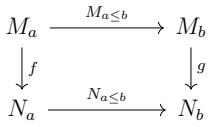
Maps with weakly ε-contractible homotopy fibers between persistence finite posets yield an upper bound on homotopy commutative interleaving.

abstract click to expand
In this paper, we establish a persistence version of the Quillen-McCord theorem for persistence finite posets. Given a map $f \colon P \rightarrow Q$ between persistence finite posets $P$ and $Q$ with weakly $\varepsilon$-contractible homotopy fibers, we provide an upper bound for the homotopy commutative interleaving distance between $P$ and $Q$.
0
0
math.AT 2026-05-13 Recognition

S/4 spectrum admits A5-multiplication

Obstructions for Associativity in Stable Homotopy Theory

Obstruction theory in stable infinity-categories shows associativity holds through level 5 for the mod-4 sphere.

Figure from the paper full image
abstract click to expand
We give a construction of the obstruction theory for $\mathbb{A}_{n}$-algebra structures in stable $\infty$-categories, and give some properties of it. We use this to show that the spectrum $\mathbb{S} / 4$ admits an $\mathbb{A}_5$-multiplication using synthetic spectra.
1 0
0
math.AT 2026-05-12 Recognition

Stable barcodes track how dependency clusters evolve in dynamic Bayesian networks

A Stable Distance Persistence Homology for Dynamic Bayesian Network Clustering

Thresholding edges by variation in conditional dependence places the DBN inside an existing dynamic-graph setting, so existing stability thm

Figure from the paper full image
abstract click to expand
Dynamic Bayesian networks (DBNs) are a widely used framework for modeling systems whose probabilistic structure evolves over time. Standard inference methods focus on local conditional distributions and can miss larger-scale patterns in how dependencies between variables organize and change over time. We introduce a topological approach to this problem. To each DBN we associate a time-varying graph, called a Dynamic Bayesian Graph (DBG), by assigning to each edge a strength that measures variation in its conditional dependence across parent configurations, and retaining edges whose strength exceeds a chosen threshold. We show that this construction fits within the dynamic graph framework of Kim and M\'emoli, enabling the use of tools from topological data analysis. Applying persistent homology to a DBG produces a barcode, which records the merging and disappearance of connected groups of strongly dependent variables over time. We prove that this barcode is stable: small perturbations in the conditional probability tables of the DBN lead to small changes in the resulting barcode. This yields a principled and noise-resistant summary of how dependency structure evolves in a dynamic Bayesian network.
0
0
math.AT 2026-05-12 2 theorems

Surgery yields infinitely many operads cobordant but not equivalent to Fulton-MacPherson

Surgery on manifold operads

The constructed examples share a bimodule cobordism relation with the standard point-configuration operad yet differ in homotopy type.

Figure from the paper full image
abstract click to expand
We study cobordisms of a class of topological operads called ``manifold operads''. These operads are generalizations of the Fulton-MacPherson operad: an operad built from configurations of points in Euclidean space. Cobordism of manifold operads, along with the associated theory of surgery, depends crucially on delicate combinatorial results for trees associated to operadic bimodules. As an application of surgery, we produce infinitely many manifold operads which are left or right ``bimodule cobordant'' to, but not homotopy equivalent to the Fulton-MacPherson operad.
0
0
math.AT 2026-05-12 Recognition

Galois groupoid of G-spectra matches Burnside ring groupoid

The Galois theory of G-spectra and the Burnside ring

This turns equivariant homotopy invariants into explicit calculations from the table of marks.

abstract click to expand
We prove that the Galois groupoid of the category of $G$-spectra for a finite group $G$ is algebraic, i.e. equivalent to the \'etale fundamental groupoid of the Burnside ring of $G$. We implement an algorithm that computes the latter from the table of marks of $G$, and provide numerous examples.
0
0
math.AT 2026-05-12 Recognition

String cobracket differs on homotopy equivalent lens spaces

Homotopy Non-Invariance of the String Cobracket and the Failure of the Lie Bialgebra Structure

Calculations on L(9;1) and L(9;4) show the operation is not preserved under homotopy equivalence and blocks a Lie bialgebra structure.

abstract click to expand
We prove that the string cobracket is not a homotopy invariant. Adapting Naef's method arXiv:2106.11307 for computing the string coproduct, we show that the string cobrackets on the three-dimensional lens spaces $L(9;1)$ and $L(9;4)$ differ. We further relate the string cobracket to the Whitehead torsion, analogously to the case of the string coproduct. In addition, we show that the string bracket and the string cobracket do not endow the $S^1$-equivariant homology of the free loop space with a Lie bialgebra structure. These findings indicate that the analogy with the Turaev cobracket breaks down in higher-dimensional string topology.
0
0
math.AT 2026-05-11 1 theorem

Milnor fibers made arbitrarily connected while non-formal

Highly connected non-formal Milnor fibers via polyhedral products

Higher-order Massey products from moment-angle complexes lift all prior connectivity limits on non-formal examples via realization theorem.

abstract click to expand
We show that the realization theorem of Fern\'andez de Bobadilla, which identifies the Milnor fiber of a weighted-homogeneous polynomial with the complement of a germ of analytic set, can be combined with the systematic Massey product constructions of Grbi\'c-Linton for moment-angle complexes $\mathcal{Z}_K = \mathcal{Z}_K(D^2, S^1)$ to produce weighted-homogeneous polynomials whose Milnor fibers are arbitrarily highly connected and non-formal. The original application of this strategy, due to Fern\'andez de Bobadilla, used the Denham-Suciu classification of lowest-degree triple Massey products and yielded only $2$-connected non-formal Milnor fibers. The Grbi\'c-Linton framework, which constructs non-trivial $n$-fold Massey products in $H^*(\mathcal{Z}_K;\mathbb{Z})$ for arbitrary $n$ and in arbitrary cohomological degrees, removes this connectivity restriction entirely.
0
0
math.AT 2026-05-11 Recognition

Quaternionic conjugation spaces are homologically pure

Purity of quaternionic conjugation spaces

Under a mild assumption this yields K4-maximality and connects to Smith-Thom inequalities in real algebraic geometry.

abstract click to expand
Conjugation spaces relate the cohomology of a space and its fixed points via a degree-halving isomorphism and admit a characterization in terms of homological purity. We extend this framework to the Klein four group, where the corresponding structures exhibit a degree-quartering behavior governed by Dickson invariants. Under a mild assumption, we prove that quaternionic conjugation spaces are homologically pure. As an application, we show that such spaces are both $\mathcal{K}_4$-maximal and $\mathcal{K}_4$-Galois maximal, establishing a connection with Smith--Thom type inequalities in real algebraic geometry.
0
0
math.AT 2026-05-11 Recognition

Rationally hyperbolic polyhedral products have no odd-prime homotopy exponents

Homotopy exponents of polyhedral products

The result holds for products built from finite spaces with torsion-free homology, and Moore's conjecture follows when suspensions are wedge

abstract click to expand
We study Moore's conjecture and homotopy exponents for polyhedral products. For $(\underline{CA},\underline{A})^K$ where each $A_i$ is finite and has torsion-free homology, we prove that if $(\underline{CA},\underline{A})^K$ is rationally hyperbolic, then it has no homotopy exponent at any odd prime. Under the additional hypothesis $\Sigma A_i$ is homotopy equivalent to a finite-type wedge of simply-connected spheres, we show Moore's conjecture holds for $(\underline{CA},\underline{A})^K$. We also give criteria such that, for a large family of polyhedral join products, the associated polyhedral products are rationally hyperbolic, mod-$p^r$ hyperbolic for all but finitely many primes, and have no homotopy exponent at all but finitely many primes.
0
0
math.AT 2026-05-11 2 theorems

Prime ideal spectrum defined for bi-incomplete Tambara functors

Spectra of bi-incomplete Tambara functors

Unifies Lewis and Nakaoka definitions while supplying tools for calculations in equivariant ring theory.

Figure from the paper full image
abstract click to expand
Bi-incomplete Tambara functors are equivariant generalizations of commutative rings. The most common forms of bi-incomplete Tambara functors are coefficient systems of commutative rings, Green functors, and Tambara functors. In the 1980s, Lewis introduced prime ideals in Green functors, and in the 2010s, Nakaoka introduced prime ideals in Tambara functors. In this work, we define the spectrum of prime ideals for an arbitrary bi-incomplete Tambara functor, simultaneously generalizing Lewis and Nakaoka's notions. We then produce many computational tools which we apply to several examples of interest.
0
0
math.AT 2026-05-11 Recognition

Condensed anima shape recovers classical shape on paracompact and locally contractible

Shape theory for condensed anima

The agreement extends prior comparisons between sheaf and condensed cohomology.

abstract click to expand
We give different perspectives on the notion of shape for condensed anima. We prove that it recovers more classical notions of shape for topological spaces in the cases of all paracompact compactly generated spaces and all locally contractible spaces. These recovering statements imply and extend comparison results on sheaf and condensed cohomology by Clausen-Scholze and Haine. Another homotopy-theoretical direction for condensed anima are their condensed homotopy groups. Connected to this, we give a description of the underlying topological group functor on condensed groups via quasi-topological groups.
0
0
math.AT 2026-05-11 1 theorem

Semisimplicial modules match chain-complex homotopy theories

Combinatorial Models for Linear Homotopy Theories

Equivalences at both localization and Quillen levels hold over characteristic-zero fields, with a partial adjunction from semicubical models

abstract click to expand
For a field $k$ of characteristic $0$, we compare $k$-linear chain complexes, semisimplicial vector spaces, augmented semisimplicial vector spaces, semicubical vector spaces, and arboreal vector spaces through small differential categorical algebras. We prove that semisimplicial modules and augmented semisimplicial modules are equivalent to appropriate chain-complex homotopy theories, both at the Gabriel--Zisman localization and the Quillen model-categorical level. The semicubical sign embedding gives a natural comparison from semicubical modules to augmented semisimplicial modules and induces a Quillen adjunction, but not a Quillen equivalence on the full semicubical category since there is an obstruction in augmented homology at degree $-1$.
0
0
math.AT 2026-05-08 2 theorems

Geometric norms model rational ultracommutative rings as span functors

An algebraic model for rational ultracommutative rings

The equivalence reduces the study of rational global ring spectra to algebraic functors on groupoid spans and recovers prior results.

abstract click to expand
Given a global equivariant ultracommutative ring spectrum $E$ and inclusion $H\hookrightarrow G$ of finite groups, one may apply geometric fixed points to the norm $N_H^G E_H \to E_G$ to obtain what we call a \emph{geometric norm} $\Phi^H E \to \Phi^G E$. We prove that, together with inflations, these assemble into a functor $\Phi\colon\mathrm{UCom}_{\mathrm{fin}} \to \mathrm{Fun}(\mathrm{Span}(\mathcal{G},\mathcal{E},\mathcal{O}),\mathrm{CAlg})$, where $\mathrm{Span}(\mathcal{G},\mathcal{E},\mathcal{O})$ is the span category of finite connected groupoids with full backwards maps and faithful forwards maps, and that $\Phi$ restricts to an equivalence between full subcategories of rational objects. Central to our construction is a refinement of geometric fixed points to a natural transformation $\Phi\colon \mathrm{Sp}_\bullet\to\mathrm{Fun}(\mathrm{Orb}_\bullet^\simeq,\mathrm{Sp})$ which is compatible with restrictions and norms, and which restricts to an equivalence on full subcategories of rational objects. We explain how this may also be used to recover theorems of Barrero--Barthel--Pol--Strickland--Williamson and Wimmer on algebraic models for rational global spectra and normed $G$-commutative ring spectra respectively.
0
0
math.AT 2026-05-08

Geometric fixed points yield algebraic models for rational ultracommutative rings

An algebraic model for rational ultracommutative rings

A functor from norms and inflations restricts to an equivalence exactly on rational objects over a span category of groupoids.

abstract click to expand
Given a global equivariant ultracommutative ring spectrum $E$ and inclusion $H\hookrightarrow G$ of finite groups, one may apply geometric fixed points to the norm $N_H^G E_H \to E_G$ to obtain what we call a \emph{geometric norm} $\Phi^H E \to \Phi^G E$. We prove that, together with inflations, these assemble into a functor $\Phi\colon\mathrm{UCom}_{\mathrm{fin}} \to \mathrm{Fun}(\mathrm{Span}(\mathcal{G},\mathcal{E},\mathcal{O}),\mathrm{CAlg})$, where $\mathrm{Span}(\mathcal{G},\mathcal{E},\mathcal{O})$ is the span category of finite connected groupoids with full backwards maps and faithful forwards maps, and that $\Phi$ restricts to an equivalence between full subcategories of rational objects. Central to our construction is a refinement of geometric fixed points to a natural transformation $\Phi\colon \mathrm{Sp}_\bullet\to\mathrm{Fun}(\mathrm{Orb}_\bullet^\simeq,\mathrm{Sp})$ which is compatible with restrictions and norms, and which restricts to an equivalence on full subcategories of rational objects. We explain how this may also be used to recover theorems of Barrero--Barthel--Pol--Strickland--Williamson and Wimmer on algebraic models for rational global spectra and normed $G$-commutative ring spectra respectively.
0
0
math.AT 2026-05-08

Explicit resolution built for symplectic Steinberg module

A projective resolution of the symplectic Steinberg module

The construction lets one compute top cohomology of level-p congruence subgroups of Sp(2n,R) for Euclidean rings.

abstract click to expand
Borel--Serre proved that for a number ring $R$ with fraction field $K$, the symplectic group $\text{Sp}_{2n}(R)$ is a virtual duality group of degree quadratic in $n$, and that the symplectic Steinberg module $\text{St}^\omega_{2n}(K)$ is its dualizing module. We construct a projective resolution of this symplectic Steinberg module as an $\text{Sp}_{2n}(R)$-representation, that is similar in form to a resolution of Lee--Szczarba for the special linear group, but whose construction is more involved. When $R$ is a Euclidean number ring, we use this resolution to compute the top degree cohomology of principal level-$p$ congruence subgroups of $\text{Sp}_{2n}(R)$, for primes $p \in R$ such that the natural map $R^\times \to (R/(p))^\times$ is surjective.
0
0
math.AT 2026-05-08

Exactly ten non-contractible weakly contractible spaces have ten points

On Weakly Contractible Non-Contractible Finite Topological Spaces of Ten Points

None with one or two middle elements; six with three as types and duals, four with four; all have contractible order complexes.

abstract click to expand
Cianci and Ottina proved that a homotopically trivial non-contractible finite $T_0$-space cannot have fewer than nine points and classified all such spaces with exactly nine points. The present paper completes the classification for spaces with exactly ten points. No such space exists when the number of middle elements is one or two; this is established by Euler-characteristic arithmetic, beat-point arguments, and an analysis of forced naked edges. For exactly three middle elements there are precisely six spaces up to homeomorphism, forming three explicit types and their order-duals; for exactly four middle elements there are precisely four such spaces. The ten valid spaces are each shown to have a contractible order complex: seven explicit elementary collapse sequences are given, one for each of Types~I through~VII, and the three remaining spaces, the order-duals of Types~I, II, and~III, inherit contractibility from the identity $\mathcal{K}(X^{\mathrm{op}})=\mathcal{K}(X)$ of simplicial complexes, since chains in $X$ and $X^{\mathrm{op}}$ coincide as sets and any collapse sequence for $\mathcal{K}(X)$ is simultaneously one for $\mathcal{K}(X^{\mathrm{op}})$.
0
0
math.AT 2026-05-08 Recognition

Exactly ten ten-point spaces are weakly contractible but non-contractible

On Weakly Contractible Non-Contractible Finite Topological Spaces of Ten Points

Six arise with three middle elements and four with four; each has a contractible order complex.

abstract click to expand
Cianci and Ottina proved that a homotopically trivial non-contractible finite $T_0$-space cannot have fewer than nine points and classified all such spaces with exactly nine points. The present paper completes the classification for spaces with exactly ten points. No such space exists when the number of middle elements is one or two; this is established by Euler-characteristic arithmetic, beat-point arguments, and an analysis of forced naked edges. For exactly three middle elements there are precisely six spaces up to homeomorphism, forming three explicit types and their order-duals; for exactly four middle elements there are precisely four such spaces. The ten valid spaces are each shown to have a contractible order complex: seven explicit elementary collapse sequences are given, one for each of Types~I through~VII, and the three remaining spaces, the order-duals of Types~I, II, and~III, inherit contractibility from the identity $\mathcal{K}(X^{\mathrm{op}})=\mathcal{K}(X)$ of simplicial complexes, since chains in $X$ and $X^{\mathrm{op}}$ coincide as sets and any collapse sequence for $\mathcal{K}(X)$ is simultaneously one for $\mathcal{K}(X^{\mathrm{op}})$.
0
0
math.AT 2026-05-07

Endomorphism inversion stabilizes higher category homotopy

Stable homotopy theory of higher categories

Categorical spectra then represent homology theories, enabling long exact sequences and derived categories for rigs.

abstract click to expand
Stable homotopy theory is governed by the principle that after inverting loop spaces, homotopy types become the representing objects for homology theories. We show that this principle extends to higher category theory: inverting endomorphism categories leads to a stable homotopy theory of higher categories, in which higher categories play the role of spaces and categorical spectra represent homology theories of higher categories. Classical stable homotopy theory is recovered by inverting morphisms. While several fundamental features of classical stable homotopy theory persist in this setting, new phenomena arise from categorical dimension. In particular, stabilization is realized by spectrum objects, and the passage from unstable to stable homotopy theory is controlled within a stable range. Our main result is a categorical Brown representability theorem classifying categorical homology theories by categorical spectra. As a consequence, categorical homology theories give rise to long exact sequences and support a higher-categorical homological algebra. As an application, we construct the derived category of a rig, extending homological algebra beyond additive contexts.
0
0
math.AT 2026-05-07

Directed graphs localize to the infinity-category of spaces

The discrete homotopy hypothesis for directed graphs

Cubical homotopy groups turn morphisms of directed graphs into the weak equivalences of all spaces.

abstract click to expand
We develop a homotopy theory of directed graphs based on cubical homotopy groups, also referred to as A-groups or reduced GLMY homotopy groups. Localizing the category of directed graphs at morphisms that induce isomorphisms on these groups yields an $\infty$-category, which we denote by ${\sf DGra}_\infty$. Our main result shows that ${\sf DGra}_\infty$ is equivalent to the $\infty$-category of spaces.
0
0
math.AT 2026-05-07

Poincaré polynomials derived for split real flag manifolds

Integral Homology and Poincar\'e Polynomials of classical and exceptional Real Flag Manifolds

Normal forms of Weyl group elements fix boundary signs in Bruhat chains for classical types to rank 7 and F4, E6, E7, settling orientability

abstract click to expand
This paper computes the integral homology of real flag manifolds associated with split real forms of classical and exceptional semisimple Lie algebras. Using the cellular homology provided by the Bruhat decomposition, we introduce a unified framework to systematically determine the coefficients of the boundary operator, explicitly resolving the issue of calculating their signs. This is achieved by computing the degree of change of coordinate maps between different reduced decompositions of Weyl group elements, analyzing commutation and braid relations through Lie bracket computations and exponential identities. By adopting the normal form of Weyl group elements as a canonical choice for reduced decompositions, we establish an explicit algorithmic implementation for these homology computations. As a direct application, we derive the Poincar\'e polynomials for the classical types $B_n, C_n$, and $D_n$ for $n \leqslant 7$, and for the exceptional types $F_4, E_6$, and $E_7$. With the aid of these polynomials, we address the question of the orientability of split real flag manifolds of exceptional Lie algebras.
0
0
math.AT 2026-05-07

Free subgroups of CP^n surgery sets computed in all dimensions

Higher Smooth Surgery Structure Sets of Complex Projective Spaces, Part I

Part I determines the free part of higher smooth structure sets for complex projective spaces and maps them to topological versions in low n

abstract click to expand
This is the first of the two articles where we determine the higher smooth surgery structure sets of complex projective spaces (up to some extension problems) and the forgetful map to their topological versions in low dimensions. In this part, we concentrate on the free subgroup, where we obtain information in all dimensions. In the second part, we study the torsion.
0
0
math.AT 2026-05-06

The paper defines a degree filtration on the discrete cubical chains of a graph and…

Quasimonophobic graphs and degree spectral sequences in discrete cubical homology

Quasimonophobicity on graphs forces the degree spectral sequence of discrete cubical homology to vanish in selected bidegrees and…

abstract click to expand
We introduce the degree filtration on the discrete cubical chain complex of a graph, defined in terms of the maximal injective dimension of the facets of singular $n$-cubes, and study the degree spectral sequence which arises from this filtration. This spectral sequence interpolates between the discrete cubical homology of a graph $H_n(G)$ and the injective homology $H_n^{inj}(G)$, a variant of the discrete cubical homology based on injective singular cubes. Building on the work of Babson et al. we introduce the combinatorial condition of quasimonophobicity on graphs, and show quasimonophobicity implies both the vanishing of the degree spectral sequence in certain bidegrees, and implies $H_n^{inj}(G)$ is isomorphic to the homology of the CW complex obtained by ``filling in'' subcubes of the graph. These results are applied to compute $H_2(G_n^{sph})$ for the Greene sphere graphs $G^{sph}_n$.
0
0
math.AT 2026-05-06 4 theorems

Relative metrics equip special-relativity spacetime with an antimetric

Weighted algebraic topology, II (Real valued metrics)

Enriching categories over the extended reals lets processes carry profit and loss values, including those extracted from the metric tensor.

abstract click to expand
Extending the `metric spaces' of Lawvere, we study `real metrics', with values in the extended real line. Formally, this ordered set is a symmetric monoidal closed category, and our structures are enriched categories on the latter. Concretely, the present goal is measuring `profits' and `losses' of a process, in any sense - possibly related to energy, or a variable in any science. In particular, linear real metrics derive from a potential function. This article is Part II in a series devoted to `weighted algebraic topology' - an enriched version of directed algebraic topology, where paths are measured. Part III will introduce a finer framework, more adequate to `quotient spaces' (as the spheres) and better related to topology.
0
0
math.AT 2026-05-06

Axioms uniquely define bordism categories with geometric structures

Higher categories of bordisms with geometric structures

The construction works for smooth, complex, super and formal manifolds and fields such as metrics or principal bundles, and the axioms are a

Figure from the paper full image
abstract click to expand
We introduce a system of axioms that uniquely defines an (infinity,d)-category of bordisms equipped with geometric data. The underlying manifolds of these bordisms may be smooth, complex, super, or formal smooth manifolds, as well as any class of manifolds satisfying conditions specified in this paper. We develop a general notion of a field on a manifold, encompassing structures such as Riemannian metrics, principal bundles with connection, conformal structures, and traditional tangential structures. Using this framework, we construct a symmetric monoidal (infinity,d)-category of bordisms with prescribed underlying manifolds and fields, and prove that it satisfies our axioms.
0
0
math.AT 2026-05-05

Categorical spectra tensor derives singular cobordism hypothesis

The Algebra of Categorical Spectra

The stabilized analogue of the lax Gray tensor product on spectrum objects in infinity-categories shows the version with singularities is a

abstract click to expand
Categorical spectra are spectrum objects in pointed $(\infty,\infty)$-categories: sequences $(X_n)$ equipped with equivalences $X_n\simeq \Omega X_{n+1}$. This thesis develops foundations for categorical spectra and constructs their tensor product, the stabilized analogue of the lax Gray tensor product of $(\infty,\infty)$-categories. We use this tensor product to study stability phenomena, expressed as the coincidence of certain finite weighted colimits and limits. As an application, we give a precise categorical derivation of the cobordism hypothesis with singularities from the ordinary cobordism hypothesis, making rigorous a sketch of Lurie.
1 0
0
math.AT 2026-05-05

Incidence algebras compute global dimension of incomplete Mackey functors

Global dimension of the category of rational incomplete Mackey functors for a finite abelian group G

For disk-like incompleteness over finite abelian groups the homological invariant reduces to the combinatorics of a poset.

abstract click to expand
In this paper, we analyse the global dimension of the category of rational incomplete Mackey functors over a finite abelian group. Incomplete Mackey functors have recently risen to prominence in algebraic topology and hence it is valuable to understand their homological algebra invariants. When working over the rational numbers, results of Greenlees--May and Th\'evanez--Webb show that the homological algebra of complete Mackey functors is quite simple, but the incomplete case is more complicated. In this paper we use splitting results by the first, third and fourth authors to give an upper bound on the global dimension of rational incomplete Mackey functors where the incompleteness is governed by what is known as a disk-like transfer system. We then avail ourselves of a new connection to incidence algebras over posets to calculate the global dimension of rational incomplete Mackey functors in the disk-like case when the group is abelian.
0
0
math.AT 2026-05-05

Survey organizes finite group actions on homotopy spheres

Equivariant CW-complexes homotopy equivalent to spheres: a survey

Overview of G-CW-complexes homotopy equivalent to spheres, with conditions from representations and fixed-point sets.

abstract click to expand
This is a survey about finite group actions on CW-complexes and related topics, primarily based on our joint work. The main applications are to finite $G$-CW-complexes which are homotopy equivalent to spheres. We have tried to give a fairly short overview of the extensive literature in this area, and we apologize in advance for our oversights and omissions.
0
0
math.AT 2026-05-05

The paper introduces a systematic construction of set-theoretic operads by iterating the…

Power set operads

Iterated power set applications generate a hierarchy of operads linking the permutative operad to triassociative, substitution, and…

Figure from the paper full image
abstract click to expand
We introduce a systematic method for constructing set-theoretic operads via iterated application of the power set functor, and use it to uncover a hierarchy connecting several classical operads. Starting from the permutative operad, the first iteration recovers the commutative triassociative operad. The second iteration produces the substitution operad and the composition operad on simplicial complexes, two structures introduced by Ayzenberg and Abramyan--Panov in the theory of polyhedral products; we prove that both are infinitely generated. This hierarchy yields a conceptual explanation for the multiplicity of polyhedral product constructions: the arrows of any cocontinuous cocomplete symmetric monoidal category carry natural algebra structures over both operads, recovering the Cartesian, smash, and join polyhedral products as instances for different monoidal structures on topological spaces. Going further, we construct a new operad on relative simplicial complexes, governed by the join polyhedral product, which contains both the composition and the substitution operads as suboperads. As an application, pairs of piecewise-linear balls without interior vertices with their boundary spheres form a suboperad, extending the stability of the $J$-construction on piecewise-linear~spheres.
0
0
math.AT 2026-05-04

Weights pair at fixed points of circle actions on oriented manifolds

Weights of circle actions on oriented manifolds with isolated fixed points

Proof holds without assuming the isotropy submanifolds are orientable.

abstract click to expand
For an action of the circle group $S^1$ on a compact oriented manifold with isolated fixed points, there is a claim that weights at the fixed points occur in pairs. This phenomenon holds for other types of $S^1$-manifolds, e.g., (almost) complex, symplectic, and unitary manifolds. A known proof of this claim assumes that the isotropy submanifolds are orientable. However, this assumption does not hold in general. In this note, we prove the claim without relying on that assumption.
0
0
math.AT 2026-05-04 3 theorems

Graph choice and distance metric shape persistent-homology features for time series

Persistent Homology of Time Series through Complex Networks

Twelve UCR benchmarks show no construction dominates while diffusion distance beats shortest paths and features resist noise

Figure from the paper full image
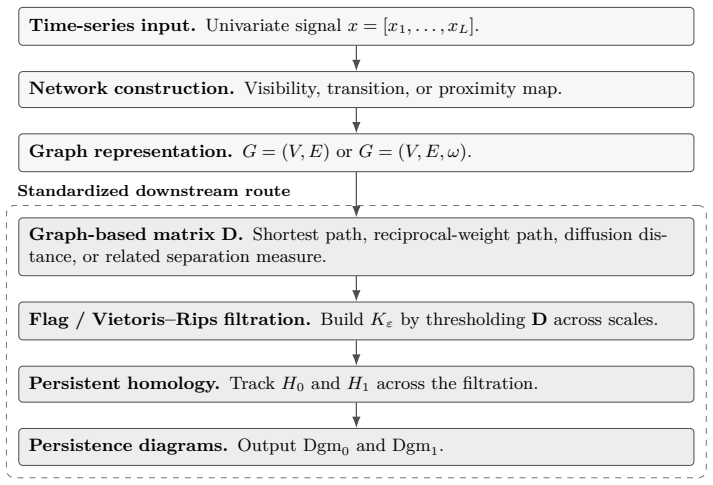
abstract click to expand
We present a unified pipeline for univariate time series classification via complex networks and persistent homology. A time series is mapped to a graph through one of five constructions across three families (visibility (natural and horizontal visibility graphs), transition, and proximity) and the graph is converted to a dissimilarity matrix from which a Vietoris-Rips filtration yields persistence diagrams. These diagrams are vectorized into fixed-length features through persistence landscapes and topological summary statistics. By standardizing the downstream processing, differences in classification performance are attributable to the network construction and distance metric alone. Experiments on twelve UCR benchmarks show that (i) no single construction dominates: the optimal graph type depends on the signal's discriminative structure; (ii) the graph distance metric is a first-order design choice, with diffusion distance uniformly outperforming shortest-path alternatives; and (iii) persistence-based features degrade gracefully under noise, consistent with the classical stability theorem of persistent homology.
0
0
math.AT 2026-05-04

The paper proves that moment-angle manifolds built from neighbourly triangulations of…

Moment-angle manifolds associated to neighbourly triangulations of spheres

Moment-angle manifolds over neighbourly triangulations of odd spheres are homotopy equivalent to connected sums of products of two spheres.

abstract click to expand
We show that a moment-angle manifold associated to a neighbourly triangulation of an odd dimensional sphere is homotopy equivalent to a connected sum of products of two spheres, resolving a problem of Buchstaber and Panov. The methods are entirely homotopy theoretic, allowing for an extension to a corresponding result in the case of generalized moment-angle manifolds.
0
0
math.AT 2026-05-04

Zero slice of quaternionic real bordism computed

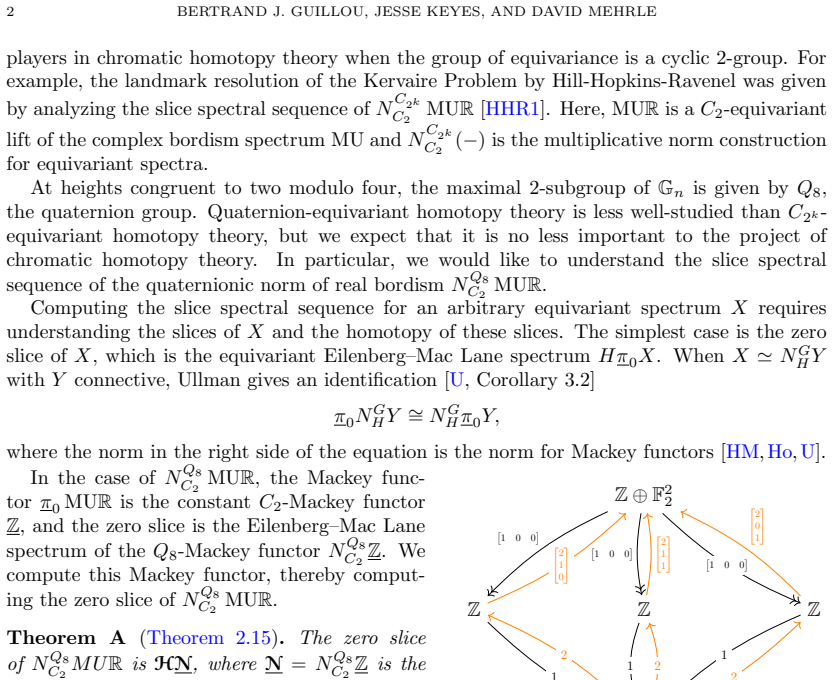
The Zero Slice of Quaternionic Real Bordism

The zero slice and a bigraded homotopy subring are calculated for the Q8-spectrum obtained by norming real bordism, setting up the slice SS.

Figure from the paper full image
abstract click to expand
Using the Hill-Hopkins-Ravenel norm, one can produce a $Q_8$-spectrum $N_{C_2}^{Q_8} \text{MU}\mathbb{R}$, where $Q_8$ is the quaternion group. Working towards a computation of the slice spectral sequence for $N_{C_2}^{Q_8} \text{MU}\mathbb{R}$, we compute the zero slice of $N_{C_2}^{Q_8} \text{MU}\mathbb{R}$ and a bigraded subring of the $\text{RO}(Q_8)$-graded homotopy Mackey functors of this slice.
0
0
math.AT 2026-05-04

Stable categories reconstruct from hearts via two-step completion

Unbounded Weight Structures: (Re)construction and Completion

A reconstruction theorem recovers any stable category with compatible weight and weak t-structures from its heart under left weight and

abstract click to expand
We develop a theory of completeness for weight structures on stable categories, dual to the theory of complete t-structures. As in the bounded case, we show that complete weight structures are determined by their weight heart, giving rise to a universal construction $A \mapsto K(A)$ that assigns a complete weight category to an additive category and recovers classical examples such as homotopy categories of chain complexes. We also give a general construction of weight structures on presentable stable categories generated by a small set of objects, generalizing a result of Bondarko. This recovers the standard weight structure on spectra and an exotic one related to Anderson duality. We identify their completions with Bousfield--Kan completions arising in Adams-type spectral sequences. To treat naturally occurring examples - such as derived categories of abelian categories and module categories over ring spectra - which are often only partially weight complete, we introduce the notion of weak t-structures. Within this framework, we prove that any stable category equipped with compatible weight and weak t-structures, and satisfying left weight completeness and right t-completeness, can be reconstructed from its heart via a two-step completion process $A \mapsto \widehat{K}(A)$.
0
0
math.AT 2026-05-04

Geodesic subspace posets realize as wedges of spheres

Scissors automorphism groups II: Solomon-Tits theorems

A Solomon-Tits variant holds for collections generated by points or hyperplanes in Euclidean, hyperbolic, and spherical geometry.

abstract click to expand
The Solomon-Tits theorem says that the poset of proper non-trivial subspaces of a finite-dimensional vector space has realisation equivalent to a wedge of spheres. In this paper we prove a variant of this result for collections of geodesic subspaces of Euclidean, hyperbolic, or spherical geometry, assuming the collection is generated either by points or by hyperplanes. In the third paper of this series of papers, we will combine this with the homological stability theorems from the first paper to compute the homology of groups of scissors automorphisms in these geometries.
0
0
math.AT 2026-05-01

Singular simplices retract to transverse versions for countable families

The transverse singular complex

For any countable collection of mapped manifolds with corners, the full singular simplicial set deformation retracts onto its transverse sub

abstract click to expand
Let $M$ be a smooth manifold without boundary and let $\mathcal{T}$ be a countable collection of manifolds with corners, each equipped with a smooth map to $M$. We show that the singular simplicial set $\mathrm{Sing}(M)$ of $M$ deformation retracts onto the simplicial subset $\mathrm{Sing}^{\mathcal{T}}\!(M)$ of smooth singular simplices that are transverse to every element of $\mathcal{T}$.
0
0
math.AT 2026-05-01

Nontrivial classes exist for S^n x S^n bundles in high degrees

Rational characteristic classes of bundles with fibre a product of spheres

Injectivity from fibration classes, identified with group cohomology of symmetric powers of the SL2(Z) representation, produces invariants,

abstract click to expand
We prove the existence of many non-trivial characteristic classes of smooth oriented bundles with fibre a product $ S^{n}\times S^{n} $ of odd-dimensional spheres. We do so by proving injectivity of the map from the ring of rational characteristic classes of oriented fibrations with fibre $ S^{n}\times S^{n} $; the latter is proven by Berglund--Zeman to be isomorphic to the group cohomology of the symmetric powers of the standard representation of a certain finite-index subgroup $ \Gamma $ of $ \mathrm{SL}_{2}(\mathbb{Z}) $. These characteristic classes of smooth bundles are not generalised Miller--Morita--Mumford classes, and they exist in arbitrarily large cohomological degrees. Inspired by an example given by Morita, we provide a collection of smooth oriented $ S^{n}\times S^{n} $-bundles, indexed by cyclic subgroups of $ \Gamma $, which detect any given non-zero characteristic class of such fibrations.
0
0
math.AT 2026-05-01

4D toric orbifolds limited to two homotopy types per proper isomorphism class

On the homotopy types of 4-dimensional toric orbifolds

Refined isomorphisms show cohomology nearly determines homotopy for these 4D spaces

Figure from the paper full image
abstract click to expand
The cohomological rigidity problem for toric orbifolds asks when an integral cohomology isomorphism implies a homotopy equivalence. In this paper we reformulate the cohomological rigidity problem in the context of $4$-dimensional toric orbifolds by introducing what we call proper isomorphisms, a variant of a concept studied by J.H.C. Whitehead. We prove that each proper isomorphism class of $4$-dimensional toric orbifolds contains at most two distinct homotopy types, and that the two classifications agree in certain special circumstances.
0
0
math.AT 2026-05-01

CP^4 has one tangential smooth manifold

Diffeomorphism Classification of Smooth Structures and Tangential Homotopy Types of mathbb{C}P^m for 5 le m le 8

Concordance groups and tangential surgery determine the diffeomorphism classes in each homotopy type for m up to 8.

abstract click to expand
This paper provides a diffeomorphism classification of smooth manifolds homeomorphic to the complex projective space $\mathbb{C}P^m$ for $m \in \{5, 6, 7, 8\}$. The classification is obtained by computing the group of concordance classes of smooth structures on $\mathbb{C}P^m$ and determining the orbit space under the action induced by the group of self-homeomorphisms. Using these computations in conjunction with the tangential surgery exact sequence and techniques from stable homotopy theory, we determine the diffeomorphism classes of smooth manifolds within the tangential homotopy type of $\mathbb{C}P^m$ for $4 \le m \le 8$. We also investigate the relationship between these two classification problems by studying the natural map from the homeomorphism type to the tangential homotopy type. As a consequence, we prove that for $m = 4$, there exists a unique smooth manifold, up to diffeomorphism, that is tangentially homotopy equivalent to $\mathbb{C}P^4$ but not homeomorphic to it. Furthermore, for $m = 8$, there exist exactly two pairwise non-diffeomorphic smooth manifolds that are tangentially homotopy equivalent to $\mathbb{C}P^8$ but not homeomorphic to it.
1 0
0
math.AT 2026-05-01

Infinite cohomological dimension yields unbounded complexity sequences

Topological complexity sequences of groups

A sequence from iterated Milnor constructions is weakly increasing and grows without limit for such groups.

abstract click to expand
We define the topological complexity sequence of a group as the sequence of topological complexities of its Milnor constructions. This sequence may be regarded as an intrinsic refinement of the topological complexity of a group and, unlike topological complexity itself, is meaningful for groups of infinite cohomological dimension. We show that the topological complexity sequence of every group of infinite cohomological dimension is weakly increasing and unbounded. We then estimate its growth and determine its asymptotic behavior for a finite group of even order.
0
0
math.AT 2026-05-01

Groups with infinite dimension have unbounded complexity sequences

Topological complexity sequences of groups

The sequence via Milnor constructions is weakly increasing and tends to infinity, with growth estimates and asymptotics for finite evenorder

abstract click to expand
We define the topological complexity sequence of a group as the sequence of topological complexities of its Milnor constructions. This sequence may be regarded as an intrinsic refinement of the topological complexity of a group and, unlike topological complexity itself, is meaningful for groups of infinite cohomological dimension. We show that the topological complexity sequence of every group of infinite cohomological dimension is weakly increasing and unbounded. We then estimate its growth and determine its asymptotic behavior for a finite group of even order.
0
0
math.AT 2026-04-30

Normed algebras reduce to subgroup collections in rational G-spectra

A model for normed algebras in rational G-spectra

The model describes them as commutative algebras in rational spectra indexed by conjugacy classes of subgroups with maps for allowed group-h

abstract click to expand
For a finite group $G$, we construct a simplified model for the $G$-symmetric monoidal $G$-$\infty$-category of rational $G$-spectra. Using this model, we classify $\mathcal{I}$-normed algebras in rational $G$-spectra for a given indexing system $\mathcal{I}$. We show that such an algebra is equivalently described as a collection $\{\mathcal{X}(G/H)\}_{(H\leq G)}$ of commutative algebras in nonequivariant rational spectra, indexed by conjugacy classes of subgroups of $G$, together with compatible morphisms of commutative algebras $\mathcal{X}(G/K)\xrightarrow{}\mathcal{X}(G/H)$ whenever $K\leq H$ and the induced map $G/K\xrightarrow{}G/H$ is in $\mathcal{I}$. This generalizes a result by Wimmer arXiv:1905.12420.
1 0
0
math.AT 2026-04-29

Loop homology of polyhedral products decomposes as colimit

A colimit decomposition for the loop homology of polyhedral products

Flagification reduces the general case to 1-neighbourly complexes and yields explicit series for HMF and flag skeleta

abstract click to expand
We show that the loop homology algebras of polyhedral products of the form $(\underline{X},\underline{*})^{\mathcal{K}}$ can be written as a colimit over the flagification of $\mathcal{K}$, and obtain a similar result for the Poincar\'e series. This effectively reduces the study of the algebras $H_*(\Omega(\underline{X},\underline{*})^{\mathcal{K}})$ to the case of 1-neighbourly simplicial complexes. We give presentations of the loop homology of Davis--Januszkiewicz spaces (i.e. Yoneda algebras of Stanley--Reisner rings) and calculate the Poincar\'e series of looped polyhedral products associated to various families of simplicial complexes, including HMF-presented complexes and skeleta of flag complexes.
0
0
math.AT 2026-04-29

KR-theory yields immersions of C2-projective spaces

Immersions of C₂-projective spaces via Kmathbb{R}-theory

The groups also give an equivariant James periodicity as an immediate corollary.

Figure from the paper full image
abstract click to expand
We compute the Atiyah Real $K$-theory of $C_2$-equivariant projective spaces and construct immersions of such spaces into multiples of the regular representation. These computations are made tractable by the recent geometric filtration of equivariant projective spaces due to Bhattacharya-Waugh-Zeng-Zou, together with a variant of the localized slice spectral sequence introduced by Meier-Shi-Zeng. As an immediate corollary of these computations, we obtain an equivariant analogue of James periodicity.
0
0
math.AT 2026-04-28

Sp(2) rational spectra match differential graded objects over A(Sp(2))

Rational Sp(2)-equivariant cohomology theories I: dominant subgroups

The conjugacy classes of subgroups decompose into 32 blocks carrying polynomial sheaves that define an algebraic model for all such theories

abstract click to expand
We give a general description of the spectral space of conjugacy classes of subgroups of Sp(2): it is a disjoint union of finitely many blocks, each dominated by a subgroup: of these blocks, 26 are of dimension 1, 6 are of dimension 2 and the remainder are isolated points. On each of these blocks there is a sheaf of polynomial rings and a component structure. These are the ingredients for constructing an abelian category A(Sp(2)) designed to reflect the structure of rational Sp(2)-equivariant cohomology theories. We assemble the results from earlier papers in the series to show that the category of rational Sp(2)-spectra is Quillen equivalent to the category of differential graded objects of A(Sp(2)). In the sequel we will make the fine structure of A(Sp(2)) explicit, and make calculations based upon it.
0
0
math.AT 2026-04-28

Koszul modules compute infinitesimal Alexander invariants

Koszul modules, holonomy Lie algebras, and resonance of groups and CDGAs

The isomorphism gives Chen rank formulas and shows cohomology controls first-order resonance behavior for CDGAs and groups with 1-finite 1-

abstract click to expand
We develop a Koszul-theoretic framework for comparing classical Alexander-type invariants with infinitesimal invariants arising from finite-type commutative differential graded algebra models. The central mechanism is Koszul linearization, which replaces nonlinear equivariant constructions with functorial algebraic objects defined from a CDGA. To a connected CDGA $(A,d)$ with finite-dimensional $H^1(A)$ we associate Koszul modules $\mathcal{B}_i(A)$ over the symmetric algebra on $H_1(A)$. We prove that the first Koszul module $\mathcal{B}_1(A)$ is isomorphic to the infinitesimal Alexander invariant of the holonomy Lie algebra $\mathfrak{h}(A)$, yielding explicit formulas for holonomy Chen ranks. We establish a tangent cone theorem for resonance varieties, showing that cohomology controls their first-order behavior at the origin. For finitely generated groups admitting 1-finite 1-models, we prove that classical Alexander invariants agree with Koszul invariants after completion and passage to associated graded objects, and that Chen ranks are determined by the model. Applications include Chen rank computations for 2-step nilpotent Lie algebras and pure elliptic braid groups, partial formality results for Sasakian manifolds, and a general framework for detecting non-formality of spaces, groups, and maps.
0
0
math.AT 2026-04-28

Topological MRI analysis separates Alzheimer's from healthy brains at 0.895 AUC

Homology-based Morphometry of Brain Atrophy: Methods and Applications

Two persistent-homology pipelines measure thinning and structural change without nonlinear registration, enabling both group comparisons and

Figure from the paper full image
abstract click to expand
Understanding the structure of the brain, and how it changes with time and disease, is a core goal of structural neuroimaging. Contemporary approaches to structural brain analysis are dominated by voxel-wise, mass-univariate methods such as voxel-based morphometry (VBM). However, these techniques require images to be normalized to a standard template, which can obscure subject-specific geometric features. Normalization to a common stereotactic space can also be problematic when comparing groups with substantial brain pathology, lesions, or other anatomical abnormalities. Here, we introduce two complementary pipelines based on persistent homology (PH), a tool from topological data analysis, to quantify multiscale geometric features of structural T1-weighted MRI scans. Pipeline 1 quantifies regional thinning by applying the Euclidean distance transform to tissue masks in a slice-wise manner. Pipeline 2 uses \(\alpha\)-filtrations to measure structural similarity between pairs of scans, capturing sulcal widening and ventricular enlargement. Synthetic experiments with controlled induced lesions showed that Pipeline 1 is best suited to between-subject analyses, whereas Pipeline 2 is better suited to within-subject designs. Applied to real-world data from the Alzheimer's Disease Neuroimaging Initiative (ADNI), Pipeline 1 separated Alzheimer's disease (AD) from cognitively normal (CN) participants using single-modality T1-weighted MRI without nonlinear registration (ROC-AUC = 0.895), with peak effects localized to medial temporal regions. Pipeline 2 captured disease-related longitudinal change, with follow-up scans remaining closest to their own baselines and AD subjects showing greater short-interval change than CN subjects. Together, these pipelines provide interpretable topological biomarkers for cross-sectional group comparisons and longitudinal tracking.
0
0
math.AT 2026-04-28

A∞-algebras model rational fiberwise THH transfer

A rational model for the fiberwise THH transfer II: A_infty-algebras

The description generalizes Bouc and yields a rational Becker-Gottlieb model plus vanishing results for graph classes on manifold bundles.

abstract click to expand
In Part I, we proved that a rational model for the fiberwise THH transfer of a map $f$ of fibrations over a base space is given by the Hochschild homology transfer of a cdga model of $f$. In this paper, we provide an explicit description of this Hochschild homology transfer in terms of $A_\infty$-algebras, generalizing work of Bouc. Using a result of Lind-Malkiewich, we deduce a rational model for the Becker-Gottlieb transfer. We furthermore use our results for the following applications to manifold topology. Firstly, we consider the rational characteristic classes constructed by Berglund for fibrations with fiber a Poincar\'e complex (which generalize classes found by Berglund-Madsen); they are defined via the Lie graph complex, and we prove that the classes corresponding to non-trivalent graphs with exactly one loop vanish when evaluated on fiber bundles with fiber a compact simply connected topological manifold. Secondly, we provide a rational model for the space of fiberwise THH-simple structures, which is a step towards obtaining rational models for the classifying spaces of diffeomorphisms and homeomorphisms of a compact simply connected manifold in the rational concordance stable range.
0
0
math.AT 2026-04-28

One stable factor makes product complexes gyration stable

Gyration Stability for Products

Proving that gyration stability carries over to products of Poincaré duality complexes whenever one factor already has it.

abstract click to expand
A gyration is an operation on Poincar\'{e} Duality complexes that arises from a certain surgery on the product of a given complex $N$ and a sphere, parametrised by a chosen twisting. Of particular recent interest is the notion of gyration stability; that is, $N$ is gyration stable when all of its gyrations have the same homotopy type, regardless of the twisting used. We prove that a product $N\times M$ of two Poincar\'{e} Duality complexes is gyration stable when one of the product terms is itself gyration stable, and provide some examples of interest.
0
0
math.AT 2026-04-27

Cohomology nilpotency computes rational sectional category for formal maps

Rational relative sectional category

The reduction supplies algebraic expressions for Lusternik-Schnirelmann category and higher topological complexity of maps.

abstract click to expand
We develop an algebraic model for the relative sectional category of a continuous map in rational homotopy theory using commutative differential graded algebras (CDGAs). Our main result establishes that for formal maps, the rational relative sectional category can be computed purely from cohomology, using ideal nilpotency. We also show that this equality may fail in general topological settings. Applying this framework, we obtain purely algebraic characterizations for the rational Lusternik-Schnirelmann category and the rational higher topological complexity of a map. Finally, we provide an algebraic description of the rational homotopic distance between formal maps.
0
0
math.AT 2026-04-27

Diagrams of Eilenberg-MacLane spaces are formal over Q

On formality of diagrams of Eilenberg-MacLane spaces

Spectral sequences for any such diagram over any small category collapse at page 2, but the result fails over rings without the rationals.

abstract click to expand
In this paper, we establish formality (over $\mathbb{Q}$) for diagrams of Eilenberg-MacLane spaces of any height $n\geq 1$. This implies spectral sequence (over $\mathbb{Q}$) collapse at page $2$ for any diagram of EML spaces over any small category. We prove by functor calculus argument that formality does not hold over any fixed commutative ring $\mathbf{k}$ not containing $\mathbb{Q}$, where the category of diagrams is over the category generated by finite direct sums of a cyclic group.
0
0
math.AT 2026-04-23

Graph criterion tests freeness of Coxeter subgroup cohomology

Equivariant formality and the cohomology of subgroups of right-angled Coxeter groups

Homotopy orbit models of moment-angle complexes identify when cohomology is free over the quotient by the commutator subgroup.

abstract click to expand
We construct models for the classifying spaces of coabelian subgroups of right-angled Coxeter groups as homotopy orbit spaces of real moment-angle complexes, generalizing well-known models for the classifying space of a right-angled Coxeter group and its commutator subgroup. This identifies the cohomology of these groups with the Borel equivariant cohomology of elementary abelian $2$-group actions on cubical subcomplexes of a cube $[-1,1]^m$. We then characterize equivariant formality for these actions, leading to a simple graph-theoretic criterion for when the cohomology of a coabelian subgroup is free as a module over the cohomology of the quotient by the commutator subgroup of the right-angled Coxeter group.
0
0
math.AT 2026-04-22

Parameterized maps yield Künneth theorems for persistence modules

A continuum of K\"unneth theorems for persistence modules

Each order-preserving φ defines a tensor and adjoint that produce their own Künneth short exact sequences, including for product spaces.

Figure from the paper full image
abstract click to expand
We develop new aspects of the homological algebra theory for persistence modules, in both the one-parameter and multi-parameter settings. For a poset $P$ and an order preserving map $\varphi:P\times P\to P$, we introduce a novel tensor product of persistence modules indexed by $P$, $\otimes_{\varphi}$. We prove that each $\otimes_{\varphi}$ has a right adjoint, $\mathbf{Hom}^{\varphi}$, the internal hom of persistence modules that also depends on $\varphi$. We prove that every $\otimes_{\varphi}$ yields a K\"unneth short exact sequence of chain complexes of persistence modules. Dually, the $\mathbf{Hom}^{\varphi}$ also has an associated K\"unneth short exact sequence in cohomology. As special cases both of these short exact sequences yield Universal Coefficient Theorems. We show how to apply these to chain complexes of persistence modules arising from filtered CW complexes. For the special case of $P=\mathbb{R}_+$, the $p$-quasinorms for each $p\in (0,\infty]$ yield a distinct $\otimes_{\ell^p_c}$ and its adjoint $\mathbf{Hom}^{\ell^p_c}$. We compute their derived functors, $\mathbf{Tor}^{\ell^p_c}$ and $\mathbf{Ext}_{\ell^p_c}$ explicitly for interval modules. We show that the Universal Coefficient Theorem developed can be used to compute persistent Borel-Moore homology of a filtration of non-compact spaces. Finally, we show that for every $p\in [1,\infty]$ the associated K\"unneth short exact sequence can be used to significantly speed up and approximate persistent homology computations in a product metric space $(X\times Y,d^p)$ with the distance $d^p((x,y),(x',y'))=||d_X(x,x'),d_Y(y,y')||_p$.
0
0
math.AT 2026-04-22

Radical ideals frame proves Nakaoka spectrum is spectral

A point-free approach to the Nakaoka spectrum of a Tambara functor

The frame RadId_G(T) has Nakaoka primes as points and is spatial and coherent, establishing the spectrum as a spectral space.

abstract click to expand
For $G$ a finite group and $T$ a $G$-Tambara functor, we construct the frame $\mathop{RadId}_G(T)$ of radical Tambara ideals and show that its points are the Nakaoka primes. We show that this frame is spatial and coherent, and deduce that the Nakaoka spectrum is a spectral space, recovering a recent result of Chan and Spitz.
0
0
math.AT 2026-04-22

Assembly functor admits fully faithful right adjoint for finite complexes

Whitehead torsion and the kernel of assembly

For spaces homeomorphic to finite simplicial complexes, this yields a Whitehead category whose K-theory matches the Whitehead spectrum and a

Figure from the paper full image
abstract click to expand
For a topological space that is homeomorphic to a finite simplicial complex, we prove that the Bartels--Nikolaus assembly functor has a fully faithful right adjoint. Using this, we define for each such topological space $X$ a {\em Whitehead category}, whose K-theory is canonically identified with the Whitehead spectrum of $X$; and for a homotopy equivalence between two such spaces, we define an object in the Whitehead category of $X$ called the {\em torsion cosheaf} of the map, whose K-theory class recovers the classical Whitehead torsion.
0
0
math.AT 2026-04-21

Complex moment-angle manifolds are equivariantly rigid

Topological rigidity of complex and quaternionic moment--angle manifolds

Equivariant homotopy type fixes equivariant homeomorphism type for locally linear actions

abstract click to expand
We investigate the equivariant topological rigidity of complex and quaternionic moment--angle manifolds. By reducing the classification to the equivariant rigidity of their quasitoric (or quoric) quotients and the classification of the associated principal bundles, we establish new rigidity results within the category of locally linear actions. We prove that complex moment-angle manifolds are equivariantly rigid: any locally linear manifold equivariantly homotopy equivalent to a complex moment--angle manifold is equivariantly homeomorphic to it. In the quaternionic setting, we establish full equivariant rigidity for manifolds with four-dimensional quoric quotients and provide a primary rigidity statement for higher dimensions based on degree-4 characteristic classes. These results characterize moment--angle manifolds as equivariant strong Borel manifolds, demonstrating that their equivariant homotopy type completely determines their equivariant homeomorphism type.
0
0
math.AT 2026-04-21

380125 optimal matchings on the 4-simplex

The complex of discrete Morse matchings of the n-simplex: homotopy types and structural results

Their count on any n-simplex reduces by a factor of n+1 to the (n-2)-skeleton, and homotopy types are given for the 3-simplex.

Figure from the paper full image
abstract click to expand
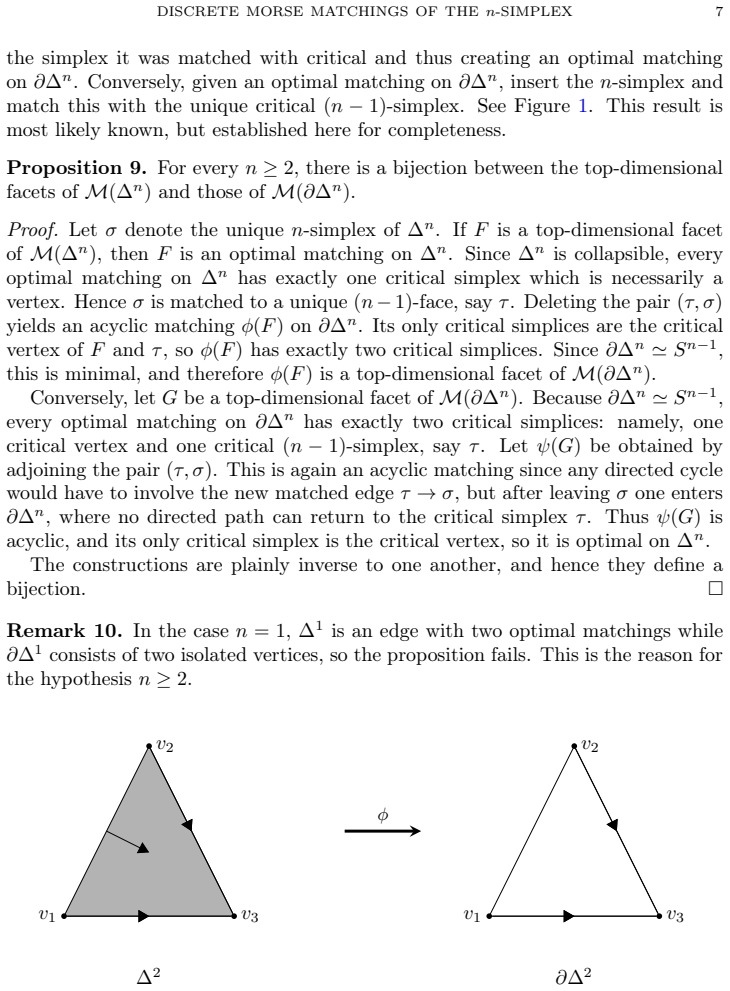
The complex of discrete Morse matchings $\M(K)$, introduced by Chari and Joswig, is a simplicial complex whose simplices are the acyclic matchings on the Hasse diagram of $K$. Its homotopy type is known in only a handful of cases. In this paper, we compute the homotopy types of $\M(\Delta^3)$ and $\M(\partial\Delta^3)$, the corresponding pure complexes $\M_{P}(\Delta^3) \simeq \M_{P}(\partial\Delta^3)$, and the generalized complex of discrete Morse matchings $\GM(\Delta^3) \simeq \GM(\partial\Delta^3)$. For general $n$ we prove the identity $f(n) = (n+1) \cdot |\text{top-dimensional facets of } \M(\Delta^n_{(n-2)})|$, reducing the enumeration of optimal matchings on $\Delta^n$ to an enumeration on its $(n-2)$-skeleton, and we show that the inclusion $\M(K) \hookrightarrow \M(CK)$ is null-homotopic for any cone. We also compute the $f$-vector of $\M(\Delta^4)$, whose top entry $f(4) = 380{,}125$ is the number of optimal discrete Morse matchings on $\Delta^4$. We conclude with two conjectures extending the $\M_{P}$ and $\GM$ equivalences to all $n$.
0
0
math.AT 2026-04-20

Moment-angle homology detects tight triangulations

Moment angle complexes and duality for tight manifolds

The total Betti number of Z_K meets the bound 2^{m-1}(β(K;F)-2)+2 exactly when the triangulation is F-tight.

Figure from the paper full image
abstract click to expand
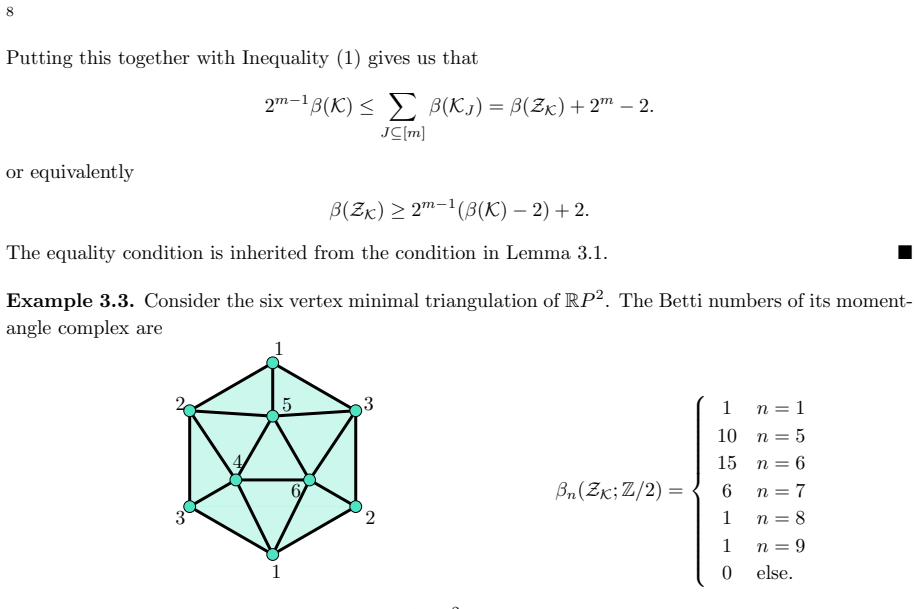
For a field $\mathbb{F}$ and a triangulated compact $\mathbb{F}$-orientable manifold, consider the homology of the associated Moment-Angle ccomplex $H_*(\mathcal{Z}_{\mathcal{K}})$. We show the total homology rank $\beta(\mathcal{Z}_{\mathcal{K}})$ satisfies the inequality $\beta(\mathcal{Z}_{\mathcal{K}};\mathbb{F})\geq 2^{m-1}(\beta(\mathcal{K};\mathbb{F})-2)+2$, with equality occurring exactly when the triangulation is $\mathbb{F}$-tight. Using Lefschetz duality, we introduce a short exact sequence of functors that, in turn, introduces a new duality theorem in Double Homology for tight manifold triangulations.
0
0
math.AT 2026-04-20

Self-maps of V_{n,2} are rigid for most n

Rigidity of self-maps of V_{n,2} and classification of manifolds tangentially homotopy equivalent to V_{n,2} times S^k

Manifolds tangentially homotopy equivalent to V_{n,2} × S^k are classified up to almost diffeomorphism for k=3,5 and 7 to n-3 excluding 2^i-

abstract click to expand
We study two problems concerning the Stiefel manifolds $V_{n,2}$ and their products with spheres. First, we address a rigidity problem: we determine, for most values of~$n$, all self-maps of $V_{n,2}$ that are homotopic to an almost diffeomorphism. Second, we classify smooth closed manifolds tangentially homotopy equivalent to $V_{n,2} \times S^k$ up to almost diffeomorphism, for $k = 3, 5$ or $7 \leq k \leq n-3$, $k \neq 2^i - 2$. Our method is to find explicit inverses in the structure set via normal invariants of specific tangential homotopy equivalences. In favourable cases -- notably $V_{12,2} \times S^3$, $V_{16,2} \times S^3$, $V_{12,2} \times S^5$, $V_{10,2} \times S^5$ -- the classification is complete: every such manifold is almost diffeomorphic to $V_{n,2} \mathbin{\#} \Sigma \times S^k$ for some exotic sphere $\Sigma$. In the general case, we identify inverses for a large subgroup of $\operatorname{Im}(\eta)$ and provide a possible way forward to the remainder.
0
0
math.AT 2026-04-17

v_n powers force v_{n-1} powers via algebraic invariants in C2 Ext

Algebraic redshift in the C₂-equivariant Adams spectral sequence

Nonzero classes for higher v_n imply nonzero lower v_{n-1} whose Mahowald invariants contain them, extending to motivic spectra.

abstract click to expand
We study $v_n$-periodic phenomena in $C_2$-equivariant stable homotopy through the lens of the $C_2$-equivariant Adams spectral sequence at the prime 2. In particular, we construct/detect certain classes related to powers of the $v_n$ generators of $\pi_*(BP)$ in the cohomology of certain finitely generated subalgebras $A^{C_2}(m)$ of the $C_2$-equivariant Steenrod algebra. We define the notion of classes in $\text{Ext}_{A^{C_2}}(\underline{H}^\star, \underline{H}^\star)$ being $v_n$-periodic or $v_n$-torsion and exhibit a chromatic filtration by showing that $v_n$-torsion classes are also $v_k$-torsion for $0\le k < n.$ We also promote the Lin-Davis-Mahowald-Adams splitting of Ext of the suitable version of ``$R P_{-\infty}^\infty$" to the $C_2$-equivariant setting and use this to define appropriate algebraic versions of Mahowald's root invariant. We establish that whenever a class corresponding to a power of $v_{n}$ is nonzero in $ \text{Ext}_{A^{C_2}(m)}(\underline{H}^\star, \underline{H}^\star),$ then the same power of $v_{n-1}$ is also nonzero in $ \text{Ext}_{A^{C_2}(m-1)}(\underline{H}^\star, \underline{H}^\star),$ and its algebraic Mahowald invariant $M_m^{C_2-alg}(v_{n-1}^{2^f}) \subset \text{Ext}_{A^{C_2}(m)}(\underline{H}^\star, \underline{H}^\star)$ contains class(es) corresponding to $v_n^{2^f}.$ Real motivic versions of these results hold as well.
0
0
math.AT 2026-04-17

This paper introduces filtrations for persistent homology on graphs that weight edges by…

Motif-based filtrations for persistent homology: A framework for graph isomorphism and property prediction

Cycle-density filtrations based on motif densities enable persistent homology to distinguish non-isomorphic graphs nearly perfectly and…

Figure from the paper full image
abstract click to expand
Determining whether two graphs are isomorphic is a fundamental problem with practical applications in areas such as molecular chemistry or social network analysis, yet it remains a challenging task, with exact solutions often being computationally expensive. We address this task using persistent homology built on motif-based filtrations of graphs, a method from topological data analysis that summarizes the shape of data by tracking the persistence of structural features along filtrations. Specifically, we use edge-weighting schemes based on the densities of triangles, chordless squares, and chordless pentagons, which have been shown to be effective for detecting network dimensionality. Our cycle-density filtrations distinguish non-isomorphic graphs perfectly or nearly perfectly across four demanding graph families, many of which exhibit symmetries. We outperform curvature-based, degree-based, and Vietoris--Rips filtrations, and match or exceed the accuracy of egonet-distance methods while incurring a lower computational cost. The expressive power of our filtrations goes beyond isomorphism testing: because they capture rich structural information from graphs, they consistently achieve top performance on property prediction tasks using real-world data, and exhibit high sensitivity to edge rewiring and removal. Together, these findings establish cycle-density filtrations as an effective and computationally tractable framework for graph comparison and characterization, bridging topological data analysis and network science.
0
0
math.AT 2026-04-17

Finite group actions preserve Witt pseudomanifolds and their L-classes

Equivariant L-Classes of Atiyah-Singer-Zagier Type for Singular Spaces

Equivariant Atiyah-Singer-Zagier classes average to recover the Goresky-MacPherson L-class of the orbit space.

abstract click to expand
If a finite group $G$ acts on a rational homology manifold, then the orbit space is well-known to be a rational homology manifold again. We consider here actions on spaces that may be much more singular. If the $G$-space is a Witt pseudomanifold, which includes all arbitrarily singular complex pure-dimensional algebraic varieties, then we prove that the orbit space is again a Witt pseudomanifold. In the compact oriented situation, this implies that the orbit space possesses characteristic L-classes, as defined by Goresky and MacPherson. We then construct Atiyah-Singer-Zagier type equivariant L-classes for such $G$-pseudomanifolds which serve, as we show by establishing an averaging formula, as a tool to compute the Goresky-MacPherson L-class of the orbit space. The construction of the equivariant class builds on intersection homological transfer properties and on recent joint K-theoretic work with Eric Leichtnam and Paolo Piazza, which established a G-signature theorem on Witt pseudomanifolds.
0
0
math.AT 2026-04-16

Hairy graph homologies of cyclic and ordinary operads are explicitly related

Relating Brauer categories, Koszul complexes, and graph complexes

Viewing them as Koszul complexes over walled and unwalled Brauer categories connected by disjoint-union functors gives the direct comparison

abstract click to expand
The purpose of this paper is to investigate the relationship between hairy graph complexes associated to cyclic operads and their counterparts for operads (and, more generally, dioperads). This is based on the author's interpretation of these as Koszul complexes for the associated modules over the respective appropriate twisted downward (walled) Brauer category. The general question of relating such Koszul complexes is addressed by analysing the relationships between the respective twisted Brauer-type categories, proceeding through a direct analysis. The passage from the walled to unwalled context involves functors induced by the disjoint union of finite sets. As an application, for the cyclic operad associated to an operad, this leads to an explicit relation between the respective (hairy) graph homologies.
0
0
math.AT 2026-04-16

GKM3 graph extensions always yield surjective cohomology maps

Equivariant cohomology epimorphisms and face ring quotients for Hamiltonian and complexity one GKM₄ manifolds

The combinatorial fact produces explicit generators-and-relations descriptions for Hamiltonian and complexity-one GKM4 manifolds.

Figure from the paper full image
abstract click to expand
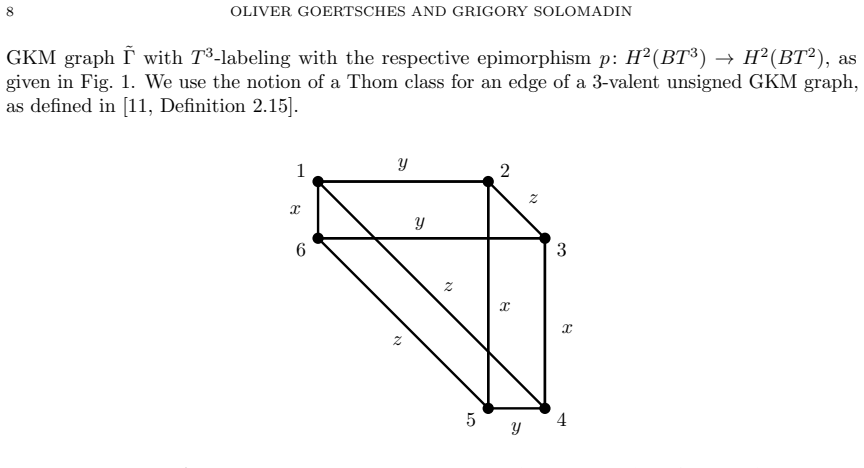
Given a GKM$_3$ action of a torus $K$ on a manifold $M$ with GKM graph $\Gamma$, we show that for any extension of $\Gamma$ to an abstract GKM graph the corresponding restriction map in equivariant graph cohomology is surjective. While the corresponding statement for extensions of actions is well-known, we observe that this graph-theoretical statement is false in the GKM$_2$ setting. As a corollary, we obtain a description of the equivariant cohomology ring of Hamiltonian and complexity one GKM$_4$ actions in terms of generators and relations.
0
0
math.AT 2026-04-16

Small covers from simplex pullbacks characterized by cohomology

Small covers as pullbacks from the simplex

Torsion-free odd integral cohomology, vanishing first Steenrod square, and Betti relations define the class equivalently.

abstract click to expand
We introduce and study small covers that are pullbacks from the simplex, extending pullbacks from the linear model. Our main result gives several equivalent characterizations of this class, including torsion-freeness of odd-degree integral cohomology, vanishing of the first Steenrod square on even-degree mod $2$ cohomology, and relations among integral and mod $2$ Betti numbers.
0
0
math.AT 2026-04-15

Short proof unifies Kahn-Priddy theorems across homotopy theories

Kahn-Priddy theorems via the norm

The same argument via norms and Adams isomorphism works in L_n-local, motivic, and synthetic settings once the structures are present.

abstract click to expand
We revisit the Kahn-Priddy theorem from the perspective of modern equivariant homotopy theory. This allows for a short proof that may be applied in other settings with sufficiently robust analogues of multiplicative norms and the Adams isomorphism. We illustrate this by establishing new Kahn-Priddy theorems in $L_n$ and $L_n^f$-local homotopy theory, motivic homotopy theory, and synthetic homotopy theory.
0
0
math.AT 2026-04-15

Pullback sphere fibration over sum homotopy equivalent to gyration sum

Pullbacks of Sphere Fibrations over Connected Sums

Homotopy theory alone yields the equivalence and extends it to Poincaré duality complexes and local coefficients.

abstract click to expand
We prove conditions under which the total space of the pullback of a sphere fibration over a connected sum is homotopy equivalent to a connected sum with a gyration. Existing results of this type often depend on geometric methods. We develop new methods based only on homotopy theory, allowing for generalisations from manifolds to Poincar\'e Duality complexes and from integral settings to local ones. Several applications are given.
1 0
0
math.AT 2026-04-14

Parametric T(n)-equivalences align two periodic localizations of spaces

On periodic homotopy and homology equivalences of spaces

The condition yields exact comparisons for general spaces and an explicit L_n^f formula for infinite loop spaces whose spectra vanish at the

abstract click to expand
There are at least two ways to approach the homotopy theory of spaces `at chromatic height $n$': one may localize with respect to $T(n)$-homology or with respect to $v_n$-periodic homotopy groups. It was already observed by Bousfield that these two options yield rather different results. We build on his work to prove precise comparison results between the two notions. A crucial concept is a more robust notion of $T(n)$-equivalence that we call `parametric $T(n)$-equivalence': this is a map of spaces that induces an equivalence on $\infty$-categories of local systems valued in $T(n)$-local spectra. Our results are sharpest in the case of infinite loop spaces, where amongst other things we prove a $T(n)$-local version of a result of Kuhn on the Morava $K$-theory of the Whitehead tower. As a corollary of our results we also produce a formula for the $L_n^f$-localization of an infinite loop space $\Omega^\infty E$ of a spectrum satisfying $L_{n-1}^f E \simeq 0$.
0
0
math.AT 2026-04-13

Uniqueness of lifts speeds up poset homomorphism computation

Computing Homomorphisms of Poset Representations with Applications to Multiparameter Persistence

Result yields O(n^4) algorithms that improve AIDA decompositions and beat naive bounds for small pointwise dimensions.

Figure from the paper full image
abstract click to expand
We present algorithms to compute the vector space of homomorphisms Hom(X,Y) between finitely generated representations of the partially ordered set Z^d. Our results generalise to any partially ordered set. Our main theoretical contribution is a uniqueness result for lifts of homomorphisms along free resolutions, which we use to obtain an algorithm running in O(n^4 (thick(Y) + thick(Omega^1 Y))^2 + T_ker(d,n)) time, where thick(Y) denotes the maximal pointwise dimension of Y and T_ker is the time it takes to compute the kernel of a map between projective Z^d-modules. We also apply and analyse a classical approach due to Green, Heath, and Struble (J. Symbolic Comput., 2001), achieving O(n^3 thick(Y)^3 + n^4). Both improve on the naive O(n^6) bound when thick(Y) is small. Applied to the decomposition algorithm AIDA (Dey-J-Kerber, SoCG '25), the classical approach improves the asymptotic runtime the most, strengthening the result of Dey and Xin (J. Appl. Comput. Topology, 2022) for uniquely graded modules. We implement all algorithms in the Persistence Algebra C++ library and benchmark them on the persistent homology of density-alpha bi-filtrations of immune-cell locations. The classical approach has the best worst-case complexity, yet for 2-parameter modules, the lifting algorithm is fastest in practice.
0
0
math.AT 2026-04-13

Conjecture links interleaving distance to derived convolution metrics

Deformations, Derived Categories, and Multiparameter Persistence: A Theoretical Framework

The framework treats stability of multiparameter persistence modules as smoothness of moduli spaces in the derived category, allowing new ge

abstract click to expand
Multiparameter persistent homology has emerged as a powerful generalization of topological data analysis, capable of encoding multivariate filtrations. However, the algebraic complexity of multiparameter persistence modules, marked by wild representation type, poses fundamental obstacles to classification, stability, and interpretability. In this paper, we propose a unifying theoretical framework that brings together deformation theory and derived categories to study multiparameter persistence from a geometric perspective. A central contribution is a comprehensive conceptual dictionary (Table 1) bridging topological data analysis and deformation theory, which interprets perturbations as deformations and stability as smoothness of moduli spaces. We present explicit calculations of extension groups \(Ext^1\) for concrete multiparameter modules over small posets, revealing diverse behaviors ranging from unexpected rigidity to large families of deformations. We further investigate obstruction classes in \(Ext^2\); while these vanish in our specific examples over the square poset, we demonstrate their inevitability in larger grids (e.g., \(3 \times 3\)) via global dimension arguments, highlighting a qualitative transition in the geometry of moduli spaces. Finally, we formulate a unified conjecture relating the interleaving distance to derived convolution metrics, establishing a bilipschitz equivalence at the level of the derived category of persistence modules. Together, these results shift the perspective on multiparameter persistence from static classification to the geometry of families, opening new avenues for invariants, stability theorems, and moduli-based analysis.
0
0
math.AT 2026-04-13

Morse profile of critical simplices refines persistent homology

Persistent Simple-homotopy invariants via discrete Morse theory

The count of minimal critical simplices at each level stays fixed under simple homotopy moves and separates filtrations with matching homol

abstract click to expand
We introduce a refinement of persistent homology that detects simple-homotopy-theoretic phenomena invisible to homology. Given a filtered simplicial complex, we define the Morse complexity profile as the minimal number of critical simplices at each filtration level. We prove that this profile is invariant under levelwise simple-homotopy equivalence and detects filtrations indistinguishable by persistent homology. We establish conditional stability under simple interleavings and provide an efficient algorithm for Vietoris-Rips filtrations. We also introduce a persistent version of Whitehead torsion and show that it is invariant under both levelwise simple-homotopy equivalence and interleaving equivalence of filtrations.
0
0
math.AT 2026-04-13

Cross effects bound projective dimension of multipersistence modules

Cross effects for functors from posets

Necessary and sufficient vanishing conditions characterize dimensions at most n-1 and n-2.

abstract click to expand
We establish a precise relationship between functor calculus and the projective dimension of multipersistence modules. Specifically, we develop a new notion of functor calculus for functors from posets, which detects vanishing total fibers of cubes. We give an explicit construction of the universal approximation functors of this functor calculus. We then use these approximations to prove two new theorems, providing necessary and sufficient conditions for an $n$-parameter multipersistence module to have projective dimension at most $n-1$ and at most $n-2$.
0
0
math.AT 2026-04-10

L-fuzzy homology assigns lattice values to simplices

L-fuzzy simplicial homology

The construction yields computable modules for fuzzy complexes and recasts poset filtrations and chromatic data inside one framework.

Figure from the paper full image
abstract click to expand
Simplicial homology is a classical tool that assigns a sequence of modules to a simplicial complex, providing invariants for the study of its topological properties. In this article, we introduce the notion of L-fuzzy simplicial homology, a generalization of simplicial homology for L-fuzzy subcomplexes, in which each simplex is assigned a value from a completely distributive lattice L. We present its definition and main properties and describe methods to compute its structure. In addition, we interpret filtrations over a poset and chromatic datasets in this setting, opening a door to further applications in topological data analysis.
0
0
math.AT 2026-04-09 2 theorems

Persistence grounded in poset algebra with interleaving stability

An Algebraic Introduction to Persistence

The algebraic view links data analysis, geometry, and representation theory while pointing to open questions on perturbations.

Figure from the paper full image
abstract click to expand
We introduce persistence with an emphasis on its algebraic foundations, using the representation theory of posets. Linear representations of posets arise in several areas of mathematics, including the representation theory of quivers and finite dimensional algebras, Morse theory and other areas of geometry, as well as topological inference and topological data analysis -- often via persistent homology. In some of these contexts, the category of poset representations of interest admits a metric structure given by the so-called interleaving distance. Persistence studies the algebraic properties of these poset representations and their behavior under perturbations in the interleaving distance. We survey fundamental results in the area and applications to pure and applied mathematics, as well as theoretical challenges and open questions.
0
0
math.AT 2026-04-09 Recognition

Interleavings define a pseudodistance on maps via Sullivan models

A distance between maps via interleavings of relative Sullivan algebras

Relative Sullivan algebras turn maps into persistence CDGAs whose interleaving distance in the homotopy category distinguishes homotopy sets

abstract click to expand
In this article, we consider extended tame persistence commutative differential graded algebras (CDGAs) associated with relative Sullivan algebras. In particular, if the relative Sullivan algebra is a model for a map between spaces, then the persistence CDGA is isomorphic to the persistence object obtained by a Postnikov tower for the map with the polynomial de Rham functor in the homotopy category of extended tame persistence CDGAs. Moreover, the interleaving distance in the homotopy category (IHC) in the sense of Lanari and Scoccola enables us to introduce a pseudodistance on the homotopy set of maps via the persistence CDGA models for maps. In contrast to persistence cochain complexes, the IHC of persistence CDGAs does not coincide with the cohomology interleaving distance in general. Due to the reason, we also discuss formalities of a persistence CDGA with interleavings. Computational examples of the pseudodistances between maps are showcased.
0
0
math.AT 2026-04-09 2 theorems

Cubical homology product lifts to free loop bialgebra

On the bialgebra structure of the free loop homology

The construction recovers string topology products on manifolds and yields a compatible bialgebra via the coHochschild complex.

Figure from the paper full image
abstract click to expand
We introduce a commutative product of degree $-n$ on the homology $H_\ast(X)$ of an $n$-dimensional special cubical set $X$ and lift it on the free loop homology $H_\ast(\Lambda M)$ for $M=|X|$ to be the geometric realization. These products agree with the intersection and string topology products respectively when $M$ is an oriented closed manifold, and we establish the compatibility relation between the string topology product and the standard coproduct on $H_\ast(\Lambda M).$ Motivated by the above relationship we introduce the notion of loop bialgebra for differential graded coalgebras $C$ by means of the coHochschild complex $\Lambda C.$ We calculate the loop bialgebra structure for some spaces.
0
0
math.AT 2026-04-08 Recognition

Simplicial chains yield global model for K-linear local systems

A Global Model Structure for mathbb{K}-Linear infty-Local Systems

The structure is monoidal on 1-types and targets multiplicative semantics for linear homotopy type theory.

abstract click to expand
Parameterized stable homotopy theory organizes local systems of spectra over homotopy types, governed by a "yoga" of six functors. To provide semantics for the recently developed Linear Homotopy Type Theory (LHoTT), good model categories of these spectra are required, preferably monoidal with respect to the external smash product. We focus on the case of parameterized $H\mathbb{K}$-module spectra ($\infty$-local systems), motivated by recent applications of parameterized homotopy to topological quantum computing. While traditionally treated via dg-categories, we leverage combinatorial model structures on simplicial chain complexes to construct the first dedicated global model structure for $\mathbb{K}$-linear $\infty$-local systems, which offers better control than existing models for general parameterized spectra. In particular, when restricted to base 1-types, our model structure is monoidal with respect to the external tensor product, making it a candidate target semantics for the multiplicative fragment of LHoTT.
0
0
math.AT 2026-04-07 2 theorems

GRT group equals automorphisms of ribbon chord diagram operad

Cyclic Symmetries of Chord Diagrams

Direct proof from the 5-cycle pentagon reformulation also produces an action on framed chord diagrams tied to the Kontsevich integral.

abstract click to expand
We give a direct proof that the proalgebraic graded Grothendieck-Teichm\"uller group $\mathsf{GRT}_{\mathbb{K}}$ is isomorphic to the group of automorphisms of the prounipotent cyclic operad of parenthesized ribbon chord diagrams based on Furusho's $5$-cycle reformulation of the pentagon equation. As an application, we describe a $\mathsf{GRT}_{\mathbb{K}}$-action on the category of framed chord diagrams with self-dual objects, which is closely related to the target category of the Kontsevich integral for framed tangles.
0
0
math.AT 2026-04-07 1 theorem

Maps from manifolds to R^n link distant equal-value pairs to coincidences

Borsuk-Ulam Type Theorems and Mountain Climbing Problem

Topological Borsuk-Ulam extension shows neighbor-space components always bridge antipodes and identical points, yielding mountain-climbing,

abstract click to expand
In this paper, we present a new qualitative extension of the Hopf theorem (and a generalization of Borsuk-Ulam theorem), concerning continuous maps $f$ from a compact Riemannian manifold $M$ of dimension $n$ to $\mathbb{R}^n$. We remove the assumption of a Riemannian structure and instead consider closed triangulable manifolds $M$ equipped with a topological notion of 'distant' points. We show that for any continuous map $f \colon M \to \mathbb{R}^n$, there exists a connected component in the space of $f$-neighbors (where a pair of points $a, b$ are $f$-neighbors if $f(a) = f(b)$) that contains both a pair of 'distant' points and a pair of identical points. This result yields further consequences for Lusternik-Schnirelmann and Tucker-type theorems, as well as a multidimensional extension of the mountain-climbing lemma, which in the special case of the standard Euclidean $2$-sphere, may be stated informally as follows. For any continuous distribution of temperature and pressure on Earth (assumed time-independent), there exists a pair of antipodal points with identical values such that travelers starting from these points can move and meet while, at each moment of their journey, experiencing matching 'climatic conditions' up to an arbitrarily small constant.
0
0
math.AT 2026-04-03 2 theorems

Lattice intersection yields integral basis for toric orbifold cohomology

Integral bases for the second degree cohomology of 4-dimensional toric orbifolds

Four-dimensional toric orbifolds with no odd cohomology get explicit generators for their degree-two equivariant groups from the meeting of

Figure from the paper full image
abstract click to expand
We study toric orbifolds of real dimension four with vanishing odd-degree cohomology and obtain a basis for its degree-two equivariant cohomology with integral coefficients by identifying it with the intersection of certain lattices. As applications, we provide an alternative construction of the \emph{algebraic cellular basis} for integral ordinary cohomology \cite{FSS2}. In addition, when the toric orbifold is an algebraic variety, we determine its Cartier divisor group and Picard group.
0

browse all of math.AT → full archive · search · sub-categories