REVIEW 4 major objections 9 minor 77 references
Each Fake News is Fake in its Own Way: An Attribution Multi-Granularity Benchmark for Multimodal Fake News Detection
T0 review · 4 major / 9 minor · reviewed 2026-08-11 · deepseek-v4-flash
Pith's one-line read Multimodal fake news can be attributed to five recurrent causes, and the AMG benchmark plus the MGCA model make that attribution learnable.
desk verdict A genuinely new attribution benchmark for multimodal fake news, but the coverage claim is internally inconsistent and the annotation reliability is under-reported. read the letter →
The pith
A machine-rendered reading of the paper's core claim, the machinery that carries it, and where it could break.
The reading
What carries the argument
The load-bearing mechanism is multi-granularity clue alignment: the paper extracts textual entities with a pretrained language model, visual entities with an image-recognition API, image events with a multimodal language model, and temporal references from the post and from reverse image search. These clues are fed in pairs into a Compare-Net, a comparison network that scores feature pairs using the vector $[C_1, C_2, C_1-C_2, C_1*C_2]$, producing consistency features for entity, event, and time. Image manipulation features come from a frozen PSCC-NET. Each clue gets its own binary real/fake classifier, and the resulting probabilities gate the features before the final detection and attribution heads.
What would settle it
Re-annotate a random sample of the 2,004 fake posts with a fresh set of annotators who are shown the same guidelines but not the original labels. If agreement falls well below the level reported in the pilot, or if a substantial share of posts are judged to fit multiple categories or none, then the attribution ground truth, and any attribution score computed on it, is not stable.
Extended reading notes
Core claim
The central claim is that multimodal fake news can be meaningfully attributed to five recurrent causes, and that a benchmark built on those causes supports a harder and more informative detection task. AMG contains 5,022 multimodal posts from Instagram, Twitter, and Facebook, with 2,004 fake posts labeled by expert annotators as either image fabrication, non-evidential image, entity inconsistency, event inconsistency, or time inconsistency, plus a None-of-the-Above category. The companion MGCA model treats detection and attribution jointly, aligning multi-granular clues extracted from text and images and using per-clue binary classifiers to weight each clue's contribution. The paper reports that MGCA reaches 83.23% accuracy and 0.8310 F1 on detection and 73.85% accuracy and 0.5666 F1 on attribution, outperforming the four baselines tested, and that removing the event-coherence or temporal modules causes the largest drops.
Load-bearing premise
The benchmark's ground truth rests on the five attribution categories being exhaustive and reliably assignable; the reported 3% coverage is hard to interpret because posts that did not fit the categories were filtered out before that figure was computed.
Editorial extensions
If this is right
- Detection systems trained on AMG can output an attribution alongside the real/fake verdict, so a flag of 'fake' comes with a reason and a suggested check.
- The ablation results show temporal coherence and event coherence are the strongest individual clues, so future detectors should model those rather than only image-text similarity.
- Because MGCA also improves F1 on Twitter, Weibo, and Weibo21, attribution-aware training appears to transfer to older binary benchmarks.
- AMG's inclusion of timestamps and its multi-platform collection make it possible to test whether models generalize across time and across social platforms.
Reading between the lines
- An attribution taxonomy of this kind could let platforms route suspected fake posts to different review queues depending on the predicted cause, since image fabrication needs a visual forensics check while time inconsistency needs a reverse-image lookup.
- As synthetic images become more common, the ImageFab category may stop being a single coherent class; future work might need to split it into AIGC-generated, spliced, and repurposed images.
- The model's reliance on reverse image search for temporal clues suggests that fake news using brand-new imagery no search engine has indexed yet would be a blind spot not covered by AMG.
Signed reviews
Editorial analysis
A structured set of objections, weighed in public.
Referee Report
Summary. The paper introduces AMG, a multimodal fake news dataset with binary real/fake labels plus fine-grained attribution labels (ImageFab, ImageNoE, EntityInc, EventInc, TimeInc, and a 'None of the Above' category) for fake posts collected via fact-checking rulings from Snopes and CheckYourFact. It also proposes MGCA, a model that extracts multi-view clues (textual/visual entities, events, temporal information, and image-manipulation features) and aligns them for joint fake-news detection and attribution. Experiments on AMG and transfer experiments on Twitter, Weibo, and Weibo21 show that MGCA outperforms several baselines, and the authors argue that AMG is more challenging than prior datasets. The central claim is that AMG is the first benchmark for multimodal fake news attribution, with a multi-granularity label scheme that reveals the causes of falsity.
Significance. If the attribution labels are valid, AMG addresses a genuine gap: existing multimodal fake news datasets provide only binary labels, while AMG introduces a five-way causal attribution scheme, temporal metadata, and multi-platform coverage (Instagram, Facebook, Twitter). The dataset and code are promised to be released, which is a positive step for reproducibility. The MGCA model is a reasonable baseline with a sensible multi-clue design, and the transfer experiments provide external grounding of its effectiveness. However, the significance of the whole contribution hinges on the reliability of the attribution ground truth, and several unresolved issues in the dataset construction directly affect that reliability.
major comments (4)
- [Data Collation and Analysis / Rationality of our attribution rules] The coverage statistic is internally inconsistent. The category counts reported as '434, 295, 133, 667, 475' sum to exactly 2,004, which equals the stated number of fake news items, yet the same section claims that 'the samples that fall outside our attribution categories account for only around 3% of the total dataset, comprising approximately 60 instances.' If those 60 out-of-taxonomy instances were filtered out, they cannot simultaneously be used to argue that the taxonomy covers 97% of the data; if they were not filtered out, the category counts are incorrect. Moreover, 60 is about 3% of the 2,004 fake items, not 3% of the 5,022 total dataset, so the numerical framing is also wrong. This undermines the 'Rationality of our attribution rules' conclusion.
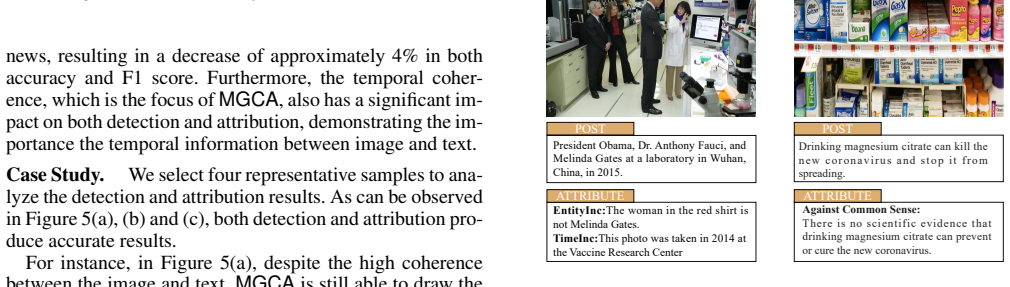
- [Data Processing and Annotation / Cross Validation and Discussion; Preliminary, Task 2] The annotation protocol assigns each fake post to exactly one of six classes by majority vote, but the paper acknowledges multi-cause cases: Appendix Figure 7(a) shows a post with both EntityInc and TimeInc, and the Limitation section explicitly refers to 'multiple overlapping attribution anomalies.' The single-label six-class scheme cannot faithfully represent such posts; majority voting over mutually exclusive choices discards the multi-cause structure. As a result, the attribution ground truth used in Tables 2 and 4 is not faithful for at least some of the data, and the benchmark's claimed multi-granularity is undermined.
- [Appendix, Additions to Annotation Process] The only reliability check reported is a 100-case pilot in which cases were pre-selected through group discussion, and expert labels were compared against the pre-selected labels, with a threshold of >95% accuracy and F1 before the labels were allowed to proceed to voting. This measures agreement with a consensus-derived gold set on an artificially easy, pre-discussed sample; it does not establish inter-annotator agreement on the full corpus. The paper should report full-corpus inter-annotator agreement (e.g., Cohen's kappa or Fleiss' kappa) on a random sample of the data to support the reliability of the attribution labels.
- [Data Collection, Real News Collection] The real-news set mixes posts from social platforms (Instagram, Facebook, Twitter) with articles from Reuters and NewsNation official accounts, plus a random supplement from archives. These sources differ systematically in format, length, and visual style, which can introduce confounds unrelated to authenticity. The later claim (Section 'Discussion on Dataset Difficulty') that AMG avoids entity bias is not supported by any distributional comparison between real and fake posts, and this weakens the conclusion that the dataset is challenging for content-based reasons rather than source artifacts.
minor comments (9)
- [Title] The title contains unintended spacing: 'Each F ake News is F ake in its Own Way' should be 'Each Fake News is Fake in its Own Way.'
- [Table 1] In the Twitter row, '13.924' should likely be '13,924', and the MR2 row appears to duplicate the '6,976' entry; please correct the formatting.
- [Visual Entity] The text reads 'we utilize Baiduan APIs'; this should be 'Baidu APIs.'
- [Multimodal Feature Learning] The phrase 'we exploit utilize BERT' is redundant; it should read 'we utilize BERT.'
- [Eq. (3) and surrounding text] The symbol T is used both for the temporal feature in the comparison function and for the temporal gap Tg; please use distinct notation to avoid confusion.
- [Appendix, Settings of LLaVA] The citation '(Liu et al. 2023; ?)' contains a missing reference placeholder; please complete the citation.
- [References] The Vicuna model is attributed to Zheng et al. 2023, but that reference is the MT-Bench paper; please cite the original Vicuna technical report or clarify the connection.
- [Abstract] The 'Extended version' link is a placeholder URL (https://aaai.org/example/extended-version); either provide the actual link or remove it.
- [Figure 6] The heatmap would be more interpretable with a colorbar and explicit axis labels indicating the classes; currently the reader cannot map colors to similarity values.
Circularity Check
The 3% coverage statistic is circular: out-of-taxonomy fake news is filtered out before the final statistics are computed, so the exhaustiveness claim is an artifact of the filter.
-
self definitional
[Section 3.3 'Data Collation and Analysis', subsection 'Rationality of our attribution rules']
"After integrating the collected news, we filter out fake news that does not fall under our attribution types. And the quantities for each attribution type are as follows: 434, 295, 133, 667, 475. ... Upon analyzing the final statistics, we make an exciting observation: the samples that fall outside our attribution categories account for only around 3% of the total dataset, comprising approximately 60 instances."
The 'final statistics' are computed after explicitly removing all fake news that does not fall under the five attribution types, so the reported category counts cannot include the ~60 out-of-taxonomy instances. Measuring the fraction of out-of-taxonomy samples from a pool that has already been filtered to exclude them makes the 3% coverage figure an artifact of the filtering step rather than independent evidence for the taxonomy's exhaustiveness. The arithmetic compounds the problem: 60/5,022 is about 1.2%, while 60/2,004 is about 3.0%, so the paper's '3% of the total dataset' confuses the fake-only denominator with the full 5,022-post corpus.
full rationale
The paper's contribution is a benchmark and a supervised model, not a theorem derivation. Training MGCA on AMG labels and reporting accuracy/F1 is standard supervised evaluation, and the transfer experiments on Twitter, Weibo, and Weibo21 provide external grounding, so no fitted parameter is being relabeled as a prediction. The attribution taxonomy is also not derived from MGCA's outputs: labels are assigned by experts using fact-checking rulings, and the model merely learns to predict them. The one genuine construction-level circularity is the exhaustiveness validation in Section 3.3. The authors first filter out any fake news that does not fall into the five attribution categories and then, from the 'final statistics' of the filtered set, report that only ~3% of cases fall outside the categories. Because the excluded instances are absent from the final counts by construction, the 3% figure cannot validate the taxonomy; it is a self-referential artifact. The contradiction is compounded by arithmetic: 60/5,022 is roughly 1.2%, while 60/2,004 is roughly 3.0%, so the '3% of the total dataset' phrasing is not coherent. This flaw weakens the 'Rationality of our attribution rules' argument but does not make the detection/attribution numbers themselves circular, since those labels are human-annotated and the benchmark is externally anchored by transfer results. Score 4: one load-bearing validation step reduces by construction, while the central content remains independently grounded.
Assumptions & free parameters
free parameters (5)
- MGCA learnable parameters (Compare-Net Wc, temporal Wt/Wr, classification MLPs) =
trained on AMG train split (3,532 posts)
- Real-to-fake dataset ratio =
3,018 real versus 2,004 fake (1.5:1)
- Train/val/test split =
3,532 / 517 / 973 (7:1:2)
- Temporal reference Tp = min{t1, t2} =
earlier of post publication time and mentioned time
- Expert annotation voting gate =
accuracy and F1 above 0.95 on 100 pre-selected cases before voting
assumptions (5)
- domain assumption Fact-checking websites (Snopes, CheckYourFact) provide accurate ground-truth authenticity labels for the collected posts.
- ad hoc to paper The five attribution categories are jointly exhaustive and can be assigned reliably from the ruling articles.
- ad hoc to paper A single middle frame of a video is representative of the visual message.
- domain assumption Pretrained extractors and tools (CLIP, BERT, Vicuna, LLaVA, Baidu API, GoogleLens, PSCC-Net) yield accurate clues for entities, events, times, and manipulations.
- domain assumption Real news collected from authoritative media accounts is comparable to fake news posted on social platforms.
Cite this review
Pith. "Pith review of Each Fake News is Fake in its Own Way: An Attribution Multi-Granularity Benchmark for Multimodal Fake News Detection." pith.science (2026). https://pith.science/paper/APOYKFQU
@misc{pith2026241214686,
  author       = {Pith},
  title        = {Pith review of: Each Fake News is Fake in its Own Way: An Attribution Multi-Granularity Benchmark for Multimodal Fake News Detection},
  year         = {2026},
  howpublished = {\url{https://pith.science/paper/APOYKFQU}},
  note         = {Machine review of arXiv:2412.14686}
}
read the original abstract
Social platforms, while facilitating access to information, have also become saturated with a plethora of fake news, resulting in negative consequences. Automatic multimodal fake news detection is a worthwhile pursuit. Existing multimodal fake news datasets only provide binary labels of real or fake. However, real news is alike, while each fake news is fake in its own way. These datasets fail to reflect the mixed nature of various types of multimodal fake news. To bridge the gap, we construct an attributing multi-granularity multimodal fake news detection dataset \amg, revealing the inherent fake pattern. Furthermore, we propose a multi-granularity clue alignment model \our to achieve multimodal fake news detection and attribution. Experimental results demonstrate that \amg is a challenging dataset, and its attribution setting opens up new avenues for future research.
Figures


Figures from the paper (5 more)




Reference graph
Works this paper leans on
-
[1]
Abdelnabi, S.; Hasan, R.; and Fritz, M. 2022. Open-Domain, Content-based, Multi-modal Fact-checking of Out-of-Context Images via Online Resources. In 2022 IEEE/CVF Conference on Computer Vision and Pattern Recognition (CVPR)
work page 2022
-
[2]
Allcott, H.; and Gentzkow, M. 2017. Social media and fake news in the 2016 election. Journal of economic perspectives, 31(2): 211--236
work page 2017
-
[3]
Apuke, O. D.; and Omar, B. 2021. Fake news and COVID-19: modelling the predictors of fake news sharing among social media users. Telematics and Informatics, 56: 101475
work page 2021
-
[4]
T.; Boato, G.; Riegler, M.; Kompatsiaris, Y.; et al
Boididou, C.; Andreadou, K.; Papadopoulos, S.; Dang Nguyen, D. T.; Boato, G.; Riegler, M.; Kompatsiaris, Y.; et al. 2015. Verifying multimedia use at mediaeval 2015. In MediaEval 2015, volume 1436. CEUR-WS
work page 2015
-
[5]
Cao, J.; Qi, P.; Sheng, Q.; Yang, T.; Guo, J.; and Li, J. 2020. Exploring the role of visual content in fake news detection. Disinformation, Misinformation, and Fake News in Social Media: Emerging Research Challenges and Opportunities, 141--161
work page 2020
-
[6]
Chen, Y.; Li, D.; Zhang, P.; Sui, J.; Lv, Q.; Tun, L.; and Shang, L. 2022. Cross-modal ambiguity learning for multimodal fake news detection. In Proceedings of the ACM Web Conference 2022, 2897--2905
2022
-
[7]
Chen, Z.; Hu, L.; Li, W.; Shao, Y.; and Nie, L. 2023. Causal intervention and counterfactual reasoning for multi-modal fake news detection. In Proceedings of the 61st Annual Meeting of the Association for Computational Linguistics (Volume 1: Long Papers), 627--638
work page 2023
-
[8]
Cui, L.; Wang, S.; and Lee, D. 2019. Same: sentiment-aware multi-modal embedding for detecting fake news. In Proceedings of the 2019 IEEE/ACM international conference on advances in social networks analysis and mining, 41--48
work page 2019
Show all 77 references
-
[9]
Dong, Y.; He, D.; Wang, X.; Jin, Y.; Ge, M.; Yang, C.; and Jin, D. 2024. Unveiling Implicit Deceptive Patterns in Multi-Modal Fake News via Neuro-Symbolic Reasoning. Proceedings of the AAAI Conference on Artificial Intelligence, 38(8): 8354--8362
2024
-
[10]
Feng, S.; Tan, Z.; Wan, H.; Wang, N.; Chen, Z.; Zhang, B.; Zheng, Q.; Zhang, W.; Lei, Z.; Yang, S.; et al. 2022. Twibot-22: Towards graph-based twitter bot detection. Advances in Neural Information Processing Systems, 35: 35254--35269
2022
-
[11]
Guo, H.; Zeng, W.; Tang, J.; and Zhao, X. 2023. Interpretable Fake News Detection with Graph Evidence. In Proceedings of the 32nd ACM International Conference on Information and Knowledge Management, 659--668
2023
-
[12]
Guo, Z.; Schlichtkrull, M.; and Vlachos, A. 2022. A survey on automated fact-checking. Transactions of the Association for Computational Linguistics, 10: 178--206
2022
-
[13]
Hu, B.; Sheng, Q.; Cao, J.; Zhu, Y.; Wang, D.; Wang, Z.; and Jin, Z. 2023 a . Learn over Past, Evolve for Future: Forecasting Temporal Trends for Fake News Detection. arXiv preprint arXiv:2306.14728
2023 arXiv
-
[14]
Hu, X.; Guo, Z.; Chen, J.; Wen, L.; and Yu, P. S. 2023 b . MR2: A Benchmark for Multimodal Retrieval-Augmented Rumor Detection in Social Media. In Proceedings of the 46th International ACM SIGIR Conference on Research and Development in Information Retrieval, SIGIR '23, 2901–2...
2023
-
[15]
Huang, B.; Wang, Z.; Yang, J.; Ai, J.; Zou, Q.; Wang, Q.; and Ye, D. 2023. Implicit Identity Driven Deepfake Face Swapping Detection. In Proceedings of the IEEE/CVF Conference on Computer Vision and Pattern Recognition, 4490--4499
2023
-
[16]
Jaiswal, A.; Wu, Y.; AbdAlmageed, W.; Masi, I.; and Natarajan, P. 2019. Aird: Adversarial learning framework for image repurposing detection. In Proceedings of the IEEE/CVF Conference on Computer Vision and Pattern Recognition, 11330--11339
2019
-
[17]
Jamet, E.; Gavota, M.; and Quaireau, C. 2008. Attention guiding in multimedia learning. Learning and instruction, 18(2): 135--145
2008
-
[18]
Jiang, Y.; Bordia, S.; Zhong, Z.; Dognin, C.; Singh, M.; and Bansal, M. 2020. HoVer: A Dataset for Many-Hop Fact Extraction And Claim Verification. In Findings of the Association for Computational Linguistics: EMNLP 2020, 3441--3460
2020
-
[19]
Jin, Z.; Cao, J.; Guo, H.; Zhang, Y.; and Luo, J. 2017. Multimodal fusion with recurrent neural networks for rumor detection on microblogs. In Proceedings of the 25th ACM international conference on Multimedia, 795--816
2017
-
[20]
Jin, Z.; Cao, J.; Zhang, Y.; Zhou, J.; and Tian, Q. 2016. Novel visual and statistical image features for microblogs news verification. IEEE transactions on multimedia, 19(3): 598--608
2016
-
[21]
Kenton, J. D. M.-W. C.; and Toutanova, L. K. 2019. Bert: Pre-training of deep bidirectional transformers for language understanding. In Proceedings of naacL-HLT, volume 1, 2
2019
-
[22]
Li, P.; Sun, X.; Yu, H.; Tian, Y.; Yao, F.; and Xu, G. 2021. Entity-oriented multi-modal alignment and fusion network for fake news detection. IEEE Transactions on Multimedia, 24: 3455--3468
2021
-
[23]
Liao, J.; Zhao, X.; Zheng, J.; Li, X.; Cai, F.; and Tang, J. 2022. PTAU: Prompt Tuning for Attributing Unanswerable Questions. In Proceedings of the 45th International ACM SIGIR Conference on Research and Development in Information Retrieval, 1219--1229
2022
-
[24]
Liu, H.; Li, C.; Wu, Q.; and Lee, Y. J. 2023. Visual Instruction Tuning
2023
-
[25]
Liu, H.; Wang, W.; and Li, H. 2023. Interpretable Multimodal Misinformation Detection with Logic Reasoning. arXiv e-prints, arXiv--2305
2023
-
[26]
Liu, X.; Liu, Y.; Chen, J.; and Liu, X. 2022. PSCC-Net: Progressive spatio-channel correlation network for image manipulation detection and localization. IEEE Transactions on Circuits and Systems for Video Technology, 32(11): 7505--7517
2022
-
[27]
Luo, G.; Darrell, T.; and Rohrbach, A. 2021. emnlp21NewsCLIPpings: Automatic Generation of Out-of-Context Multimodal Media. In Proceedings of the 2021 Conference on Empirical Methods in Natural Language Processing
2021
-
[28]
Mann, B.; Ryder, N.; Subbiah, M.; Kaplan, J.; Dhariwal, P.; Neelakantan, A.; Shyam, P.; Sastry, G.; Askell, A.; Agarwal, S.; et al. 2020. Language models are few-shot learners. arXiv preprint arXiv:2005.14165
2020 arXiv
-
[29]
Mayer, R. E. 2002. Multimedia learning. In Psychology of learning and motivation, volume 41, 85--139. Elsevier
2002
-
[30]
Mayer, R. E. 2014. Incorporating motivation into multimedia learning. Learning and instruction, 29: 171--173
2014
-
[31]
Fake news
Molina, M. D.; Sundar, S. S.; Le, T.; and Lee, D. 2021. “Fake news” is not simply false information: A concept explication and taxonomy of online content. American behavioral scientist, 65(2): 180--212
2021
-
[32]
Nakamura, K.; Levy, S.; and Wang, W. Y. 2020. Fakeddit: A New Multimodal Benchmark Dataset for Fine-grained Fake News Detection. In Proceedings of the Twelfth Language Resources and Evaluation Conference, 6149--6157
2020
-
[33]
Nan, Q.; Cao, J.; Zhu, Y.; Wang, Y.; and Li, J. 2021. MDFEND: Multi-domain fake news detection. In Proceedings of the 30th ACM International Conference on Information & Knowledge Management, 3343--3347
2021
-
[34]
Qi, P.; Bu, Y.; Cao, J.; Ji, W.; Shui, R.; Xiao, J.; Wang, D.; and Chua, T.-S. 2023 a . Fakesv: A multimodal benchmark with rich social context for fake news detection on short video platforms. In Proceedings of the AAAI Conference on Artificial Intelligence, volume 37, 14444--14452
2023
-
[35]
Qi, P.; Cao, J.; Li, X.; Liu, H.; Sheng, Q.; Mi, X.; He, Q.; Lv, Y.; Guo, C.; and Yu, Y. 2021 a . Improving fake news detection by using an entity-enhanced framework to fuse diverse multimodal clues. In Proceedings of the 29th ACM International Conference on Multimedia, 1212--1220
2021
-
[36]
Qi, P.; Cao, J.; Li, X.; Liu, H.; Sheng, Q.; Mi, X.; He, Q.; Lv, Y.; Guo, C.; and Yu, Y. 2021 b . Improving fake news detection by using an entity-enhanced framework to fuse diverse multimodal clues. In Proceedings of the 29th ACM International Conference on Multimedia, 1212--1220
2021
-
[37]
Qi, P.; Cao, J.; Yang, T.; Guo, J.; and Li, J. 2019. Exploiting multi-domain visual information for fake news detection. In 2019 IEEE international conference on data mining (ICDM), 518--527. IEEE
2019
-
[38]
Qi, P.; Yan, Z.; Hsu, W.; and Lee, M. L. 2024. SNIFFER: Multimodal Large Language Model for Explainable Out-of-Context Misinformation Detection. arXiv preprint arXiv:2403.03170
2024 arXiv
-
[39]
Qi, P.; Zhao, Y.; Shen, Y.; Ji, W.; Cao, J.; and Chua, T.-S. 2023 b . Two Heads Are Better Than One: Improving Fake News Video Detection by Correlating with Neighbors. In Findings of the Association for Computational Linguistics: ACL 2023, 11947--11959
2023
-
[40]
W.; Hallacy, C.; Ramesh, A.; Goh, G.; Agarwal, S.; Sastry, G.; Askell, A.; Mishkin, P.; Clark, J.; et al
Radford, A.; Kim, J. W.; Hallacy, C.; Ramesh, A.; Goh, G.; Agarwal, S.; Sastry, G.; Askell, A.; Mishkin, P.; Clark, J.; et al. 2021. Learning transferable visual models from natural language supervision. In International conference on machine learning, 8748--8763. PMLR
2021
-
[41]
Rajpurkar, P.; Jia, R.; and Liang, P. 2018. Know what you don't know: Unanswerable questions for SQuAD. arXiv preprint arXiv:1806.03822
2018 arXiv
-
[42]
Rombach, R.; Blattmann, A.; Lorenz, D.; Esser, P.; and Ommer, B. 2022. High-resolution image synthesis with latent diffusion models. In Proceedings of the IEEE/CVF conference on computer vision and pattern recognition, 10684--10695
2022
-
[43]
L.; Conroy, N.; Chen, Y.; and Cornwell, S
Rubin, V. L.; Conroy, N.; Chen, Y.; and Cornwell, S. 2016. Fake news or truth? using satirical cues to detect potentially misleading news. In Proceedings of the second workshop on computational approaches to deception detection, 7--17
2016
-
[44]
Sabir, E.; AbdAlmageed, W.; Wu, Y.; and Natarajan, P. 2018. Deep Multimodal Image-Repurposing Detection. In Proceedings of the 26th ACM international conference on Multimedia
2018
-
[45]
Schlichtkrull, M.; Guo, Z.; and Vlachos, A. 2024. Averitec: A dataset for real-world claim verification with evidence from the web. Advances in Neural Information Processing Systems, 36
2024
-
[46]
Shang, L.; Kou, Z.; Zhang, Y.; and Wang, D. 2021. A multimodal misinformation detector for covid-19 short videos on tiktok. In 2021 IEEE international conference on big data (big data), 899--908. IEEE
2021
-
[47]
Shao, R.; Wu, T.; and Liu, Z. 2023. Detecting and grounding multi-modal media manipulation. In Proceedings of the IEEE/CVF Conference on Computer Vision and Pattern Recognition, 6904--6913
2023
-
[48]
Shen, D.; Zhang, X.; Henao, R.; and Carin, L. 2018. Improved semantic-aware network embedding with fine-grained word alignment. arXiv preprint arXiv:1808.09633
2018 arXiv
-
[49]
Shu, K.; Mahudeswaran, D.; Wang, S.; Lee, D.; and Liu, H. 2020. Fakenewsnet: A data repository with news content, social context, and spatiotemporal information for studying fake news on social media. Big data, 8(3): 171--188
2020
-
[50]
Shu, K.; Sliva, A.; Wang, S.; Tang, J.; and Liu, H. 2017. Fake news detection on social media: A data mining perspective. ACM SIGKDD explorations newsletter, 19(1): 22--36
2017
-
[51]
Vlachos, A.; and Riedel, S. 2014. Fact checking: Task definition and dataset construction. In Proceedings of the ACL 2014 workshop on language technologies and computational social science, 18--22
2014
-
[52]
Vlachos, A.; and Riedel, S. 2015. Identification and verification of simple claims about statistical properties. In Proceedings of the 2015 Conference on Empirical Methods in Natural Language Processing, 2596--2601. Association for Computational Linguistics
2015
-
[53]
Wang, L.; Zhang, C.; Xu, H.; Xu, Y.; Xu, X.; and Wang, S. 2023. Cross-modal contrastive learning for multimodal fake news detection. In Proceedings of the 31st ACM International Conference on Multimedia, 5696--5704
2023
-
[54]
Wang, Y.; Ma, F.; Jin, Z.; Yuan, Y.; Xun, G.; Jha, K.; Su, L.; and Gao, J. 2018. Eann: Event adversarial neural networks for multi-modal fake news detection. In Proceedings of the 24th acm sigkdd international conference on knowledge discovery & data mining, 849--857
2018
-
[55]
Wang, Y.; Qian, S.; Hu, J.; Fang, Q.; and Xu, C. 2020. Fake news detection via knowledge-driven multimodal graph convolutional networks. In Proceedings of the 2020 international conference on multimedia retrieval, 540--547
2020
-
[56]
Wei, P.; Wu, F.; Sun, Y.; Zhou, H.; and Jing, X.-Y. 2022. Modality and event adversarial networks for multi-modal fake news detection. IEEE Signal Processing Letters, 29: 1382--1386
2022
-
[57]
Wu, L.; Liu, P.; and Zhang, Y. 2023. See how you read? multi-reading habits fusion reasoning for multi-modal fake news detection. In Proceedings of the AAAI Conference on Artificial Intelligence, volume 37, 13736--13744
2023
-
[58]
Wu, L.; Rao, Y.; Sun, L.; and He, W. 2021 a . Evidence inference networks for interpretable claim verification. In Proceedings of the AAAI conference on artificial intelligence, volume 35, 14058--14066
2021
-
[59]
Wu, Y.; Zhan, P.; Zhang, Y.; Wang, L.; and Xu, Z. 2021 b . Multimodal fusion with co-attention networks for fake news detection. In Findings of the association for computational linguistics: ACL-IJCNLP 2021, 2560--2569
2021
-
[60]
M.; Raghunathan, A.; Liang, P.; and Ma, T
Xie, S. M.; Raghunathan, A.; Liang, P.; and Ma, T. 2021. An explanation of in-context learning as implicit bayesian inference. arXiv preprint arXiv:2111.02080
2021 arXiv
-
[61]
Xu, D.; Fan, S.; and Kankanhalli, M. 2023. Combating misinformation in the era of generative AI models. In Proceedings of the 31st ACM International Conference on Multimedia, 9291--9298
2023
-
[62]
Xue, J.; Wang, Y.; Tian, Y.; Li, Y.; Shi, L.; and Wei, L. 2021. Detecting fake news by exploring the consistency of multimodal data. Information Processing & Management, 58(5): 102610
2021
-
[63]
M.; Shah, A.; Sun, L.; Cho, J.-H.; and Huang, L
Yao, B. M.; Shah, A.; Sun, L.; Cho, J.-H.; and Huang, L. 2023. End-to-end multimodal fact-checking and explanation generation: A challenging dataset and models. In Proceedings of the 46th International ACM SIGIR Conference on Research and Development in Information Retrieval, ...
2023
-
[64]
Ying, Q.; Hu, X.; Zhou, Y.; Qian, Z.; Zeng, D.; and Ge, S. 2023. Bootstrapping multi-view representations for fake news detection. In Proceedings of the AAAI conference on Artificial Intelligence, volume 37, 5384--5392
2023
-
[65]
Zannettou, S.; Sirivianos, M.; Blackburn, J.; and Kourtellis, N. 2019. The web of false information: Rumors, fake news, hoaxes, clickbait, and various other shenanigans. Journal of Data and Information Quality (JDIQ), 11(3): 1--37
2019
-
[66]
Zhang, L.; Zhang, X.; Zhou, Z.; Huang, F.; and Li, C. 2024. Reinforced adaptive knowledge learning for multimodal fake news detection. In Proceedings of the AAAI Conference on Artificial Intelligence, volume 38, 16777--16785
2024
-
[67]
Zhang, Q.; Liu, J.; Zhang, F.; Xie, J.; and Zha, Z.-J. 2023. Hierarchical Semantic Enhancement Network for Multimodal Fake News Detection. In Proceedings of the 31st ACM International Conference on Multimedia, MM '23, 3424–3433. New York, NY, USA: Association for Computing Mac...
2023
-
[68]
P.; Zhang, H.; Gonzalez, J
Zheng, L.; Chiang, W.-L.; Sheng, Y.; Zhuang, S.; Wu, Z.; Zhuang, Y.; Lin, Z.; Li, Z.; Li, D.; Xing, E. P.; Zhang, H.; Gonzalez, J. E.; and Stoica, I. 2023. Judging LLM-as-a-judge with MT-Bench and Chatbot Arena. arXiv:2306.05685
2023 arXiv
-
[69]
Zhong, W.; Xu, J.; Tang, D.; Xu, Z.; Duan, N.; Zhou, M.; Wang, J.; and Yin, J. 2020. Reasoning Over Semantic-Level Graph for Fact Checking. In Proceedings of the 58th Annual Meeting of the Association for Computational Linguistics, 6170--6180
2020
-
[70]
Zhou, J.; Han, X.; Yang, C.; Liu, Z.; Wang, L.; Li, C.; and Sun, M. 2019. GEAR: Graph-based Evidence Aggregating and Reasoning for Fact Verification. In Proceedings of the 57th Annual Meeting of the Association for Computational Linguistics, 892--901
2019
-
[71]
Zhou, X.; Mulay, A.; Ferrara, E.; and Zafarani, R. 2020. Recovery: A multimodal repository for covid-19 news credibility research. In Proceedings of the 29th ACM international conference on information & knowledge management, 3205--3212
2020
-
[72]
Zhou, X.; Wu, J.; and Zafarani, R. 2020. : Similarity-Aware Multi-modal Fake News Detection. In Pacific-Asia Conference on knowledge discovery and data mining, 354--367. Springer
2020
-
[73]
Zhu, Y.; Sheng, Q.; Cao, J.; Li, S.; Wang, D.; and Zhuang, F. 2022. Generalizing to the future: Mitigating entity bias in fake news detection. In Proceedings of the 45th International ACM SIGIR Conference on Research and Development in Information Retrieval, 2120--2125
2022
-
[74]
Zhu, Y.; Sheng, Q.; Cao, J.; Nan, Q.; Shu, K.; Wu, M.; Wang, J.; and Zhuang, F. 2023. Memory-Guided Multi-View Multi-Domain Fake News Detection. IEEE Transactions on Knowledge and Data Engineering, 35(7): 7178--7191
2023
-
[75]
Zubiaga, A.; Liakata, M.; and Procter, R. 2017. Exploiting context for rumour detection in social media. In Social Informatics: 9th International Conference, SocInfo 2017, Oxford, UK, September 13-15, 2017, Proceedings, Part I 9, 109--123. Springer
2017
-
[76]
, " * write output.state after.block = add.period write newline
ENTRY address archivePrefix author booktitle chapter edition editor eid eprint howpublished institution isbn journal key month note number organization pages publisher school series title type volume year label extra.label sort.label short.list INTEGERS output.state before.all...
-
[77]
write newline
" write newline "" before.all 'output.state := FUNCTION n.dashify 't := "" t empty not t #1 #1 substring "-" = t #1 #2 substring "--" = not "--" * t #2 global.max substring 't := t #1 #1 substring "-" = "-" * t #2 global.max substring 't := while if t #1 #1 substring * t #2 gl...
Reviewed August 11, 2026 · model on record in the stance chip above.
Discussion (0). Continue with ORCID to comment.