REVIEW 3 major objections 6 minor 4 cited by
IDOL: Instant Photorealistic 3D Human Creation from a Single Image
T0 review · 3 major / 6 minor · reviewed 2026-08-11 · deepseek-v4-flash
Pith's one-line read A single photo yields an animatable, photorealistic 3D human in under a second
desk verdict A serious, well-engineered avatar system with a genuinely large synthetic dataset, but the end-to-end 'single image' claim is unmeasured because all quantitative tests provide ground-truth SMPL-X/camera and the main test set comes from the same generator as training. read the letter →
The pith
A machine-rendered reading of the paper's core claim, the machinery that carries it, and where it could break.
The reading
What carries the argument
The load-bearing object is the canonical UV Gaussian avatar: every reconstructed person is expressed as Gaussian attribute maps registered to SMPL-X vertices, so pose, shape, clothing geometry, and texture are predicted as structured 2D maps rather than as a free 3D field. A pretrained high-resolution human-image encoder, kept frozen, supplies tokens to a UV-alignment transformer that fuses them with learnable UV tokens; a decoder lifts the fused tokens to Gaussian parameter maps, and differentiable rendering trains the whole pipeline against multi-view images. The dataset side is carried by MVChamp, a re-trained pose-controllable image animation model that turns a reference photo plus SMPL-X pose sequences into 24 consistent views, with temporal shift denoising to close the first-to-last-frame gap and face swapping to sharpen facial detail.
What would settle it
Take a set of real people photographed simultaneously by 24 calibrated cameras, feed one view into IDOL, and compare rendered novel views against the true captured views at the same resolution; if the error on these real captures is substantially worse than the error on held-out HuGe100K samples (for example, LPIPS more than twice as high) or worse than a strong optimization baseline, the generated-data assumption is falsified. The 2K2K experiment in the paper is a small step in this direction but uses only a few subjects.
Extended reading notes
Core claim
The central claim, stated on the paper's own terms, is that a single feed-forward pass over one input image can predict a full animatable human avatar as a set of Gaussian primitives parameterized in a canonical SMPL-X UV space, and that this becomes possible when the model is trained on HuGe100K's 2.4M generated multi-view frames. The model predicts per-vertex offsets, colors, and opacities as UV attribute maps; linear blend skinning then animates the result, and editing is done by modifying UV textures or SMPL-X shape parameters. On held-out generated data the method reports lower error than optimization-based and generic large reconstruction baselines on MSE, PSNR, and LPIPS, and qualitative in-the-wild tests show it generalizes to cartoon inputs and large-angle views. The paper also reports a user study in which participants preferred its outputs on face, clothing, back-view consistency, and overall quality.
Load-bearing premise
The whole pipeline assumes that the views generated by MVChamp are consistent, photorealistic, and diverse enough to stand in for real multi-view captures; if generated images have systematic artifacts or a domain gap from real photos, the model's quality on real inputs will not match the numbers reported on held-out generated data.
Editorial extensions
If this is right
- Reconstructing an animatable, textured human avatar from a casual photo becomes a one-second operation rather than a minutes-long optimization.
- Because the output lives in SMPL-X UV space, animation and shape or texture editing come directly from the representation, with no manual rigging or post-processing.
- Scaling up generated multi-view data appears to be the main driver of reconstruction quality, suggesting further synthetic-data scaling will keep improving generalization.
- Avatar creation is no longer limited by the high cost and small size of scanned human datasets, sidestepping scanning infrastructure and many privacy or copyright constraints.
Reading between the lines
- Beyond the paper's own evaluation, the quantitative gains are measured mainly on held-out generated data, so real-world performance may be weaker than reported until a larger real-capture benchmark is run; the paper's own 2K2K evaluation suggests the gap is not zero.
- Because every avatar is anchored to SMPL-X vertices, very loose clothing, asymmetric garments, and extreme topologies are likely to stress the representation, and a focused benchmark on garments with large offsets from the body would test this ceiling.
- The data-generation recipe (LLM-designed prompts, pose-conditioned multi-view video model, face refinement) is portable to other subject categories; testing it on animals or objects with articulated skeletons would show whether the scaling story generalizes beyond humans.
- Chaining MVChamp-style longer sequences with IDOL reconstruction could extend the method from single images to video reenactment with persistent identity, but temporal consistency over long sequences remains an open question and the paper only demonstrates short reenactments.
Editorial analysis
A structured set of objections, weighed in public.
Referee Report
Summary. The paper introduces IDOL, a feed-forward transformer that reconstructs an animatable 3D Gaussian avatar from a single image, trained on a new large-scale synthetic multi-view dataset, HuGe100K, generated by a pose-conditioned video diffusion model (MVChamp). The method represents the avatar as Gaussian attribute maps in a SMPL-X UV space, which supports animation and editing. The authors report quantitative improvements over existing baselines on held-out synthetic data and a small real-capture benchmark, along with qualitative results on in-the-wild images.
Significance. If the result holds, the paper offers two contributions: a fast (sub-second) single-image human avatar reconstruction model and a large-scale generated dataset that enables training of such models. The use of generated data at scale is a timely direction with potential to address the scarcity of photorealistic 3D human data. The UV-space Gaussian representation is also practical for downstream editing and animation. However, as detailed below, the evaluation protocol currently limits the strength of the central claim, and the paper's comparative evidence is weakened by metric and baseline issues. The work is nevertheless a plausible and useful step, provided the evaluation gaps are addressed.
major comments (3)
- [Sec. 5.2 (Dataset and Metrics)] The quantitative evaluation provides ground-truth SMPL-X parameters and camera parameters to all methods (quote: 'The ground-truth camera parameters and SMPL-X parameters are provided for all methods'), so Tables 2 and 4 measure conditional reconstruction given an exact body model rather than the advertised single-image pipeline. Because the model's representation and animation are defined relative to SMPL-X vertices (Sec. 4.1), and because supplementary Fig. 16b shows that imperfect SMPL-X input causes leaning/bent avatars, the actual RGB-to-avatar claim is not quantitatively validated. Please add an end-to-end evaluation using an off-the-shelf SMPL-X estimator on real captures, or explicitly reframe the claim and protocol to state that the method assumes an accurate upstream body estimate.
- [Sec. 5.2 and Table 2] The main evaluation is on held-out HuGe100K images produced by MVChamp, the same generator used to create the training set, so the reported metrics partly measure self-consistency within the synthetic distribution. The 2K2K results in the supplementary (Tab. 4) provide useful external grounding, but the absolute performance drops substantially (PSNR 16.7 vs 21.7), and that real-data evaluation is small. To support the generalization claim, please report a more extensive real-capture benchmark (e.g., a larger subset of 2K2K or a comparable multi-view human dataset) with estimated SMPL-X parameters.
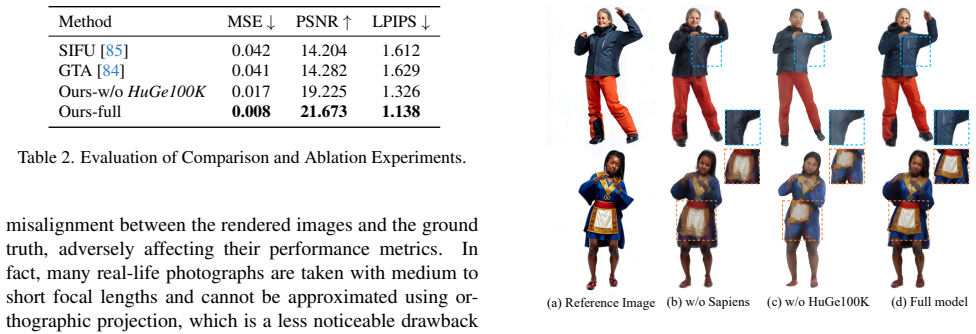
- [Table 2 and Sec. 5.2] The reported LPIPS values for SIFU and GTA (≈1.6) are far above the typical range for image reconstruction metrics, and the authors attribute this to an orthographic-vs-perspective projection mismatch. This makes the quantitative comparison against these baselines difficult to interpret. Please report results under a matched projection/camera setting (e.g., re-render all methods with the same perspective camera or provide orthographic equivalents) and specify the exact LPIPS computation. In addition, the main quantitative table omits strong feed-forward human-specific baselines such as HumanLRM, which appear only in the supplementary; including such a baseline in the unified protocol would make the comparison more convincing.
minor comments (6)
- [Fig. 4] The word 'Spaiens' in the architecture figure appears to be a typo for 'Sapiens'.
- [References, [25]] Reference [25] contains a malformed URL (a space in 'black-forest labs/flux'); please correct it.
- [Sec. 3.2] The use of FaceFusion to enhance facial details may alter identity; please discuss whether and how identity consistency is verified after face swapping.
- [Sec. 6 (Limitations)] The limitation paragraph lists fixed viewpoints and facial optimization but does not mention the method's dependence on an accurate SMPL-X estimate; given the evaluation protocol, this should be explicitly acknowledged.
- [Sec. 1 and Sec. 5.2] The 'under 1 second' claim should specify whether the time includes SMPL-X estimation or only the IDOL forward pass.
- [Sec. 4.1] Setting opacity to 1 for all Gaussians may limit modeling of transparency in hair and loose clothing; a brief comment on this choice would be helpful.
Circularity Check
No significant circularity: the empirical pipeline is self-contained and the evaluation gap is not a by-construction reduction.
full rationale
IDOL is an empirical system paper, not a formal derivation, and I found no load-bearing step in which a prediction or first-principles result reduces to its own inputs by construction. The main quantitative evaluation (Sec. 5.2, Tab. 2) does use held-out HuGe100K data generated by the same MVChamp pipeline used for training, and the test protocol supplies ground-truth camera and SMPL-X parameters to all methods; this is a genuine concern about generalization from generated to real captures, but it is not circular in the defined sense. The held-out split is not used for fitting, the model is compared against held-out rendered views rather than against any fitted parameter, and the paper provides independent external checks: THuman2.1 in Tab. 2, the 2K2K evaluation in supplementary Tab. 4, qualitative in-the-wild comparisons, and a user study. The representation choices (Gaussian attributes in SMPL-X UV space, Sapiens encoder, MVChamp) are adopted as external building blocks rather than derived from the target result, and the few self-citations (e.g., Champ as a starting point for MVChamp) are not used as an unexamined uniqueness premise. Thus, while the paper's strongest 'single image' claim is not fully measured end-to-end on real captures, that is an evaluation-protocol gap, not circularity by definition.
Assumptions & free parameters
free parameters (3)
- VGG loss weight lambda =
1:1 ratio with MSE
- Number of multi-view supervision frames N =
24
- Number of Gaussian vertices (densified SMPL-X) =
~200,000
assumptions (3)
- domain assumption SMPL-X is an adequate parametric prior for body shape, pose, and UV space anchoring of Gaussian primitives.
- domain assumption MVChamp-generated multi-view images are sufficiently 3D-consistent and photorealistic to serve as training and test supervision.
- domain assumption Providing ground-truth SMPL-X and camera parameters to all compared methods is a fair evaluation protocol for single-image reconstruction.
invented entities (3)
-
HuGe100K dataset
-
MVChamp
-
IDOL model
Cite this review
Pith. "Pith review of IDOL: Instant Photorealistic 3D Human Creation from a Single Image." pith.science (2026). https://pith.science/paper/6W7LDXNY
@misc{pith2026241214963,
  author       = {Pith},
  title        = {Pith review of: IDOL: Instant Photorealistic 3D Human Creation from a Single Image},
  year         = {2026},
  howpublished = {\url{https://pith.science/paper/6W7LDXNY}},
  note         = {Machine review of arXiv:2412.14963}
}
read the original abstract
Creating a high-fidelity, animatable 3D full-body avatar from a single image is a challenging task due to the diverse appearance and poses of humans and the limited availability of high-quality training data. To achieve fast and high-quality human reconstruction, this work rethinks the task from the perspectives of dataset, model, and representation. First, we introduce a large-scale HUman-centric GEnerated dataset, HuGe100K, consisting of 100K diverse, photorealistic sets of human images. Each set contains 24-view frames in specific human poses, generated using a pose-controllable image-to-multi-view model. Next, leveraging the diversity in views, poses, and appearances within HuGe100K, we develop a scalable feed-forward transformer model to predict a 3D human Gaussian representation in a uniform space from a given human image. This model is trained to disentangle human pose, body shape, clothing geometry, and texture. The estimated Gaussians can be animated without post-processing. We conduct comprehensive experiments to validate the effectiveness of the proposed dataset and method. Our model demonstrates the ability to efficiently reconstruct photorealistic humans at 1K resolution from a single input image using a single GPU instantly. Additionally, it seamlessly supports various applications, as well as shape and texture editing tasks. Project page: https://yiyuzhuang.github.io/IDOL/.
Figures


Figures from the paper (12 more)




Forward citations
Cited by 4 Pith papers
-
PERSONA: Personalized Whole-Body 3D Avatar with Pose-Driven Deformations from a Single Image
PERSONA creates a personalized 3D avatar from one image by using diffusion-generated pose-rich videos to train a 3D Gaussian avatar with balanced sampling and geometry-weighted optimization.
-
Parametric Gaussian Human Model: Generalizable Prior for Efficient and Realistic Human Avatar Modeling
A pretrained parametric Gaussian prior with a UV-aligned latent identity map and disentangled multi-head U-Net creates animatable human avatars from monocular video in about 20 minutes per subject.
-
GAS: Generative Avatar Synthesis from a Single Image
GAS generates view-consistent, temporally coherent avatars from a single image by feeding NeRF renderings of the target view plus SMPL normal maps into a video diffusion model.
-
FATE: Full-head Gaussian Avatar with Textural Editing from Monocular Video
FATE is a monocular full-head avatar system that improves Gaussian efficiency with sampling-based densification, enables UV-space texture editing through neural baking, and completes non-frontal views using SphereHead priors.
Reference graph
Works this paper leans on
-
[1]
Josh Achiam, Steven Adler, Sandhini Agarwal, Lama Ah- mad, Ilge Akkaya, Florencia Leoni Aleman, Diogo Almeida, Janko Altenschmidt, Sam Altman, Shyamal Anadkat, et al. Gpt-4 technical report. arXiv preprint arXiv:2303.08774 ,
-
[2]
Single-image 3d human digitization with shape-guided diffusion
Badour AlBahar, Shunsuke Saito, Hung-Yu Tseng, Changil Kim, Johannes Kopf, and Jia-Bin Huang. Single-image 3d human digitization with shape-guided diffusion. In SIG- GRAPH Asia 2023 Conference Papers, 2023. 2, 3, 4, 8
2023
-
[3]
Stable video diffusion: Scaling latent video diffusion models to large datasets
Andreas Blattmann, Tim Dockhorn, Sumith Kulal, Daniel Mendelevitch, Maciej Kilian, Dominik Lorenz, Yam Levi, Zion English, Vikram V oleti, Adam Letts, et al. Stable video diffusion: Scaling latent video diffusion models to large datasets. arXiv preprint arXiv:2311.15127, 2023. 2
arXiv 2023
-
[4]
Humman: Multi-modal 4d human dataset for ver- satile sensing and modeling
Zhongang Cai, Daxuan Ren, Ailing Zeng, Zhengyu Lin, Tao Yu, Wenjia Wang, Xiangyu Fan, Yang Gao, Yifan Yu, Liang Pan, et al. Humman: Multi-modal 4d human dataset for ver- satile sensing and modeling. In European Conference on Computer Vision, pages 557–577. Springer, 2022. 2, 3
2022
-
[5]
Smpler-x: Scaling up expressive human pose and shape estimation
Zhongang Cai, Wanqi Yin, Ailing Zeng, Chen Wei, Qing- ping Sun, Wang Yanjun, Hui En Pang, Haiyi Mei, Mingyuan Zhang, Lei Zhang, et al. Smpler-x: Scaling up expressive human pose and shape estimation. Advances in Neural In- formation Processing Systems, 36, 2024. 4, 3
2024
-
[6]
Magicpose: Realistic human poses and facial expressions retargeting with identity-aware diffusion
Di Chang, Yichun Shi, Quankai Gao, Hongyi Xu, Jessica Fu, Guoxian Song, Qing Yan, Yizhe Zhu, Xiao Yang, and Mo- hammad Soleymani. Magicpose: Realistic human poses and facial expressions retargeting with identity-aware diffusion. In Forty-first International Conference on Machine Learn- ing, 2023. 3
2023
-
[7]
Fast-snarf: A fast deformer for articulated neural fields
Xu Chen, Tianjian Jiang, Jie Song, Max Rietmann, Andreas Geiger, Michael J Black, and Otmar Hilliges. Fast-snarf: A fast deformer for articulated neural fields. IEEE Transac- tions on Pattern Analysis and Machine Intelligence, 45(10): 11796–11809, 2023. 5
2023
-
[8]
Generalizable neural performer: Learning robust radiance fields for human novel view synthesis
Wei Cheng, Su Xu, Jingtan Piao, Chen Qian, Wayne Wu, Kwan-Yee Lin, and Hongsheng Li. Generalizable neural performer: Learning robust radiance fields for human novel view synthesis. arXiv preprint arXiv:2204.11798, 2022. 2, 3
arXiv 2022
Show all 103 references
-
[9]
Dna-rendering: A diverse neural actor repository for high-fidelity human-centric rendering
Wei Cheng, Ruixiang Chen, Siming Fan, Wanqi Yin, Keyu Chen, Zhongang Cai, Jingbo Wang, Yang Gao, Zhengming Yu, Zhengyu Lin, et al. Dna-rendering: A diverse neural actor repository for high-fidelity human-centric rendering. In Proceedings of the IEEE/CVF International Conferenc...
2023
-
[10]
Structured 3d features for reconstructing control- lable avatars
Enric Corona, Mihai Zanfir, Thiemo Alldieck, Ed- uard Gabriel Bazavan, Andrei Zanfir, and Cristian Smin- chisescu. Structured 3d features for reconstructing control- lable avatars. In Proceedings of the IEEE/CVF Conference on Computer Vision and Pattern Recognition, pages 1695...
2023
-
[11]
Objaverse: A universe of annotated 3d objects
Matt Deitke, Dustin Schwenk, Jordi Salvador, Luca Weihs, Oscar Michel, Eli VanderBilt, Ludwig Schmidt, Kiana Ehsani, Aniruddha Kembhavi, and Ali Farhadi. Objaverse: A universe of annotated 3d objects. In Proceedings of the IEEE/CVF Conference on Computer Vision and Pattern Rec...
2023
-
[12]
Objaverse-xl: A universe of 10m+ 3d objects
Matt Deitke, Ruoshi Liu, Matthew Wallingford, Huong Ngo, Oscar Michel, Aditya Kusupati, Alan Fan, Christian Laforte, Vikram V oleti, Samir Yitzhak Gadre, et al. Objaverse-xl: A universe of 10m+ 3d objects. Advances in Neural Informa- tion Processing Systems, 36, 2024. 2, 3
2024
-
[13]
Fof: Learning fourier occupancy field for monocular real- time human reconstruction
Qiao Feng, Yebin Liu, Yu-Kun Lai, Jingyu Yang, and Kun Li. Fof: Learning fourier occupancy field for monocular real- time human reconstruction. In NeurIPS, 2022. 2
2022
-
[14]
Mps-nerf: Generalizable 3d hu- man rendering from multiview images
Xiangjun Gao, Jiaolong Yang, Jongyoo Kim, Sida Peng, Zicheng Liu, and Xin Tong. Mps-nerf: Generalizable 3d hu- man rendering from multiview images. IEEE Transactions on Pattern Analysis and Machine Intelligence, 2022
2022
-
[15]
Contex-human: Free- view rendering of human from a single image with texture- consistent synthesis
Xiangjun Gao, Xiaoyu Li, Chaopeng Zhang, Qi Zhang, Yan- pei Cao, Ying Shan, and Long Quan. Contex-human: Free- view rendering of human from a single image with texture- consistent synthesis. In Proceedings of the IEEE/CVF Con- ference on Computer Vision and Pattern Recognition...
2024
-
[16]
Mani-gs: Gaussian splatting manipulation with triangular mesh
Xiangjun Gao, Xiaoyu Li, Yiyu Zhuang, Qi Zhang, Wenbo Hu, Chaopeng Zhang, Yao Yao, Ying Shan, and Long Quan. Mani-gs: Gaussian splatting manipulation with triangular mesh. arXiv preprint arXiv:2405.17811, 2024. 2
2024 arXiv
-
[17]
Make-it-animatable: An ef- ficient framework for authoring animation-ready 3d charac- ters
Zhiyang Guo, Jinxu Xiang, Kai Ma, Wengang Zhou, Houqiang Li, and Ran Zhang. Make-it-animatable: An ef- ficient framework for authoring animation-ready 3d charac- ters. arXiv preprint arXiv:2411.18197, 2024. 9
2024 arXiv
-
[18]
Vfusion3d: Learning scalable 3d generative models from video diffusion models
Junlin Han, Filippos Kokkinos, and Philip Torr. Vfusion3d: Learning scalable 3d generative models from video diffusion models. In European Conference on Computer Vision, pages 333–350. Springer, 2025. 4
2025
-
[19]
High-fidelity 3d human digitization from single 2k resolution images
Sang-Hun Han, Min-Gyu Park, Ju Hong Yoon, Ju-Mi Kang, Young-Jae Park, and Hae-Gon Jeon. High-fidelity 3d human digitization from single 2k resolution images. In Proceed- ings of the IEEE/CVF Conference on Computer Vision and Pattern Recognition, pages 12869–12879, 2023. 2, 3
2023
-
[20]
Masked autoencoders are scalable vision learners
Kaiming He, Xinlei Chen, Saining Xie, Yanghao Li, Piotr Doll´ar, and Ross Girshick. Masked autoencoders are scalable vision learners. In Proceedings of the IEEE/CVF conference on computer vision and pattern recognition , pages 16000– 16009, 2022. 5
2022
-
[21]
Arch++: Animation-ready clothed human recon- struction revisited
Tong He, Yuanlu Xu, Shunsuke Saito, Stefano Soatto, and Tony Tung. Arch++: Animation-ready clothed human recon- struction revisited. In Proceedings of the IEEE/CVF interna- tional conference on computer vision , pages 11046–11056,
-
[22]
Magicman: Generative novel view synthesis of humans with 3d-aware diffusion and iterative refinement
Xu He, Xiaoyu Li, Di Kang, Jiangnan Ye, Chaopeng Zhang, Liyang Chen, Xiangjun Gao, Han Zhang, Zhiyong Wu, and Haolin Zhuang. Magicman: Generative novel view synthesis of humans with 3d-aware diffusion and iterative refinement. arXiv preprint arXiv:2408.14211, 2024. 2
2024 arXiv
-
[23]
Head360: Learning a parametric 3d full-head for free-view synthesis in 360
Yuxiao He, Yiyu Zhuang, Yanwen Wang, Yao Yao, Siyu Zhu, Xiaoyu Li, Qi Zhang, Xun Cao, and Hao Zhu. Head360: Learning a parametric 3d full-head for free-view synthesis in 360. In European Conference on Computer Vision, pages 254–272. Springer, 2024. 2
2024
-
[24]
Lrm: Large reconstruction model for single image to 3d
Yicong Hong, Kai Zhang, Jiuxiang Gu, Sai Bi, Yang Zhou, Difan Liu, Feng Liu, Kalyan Sunkavalli, Trung Bui, and Hao Tan. Lrm: Large reconstruction model for single image to 3d. arXiv preprint arXiv:2311.04400, 2023. 2
2023 arXiv
-
[25]
Flux latent recti- fied flow transformers, 2024
https://github.com/black-forest labs/flux. Flux latent recti- fied flow transformers, 2024. 3, 1, 5
2024
-
[26]
Facefusion, 2024
https://github.com/facefusion/facefusion. Facefusion, 2024. 4
2024
-
[27]
Renderpeople dataset,
https://renderpeople.com/3d people. Renderpeople dataset,
-
[28]
Twindom dataset, 2020
https://web.twindom.com/. Twindom dataset, 2020. 2
2020
-
[29]
Animate anyone: Consistent and controllable image- to-video synthesis for character animation
Li Hu. Animate anyone: Consistent and controllable image- to-video synthesis for character animation. InProceedings of the IEEE/CVF Conference on Computer Vision and Pattern Recognition, pages 8153–8163, 2024. 3
2024
-
[30]
Gaussianavatar: Towards realistic human avatar modeling from a single video via animatable 3d gaussians
Liangxiao Hu, Hongwen Zhang, Yuxiang Zhang, Boyao Zhou, Boning Liu, Shengping Zhang, and Liqiang Nie. Gaussianavatar: Towards realistic human avatar modeling from a single video via animatable 3d gaussians. In Pro- ceedings of the IEEE/CVF Conference on Computer Vision and Pat...
2024
-
[31]
Sherf: Generalizable human nerf from a single image
Shoukang Hu, Fangzhou Hong, Liang Pan, Haiyi Mei, Lei Yang, and Ziwei Liu. Sherf: Generalizable human nerf from a single image. In Proceedings of the IEEE/CVF Interna- tional Conference on Computer Vision (ICCV), 2023. 3
2023
-
[32]
One-shot implicit animatable avatars with model- based priors
Yangyi Huang, Hongwei Yi, Weiyang Liu, Haofan Wang, Boxi Wu, Wenxiao Wang, Binbin Lin, Debing Zhang, and Deng Cai. One-shot implicit animatable avatars with model- based priors. In IEEE Conference on Computer Vision (ICCV), 2023. 3
2023
-
[33]
DreamWaltz-G: Expressive 3D Gaussian Avatars from Skeleton-Guided 2D Diffusion
Yukun Huang, Jianan Wang, Ailing Zeng, Zheng-Jun Zha, Lei Zhang, and Xihui Liu. DreamWaltz-G: Expressive 3D Gaussian Avatars from Skeleton-Guided 2D Diffusion. 2024. 2
2024
-
[34]
Arch: Animatable reconstruction of clothed hu- mans
Zeng Huang, Yuanlu Xu, Christoph Lassner, Hao Li, and Tony Tung. Arch: Animatable reconstruction of clothed hu- mans. In Proceedings of the IEEE/CVF Conference on Com- puter Vision and Pattern Recognition , pages 3093–3102,
-
[35]
Humanrf: High-fidelity neural radiance fields for humans in motion
Mustafa Is ¸ık, Martin R ¨unz, Markos Georgopoulos, Taras Khakhulin, Jonathan Starck, Lourdes Agapito, and Matthias Nießner. Humanrf: High-fidelity neural radiance fields for humans in motion. ACM Transactions on Graphics (TOG), 42(4):1–12, 2023. 2, 3
2023
-
[36]
3d gaussian splatting for real-time radiance field rendering
Bernhard Kerbl, Georgios Kopanas, Thomas Leimk ¨uhler, and George Drettakis. 3d gaussian splatting for real-time radiance field rendering. ACM Trans. Graph., 42(4):139–1,
-
[37]
Sapiens: Foundation for human vision mod- els
Rawal Khirodkar, Timur Bagautdinov, Julieta Martinez, Su Zhaoen, Austin James, Peter Selednik, Stuart Anderson, and Shunsuke Saito. Sapiens: Foundation for human vision mod- els. In European Conference on Computer Vision , pages 206–228. Springer, 2025. 2, 5, 6, 8, 3, 4
2025
-
[38]
Segment any- thing
Alexander Kirillov, Eric Mintun, Nikhila Ravi, Hanzi Mao, Chloe Rolland, Laura Gustafson, Tete Xiao, Spencer White- head, Alexander C Berg, Wan-Yen Lo, et al. Segment any- thing. In Proceedings of the IEEE/CVF International Con- ference on Computer Vision, pages 4015–4026, 2023. 3
2023
-
[39]
Gghead: Fast and generalizable 3d gaussian heads
Tobias Kirschstein, Simon Giebenhain, Jiapeng Tang, Markos Georgopoulos, and Matthias Nießner. Gghead: Fast and generalizable 3d gaussian heads. arXiv preprint arXiv:2406.09377, 2024. 4
2024 arXiv
-
[40]
Instant3d: Fast text-to-3d with sparse-view generation and large reconstruction model
Jiahao Li, Hao Tan, Kai Zhang, Zexiang Xu, Fujun Luan, Yinghao Xu, Yicong Hong, Kalyan Sunkavalli, Greg Shakhnarovich, and Sai Bi. Instant3d: Fast text-to-3d with sparse-view generation and large reconstruction model. In International Conference on Learning Representations (IC...
2024
-
[41]
Pshuman: Photorealistic single-view human reconstruction using cross-scale diffusion
Peng Li, Wangguandong Zheng, Yuan Liu, Tao Yu, Yang- guang Li, Xingqun Qi, Mengfei Li, Xiaowei Chi, Siyu Xia, Wei Xue, et al. Pshuman: Photorealistic single-view human reconstruction using cross-scale diffusion. arXiv preprint arXiv:2409.10141, 2024. 2
2024 arXiv
-
[42]
Ai choreographer: Music conditioned 3d dance generation with aist++
Ruilong Li, Shan Yang, David A Ross, and Angjoo Kanazawa. Ai choreographer: Music conditioned 3d dance generation with aist++. In Proceedings of the IEEE/CVF In- ternational Conference on Computer Vision , pages 13401– 13412, 2021. 2, 3
2021
-
[43]
Ani- matable gaussians: Learning pose-dependent gaussian maps for high-fidelity human avatar modeling
Zhe Li, Zerong Zheng, Lizhen Wang, and Yebin Liu. Ani- matable gaussians: Learning pose-dependent gaussian maps for high-fidelity human avatar modeling. In Proceedings of the IEEE/CVF Conference on Computer Vision and Pattern Recognition, pages 19711–19722, 2024. 2
2024
-
[44]
Motion-x: A large-scale 3d expressive whole-body human motion dataset
Jing Lin, Ailing Zeng, Shunlin Lu, Yuanhao Cai, Ruimao Zhang, Haoqian Wang, and Lei Zhang. Motion-x: A large-scale 3d expressive whole-body human motion dataset. Advances in Neural Information Processing Systems , 36: 25268–25280, 2023. 3
2023
-
[45]
Neural actor: Neural free-view synthesis of human actors with pose con- trol
Lingjie Liu, Marc Habermann, Viktor Rudnev, Kripasindhu Sarkar, Jiatao Gu, and Christian Theobalt. Neural actor: Neural free-view synthesis of human actors with pose con- trol. ACM transactions on graphics (TOG) , 40(6):1–16,
-
[46]
Evalcrafter: Benchmarking and eval- uating large video generation models
Yaofang Liu, Xiaodong Cun, Xuebo Liu, Xintao Wang, Yong Zhang, Haoxin Chen, Yang Liu, Tieyong Zeng, Raymond Chan, and Ying Shan. Evalcrafter: Benchmarking and eval- uating large video generation models. In Proceedings of the IEEE/CVF Conference on Computer Vision and Pattern R...
2024
-
[47]
Deepfashion: Powering robust clothes recognition and retrieval with rich annotations
Ziwei Liu, Ping Luo, Shi Qiu, Xiaogang Wang, and Xiaoou Tang. Deepfashion: Powering robust clothes recognition and retrieval with rich annotations. In Proceedings of the IEEE conference on computer vision and pattern recogni- tion, pages 1096–1104, 2016. 3, 1, 7
2016
-
[48]
Smpl: A skinned multi- person linear model
Matthew Loper, Naureen Mahmood, Javier Romero, Gerard Pons-Moll, and Michael J Black. Smpl: A skinned multi- person linear model. ACM Transactions on Graphics, 34(6),
-
[49]
Scalable 3d captioning with pretrained models
Tiange Luo, Chris Rockwell, Honglak Lee, and Justin John- son. Scalable 3d captioning with pretrained models. Ad- vances in Neural Information Processing Systems, 36, 2024. 2
2024
-
[50]
Nerf: Representing scenes as neural radiance fields for view syn- thesis
Ben Mildenhall, Pratul P Srinivasan, Matthew Tancik, Jonathan T Barron, Ravi Ramamoorthi, and Ren Ng. Nerf: Representing scenes as neural radiance fields for view syn- thesis. Communications of the ACM , 65(1):99–106, 2021. 2
2021
-
[51]
Dinov2: Learning robust visual features without supervision
Maxime Oquab, Timoth ´ee Darcet, Th ´eo Moutakanni, Huy V o, Marc Szafraniec, Vasil Khalidov, Pierre Fernandez, Daniel Haziza, Francisco Massa, Alaaeldin El-Nouby, et al. Dinov2: Learning robust visual features without supervision. arXiv preprint arXiv:2304.07193, 2023. 5, 8
2023 arXiv
-
[52]
Expressive body capture: 3d hands, face, and body from a single image
Georgios Pavlakos, Vasileios Choutas, Nima Ghorbani, Timo Bolkart, Ahmed AA Osman, Dimitrios Tzionas, and Michael J Black. Expressive body capture: 3d hands, face, and body from a single image. In Proceedings of the IEEE/CVF conference on computer vision and pattern recognitio...
2019
-
[53]
Recon- structing hands in 3d with transformers
Georgios Pavlakos, Dandan Shan, Ilija Radosavovic, Angjoo Kanazawa, David Fouhey, and Jitendra Malik. Recon- structing hands in 3d with transformers. In Proceedings of the IEEE/CVF Conference on Computer Vision and Pattern Recognition, pages 9826–9836, 2024. 4, 1
2024
-
[54]
Charactergen: Efficient 3d character generation from single images with multi-view pose canoni- calization
Hao-Yang Peng, Jia-Peng Zhang, Meng-Hao Guo, Yan-Pei Cao, and Shi-Min Hu. Charactergen: Efficient 3d character generation from single images with multi-view pose canoni- calization. ACM Transactions on Graphics (TOG), 2024. 2, 3
2024
-
[55]
Neural body: Implicit neural representations with structured latent codes for novel view synthesis of dynamic humans
Sida Peng, Yuanqing Zhang, Yinghao Xu, Qianqian Wang, Qing Shuai, Hujun Bao, and Xiaowei Zhou. Neural body: Implicit neural representations with structured latent codes for novel view synthesis of dynamic humans. In Proceed- ings of the IEEE/CVF Conference on Computer Vision a...
2021
-
[56]
Sdxl: Improving latent diffusion mod- els for high-resolution image synthesis
Dustin Podell, Zion English, Kyle Lacey, Andreas Blattmann, Tim Dockhorn, Jonas M ¨uller, Joe Penna, and Robin Rombach. Sdxl: Improving latent diffusion mod- els for high-resolution image synthesis. arXiv preprint arXiv:2307.01952, 2023. 2
2023 arXiv
-
[57]
High-resolution image syn- thesis with latent diffusion models, 2022
Robin Rombach, Andreas Blattmann, Dominik Lorenz, Patrick Esser, and Bj¨orn Ommer. High-resolution image syn- thesis with latent diffusion models, 2022. 2
2022
-
[58]
Pifu: Pixel-aligned implicit function for high-resolution clothed human digitiza- tion
Shunsuke Saito, Zeng Huang, Ryota Natsume, Shigeo Mor- ishima, Angjoo Kanazawa, and Hao Li. Pifu: Pixel-aligned implicit function for high-resolution clothed human digitiza- tion. In Proceedings of the IEEE/CVF international confer- ence on computer vision, pages 2304–2314, 2019. 2, 3
2019
-
[59]
Pifuhd: Multi-level pixel-aligned implicit function for high-resolution 3d human digitization
Shunsuke Saito, Tomas Simon, Jason Saragih, and Hanbyul Joo. Pifuhd: Multi-level pixel-aligned implicit function for high-resolution 3d human digitization. In Proceedings of the IEEE/CVF conference on computer vision and pattern recognition, pages 84–93, 2020. 2, 3
2020
-
[60]
Neural localizer fields for continuous 3d human pose and shape estimation
Istv ´an S´ar´andi and Gerard Pons-Moll. Neural localizer fields for continuous 3d human pose and shape estimation. arXiv preprint arXiv:2407.07532, 2024. 4
2024 arXiv
-
[61]
X- avatar: Expressive human avatars
Kaiyue Shen, Chen Guo, Manuel Kaufmann, Juan Jose Zarate, Julien Valentin, Jie Song, and Otmar Hilliges. X- avatar: Expressive human avatars. In Proceedings of the IEEE/CVF Conference on Computer Vision and Pattern Recognition, pages 16911–16921, 2023. 3
2023
-
[62]
Dreamgaussian: Generative gaussian splatting for effi- cient 3d content creation
Jiaxiang Tang, Jiawei Ren, Hang Zhou, Ziwei Liu, and Gang Zeng. Dreamgaussian: Generative gaussian splatting for effi- cient 3d content creation. arXiv preprint arXiv:2309.16653,
-
[63]
Lgm: Large multi-view gaussian model for high-resolution 3d content creation
Jiaxiang Tang, Zhaoxi Chen, Xiaokang Chen, Tengfei Wang, Gang Zeng, and Ziwei Liu. Lgm: Large multi-view gaussian model for high-resolution 3d content creation. In European Conference on Computer Vision, pages 1–18. Springer, 2025. 2, 6, 8
2025
-
[64]
Sv3d: Novel multi-view syn- thesis and 3d generation from a single image using latent video diffusion
Vikram V oleti, Chun-Han Yao, Mark Boss, Adam Letts, David Pankratz, Dmitry Tochilkin, Christian Laforte, Robin Rombach, and Varun Jampani. Sv3d: Novel multi-view syn- thesis and 3d generation from a single image using latent video diffusion. In European Conference on Computer...
2025
-
[65]
Vividpose: Advancing stable video diffusion for realistic human image animation
Qilin Wang, Zhengkai Jiang, Chengming Xu, Jiangning Zhang, Yabiao Wang, Xinyi Zhang, Yun Cao, Weijian Cao, Chengjie Wang, and Yanwei Fu. Vividpose: Advancing stable video diffusion for realistic human image animation. arXiv preprint arXiv:2405.18156, 2024. 3
2024 arXiv
-
[66]
Template-free single-view 3d human digitalization with diffusion-guided lrm
Zhenzhen Weng, Jingyuan Liu, Hao Tan, Zhan Xu, Yang Zhou, Serena Yeung-Levy, and Jimei Yang. Template-free single-view 3d human digitalization with diffusion-guided lrm. arXiv preprint arXiv:2401.12175, 2024. 2, 3, 4, 8, 10
2024 arXiv
-
[67]
Unique3d: High-quality and efficient 3d mesh generation from a single image
Kailu Wu, Fangfu Liu, Zhihan Cai, Runjie Yan, Hanyang Wang, Yating Hu, Yueqi Duan, and Kaisheng Ma. Unique3d: High-quality and efficient 3d mesh generation from a single image. arXiv preprint arXiv:2405.20343, 2024. 2
2024 arXiv
-
[68]
High-fidelity 3d face genera- tion from natural language descriptions
Menghua Wu, Hao Zhu, Linjia Huang, Yiyu Zhuang, Yuanxun Lu, and Xun Cao. High-fidelity 3d face genera- tion from natural language descriptions. In Proceedings of the IEEE/CVF Conference on Computer Vision and Pattern Recognition, pages 4521–4530, 2023. 2
2023
-
[69]
Structured 3d latents for scalable and versatile 3d gen- eration
Jianfeng Xiang, Zelong Lv, Sicheng Xu, Yu Deng, Ruicheng Wang, Bowen Zhang, Dong Chen, Xin Tong, and Jiaolong Yang. Structured 3d latents for scalable and versatile 3d gen- eration. arXiv preprint arXiv:2412.01506, 2024. 9
2024 arXiv
-
[70]
Mvhumannet: A large- scale dataset of multi-view daily dressing human captures
Zhangyang Xiong, Chenghong Li, Kenkun Liu, Hongjie Liao, Jianqiao Hu, Junyi Zhu, Shuliang Ning, Lingteng Qiu, Chongjie Wang, Shijie Wang, et al. Mvhumannet: A large- scale dataset of multi-view daily dressing human captures. In Proceedings of the IEEE/CVF Conference on Compute...
2024
-
[71]
Icon: Implicit clothed humans obtained from nor- mals
Yuliang Xiu, Jinlong Yang, Dimitrios Tzionas, and Michael J Black. Icon: Implicit clothed humans obtained from nor- mals. In 2022 IEEE/CVF Conference on Computer Vi- sion and Pattern Recognition (CVPR), pages 13286–13296. IEEE, 2022. 2, 3
2022
-
[72]
Yuliang Xiu, Jinlong Yang, Xu Cao, Dimitrios Tzionas, and Michael J. Black. ECON: Explicit Clothed humans Optimized via Normal integration. In Proceedings of the IEEE/CVF Conference on Computer Vision and Pattern Recognition (CVPR), 2023. 2, 3
2023
-
[73]
Instantmesh: Efficient 3d mesh generation from a single image with sparse-view large reconstruction models
Jiale Xu, Weihao Cheng, Yiming Gao, Xintao Wang, Shenghua Gao, and Ying Shan. Instantmesh: Efficient 3d mesh generation from a single image with sparse-view large reconstruction models. arXiv preprint arXiv:2404.07191 ,
-
[74]
Magicanimate: Temporally consistent human im- age animation using diffusion model
Zhongcong Xu, Jianfeng Zhang, Jun Hao Liew, Hanshu Yan, Jia-Wei Liu, Chenxu Zhang, Jiashi Feng, and Mike Zheng Shou. Magicanimate: Temporally consistent human im- age animation using diffusion model. In Proceedings of the IEEE/CVF Conference on Computer Vision and Pattern Reco...
2024
-
[75]
Function4d: Real-time human vol- umetric capture from very sparse consumer rgbd sensors
Tao Yu, Zerong Zheng, Kaiwen Guo, Pengpeng Liu, Qiong- hai Dai, and Yebin Liu. Function4d: Real-time human vol- umetric capture from very sparse consumer rgbd sensors. In Proceedings of the IEEE/CVF conference on computer vi- sion and pattern recognition, pages 5746–5756, 2021. 2, 3
2021
-
[76]
Hifi-123: Towards high-fidelity one image to 3d content gen- eration
Wangbo Yu, Li Yuan, Yan-Pei Cao, Xiangjun Gao, Xiaoyu Li, Wenbo Hu, Long Quan, Ying Shan, and Yonghong Tian. Hifi-123: Towards high-fidelity one image to 3d content gen- eration. In European Conference on Computer Vision, pages 258–274. Springer, 2024. 2
2024
-
[77]
Mvimgnet: A large-scale dataset of multi-view images
Xianggang Yu, Mutian Xu, Yidan Zhang, Haolin Liu, Chongjie Ye, Yushuang Wu, Zizheng Yan, Chenming Zhu, Zhangyang Xiong, Tianyou Liang, et al. Mvimgnet: A large-scale dataset of multi-view images. In Proceedings of the IEEE/CVF conference on computer vision and pattern recognit...
2023
-
[78]
Humbi: A large multiview dataset of human body expres- sions
Zhixuan Yu, Jae Shin Yoon, In Kyu Lee, Prashanth Venkatesh, Jaesik Park, Jihun Yu, and Hyun Soo Park. Humbi: A large multiview dataset of human body expres- sions. In Proceedings of the IEEE/CVF Conference on Com- puter Vision and Pattern Recognition , pages 2990–3000,
-
[79]
Humanref: Single image to 3d human gen- eration via reference-guided diffusion
Jingbo Zhang, Xiaoyu Li, Qi Zhang, Yanpei Cao, Ying Shan, and Jing Liao. Humanref: Single image to 3d human gen- eration via reference-guided diffusion. In Proceedings of the IEEE/CVF Conference on Computer Vision and Pattern Recognition, pages 1844–1854, 2024. 2
2024
-
[80]
The unreasonable effectiveness of deep features as a perceptual metric
Richard Zhang, Phillip Isola, Alexei A Efros, Eli Shecht- man, and Oliver Wang. The unreasonable effectiveness of deep features as a perceptual metric. In Proceedings of the IEEE conference on computer vision and pattern recogni- tion, pages 586–595, 2018. 6
2018
-
[81]
E3gen: Efficient, expressive and ed- itable avatars generation
Weitian Zhang, Yichao Yan, Yunhui Liu, Xingdong Sheng, and Xiaokang Yang. E3gen: Efficient, expressive and ed- itable avatars generation. In Proceedings of the 32nd ACM International Conference on Multimedia, pages 6860–6869,
-
[82]
Mim- icmotion: High-quality human motion video generation with confidence-aware pose guidance
Yuang Zhang, Jiaxi Gu, Li-Wen Wang, Han Wang, Junqi Cheng, Yuefeng Zhu, and Fangyuan Zou. Mim- icmotion: High-quality human motion video generation with confidence-aware pose guidance. arXiv preprint arXiv:2406.19680, 2024. 3, 6
2024 arXiv
-
[83]
Global-correlated 3d-decoupling transformer for clothed avatar reconstruction
Zechuan Zhang, Li Sun, Zongxin Yang, Ling Chen, and Yi Yang. Global-correlated 3d-decoupling transformer for clothed avatar reconstruction. In Advances in Neural Infor- mation Processing Systems (NeurIPS), 2023. 3
2023
-
[84]
Global-correlated 3d-decoupling transformer for clothed avatar reconstruction
Zechuan Zhang, Li Sun, Zongxin Yang, Ling Chen, and Yi Yang. Global-correlated 3d-decoupling transformer for clothed avatar reconstruction. Advances in Neural Informa- tion Processing Systems, 36, 2024. 3, 6, 8
2024
-
[85]
Sifu: Side-view conditioned implicit function for real-world us- able clothed human reconstruction
Zechuan Zhang, Zongxin Yang, and Yi Yang. Sifu: Side-view conditioned implicit function for real-world us- able clothed human reconstruction. In Proceedings of the IEEE/CVF Conference on Computer Vision and Pattern Recognition, pages 9936–9947, 2024. 2, 3, 6, 8
2024
-
[86]
Deephuman: 3d human reconstruction from a single image
Zerong Zheng, Tao Yu, Yixuan Wei, Qionghai Dai, and Yebin Liu. Deephuman: 3d human reconstruction from a single image. In Proceedings of the IEEE/CVF International Conference on Computer Vision, pages 7739–7749, 2019. 2, 3, 6, 1
2019
-
[87]
Pamir: Parametric model-conditioned implicit representa- tion for image-based human reconstruction
Zerong Zheng, Tao Yu, Yebin Liu, and Qionghai Dai. Pamir: Parametric model-conditioned implicit representa- tion for image-based human reconstruction. IEEE transac- tions on pattern analysis and machine intelligence , 44(6): 3170–3184, 2021. 2, 3
2021
-
[88]
Propainter: Improving propagation and transformer for video inpainting
Shangchen Zhou, Chongyi Li, Kelvin CK Chan, and Chen Change Loy. Propainter: Improving propagation and transformer for video inpainting. In Proceedings of the IEEE/CVF International Conference on Computer Vision , pages 10477–10486, 2023. 3
2023
-
[89]
Champ: Controllable and consistent human image animation with 3d parametric guidance
Shenhao Zhu, Junming Leo Chen, Zuozhuo Dai, Yinghui Xu, Xun Cao, Yao Yao, Hao Zhu, and Siyu Zhu. Champ: Controllable and consistent human image animation with 3d parametric guidance. In European Conference on Computer Vision (ECCV), 2024. 3, 4, 1
2024
-
[90]
Mofanerf: Morphable facial neural radiance field
Yiyu Zhuang, Hao Zhu, Xusen Sun, and Xun Cao. Mofanerf: Morphable facial neural radiance field. In European confer- ence on computer vision, pages 268–285. Springer, 2022. 2
2022
-
[91]
Anti-aliased neural implicit surfaces with encoding level of detail
Yiyu Zhuang, Qi Zhang, Ying Feng, Hao Zhu, Yao Yao, Xi- aoyu Li, Yan-Pei Cao, Ying Shan, and Xun Cao. Anti-aliased neural implicit surfaces with encoding level of detail. InSIG- GRAPH Asia 2023 Conference Papers, pages 1–10, 2023. 2
2023
-
[92]
Neai: A pre-convoluted representation for plug-and-play neural ambient illumina- tion
Yiyu Zhuang, Qi Zhang, Xuan Wang, Hao Zhu, Ying Feng, Xiaoyu Li, Ying Shan, and Xun Cao. Neai: A pre-convoluted representation for plug-and-play neural ambient illumina- tion. arXiv preprint arXiv:2304.08757, 2023. 2
2023 arXiv
-
[93]
To- wards native generative model for 3d head avatar
Yiyu Zhuang, Yuxiao He, Jiawei Zhang, Yanwen Wang, Ji- ahe Zhu, Yao Yao, Siyu Zhu, Xun Cao, and Hao Zhu. To- wards native generative model for 3d head avatar. arXiv preprint arXiv:2410.01226, 2024. 2 IDOL: Instant Photorealistic 3D Human Creation from a Single Image Supplement...
2024 arXiv
-
[94]
The visualization of the reenactment
Area: United States, Canada, Mexico, Guatemala, Cuba, Brazil, Argentina, Colombia, Chile, Peru, United Kingdom, Germany, France, Italy, Spain, Nether- lands, Belgium, Switzerland, Poland, Sweden, Nige- ria, Egypt, South Africa, Kenya, Morocco, Ghana, Tanzania, Ethiopia, Uganda...
-
[95]
Clothing: T-shirts, Jeans, Casual pants, Dresses, Shorts, Tank tops, Sweaters, Cardigans, Jumpsuits, Hoodies, Suits, Business shirts, Formal skirts, Dress pants, Blazers, Tie, Waistcoats, Formal shoes, Brief- cases, Leather belts, Sport shirts, Fitness clothes, Sports shoes, T...
-
[96]
Body shape: Slight, Lean, Petite, Athletic, Fit, Average, Built, Buff, Bodybuilder, Full-figured, Stocky, Large
-
[97]
Age: 20–30 years, 30–40 years, 40–50 years, 50–60 years, 60–70 years, 70–80 years, 80–90 years
-
[98]
Gender: Female and male. A.3. Additional Visualization Fig. 11 shows the diversity of reference images generated using our prompt template and attribute set. Fig.12 and Fig. 13 illustrate the multi-view images under diverse poses generated by our MVChamp. A.4. Application: Hum...
-
[99]
A layer normalization operation for input stabilization, enhancing training dynamics, and preventing gradient instability
-
[100]
This process is regularized through dropout for improved generalization and further normalized to ensure consis- tent feature scales
A multi-head self-attention mechanism that maps inputs into query, key, and value representations, followed by a linear projection layer to integrate attention outputs. This process is regularized through dropout for improved generalization and further normalized to ensure con...
-
[101]
The FFN architecture is complemented by in- termediate normalization layers to enhance stability and improve optimization convergence
A feed-forward network (FFN) composed of two dense layers with a GeLU activation function applied between them. The FFN architecture is complemented by in- termediate normalization layers to enhance stability and improve optimization convergence. UV Decoder. The decoder begins...
-
[102]
Instance normalization and SiLU activations provide stable scaling and enable non- linear feature transformations
Upsampling Blocks: The decoder incorporates multiple transposed convolutional layers, which double the spa- tial resolution at each stage. Instance normalization and SiLU activations provide stable scaling and enable non- linear feature transformations
-
[103]
Head Module
Convolution Block: Three convolutional layers with out- put channels {128, 128, 32} further process the features, applying instance normalization and activation functions to improve feature quality and representation. Head Module. Following [81], we construct two distinct conv...
Reviewed August 11, 2026 · model on record in the stance chip above.
Discussion (0). Continue with ORCID to comment.