REVIEW 5 major objections 5 minor 36 references
CareBot: A Pioneering Full-Process Open-Source Medical Language Model
T0 review · 5 major / 5 minor · reviewed 2026-08-11 · deepseek-v4-flash
Pith's one-line read The paper claims its 8-billion-parameter open model CareBot outperforms ChatGPT and the best open-source medical models on the average of five Chinese and English medical benchmarks.
desk verdict A coherent full-pipeline medical LLM recipe whose headline numbers are undercut by likely benchmark contamination, so the performance claims should be read with real caution until the authors document train/test splits and release artifacts. read the letter →
The pith
A machine-rendered reading of the paper's core claim, the machinery that carries it, and where it could break.
The reading
What carries the argument
The central machinery is a two-stage continuous pre-training schedule. Stable CPT first mixes medical pre-training data with general data at 19:1 (token-level Chinese:English 1:9) to insert domain knowledge without degrading general language ability; Boost CPT then mixes very high-quality medical pre-training data with open-source medical SFT data at 1:1 (Chinese:English 4:6) to close the gap toward instruction tuning. Around this sit two data filters: DataRater, a quality-scoring model built on the multilingual bge-m3 encoder and trained on GPT-4 scores, which scores CPT candidates on grammar, information density, semantic consistency, and domain relevance; and ConFilter, which computes the ratio of a turn's loss conditioned on dialogue history to its loss in isolation, $CF^\theta(H,T)=L_\theta(t_i|H)/L_\theta(t_i)$, to reject multi-turn dialogues whose context is either irrelevant or redundantly repetitive. The final stage applies DPO on 12,727 preference pairs, 9,019 subjective (GPT-4-generated and judged) and 3,708 objective (ground-truth multiple-choice answers), to align style while limiting alignment tax.
What would settle it
Have a panel of licensed clinicians blindly score CareBot-Chat and HuatuoGPT II on, say, 200 held-out multi-turn consultations from CMB-Clin using the same four dimensions; if clinicians do not prefer CareBot-Chat overall, the paper's attribution of its consultation advantage to the training recipe is not supported. A second check would re-run the pipeline once with human expert labels substituted for GPT-4 labels at a single stage and compare benchmark scores.
Extended reading notes
Core claim
Using LLaMA3-8B as the base, the paper trains CareBot in three phases and measures the result on five medical knowledge benchmarks (MedQA, MMLU-Med, CMB, CMMLU-Med, C-Eval-Med) and on Chinese consultation benchmarks. On the average of the five knowledge benchmarks, CareBot-Chat reaches 61.58, exceeding HuatuoGPT II, the best open-source medical model tested, by 6.69 percentage points and ChatGPT by 8.65 percentage points; the DPO-finetuned variant scores 61.39. On multi-turn consultation, CareBot-Chat averages 4.53 on CMtMedQA and 4.22 on CMB-Clin, ahead of every baseline, with its advantage concentrated in relevance and completeness as conversations lengthen. The paper attributes the consultation gains to its ConFilter selection of multi-turn SFT data and the knowledge gains to the two-stage CPT schedule, not to a larger model.
Load-bearing premise
Throughout the pipeline, GPT-4 supplies the labels, quality scores, rewritten answers, preference pairs, and dialogue judgments that decide what counts as good medical text, and the paper reports no human agreement study on any of those judgments.
Editorial extensions
If this is right
- An 8-billion-parameter open-source model can outperform ChatGPT on the average of five medical knowledge benchmarks, suggesting model size is not the binding constraint for domain competence.
- The two-stage CPT schedule improves Chinese medical benchmarks substantially while keeping English medical knowledge roughly stable, so the recipe can deliberately shift a base model's language-domain balance.
- ConFilter-filtered multi-turn data yields higher relevance and completeness in long consultations, where one-stage and SFT-only baselines degrade.
- DPO after SFT leaves knowledge benchmarks roughly unchanged while slightly improving multi-turn consultation scores, consistent with alignment affecting style more than factual knowledge.
- The released datasets and models let others reproduce or extend the pipeline, including applying the same data-quality filters to other expertise-heavy domains.
Reading between the lines
- Because GPT-4 supplies nearly every quality judgment in the pipeline, the reported gains are best read as gains against GPT-4's standard of medical quality; a human-clinician agreement study would show how much of the win is clinical rather than stylistic.
- The DataRater and ConFilter machinery is not medicine-specific, so the same two-stage CPT plus filtered SFT recipe could transfer to other expertise-heavy domains where high-quality open data is scarce.
- The pattern of large Chinese gains and slight English losses on some benchmarks suggests that starting from a stronger multilingual base, or rebalancing the CPT data ratios, could shift the trade-off; this is an untested extrapolation.
- A direct comparison of CareBot against GPT-4 on the same benchmarks would clarify what remains closed-source advantage, but the paper does not report that comparison.
Editorial analysis
A structured set of objections, weighed in public.
Referee Report
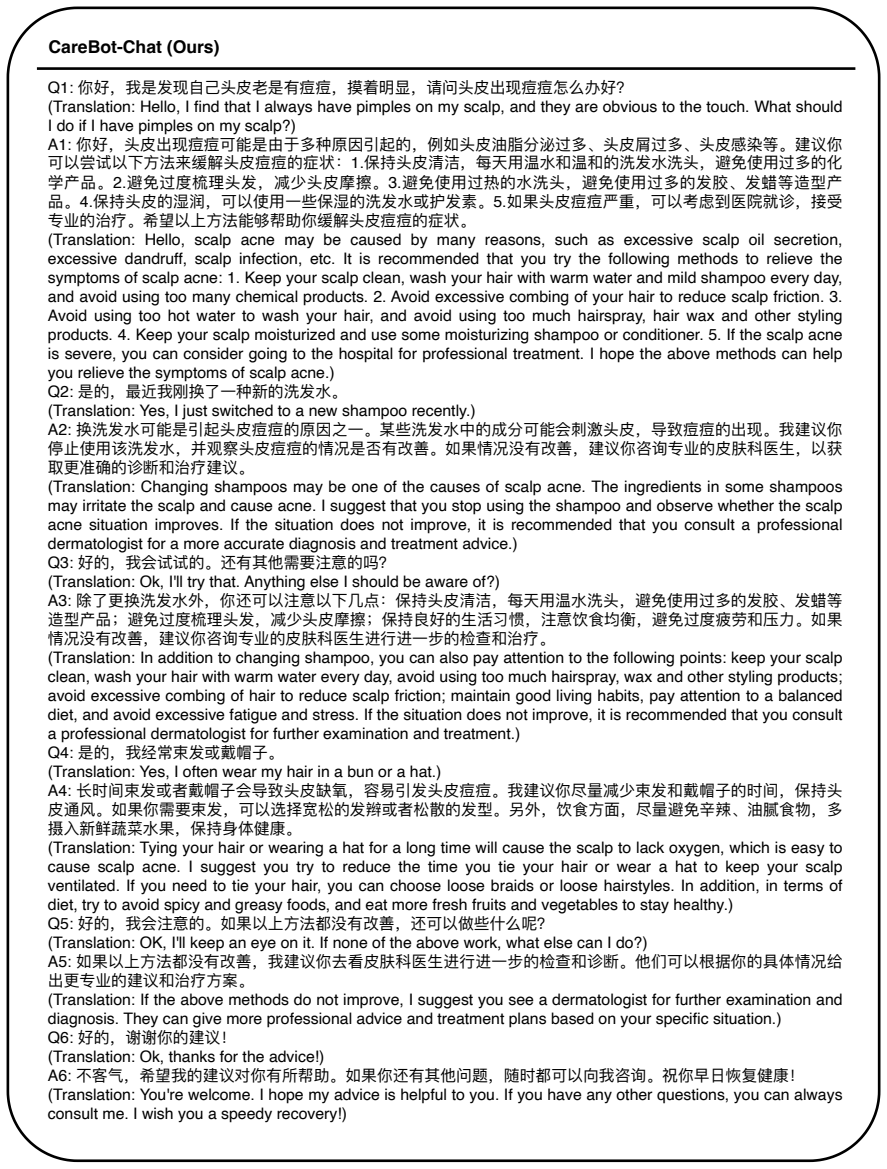
Summary. The paper proposes CareBot, a bilingual (Chinese/English) medical language model built on LLaMA-3-8B, trained with a three-stage pipeline: continuous pre-training (CPT), supervised fine-tuning (SFT), and DPO-based RLHF. The main methodological contributions are a two-stage CPT scheme (Stable CPT followed by Boost CPT), a GPT-4-trained data quality assessor called DataRater, and a multi-turn dialogue filtering metric called ConFilter. The authors evaluate CareBot on Chinese and English medical multiple-choice benchmarks (Table 1) and on single-turn and multi-turn medical consultation benchmarks (Tables 2 and 3, Figure 3), reporting that CareBot-Chat outperforms ChatGPT and the open-source medical model HuatuoGPT II on average. The paper promises to release datasets and models.
Significance. If the results are correct, CareBot would be a strong open-source bilingual medical LLM, and the training pipeline—especially the two-stage CPT and ConFilter—would be a useful recipe for domain adaptation. The paper has several genuine strengths: the core MCQ claims are benchmarked against external ground truth, the authors report a t-test for Table 1, they provide ablation-style comparisons for one-stage versus two-stage CPT and for ConFilter versus random selection, and the appendix contains substantial training and evaluation detail. However, the current evidence has important gaps: the SFT corpus overlaps with several evaluation sets without documented decontamination; Table 1 lacks a LLaMA-3-8B or plain-SFT baseline; key thresholds for Deita and ConFilter are missing; the multi-turn dialogue evaluation relies on GPT-4 as both generator and judge without human agreement; and DataRater has no downstream ablation. These gaps do not necessarily invalidate the central claim, but they are load-bearing for reproducibility and for attributing the reported gains to the proposed components.
major comments (5)
- [Supervised Fine-Tuning / Experimental Setup] The SFT corpus is described as integrating data from seven public sources, explicitly including CMB, MedQA, and Huatuo26M (Section 'Supervised Fine-Tuning', Data Construction). The same three collections are used as evaluation benchmarks in Table 1 and Figure 3 (CMB, MedQA, Huatuo26M-test). The manuscript never states that only the official training splits were used and reports no overlap check or decontamination for these sets. Because the models and datasets are not yet released, this overlap cannot be checked externally. If any test items are present in the SFT data, the reported average advantages of CareBot-Chat over HuatuoGPT II (6.69%) and ChatGPT (8.65%) in Table 1 would be partly memorization artifacts. Please document the exact splits, perform and report a decontamination analysis (e.g., n-gram overlap), or re-evaluate on held-out subsets.
- [Table 1 / One Stage CPT vs Two Stage CPT] Table 1 compares CareBot-Chat with medical LLMs and ChatGPT, but it does not report the LLaMA-3-8B base model or a plain SFT-only CareBot. Without these baselines, the gains in Table 1 cannot be attributed to the proposed CPT and data-filtering pipeline rather than to the choice of base model. In addition, Figure 4 is captioned 'Comparison of the loss between our proposed two-stage CPT and the plain CPT,' while the text of 'One Stage CPT vs Two Stage CPT' repeatedly refers to 'Acc'; if the figure plots loss, the claim of a 'marked and consistent improvement in Acc' is not directly supported. Please clarify the metric and add the missing baselines or an ablation.
- [Multi-turn Medical Dialogue Data (ConFilter)] The selection thresholds for Deita and ConFilter are never specified. The text says 'we set a score threshold' for the Deita score s_i and 'We also set a threshold' for CF in Eq. (3), but no values, normalization, or selection criterion are given. The ConFilter definition also leaves open which model computes L_theta and whether it is frozen. Without these details, the 110k-dialogue selection in Figure 5 and the multi-turn SFT pipeline cannot be reproduced, and the reported benefits of ConFilter cannot be separated from threshold choice. Please report the thresholds and, ideally, a sensitivity analysis.
- [RLHF / Results for Medical Consultation Ability] GPT-4 is used to construct the subjective DPO preference pairs (it writes the doctor-style response and judges which response is superior) and the same style of four-dimension rating (fluency, relevance, completeness, proficiency) is used to evaluate multi-turn dialogues in Tables 2 and 3. The paper reports no human agreement study on either the preference labels or the dialogue judgments. Since the preferred responses come from GPT-4, an evaluation by GPT-4 on the same dimensions risks confirming the model's own stylistic preferences rather than measuring medical quality. Please add a human evaluation on a sample of dialogues or report agreement statistics (e.g., Cohen's kappa) between GPT-4 and human raters.
- [LLM-based Data Quality Filtering] DataRater is presented as a key contribution, but the paper provides no ablation showing its effect on the final CareBot. Section 'LLM-based Data Quality Filtering' describes the 15k GPT-4-labeled training set and Appendix B reports the MSE of the learned predictor, while Figure 9 compares CPT strategies. There is no experiment that trains CareBot with and without DataRater-filtered CPT data. Without such an ablation, the claim that DataRater 'effectively mitigates data bias' and is responsible for CareBot's performance is not supported. Please add this comparison or weaken the claim accordingly.
minor comments (5)
- [Table 4] In the turn-10 row, the average for HuatuoGPT II is listed as 3.18, but the four dimension scores (4.96, 3.41, 3.47, 4.27) average to 4.03; please correct the table and re-check the other rows for the same calculation error.
- [Table 1] The t-test statement ('p<0.05 under t-test') is underspecified: no test type, comparison group, or number of observations is given; please report the test details so the significance claim can be assessed.
- [Abstract and Introduction] There are numerous typos and inconsistencies, including 'develope' in the abstract, 'pipline' in Figure 1, 'mdedical' in Appendix E, and inconsistent capitalization of 'Carebot' versus 'CareBot'; a careful proofread is needed.
- [Supervised Fine-Tuning, Data Construction] The claim that the SFT corpus is 'the largest open-source bilingual medical SFT dataset available' is not supported by any dataset statistics or a comparison with prior datasets; please provide the dataset size, topic coverage, and a quantitative comparison.
- [Availability] The paper says 'We will open-source the datasets and models later,' but the GitHub link is not yet populated; please provide an availability statement with a concrete timeline or an anonymous link for review.
Circularity Check
Multi-turn consultation scores are partly self-referential: GPT-4 supplies the DPO preference labels and the same four-dimension rubric used to grade the dialogue benchmarks; the MCQ knowledge claims are externally grounded and not circular.
-
fitted input called prediction
[RLHF (Subjective Preference Data) -> Experimental Setup (Medical Benchmark); Tables 2-3]
"Then, using GPT-4, we evaluate the superiority or inferiority of the original response and this newly generated response from the prompt. The evaluation considers four aspects: fluency, relevance, completeness, and proficiency in medical. We select the superior response as the chosen response for the dpo pair ... Consistent with Wang et al. (2024), the model’s responses are rated based on the fluency, relevance, completeness and medical proficiency of the reference answers."
The DPO training signal is GPT-4's preference on exactly the four dimensions later used to score the multi-turn consultation benchmarks. CareBot-Chat (RL) is trained to favor responses GPT-4 judged superior, and its reported consultation quality is then rated on that same fluency/relevance/completeness/proficiency rubric, with no human agreement study reported. The high dialogue scores therefore partly measure alignment with the same GPT-4 preference model that produced the training targets, rather than an independent medical-quality measurement. The MCQ results in Table 1 rest on fixed answer keys, so the circularity is partial and does not affect the knowledge-benchmark claim.
full rationale
The paper's strongest quantitative claim splits into two parts. The medical-concept-knowledge results (MedQA, MMLU-Med, CMB, CMMLU-Med, C-Eval-Med in Table 1) are scored against fixed multiple-choice answer keys, so they are independent of the paper's own quality filters and preference signals; no circular reduction is present there. The multi-turn consultation results are different: subjective DPO pairs are constructed by asking GPT-4 to generate a doctor-style response and then judging original versus generated responses on fluency, relevance, completeness, and medical proficiency, and the final multi-turn evaluation rates responses on the same four dimensions 'consistent with Wang et al. (2024).' With no human agreement study reported, the dialogue scores are partly a measurement of how well the model reproduces GPT-4's preferences, i.e., a fitted input is presented as an independent prediction of consultation quality. This is partial rather than total because held-out prompts, the SFT stage, and the external MCQ benchmarks still contribute independent evidence. I did not count the potential train/evaluation overlap (CMB, MedQA, and Huatuo26M appear both as SFT sources and as evaluation sets, and the ConFilter ablation trains on CMtMedQA while evaluating on CMtMedQA) as a circular step, because the paper does not state the split and no overlap is demonstrated; that is a contamination risk for the correctness review rather than an exhibited by-construction reduction. Self-citations (e.g., Deita/Zeng et al.) are not load-bearing, and DataRater's GPT-4-derived labels are evaluated only indirectly through external benchmarks, so they do not raise the score.
Assumptions & free parameters
free parameters (5)
- Stable CPT medical to general data ratio =
19:1
- Stable CPT Chinese to English token ratio =
1:9
- Boost CPT data ratio and Chinese to English token ratio =
1:1 data, 4:6 Chinese:English
- ConFilter threshold =
not reported
- Deita score threshold =
not reported
assumptions (4)
- domain assumption GPT-4 judgments are a valid proxy for medical text quality, domain relevance, and human preference.
- ad hoc to paper The loss ratio CF = L(t_i|H)/L(t_i) measures contextual relevance.
- domain assumption A domain classifier trained on 36k GPT-4-labeled samples with 86% validation accuracy generalizes to a 15T-token corpus.
- ad hoc to paper Small proxy-model ratio search transfers to LLaMA-3-8B.
invented entities (2)
-
DataRater
-
ConFilter
Cite this review
Pith. "Pith review of CareBot: A Pioneering Full-Process Open-Source Medical Language Model." pith.science (2026). https://pith.science/paper/PYGKKENI
@misc{pith2026241215236,
  author       = {Pith},
  title        = {Pith review of: CareBot: A Pioneering Full-Process Open-Source Medical Language Model},
  year         = {2026},
  howpublished = {\url{https://pith.science/paper/PYGKKENI}},
  note         = {Machine review of arXiv:2412.15236}
}
read the original abstract
Recently, both closed-source LLMs and open-source communities have made significant strides, outperforming humans in various general domains. However, their performance in specific professional domains such as medicine, especially within the open-source community, remains suboptimal due to the complexity of medical knowledge. In this paper, we propose CareBot, a bilingual medical LLM, which leverages a comprehensive approach integrating continuous pre-training (CPT), supervised fine-tuning (SFT), and reinforcement learning with human feedback (RLHF). Our novel two-stage CPT method, comprising Stable CPT and Boost CPT, effectively bridges the gap between general and domain-specific data, facilitating a smooth transition from pre-training to fine-tuning and enhancing domain knowledge progressively. We also introduce DataRater, a model designed to assess data quality during CPT, ensuring that the training data is both accurate and relevant. For SFT, we develope a large and diverse bilingual dataset, along with ConFilter, a metric to enhance multi-turn dialogue quality, which is crucial to improving the model's ability to handle more complex dialogues. The combination of high-quality data sources and innovative techniques significantly improves CareBot's performance across a range of medical applications. Our rigorous evaluations on Chinese and English benchmarks confirm CareBot's effectiveness in medical consultation and education. These advancements not only address current limitations in medical LLMs but also set a new standard for developing effective and reliable open-source models in the medical domain. We will open-source the datasets and models later, contributing valuable resources to the research community.
Figures


Figures from the paper (7 more)




Reference graph
Works this paper leans on
-
[1]
, " * write output.state after.block = add.period write newline
ENTRY address archivePrefix author booktitle chapter edition editor eid eprint howpublished institution isbn journal key month note number organization pages publisher school series title type volume year label extra.label sort.label short.list INTEGERS output.state before.all mid.sentence after.sentence after.block FUNCTION init.state.consts #0 'before.a...
-
[2]
write newline
" write newline "" before.all 'output.state := FUNCTION n.dashify 't := "" t empty not t #1 #1 substring "-" = t #1 #2 substring "--" = not "--" * t #2 global.max substring 't := t #1 #1 substring "-" = "-" * t #2 global.max substring 't := while if t #1 #1 substring * t #2 global.max substring 't := if while FUNCTION word.in bbl.in capitalize " " * FUNCT...
-
[3]
Chatgpt: Language models are few-shot learners
2023. Chatgpt: Language models are few-shot learners. Dublin, Ireland: Association for Computational Linguistics
work page 2023
-
[4]
Bai, Y.; Jones, A.; Ndousse, K.; Askell, A.; Chen, A.; DasSarma, N.; Drain, D.; Fort, S.; Ganguli, D.; Henighan, T.; et al. 2022. Training a helpful and harmless assistant with reinforcement learning from human feedback. arXiv preprint arXiv:2204.05862
arXiv 2022
-
[5]
Chen, J.; Wang, X.; Gao, A.; Jiang, F.; Chen, S.; Zhang, H.; Song, D.; Xie, W.; Kong, C.; Li, J.; Wan, X.; Li, H.; and Wang, B. 2023. HuatuoGPT-II, One-stage Training for Medical Adaption of LLMs. arXiv:2311.09774
arXiv 2023
-
[6]
Cheng, D.; Huang, S.; and Wei, F. 2024. Adapting Large Language Models via Reading Comprehension. In The Twelfth International Conference on Learning Representations
2024
-
[7]
Dong, G.; Yuan, H.; Lu, K.; Li, C.; Xue, M.; Liu, D.; Wang, W.; Yuan, Z.; Zhou, C.; and Zhou, J. 2023 a . How abilities in large language models are affected by supervised fine-tuning data composition. arXiv preprint arXiv:2310.05492
arXiv 2023
-
[8]
Dong, H.; Xiong, W.; Goyal, D.; Zhang, Y.; Chow, W.; Pan, R.; Diao, S.; Zhang, J.; Shum, K.; and Zhang, T. 2023 b . Raft: Reward ranked finetuning for generative foundation model alignment. arXiv preprint arXiv:2304.06767
arXiv 2023
Show all 36 references
-
[9]
C.; Papaioannou, J.-M.; Grundmann, P.; Oberhauser, T.; Löser, A.; Truhn, D.; and Bressem, K
Han, T.; Adams, L. C.; Papaioannou, J.-M.; Grundmann, P.; Oberhauser, T.; Löser, A.; Truhn, D.; and Bressem, K. K. 2023. MedAlpaca -- An Open-Source Collection of Medical Conversational AI Models and Training Data. arXiv:2304.08247
2023 arXiv
-
[10]
Hendrycks, D.; Burns, C.; Basart, S.; Zou, A.; Mazeika, M.; Song, D.; and Steinhardt, J. 2021. Measuring Massive Multitask Language Understanding. In International Conference on Learning Representations
2021
-
[11]
Huang, Y.; Bai, Y.; Zhu, Z.; Zhang, J.; Zhang, J.; Su, T.; Liu, J.; Lv, C.; Zhang, Y.; jiayi lei; Fu, Y.; Sun, M.; and He, J. 2023. C-Eval: A Multi-Level Multi-Discipline Chinese Evaluation Suite for Foundation Models. In Thirty-seventh Conference on Neural Information Process...
2023
-
[12]
Jin, D.; Pan, E.; Oufattole, N.; Weng, W.-H.; Fang, H.; and Szolovits, P. 2021. What Disease Does This Patient Have? A Large-Scale Open Domain Question Answering Dataset from Medical Exams. Applied Sciences, 11(14)
2021
-
[13]
W.; and Lu, X
Jin, Q.; Dhingra, B.; Liu, Z.; Cohen, W. W.; and Lu, X. 2019. Pubmedqa: A dataset for biomedical research question answering. arXiv preprint arXiv:1909.06146
2019 arXiv
-
[14]
Labrak, Y.; Bazoge, A.; Morin, E.; Gourraud, P.-A.; Rouvier, M.; and Dufour, R. 2024. BioMistral: A Collection of Open-Source Pretrained Large Language Models for Medical Domains. arXiv:2402.10373
2024 arXiv
-
[15]
Li, H.; Zhang, Y.; Koto, F.; Yang, Y.; Zhao, H.; Gong, Y.; Duan, N.; and Baldwin, T. 2024. CMMLU: Measuring massive multitask language understanding in Chinese. arXiv:2306.09212
2024 arXiv
-
[16]
Li, J.; Wang, X.; Wu, X.; Zhang, Z.; Xu, X.; Fu, J.; Tiwari, P.; Wan, X.; and Wang, B. 2023 a . Huatuo-26M, a Large-scale Chinese Medical QA Dataset. arXiv:2305.01526
2023 arXiv
-
[17]
Li, Y.; Li, Z.; Zhang, K.; Dan, R.; Jiang, S.; and Zhang, Y. 2023 b . ChatDoctor: A Medical Chat Model Fine-Tuned on a Large Language Model Meta-AI (LLaMA) Using Medical Domain Knowledge. arXiv:2303.14070
2023 arXiv
-
[18]
Liu, W.; Zeng, W.; He, K.; Jiang, Y.; and He, J. 2024. What Makes Good Data for Alignment? A Comprehensive Study of Automatic Data Selection in Instruction Tuning. In The Twelfth International Conference on Learning Representations
2024
-
[19]
Lu, K.; Yu, B.; Huang, F.; Fan, Y.; Lin, R.; and Zhou, C. 2024. Online Merging Optimizers for Boosting Rewards and Mitigating Tax in Alignment. arXiv preprint arXiv:2405.17931
2024 arXiv
-
[20]
K.; and Sankarasubbu, M
Pal, A.; Umapathi, L. K.; and Sankarasubbu, M. 2022. Medmcqa: A large-scale multi-subject multi-choice dataset for medical domain question answering. In Conference on health, inference, and learning, 248--260. PMLR
2022
-
[21]
D.; Ermon, S.; and Finn, C
Rafailov, R.; Sharma, A.; Mitchell, E.; Manning, C. D.; Ermon, S.; and Finn, C. 2023. Direct Preference Optimization: Your Language Model is Secretly a Reward Model. In Thirty-seventh Conference on Neural Information Processing Systems
2023
-
[22]
Raffel, C.; Shazeer, N.; Roberts, A.; Lee, K.; Narang, S.; Matena, M.; Zhou, Y.; Li, W.; and Liu, P. J. 2023. Exploring the Limits of Transfer Learning with a Unified Text-to-Text Transformer. arXiv:1910.10683
2023 arXiv
-
[23]
Sun, Z.; Shen, Y.; Zhou, Q.; Zhang, H.; Chen, Z.; Cox, D.; Yang, Y.; and Gan, C. 2024. Principle-driven self-alignment of language models from scratch with minimal human supervision. Advances in Neural Information Processing Systems, 36
2024
-
[24]
Tian, Y.; Gan, R.; Song, Y.; Zhang, J.; and Zhang, Y. 2023. ChiMed-GPT: A Chinese Medical Large Language Model with Full Training Regime and Better Alignment to Human Preferences. arXiv:2311.06025
2023 arXiv
-
[25]
Touvron, H.; Lavril, T.; Izacard, G.; Martinet, X.; Lachaux, M.-A.; Lacroix, T.; Rozière, B.; Goyal, N.; Hambro, E.; Azhar, F.; Rodriguez, A.; Joulin, A.; Grave, E.; and Lample, G. 2023 a . LLaMA: Open and Efficient Foundation Language Models. arXiv:2302.13971
2023 arXiv
-
[26]
Touvron, H.; Martin, L.; Stone, K.; Albert, P.; Almahairi, A.; Babaei, Y.; Bashlykov, N.; Batra, S.; Bhargava, P.; Bhosale, S.; Bikel, D.; Blecher, L.; Ferrer, C. C.; Chen, M.; Cucurull, G.; Esiobu, D.; Fernandes, J.; Fu, J.; Fu, W.; Fuller, B.; Gao, C.; Goswami, V.; Goyal, N....
2023 arXiv
-
[27]
Wang, X.; Chen, G.; Dingjie, S.; Zhiyi, Z.; Chen, Z.; Xiao, Q.; Chen, J.; Jiang, F.; Li, J.; Wan, X.; Wang, B.; and Li, H. 2024. CMB : A Comprehensive Medical Benchmark in C hinese. In Duh, K.; Gomez, H.; and Bethard, S., eds., Proceedings of the 2024 Conference of the North A...
2024
-
[28]
Xiong, H.; Wang, S.; Zhu, Y.; Zhao, Z.; Liu, Y.; Huang, L.; Wang, Q.; and Shen, D. 2023. DoctorGLM: Fine-tuning your Chinese Doctor is not a Herculean Task. arXiv:2304.01097
2023 arXiv
-
[29]
Yang, A.; Xiao, B.; Wang, B.; Zhang, B.; Bian, C.; Yin, C.; Lv, C.; Pan, D.; Wang, D.; Yan, D.; Yang, F.; Deng, F.; Wang, F.; Liu, F.; Ai, G.; Dong, G.; Zhao, H.; Xu, H.; Sun, H.; Zhang, H.; Liu, H.; Ji, J.; Xie, J.; Dai, J.; Fang, K.; Su, L.; Song, L.; Liu, L.; Ru, L.; Ma, L....
2023 arXiv
-
[30]
Yang, S.; Zhao, H.; Zhu, S.; Zhou, G.; Xu, H.; Jia, Y.; and Zan, H. 2023 b . Zhongjing: Enhancing the Chinese Medical Capabilities of Large Language Model through Expert Feedback and Real-world Multi-turn Dialogue. arXiv:2308.03549
2023 arXiv
-
[31]
Zeng, G.; Yang, W.; Ju, Z.; Yang, Y.; Wang, S.; Zhang, R.; Zhou, M.; Zeng, J.; Dong, X.; Zhang, R.; Fang, H.; Zhu, P.; Chen, S.; and Xie, P. 2020. M ed D ialog: Large-scale Medical Dialogue Datasets. In Webber, B.; Cohn, T.; He, Y.; and Liu, Y., eds., Proceedings of the 2020 C...
2020
-
[32]
Zeng, W.; Xu, C.; Zhao, Y.; Lou, J.-G.; and Chen, W. 2024. Automatic Instruction Evolving for Large Language Models. arXiv preprint arXiv:2406.00770
2024 arXiv
-
[33]
Zhang, H.; Chen, J.; Jiang, F.; Yu, F.; Chen, Z.; Li, J.; Chen, G.; Wu, X.; Zhang, Z.; Xiao, Q.; Wan, X.; Wang, B.; and Li, H. 2023. HuatuoGPT, towards Taming Language Model to Be a Doctor. arXiv:2305.15075
2023 arXiv
-
[34]
Zhang, K.; Zeng, S.; Hua, E.; Ding, N.; Chen, Z.-R.; Ma, Z.; Li, H.; Cui, G.; Qi, B.; Zhu, X.; Lv, X.; Jinfang, H.; Liu, Z.; and Zhou, B. 2024 a . UltraMedical: Building Specialized Generalists in Biomedicine. arXiv:2406.03949
2024 arXiv
-
[35]
Zhang, X.; Tian, C.; Yang, X.; Chen, L.; Li, Z.; and Petzold, L. R. 2024 b . AlpaCare:Instruction-tuned Large Language Models for Medical Application. arXiv:2310.14558
2024 arXiv
-
[36]
Zhou, C.; Liu, P.; Xu, P.; Iyer, S.; Sun, J.; Mao, Y.; Ma, X.; Efrat, A.; Yu, P.; YU, L.; Zhang, S.; Ghosh, G.; Lewis, M.; Zettlemoyer, L.; and Levy, O. 2023. LIMA : Less Is More for Alignment. In Thirty-seventh Conference on Neural Information Processing Systems
2023
Reviewed August 11, 2026 · model on record in the stance chip above.
Discussion (0). Continue with ORCID to comment.