REVIEW 3 major objections 7 minor 1 cited by
Limit Theorems for the Volume of Random Projections and Sections of $\ell_p^N$-balls
T0 review · 3 major / 7 minor · reviewed 2026-08-11 · deepseek-v4-flash
Pith's one-line read For every fixed dimension m and every p in (1,∞)\textbackslash{2}, the volume of a uniformly random m-dimensional projection or section of a rescaled $\ell_p^N$-ball fluctuates around an explicit constant like a Gaussian at scale…
desk verdict A rich, mostly sound paper whose stated section LDP rate function is undercut by an exponent mismatch, and whose p=1 CLT is announced but not proved. read the letter →
The pith
A machine-rendered reading of the paper's core claim, the machinery that carries it, and where it could break.
The reading
What carries the argument
The argument runs through the Stiefel manifold: a uniform $m$-subspace is the row space of a uniform element $V_N\in V_{m,N}$, and the support function of the projected ball satisfies $h(N^{1/2-1/q}V_N B_p^N,u)^q = \frac{1}{N}\sum_{i=1}^N |\langle\sqrt{N}v_i,u\rangle|^q$, where $v_i$ are the columns of $V_N$ and $q$ is the H\"older conjugate of $p$. Section volumes have an analogous representation with $p$ in place of $q$, integrated against the normalized spherical measure. A functional central limit theorem for these sums on $S^{m-1}$ is obtained by a Taylor expansion that separates the Gaussian matrix from its inverse square root, producing a Gaussian process with a covariance kernel computed in closed form from absolute moments of inner products of standard Gaussian vectors. Hadamard differentiability of the maps $f\mapsto f^\alpha$ and of the radial-function-to-volume map transfers the functional limits to the volume, while the large deviation principle is built from a Sanov-type large deviation principle for the empirical measure of the scaled columns $\sqrt{N}v_i$ together with the contraction principle.
What would settle it
Take $m=2$, $p=3$, sample many uniform 2-dimensional subspaces of $\mathbb{R}^N$ for very large $N$, and compare the empirical distribution of $\sqrt{N}(\mathrm{vol}_2(N^{1/3-1/2}(B_3^N|E_N))-\mu_\diamond)$ with $\mathcal{N}(0,\sigma_\diamond^2)$; a mismatch at the $1/\sqrt{N}$ scale would disprove the CLT.
Extended reading notes
Core claim
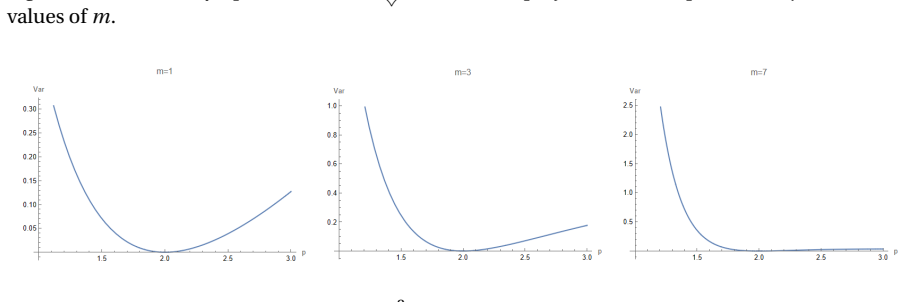
The central discovery is a fluctuation theorem: for fixed $m$ and $p\in(1,\infty)\setminus\{2\}$, the volume of a uniformly random $m$-dimensional projection or section of the rescaled ball $N^{1/p-1/2}B_p^N$ converges in distribution, after centering by an explicit $\mu_\diamond$ and scaling by $\sqrt{N}$, to a normal distribution with explicit variance $\sigma_\diamond^2$ (given in Remark 2.1). Projections include $p=\infty$ and sections include $p=1$, recovering the cube CLT with explicit normalizing constants and generalizing the hyperplane-section CLT to fixed codimension. Beyond the central limit, the paper proves a moderate deviation principle at intermediate scales and a large deviation principle at speed $N$, with rate functions expressed through a relative-entropy-plus-covariance functional on probability measures on $\mathbb{R}^m$. Together these form a complete asymptotic description of the volume of random projections and sections of $\ell_p^N$-balls.
Load-bearing premise
The entire large-deviation result rests on an imported theorem about how the empirical distribution of the columns of a random orthogonal-frame matrix concentrates, and the $p=1$ section case of the central limit theorem is stated without proof; if either gap is real, the corresponding part of the claimed picture collapses.
Editorial extensions
If this is right
- For fixed $m$ and $p\in(1,\infty)\setminus\{2\}$, volumes of random projections and sections of $N^{1/p-1/2}B_p^N$ fluctuate as $\mu_\diamond \pm \sigma_\diamond/\sqrt{N}$ to first order in distribution.
- The cube case $p=\infty$ (projections) and cross-polytope case $p=1$ (sections) are covered, so the known cube CLT is recovered with explicit variance.
- At intermediate scales $\beta_N\to\infty$, $\beta_N=o(\sqrt{N})$, the same fluctuations satisfy a moderate deviation principle with speed $\beta_N^2$ and a quadratic rate function, so Gaussian tails persist until $\beta_N$ reaches the $\sqrt{N}$ scale.
- At speed $N$, the large deviation rate function is expressed as an infimum over probability measures on $\mathbb{R}^m$, so rare events are governed by a relative-entropy-plus-covariance criterion rather than by a universal law.
- Since the limit theorems hold at the level of random functions on the sphere, continuous functionals of the support or radial function---including intrinsic volumes and dual volumes---inherit the corresponding CLT, MDP, and LDP.
Reading between the lines
- A consequence the paper leaves implicit: as the subspace dimension $m$ grows with $N$, the variance formulas degenerate in some parameter ranges, so the $\sqrt{N}$ scaling should eventually give way to a different speed; locating that transition is a natural next step.
- The same support-function representation may transfer to other convex bodies whose dual norm is a sum of one-dimensional contributions, such as Orlicz balls, yielding Gaussian fluctuations with covariance built from the same absolute-moment integrals.
- The large deviation rate function suggests a maximum-entropy picture: rare volumes are achieved by an empirical distribution of the random matrix columns that minimizes relative entropy plus a covariance penalty; this could be tested by conditionally sampling Stiefel columns under a volume constraint.
- A concrete simulation check would be to take $p=3$, $m=2$, generate many random 2-subspaces in $\mathbb{R}^N$ for large $N$, and compare the histogram of $\sqrt{N}(\mathrm{vol}-\mu_\diamond)$ with the predicted normal density; the fit should hold to Monte Carlo error.
Editorial analysis
A structured set of objections, weighed in public.
Referee Report
Summary. The paper studies fixed-dimensional random projections and sections of ℓ_p^N balls. For p∈[1,∞] and fixed m, it proves a CLT at the N^{1/2} scale (Theorem A), an MDP (Theorem B), and an LDP (Theorem C) for the volume, with explicit means, variances, speeds, and rate functions. These results are derived from functional CLT/MDP/LDP theorems for processes of the form u ↦ (1/N)∑_{i=1}^N |⟨√N v_i,u⟩|^q, where v_i are columns of a uniform Stiefel matrix (Theorems 2.2–2.4), followed by Hadamard-differentiable maps to the volume and contraction/delta-method arguments. The paper also proves almost-sure approximation of the projected/sectioned bodies by Euclidean balls.
Significance. If the main theorems hold, the paper provides a complete asymptotic picture for fixed-dimensional random projections and sections of ℓ_p balls, generalizing the cube-projection CLT of Paouris–Pivovarov–Zinn and the section results of Adamczak–Pivovarov–Simanjuntak, and giving explicit non-universal rate functions. The proof strategy is coherent and the paper contains detailed moment computations (Lemmas 4.7–4.9) that support the explicit constants. There are no fitted parameters. However, the LDP for sections has an exponent mismatch that affects a main theorem, and the statement and proof of the functional LDP Theorem 2.4 are inconsistent; these issues are locally fixable but must be corrected.
major comments (3)
- [Theorem C (Section 2.1); proof in Section 4.7] The LDP for sections in Theorem C is not justified as stated. For ♦=∩ the paper takes p∈[1,2), so the Hölder conjugate q=p/(p−1) lies in (2,∞], while the functional LDP (Theorem 2.4) and the Sanov-type lemma (Lemma 4.13) are proved only for exponents in [1,2) (Lemma 4.13 states 0<q<2). Moreover, Lemma 4.4 represents the section volume through the p-th power average X_N(u)=(1/N)∑_{i=1}^N |⟨√N v_i,u⟩|^p, not through the q-th power. Therefore the contraction principle can only produce a section LDP whose rate function is defined via F^p_k(µ)=∫|<x,u>|^p dµ, not via the displayed F_k with exponent q. The proof in Section 4.7 does not address this discrepancy, so the section case of Theorem C is internally inconsistent as written.
- [Theorem 2.4 (statement vs. proof in Section 4.6)] The statement of Theorem 2.4 and its proof disagree on the rate function. The theorem states I'_LDP(f)=sup_k inf{I_Stiefel(µ): (f^q(u1),...,f^q(uk))=F_k(µ)}, but the proof in Section 4.6 derives the rate with the condition F^(k)(µ)=(f(u1),...,f(uk)). Since X_N(u_i)=∫|<x,u_i>|^q dL_N(x)=F^(k)(L_N)_i, the proof's version is the correct rate for the LDP of X_N. As printed, the theorem's rate function is the rate for the q-th root of X_N, not for X_N itself. This inconsistency propagates to Theorem C: in the projection case, h^q=X_N, so under the proof's convention the contraction should use I'_LDP(h^q) rather than I'_LDP(h). The authors should adopt one convention consistently in the statement, proof, and applications.
- [Theorem A; Lemma 4.4; Theorem C] Theorem A explicitly extends the section case to p=1, but the proof does not cover this value. The volume representation in Lemma 4.4 is stated only for p∈(1,∞], and the proof of Theorem A in Section 4.7 invokes this lemma for the section case. Since p=1 is included in Theorem A and also in Theorem C for sections, either Lemma 4.4 must be extended to p=1 (the argument appears to work with minor changes, using Theorem 2.2 with exponent p=1 rather than q=∞) or a separate proof must be supplied. As written, this is a gap in a stated part of a main theorem.
minor comments (7)
- [Section 3.3] The section heading contains a typo: 'Brackground' should be 'Background'.
- [Introduction, paragraph 3] 'Its is immediate from the discussion above' should read 'It is immediate from the discussion above'.
- [Section 2.1, definition of ♦] The phrase 'the symbol stands for for an orthogonal projection or a section' contains a duplicated 'for'.
- [Theorem C, definition of I^∩_LDP] The constraint in the section case is written as ∫_{S^{m-1}} f^{-k/p}(t)dt = x, but the dimension parameter k is not defined there; it should presumably be m, so that the integral matches the representation in Lemma 4.4.
- [Remark 2.1, formula for σ^2_∩] The typeset formula for σ^2_∩ appears garbled, particularly the expression 'mπ(pm +m)/p'; please check the exponent and typeset the formula so that it matches the derivation at the end of the proof of Theorem A.
- [Proof of Theorem 2.4, definition of F^(k)] In the proof of Theorem 2.4, the displayed definition of F^(k)(µ) has |⟨√N v_i,u_j⟩|^q inside the integral with respect to µ(dx); it should be |⟨x,u_j⟩|^q.
- [Lemma 4.10] In the last display of the proof of Lemma 4.10, the factor ∥x_i∥^q should be ∥x_i∥^{q-1} to match the Lipschitz estimate in the statement.
Circularity Check
No circularity: the constants and rate functions are computed from stated integrals and an external Sanov-type theorem, not fitted or self-referential.
full rationale
The paper's derivation chain is self-contained against external benchmarks. The CLT and MDP proofs build functional limit theorems for sums over Stiefel-manifold columns via a Gaussian matrix decomposition, a Taylor expansion, and the delta method, with the asymptotic mean and variance evaluated from explicit moment integrals in Lemmas 4.7-4.9; no parameter is fitted to data and no quantity is defined in terms of the target limit. The LDP imports the Sanov-type empirical-measure LDP from Kim and Ramanan [52, Theorem 2.8] as an external theorem, the authors of which do not overlap with the present paper, and the rate function I_Stiefel is not derived from the volume result being proved. The self-citations in the paper are contextual or complementary and are not load-bearing for the main derivations, which are proved in the text. The reviewer-flagged concern that the section-case LDP in Theorem C uses an exponent q>2 outside the range of the imported Stiefel LDP is a correctness or foundational issue about the applicability of an external result, not a circularity: it does not make the conclusion equivalent to its input by construction. Similarly, the black-box reliance on [52] is a support risk, not a circular step.
Assumptions & free parameters
assumptions (3)
- domain assumption Sanov-type LDP for empirical measures of columns of random Stiefel matrices (Lemma 4.13, cited from [52, Theorem 2.8]) with rate I_Stiefel(nu) = H(nu|gamma^otimes m) + (1/2) Trace(Id_m - C(nu)).
- standard math Gaussian representation of uniform Stiefel columns: v_i = (G_N G_N^*)^{-1/2} g_i for a standard Gaussian matrix G_N.
- standard math Volume representation of a convex body from its radial function: vol_m(C) = kappa_m integral over S^{m-1} of rho(C,u)^m sigma(du).
Cite this review
Pith. "Pith review of Limit Theorems for the Volume of Random Projections and Sections of $\ell_p^N$-balls." pith.science (2026). https://pith.science/paper/2BPHMNGS
@misc{pith2026241216054,
  author       = {Pith},
  title        = {Pith review of: Limit Theorems for the Volume of Random Projections and Sections of $\ell_p^N$-balls},
  year         = {2026},
  howpublished = {\url{https://pith.science/paper/2BPHMNGS}},
  note         = {Machine review of arXiv:2412.16054}
}
abstract
Let $\mathbb{B}_p^N$ be the $N$-dimensional unit ball corresponding to the $\ell_p$-norm. For each $N\in\mathbb N$ we sample a uniform random subspace $E_N$ of fixed dimension $m\in\mathbb{N}$ and consider the volume of $\mathbb{B}_p^N$ projected onto $E_N$ or intersected with $E_N$. We also consider geometric quantities other than the volume such as the intrinsic volumes or the dual volumes. In this setting we prove central limit theorems, moderate deviation principles, and large deviation principles as $N\to\infty$. Our results provide a complete asymptotic picture. In particular, they generalize and complement a result of Paouris, Pivovarov, and Zinn [A central limit theorem for projections of the cube, Probab. Theory Related Fields. 159 (2014), 701-719] and another result of Adamczak, Pivovarov, and Simanjuntak [Limit theorems for the volumes of small codimensional random sections of $\ell_p^n$-balls, Ann. Probab. 52 (2024), 93-126].
Figures


Figures from the paper (1 more)

Forward citations
Cited by 1 Pith paper
-
Strange shadows of $\ell_p$-balls
Random projections of ℓ_p-balls satisfy a large deviations principle whose rate function is finite only on L_q-zonoids and given by a maximum entropy gap, with almost sure convergence to a Euclidean ball.
Reference graph
Works this paper leans on
-
[52]
S. S. Kim and K. Ramanan. Large deviation principles induced by the Stiefel manifold, and random multidimensional projections. Electron. J. Probab., 28:23, 2023. Id/No 169
work page 2023
-
[1]
NIST Handbook of Mathematical Functions. pages xvi+951, 2010. With 1 CD-ROM (Windows, Macintosh and UNIX)
work page 2010
-
[2]
R. Adamczak, P . Pivovarov, and P . Simanjuntak. Limit theorems for the volumes of small codi- mensional random sections of ℓn p-balls. Ann. Probab., 52(1):93–126, 2024
work page 2024
-
[3]
D. Alonso-Gutiérrez. On the isotropy constant of random convex sets. Proc. Am. Math. Soc. , 136(9):3293–3300, 2008
work page 2008
-
[4]
D. Alonso-Gutiérrez, J. Prochno, and C. Thäle. Large deviations for high-dimensional random projections of ℓn p-balls. Advances in Applied Mathematics, 99:1–35, 2018
work page 2018
-
[5]
D. Alonso-Gutiérrez, J. Prochno, and C. Thäle. Gaussian fluctuations for high-dimensional ran- dom projections of ℓn p-balls. Bernoulli, 25(4A):3139–3174, 2019
work page 2019
-
[6]
D. Alonso-Gutiérrez, J. Prochno, and C. Thäle. Large deviations, moderate deviations, and the KLS conjecture. J. Funct. Anal., 280(1):33, 2021. Id/No 108779
work page 2021
-
[7]
S. Artstein-Avidan, A. Giannopoulos, and V . D. Milman.Asymptotic geometric analysis. I, volume 202 of Math. Surv. Monogr .Providence, RI: American Mathematical Society (AMS), 2015
work page 2015
Show all 79 references
-
[8]
Aubrun and S
G. Aubrun and S. Szarek. Alice and Bob meet Banach, volume 223 of Mathematical Surveys and Monographs. American Mathematical Society, Providence, RI, 2017. The interface of asymptotic geometric analysis and quantum information theory
2017
-
[9]
R. R. Bahadur and S. L. Zabell. Large deviations of the sample mean in general vector spaces. Ann. Probab., pages 587–621, 1979
1979
-
[10]
Bárány and V
I. Bárány and V . Vu. Central limit theorems for Gaussian polytopes. Ann. Probab., 35(4):1593– 1621, 2007. 34
2007
-
[11]
Barthe and P
F . Barthe and P . Wolff. Volume properties of high-dimensional Orlicz balls. InHigh dimensional probability IX. The ethereal volume. Selected papers based on the presentations at the 9th confer- ence, virtual, June 15–19, 2020, pages 75–95. Cham: Springer, 2023
2020
-
[12]
Probability, volume 7 of classics in applied mathematics
Leo Breiman. Probability, volume 7 of classics in applied mathematics. Society for Industrial and Applied Mathematics (SIAM), Philadelphia, PA, 2:6, 1992
1992
-
[13]
Chafaï, O
D. Chafaï, O. Guédon, G. Lecué, and A. Pajor. Interactions between compressed sensing random matrices and high-dimensional geometry , volume 37 of Panor . Synth.Paris: Société Mathéma- tique de France (SMF), 2012
2012
-
[14]
Chasapis, P
G. Chasapis, P . Nayar, and T . Tkocz. Slicing ℓp-balls reloaded: stability, planar sections in ℓ1. Ann. Probab., 50(6):2344–2372, 2022
2022
-
[15]
Y. Chen. An almost constant lower bound of the isoperimetric coefficient in the KLS conjecture. Geom. Funct. Anal., 31(1):34–61, 2021
2021
-
[16]
P . R. Chernoff. A simple proof of Tychonoff’ s theorem via nets.American Mathematical Monthly, 99(10):932–934, 1992
1992
-
[17]
Dadoun, M
B. Dadoun, M. Fradelizi, O. Guédon, and P .-A. Zitt. Asymptotics of the inertia moments and the variance conjecture in Schatten balls. J. Funct. Anal., 284(2):32, 2023. Id/No 109741
2023
-
[18]
D. A. Dawsont and J. Gärtner. Large deviations from the mckean-vlasov limit for weakly inter- acting diffusions. Stochastics: An International Journal of Probability and Stochastic Processes , 20(4):247–308, 1987
1987
-
[19]
Del Moral and A
P . Del Moral and A. Niclas. A Taylor expansion of the square root matrix function. Journal of Mathematical Analysis and Applications, 465(1):259–266, 2018
2018
-
[20]
Dembo and O
A. Dembo and O. Zeitouni. Large deviations techniques and applications. , volume 38 of Stoch. Model. Appl. Probab. Berlin: Springer, 2nd ed., corrected 2nd printing edition, 2010
2010
-
[21]
R. Eldan. Thin shell implies spectral gap up to polylog via a stochastic localization scheme. Geom. Funct. Anal., 23(2):532–569, 2013
2013
-
[22]
Eldan and O
R. Eldan and O. Shamir. The power of depth for feedforward neural networks. In Vitaly Feldman, Alexander Rakhlin, and Ohad Shamir, editors, 29th Annual Conference on Learning Theory, vol- ume 49 of Proceedings of Machine Learning Research, pages 907–940, Columbia University, N...
2016
-
[23]
Figiel, J
T . Figiel, J. Lindenstrauss, and V . D. Milman. The dimension of almost spherical sections of convex bodies. Acta Mathematica, 139:53 – 94, 1977
1977
-
[24]
G. B. Folland. Higher-order derivatives and Taylor’ s formula in several variables.Preprint, pages 1–4, 2005
2005
-
[25]
Foucart and H
S. Foucart and H. Rauhut. A mathematical introduction to compressive sensing . Appl. Numer. Harmon. Anal. New York, NY: Birkhäuser/Springer, 2013
2013
-
[26]
Frühwirth and J
L. Frühwirth and J. Prochno. Sanov-type large deviations and conditional limit theorems for high-dimensional Orlicz balls. J. Math. Anal. Appl., 536(1):25, 2024. Id/No 128169
2024
-
[27]
Gantert, S
N. Gantert, S. S. Kim, and K. Ramanan. Cramér’ s theorem is atypical. In Advances in the math- ematical sciences. Research from the 2015 association for women in mathematics symposium, University of Maryland, College Park, MD, USA, pages 253–270. Cham: Springer, 2016. 35
2015
-
[28]
Gantert, S
N. Gantert, S. S. Kim, and K. Ramanan. Large deviations for random projections ofℓp balls. Ann. Probab., 45(6B):4419–4476, 2017
2017
-
[29]
Gao and X
F . Gao and X. Zhao. Delta method in large deviations and moderate deviations for estimators. Ann. Stat., 39(2):1211–1240, 2011
2011
-
[30]
E. Giné. On the central limit theorem for sample continuous processes. Ann. Probab., 2:629–641, 1974
1974
-
[31]
Hinrichs, D
A. Hinrichs, D. Krieg, E. Novak, J. Prochno, and M. Ullrich. Random sections of ellipsoids and the power of random information. Trans. Am. Math. Soc., 374(12):8691–8713, 2021
2021
-
[32]
Hinrichs, J
A. Hinrichs, J. Prochno, and M. Ullrich. The curse of dimensionality for numerical integration on general domains. J. Complexity, 50:25–42, 2019
2019
-
[33]
Hu and T .-Y
Y. Hu and T .-Y. Lee. Moderate deviation principles for trajectories of sums of independent Banach space valued random variables. Transactions of the American Mathematical Society , 355(8):3047–3064, 2003
2003
-
[34]
D. Hug, G. Last, and M. Schulte. Second-order properties and central limit theorems for geo- metric functionals of Boolean models. Ann. Appl. Probab., 26(1):73–135, 2016
2016
-
[35]
Hug and M
D. Hug and M. Reitzner. Gaussian polytopes: variances and limit theorems. Adv. Appl. Probab., 37(2):297–320, 2005
2005
-
[36]
Johnston and J
S. Johnston and J. Prochno. Berry-Esseen bounds for random projections of ℓn p-balls. Studia Math., 266(3):291–322, 2022
2022
-
[37]
S. G. G. Johnston and J. Prochno. A Maxwell principle for generalized Orlicz balls. Ann. Inst. Henri Poincaré, Probab. Stat., 59(3):1223–1247, 2023
2023
-
[38]
Juhos, Z
M. Juhos, Z. Kabluchko, and J. Prochno. Asymptotic theory of Schatten classes. Preprint, arXiv:2404.07145 [math.FA] (2024), 2024
2024 arXiv
-
[39]
Kabluchko and J
Z. Kabluchko and J. Prochno. The maximum entropy principle and volumetric properties of Orlicz balls. J. Math. Anal. Appl., 495(1):19, 2021. Id/No 124687
2021
-
[40]
Kabluchko, J
Z. Kabluchko, J. Prochno, and M. Sonnleitner. A probabilistic approach to Lorentz balls ℓn q,1. J. Funct. Anal., 288(1):32, 2025. Id/No 110682
2025
-
[41]
Kabluchko, J
Z. Kabluchko, J. Prochno, and C. Thäle. High-dimensional limit theorems for random vectors in ℓn p-balls. Communications in Contemporary Mathematics, 21(01):1750092, 2019
2019
-
[42]
Kabluchko, J
Z. Kabluchko, J. Prochno, and C. Thäle. Exact asymptotic volume and volume ratio of Schatten unit balls. J. Approx. Theory, 257:12, 2020. Id/No 105457
2020
-
[43]
Kabluchko, J
Z. Kabluchko, J. Prochno, and C. Thäle. Sanov-type large deviations in Schatten classes. Ann. Inst. Henri Poincaré, Probab. Stat., 56(2):928–953, 2020
2020
-
[44]
Kabluchko, J
Z. Kabluchko, J. Prochno, and C. Thäle. High-dimensional limit theorems for random vectors in ℓn p-balls. II. Commun. Contemp. Math., 23(3):35, 2021. Id/No 1950073
2021
-
[45]
Kabluchko, J
Z. Kabluchko, J. Prochno, and C. Thäle. A new look at random projections of the cube and general product measures. Bernoulli, 27(3):2117–2138, 2021
2021
-
[46]
Kallenberg
O. Kallenberg. Foundations of modern probability, volume 2. Springer, 1997. 36
1997
-
[47]
Kaufmann
T . Kaufmann. Sharp asymptotics for q-norms of random vectors in high-dimensional ℓn p-balls. Mod. Stoch., Theory Appl., 8(2):239–274, 2021
2021
-
[48]
Kaufmann and C
T . Kaufmann and C. Thäle. Weighted p-radial distributions on euclidean and matrix p-balls with applications to large deviations. J. Math. Anal. Appl., 515(1):41, 2022. Id/No 126377
2022
-
[49]
J. L. Kelley. General topology. Courier Dover Publications, 2017
2017
-
[50]
S. S. Kim, Y.-T . Liao, and K. Ramanan. An asymptotic thin shell condition and large deviations for random multidimensional projections. Adv. Appl. Math., 134:64, 2022. Id/No 102306
2022
-
[51]
S. S. Kim and K. Ramanan. A conditional limit theorem for high-dimensional ℓp-spheres. J. Appl. Probab., 55(4):1060–1077, 2018
2018
-
[53]
B. Klartag. A central limit theorem for convex sets. Invent. Math., 168(1):91–131, 2007
2007
-
[54]
Klartag and J
B. Klartag and J. Lehec. Bourgain’ s slicing problem and KLS isoperimetry up to polylog. Geom. Funct. Anal., 32(5):1134–1159, 2022
2022
-
[55]
Klartag and J
B. Klartag and J. Lehec. Affirmative resolution of Bourgain’ s slicing problem using Guan’ s bound. Preprint, arXiv:2412.15044 [math.MG] (2024), 2024
2024 arXiv
-
[56]
Koldobsky and M
A. Koldobsky and M. Lifshits. Average volume of sections of star bodies. In Geometric Aspects of Functional Analysis: Israel Seminar 1996–2000, pages 119–146. Springer, 2000
1996
-
[57]
Ledoux and M
M. Ledoux and M. Talagrand. Probability in Banach Spaces: isoperimetry and processes. Springer Science & Business Media, 2013
2013
-
[58]
Y. T . Lee and S. S. Vempala. Eldan’ s stochastic localization and the KLS conjecture: Isoperimetry, concentration and mixing. Annals of Mathematics, 199(3):1043 – 1092, 2024
2024
-
[59]
Liao and K
Y.-T . Liao and K. Ramanan. Geometric sharp large deviations for random projections of ℓn p spheres and balls. Electron. J. Probab., 29:56, 2024. Id/No 1
2024
-
[60]
Lopatto, K
P . Lopatto, K. Ramanan, and X. Xie. Quenched large deviation principles for random projections of ℓp n balls. Preprint, arXiv:2308.00649 [math.PR] (2023), 2023
2023 arXiv
-
[61]
J. R. Magnus and H. Neudecker. Matrix differential calculus with applications in statistics and econometrics. John Wiley & Sons, 2019
2019
-
[62]
Mendelson and P
S. Mendelson and P . Philips. On the importance of small coordinate projections.J. Mach. Learn. Res., 5:219–238, 2004
2004
-
[63]
Mendelson and A
S. Mendelson and A. J. Smola, editors. Advanced lectures on machine learning. Machine learning summer school 2002, Canberra, Australia, February 11–22, 2002. Revised lectures , volume 2600 of Lect. Notes Comput. Sci. Berlin: Springer, 2003
2002
-
[64]
Nayar and T
P . Nayar and T . Tkocz. On a convexity property of sections of the cross-polytope. Proc. Amer . Math. Soc., 148(3):1271–1278, 2020
2020
-
[65]
Paouris and P
G. Paouris and P . Pivovarov. Small-ball probabilities for the volume of random convex sets.Dis- crete & Computational Geometry, 49:601–646, 2013. 37
2013
-
[66]
Paouris, P
G. Paouris, P . Pivovarov, and J. Zinn. A central limit theorem for projections of the cube.Probab. Theory Relat. Fields, 159(3-4):701–719, 2014
2014
-
[67]
J. Prochno. The large and moderate deviations approach in geometric functional analysis. arXiv e-prints, page arXiv:2403.03940, March 2024
2024 arXiv
-
[68]
Qingyang
G. Qingyang. A note on Bourgain’ s slicing problem. Preprint, arXiv:2412.09075 [math.MG] (2024), 2024
2024 arXiv
-
[69]
Reitzner
M. Reitzner. Central limit theorems for random polytopes. Probab. Theory Relat. Fields , 133(4):483–507, 2005
2005
-
[70]
Roemisch
W . Roemisch. Delta method, infinite dimensional. In Encyclopedia of Statistical Sciences. John Wiley & Sons, 2006
2006
-
[71]
Schechtman and M
G. Schechtman and M. Schmuckenschläger. Another remark on the volume of the intersection of two ℓn p balls. In Geometric aspects of functional analysis. Proceedings of the Israel seminar (GAFA) 1989-90, pages 174–178. Berlin etc.: Springer-Verlag, 1991
1989
-
[72]
Schmuckenschläger
M. Schmuckenschläger. CLT and the volume of intersections of ℓn p-balls. Geom. Dedicata, 85(1- 3):189–195, 2001
2001
-
[73]
Schneider
R. Schneider. Convex Bodies: The Brunn–Minkowski Theory. Encyclopedia of Mathematics and its Applications. Cambridge University Press, 2 edition, 2013
2013
-
[74]
Schneider and W
R. Schneider and W . Weil. Stochastic and Integral Geometry . Probability and its Applications (New York). Springer-Verlag, Berlin, 2008
2008
-
[75]
Sonnleitner and C
M. Sonnleitner and C. Thäle. A note on critical intersections of classical and Schatten p-balls. Preprint, arXiv:2308.10635 [math.PR] (2023), 2023
2023 arXiv
-
[76]
Turchi and F
N. Turchi and F . Wespi. Limit theorems for random polytopes with vertices on convex surfaces. Adv. Appl. Probab., 50(4):1227–1245, 2018
2018
-
[77]
Vershynin
R. Vershynin. High-dimensional probability. An introduction with applications in data science , volume 47 of Camb. Ser . Stat. Probab. Math.Cambridge: Cambridge University Press, 2018
2018
-
[78]
Richard A. Vitale. Symmetric statistics and random shape. Probability theory and applications, Proc. World Congr. Bernoulli Soc., Tashkent/USSR 1986, Vol. 1, 595-600 (1987)., 1987
1987
-
[79]
Winkelbauer
A. Winkelbauer. Moments and absolute moments of the normal distribution. arXiv preprint arXiv:1209.4340, 2012. JOSCHA PROCHNO : Faculty of Computer Science and Mathematics, University of Passau, Dr.-Hans-Kapfinger- Str. 30, 94032 Passau, Germany E-mail: joscha.prochno@uni-pass...
2012 arXiv
Reviewed August 11, 2026 · model on record in the stance chip above.
Discussion (0). Continue with ORCID to comment.