Explicit conditions decide which case applies to any given isosceles triangle.
abstractclick to expand
We consider the problem of optimizing the product of the distances from a given point in a triangle to each vertex. There are two possible cases in general. For isosceles triangles, we explicitly show exactly when both cases occur.
Each self-similar dendrite K with a finite self-similar boundary defines a finite acyclic edge-labeled bipartite graph G, called the sprout of K. The paper shows that the sprout G determines the combinatorial properties of the dendrite K and its topological structure.
Absolute constants control p-moment growth by sqrt(p) for at least 90 percent of orthonormal directions, with no dependence on dimension.
abstractclick to expand
Let $K \subset \mathbb{R}^n$ be a centered convex body of volume one. We prove that there exist absolute constants $c,C > 0$ and an orthonormal set of vectors $\Theta \subset S^{n-1}$ with size $\left|\Theta\right| \ge 9n/10$ such that, if $X$ is a random vector uniformly distributed on $K$, then for all $\theta \in \Theta$ one has \[
c\cdot \sqrt{p}\,\left(\mathbb{E} \left|\left\langle X,\theta \right\rangle\right|^2\right)^{1/2}
\le
\left(\mathbb{E} \left|\left\langle X,\theta \right\rangle\right|^p\right)^{1/p}
\le
C\cdot \sqrt{p}\,\left(\mathbb{E} \left|\left\langle X,\theta \right\rangle\right|^2\right)^{1/2}, \] where the upper estimate holds for all $p \ge 1$ while the lower bound only holds for $1 \le p \le n$.
We introduce the observable Wasserstein distance, a framework for deriving lower bounds on the Wasserstein distance between probability measures on Polish metric spaces, designed to bypass the computational intractability of exact optimal transport in large-scale, non-Euclidean datasets. Analogous to the sliced Wasserstein distance in $\mathbb{R}^d$, our approach projects measures onto the real line via 1-Lipschitz observables and computes the Wasserstein distances between the resulting pushforward distributions. We define a hierarchy of pseudo-metrics by restricting observables to a nested chain of subspaces. A central theoretical contribution is an injectivity result linking the metric covering dimension of the support of a measure to the specific order in the hierarchy that guarantees unique recovery. This serves as a metric-space analogue to the Cram\'{e}r-Wold Device for Euclidean distributions. We demonstrate that this hierarchy offers a tunable trade-off between sharpness as a lower bound on the Wasserstein distance and computational efficiency. We also present a discrete computational model for finite grids and numerical experiments validating the efficacy and utility of these approximations.
We prove that a convex polytope $P \subset \mathbb{R}^d$, $d \ge 2$, of uniform density $\delta \in (0,1)$ floating in a liquid of density $1$, is uniquely determined by its surface of flotation $P_{[\delta]}$ whenever $\delta \neq \tfrac{1}{2}$. Analogously, we show that the buoyancy surface $\mathcal{C}_\delta P$ of a convex polytope $P$ with prescribed density $\delta \in (0,1)$ uniquely determines $P$.
The non-symmetric Mahler conjecture is proved in three dimensions with a sharp constant.
abstractclick to expand
We prove the non-symmetric Mahler conjecture in dimension three. More precisely, we prove the sharp lower bound \[ \mathcal P(K) \geq \frac{64}{9} \] for every convex body $K \subset \mathbb R^3$, where $\mathcal P(K)$ denotes the non-symmetric volume product with respect to the Santal\'o point.
Controlling maps that fix causal-diamond diameters deliver the inequality plus a covering lemma in pre-length spaces
abstractclick to expand
In this article, we introduce the notion of locally uniformly d-controlling map between Lorentzian pre-length spaces which is preserving the diameters of causal diamonds, and through that we establish the coarea inequality for Lorentzian Hausdorff measure which is introduced by McCann and S\"{a}mann. Besides that we get a covering lemma for subsets in a Lorentzian pre-length space with a new local assumption named the local causal enlargement property, which enables us to enlarge causal diamonds.
Complete solutions for k=3 and k=4 plus proof that any k works when n is large enough and nk even.
abstractclick to expand
We investigate the existence of closed polylines (also known as closed polygonal chains or self-crossing polygons) that intersect each of their edges the same number of times. The most general question in this corner of combinatorial geometry asks for all pairs $(n, k)$ such that there exists a closed polyline with $n$ edges, each intersecting the same polyline exactly $k$ times. For $k = 1$ and $k = 2$, this is a very simple question answered several decades ago. In this article, we present a complete solution for $k = 3$ and $k = 4$, as well as the proof of some non-existence theorems. In conclusion, we show that, for an arbitrary positive integer $k$, a polyline of the required type exists for any sufficiently large integer $n$ such that $nk$ is even.
The parity condition that nk must be even is necessary and becomes sufficient for all n beyond a k-dependent bound, with full solutions when
abstractclick to expand
We investigate the existence of closed polylines (also known as closed polygonal chains or self-crossing polygons) that intersect each of their edges the same number of times. The most general question in this corner of combinatorial geometry asks for all pairs $(n, k)$ such that there exists a closed polyline with $n$ edges, each intersecting the same polyline exactly $k$ times. For $k = 1$ and $k = 2$, this is a very simple question answered several decades ago. In this article, we present a complete solution for $k = 3$ and $k = 4$, as well as the proof of some non-existence theorems. In conclusion, we show that, for an arbitrary positive integer $k$, a polyline of the required type exists for any sufficiently large integer $n$ such that $nk$ is even.
Let $K$ be a convex body in an affine chart of the $n$ dimensional real Projective space $\mathbb{RP}^n$, $n \geq 3$, let $H$ be a hyperplane which is not a support hyperplane of $K$ and let $p_1,p_2 \in \mathbb{RP}^n \setminus H$ be two distinct interior points of $K$. In this work we prove that if for every $(n-2)$-plane $l \subset H$, there exists a harmonic homology, with plane $G$ and center $\tau$, such that $l\subset G$, $\tau \in H$ and which maps the hypersection of $K$ defined by aff$\{p_1, l\}$ onto the hypersection of $K$ defined by aff$\{p_2, l\}$, then $K$ is an ellipsoid.
We prove that for any self-affine dendrite K generated by a polygonal system, there are constants C>0 and $\lambda\in(0, 1)$ such that for any x, y in K, the Jordan arc $\gamma$ in K with endpoints x, y satisfies the inequality $diam({\gamma})\le C |x-y|^\lambda$.
The invariant tracks length alone, while diversity measures concentrate on leaves and ignore branch points.
abstractclick to expand
We compute the magnitude (an isometric invariant of metric spaces) of compact $\mathbb{R}$-trees and show that it equals $1 + L/2$, where $L \in [0, \infty]$ denotes the total length. Although length is the only geometric invariant captured by magnitude, we show that diversity-maximizing measures on compact $\mathbb{R}$-trees are more sensitive to the branching structure as they tend to be more concentrated toward the leaves: their support contains no branch points. In the finite case, we further show that maximum diversity on a weighted tree can be computed in polynomial time.
The inequality for symmetric convex sets follows from a bound linear in dimension on the gradient of the log-density.
abstractclick to expand
We study the dimensional Brunn-Minkowski inequality for even log-concave probability measures $\mu$ on $\mathbb{R}^n$ via an analytic approach based on diffusion operators and gradient estimates. Our main result asserts that for every pair of symmetric convex sets $K,L$ in $\mathbb{R}^n$ and every $\lambda\in(0,1)$, $$\mu(\lambda K+(1-\lambda)L)^{c_n} \geq \lambda \mu(K)^{c_n}+(1-\lambda)\mu(L)^{c_n},$$ where $c_n\geq c/n^3\ln n$ for some absolute constant $c>0$. A key ingredient in our proof is the bound $$\int_{\mathbb{R}^n} |\nabla\psi|\,d\mu \leq Cn$$ that we establish for isotropic log-concave probability measures $\mu$ on $\mathbb{R}^n$ with density $e^{-\psi}$, which is optimal in terms of the dimension. This estimate yields structural information on the size of sub-level sets of the gradient of $\psi$ and puts forth a geometric obstruction to further improvements of the Brunn-Minkowski exponent. We also present applications of this estimate to the weighted perimeter of level sets, projections, moment and surface area measures of isotropic log-concave functions, highlighting the central role of the gradient of the logarithmic potential in high-dimensional convexity.
Although the Sierpi\'nski triangle has planar area $0$, it is uniformly non-flat: at every point and every scale, its nearby points span a two-dimensional region of comparable size. We prove a sharp version of this statement, showing that the Feng--Wu thickness of $E$ is exactly $\sqrt{3}/6$, the inradius of a unit equilateral triangle. More precisely, if $E$ is the standard Sierpi\'nski triangle of side length $1$ and $B(x,r)$ denotes the closed disk of radius $r$ centered at $x$, then for every $x\in E$ and every $0<r\le 1$, the convex hull of $E\cap B(x,r)$ contains an equilateral triangle of side length $r$. Consequently, $\operatorname{conv}(E\cap B(x,r))$ contains a closed disk of radius $(\sqrt{3}/6)r$; this constant is best possible. The proof is elementary -- boundary edges of all construction triangles survive in the limit set, and self-similarity reduces the problem to the normalized range $1/2\le r\le 1$.
We prove that if $C$ is a symmetric convex body of revolution in $\mathbb R^4$ containing the unit Euclidean ball $\mathbb B_4$, such that the sections of $C$ by hyperplanes tangent to $\mathbb B_4$ have constant area $A>0$, then $C$ is a Euclidean ball, provided $\frac 1{\pi} \arctan((\frac{3A}{4\pi})^{1/3})$ satisfies certain arithmetic properties that can be read from its expansion as a continued fraction.
We show that the set of values $A$ satisfying these properties has positive Hausdorff dimension.
This work investigates minimal parametric networks in hyperspaces of closed subsets of metric spaces endowed with the Hausdorff distance. It is shown that the problems of finding such networks are nontrivial only within finiteness classes, where all Hausdorff distances between elements are finite. It is demonstrated that when studying the properties of minimal parametric networks, it is convenient to view their interior vertices as solutions of the Fermat--Steiner problem on the adjacent vertices. In this connection, already within the framework of the Fermat--Steiner problem, the structure of solution classes in hyperspaces of closed subsets of metric spaces is described. Results on the existence of $d$-far points in the case of convex boundary sets are also generalized. Namely, conditions are shown under which realizing one-sided Hausdorff distances holds.
This work investigates minimal parametric networks in hyperspaces of closed subsets of metric spaces endowed with the Hausdorff distance. It is shown that the problems of finding such networks are nontrivial only within finiteness classes, where all Hausdorff distances between elements are finite. It is demonstrated that when studying the properties of minimal parametric networks, it is convenient to view their interior vertices as solutions of the Fermat--Steiner problem on the adjacent vertices. In this connection, already within the framework of the Fermat--Steiner problem, the structure of solution classes in hyperspaces of closed subsets of metric spaces is described. Results on the existence of $d$-far points in the case of convex boundary sets are also generalized. Namely, conditions are shown under which realizing one-sided Hausdorff distances holds.
A variant of the flatness problem from integer programming is studied, in which one considers convex bodies in $\mathbb{R}^d$ with at most $k$ interior lattice points. The maximum lattice width of such a body is denoted by Flt(d,k) and it is related to the classical flatness constant as well as a conjectural dual version of Minkowski's convex body theorem due to Makai. Moreover, it is shown that Flt(2, 1) = 3, i.e., any planar convex body with at most one interior point has lattice width at most three. This leads to an isominwidth inequality for the lattice point enumerator of planar convex bodies.
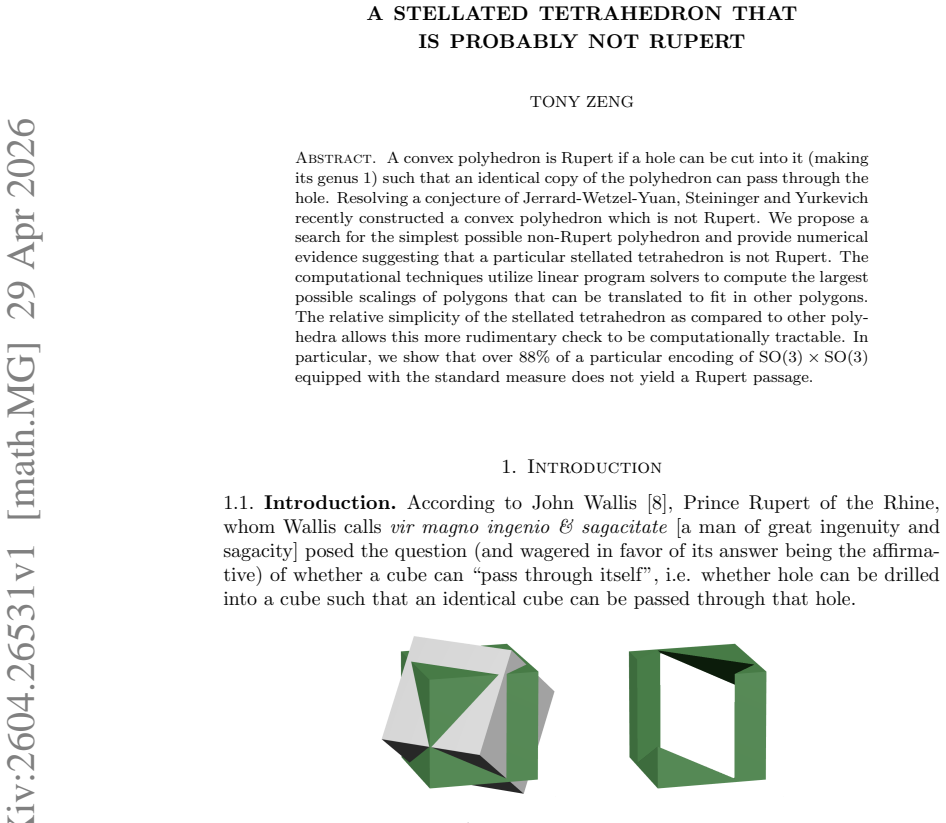
A convex polyhedron is Rupert if a hole can be cut into it (making its genus $1$) such that an identical copy of the polyhedron can pass through the hole. Resolving a conjecture of Jerrard-Wetzel-Yuan, Steininger and Yurkevich recently constructed a convex polyhedron which is not Rupert. We propose a search for the simplest possible non-Rupert polyhedron and provide numerical evidence suggesting that a particular stellated tetrahedron is not Rupert. The computational techniques utilize linear program solvers to compute the largest possible scalings of polygons that can be translated to fit in other polygons. The relative simplicity of the stellated tetrahedron as compared to other polyhedra allows this more rudimentary check to be computationally tractable. In particular, we show that over 88% of a particular encoding of $\text{SO}(3) \times \text{SO}(3)$ equipped with the standard measure does not yield a Rupert passage.
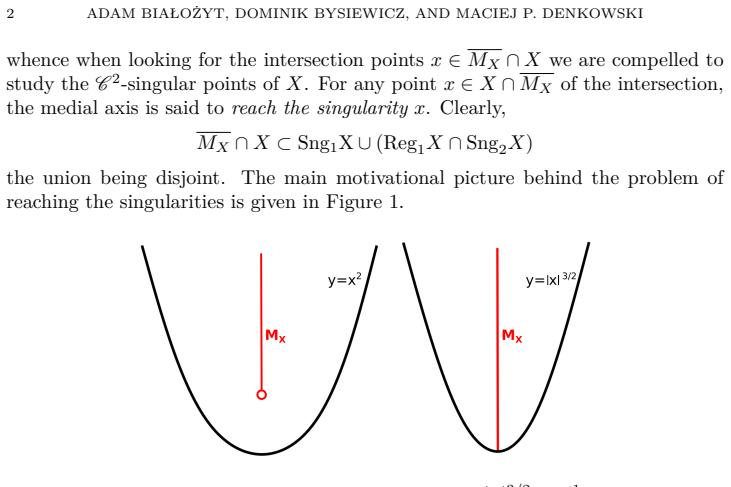
The medial axis $M_X$ of a closed set $X\subset \mathbb{R}^n$ is the set of points from the ambient space that admit more than one closest point in $X$. We study the problem of reaching the singularities, i.e. of characterising the points of the set $\overline{M_X}\cap X$. In order to tame the geometry, we assume that $X$ is definable in a polynomially bounded structure and obtain a general criterion based on a generalisation of the notion of superquadraticity previously introduced by Birbrair and Denkowski for $C^1$-smooth hypersurfaces and extended to any codimension by Bia{\l}o\.zyt. We do not require any smoothness as we achieve our goal by introducing a notion of directional curvature in some naturally chosen camber directions. This allows us in particular to complete the study of the plane case.
In R^n a set must reach Hausdorff dimension n-1 once it includes a translate of each meridian from a fixed sphere with chosen poles.
abstractclick to expand
Let us consider a sphere $S^{n-1}$ of radius $r$ in $\mathbb{R}^n$, where we have fixed poles $N$ and $S$. Suppose that $K$ is a set in $\mathbb{R}^n$ containing a translated copy of each meridian (that is an $S^{n-2}$-sphere) of $S^{n-1}$. Then the Hausdorff dimension of $K$ must be bigger than or equal to $n-1$.
Two points keep fixed power to circumcircle and Euler circle in generic families.
abstractclick to expand
We prove that over a generic Poncelet triangle family, the locus of the circumcenter of an inversive triangle is a conic. Additionally, we prove an earlier conjecture: over generic Poncelet triangles, two unique points exist which maintain constant power with respect to the circumcircle and Euler's circle of the family, respectively.
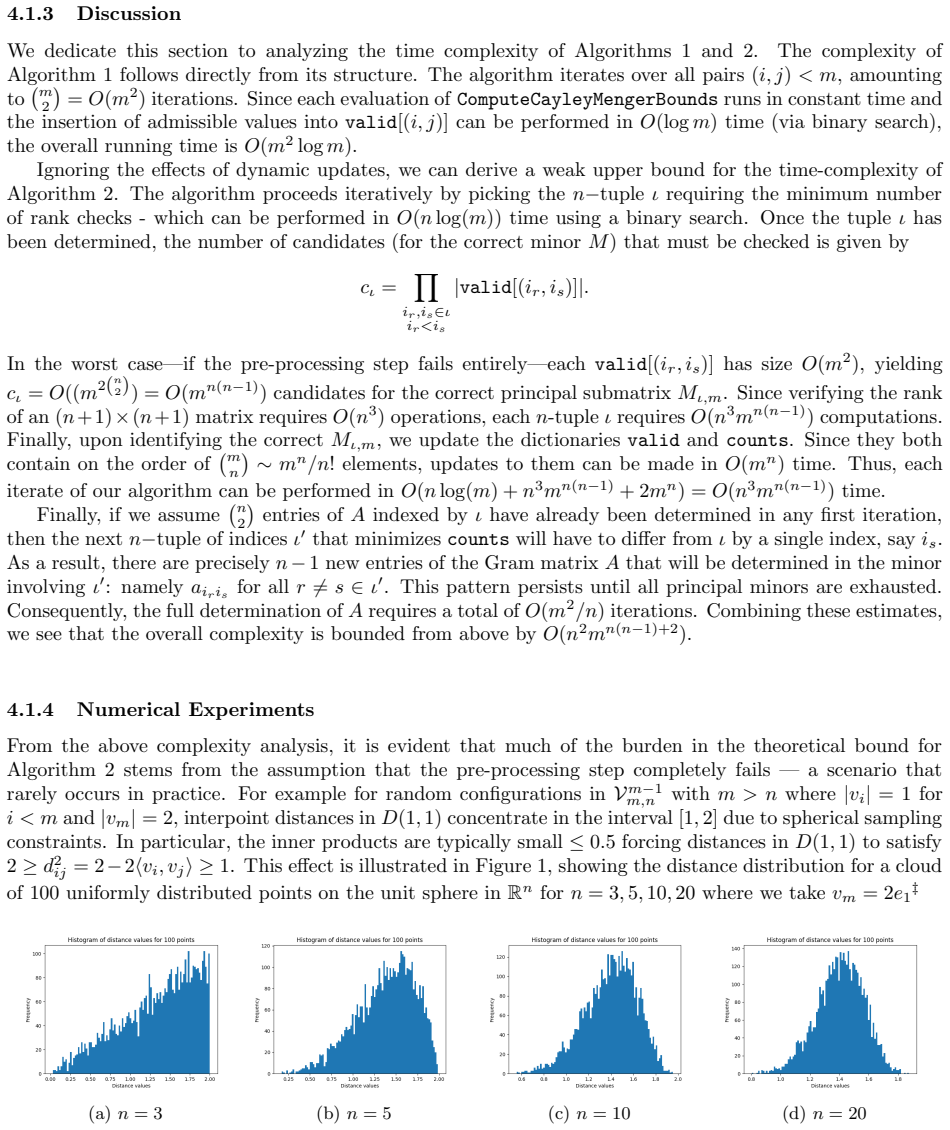
The orthogonal beltway problem is the problem of recovering the $\mathrm{O}(n)$-orbit of a $\delta$-function supported at a finite number of points in $\r^n$ from its auto-correlation or, equivalently, second moment. It was introduced as a generalization of the classical beltway problem in X-ray crystallography and was motivated by cryo-electron microscopy. In this paper we prove that if $m > n$, then the $\mathrm{O}(n)$-orbit of generic binary signal supported at $m$ points where at least $\ell$ of them have equal magnitude can be recovered from its auto-correlation. We also provide a connection to Euclidean distance geometry and prove, as a corollary of our main theorem, that if $m > n$, then the $\mathrm{O}(n)$-orbit of a generic collection of $m$ points on the sphere $S^{n-1}$ can be recovered from their unlabeled interpoint distances.
We take advantage of the parallels to Euclidean distance geometry and develop a polynomial-time reconstruction algorithm for recovering the $\O(n)$-orbits of binary $\delta$-functions from their second-moment data when at least one of the points has distinct magnitude. In $\mathbb{R}^3$, the complexity of our algorithm is bounded from above by $O(m^8)$ but we show that in practice the complexity is much lower. We also demonstrate that the algorithm is robust to low levels of noise. Finally, we extend our algorithm to successfully perform recovery when all the support vectors lie on a common sphere, and in this case we match the time complexity of $O(m^8)$.
Error terms enable the limit to be taken as screens vary across sequences of spaces.
abstractclick to expand
In this paper, we obtain the limit formula of the observable diameter with non-Euclidean screen. In order to treat a sequence of observable diameters with varying screens, we define new types of observable diameters with errors.
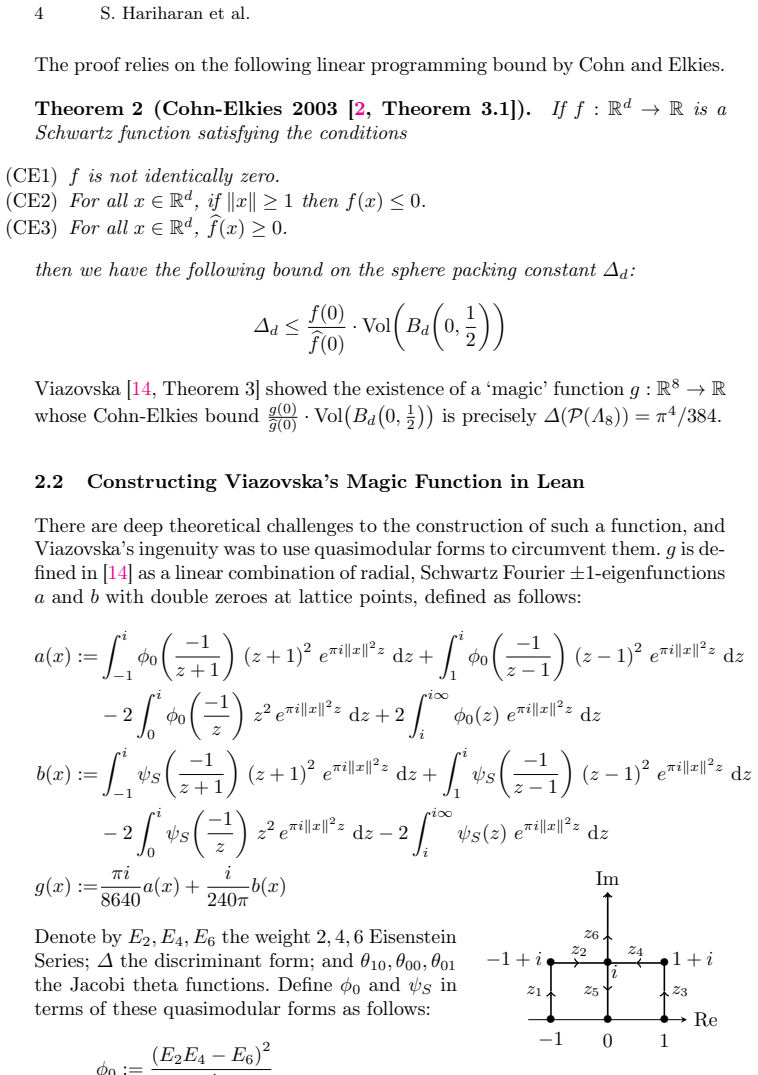
In 2016, Viazovska famously solved the sphere packing problem in dimension $8$, using modular forms to construct a 'magic' function satisfying optimality conditions determined by Cohn and Elkies in 2003. In March 2024, Hariharan and Viazovska launched a project to formalize this solution and related mathematical facts in the Lean Theorem Prover. A significant milestone was achieved in February 2026: the result was formally verified, with the final stages of the verification done by Math, Inc.'s autoformalization model 'Gauss'. We discuss the techniques used to achieve this milestone, reflect on the unique collaboration between humans and Gauss, and discuss project objectives that remain.
The equivalence produces the same convergence and a compactness theorem via Gromov's classical result, together with stability of causality.
abstractclick to expand
We introduce the notion of timed-Gromov--Hausdorff distance for timed-metric spaces. We prove that this distance is bi-Lipschitz equivalent to the intrinsic timed-Hausdorff distance of Sakovich--Sormani, and therefore induces the same notion of convergence. We establish a compactness theorem for the timed Gromov--Hausdorff distance, obtained as a straightforward consequence of Gromov's classical compactness theorem.
We then investigate the causal structure of timed-metric spaces and the stability of causality under intrinsic timed-Hausdorff convergence. We further analyze causally-null timed-metric spaces and develop several of their basic properties. As a curiosity, we include in an appendix Gromov's original proof of his compactness theorem, as presented in his paper on groups of polynomial growth.
We determine putative optimal packings of regular spherical polygons via optimization on smooth manifolds. For several cases, we establish maximality by extending the Lov\'asz theta number to Cayley graphs on the special orthogonal group ${\rm SO}(3)$. To this end, we introduce an algebraic criterion characterizing when congruent regular spherical polygons have disjoint interiors, leading to a unified formulation of the packing constraints. Using harmonic analysis on ${\rm SO}(3)$, we reduce the theta number to a trigonometric sum-of-squares problem, which can be solved via semidefinite programming.
Closed subsets of n-dimensional space recover uniquely from their medial axis precisely under a new criterion.
abstractclick to expand
The medial axis of a closed set is well established tool in pattern recognition, cherished for its power of reconstruction of domains. In this article we fill this gap answering the question which sets precisely are reconstructible from the medial axis information. We do not assume any additional structure of considered sets besides them being closed in n-dimensional Euclidean space.
We define a multi-scale metric $d_\rho$ on strings by aggregating angle distances between all $n$-gram count vectors with exponential weights $\rho^n$. We benchmark $d_\rho$ in DBSCAN clustering against edit and $n$-gram baselines, give a linear-time suffix-tree algorithm for evaluation, prove metric and stability properties (including robustness under tandem-repeat stutters), and characterize isometries.
We study the $l_p$ Hausdorff distance from convex hull of a compact set $A\subset\mathbb{R}^n$, which is the distance \begin{equation*}
d^{(l_p)}(A):=\sup_{x\in conv(A)}\inf_{a\in A}\|x-a\|_p, \end{equation*}
where $\|\cdot\|_p$ is the $l_p$-norm on $\mathbb{R}^n$. We prove that when $n=2$ and $1\leq p<\infty$, the function $(d^{(l_p)})^p$ is subadditive with respect to Minkowski summation, up to multiplication by the factor $\max\{1,2^{p-2}\}$, and we observe that this bound is sharp.
For any k at least 2 the k-fold Cartesian product does not reach its conformal dimension, shown by singularity of energy measures on the rug
abstractclick to expand
It is a long-standing open question to determine whether the Sierpi\'nski carpet attains its conformal dimension or not. While this problem remains unresolved, we prove that Cartesian products $\mathbb{S}^k$, where $\mathbb{S}$ is the Sierpi\'nski carpet and $k \geq 2$, do not attain their conformal dimension. Our approach is based on the Sobolev spaces and energy measures on $\mathbb{S}$ -- constructed by Shimizu, Kigami, and Murugan and Shimizu -- together with a certain singularity result of energy measures from the theory of analysis on fractals. This work formulates a general non-attainment result of conformal dimension for product metric spaces $X^k$ for $k \geq 2$ in terms of self-similarity and energy measures of the factor $X$. It applies, in particular, to the cases where $X$ is the Sierpi\'nski carpet, the Sierpi\'nski gasket, the Menger sponge, and the Laakso diamond.
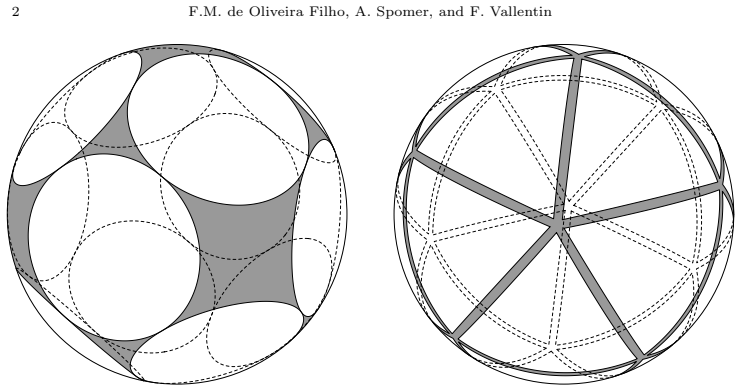
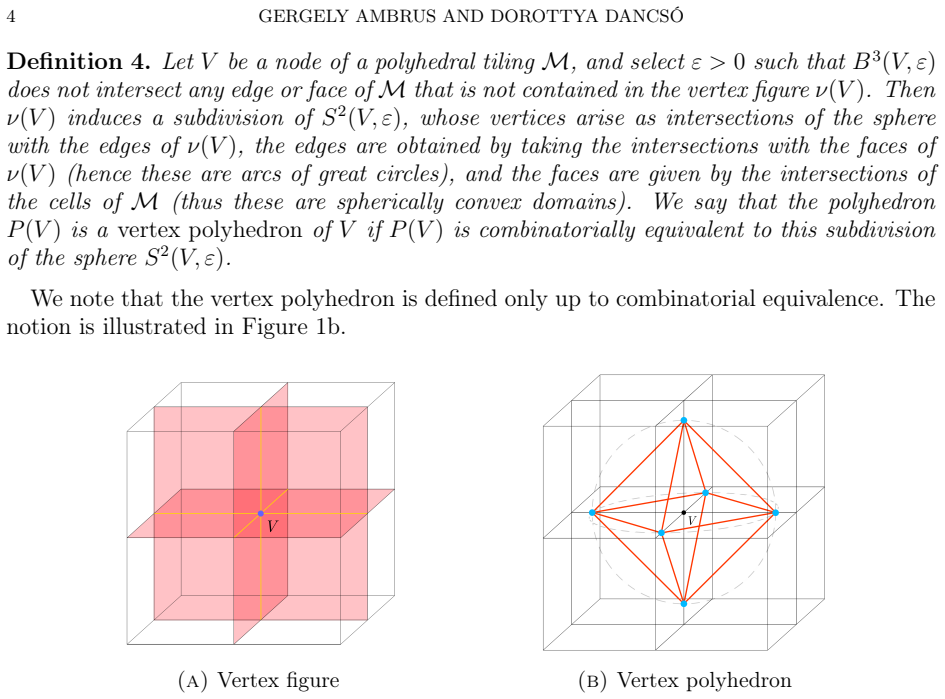
By means of constructing a new edge-bending algorithm, we prove that every locally polyhedral tiling of $\mathbb{R}^3$ can be completely softened. A weaker form of this statement, for polyhedral space tilings, was conjectured by Domokos, Goriely, G. Horv\'ath and Reg\H{o}s in 2024. We also provide a short proof for a result of Domokos, G. Horv\'ath, and Reg\H{o}s, stating that in a balanced polygonic tiling of the plane, the average number of spikes is at least 2 per cell.
In this paper we provide conditions for a Wasserstein barycenter to be absolutely continuous with respect to its Hausdorff measure away from the vertices of the graph.
What is the largest constant $c\in [0,1]$ with the property that every finite collection $\mathcal{C}$ of axis-parallel squares in the plane admits a disjoint sub-collection $\mathcal{S}$ occupying at least a fraction $c$ of the area covered by $\mathcal{C}$? This problem was first raised by T.~Rad\'o in 1928, who was motivated by a classical covering lemma in real analysis due to Vitali. R.~Rado later generalized the problem from axis-parallel squares in the plane to homothetic copies of any given convex body $K$ in $\mathbb{R}^d$, where now we are looking for an optimal constant $F(K)$.
Our utmost interest is for cubes and balls in the high-dimensional regime $d\rightarrow \infty$. The estimates that we currently have for cubes are much more precise than those for balls: namely if $Q^d$ is a $d$-dimensional cube, then \[ (e^{-1}+o(1))\frac{2^{-d}}{d \log{d}} \leq F(Q^d)\leq 2^{-d}, \] while denoting $B^d$ a $d$-dimensional Euclidean ball, then \[ (1+\epsilon_d)3^{-d}\leq F(B^d)\leq 2.447^{-d}, \] where $\epsilon_d>0$ vanishes exponentially fast as $d\rightarrow \infty$. The latter upper bound is obtained here by using the Kabatiansky--Levenshtein bound for the sphere packing problem.
In the free step-3 Carnot group on two generators this shows the C1_H-Lusin property fails and yields purely unrectifiable curves unlike in
abstractclick to expand
We construct a Lipschitz curve in the free Carnot group of step 3 with 2 generators that meets every $C^{1}$ horizontal curve in a set of measure zero. This shows that the $C^{1}_{H}$-Lusin property fails in a strong sense in this group, and we deduce that such a curve must be purely $C^1_H$ 1-unrectifiable. Hence 1-rectifiability in Carnot groups is wildly different to its counterpart in Euclidean spaces, wherein the Whitney Extension Theorem guarantees that Lipschitz rectifiability and $C^1$ rectifiability are equivalent.
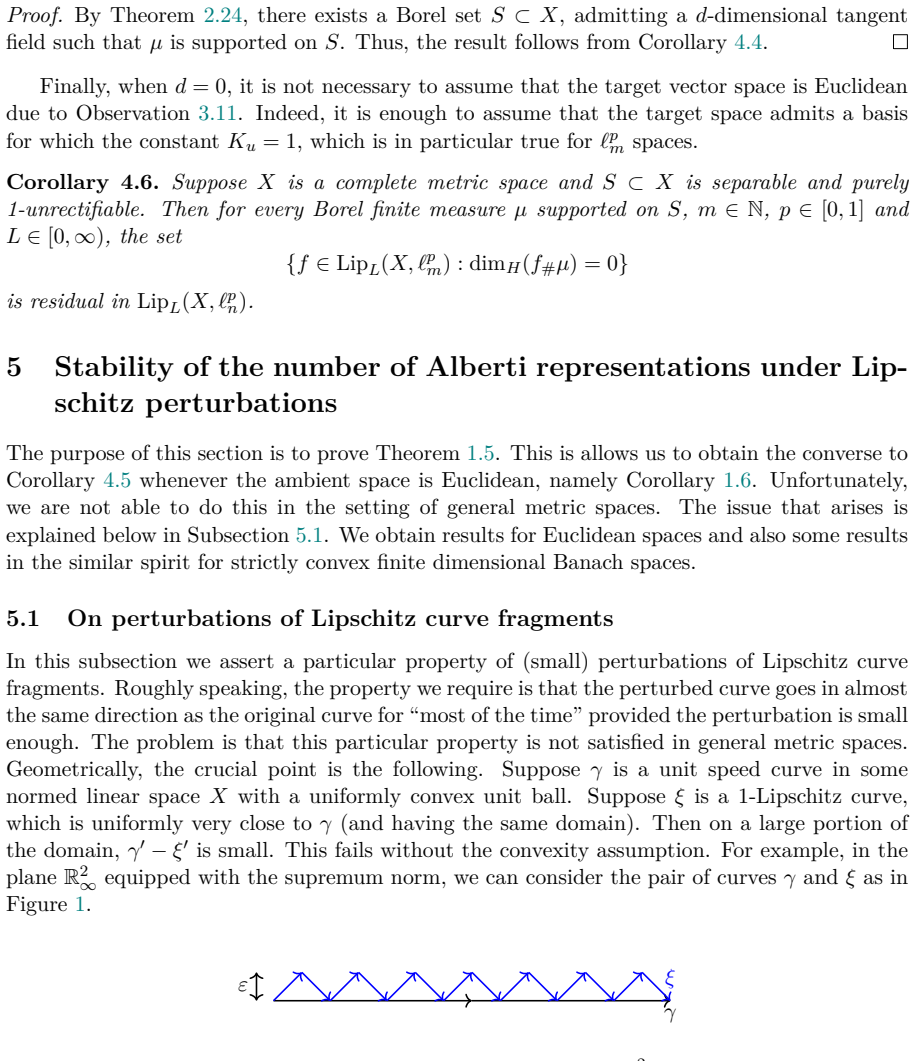
We show that whenever a separable subset $S$ of a complete metric space $X$ admits a $d$-dimensional weak tangent field, the set $S$ is close to being $d$-dimensional in the following sense. Whenever $\mu$ is a Borel finite measure on $X$ supported on $S$, then a typical $1$-Lispchitz map (in the sense of Baire category) into a Euclidean space maps $\mu$-almost all of $S$ into a set of Hausdorff dimension at most $d$. When taking $d=0$, this implies that any $1$-purely unrectifiable set is typically carried into a Hausdorff $0$-dimensional set up to a $\mu$-null set. We show that the result is sharp in Euclidean spaces and, more generally, in strictly convex Banach spaces of finite dimension.
Potential theory yields deterministic profiles that determine the intermediate dimensions of typical m-dimensional projections for any scale
abstractclick to expand
$\Phi$-intermediate dimensions interpolate between Hausdorff and box-counting dimensions by restricting admissible coverings to scale windows of the form $[\Phi(r),r]$. Using a family of $\Phi$-dependent kernels, we develop a potential-theoretic framework that characterizes these dimensions in terms of capacities and leads to associated $\Phi$-dimension profiles. This framework provides effective tools for obtaining lower bounds from uniform potential estimates. As an application, we prove Marstrand--Mattila type projection theorems, showing that for $\gamma_{n,m}$-almost all $m$-dimensional subspaces $V$, the $\Phi$-intermediate dimensions of $\pi_V E$ coincide with deterministic profile values depending only on $E$ and $m$. We also discuss consequences for continuity at the Hausdorff end-point and for the box dimensions of typical projections.
The uniqueness supplies a criterion for deciding whether a pyramid is an extended metric measure space.
abstractclick to expand
Gromov introduced the notion of a pyramid as a generalization of a metric measure space, based on the idea of the concentration of measure phenomenon. In this paper, we introduce the concept of a direct sum of pyramids, which naturally appears as a limit of a sequence of metric measure spaces whose measures concentrate on finitely or countably many regions, with the distances between these regions diverging to infinity. As one of our main results, we prove that any pyramid admits a unique direct sum decomposition. Moreover, as an application, we establish the method for checking whether a given pyramid is an extended metric measure space.
We consider solutions to the
$4$-color problem for the vertices of
sphere triangulations with
degree sequence $6,...,6,4,4,4,4,4,4$.
We sort these solutions into combinatorial
types and show that each generic type $\tau$ is
parametrized by the set of integer lattice points inside a
$4$-dimensional rational polyhedral convex cone ${\cal C\/}_{\tau}$.
There is an integral quadratic form $Q_{\tau}$
on ${\cal C\/}_{\tau}$
whose diagonal part, evaluated on a lattice point,
is $3$ times the number of triangles in the corresponding
triangulation. We relate this structure to
the octahedral stratum of Thurston's
moduli space of flat cone structures on the
sphere.
We study the two-dimensional Ulam's floating body problem for convex domains with perimetral density $\sigma=\tfrac16$. Using the framework of Zindler carousels, we reduce the problem to a two-dimensional dynamical system associated with an inscribed equilateral hexagon. Our main result shows that the disk is the only convex domain floating in equilibrium in every position for this perimetral density. This provides a new rigidity result for rational perimetral densities in the convex setting.
Let $K$ be a convex body in the 3-dimensional Euclidian space $\mathbb{E}^3$ and let $N,S$ in the boubdary bd$K$ of $K$, $N\not=S$. Suppose that the support plane $\Pi_S$ of $K$ at $S$ is unique. For every point $x$ in bd$ K$, different than $N$, we define the stereographic projection $\Psi:\textrm{bd}K\backslash \{N\} \rightarrow \Pi_S$ of $x$ onto $\Pi_S$ as the point $y:=L(N,x)\cap \Pi_S$.
It is a well known property of the sphere $\mathbb{S}^2$ in $\mathbb{E}^3$ that the stereographic projection maps circles onto circles (see \cite{Hilbert} pag. 248). In this work we investigate what geometric elements determines that this property is fulfilled.
Here we demonstrate that the following two properties of a convex body $K\subset \mathbb{E}^3$ in terms of the stereographic projection characterize the sphere in $\mathbb{E}^3$:
(1) The cones defined by the sections of $K$ and the point $N$ are axially symmetric (that is, they are invariant under a rotation by an angle of $\pi$).
(2) given a section $K_\Gamma$ of $K$, the rotation that leaves the cone defined by $K_\Gamma$ and $N$ invariant is such that it maps $K_\Gamma$ into a homothetic figure to $\Psi(K_\Gamma)$ by a homothety with center of homothety at $N$.
An important element in the proof of the main theorem of this work is a cha\-racterization of the circle based on a geometric property, which will be called the stereographic property. It is worth highlighting that the stereographic projection defined on the sphere maps circles onto circles is intimately linked to the conditions (1) and (2) and the stereographic property of the circle.
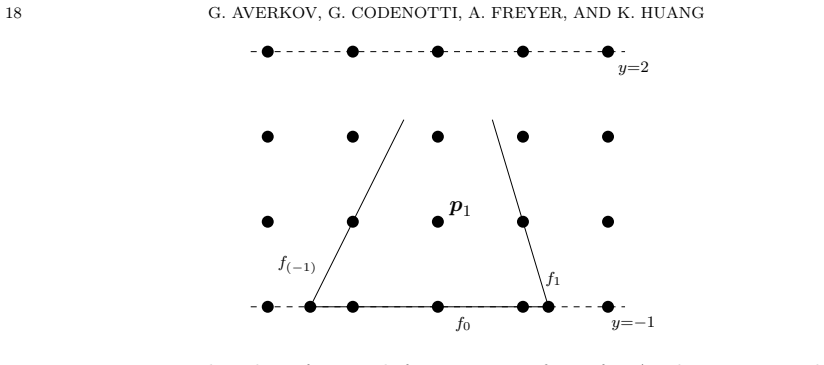
Reduces required number of summands from cubic to quadratic dependence on the reciprocal of thickness.
abstractclick to expand
Let $E_1,\dots,E_n \subset \mathbb{R}^d$ be compact sets of positive diameter with Feng--Wu thickness at least $c>0$. Feng and Wu proved that $E_1+\cdots+E_n$ has non-empty interior when $n>2^{11}c^{-3}+1$. We show that \[n>\frac{\sqrt d}{(\sqrt{1+c}-1)^2}=\frac{\sqrt d\,(\sqrt{1+c}+1)^2}{c^2}\] already suffices. In particular, since $0<c\le 1$, the bound $n>6\sqrt d\,c^{-2}$ is enough. For fixed dimension $d$, this improves the exponent in $c^{-1}$ from $3$ to $2$, while introducing only an explicit factor of $\sqrt d$. The proof replaces the one-summand-at-a-time enlargement of Feng--Wu by a simultaneous convexification step based on a radius form of the Shapley--Folkman theorem.
We study the iteration that replaces a planar hexagon by the hexagon formed by joining the midpoints of consecutive edges. While this iteration quickly drives any polygon toward a point and their shapes asymptotically regularize, we show a stronger and unexpected rigidity holds for hexagons: from the second iterate onward, the centroids of the filled hexagons all lie exactly on a fixed line. This exact colinearity reflects a special algebraic feature of the hexagonal case and does not hold generally for any other polygons.
The Apollonius problem asks for a sphere tangent to $n+1$ given spheres or hyperplanes in $\mathbb{R}^n$. This problem has been widely studied for an isolated configuration of $n+1$ spheres. In this paper, we study relations among the solutions of the Apollonius problem arising from a common family of spheres within the framework of Lie sphere geometry. More precisely, we consider a configuration of $n+2$ spheres in $\mathbb{R}^n$ and the solutions of the Apollonius problem corresponding to all its subsets of size $n+1$. The first main result concerns lines passing through the centers of pairs of solutions to the Apollonius problem. We prove that all these lines intersect at a single point $P_X$. We then introduce a two--step construction of further Apollonius spheres and show that the lines determined by their centers also pass through $P_X$. This yields numerous applications in two and three dimensions and, at the same time, automatically extends them to $\mathbb{R}^n$. The second main result is an $n$--dimensional generalization of K. Morita's three-dimensional theorem on the inscribed sphere in a configuration of mutually tangent spheres. We show that Morita's theorem is a special case of our result for an arbitrary configuration of $n+2$ spheres in $\mathbb{R}^n$, not necessarily mutually tangent. Moreover, we connect this result with the preceding ones by proving that the center of the corresponding inscribed sphere is again the point $P_X$.
This paper presents a new Lemoine-type circle defined by a six-point configuration satisfying a cocyclicity criterion. We prove the result, establish a converse theorem, and relate the new circle to previously known Lemoine circles, in particular the one introduced by Q.T. Bui. We show that the new circle does not belong to the family of Tucker circles.
Conjecture states that for any sheet, irregular forms beat smooth convex solids in enclosed volume without stretching or tearing.
abstractclick to expand
We consider the problem of wrapping three-dimensional solid bodies with a given planar sheet of paper, where the paper may be folded or wrinkled but not stretched or torn. We propose a conjecture characterising the maximumvolume solid wrappable by any given sheet: the maximum is always achieved (or approached) by a non-convex body. In other words, for any convex solid wrappable by a given sheet, there exists a non-convex solid of strictly greater volume that the same sheet can wrap. We discuss related work, a key subquestion involving the sphere, and several further directions.
Recursive boundary integration defines volume for any normed ball so P/V equals dimension and stays invariant under affine maps and duality
abstractclick to expand
This paper introduces a natural definition for the volume of the unit ball in $n$-dimensional normed spaces $\mathbb{R}^n$. This definition preserves the Euclidean relation $P(B)/V(B)=n$ between the perimiter and the volume of the unit ball $B$ in $R^n$.
We show that this volume definition is invariant under origin-preserving affine transformations and polar duality. For $n=2$, we derive an explicit integral formula for the self-perimeter of the unit ball, extend it to non-centrally symmetric sets;. The construction is extended to $\mathbb{R}^n$ via a recursive integration over the boundary, utilizing $(n-1)$-dimensional volumes of planar intersections. Finally, we pose and discuss an Alexandrov-type problem for the associated surface measure, providing perturbative solutions in the 2D case. In particular we prove that, generically, any perturbation of the surface measure of the Euclidean 2-D disk yields a 4-fold symmetric convex set in the leading order.