REVIEW 3 major objections 5 minor 2 cited by
PepTune: De Novo Generation of Therapeutic Peptides with Multi-Objective-Guided Discrete Diffusion
T0 review · 3 major / 5 minor · reviewed 2026-08-11 · deepseek-v4-flash
Pith's one-line read A discrete diffusion generator with Monte Carlo tree guidance designs chemically modified peptides while optimizing several therapeutic properties at once.
desk verdict Novel MCTS-guided discrete diffusion for peptide SMILES, with a real circularity problem in the biological validation; worth reviewing, not ready as claimed. read the letter →
The pith
A machine-rendered reading of the paper's core claim, the machinery that carries it, and where it could break.
The reading
What carries the argument
PepTune's load-bearing mechanism is Monte Carlo Tree Guidance (MCTG), an inference-time algorithm that reformulates classifier-guided discrete diffusion as a search over unmasking steps. Starting from a fully masked sequence, each MCTS iteration selects a child node via a Pareto selection score that balances normalized reward vectors with the unconditional reverse-posterior probability and an exploration term, expands the node into $M = 50$ distinct Gumbel-perturbed partial sequences, rolls each out greedily to a clean peptide SMILES, scores it with peptide-SMILES property predictors for binding affinity, permeability, solubility, hemolysis, and non-fouling, updates the Pareto-optimal set, and back-propagates reward vectors to ancestors. Two supporting components make the search space tractable: a bond-dependent masking schedule in which peptide-bond tokens survive longer under $\alpha_t = 1 - t^w$ with $w = 3$, so the model learns backbone structure first, and an invalid peptide loss that propagates penalties from argmax-invalid SMILES back through softmax probabilities. The property predictors themselves are part of the contribution, including a cross-attention binding-affinity regressor and XGBoost classifiers for the other properties, trained specifically on peptide SMILES data.
What would settle it
Generate a separate set of peptides with the binding-affinity regressor's reward replaced by a random or reversed scorer and compare docking distributions: if the optimized set still docks as well or better than the unconditional set, the apparent affinity gains come from the generator's prior rather than from the guidance. A cheaper check is to compute the rank correlation between the regressor's predictions and AutoDock Vina scores on the paper's own generated binders; a near-zero or negative correlation would mean the two validation layers disagree.
Extended reading notes
Core claim
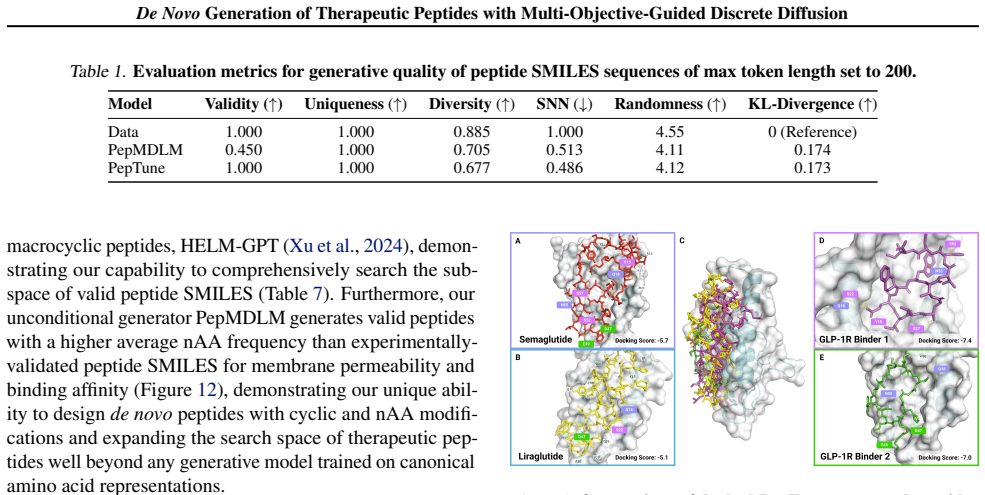
On the paper's own terms, the discovery is that multi-objective guidance for discrete diffusion can be carried out entirely in the discrete token space by treating partial unmaskings as nodes of a search tree. MCTG rolls out each candidate unmasking path to a complete peptide SMILES, scores it with trained classifiers and regressors for the desired properties, retains only Pareto-non-dominated sequences, and back-propagates reward vectors up the tree so subsequent iterations favor unmasking steps that lead to high-scoring, valid peptides. Paired with a bond-dependent masking schedule that masks peptide-bond tokens more slowly, using $\alpha_t = 1 - t^w$ with $w = 3$, and a softmax-scaled invalid loss, the generator reaches 100% valid peptide SMILES after about 20 MCTS iterations while maintaining diversity comparable to the unconditional model. The paper reports two PepTune GLP-1R binders with docking scores of -7.4 and -7.0 kcal/mol, compared with -5.7 for semaglutide and -5.1 for liraglutide, and seven dual TfR/GLAST binders with docking scores at or below -7.5 kcal/mol, the best reaching -10.5 kcal/mol for TfR and -9.2 kcal/mol for GLAST.
Load-bearing premise
The load-bearing premise is that the trained property predictors, especially the binding-affinity regressor with a held-out Spearman correlation of only 0.633 on 1,806 training sequences, rank true therapeutic quality well enough that reward-guided unmasking toward higher predicted scores also moves real binding, permeability, solubility, hemolysis, and fouling behavior in the right direction.
Editorial extensions
If this is right
- If PepTune works as claimed, researchers can generate chemically modified, cyclic peptide candidates for targets with no existing binders or no stable 3D structure, since guidance needs only the target sequence and trained property predictors.
- A single trained unconditional diffusion model can be steered toward new objectives or new target sequences at inference time, because MCTG requires no retraining of the generator and no gradient estimates in the discrete space.
- Optimizing several therapeutic properties together should reduce the binding-versus-developability trade-off; the paper's TfR/GLAST and GFAP/RBX1 cases show predicted property scores improving together over MCTS iterations.
- Shorter GLP-1R peptide leads with in silico docking scores better than approved agonists could point toward cheaper, lower-immunogenicity alternatives, if the docking and predicted-affinity signals hold up in experiments.
- The time-dependent guidance variant described in the appendix suggests that practitioners can prioritize one property first and layer in additional objectives later, which may help when some properties are much harder to optimize than others.
Reading between the lines
- An implication left implicit by the paper is that MCTG is a general recipe for any discrete sequence domain, including DNA, RNA, or small-molecule SMILES, wherever a scorer exists and data is too sparse for classifier-free training; the machinery itself does not depend on peptide chemistry.
- The strongest caveat is that every optimized property is measured by a learned proxy, and the binding-affinity regressor was trained on only 1,806 PepLand sequences with a held-out Spearman correlation of 0.633; if those proxies are biased, the Pareto front may be optimal for the predictors rather than for biology.
- A natural testable extension would be to synthesize a small set of top-scoring binders and measure affinity, permeability, and hemolysis in vitro, then compare whether the ordering predicted by the classifiers matches the experimental ordering.
- Because MCTG returns the full Pareto front in one run, downstream users could apply a secondary filter, such as synthesis cost, route availability, or a patent landscape, to choose from the non-dominated set without rerunning generation.
Signed reviews
Editorial analysis
A structured set of objections, weighed in public.
Referee Report
Summary. The paper proposes PepTune, a discrete masked diffusion model for de novo peptide SMILES generation, together with Monte Carlo Tree Guidance (MCTG), an inference-time algorithm for multi-objective optimization. The unconditional generator, PepMDLM, uses a bond-dependent masking schedule and an invalid-peptide loss to improve structural validity. The MCTG procedure builds a search tree over partially unmasked sequences, rolls out candidates, scores them with trained property classifiers for binding affinity, permeability, solubility, hemolysis, and non-fouling, and returns a Pareto front of non-dominated sequences. The authors report that PepTune generates chemically modified and cyclic peptides, reaches 100% validity after 20 MCTS iterations, and produces in silico docking scores for GLP-1R, TfR, GLAST, GFAP, NCAM1, AMHR2, and RBX1, including GLP-1R scores claimed to be better than those of semaglutide and liraglutide.
Significance. If the empirical claims hold, MCTG would be a useful and modular contribution to guided discrete diffusion, particularly because it avoids gradient estimation in discrete spaces and can combine arbitrary reward signals. The manuscript ships several strengths: the theoretical derivations of the bond-dependent reverse posterior and NELBO in Appendix G are presented in detail, the validity-filter tool is released, and the code is publicly available. The main limitation is that the multi-objective improvements are measured with the same classifiers that define the MCTG reward, and the only external check, docking, is applied to a hand-picked subset without matched-length or random-sequence baselines. The central claim of simultaneous optimization of true therapeutic properties is therefore not yet established, although the methodological framework itself is plausible and worth further validation.
major comments (3)
- [Section 5, Eq. (14), Appendix F.3] The central claim that PepTune improves multi-objective therapeutic properties is evaluated with the same trained classifiers that define the MCTG reward. Since Eq. (14) computes rewards from these classifiers and the Pareto front is updated from the same scores, increases in solubility, hemolysis, non-fouling, and predicted binding affinity over iterations are partly by construction. The only external validation, Autodock Vina docking, is applied in Section 5 and Appendix F.3 only to non-dominated sequences with the highest predicted binding-affinity scores; no random sample of PepMDLM outputs or training-set peptides is docked under the same protocol, and the clinical comparators are not length-matched. The GLP-1R comparison (-7.4 and -7.0 kcal/mol for PepTune versus -5.7 and -5.1 kcal/mol for semaglutide and liraglutide) is therefore uninterpretable as evidence that optimized peptides bind better than unconditionally generated or known peptides. This should be fixed by docking random PepMDLM samples and training peptides of matched length under the identical protocol and reporting the full distribution of scores.
- [Section 2.3, Eq. (6)-(7), Proposition 2.3] There is a load-bearing notational inconsistency in the invalid-loss derivation. Section 2.1 defines x_theta(zt,t) as a vector of token probabilities in the simplex Delta^|V|, but Eq. (6) applies a softmax to x_theta, and Eq. (7) is derived as the derivative of softmax(x_theta,k) with respect to x_theta,k. If x_theta is already a probability vector, applying softmax is not the correct transformation and Eq. (7) is not the gradient of Eq. (6). If x_theta instead denotes logits, then the simplex notation and the use of x_theta as probabilities in Eq. (4) are inconsistent. The authors should clarify this distinction and restate the invalid loss and its gradient accordingly, since the claimed novel gradient mechanism depends on this step.
- [Appendix F.3, Table 3, Figure 3] The docking validation is not controlled for ligand length or sequence background. Vina scores are not size-normalized, and the GLP-1R comparators semaglutide and liraglutide are over 30 residues while the PepTune binders are shorter; the TfR/GLAST table reports only selected binders without docking scores for PepMDLM baselines or for random peptides from the training set. Without matched-length baseline docking, the absolute score comparisons in Table 3 and Figure 3 do not support the conclusion that the generated peptides bind better than existing drugs or than unconditionally generated peptides. A matched-length random baseline is needed before these numbers can be cited as evidence of improved binding.
minor comments (5)
- [Appendix overview, G.2-G.3] The appendix overview states that the proofs for Proposition 2.2 appear in G.2 and for Proposition 2.1 in G.3, but the actual sections are reversed relative to the main-text numbering; please correct the mapping.
- [Abstract, Table 1] The abstract says PepTune 'ensures valid peptide structures', but Table 1 reports PepMDLM validity of 0.450 and PepTune validity of 1.000 only after MCTS; the unconditional model does not by itself ensure validity, so the wording should be qualified.
- [Table 2] For non-fouling, the reported accuracy of PeptideBERT (0.873) is higher than the reported accuracy of the proposed model (0.766); the text should acknowledge that the improvement is on F1, not on accuracy.
- [Eq. (7)] Equation (7) contains a typographical period in the subscript SM(x^(ell)_theta.k); it should be a comma: SM(x^(ell)_theta,k).
- [Algorithm 6] In Algorithm 6, the dominance flag d is defined using the weak inequality s_k(x_s) >= s*_k, but the definition of dominance in Eq. (10) requires strict improvement in at least one objective; the flag should use strict inequality to match the formal definition.
Circularity Check
Multi-objective gains are reported with the same classifier scores used as MCTG rewards; the only external check is docking on hand-picked top-scoring binders.
-
fitted input called prediction
[Section 3 (Rollout, Eq. 14); Section 5 (property tables); Appendix A.1 (iteration evaluation)]
"To generate the property scores given an input peptide SMILES, we train regression models for target-binding affinity and cell membrane permeability and binary classification models for solubility, hemolysis, and non-fouling specifically on peptide SMILES data (Appendix E)."
MCTG's reward rk is a rank statistic over the trained classifier scores sk (Eq. 14), and selection (Eq. 12) plus backpropagation (Eqs. 16-17) explicitly maximize cumulative versions of these same scores. The paper then validates the optimization by reporting those same sk: 'all property scores improved over iterations' (Section 5) and tables listing classifier-predicted solubility, hemolysis, non-fouling, and bracketed predicted binding scores (Table 3, Table 4). Because the reported outcomes are the optimized reward functions, their increase is a property of the search procedure, not independent evidence that the classifiers track real peptide properties.
full rationale
The core generative and guidance machinery is self-contained: the bond-dependent masking schedule, NELBO, invalid loss, and MCTG are defined and derived in the paper without relying on a self-citation chain or on importing the claimed result. No load-bearing self-citation or imported uniqueness theorem was found. However, the central multi-objective claim is partially circular in evaluation: the property classifiers trained in Section 4 are both the reward signal in Eq. 14 and the metric used to report optimization success in Section 5 and the appendices. Increasing these scores across MCTS iterations is expected from the algorithm's design even if the classifiers are unrelated to true therapeutic properties. The binding-affinity docking studies provide an external check for a hand-selected subset, but the non-fouling, hemolysis, solubility, and permeability improvements are never independently benchmarked, so those claims reduce to optimizing fitted predictors. This warrants a score of 6: the derivation of the generative model is independent, but the headline multi-objective 'prediction' is partly forced by construction.
Assumptions & free parameters
free parameters (6)
- w (peptide-bond mask exponent) =
3
- c (MCTS exploration constant) =
0.1
- M (children per expansion) =
50
- Niter and T (iterations and denoising steps) =
128
- Max token length L =
200 (also 100)
- Classifier positive-class thresholds =
0.500 solubility, 0.800 hemolysis, 0.450 non-fouling
assumptions (5)
- domain assumption BOND_MASK regex patterns correctly identify all peptide-bond tokens in every peptide SMILES.
- domain assumption The SMILES2PEPTIDE validity filter correctly distinguishes synthesizable peptides from invalid SMILES.
- domain assumption The trained property classifiers are reliable proxies for true therapeutic properties.
- domain assumption The 11M-SMILES training set, including about 10M synthetic CycloPs-generated peptides, is representative of therapeutic modified-peptide space.
- standard math Standard Bayesian and calculus identities used in NELBO and invalid-loss derivations.
Cite this review
Pith. "Pith review of PepTune: De Novo Generation of Therapeutic Peptides with Multi-Objective-Guided Discrete Diffusion." pith.science (2026). https://pith.science/paper/UTF6PVSQ
@misc{pith2026241217780,
  author       = {Pith},
  title        = {Pith review of: PepTune: De Novo Generation of Therapeutic Peptides with Multi-Objective-Guided Discrete Diffusion},
  year         = {2026},
  howpublished = {\url{https://pith.science/paper/UTF6PVSQ}},
  note         = {Machine review of arXiv:2412.17780}
}
read the original abstract
We present PepTune, a multi-objective discrete diffusion model for simultaneous generation and optimization of therapeutic peptide SMILES. Built on the Masked Discrete Language Model (MDLM) framework, PepTune ensures valid peptide structures with a novel bond-dependent masking schedule and invalid loss function. To guide the diffusion process, we introduce Monte Carlo Tree Guidance (MCTG), an inference-time multi-objective guidance algorithm that balances exploration and exploitation to iteratively refine Pareto-optimal sequences. MCTG integrates classifier-based rewards with search-tree expansion, overcoming gradient estimation challenges and data sparsity. Using PepTune, we generate diverse, chemically-modified peptides simultaneously optimized for multiple therapeutic properties, including target binding affinity, membrane permeability, solubility, hemolysis, and non-fouling for various disease-relevant targets. In total, our results demonstrate that MCTG for masked discrete diffusion is a powerful and modular approach for multi-objective sequence design in discrete state spaces.
Figures


Figures from the paper (13 more)


Forward citations
Cited by 2 Pith papers
-
On the Design Space of Discrete Diffusion Online Adaptation for Molecular Optimization
Online fine-tuning of discrete diffusion models with complementary acquisition, CVaR shaping, density-entropy debiasing, replay, and validity control finds better molecules under fixed oracle budgets than offline fine...
-
Beyond SMILES: Evaluating Agentic Systems for Drug Discovery
Drug-discovery AI agents are built for small-molecule, big-pharma settings and lack peptide, in vivo, training-loop, small-lab, and multi-objective capabilities, even though LLMs themselves can reason about peptides.
Reference graph
Works this paper leans on
-
[2]
Since T7 is known to bind to an alternative site than endogenous Tf (Lee et al., 2001), we show that PepTune can generate viable candidates for non-competitive binding to TfR for BBB-targeting applications. A.2. Targeting Intracellular Proteins Glial fibrillary acidic protein (GFAP) is an intracellular protein differentially expressed in astrocytes, a fam...
work page 2001
-
[3]
Lee, J. H., Engler, J. A., Collawn, J. F., and Moore, B. A. Receptor mediated uptake of peptides that bind the human transferrin receptor. European Journal of Biochemistry, 268(7):2004–2012,
work page 2004
-
[4]
Larger scores indicate stronger binding for our classifier
PepTune-generated dual-target binders to GFAP and RBX1.The predicted binding affinity scores by our trained classifier are placed in brackets beside the docking score. Larger scores indicate stronger binding for our classifier. Binder ID GFAP Docking Score(kcal/mol) (↓) E3 Docking Score(kcal/mol) (↓) Solubility(↑) Hemolysis(↑) Non-fouling(↑) Binder 1 -8.0...
work page 2022
-
[6]
Comparison of PepTune-generated peptides and established T7-peptide to TfR. Two-dimensional chemical structure of (A) PepTune-generated binder 1, (C) established T7 peptide, and (E) PepTune-generated TfR binder 2 and their Vina docking scores to TfR (↓). Zoomed-in visualization of the docked binding positions of (A) binder 1, (B) T7, and (C) binder 2 with...
work page 2003
-
[8]
512 512 Linear Layer 2048 2048 ReLU 2048 2048 Dropout 2048 2048 Linear Layer 512 512 Shared Prediction Head Linear Layer 1024 ReLU 1024 Dropout 1024 Regression Head 1 Classification Head 3 Figure
-
[10]
Roformer: Enhanced transformer with rotary position embedding
Su, J., Lu, Y ., Pan, S., Murtadha, A., Wen, B., and Liu, Y . Roformer: Enhanced transformer with rotary position embedding. arXiv preprint arXiv:2104.09864,
-
[11]
Protein PDB GFAP 6A9P TfR 3KAS GLP-1R 3C5T AMHR2 7L0J GLAST 5LM4 NCAM1 2HAZ RBX1 1LDJ G
PDB structures of target proteins used for docking. Protein PDB GFAP 6A9P TfR 3KAS GLP-1R 3C5T AMHR2 7L0J GLAST 5LM4 NCAM1 2HAZ RBX1 1LDJ G. Theoretical Details G.1. Bond-Dependent Masking Schedule From Equation (20), we define the continuous-time forward masking probability 1 − αt at time t with αt = exp(−¯σ(t)) , where ¯σ : [0, 1] → R+ is the cumulative...
work page 2024
-
[12]
ISSN 2041-1723. 13 De Novo Generation of Therapeutic Peptides with Multi-Objective-Guided Discrete Diffusion Vinogradov, A. A., Yin, Y ., and Suga, H. Macrocyclic pep- tides as drug candidates: Recent progress and remaining challenges. Journal of the American Chemical Society, 141(10):4167–4181,
Show all 31 references
-
[13]
A., and Riniker, S
Wang, S., Witek, J., Landrum, G. A., and Riniker, S. Improv- ing conformer generation for small rings and macrocycles based on distance geometry and experimental torsional- angle preferences. Journal of chemical information and modeling, 60(4):2044–2058,
-
[14]
Pepland: a large-scale pre-trained peptide representation model for a compre- hensive landscape of both canonical and non-canonical amino acids
Zhang, R., Wu, H., Xiu, Y ., Li, K., Chen, N., Wang, Y ., Wang, Y ., Gao, X., and Zhou, F. Pepland: a large-scale pre-trained peptide representation model for a compre- hensive landscape of both canonical and non-canonical amino acids. arXiv preprint arXiv:2311.04419,
-
[15]
to compute in silico binding affinities of our generated binders (Appendix F.3). A.1. Targeting Receptors on the Blood-Brain Barrier The Transferrin receptor (TfR) is a receptor protein abundant on the selectively permeable blood-brain barrier (BBB) that is responsible for tra...
2017
-
[19]
(Bottom) Plots depicting the average predicted score for NCAM1 binding affinity, solubility, hemolysis, and non-fouling over iterations of MCTS
(H) (Top) Density plot of NCAM1 binding affinity scores for PepTune (mean: 6.708), PepMDLM (mean: 5.298), and peptides from a control set of experimentally-tested peptide SMILES (mean: 5.360). (Bottom) Plots depicting the average predicted score for NCAM1 binding affinity, sol...
1996
-
[21]
( B) Plot of average predicted binding affinity score to TfR over iterations
Property Scores Over Iteration for Dual-Target Conditioning on TfR and GLAST.(A) Plot of average predicted binding affinity score to GLAST over iterations. ( B) Plot of average predicted binding affinity score to TfR over iterations. ( C, D, E) Plot of average predicted solubi...
2024
-
[22]
uses the Taylor-approximated conditional distribution log pϕ(y|zs) to adjust the unconditional transition rates Rt(zt, zs|y) given the unconditional rates Rt(zt, zs) for predictor- guidance of Continuous-Time Markov Chains (CTMCs) in the discrete state space. Rt(zt, zs|y) = Rt...
2021
-
[23]
to check the integrity of the SMILES sequences. 25 De Novo Generation of Therapeutic Peptides with Multi-Objective-Guided Discrete Diffusion We split our data by k-means clustering into 1000 groups of sequences with similar chemical properties based on their Morgan fingerprint...
2010
-
[24]
Model Train Loss ( ↓) Train PPL ( ↓) Val Loss ( ↓) Val PPL ( ↓) PepMDLM 0.832 2.460 0.880 2.277 D.3
Training and Validation Loss of PepMDLM.Loss values are taken after convergence at 8 epochs when training PepMDLM on 11 million peptide SMILES with bond-dependent masking and invalid loss. Model Train Loss ( ↓) Train PPL ( ↓) Val Loss ( ↓) Val PPL ( ↓) PepMDLM 0.832 2.460 0.88...
2024
-
[26]
Plot of true permeability (logP) on the x-axis and predicted permeability on the y-axis for the (A) validation set and (B) training set
Correlation plots for binding affinity and membrane permeability classifiers. Plot of true permeability (logP) on the x-axis and predicted permeability on the y-axis for the (A) validation set and (B) training set. Plot of true binding affinity (log-scale) on the x-axis and pr...
2023
-
[27]
baseline model (Table 2). F. Evaluation F.1. Peptide Validity Filter Among the sequential representations of peptides, including amino acid sequences, HELM (Zhang et al., 2012), and SMILES (Weininger, 1988), SMILES is the most intricate representation of peptide sequences. Alt...
2012
-
[31]
Plots of bond-dependent masking schedules. (A) The probability of remaining unmasked during the continuous-time forward diffusion process over time t given different values of w as the exponent of the masking schedule αt = 1− tw. We use w = 1for non-peptide bond tokens and w =...
2024
-
[200]
The shaded region represents the standard deviation. (C) Two-dimensional visualization of generated binders with token length 100, their corresponding docking scores (↓) computed using Vina docking, and predicted classifier scores (↑) from the trained classifiers. (D) Visualiz...
2001
-
[2003]
Z., Bezemek, Z., Patel, S., Rector-Brooks, J., Yao, S., Tong, A., and Chatterjee, P
Peng, F. Z., Bezemek, Z., Patel, S., Rector-Brooks, J., Yao, S., Tong, A., and Chatterjee, P. Path planning for masked diffusion model sampling. arXiv preprint arXiv:2502.03540, 2025a. Peng, F. Z., Wang, C., Chen, T., Schussheim, B., Vincoff, S., and Chatterjee, P. Ptm-mamba: ...
-
[2009]
The final results were visualized in PyMol (Schrödinger, LLC,
(v 1.5.7) and the conformations of the SMILES were optimized by ETKDG from RDKit (Eberhardt et al., 2021; Wang et al., 2020). The final results were visualized in PyMol (Schrödinger, LLC,
2021
-
[2012]
The tool is freely available on HuggingFace: https://huggingface.co/spaces/ChatterjeeLab/SMILES2PEPTIDE
and can classify a peptide SMILES as cyclic or non-cyclic. The tool is freely available on HuggingFace: https://huggingface.co/spaces/ChatterjeeLab/SMILES2PEPTIDE. F.2. Metrics To evaluate the generation quality of our unconditional MDLM, PepMDLM, and our MCTS-guided MDLM, Pep...
2020
-
[2016]
Chen, T., Dumas, M., Watson, R., Vincoff, S., Peng, C., Zhao, L., Hong, L., Pertsemlidis, S., Shaepers-Cheu, M., and Wang, T. Z. e. a. Pepmlm: Target sequence- conditioned generation of therapeutic peptide binders via span masked language modeling. arXiv preprint arXiv:2310.03842,
-
[2018]
N., and Bryant, P
Li, Q., Vlachos, E. N., and Bryant, P. Design of linear and cyclic peptide binders of different lengths from protein sequence information. bioRxiv preprint bioRxiv:10.1101/2024.06.20.599739,
2024 doi
-
[2020]
RDKit: Open-source cheminformatics
RDKit, online. RDKit: Open-source cheminformatics. Rector-Brooks, J., Hasan, M., Peng, Z., Quinn, Z., Liu, C., Mittal, S., Dziri, N., Bronstein, M., Bengio, Y ., Chat- terjee, P., Tong, A., and Bose, A. J. Steering masked discrete diffusion models via discrete denoising poster...
-
[2021]
L., and Mitchell, M
Tang, S., Han, E. L., and Mitchell, M. J. Peptide- functionalized nanoparticles for brain-targeted therapeu- tics. Drug Delivery and Translational Research, 2025a. ISSN 2190-3948. Tang, S., Zhang, Y ., Tong, A., and Chatterjee, P. Gumbel- softmax flow matching with straight-th...
-
[2022]
Unlocking guidance for discrete state-space diffusion and flow models
12 De Novo Generation of Therapeutic Peptides with Multi-Objective-Guided Discrete Diffusion Nisonoff, H., Xiong, J., Allenspach, S., and Listgarten, J. Unlocking guidance for discrete state-space diffusion and flow models. arXiv preprint arXiv:2406.01572,
-
[2023]
mop- pit:de novogeneration of motif-specific binders 10 De Novo Generation of Therapeutic Peptides with Multi-Objective-Guided Discrete Diffusion with protein language models
Chen, T., Zhang, Y ., and Chatterjee, P. mop- pit:de novogeneration of motif-specific binders 10 De Novo Generation of Therapeutic Peptides with Multi-Objective-Guided Discrete Diffusion with protein language models. bioRxiv preprint bioRxiv:10.1101/2024.07.31.606098,
-
[2024]
Your absorbing discrete diffusion secretly models the conditional distributions of clean data
Ou, J., Nie, S., Xue, K., Zhu, F., Sun, J., Li, Z., and Li, C. Your absorbing discrete diffusion secretly models the conditional distributions of clean data. arXiv preprint arXiv:2406.03736,
-
[2025]
Rigon, C., Andrisani, A., Forzan, M., D’Antona, D., Bru- son, A., Cosmi, E., Ambrosini, G., Tiboni, G
ISSN 2041-1723. Rigon, C., Andrisani, A., Forzan, M., D’Antona, D., Bru- son, A., Cosmi, E., Ambrosini, G., Tiboni, G. M., and Clementi, M. Association study of amh and amhrii poly- morphisms with unexplained infertility. Fertility and sterility, 94(4):1244–1248,
Reviewed August 11, 2026 · model on record in the stance chip above.
Discussion (0). Continue with ORCID to comment.