REVIEW 4 major objections 5 minor 91 references
FACEMUG: A Multimodal Generative and Fusion Framework for Local Facial Editing
T0 review · 4 major / 5 minor · reviewed 2026-08-11 · deepseek-v4-flash
Pith's one-line read FACEMUG generates realistic local facial edits from five input modalities at once, preserving unedited regions.
desk verdict A capable multimodal local-editing system with a real fairness problem in its headline comparisons and an under-supported warping module. read the letter →
The pith
A machine-rendered reading of the paper's core claim, the machinery that carries it, and where it could break.
The reading
What carries the argument
The central object is the unified generative latent space $\mathcal{W}^+$ of StyleGAN V2, which receives all modalities through a shared style encoder. The multimodal aggregation module merges heterogeneous pixel-wise inputs into a homogeneous feature space using per-modality residual blocks and a softmax-normalized adaptive weighting scheme; the multimodal generator then fuses these features with StyleGAN facial priors using style fusion blocks that compute spatially-variant gate maps. The self-supervised latent warping network, built from code-to-code modulation blocks with channel and position cross-attention plus gating, learns pose transfer from augmented and flipped images under identity, LPIPS, and attribute losses; the diversity-enhanced attribute loss uses style mixing and interpolation to expose the model to a wide range of latent codes during training.
What would settle it
A controlled comparison would take a set of free-hand sketches and hand-edited semantic maps, condition FACEMUG on them versus on the automatically generated equivalents, and measure output quality with FID, LPIPS, or user preference; if quality drops substantially for the real user inputs, the claim that training requires no manual annotation would be weakened.
Extended reading notes
Core claim
The authors claim that aligning all modalities into the StyleGAN $\mathcal{W}^+$ latent space, then fusing them with a multimodal aggregation module and a generator that draws on a pre-trained StyleGAN as a facial feature bank, yields globally consistent local facial edits that respond to multimodal guidance. A self-supervised latent warping module transfers the pose of the edited image onto exemplar latent codes without pose detectors or manual annotations, and a diversity-enhanced attribute loss simulates latent editing during training. Extensive comparisons to diffusion-based and other multimodal editing methods show lower FID and LPIPS scores when masks are used, faster inference (about 34 FPS on a consumer GPU), and no quality collapse in incremental editing scenarios.
Load-bearing premise
The training modalities—sketches, semantic maps, and colors—are generated automatically, and editing quality on real user-drawn inputs depends on those auto-generated inputs being representative of what users actually provide at inference time.
Editorial extensions
If this is right
- Users can edit a face in several successive steps, each changing only the masked region, without the quality collapse that the paper demonstrates for existing multimodal methods.
- A single trained model covers all combinations of the five modalities; adding a modality does not require training a separate uni-modal network or collecting paired annotations.
- Text and attribute labels steer attributes semantically while sketches, semantic maps, and colors control geometry and texture in the same editing pass.
- Exemplar-guided local editing remains coherent even when the exemplar's pose differs from the edited photo, because the latent warping module aligns poses in $\mathcal{W}^+$ space.
- Inference runs at roughly 34 frames per second, making interactive local facial editing practical on consumer hardware.
Reading between the lines
- The same architecture could be lifted from faces to other structured categories, such as full bodies, cars, or indoor scenes, because the aggregation and fusion mechanism makes no face-specific assumption beyond the pre-trained generator used as the feature bank.
- A natural stress test is contradictory modalities, for example a sketch of closed eyes paired with a text prompt saying 'open eyes'; a learned per-modality confidence weighting trained on synthetic conflicting inputs could extend the aggregation module and likely improve robustness.
- Because the latent warping module learns pose transfer without pose annotations, it could be applied to other latent-code transformation tasks such as video face reenactment or cross-view editing, where alignment in latent space replaces explicit 3D reconstruction.
- The one-month training time on a single V100 is a practical bottleneck for adoption; testing a lightweight generator or progressive training schedule would reveal whether the claimed editing quality can survive reduced capacity.
Editorial analysis
A structured set of objections, weighed in public.
Referee Report
Summary. The paper introduces FACEMUG, a GAN-based framework for local facial editing conditioned on up to five modalities (sketch, semantic map, color map, exemplar image, text/attribute label) plus a mask. The pipeline maps inputs into StyleGAN W+ space, warps exemplar latents to match the target pose via a self-supervised latent warping module, and uses a multimodal aggregation module and style fusion blocks to generate the edited region; Eq. (1) then pastes generated pixels only inside the mask. The authors report FID/U-IDS/LPIPS comparisons against TediGAN, PoE-GAN, ColDiffusion, Unite&Conquer, and several uni-modal baselines, ablation studies, a user study, and qualitative incremental editing examples.
Significance. If the results hold, FACEMUG would be a useful contribution: it offers fast (29 ms inference), single-model multimodal local editing with exact preservation of unmasked pixels, and it avoids manually paired cross-modality annotations. The architecture is coherent, and the mask-composition formulation in Eq. (1) gives a by-construction guarantee that unedited pixels remain unchanged. The paper also reports extensive experiments and ablations, including a user study, and the self-supervised warping objective is an interesting idea. However, several of the central empirical claims—modality-matched superiority, cross-identity exemplar warping, and incremental editing—are not fully supported by the experiments as reported.
major comments (4)
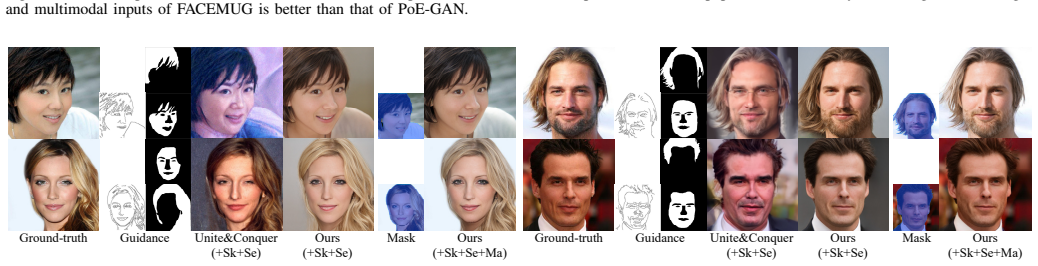
- [Tables I, II, IV, V] The quantitative comparisons are not modality-matched: the largest improvements come from adding the mask input (+Ma), which baselines do not receive. For example, Table II shows FID falling from 29.96 (Ours +Sk+Se) to 10.36 (Ours +Sk+Se+Ma) on CelebA-HQ, and Table IV from 36.58 (Ours +Sk) to 11.43 (Ours +Sk+Ma). Because the mask supplies the exact ground-truth pixels outside the edit region, this is a strong additional conditioning signal unavailable to the baselines. The paper should either compare baselines under the same mask-conditioned protocol, or present the non-mask results as the primary modality-matched comparison and clearly state that the +Ma rows address a different task. As written, the headline claim that FACEMUG outperforms SOTA multimodal editing methods is inflated.
- [II.F.2, Eq. (10), Algorithm 2, Table VII] The latent warping module is trained exclusively on same-identity triplets: source codes are interpolations between w_ini and w_f of the same image, and the losses in Eq. (10) all anchor to w_ini. There is no term that encourages preservation of the source identity when w_so comes from a different person than the target, which is exactly the inference setting in Section II.B and Fig. 2. The evaluation in Table VII reports only FID and LPIPS for exemplar-guided editing, and the CSIM result in Section H compares frontalized images to ground truth, not output-to-exemplar identity. I therefore do not see evidence that the claimed cross-identity pose transfer and identity preservation are achieved. Please add cross-identity training pairs or a direct identity-preservation metric (e.g., ArcFace cosine similarity between I_out and I_ex) with and without warping.
- [II.F.4, Figs. 25 and 26] The training modalities are auto-generated (pencil-sketch filter, face-parsing semantic maps, mean region colors), while the interactive examples in Figs. 25 and 26 use free-hand sketches and hand-edited semantic maps. No quantitative evaluation is given for such free-form inputs, so the claim that FACEMUG supports interactive or free-hand editing is only qualitatively supported. Please report quantitative metrics on hand-drawn/hand-edited inputs or otherwise characterize the sensitivity of the system to this train/inference distribution shift.
- [III.B, Figs. 1, 8, 23] The motivating claim that existing methods degrade after several iterations of incremental editing is not backed by any quantitative multi-step evaluation. The paper shows qualitative incremental sequences but does not measure how FID, LPIPS, or background consistency evolve over edit rounds, nor does it compare the incremental protocol with baselines under the same protocol. This is load-bearing for the incremental-editing part of the central contribution; please add a quantitative incremental-editing experiment.
minor comments (5)
- [II.C] The stated range lambda_clip in [0.1, 1.0] is inconsistent with the default lambda_clip = 0.05 used in the experiments.
- [Appendix C and D] There are typos in the headings: 'discrinimator' should be 'discriminator' and 'peseudo-codes' should be 'pseudo-codes'.
- [Fig. 14] The x-axis is labeled 'Masked ratio' but the tick labels are not legible; please provide a clearer axis with visible tick values.
- [III.A] The paper states that the same training and testing splits were used for all experiments, but ControlNet was fine-tuned on FFHQ; please clarify whether all pre-trained baselines were trained on the same FFHQ training split as FACEMUG.
- [Table III] The user study mixes results with and without masks; please report the with-mask and without-mask preference percentages separately, since they evaluate different settings.
Circularity Check
No significant circularity: FACEMUG is an empirical GAN framework validated on held-out test splits and external baselines; the cited self-losses are defined in-line and are not load-bearing.
full rationale
FACEMUG's central claims — multimodal local editing, global consistency, and latent warping — are empirical system properties. The training procedure (Section II.F) optimizes reconstruction/identity/perceptual/adversarial losses against ground-truth images, and the reported FID, U-IDS, LPIPS, and user-study numbers are computed on CelebA-HQ/FFHQ test images that were not used for training, using standard external metrics. The pretrained components (StyleGAN2, e4e, CLIP, ArcFace, VGG) are fixed external tools, not evidence imported from the authors' own prior work. No fitted parameter is renamed as a prediction: for example, the latent warping loss in Eq. (10) is a direct training objective, not a quantity that is later reported as a 'predicted' result. The only self-referential element is the citation of the authors' prior inpainting paper [24] for the identity/attribute losses, but those losses are fully defined in Eqs. (11)-(13) and are standard L2/cosine losses, so the citation is not load-bearing. The potential concern that the warping module is trained only on same-identity triples while deployed for cross-identity exemplar transfer is a generalization/evidence limitation, not a circularity: the learned residual is not defined in terms of the test-time output. Overall, the paper's claims rest on held-out evaluation rather than on a self-referential derivation.
Assumptions & free parameters
free parameters (11)
- lambda_latent (warping loss weight) =
0.1
- lambda_id (identity loss weight) =
0.1
- lambda_attr (attribute loss weight) =
0.1
- lambda_lpips (perceptual loss weight) =
0.5
- lambda_clip (CLIP directional loss weight) =
0.05, though text states range [0.1, 1.0]
- lambda_reg (text optimization regularization weight) =
0.08
- rho (exemplar source probability) =
0.5
- omega (modality keep probability) =
0.8
- gamma (R1 regularization weight) =
10
- text optimization schedule =
100-300 iterations, learning rate 0.1
- main training schedule =
800k iterations, batch size 8, learning rate 0.002
assumptions (6)
- domain assumption The pretrained StyleGAN2 W+ latent space is sufficiently disentangled and expressive to act as a unified generative space for sketches, semantic maps, colors, exemplars, text, and attributes.
- domain assumption Automatically generated sketches, semantic maps, and color maps are representative of user-provided free-hand and hand-edited inputs.
- domain assumption Pretrained StyleGAN2, e4e, ArcFace, VGG, and CLIP models provide reliable fixed feature extractors for face editing.
- domain assumption The directional CLIP loss in Eq. (5) correctly captures semantically meaningful text-driven facial edits.
- domain assumption Mirror-flipped and augmented images provide a self-supervised training signal that separates identity from pose in W+.
- domain assumption Generating content only inside the mask, conditioned on unmasked pixels, yields globally consistent results without boundary artifacts.
Cite this review
Pith. "Pith review of FACEMUG: A Multimodal Generative and Fusion Framework for Local Facial Editing." pith.science (2026). https://pith.science/paper/RKUM7GAW
@misc{pith2026241219009,
  author       = {Pith},
  title        = {Pith review of: FACEMUG: A Multimodal Generative and Fusion Framework for Local Facial Editing},
  year         = {2026},
  howpublished = {\url{https://pith.science/paper/RKUM7GAW}},
  note         = {Machine review of arXiv:2412.19009}
}
read the original abstract
Existing facial editing methods have achieved remarkable results, yet they often fall short in supporting multimodal conditional local facial editing. One of the significant evidences is that their output image quality degrades dramatically after several iterations of incremental editing, as they do not support local editing. In this paper, we present a novel multimodal generative and fusion framework for globally-consistent local facial editing (FACEMUG) that can handle a wide range of input modalities and enable fine-grained and semantic manipulation while remaining unedited parts unchanged. Different modalities, including sketches, semantic maps, color maps, exemplar images, text, and attribute labels, are adept at conveying diverse conditioning details, and their combined synergy can provide more explicit guidance for the editing process. We thus integrate all modalities into a unified generative latent space to enable multimodal local facial edits. Specifically, a novel multimodal feature fusion mechanism is proposed by utilizing multimodal aggregation and style fusion blocks to fuse facial priors and multimodalities in both latent and feature spaces. We further introduce a novel self-supervised latent warping algorithm to rectify misaligned facial features, efficiently transferring the pose of the edited image to the given latent codes. We evaluate our FACEMUG through extensive experiments and comparisons to state-of-the-art (SOTA) methods. The results demonstrate the superiority of FACEMUG in terms of editing quality, flexibility, and semantic control, making it a promising solution for a wide range of local facial editing tasks.
Figures


Figures from the paper (21 more)




Reference graph
Works this paper leans on
-
[1]
Identity-aware and shape- aware propagation of face editing in videos,
Y .-R. Jiang, S.-Y . Chen, H. Fu, and L. Gao, “Identity-aware and shape- aware propagation of face editing in videos,” TVCG, pp. 1–12, 2023
2023
-
[2]
Reenactartface: Artistic face image reenactment,
L. Qu, J. Shang, X. Han, and H. Fu, “Reenactartface: Artistic face image reenactment,” TVCG, pp. 1–13, 2023
2023
-
[3]
Caricatureshop: Personalized and photorealistic caricature sketching,
X. Han, K. Hou, D. Du, Y . Qiu, S. Cui, K. Zhou, and Y . Yu, “Caricatureshop: Personalized and photorealistic caricature sketching,” TVCG, vol. 26, no. 7, pp. 2349–2361, 2020
2020
-
[4]
Cross-domain and disentangled face manipulation with 3d guidance,
C. Wang, M. Chai, M. He, D. Chen, and J. Liao, “Cross-domain and disentangled face manipulation with 3d guidance,” TVCG, vol. 29, no. 4, p. 2053–2066, 2023
2023
-
[5]
Drawinginstyles: Por- trait image generation and editing with spatially conditioned stylegan,
W. Su, H. Ye, S.-Y . Chen, L. Gao, and H. Fu, “Drawinginstyles: Por- trait image generation and editing with spatially conditioned stylegan,” TVCG, vol. 29, no. 10, pp. 4074–4088, 2023
2023
-
[6]
Tedigan: Text-guided diverse face image generation and manipulation,
W. Xia, Y . Yang, J.-H. Xue, and B. Wu, “Tedigan: Text-guided diverse face image generation and manipulation,” in CVPR, 2021, pp. 2256– 2265
2021
-
[7]
Multimodal condi- tional image synthesis with product-of-experts gans,
X. Huang, A. Mallya, T.-C. Wang, and M.-Y . Liu, “Multimodal condi- tional image synthesis with product-of-experts gans,” in ECCV, 2022, p. 91–109
2022
-
[8]
Collaborative diffusion for multi-modal face generation and editing,
Z. Huang, K. C. Chan, Y . Jiang, and Z. Liu, “Collaborative diffusion for multi-modal face generation and editing,” in CVPR, 2023, pp. 6080– 6090. 19 + Curl hair + Age Ground-truth Three modalities Out put Ground-truth Four modalities Ou tput Ground-truth Five modalities Output Fig. 24. More multimodal local facial editing examples with our FACEMUG. Sketc...
2023
Show all 91 references
-
[9]
Unite and conquer: Plug & play multi-modal synthesis using diffusion models,
N. G. Nair, W. G. C. Bandara, and V . M. Patel, “Unite and conquer: Plug & play multi-modal synthesis using diffusion models,” in CVPR, 2023, pp. 6070–6079
2023
-
[10]
Generative adversarial nets,
I. Goodfellow, J. Pouget-Abadie, M. Mirza, B. Xu, D. Warde-Farley, S. Ozair, A. Courville, and Y . Bengio, “Generative adversarial nets,” in NeurIPS, vol. 27, 2014, pp. 2672–2680
2014
-
[11]
Analyzing and improving the image quality of stylegan,
T. Karras, S. Laine, M. Aittala, J. Hellsten, J. Lehtinen, and T. Aila, “Analyzing and improving the image quality of stylegan,” in CVPR, 2020, pp. 8107–8116
2020
-
[12]
Glean: Generative latent bank for large-factor image super-resolution,
K. C. Chan, X. Wang, X. Xu, J. Gu, and C. C. Loy, “Glean: Generative latent bank for large-factor image super-resolution,” in CVPR, 2021, pp. 14 245–14 254
2021
-
[13]
Fader networks:manipulating images by sliding attributes,
G. Lample, N. Zeghidour, N. Usunier, A. Bordes, L. DENOYER, and M. A. Ranzato, “Fader networks:manipulating images by sliding attributes,” in NeurIPS, vol. 30, 2017
2017
-
[14]
A style-based generator architecture for generative adversarial networks,
T. Karras, S. Laine, and T. Aila, “A style-based generator architecture for generative adversarial networks,” TPAMI, vol. 43, no. 12, pp. 4217– 4228, 2021
2021
-
[15]
Alias-free generative adversarial networks,
T. Karras, M. Aittala, S. Laine, E. H ¨ark¨onen, J. Hellsten, J. Lehtinen, and T. Aila, “Alias-free generative adversarial networks,” in NeurIPS, vol. 34, 2021, pp. 852–863
2021
-
[16]
Deep unsupervised learning using nonequilibrium thermodynamics,
J. Sohl-Dickstein, E. Weiss, N. Maheswaranathan, and S. Ganguli, “Deep unsupervised learning using nonequilibrium thermodynamics,” in ICML, vol. 37, 2015, pp. 2256–2265
2015
-
[17]
Denoising diffusion probabilistic models,
J. Ho, A. Jain, and P. Abbeel, “Denoising diffusion probabilistic models,” in NeurIPS, vol. 33, 2020, pp. 6840–6851
2020
-
[18]
Diffusion models beat gans on image synthesis,
P. Dhariwal and A. Nichol, “Diffusion models beat gans on image synthesis,” in NeurIPS, vol. 34, 2021, pp. 8780–8794
2021
-
[19]
High- resolution image synthesis with latent diffusion models,
R. Rombach, A. Blattmann, D. Lorenz, P. Esser, and B. Ommer, “High- resolution image synthesis with latent diffusion models,” in CVPR, 2022, pp. 10 684–10 695
2022
-
[20]
Denoising diffusion implicit models,
J. Song, C. Meng, and S. Ermon, “Denoising diffusion implicit models,” in ICLR, 2021
2021
-
[21]
Score-based generative modeling in latent space,
A. Vahdat, K. Kreis, and J. Kautz, “Score-based generative modeling in latent space,” in NeurIPS, vol. 34, 2021, pp. 11 287–11 302
2021
-
[22]
Sc-fegan: Face editing generative adversarial network with user’s sketch and color,
Y . Jo and J. Park, “Sc-fegan: Face editing generative adversarial network with user’s sketch and color,” in ICCV, 2019, pp. 1745–1753
2019
-
[23]
Coarse-to-fine: facial structure editing of portrait images via latent space classifications,
Y . Wu, Y . Yang, Q. Xiao, and X. Jin, “Coarse-to-fine: facial structure editing of portrait images via latent space classifications,” TOG, vol. 40, no. 4, p. Article 46, 2021
2021
-
[24]
Do inpainting yourself: Generative facial inpainting guided by 20 exemplars,
W. Lu, H. Zhao, X. Jiang, X. Jin, Y . Yang, M. Wang, J. Lyu, and K. Shi, “Do inpainting yourself: Generative facial inpainting guided by 20 exemplars,” arXiv preprint, vol. arXiv:2202.06358, 2022
2022
-
[25]
Contextual residual aggregation for ultra high-resolution image inpainting,
Z. Yi, Q. Tang, S. Azizi, D. Jang, and Z. Xu, “Contextual residual aggregation for ultra high-resolution image inpainting,” in CVPR, 2020, pp. 7508–7517
2020
-
[26]
Grig: Few-shot generative residual image inpainting,
W. Lu, X. Jiang, X. Jin, Y .-L. Yang, M. Gong, T. Wang, K. Shi, and H. Zhao, “Grig: Few-shot generative residual image inpainting,” arXiv preprint, vol. arXiv:2304.12035, 2023
2023 arXiv
-
[27]
Large scale image completion via co-modulated generative adversarial networks,
S. Zhao, J. Cui, Y . Sheng, Y . Dong, X. Liang, E. I. Chang, and Y . Xu, “Large scale image completion via co-modulated generative adversarial networks,” in ICLR, 2021
2021
-
[28]
Faceshop: Deep sketch-based face image editing,
T. Portenier, Q. Hu, A. Szab ´o, S. A. Bigdeli, P. Favaro, and M. Zwicker, “Faceshop: Deep sketch-based face image editing,” TOG, vol. 37, no. 4, 2018
2018
-
[29]
Foreground-aware image inpainting,
W. Xiong, J. Yu, Z. Lin, J. Yang, X. Lu, C. Barnes, and J. Luo, “Foreground-aware image inpainting,” in CVPR, 2019, pp. 5833–5841
2019
-
[30]
Structureflow: Image inpainting via structure-aware appearance flow,
Y . Ren, X. Yu, R. Zhang, T. H. Li, S. Liu, and G. Li, “Structureflow: Image inpainting via structure-aware appearance flow,” in ICCV, 2019, pp. 181–190
2019
-
[31]
Stargan: Unified generative adversarial networks for multi-domain image-to- image translation,
Y . Choi, M. Choi, M. Kim, J.-W. Ha, S. Kim, and J. Choo, “Stargan: Unified generative adversarial networks for multi-domain image-to- image translation,” in CVPR, 2018, pp. 8789–8797
2018
-
[32]
Stargan v2: Diverse image synthesis for multiple domains,
Y . Choi, Y . Uh, J. Yoo, and J.-W. Ha, “Stargan v2: Diverse image synthesis for multiple domains,” in CVPR, 2020, pp. 8185–8194
2020
-
[33]
Encoding in style: a stylegan encoder for image-to- image translation,
E. Richardson, Y . Alaluf, O. Patashnik, Y . Nitzan, Y . Azar, S. Shapiro, and D. Cohen-Or, “Encoding in style: a stylegan encoder for image-to- image translation,” in CVPR, 2021, pp. 2287–2296
2021
-
[34]
DeepFaceEditing: Deep face generation and editing with disentangled geometry and appearance control,
S.-Y . Chen, F.-L. Liu, Y .-K. Lai, P. L. Rosin, C. Li, H. Fu, and L. Gao, “DeepFaceEditing: Deep face generation and editing with disentangled geometry and appearance control,” TOG, vol. 40, no. 4, pp. 90:1–90:15, 2021
2021
-
[35]
Adding conditional control to text-to-image diffusion models,
L. Zhang, A. Rao, and M. Agrawala, “Adding conditional control to text-to-image diffusion models,” in ICCV, 2023, pp. 3836–3847
2023
-
[36]
Maskgan: Towards diverse and interactive facial image manipulation,
C.-H. Lee, Z. Liu, L. Wu, and P. Luo, “Maskgan: Towards diverse and interactive facial image manipulation,” in CVPR, 2020, pp. 5548–5557
2020
-
[37]
Sofgan: A portrait image generator with dynamic styling,
A. Chen, R. Liu, L. Xie, Z. Chen, H. Su, and J. Yu, “Sofgan: A portrait image generator with dynamic styling,” TOG, vol. 41, no. 1, p. Article 1, 2022
2022
-
[38]
Sean: Image synthesis with semantic region-adaptive normalization,
P. Zhu, R. Abdal, Y . Qin, and P. Wonka, “Sean: Image synthesis with semantic region-adaptive normalization,” in CVPR, 2020
2020
-
[39]
Semanticstylegan: Learning compositional generative priors for controllable image synthesis and editing,
Y . Shi, X. Yang, Y . Wan, and X. Shen, “Semanticstylegan: Learning compositional generative priors for controllable image synthesis and editing,” in CVPR, 2022, pp. 11 254–11 264
2022
-
[40]
Semantic image synthesis via diffusion models,
W. Wang, J. Bao, W. Zhou, D. Chen, D. Chen, L. Yuan, and H. Li, “Semantic image synthesis via diffusion models,” arXiv preprint arXiv:2207.00050, 2022
2022
-
[41]
Ide-3d: Interactive disentangled editing for high-resolution 3d-aware portrait synthesis,
J. Sun, X. Wang, Y . Shi, L. Wang, J. Wang, and Y . Liu, “Ide-3d: Interactive disentangled editing for high-resolution 3d-aware portrait synthesis,” TOG, vol. 41, no. 6, 2022
2022
-
[42]
Elegant: Exchanging latent encodings with gan for transferring multiple face attributes,
T. Xiao, J. Hong, and J. Ma, “Elegant: Exchanging latent encodings with gan for transferring multiple face attributes,” in ECCV, 2018, pp. 172–187
2018
-
[43]
Mulgan: Facial attribute editing by exemplar,
J. Guo, Z. Qian, Z. Zhou, and Y . Liu, “Mulgan: Facial attribute editing by exemplar,” arXiv preprint, vol. arXiv:1912.12396, 2019
1912 arXiv
-
[44]
Advancing high fidelity identity swapping for forgery detection,
L. Li, J. Bao, H. Yang, D. Chen, and F. Wen, “Advancing high fidelity identity swapping for forgery detection,” inCVPR, 2020, pp. 5073–5082
2020
-
[45]
Learning to warp for style transfer,
X. Liu, Y . Yang, and P. Hall, “Learning to warp for style transfer,” in CVPR, 2021, pp. 3701–3710
2021
-
[46]
Simswap: An efficient framework for high fidelity face swapping,
R. Chen, X. Chen, B. Ni, and Y . Ge, “Simswap: An efficient framework for high fidelity face swapping,” in ACM MM, 2020, pp. 2003–2011
2020
-
[47]
Image-to-image translation via hierarchical style disentan- glement,
X. Li, S. Zhang, J. Hu, L. Cao, X. Hong, X. Mao, F. Huang, Y . Wu, and R. Ji, “Image-to-image translation via hierarchical style disentan- glement,” in CVPR, 2021, pp. 8639–8648
2021
-
[48]
Guided image inpainting: Replacing an image region by pulling content from another image,
Y . Zhao, B. Price, S. Cohen, and D. Gurari, “Guided image inpainting: Replacing an image region by pulling content from another image,” in WACV, 2019, pp. 1514–1523
2019
-
[49]
Image re-composition via regional content-style decoupling,
R. Zhang, W. Li, Y . Zhang, H. Zhang, J. Yu, R. Yang, and W. Xu, “Image re-composition via regional content-style decoupling,” in ACM MM, 2021, pp. 3–11
2021
-
[50]
Exploiting spatial dimensions of latent in gan for real-time image editing,
H. Kim, Y . Choi, J. Kim, S. Yoo, and Y . Uh, “Exploiting spatial dimensions of latent in gan for real-time image editing,” in CVPR, 2021, pp. 852–861
2021
-
[51]
Hairmapper: Removing hair from portraits using gans,
Y . Wu, Y . Yang, and X. Jin, “Hairmapper: Removing hair from portraits using gans,” in CVPR, 2022, pp. 4227–4236
2022
-
[52]
Interfacegan: Interpreting the disentangled face representation learned by gans,
Y . Shen, C. Yang, X. Tang, and B. Zhou, “Interfacegan: Interpreting the disentangled face representation learned by gans,” TPAMI, vol. 44, no. 4, pp. 2004–2018, 2022
2004
-
[53]
Styleflow: Attribute- conditioned exploration of stylegan-generated images using conditional continuous normalizing flows,
R. Abdal, P. Zhu, N. J. Mitra, and P. Wonka, “Styleflow: Attribute- conditioned exploration of stylegan-generated images using conditional continuous normalizing flows,” TOG, vol. 40, no. 3, may 2021
2021
-
[54]
Clip2stylegan: Unsupervised extraction of stylegan edit directions,
R. Abdal, P. Zhu, J. Femiani, N. Mitra, and P. Wonka, “Clip2stylegan: Unsupervised extraction of stylegan edit directions,” in SIGGRAPH, 2022, pp. 48:1–48:9
2022
-
[55]
Closed-form factorization of latent semantics in gans,
Y . Shen and B. Zhou, “Closed-form factorization of latent semantics in gans,” in CVPR, 2020, pp. 1532–1540
2020
-
[56]
Ganspace: Discovering interpretable gan controls,
E. H ¨ark¨onen, A. Hertzmann, J. Lehtinen, and S. Paris, “Ganspace: Discovering interpretable gan controls,” in NeurIPS, vol. 33, 2020, pp. 9841–9850
2020
-
[57]
Styleclip: Text-driven manipulation of stylegan imagery,
O. Patashnik, Z. Wu, E. Shechtman, D. Cohen-Or, and D. Lischinski, “Styleclip: Text-driven manipulation of stylegan imagery,” in ICCV, 2021, pp. 2085–2094
2021
-
[58]
One model to edit them all: Free-form text-driven image manipulation with semantic modulations,
Y . Zhu, H. Liu, Y . Song, Z. Yuan, X. Han, C. Yuan, Q. Chen, and J. Wang, “One model to edit them all: Free-form text-driven image manipulation with semantic modulations,” in NeurIPS, vol. 35, 2022, pp. 25 146–25 159
2022
-
[59]
Clip-guided stylegan inversion for text-driven real image editing,
A. C. Baykal, A. B. Anees, D. Ceylan, E. Erdem, A. Erdem, and D. Yuret, “Clip-guided stylegan inversion for text-driven real image editing,” TOG, vol. 42, no. 5, 2023
2023
-
[60]
Image2stylegan: How to embed images into the stylegan latent space?
R. Abdal, Y . Qin, and P. Wonka, “Image2stylegan: How to embed images into the stylegan latent space?” in ICCV, 2019, pp. 4431–4440
2019
-
[61]
Image2stylegan++: How to edit the embedded images?
——, “Image2stylegan++: How to edit the embedded images?” in CVPR, 2020, pp. 8293–8302
2020
-
[62]
Pivotal tuning for latent-based editing of real images,
D. Roich, R. Mokady, A. H. Bermano, and D. Cohen-Or, “Pivotal tuning for latent-based editing of real images,” TOG, vol. 42, no. 1, 2022
2022
-
[63]
In-domain gan inversion for real image editing,
J. Zhu, Y . Shen, D. Zhao, and B. Zhou, “In-domain gan inversion for real image editing,” in ECCV, 2020, pp. 592–608
2020
-
[64]
Designing an encoder for stylegan image manipulation,
O. Tov, Y . Alaluf, Y . Nitzan, O. Patashnik, and D. Cohen-Or, “Designing an encoder for stylegan image manipulation,” TOG, vol. 40, no. 4, p. Article 133, 2021
2021
-
[65]
High-fidelity gan inversion for image attribute editing,
T. Wang, Y . Zhang, Y . Fan, J. Wang, and Q. Chen, “High-fidelity gan inversion for image attribute editing,” inCVPR, 2022, pp. 11 379–11 388
2022
-
[66]
Reganie: Rectifying gan inversion errors for accurate real image editing,
B. Li, T. Ma, P. Zhang, M. Hua, W. Liu, Q. He, and Z. Yi, “Reganie: Rectifying gan inversion errors for accurate real image editing,” AAAI, vol. 37, no. 1, pp. 1269–1277, 2023
2023
-
[67]
Variational mixture- of-experts autoencoders for multi-modal deep generative models,
Y . Shi, N. Siddharth, B. Paige, and P. H. S. Torr, “Variational mixture- of-experts autoencoders for multi-modal deep generative models,” in NeurIPS, 2019
2019
-
[68]
Generalized multimodal ELBO,
T. M. Sutter, I. Daunhawer, and J. E. V ogt, “Generalized multimodal ELBO,” in ICLR, 2021
2021
-
[69]
Joint multimodal learning with deep generative models,
M. Suzuki, K. Nakayama, and Y . Matsuo, “Joint multimodal learning with deep generative models,” in ICLRW, 2017
2017
-
[70]
Multimodal image synthesis and editing: The generative ai era,
F. Zhan, Y . Yu, R. Wu, J. Zhang, S. Lu, L. Liu, A. Kortylewski, C. Theobalt, and E. Xing, “Multimodal image synthesis and editing: The generative ai era,” TPAMI, vol. 45, no. 12, pp. 15 098–15 119, 2023
2023
-
[71]
Finding directions in gan’s latent space for neural face reenactment,
S. Bounareli, V . Argyriou, and G. Tzimiropoulos, “Finding directions in gan’s latent space for neural face reenactment,” BMVC, 2022
2022
-
[72]
Stylerig: Rigging stylegan for 3d control over portrait images,
A. K. Tewari, M. A. Elgharib, G. Bharaj, F. Bernard, H.-P. Seidel, P. P ´erez, M. Zollh ¨ofer, and C. Theobalt, “Stylerig: Rigging stylegan for 3d control over portrait images,” CVPR, pp. 6141–6150, 2020
2020
-
[73]
Interpreting the latent space of gans for semantic face editing,
Y . Shen, J. Gu, X. Tang, and B. Zhou, “Interpreting the latent space of gans for semantic face editing,” in CVPR, 2020
2020
-
[74]
Learning transferable visual models from natural language supervision,
A. Radford, J. W. Kim, C. Hallacy, A. Ramesh, G. Goh, S. Agarwal, G. Sastry, A. Askell, P. Mishkin, J. Clark et al., “Learning transferable visual models from natural language supervision,” in ICML, 2021, pp. 8748–8763
2021
-
[75]
Clip2protect: Protecting facial privacy using text-guided makeup via adversarial latent search,
F. Shamshad, M. Naseer, and K. Nandakumar, “Clip2protect: Protecting facial privacy using text-guided makeup via adversarial latent search,” in CVPR, 2023, pp. 20 595–20 605
2023
-
[76]
Spatially multi-conditional image generation,
N. Popovi ´c, R. Chakraborty, D. P. Paudel, T. Probst, and L. Van Gool, “Spatially multi-conditional image generation,” in WACV, 2023, pp. 734–743
2023
-
[77]
Differentiable augmen- tation for data-efficient gan training,
S. Zhao, Z. Liu, J. Lin, J.-Y . Zhu, and S. Han, “Differentiable augmen- tation for data-efficient gan training,” in NeurIPS, vol. 33, 2020, pp. 7559–7570
2020
-
[78]
Arcface: Additive angular margin loss for deep face recognition,
J. Deng, J. Guo, N. Xue, and S. Zafeiriou, “Arcface: Additive angular margin loss for deep face recognition,” in CVPR, 2019, pp. 4685–4694
2019
-
[79]
The unreasonable effectiveness of deep features as a perceptual metric,
R. Zhang, P. Isola, A. A. Efros, E. Shechtman, and O. Wang, “The unreasonable effectiveness of deep features as a perceptual metric,” in CVPR, 2018, pp. 586–595
2018
-
[80]
Very deep convolutional networks for large-scale image recognition,
K. Simonyan and A. Zisserman, “Very deep convolutional networks for large-scale image recognition,” in ICLR, 2015
2015
-
[81]
Feat: Face editing with attention,
X. Hou, L. Shen, O. Patashnik, D. Cohen-Or, and H. Huang, “Feat: Face editing with attention,” arXiv preprint, vol. arXiv:2202.02713, 2022. 21
2022 arXiv
-
[82]
Which training methods for gans do actually converge?
L. Mescheder, S. Nowozin, and A. Geiger, “Which training methods for gans do actually converge?” in ICML, vol. 80, 2018, pp. 3481–3490
2018
-
[83]
Face parsing in pytorch,
zllrunning, “Face parsing in pytorch,” 2023, [Online; accessed 14-Feb- 2023]. [Online]. Available: https://github.com/zllrunning/face-parsing. PyTorch
2023
-
[84]
Progressive growing of GANs for improved quality, stability, and variation,
T. Karras, T. Aila, S. Laine, and J. Lehtinen, “Progressive growing of GANs for improved quality, stability, and variation,” in ICLR, 2018
2018
-
[85]
Gans trained by a two time-scale update rule converge to a local nash equilibrium,
M. Heusel, H. Ramsauer, T. Unterthiner, B. Nessler, and S. Hochreiter, “Gans trained by a two time-scale update rule converge to a local nash equilibrium,” in NeurIPS, vol. 30, 2017, pp. 6629–6640
2017
-
[86]
Image inpainting for irregular holes using partial convolutions,
G. Liu, F. A. Reda, K. J. Shih, T.-C. Wang, A. Tao, and B. Catanzaro, “Image inpainting for irregular holes using partial convolutions,” in ECCV, 2018, pp. 89–105
2018
-
[87]
Talk-to-edit: Fine- grained facial editing via dialog,
Y . Jiang, Z. Huang, X. Pan, C. C. Loy, and Z. Liu, “Talk-to-edit: Fine- grained facial editing via dialog,” in ICCV, 2021, pp. 13 799–13 808
2021
-
[88]
Free-form image inpainting with gated convolution,
J. Yu, Z. Lin, J. Yang, X. Shen, X. Lu, and T. Huang, “Free-form image inpainting with gated convolution,” in ICCV, 2019, pp. 4470–4479
2019
-
[89]
Vectortalker: Svg talking face generation with progressive vectorisation,
H. Hu, X. Wang, J. Sun, Y . Fan, Y . Guo, and C. Jiang, “Vectortalker: Svg talking face generation with progressive vectorisation,” arXiv preprint, vol. arXiv:2312.11568, 2023
2023 arXiv
-
[90]
Dual attention network for scene segmentation,
J. Fu, J. Liu, H. Tian, Y . Li, Y . Bao, Z. Fang, and H. Lu, “Dual attention network for scene segmentation,” in CVPR, 2019, pp. 3146–3154
2019
-
[91]
Ilvr: Conditioning method for denoising diffusion probabilistic models,
J. Choi, S. Kim, Y . Jeong, Y . Gwon, and S. Yoon, “Ilvr: Conditioning method for denoising diffusion probabilistic models,” in ICCV, 2021, pp. 14 347–14 356
2021
Reviewed August 11, 2026 · model on record in the stance chip above.
Discussion (0). Continue with ORCID to comment.