REVIEW 4 major objections 6 minor 31 references
SolarDesign: An Online Photovoltaic Device Simulation and Design Platform
T0 review · 4 major / 6 minor · reviewed 2026-08-10 · deepseek-v4-flash
Pith's one-line read SolarDesign is an online photovoltaic simulation platform claiming under-1% J-V agreement with commercial simulators while running at least ten times faster.
desk verdict A genuinely useful PV platform paper whose headline accuracy/speed claims need benchmark protocol before they are citable. read the letter →
The pith
A machine-rendered reading of the paper's core claim, the machinery that carries it, and where it could break.
The reading
What carries the argument
The load-bearing machinery is a three-level cross-scale simulation stack. At the material level, density-functional-theory calculations produce bandgap, dielectric constant, complex refractive index, electron affinity, and effective mass. At the device level, a mode-matching optical solver computes absorptance and generation rates, and a drift-diffusion solver with exponential-fitting discretization and nonlinear iteration handles electrical transport; specialized modules add non-local band-to-band tunneling, a mixed exciton dissociation model combining local diffusion-dissociation with direct delocalization, and ion drift-diffusion with annihilation boundary conditions. At the circuit level, modified nodal analysis and a high-dimensional nonlinear solver handle diode and detailed-balance models whose five parameters (including separate bulk, surface, and Auger dark currents) quantify individual loss channels. The claimed speed advantage comes from combining these numerical methods in a distributed, browser-based cloud service with user-updatable material and device libraries.
What would settle it
Run the three reported device structures in SolarDesign and in commercial simulators on identical hardware with matched meshes and tolerances, and compare the J-V curves to measured data from fabricated cells; the central claim fails if the under-1% error or the tenfold speed advantage does not survive such controlled benchmarking.
Extended reading notes
Core claim
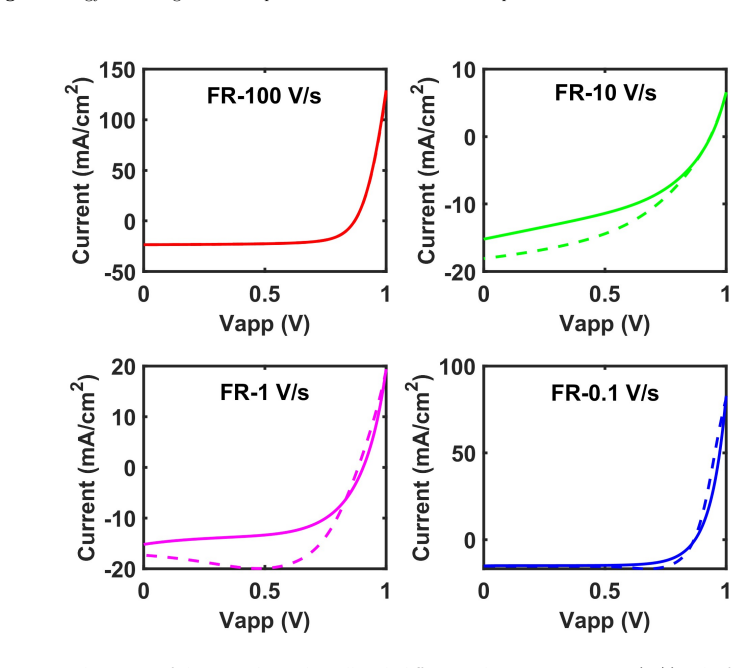
The paper's central claim is that one online platform can cover the full photovoltaic simulation chain—materials, devices, and circuits—and do it more quickly than commercial software without sacrificing accuracy. For a TOPCon silicon cell, the computed J-V curve agrees with a commercial device simulator to within 1% while reducing computation time and memory by more than a factor of ten; for a perovskite cell, the J-V error is again below 1% while computation time drops by more than 100 times. The platform also reproduces hysteresis in perovskite cells at different voltage scan rates, a behavior traced to ion migration, and it simulates organic-cell exciton dissociation, with higher delocalization ratios yielding higher short-circuit current. A separate circuit-level analysis, based on detailed balance theory, decomposes measured J-V curves into bulk, surface, and Auger recombination plus series and shunt resistive losses, and the paper demonstrates this by showing how a polymer additive shifts the loss balance in a perovskite cell.
Load-bearing premise
The accuracy claim rests on commercial simulators being correct references and on the three tested cell types being representative; no measured-device comparison or detailed benchmark protocol is given.
Editorial extensions
If this is right
- Silicon cell design (e.g., TOPCon optimization) could move from expensive desktop tools to a browser service with the same J-V fidelity but much shorter turnaround.
- Organic, perovskite, and tunnel-contact modeling no longer requires assembling separate codes, since tunneling, exciton, and ion-migration physics are integrated in one device solver.
- Measured J-V curves can be converted into a quantitative loss budget (bulk, surface, and Auger recombination plus series and shunt resistance), enabling direct ranking of efficiency bottlenecks.
- If the speed advantage holds across parameter sweeps, high-resolution scans of thickness, doping, and contact properties become practical on the platform.
- The cloud library model lets material and device parameters be updated and shared across organizations, which could support standardization and collaborative benchmarking.
Reading between the lines
- The 1% agreement is with other simulators, not with experiment; testing the same structures against fabricated cells would separate numerical agreement from physical model accuracy.
- The platform's architecture suggests an obvious stress test: run tandem cells or textured silicon devices, where optical-electrical coupling is stronger, to see whether the claimed speed and accuracy generalize beyond the three reported cases.
- If the specialized models are released as open test cases, they could become de facto benchmarks for tunneling, exciton, and ion-migration physics that mainstream commercial tools lack.
- The reported memory and time reductions may depend on benchmark protocol (mesh, tolerance, hardware), so an independent, reproducible benchmark would be needed to convert the claim into a general performance spec.
Editorial analysis
A structured set of objections, weighed in public.
Referee Report
Summary. The paper introduces SolarDesign, an online photovoltaic device simulation and design platform that integrates first-principles material data, optical mode-matching simulations, drift-diffusion electrical models, specialized models for tunneling/exciton/ion dynamics, and circuit-level compact models. It reports J-V simulation results for a TOPCon silicon cell, an organic cell, and a perovskite cell, claiming lower-than-1% agreement with Silvaco/COMSOL and speedups of more than 10x (silicon) and 100x (perovskite). It also presents a circuit-model-based quantification of efficiency losses for perovskite cells.
Significance. If the accuracy and speed claims can be substantiated, SolarDesign would be a useful community resource: it is freely accessible online, spans materials-to-devices-to-circuits, includes models for emerging photovoltaic technologies that commercial solvers lack, and provides a public device library. The platform also benchmarks its ion-migration model against IonMonger, which is a positive sign of engagement with existing tools. However, the current manuscript does not provide a reproducible benchmark protocol or independent validation data, so the central quantitative claims are not yet established.
major comments (4)
- [Sections 5.1 and 5.3, Figs. 1 and 4] The central claims of 'calculation error lower than 1%' and 'computer time reduced by more than 10/100 times' are not supported by a defined benchmark. The error metric is never specified (e.g., maximum absolute error, RMSE, or error normalized by Jsc), no numerical error values are tabulated, and the reported comparisons omit mesh sizes, solver tolerances, Silvaco/COMSOL versions, hardware specifications, and runtime measurement procedures. The statements '1000 sampling points are adopted' do not constitute a protocol. Because the abstract and conclusion rest on these quantitative comparisons, the manuscript must provide a complete benchmark description, a numerical results table, and a comparison against measured device data to establish physical accuracy.
- [Section 5.4, Fig. 7] The 'quantified efficiency losses' are not independent predictions. The modified diode model is fitted to the measured J-V curves, and the pie charts in Fig. 7(c,d) are then computed from those same fitted circuit parameters (bulk SRH, surface SRH, Auger, series, and shunt components). This makes the loss decomposition a restatement of the fit rather than an independent quantification. No parameter uncertainties, confidence intervals, or cross-validation are reported, so the conclusion that 'the dominated surface recombination' causes the high FF of 0.86 is not statistically supported.
- [Sections 3.2-3.4] The numerical methods are described almost entirely by name: mode-matching, Scharfetter-Gummel discretization, Gummel iteration, WKB approximation, Onsager-Braun dissociation, and detailed-balance-based circuit models. Governing equations, boundary conditions, discretization details, convergence criteria, and coupling procedures are not given. For a platform paper whose central value claim is accuracy and speed, the absence of these details prevents an independent assessment of the numerical methods and makes the reported benchmarks difficult to evaluate or reproduce.
- [Section 5.2, Table 3 and Fig. 3] The organic solar cell results are not validated against any commercial package, experimental data, or analytic reference. Table 3 shows a monotonic trend of increasing Jsc with delocalization ratio, but no quantitative accuracy assessment is offered. Since the paper explicitly advertises exciton dissociation as one of the platform's unique capabilities, the organic cell case needs a reference comparison or experimental validation before the capability can be considered demonstrated.
minor comments (6)
- [Abstract] Phrases such as 'fully independent intellectual property rights' and 'internationally advanced numerical methods' are promotional rather than scientific; the abstract should state verifiable technical claims and, if possible, a URL or data availability statement.
- [Table 1] The feature comparison table lists software names without references, version numbers, or dates, which makes the entries hard to verify; add citations and specify the exact versions compared.
- [Section 5.1, Fig. 2] The statement that 'the continuity of classical total current ... can be satisfied at all device regions except for the tunnel oxide layer' is unclear; clarify whether the classical current is expected to be discontinuous there and how the tunneling model restores current conservation.
- [Header and PACS codes] The PACS code line is malformed ('P ACS: 88.40.H- 88.40.hj 07.05.T p 02.60.-x'); correct the formatting and ensure each code is valid.
- [Figures 1 and 4] The runtime and memory comparisons are presented qualitatively in the figures; report actual values (e.g., wall-clock time, peak memory, hardware model) in the text or captions so the claimed speedups can be checked.
- [References] Several references are incomplete (e.g., missing page numbers for Refs. 16 and 21) and web references lack access dates; the reference list should be harmonized to the journal style.
Circularity Check
No significant circularity: the platform's accuracy claims are benchmarked against external commercial software, and the Section 5.4 loss quantification is explicitly a model fit to measured J-V curves, not an independent first-principles prediction.
full rationale
The paper's central claim is that SolarDesign matches Silvaco and COMSOL to within 1% for J-V curves while running over an order of magnitude faster (Sections 5.1 and 5.3). These comparisons are against external commercial solvers, not against outputs of the platform itself, so they are not circular by construction; the absence of detailed benchmark protocol (error metric, mesh, tolerances, versions, hardware) is a reproducibility concern, not a circularity one. The only apparent candidate for circularity is the efficiency-loss quantification in Section 5.4. Section 4.4 states explicitly that the circuit model takes 'experimentally measured current density-voltage curves' as input and outputs fitted J-V curves, the five fitted parameters, and 'the quantified proportion of device efficiency loss.' The loss proportions are therefore a transparent reparameterization of the fitted diode model, not an independently predicted quantity; the paper does not claim to predict those losses from first principles. This is a standard model-based loss attribution, not a case where a quantity is used to derive itself. The specialized models (tunneling, exciton dissociation, ion migration) are cited to published independent work or prior peer-reviewed papers, and the ion-migration results are benchmarked against IonMonger. No self-citation chain is invoked to force a conclusion. Overall, the derivation chain is not circular; the principal risks are empirical validation and benchmark reproducibility, which fall under correctness, not circularity.
Assumptions & free parameters
free parameters (3)
- Five circuit model parameters (traditional: Isc, dark current, ideality factor, Rs, Rsh; new model: bulk SRH, surface…
- Exciton delocalization ratio =
0.7 and 0.3
- Texture factor =
0 to 1
assumptions (4)
- standard math Maxwell's equations and boundary conditions describe optical absorption in multilayer devices.
- standard math Drift-diffusion model (Poisson equation and current continuity) describes carrier transport in solar cells.
- domain assumption Density functional theory with GGA and HSE functionals gives accurate material parameters for photovoltaic materials.
- domain assumption Commercial software (Silvaco, COMSOL) results are a valid reference for accuracy of SolarDesign.
Cite this review
Pith. "Pith review of SolarDesign: An Online Photovoltaic Device Simulation and Design Platform." pith.science (2026). https://pith.science/paper/NFEIN6MS
@misc{pith2026241220009,
  author       = {Pith},
  title        = {Pith review of: SolarDesign: An Online Photovoltaic Device Simulation and Design Platform},
  year         = {2026},
  howpublished = {\url{https://pith.science/paper/NFEIN6MS}},
  note         = {Machine review of arXiv:2412.20009}
}
read the original abstract
SolarDesign (https://solardesign.cn/) is an online photovoltaic device simulation and design platform that provides engineering modeling analysis for crystalline silicon solar cells, as well as emerging high-efficiency solar cells such as organic, perovskite, and tandem cells. The platform offers user-updatable libraries of basic photovoltaic materials and devices, device-level multi-physics simulations involving optical-electrical-thermal interactions, and circuit-level compact model simulations based on detailed balance theory. Employing internationally advanced numerical methods, the platform accurately, rapidly, and efficiently solves optical absorption, electrical transport, and compact circuit models. It achieves multi-level photovoltaic simulation technology from ``materials to devices to circuits'' with fully independent intellectual property rights. Compared to commercial software, the platform achieves high accuracy and improves speed by more than an order of magnitude. Additionally, it can simulate unique electrical transport processes in emerging solar cells, such as quantum tunneling, exciton dissociation, and ion migration.
Figures


Figures from the paper (4 more)



Reference graph
Works this paper leans on
-
[1]
2024Journal of Applied Physics 135 225703
Tian L, Sha W E I, Xie H, Liu D, Sun T G, Xia Y S, et al. 2024Journal of Applied Physics 135 225703
-
[2]
Wang Z S, Sha W E I, and Choy W C H 2016Journal of Applied Physics 120 213101
-
[3]
Courtier N E, Cave J M, Walker A B, Richardson G, and Foster J M 2019Journal of Computational Electronics 18 1435-1449
-
[4]
Courtier N E, Cave J M, Foster J M, Walker A B, and Richardson G 2019Energy & Environmental Science 12 396-409
-
[5]
https://www.comsol.com/
-
[6]
https://silvaco.com/
-
[7]
https://www.ansys.com/products/optics/fdtd
-
[8]
https://www.pvlighthouse.com.au/
Show all 31 references
-
[9]
https://www.pveducation.org/
-
[10]
Hohenberg P and Kohn W 1964Phys. Rev. 136 B864
-
[11]
Kresse G and Furthmüller J 1996Phys. Rev. B 54 11169
-
[12]
Kresse G and Furthmüller J 1996Computational Materials Science 6 15
-
[13]
Blöchl P E 1994Phys. Rev. B 50 17953
-
[14]
Perdew J P, Burke K, and Ernzerhof M 1996Phys. Rev. Lett. 77 18
-
[15]
Paier J, Marsman M, Hummer K, Kresse G, Gerber I C, and Ángyán J G 2006J. Chem. Phys. 124 154709
-
[16]
Heyd J, Scuseria G E, and Ernzerhof M 2003J. Chem. Phys. 118 8207
-
[17]
Phys.: Condens
Klimeš J, Bowler D R, and Michaelides A 2009J. Phys.: Condens. Matter 22 022201
-
[18]
2021Science Bulletin 66 1973
Zhao X G, et al. 2021Science Bulletin 66 1973
1973
-
[19]
Luo S, et al. 2022J. Phys. Chem. A 126 4300
-
[20]
Gajdoš M, Hummer K, Kresse G, Furthmüller J, and Bechstedt F 2006Phys. Rev. B 73 045112
-
[21]
Tanaka K, Takahashi T, Ban T, Kondo T, Uchida K, and Miura N 2003Solid State Communications 127 619
-
[22]
Chew W C 1984Waves and Fields in Inhomogenous Media (New York: Wiley-IEEE Press)
-
[23]
Sha W E I, Choy W C H, Liu Y G, and Chew W C 2011Applied Physics Letters 99 113304
-
[24]
Sha W E I, Ren X, Chen L, and Choy W C H 2015Applied Physics Letters 106 221104
-
[25]
Ren X, Wang Z, Sha W E I, and Choy W C H 2017ACS Photonics 4 934-942
-
[26]
Selberherr S 1984 Analysis and Simulation of Semiconductor Devices (New York: Springer)
1984
-
[27]
Sha W E I, Choy W C H, Wu Y, and Chew W C 2012Optics Express 20 2572-2580
-
[28]
2018Advanced Energy Materials 8 1701586
Sha W E I, Zhang H, Wang Z S, Zhu H L, Ren X, Lin F, et al. 2018Advanced Energy Materials 8 1701586
-
[29]
Xu T, Wang Z S, Li X H, and Sha W E I 2021Acta Physica Sinica 70 098801
-
[30]
Lin M, Xu X, Tian H, Yang Y, Sha W E I, and Zhong W 2024Solar RRL 8 2300722
-
[31]
2021Science Advances 7 eabg0633 12
Cao Q, Li Y, Zhang H, Yang J, Han J, Xu T, et al. 2021Science Advances 7 eabg0633 12
Reviewed August 10, 2026 · model on record in the stance chip above.
Discussion (0). Continue with ORCID to comment.