REVIEW 2 major objections 6 minor 73 references
Symbiotic novae
T0 review · 2 major / 6 minor · reviewed 2026-08-10 · deepseek-v4-flash
Pith's one-line read This review proposes a single 3D geometry for symbiotic novae, placing hard X-rays, radio synchrotron, and permitted lines at the equatorial wind-enhancement interface and forbidden lines in polar lobes.
desk verdict A useful review with a new catalog and a clear 3D synthesis, but the quantitative argument placing Hα and hard X-rays at the DEOP interface rests on a shaky FWHM-to-distance conversion. read the letter →
The pith
A machine-rendered reading of the paper's core claim, the machinery that carries it, and where it could break.
The reading
What carries the argument
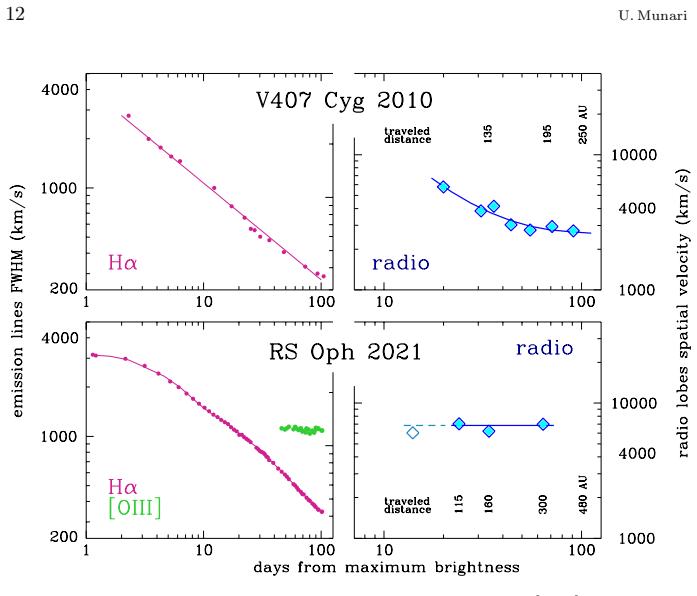
The central object is the DEOP (Density Enhancement on the Orbital Plane): the dense, equatorial concentration of the red giant's wind created by the white dwarf's gravitational pull. The paper uses this structure as the organizing element of the whole multi-wavelength phenomenology; it sets the deceleration profile of the ejecta, determines where the hard X-ray and permitted-line shocks occur, and absorbs the radio emission from the far lobe. A second essential element is the measured contrast in deceleration: RS Oph's radio lobes maintain ~8150 km/s to day 64 while the H-alpha-emitting ejecta travel only ~15 AU in 100 days, showing that the permitted-line region is distinct from the fast polar outflow.
What would settle it
Very long baseline interferometry of RS Oph at late epochs (years after outburst) could image the central radio component: if it is found to move outward with the speed of the polar lobes rather than staying stationary near the binary position, the DEOP/ejecta interface would not be the source of the compact radio emission.
Extended reading notes
Core claim
The paper establishes a 3D picture of a symbiotic nova in which the ejecta from the white dwarf interact with the pre-existing circumstellar material in two distinct locations. Close to the binary, the ejecta slam into the DEOP, a density enhancement on the orbital plane formed when the white dwarf's gravity deflects the red giant's wind away from the poles. This DEOP/ejecta interface is where most of the hard X-rays, the compact radio-synchrotron component, and the permitted optical emission lines originate, and probably also the early gamma-ray emission. Toward the poles, where the density is much lower, the ejecta keep moving at thousands of km/s and form wide bipolar lobes whose inner regions host the forbidden lines, while the shocked outer edges are the site of the radio synchrotron lobes. The same model also explains the free-free absorption of the receding radio lobe by the ionized DEOP seen in RS Oph.
Load-bearing premise
The entire 3D picture rests on the assumption that the red giant's wind is efficiently deflected into a dense equatorial plane (DEOP) by the white dwarf's gravity, leaving the polar directions relatively empty; if this focusing is weaker than assumed, the assigned emission sites would have to be revised.
Editorial extensions
If this is right
- The next outburst of T CrB, expected around 2025-2026, should show a prompt free-free radio flash from the UV-ionized red giant wind within 1-2 days, before synchrotron emission from shocked ejecta takes over.
- If the 3D geometry is generic, then for any symbiotic nova the hard X-ray and H-alpha light curves should evolve identically and smoothly, as observed in RS Oph in both 2006 and 2021.
- The DEOP/ejecta interface should remain a compact, unresolved radio source near the binary position, not expanding with the polar lobes, a prediction that VLBI can test.
- Forbidden-line profiles should stay narrow and decouple from the broad permitted lines, tracing the slowly moving inner cavity of the bipolar lobes.
- The recurrence timescale of symbiotic novae depends on how quickly the red giant wind refills the cavity blown by the previous eruption; RS Oph data suggest refilling is complete within about 9 years.
Reading between the lines
- The DEOP wind-focusing mechanism implies that the mass-loss geometry of the red giant directly controls the nova's multi-wavelength visibility; an observer looking down the orbital poles would see a very different light curve than one looking through the orbital plane.
- If the permitted lines and hard X-rays are co-spatial, then high-resolution spectroscopy during the first days could measure the density and temperature structure of the very inner DEOP, which is otherwise inaccessible.
- The 'K' radio blob in V407 Cyg suggests that super-active accretion phases before eruption can eject collimated mass; searching for similar blobs in T CrB's pre-eruption data might reveal a common pre-nova ejection mechanism.
- The paper's catalog of symbiotic novae, selected by M(K) from 2MASS and Gaia, could be extended to fainter or more reddened objects by using mid-infrared colors or variability, which would test whether the bimodal M(K) distribution is complete.
Signed reviews
Editorial analysis
A structured set of objections, weighed in public.
Referee Report
Summary. The manuscript is an invited review of symbiotic novae, defined as thermonuclear runaways occurring in symbiotic binaries. It presents a revised catalog of Galactic symbiotic novae based on Gaia DR3 astrometry and 2MASS K-band photometry, then uses the well-observed 2006/2021 outbursts of RS Oph and the 2010 outburst of V407 Cyg to propose a three-dimensional model of the outburst structure. In this model, the gravitational focusing of the red-giant wind creates a dense equatorial structure (DEOP); the DEOP/ejecta interface is claimed to be the site of the hard X-rays, the central radio-synchrotron component, and the permitted optical lines, while forbidden lines form in the inner regions of the bipolar lobes. The review also discusses the UV-flash ionization of the red-giant wind, the prompt radio emission, and the expected imminent eruption of T CrB.
Significance. The paper is a valuable synthesis of multi-wavelength observations of two rare and closely monitored symbiotic novae, and the revised catalog is a useful community resource built on public data with explicit astrometric vetting. The proposed 3D model is physically motivated and makes specific, testable predictions (e.g., the spatial coincidence of Hα and hard X-rays, the DEOP as a free-free absorber, and the expected behavior of the upcoming T CrB outburst). The manuscript is also notable for explicitly integrating VLBI lobe kinematics, X-ray light curves, and optical line profiles into a single geometric picture.
major comments (2)
- [§3.2] The 14–15 AU distance traveled by the Hα-emitting ejecta is derived by integrating v_exp(t) = FWHM_Hα(t)/2.355, which assumes that the Gaussian line width directly measures the bulk expansion velocity of the emitting gas. This assumption is not uniquely justified: in an optically thick, velocity-stratified ejecta the line width can shrink as the photosphere recedes into slower material even if the ejecta coast at constant velocity, and in a radiative shock Hα can be emitted by decelerated post-shock gas whose width does not track the spatial displacement of the emitting region. The observed smooth FWHM ∝ t^(−0.6/−0.7) decline is equally compatible with a smooth radial density/velocity gradient in a no-deceleration flow. Because this conversion is the only quantitative estimate of the size of the Hα-emitting region, the statement in §3.4 that 'the DEOP/ejecta interface is the location from where originates most of the hard X-rays, the central radio-synchrotron component, and the permitted optical emission lines' is stronger than the current evidence supports. The authors should either provide an independent check (e.g., resolved line-profile constraints, light-echo bounds, or model comparison) or rephrase this conclusion as a working hypothesis to be tested by future observations.
- [§3.4] The model is presented as a '3D picture of RS Oph (serving also as a guideline for symbiotic novae in general)', but the two systems used to construct the model have qualitatively different deceleration behaviors: the radio lobes of RS Oph expand at constant 8150 km/s after day 14, while those of V407 Cyg decelerate from 6000 to 2800 km/s over days 20–91, a difference attributed to a factor of ~20 in orbital separation (§3.2). It is therefore not self-evident that a single geometric assignment (Hα and hard X-rays always at the DEOP interface, forbidden lines always in the inner lobes) applies to all symbiotic novae, including systems like T CrB that have not yet been observed in a comparable multi-wavelength campaign. The authors should state explicitly the conditions under which the model applies and what observations would falsify it for a particular system.
minor comments (6)
- [Abstract] The word 'syncrothron' appears in the abstract; it should be 'synchrotron'.
- [§1] In the sentence beginning 'Unbind from the system', the intended word is 'Unbound' rather than 'Unbind'.
- [§3.4] In the first paragraph of Section 3.4, 'lunched' should be 'launched'.
- [§4] In the final paragraph, 'will results is' should be 'will result in', and 'particoular' should be 'particular'.
- [Table 1] V5581 Sgr is listed with a negative Gaia DR3 parallax (π = −0.04, σ(π) = 0.145); the text mentions that some systems use literature distances, but it is not clear which rows use that approach and how the adopted distance for V5581 Sgr was determined, so a clarifying note would be helpful.
- [§3.2] The recombination e-folding times, derived electron densities, and FWHM power-law slopes are quoted without uncertainties; adding error bars or a systematic-uncertainty statement would strengthen the quantitative comparisons in Figures 2 and 4.
Circularity Check
No significant circularity: the 3D model is an interpretive synthesis of independent multi-wavelength data, and no derived quantity reduces by construction to a fitted input or to a self-citation chain.
full rationale
The paper is an invited review whose central contribution is a 3D interpretive model for symbiotic novae. The model locates hard X-rays, permitted lines, and the central radio-synchrotron source at the DEOP/ejecta interface, and forbidden lines in the inner bipolar lobes, using converging but independent evidence: VLBI radio-lobe kinematics, free-free absorption geometry, H-alpha FWHM evolution, Swift X-ray light curves, and nebular line behavior. No equation in the paper defines a derived quantity in terms of an earlier fitted quantity in a way that makes the conclusion true by construction. The H-alpha FWHM-to-distance conversion (FWHM/2.355 integrated over time) is an interpretive assumption about what the line width measures, not a circular reduction: it is not the case that the distance traveled is inserted into the same formula that produces the FWHM, nor is the DEOP location imposed as an input and then recovered as an output. Similarly, the matching time dependence of H-alpha and hard X-ray fluxes is cited as empirical support for co-spatiality, but co-spatiality is not used to define either light curve. The heavy reliance on the author's own earlier papers is for observational data (spectra, VLBI maps, X-ray decompositions) and catalog work; these are external empirical measurements, and the central conclusion does not rest on an unverified self-citation or on a uniqueness theorem imported from the author's prior work. The DEOP concept itself is grounded in cited external wind-focusing models and in direct radio evidence of bipolar lobes and free-free absorption. Potential weaknesses such as the degeneracy between line-width shrinking and optical-depth/velocity-stratification effects are modeling uncertainties, not circularities. Accordingly, the derivation chain is self-contained against external benchmarks and the circularity score is 0.
Assumptions & free parameters
free parameters (6)
- Recombination e-folding time for V407 Cyg 2010 =
100 hours
- Recombination e-folding time for RS Oph 2021 =
60 hours
- Recombination e-folding time for V3890 Sgr 2019 =
13 hours
- FWHM power-law slope for V407 Cyg Hα =
-0.59
- FWHM power-law slope for RS Oph Hα =
-0.73
- M(K) cutoff for symbiotic novae =
-4.0 mag
assumptions (4)
- domain assumption The ejecta are decelerated by sweeping up the red giant wind, with kinetic energy converted to radiation.
- domain assumption The red giant wind is gravitationally focused by the WD into a density enhancement on the orbital plane (DEOP).
- standard math The recombination timescale formula t_rec = 0.66 T_e^0.8 n_e^-1 (Ferland 2003) applies to the flashed wind.
- domain assumption The WD in symbiotic novae undergoes the same thermonuclear runaway as in classical novae.
Cite this review
Pith. "Pith review of Symbiotic novae." pith.science (2026). https://pith.science/paper/DWSVGURD
@misc{pith2026241220499,
  author       = {Pith},
  title        = {Pith review of: Symbiotic novae},
  year         = {2026},
  howpublished = {\url{https://pith.science/paper/DWSVGURD}},
  note         = {Machine review of arXiv:2412.20499}
}
read the original abstract
(Invited Review) According to modern definition, a symbiotic nova is an otherwise normal nova (i.e. powered by explosive thermonuclear burning) that erupts within a symbiotic star, which is a binary where a WD accretes from a cool giant companion. Guided primarily by the very well observed eruptions of RS Oph in 2006 and 2021, and that of V407 Cyg in 2010, we investigate the main multi-wavelength properties of symbiotic novae and their relation to classical novae, and propose a 3D model structure that identifies the emitting source location for hard and supersoft X-rays, radio syncrothron and thermal, permitted and forbidden emission lines. Very few symbiotic novae are known in the Galaxy, and we compile a revised catalog based on firm astrometric identification. The exciting prospect of an imminent new outburst of T CrB is also discussed.
Figures


Figures from the paper (3 more)


Reference graph
Works this paper leans on
-
[1]
, " * write output.state after.block = add.period write newline
ENTRY address archiveprefix author booktitle chapter edition editor howpublished institution eprint journal key month note number organization pages publisher school series title type volume year doi label extra.label sort.label short.list INTEGERS output.state before.all mid.sentence after.sentence after.block FUNCTION init.state.consts #0 'before.all :=...
-
[2]
write newline
" write newline "" before.all 'output.state := FUNCTION n.dashify 't := "" t empty not t #1 #1 substring "-" = t #1 #2 substring "--" = not "--" * t #2 global.max substring 't := t #1 #1 substring "-" = "-" * t #2 global.max substring 't := while if t #1 #1 substring * t #2 global.max substring 't := if while FUNCTION word.in bbl.in " " * FUNCTION format....
-
[3]
A., Ackermann , M., Ajello , M., et al
Abdo , A. A., Ackermann , M., Ajello , M., et al. , Gamma-Ray Emission Concurrent with the Nova in the Symbiotic Binary V407 Cygni . 2010, Science , 329 , 817, DOI: 10.1126/science.1192537
-
[4]
A., Ansoldi , S., Antonelli , L
Acciari , V. A., Ansoldi , S., Antonelli , L. A., et al. , Proton acceleration in thermonuclear nova explosions revealed by gamma rays . 2022, Nature Astronomy , 6 , 689, DOI: 10.1038/s41550-022-01640-z
-
[5]
A., On the late-type components of slow novae and symbiotic stars
Allen , D. A., On the late-type components of slow novae and symbiotic stars. 1980, , 192 , 521, DOI: 10.1093/mnras/192.3.521
-
[6]
, Measuring the Mass Radius Relation of White Dwarfs Using Wide Binaries
Arseneau , S., Chandra , V., Hwang , H.-C., et al. , Measuring the Mass Radius Relation of White Dwarfs Using Wide Binaries . 2024, , 963 , 17, DOI: 10.3847/1538-4357/ad2168
-
[7]
Banerjee , D. P. K., Joshi , V., Venkataraman , V., et al. , Near-IR Studies of Recurrent Nova V745 Scorpii during its 2014 Outburst . 2014, , 785 , L11, DOI: 10.1088/2041-8205/785/1/L11
-
[8]
Bode , M. F. & Evans , A., eds. 1989, Classical novae (John Wiley & Sons)
work page 1989
Show all 73 references
-
[9]
Bode , M. F. & Evans , A., eds. 2008, Classical Novae (Cambridge Univ. Press)
2008
-
[10]
E., & Garc \' a , L
Brandi , E., Quiroga , C., Miko ajewska , J., Ferrer , O. E., & Garc \' a , L. G., Spectroscopic orbits and variations of RS Ophiuchi . 2009, , 497 , 815, DOI: 10.1051/0004-6361/200811417
2009 doi
-
[11]
2004, ESA Special Publication, Vol
Cassatella , A., Gonz \'a lez-Riestra , R., & Selvelli , P., eds. 2004, ESA Special Publication, Vol. 1283 , INES Access Guide No. 3 - Classical Novae
2004
-
[12]
L., Gilmozzi , R., Bianchini , A., & Friedjung , M., IUE observations of faint old novae
Cassatella , A., Selvelli , P. L., Gilmozzi , R., Bianchini , A., & Friedjung , M., IUE observations of faint old novae. 1990, in Accretion-Powered Compact Binaries , ed. C. W. Mauche (Cambridge Univ. Press), 373--376
1990
-
[13]
& Viotti , R., eds
Cassatella , A. & Viotti , R., eds. 1990, Lecture Notes in Physics, Vol. 369 , Physics of Classical Novae (Springer-Verlag)
1990
-
[14]
F., & Shara , M
Downes , R., Webbink , R. F., & Shara , M. M., A Catalog and Atlas of Cataclysmic Variables-Second Edition . 1997, , 109 , 345, DOI: 10.1086/133900
1997 doi
-
[15]
Downes , R. A. & Shara , M. M., A Catalog of Cataclysmic Variables . 1993, , 105 , 127, DOI: 10.1086/133139
1993 doi
-
[16]
A., Webbink , R
Downes , R. A., Webbink , R. F., Shara , M. M., et al. , A Catalog and Atlas of Cataclysmic Variables: The Living Edition . 2001, , 113 , 764, DOI: 10.1086/320802
2001 doi
-
[17]
Duerbeck , H. W. 1987, A reference catalogue and atlas of galactic novae (D. Reidel Publ.)
1987
-
[18]
F., O'Brien , T
Evans , A., Bode , M. F., O'Brien , T. J., & Darnley , M. J., eds. 2008, Astronomical Society of the Pacific Conference Series, Vol. 401 , RS Ophiuchi (2006) and the Recurrent Nova Phenomenon
2006
-
[19]
J., Quantitative Spectroscopy of Photoionized Clouds
Ferland , G. J., Quantitative Spectroscopy of Photoionized Clouds . 2003, , 41 , 517, DOI: 10.1146/annurev.astro.41.011802.094836
2003 arXiv
-
[20]
Y., A Theory of Hydrogen Shell Flashes on Accreting White Dwarfs - Part Two - the Stable Shell Burning and the Recurrence Period of Shell Flashes
Fujimoto , M. Y., A Theory of Hydrogen Shell Flashes on Accreting White Dwarfs - Part Two - the Stable Shell Burning and the Recurrence Period of Shell Flashes . 1982 a , , 257 , 767, DOI: 10.1086/160030
1982 doi
-
[21]
Y., A theory of hydrogen shell flashes on accreting white dwarfs
Fujimoto , M. Y., A theory of hydrogen shell flashes on accreting white dwarfs. I - Their progress and the expansion of the envelope. II - The stable shell burning and the recurrence period of shell flashes . 1982 b , , 257 , 752, DOI: 10.1086/160029
1982 doi
-
[22]
2016, , 595 , A1, DOI: 10.1051/0004-6361/201629272
Gaia Collaboration , The Gaia mission . 2016, , 595 , A1, DOI: 10.1051/0004-6361/201629272
2016 doi
-
[23]
Summary of the content and survey properties
Gaia Collaboration , Gaia Data Release 3. Summary of the content and survey properties . 2023, , 674 , A1, DOI: 10.1051/0004-6361/202243940
2023 doi
-
[24]
Gaposchkin , C. H. P. 1957, The Galactic Novae (Dover Pub.)
1957
-
[25]
, Very long baseline interferometry imaging of the advancing ejecta in the first gamma-ray nova V407 Cygni
Giroletti , M., Munari , U., K \"o rding , E., et al. , Very long baseline interferometry imaging of the advancing ejecta in the first gamma-ray nova V407 Cygni . 2020, , 638 , A130, DOI: 10.1051/0004-6361/202038142
2020 doi
-
[26]
H. E. S. S. Collaboration , Aharonian , F., Ait Benkhali , F., et al. , Time-resolved hadronic particle acceleration in the recurrent nova RS Ophiuchi . 2022, Science , 376 , 77, DOI: 10.1126/science.abn0567
2022 doi
-
[27]
& Jos \'e , J., eds
Hernanz , M. & Jos \'e , J., eds. 2002, American Institute of Physics Conference Series, Vol. 637 , Classical Nova Explosions (AIP)
2002
-
[28]
H., Fekel , F
Hinkle , K. H., Fekel , F. C., Joyce , R. R., & Wood , P., Infrared Spectroscopy of Symbiotic Stars. IX. D-type Symbiotic Novae . 2013, , 770 , 28, DOI: 10.1088/0004-637X/770/1/28
2013 doi
-
[29]
1982, , 259 , 244, DOI: 10.1086/160164
Iben , I., J., Hot accreting white dwarfs in the quasi-static approximation . 1982, , 259 , 244, DOI: 10.1086/160164
1982 doi
-
[30]
Kenyon , S. J. 1986, The symbiotic stars (Cambridge Univ. Press)
1986
-
[31]
Kenyon , S. J. & Truran , J. W., The outbursts of symbiotic novae. 1983, , 273 , 280, DOI: 10.1086/161367
1983 doi
-
[32]
A., Shenavrin , V
Kolotilov , E. A., Shenavrin , V. I., Shugarov , S. Y., & Yudin , B. F., UBVJHKLM photometry of the symbiotic Mira V407 Cyg in 1998 2002 . 2003, Astronomy Reports , 47 , 777, DOI: 10.1134/1.1611218
1998 doi
-
[33]
, High-resolution imaging of the evolving bipolar outflows in symbiotic novae: The case of the RS Ophiuchi 2021 nova outburst
Lico , R., Giroletti , M., Munari , U., et al. , High-resolution imaging of the evolving bipolar outflows in symbiotic novae: The case of the RS Ophiuchi 2021 nova outburst . 2024, , 692 , A107, DOI: 10.1051/0004-6361/202451364
2021 doi
-
[34]
Liimets , T., Corradi , R. L. M., Santander-Garc \' a , M., et al. , A Three-dimensional View of the Remnant of Nova Persei 1901 (GK Per) . 2012, , 761 , 34, DOI: 10.1088/0004-637X/761/1/34
1901 doi
-
[35]
& Podsiadlowski , P., Mass Transfer in Mira-type Binaries
Mohamed , S. & Podsiadlowski , P., Mass Transfer in Mira-type Binaries . 2012, Baltic Astronomy , 21 , 88, DOI: 10.1515/astro-2017-0362
2012 doi
-
[36]
D., et al
Molina , I., Chomiuk , L., Linford , J. D., et al. , The symbiotic recurrent nova V745 Sco at radio wavelengths . 2024, , 534 , 1227, DOI: 10.1093/mnras/stae2093
2024 doi
-
[37]
Montez , R., Luna , G. J. M., Mukai , K., Sokoloski , J. L., & Kastner , J. H., Expanding Bipolar X-Ray Structure After the 2006 Eruption of RS Oph . 2022, , 926 , 100, DOI: 10.3847/1538-4357/ac4583
2006 doi
-
[38]
2019, in The Impact of Binary Stars on Stellar Evolution , ed
Munari , U., The Symbiotic Stars . 2019, in The Impact of Binary Stars on Stellar Evolution , ed. G. Beccari & H. Boffin , arXiv:1909.01389
2019 arXiv
-
[39]
2016, , 47 , 7, DOI: 10.1016/j.newast.2016.01.002
Munari , U., Dallaporta , S., & Cherini , G., The 2015 super-active state of recurrent nova T CrB and the long term evolution after the 1946 outburst . 2016, , 47 , 7, DOI: 10.1016/j.newast.2016.01.002
2015 doi
-
[40]
, Radio interferometric imaging of RS Oph bipolar ejecta for the 2021 nova outburst
Munari , U., Giroletti , M., Marcote , B., et al. , Radio interferometric imaging of RS Oph bipolar ejecta for the 2021 nova outburst . 2022, , 666 , L6, DOI: 10.1051/0004-6361/202244821
2021 doi
-
[41]
H., Ashok , N
Munari , U., Joshi , V. H., Ashok , N. M., et al. , The 2010 nova outburst of the symbiotic Mira V407 Cyg . 2011, , 410 , L52, DOI: 10.1111/j.1745-3933.2010.00979.x
2010
-
[42]
& Tabacco , F., Flickering Returns as RS Oph Reestablishes Quiescent Conditions Following its 2021 Nova Outburst
Munari , U. & Tabacco , F., Flickering Returns as RS Oph Reestablishes Quiescent Conditions Following its 2021 Nova Outburst . 2022, Research Notes of the American Astronomical Society , 6 , 103, DOI: 10.3847/2515-5172/ac72ae
2021 doi
-
[43]
, The GALAH survey and symbiotic stars - I
Munari , U., Traven , G., Masetti , N., et al. , The GALAH survey and symbiotic stars - I. Discovery and follow-up of 33 candidate accreting-only systems . 2021, , 505 , 6121, DOI: 10.1093/mnras/stab1620
2021 doi
- [44]
-
[45]
& Valisa , P., The 2021 outburst of RS Oph: a pictorial atlas of the spectroscopic evolution
Munari , U. & Valisa , P., The 2021 outburst of RS Oph: a pictorial atlas of the spectroscopic evolution. II. From day 19 to 102 (solar conjunction) . 2022, arXiv e-prints , arXiv:2203.01378, DOI: 10.48550/arXiv.2203.01378
-
[46]
U., Beardmore , A
Ness , J. U., Beardmore , A. P., Bode , M. F., et al. , High-resolution X-ray spectra of RS Ophiuchi (2006 and 2021): Revealing the cause of SSS variability . 2023, , 670 , A131, DOI: 10.1051/0004-6361/202245269
2006 doi
-
[47]
M., Linford , J
Nyamai , M. M., Linford , J. D., Allison , J. R., et al. , Synchrotron emission from double-peaked radio light curves of the symbiotic recurrent nova V3890 Sgr . 2023, , 523 , 1661, DOI: 10.1093/mnras/stad1534
2023 doi
-
[48]
& Bode , M., Resolved nebular remnants
O'Brien , T. & Bode , M., Resolved nebular remnants . 2008, in Classical Novae , ed. M. F. Bode & A. Evans (Cabridge Univ. Press), 285--305
2008
-
[49]
P., Page , K
Osborne , J. P., Page , K. L., Beardmore , A. P., et al. , The Supersoft X-ray Phase of Nova RS Ophiuchi 2006 . 2011, , 727 , 124, DOI: 10.1088/0004-637X/727/2/124
2006 doi
-
[50]
L., Beardmore , A
Page , K. L., Beardmore , A. P., Osborne , J. P., et al. , The 2021 outburst of the recurrent nova RS Ophiuchi observed in X-rays by the Neil Gehrels Swift Observatory: a comparative study . 2022, , 514 , 1557, DOI: 10.1093/mnras/stac1295
2021 doi
-
[51]
& Wright , F
Payne-Gaposchkin , C. & Wright , F. W., The Photographic Light-Curve of T Coronae Borealis. 1946, , 104 , 75, DOI: 10.1086/144834
1946 doi
-
[52]
Ribeiro , V. A. R. M., Bode , M. F., Darnley , M. J., et al. , The Expanding Nebular Remnant of the Recurrent Nova RS Ophiuchi (2006). II. Modeling of Combined Hubble Space Telescope Imaging and Ground-based Spectroscopy . 2009, , 703 , 1955, DOI: 10.1088/0004-637X/703/2/1955
2006 doi
-
[53]
Saikia , D. F. & Anupama , G. C., eds. 2012, Bull. Astr. Soc. India, Vol. 40 , Novae from radio to gamma rays (Astron. Soc. India)
2012
-
[54]
Schaefer , B. E., The B & V light curves for recurrent nova T CrB from 1842-2022, the unique pre- and post-eruption high-states, the complex period changes, and the upcoming eruption in 2025.5 1.3 . 2023, , 524 , 3146, DOI: 10.1093/mnras/stad735
2022 doi
-
[55]
J., Ness , J.-U., Osborne , J
Schwarz , G. J., Ness , J.-U., Osborne , J. P., et al. , Swift X-Ray Observations of Classical Novae. II. The Super Soft Source Sample . 2011, , 197 , 31, DOI: 10.1088/0067-0049/197/2/31
2011 doi
-
[56]
R., Krogulec , M., & Taylor , A
Seaquist , E. R., Krogulec , M., & Taylor , A. R., A Highly Sensitive Radio Survey of Symbiotic Stars at 3.6 Centimeters . 1993, , 410 , 260, DOI: 10.1086/172742
1993 doi
-
[57]
Seaquist , E. R. & Taylor , A. R., The Collective Radio Properties of Symbiotic Stars . 1990, , 349 , 313, DOI: 10.1086/168315
1990 doi
-
[58]
R., Taylor , A
Seaquist , E. R., Taylor , A. R., & Button , S., A Radio Survey of Symbiotic Stars . 1984, , 284 , 202, DOI: 10.1086/162399
1984 doi
-
[59]
N., Wahlgren , G
Shore , S. N., Wahlgren , G. M., Augusteijn , T., et al. , The spectroscopic evolution of the symbiotic-like recurrent nova V407 Cygni during its 2010 outburst. I. The shock and its evolution . 2011, , 527 , A98, DOI: 10.1051/0004-6361/201015901
2010 doi
-
[60]
& Carikov \'a , Z., Wind mass transfer in S-type symbiotic binaries
Skopal , A. & Carikov \'a , Z., Wind mass transfer in S-type symbiotic binaries. I. Focusing by the wind compression model . 2015, , 573 , A8, DOI: 10.1051/0004-6361/201424779
2015 doi
-
[61]
Y., Munari , U., et al
Skopal , A., Shugarov , S. Y., Munari , U., et al. , The path to Z And-type outbursts: The case of V426 Sagittae (HBHA 1704-05) . 2020, , 636 , A77, DOI: 10.1051/0004-6361/201937199
2020 doi
-
[62]
F., Cutri , R
Skrutskie , M. F., Cutri , R. M., Stiening , R., et al. , The Two Micron All Sky Survey (2MASS) . 2006, , 131 , 1163, DOI: 10.1086/498708
2006 doi
-
[63]
L., Rupen , M
Sokoloski , J. L., Rupen , M. P., & Mioduszewski , A. J., Uncovering the Nature of Nova Jets: A Radio Image of Highly Collimated Outflows from RS Ophiuchi . 2008, , 685 , L137, DOI: 10.1086/592602
2008 doi
-
[64]
, VLA observations of the 2021 eruption of RS Oph
Sokolovsky , K., Aydi , E., Chomiuk , L., et al. , VLA observations of the 2021 eruption of RS Oph . 2021, The Astronomer's Telegram , 14886 , 1
2021
-
[65]
1989, in Classical Novae , ed
Starrfield , S., Thermonuclear processes and the classical nova outburst. 1989, in Classical Novae , ed. M. F. Bode & A. Evans (John Wiley & Sons), 39--60
1989
-
[66]
R., Thermonuclear processes
Starrfield , S., Iliadis , C., & Hix , W. R., Thermonuclear processes . 2008, in Classical Novae , ed. M. F. Bode & A. Evans (Cambridge Univ. Press), 77--101
2008
-
[67]
A., Marrese , P
Tatarnikova , A. A., Marrese , P. M., Munari , U., Tomov , T., & Yudin , B. F., Spectral observations of the symbiotic Mira variable V407 Cyg in 1993 2002 . 2003, Astronomy Reports , 47 , 889, DOI: 10.1134/1.1626192
1993 doi
-
[68]
Taylor , A. R. & Seaquist , E. R., Radio emission from symbiotic stars : a binary model. 1984, , 286 , 263, DOI: 10.1086/162594
1984 doi
-
[69]
V., Stoyanov , K
Tomov , T. V., Stoyanov , K. A., & Zamanov , R. K., AG Pegasi - now a classical symbiotic star in outburst? 2016, , 462 , 4435, DOI: 10.1093/mnras/stw2012
2016 doi
-
[70]
Cataclysmic variable stars , , Vol
Warner , B. Cataclysmic variable stars , , Vol. 28 (Cambridge Univ. Press)
-
[71]
, AMI-LA, e-MERLIN and MeerKAT radio detections of RS Oph in outburst
Williams , D., O'Brien , T., Woudt , P., et al. , AMI-LA, e-MERLIN and MeerKAT radio detections of RS Oph in outburst . 2021, The Astronomer's Telegram , 14849 , 1
2021
-
[72]
Woudt , P. A. & Ribeiro , V. A. R. M., eds. 2014, Astronomical Society of the Pacific Conference Series, Vol. 490 , Stella Novae: Past and Future Decades
2014
-
[73]
Y., et al
Zamanov , R., Boeva , S., Latev , G. Y., et al. , Accretion in the recurrent nova T CrB: Linking the superactive state to the predicted outburst . 2023, , 680 , L18, DOI: 10.1051/0004-6361/202348372
2023 doi
Reviewed August 10, 2026 · model on record in the stance chip above.
Discussion (0). Continue with ORCID to comment.