Atmosphere as a steam engine
Pith reviewed 2026-05-25 02:07 UTC · model grok-4.3
The pith
The atmosphere functions as a steam engine in which water vapor evaporation, expansion and condensation generate power matching the total energy of atmospheric motion.
A machine-rendered reading of the paper's core claim, the machinery that carries it, and where it could break.
Core claim
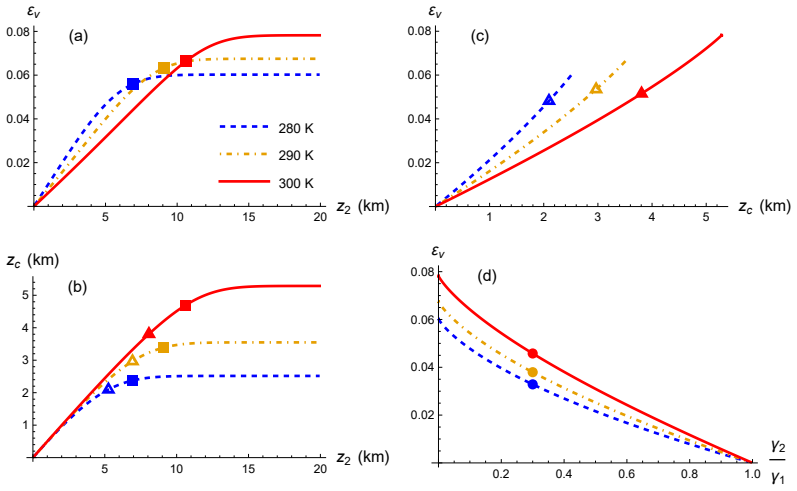
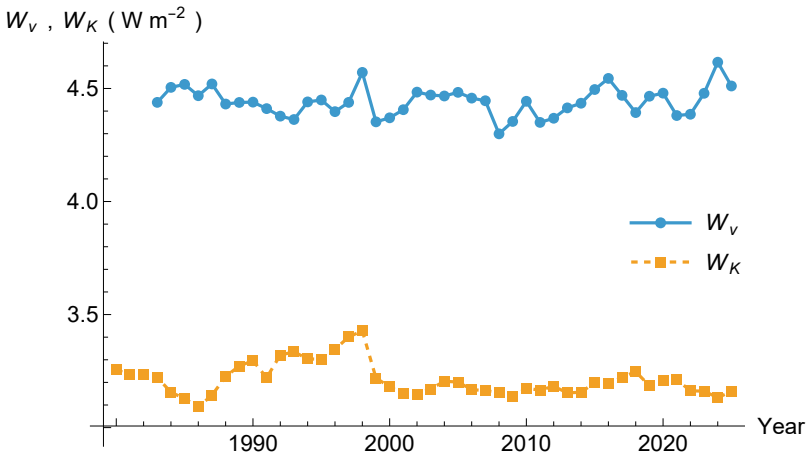
By extending the Clausius-Clapeyron law to condensation distributed over heights and adding gravitational lifting work plus an incomplete-condensation correction, the expansion work per mole of precipitated water can be calculated; when combined with GPCP precipitation rates and observed mean condensation height this produces a global steam-engine power W_v of 4.4 ± 0.9 W/m² that equals the sum of precipitation gravitational power and pressure-gradient kinetic energy generation diagnosed from MERRA-2 reanalysis.
What carries the argument
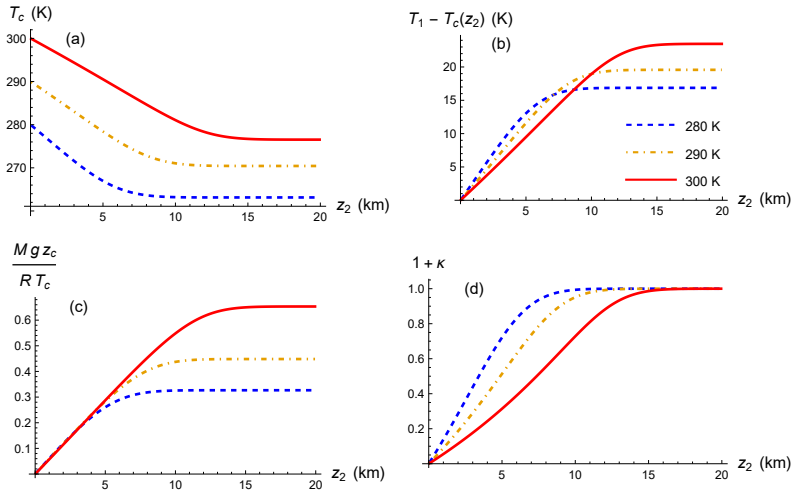
The generalized Clausius-Clapeyron relation for an atmospheric column with condensation over a range of heights, which sums gravitational lifting of moist air, expansion work from condensation, and a correction for incomplete condensation to obtain total work per mole of precipitated water.
If this is right
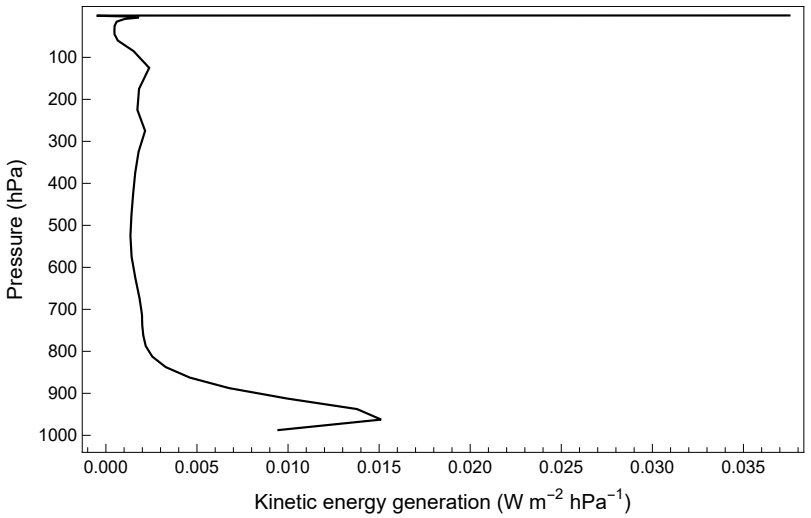
- Kinetic energy generation totals 3.2 ± 0.3 W/m², with at least two thirds occurring in the lower atmosphere.
- The upper-atmosphere kinetic energy contribution is smaller and comparable in magnitude to Lorenz available potential energy generation.
- Precipitation maintains surface pressure gradients by removing water mass and enabling column-mass redistribution that drives cross-isobaric flow.
- Condensation and precipitation fallout supply the thermodynamic basis for the dominant lower-atmospheric power pathway.
Where Pith is reading between the lines
- The framework implies that alterations in global precipitation patterns would directly change the power available to drive atmospheric circulation.
- Regional applications could test whether local steam-engine power scales with observed precipitation and condensation height in different climates.
- Without the mass removal by precipitation, the pressure gradients required for sustained cross-isobaric flow would not be maintained at the observed strength.
Load-bearing premise
The generalization of the Clausius-Clapeyron relation to condensation at varying heights, together with mean condensation height and precipitation data, correctly gives the total expansion work per mole of precipitated water.
What would settle it
Global observations or reanalysis showing the steam-engine power differing from the independently estimated total atmospheric power by more than the stated uncertainty ranges of roughly 1 W/m².
Figures




read the original abstract
Earth's atmosphere operates a steam cycle in which water vapor evaporates from the surface, expands, condenses, and returns as precipitation. The Clausius-Clapeyron law relates the incremental expansion work of saturated water vapor to latent heat converted at a Carnot efficiency corresponding to the temperature difference between evaporation and condensation. We generalize this relation to an atmospheric column with condensation occurring over a range of heights and derive the expansion work per mole of precipitated water. This includes the gravitational work associated with lifting moist air to the mean condensation height, the expansion work generated by condensation, and a correction for incomplete condensation. Using GPCP v3.3 precipitation and observational constraints on condensation height, we estimate the global steam-engine power as $W_v=4.4\pm0.9$ W/m2, close to an independent estimate of total atmospheric power, $W=W_P+W_K\simeq4.3\pm0.6$ W/m2, obtained from the gravitational power of precipitation and kinetic energy generation by horizontal pressure gradients diagnosed from MERRA-2. Kinetic energy generation is $W_K\simeq3.2\pm0.3$ W/m2, of which at least two thirds is generated in the lower atmosphere. The smaller upper-atmospheric contribution, dominated by temperature-related pressure gradients, is comparable to Lorenz available potential energy generation. The agreement between steam-engine and atmospheric power is linked to condensation and precipitation fallout. By removing water from the atmospheric gas phase and enabling column-mass redistribution, precipitation maintains surface pressure gradients that drive cross-isobaric flow in the frictional lower atmosphere. The steam-engine framework thus provides a thermodynamic basis for condensation-induced atmospheric dynamics and identifies a major lower-atmospheric power pathway associated with water phase transitions.
Editorial analysis
A structured set of objections, weighed in public.
Referee Report
Summary. The paper claims that Earth's atmosphere functions as a steam engine, generalizing the Clausius-Clapeyron relation to an atmospheric column to derive the expansion work per mole of precipitated water (including gravitational lifting to mean condensation height, condensation expansion, and incomplete-condensation correction). Using GPCP v3.3 precipitation rates and observational condensation-height constraints, it computes a global steam-engine power W_v = 4.4 ± 0.9 W/m² that agrees with an independent MERRA-2 estimate of total atmospheric power W = W_P + W_K ≈ 4.3 ± 0.6 W/m² (gravitational precipitation power plus kinetic-energy generation by horizontal pressure gradients). It further decomposes W_K ≈ 3.2 ± 0.3 W/m², attributes at least two-thirds to the lower atmosphere, and interprets the numerical match as evidence that precipitation maintains surface pressure gradients driving cross-isobaric flow.
Significance. If the central numerical agreement holds after addressing the mean-height approximation, the result would be significant: it supplies a thermodynamic accounting that directly ties the water cycle to atmospheric power generation and dynamics, identifies a major lower-atmospheric kinetic-energy pathway linked to phase changes, and offers falsifiable predictions via the independent GPCP–MERRA-2 comparison. The use of two distinct observational datasets and the explicit decomposition of W_K strengthen the quantitative claim.
major comments (1)
- [derivation of expansion work per mole] The derivation of expansion work per mole (abstract and associated calculation): the work function is evaluated at a single mean condensation height rather than integrated over the actual vertical distribution of condensation. Because the ideal-gas expansion term, hydrostatic pressure, and temperature-dependent latent heat are nonlinear in height, the mean-value approximation can bias the column-integrated value; the stated ±0.9 W/m² uncertainty is described as arising from precipitation and height constraints but does not explicitly incorporate this distributional error, which directly affects the claimed agreement between W_v and W.
Simulated Author's Rebuttal
We thank the referee for the constructive comment and the positive assessment of the manuscript's significance. We address the major comment point by point below.
read point-by-point responses
-
Referee: [derivation of expansion work per mole] The derivation of expansion work per mole (abstract and associated calculation): the work function is evaluated at a single mean condensation height rather than integrated over the actual vertical distribution of condensation. Because the ideal-gas expansion term, hydrostatic pressure, and temperature-dependent latent heat are nonlinear in height, the mean-value approximation can bias the column-integrated value; the stated ±0.9 W/m² uncertainty is described as arising from precipitation and height constraints but does not explicitly incorporate this distributional error, which directly affects the claimed agreement between W_v and W.
Authors: We agree that the use of a single mean condensation height constitutes an approximation, given the nonlinearity of the ideal-gas expansion, hydrostatic pressure, and temperature-dependent latent heat terms with height. The mean height in the manuscript is obtained from observational constraints (reanalysis and satellite-derived condensation levels) that provide a robust global average but do not resolve the full vertical distribution for explicit integration. While this mean-value approach is expected to capture the dominant contribution, it does not explicitly quantify the second-order distributional bias. We will revise the manuscript to estimate this error by comparing the mean-based calculation against a vertically integrated evaluation using available condensation profiles from MERRA-2 at representative locations. The resulting bias estimate will be added to the uncertainty budget for W_v (currently ±0.9 W/m²), allowing a more complete assessment of the agreement with the independent W estimate. This addition will appear in the methods, results, and discussion sections. revision: yes
Circularity Check
No significant circularity; estimates rely on independent datasets
full rationale
The paper derives W_v from a column generalization of the Clausius-Clapeyron relation multiplied by GPCP precipitation rates and mean condensation height constraints. This is compared to a separate W estimate obtained from MERRA-2 reanalysis via gravitational precipitation power and diagnosed kinetic energy generation. The two quantities use distinct data sources with no shared fitted parameters or self-referential equations, so the reported numerical agreement is not forced by construction. No self-citations, ansatzes smuggled via prior work, or renamings of known results appear as load-bearing steps in the provided derivation chain.
Axiom & Free-Parameter Ledger
axioms (1)
- standard math Clausius-Clapeyron law relates incremental expansion work of saturated water vapor to latent heat at Carnot efficiency set by evaporation-condensation temperature difference
Reference graph
Works this paper leans on
-
[1]
Ahbe, E. and Caldeira, K.: Spatial distribution of generation of Lorenz’s available potential energy in a global climate model, J. Clim., 30, 2089–2101, https://doi.org/10.1175/JCLI-D-15-0614.1,
-
[2]
Bejan, A.: Discipline in thermodynamics, Energies, 13, 2487, https://doi.org/10.3390/en13102487,
-
[3]
J.: Diagnostic equations in isobaric coordinates, Mon
Boer, G. J.: Diagnostic equations in isobaric coordinates, Mon. Wea. Rev., 110, 1801–1820, https://doi.org/10.1175/1520- 0493(1982)110<1801:DEIIC>2.0.CO;2,
-
[4]
Bohren, C. F. and Albrecht, B. A.: Atmospheric Thermodynamics, Oxford University Press, New York, 2 edn., https://doi.org/10.1093/oso/9780198872702.001.0001,
-
[5]
Bryan, G. H. and Rotunno, R.: Evaluation of an analytical model for the maximum intensity of tropical cyclones, J. Atmos. Sci., 66, 3042– 3060, https://doi.org/10.1175/2009JAS3038.1,
-
[6]
and Hauser, D.: A tropical squall line observed during the COPT 81 experiment in West Africa
Chong, M. and Hauser, D.: A tropical squall line observed during the COPT 81 experiment in West Africa. Part II: Water budget, Mon. Wea. Rev., 117, 728–744, https://doi.org/10.1175/1520-0493(1989)117<0728:ATSLOD>2.0.CO;2,
-
[7]
Gamache, J. F. and Houze, R. A.: Water budget of a mesoscale convective system in the tropics, J. Atmos. Sci., 40, 1835–1850, https://doi.org/10.1175/1520-0469(1983)040<1835:WBOAMC>2.0.CO;2,
-
[8]
J., Todling, R., Molod, A., Takacs, L., Randles, C
Gelaro, R., McCarty, W., Suárez, M. J., Todling, R., Molod, A., Takacs, L., Randles, C. A., Darmenov, A., Bosilovich, M. G., Reichle, R., Wargan, K., Coy, L., Cullather, R., Draper, C., Akella, S., Buchard, V ., Conaty, A., da Silva, A. M., Gu, W., Kim, G.-K., Koster, R., Lucchesi, R., Merkova, D., Nielsen, J. E., Partyka, G., Pawson, S., Putman, W., Rien...
-
[9]
Held, I. M. and Hou, A. Y .: Nonlinear axially symmetric circulations in a nearly inviscid atmosphere., J. Atmos. Sci., 37, 515–533, https://doi.org/10.1175/1520-0469(1980)037<0515:NASCIA>2.0.CO;2,
-
[10]
Holton, J. R. and Hakim, G. J.: An Introduction to Dynamic Meteorology, vol. 88 ofInternational Geophysics, Academic Press, Amsterdam, 5 edn., ISBN 978-0-12-384866-6, https://doi.org/10.1016/C2009-0-63394-8,
-
[11]
Huang, J. and McElroy, M. B.: Contributions of the Hadley and Ferrel Circulations to the Energetics of the Atmosphere over the Past 32 Years, J. Climate, 27, 2656–2666, https://doi.org/10.1175/JCLI-D-13-00538.1,
-
[12]
Huang, J. and McElroy, M. B.: A 32-year perspective on the origin of wind energy in a warming climate, Renew. Energy, 77, 482–492, https://doi.org/10.1016/j.renene.2014.12.045,
-
[13]
Huffman, G. J., Behrangi, A., Bolvin, D. T., and Nelkin, E. J.: GPCP Version 3.3 Satellite-Gauge (SG) Combined Precipitation Data Set, https://doi.org/10.5067/MEASURES/GPCP/DATA306, accessed 17 May 2026,
-
[14]
31 Iribarne, J. V . and Godson, W. L.: Atmospheric Thermodynamics, Geophysics and Astrophysics Monographs, D. Reidel / Springer, Dor- drecht, 2 edn., ISBN 978-90-277-1296-7, https://doi.org/10.1007/978-94-009-8509-4,
-
[15]
Kim, W. and Choi, Y .-S.: Long-term change of the atmospheric energy cycles and weather disturbances, Climate Dyn., 49, 3605–3617, https://doi.org/10.1007/s00382-017-3533-0,
-
[16]
Kim, Y .-H. and Kim, M.-K.: Examination of the global lorenz energy cycle using MERRA and NCEP-reanalysis 2, Climate Dyn., 40, 1499–1513, https://doi.org/10.1007/s00382-012-1358-4,
-
[17]
Kleidon, A.: Physical limits of wind energy within the atmosphere and its use as renewable energy: From the theoretical basis to practical implications, Meteorol. Z. (Contrib. Atm. Sci.), 30, 203–225, https://doi.org/10.1127/metz/2021/1062,
-
[18]
Kurihara, Y .: Budget Analysis of a Tropical Cyclone Simulated in an Axisymmetric Numerical Model, J. Atmos. Sci., 32, 25–59, https://doi.org/10.1175/1520-0469(1975)032<0025:BAOATC>2.0.CO;2,
-
[19]
Laliberté, F., Zika, J., Mudryk, L., Kushner, P. J., Kjellsson, J., and Döös, K.: Constrained work output of the moist atmospheric heat engine in a warming climate, Science, 347, 540–543, https://doi.org/10.1126/science.1257103,
-
[20]
Landau, L. D., Akhiezer, A. I., and Lifshitz, E. M.: General Physics: Mechanics and Molecular Physics, Pergamon Press, Oxford, 1 edn., ISBN 978-0-08-009106-8, https://doi.org/10.1016/C2009-0-10924-8,
-
[21]
P., Jiang, X., Feldman, D., and Yung, Y
Li, L., Ingersoll, A. P., Jiang, X., Feldman, D., and Yung, Y . L.: Lorenz energy cycle of the global atmosphere based on reanalysis datasets, Geophys. Res. Lett., 34, L16 813, https://doi.org/10.1029/2007GL029985,
-
[22]
Liu, C. and Zipser, E. J.: The global distribution of largest, deepest, and most intense precipitation systems, Geophys. Res. Lett., 42, 3591– 3595, https://doi.org/10.1002/2015GL063776,
-
[23]
Lorenz, E. N.: Available potential energy and the maintenance of the general circulation, Tellus, 7, 157–167, https://doi.org/10.1111/j.2153- 3490.1955.tb01148.x,
-
[24]
Ma, Q., Lembo, V ., and Franzke, C. L.: The Lorenz energy cycle: trends and the impact of modes of climate variability, Tellus A, 73, 1900 033, https://doi.org/10.1080/16000870.2021.1900033,
-
[25]
Makarieva, A. M. and Gorshkov, V . G.: Biotic pump of atmospheric moisture as driver of the hydrological cycle on land, Hydrol. Earth Syst. Sci., 11, 1013–1033, https://doi.org/10.5194/hess-11-1013-2007,
-
[26]
Makarieva, A. M. and Nefiodov, A. V .: Alternative expressions for the maximum potential intensity of tropical cyclones, Phys. Fluids, 37, 036 620, https://doi.org/10.1063/5.0253001,
-
[27]
The tropospheric land-sea warming contrast as the driver of tropical sea level pressure changes
Makarieva, A. M., Gorshkov, V . G., Nefiodov, A. V ., Sheil, D., Nobre, A. D., Bunyard, P., and Li, B.-L.: The key physical parameters governing frictional dissipation in a precipitating atmosphere, J. Atmos. Sci., 70, 2916–2929, https://doi.org/10.1175/JAS-D-12-0231.1, 2013a. Makarieva, A. M., Gorshkov, V . G., Sheil, D., Nobre, A. D., and Li, B.-L.: Whe...
-
[28]
32 Makarieva, A. M., Gorshkov, V . G., Nefiodov, A. V ., Sheil, D., Nobre, A. D., Shearman, P. L., and Li, B.-L.: Kinetic energy generation in heat engines and heat pumps: The relationship between surface pressure, temperature and circulation cell size, Tellus A, 69, 1272 752, https://doi.org/10.1080/16000870.2016.1272752,
-
[29]
Is condensation-induced atmospheric dynamics a new theory of the origin of the winds?
Makarieva, A. M., Gorshkov, V . G., Nobre, A. D., Nefiodov, A. V ., Sheil, D., Nobre, P., and Li, B.-L.: Comments on “Is condensation-induced atmospheric dynamics a new theory of the origin of the winds?", J. Atmos. Sci., 76, 2181–2185, https://doi.org/10.1175/JAS-D-18-0358.1,
-
[30]
Makarieva, A. M., Nefiodov, A. V ., Cuartas, L. A., Nobre, A. D., Pasini, F., Andrade, D., and Nobre, P.: Assessing changes in at- mospheric circulation due to ecohydrological restoration: how can global climate models help?, Front. Environ. Sci., 13, 1516 747, https://doi.org/10.3389/fenvs.2025.1516747,
-
[31]
51 ofSmithsonian Miscellaneous Collections, pp
Margules, M.: The mechanical equivalent of any given distribution of atmospheric pressure, and the maintenance of a given difference in pressure, in: The Mechanics of the Earth’s Atmosphere: A Collection of Translations, edited by Abbe, C., vol. 51 ofSmithsonian Miscellaneous Collections, pp. 501–532, Smithsonian Institution, Washington, D.C., English tra...
work page 1901
-
[32]
Marques, C. A. F., Rocha, A., Corte-Real, J. a., Castanheira, J. M., Ferreira, J., and Melo-Gonçalves, P.: Global atmospheric energetics from NCEP-Reanalysis 2 and ECMWF-ERA40 Reanalysis, Int. J. Climatol., 29, 159–174, https://doi.org/10.1002/joc.1704,
-
[33]
Marques, C. A. F., Rocha, A., and Corte-Real, J.: Comparative energetics of ERA-40, JRA-25 and NCEP-R2 reanalysis, in the wave number domain, Dyn. Atmos. Oceans, 50, 375–399, https://doi.org/10.1016/j.dynatmoce.2010.03.003,
-
[34]
Marquet, P.: On the concept of pseudo-energy of T. G. Shepherd. A close link with exergy functions, Q. J. Roy. Meteorol. Soc., 121, 455–459, https://doi.org/10.1002/qj.49712152212,
-
[35]
On the energy balance of the Earth
Mulligan, J. F. and Hertz, H. G.: An unpublished lecture by Heinrich Hertz: “On the energy balance of the Earth”, Am. J. Phys., 65, 36–45, https://doi.org/10.1119/1.18565,
-
[36]
P.: Earth’s changing global atmospheric energy cycle in response to climate change, Nat
Pan, Y ., Li, L., Jiang, X., Li, G., Zhang, W., Wang, X., and Ingersoll, A. P.: Earth’s changing global atmospheric energy cycle in response to climate change, Nat. Commun., 8, 14 367, https://doi.org/10.1038/ncomms14367,
-
[37]
Pauluis, O.: Water vapor and mechanical work: A comparison of Carnot and steam cycles, J. Atmos. Sci., 68, 91–102, https://doi.org/10.1175/2010JAS3530.1,
-
[38]
Pauluis, O. and Dias, J.: Satellite estimates of precipitation-induced dissipation in the atmosphere, Science, 335, 953–956, https://doi.org/10.1126/science.1215869,
-
[39]
Pauluis, O. and Held, I. M.: Entropy budget of an atmosphere in radiative–convective equilibrium. Part II: Latent heat transport and moist processes, J. Atmos. Sci., 59, 140–149, https://doi.org/10.1175/1520-0469(2002)059<0140:EBOAAI>2.0.CO;2,
-
[40]
M.: The global engine that could, Science, 347, 475–476, https://doi.org/10.1126/science.aaa3681,
Pauluis, O. M.: The global engine that could, Science, 347, 475–476, https://doi.org/10.1126/science.aaa3681,
-
[41]
Pearce, F.: Weather makers, Science, 368, 1302–1305, https://doi.org/10.1126/science.368.6497.1302,
-
[42]
Romanski, J. and Rossow, W. B.: Contributions of individual atmospheric diabatic heating processes to the generation of available potential energy, J. Clim., 26, 4244–4263, https://doi.org/10.1175/JCLI-D-12-00457.1,
-
[43]
Shepherd, T. G.: A unified theory of available potential energy, Atmos.-Ocean, 31, 1–26, https://doi.org/10.1080/07055900.1993.9649460,
-
[44]
33 Skamarock, W. C., Klemp, J. B., Dudhia, J., Gill, D. O., Liu, Z., Berner, J., Wang, W., Powers, J. G., Duda, M. G., Barker, D. M., and Huang, X.-Y .: A Description of the Advanced Research WRF Model Version 4, NCAR Technical Note NCAR/TN-556+STR, National Center for Atmospheric Research, Boulder, Colorado, https://doi.org/10.5065/1dfh-6p97,
-
[45]
Smith, R. K., Montgomery, M. T., and Kilroy, G.: The generation of kinetic energy in tropical cyclones revisited, Q. J. Roy. Meteorol. Soc., 144, 2481–2490, https://doi.org/10.1002/qj.3332,
-
[46]
T.: How does rain affect surface pressure in a one-dimensional framework?, J
Spengler, T., Egger, J., and Garner, S. T.: How does rain affect surface pressure in a one-dimensional framework?, J. Atmos. Sci., 68, 347–360, https://doi.org/10.1175/2010JAS3582.1,
-
[47]
Steinheimer, M., Hantel, M., and Bechtold, P.: Convection in Lorenz’s global energy cycle with the ECMWF model, Tellus A, 60, 1001–1022, https://doi.org/10.1111/j.1600-0870.2008.00348.x,
-
[48]
Sui, C.-H., Satoh, M., and Suzuki, K.: Precipitation efficiency and its role in cloud-radiative feedbacks to climate variability, J. Meteorol. Soc. Jpn, 98, 261–282, https://doi.org/10.2151/jmsj.2020-024,
-
[49]
Wang, C.-C., Lee, W.-L., Hsu, H.-H., Kuo, W.-C., and Lin, Y .-S.: The global atmospheric energy cycle in TaiESM1: Present and future, J. Geophys. Res. Atmos., 129, e2024JD041 108, https://doi.org/10.1029/2024JD041108,
-
[50]
and Lin, Y .: Size and structure of dry and moist reversible tropical cyclones, J
Wang, D. and Lin, Y .: Size and structure of dry and moist reversible tropical cyclones, J. Atmos. Sci., 77, 2091–2114, https://doi.org/10.1175/JAS-D-19-0229.1,
-
[51]
Wang, D. and Lin, Y .: Potential role of irreversible moist processes in modulating tropical cyclone surface wind structure, J. Atmos. Sci., 78, 709 – 725, https://doi.org/10.1175/JAS-D-20-0192.1,
-
[52]
Weaver, C. P. and Ramanathan, V .: Deductions from a simple climate model: Factors governing surface temperature and atmospheric thermal structure, J. Geophys. Res. Atmos., 100, 11 585–11 591, https://doi.org/10.1029/95JD00770,
discussion (0)
Sign in with ORCID, Apple, or X to comment. Anyone can read and Pith papers without signing in.