REVIEW 2 major objections 4 minor 12 references
Re-evaluating Automatic LLM System Ranking for Alignment with Human Preference
T0 review · 2 major / 4 minor · reviewed 2026-08-10 · deepseek-v4-flash
Pith's one-line read Automatic LLM benchers—rankers that score models by human preference—agree with humans on wide performance gaps but degrade sharply when the models being ranked are close together.
desk verdict A genuinely useful controlled sweep of LLM bencher components, but the RQ2 'close-performance degradation' headline is not statistically established and one 'always' claim in the abstract is contradicted by the paper's own Table 5. read the letter →
The pith
A machine-rendered reading of the paper's core claim, the machinery that carries it, and where it could break.
The reading
What carries the argument
The paper's working instrument is a four-component decomposition of a bencher: the input instruction set, the evaluation model (the LLM judge), the evaluation type (pointwise scoring on a 0-9 scale, binary pairwise comparison, 5-point pairwise comparison, with or without a reference system), and the aggregation method (Bradley-Terry, win ratio, mean, or median). The new measuring device is the controllable Kendall's tau, $\tau_u$, which evaluates rank agreement using only system pairs whose human-rating gap is below a threshold $u$ and whose rating confidence intervals do not overlap, letting the authors plot bencher quality against the difficulty of the ranking problem. They also compare three meta-evaluation settings: system-level ranking against Arena (Setting 1), instance-level judgment accuracy (Setting 2), and system-level ranking after aggregating instance-level human judgments (Setting 3).
What would settle it
Recompute $\tau_u$ for the same component grid on a later, larger Chatbot Arena snapshot or on an alternative human-preference dataset; the central claim would be refuted if benchers no longer show the sharp drop on close pairs, or if a judge's instance-level accuracy order matches the system-level order across several settings.
Extended reading notes
Core claim
The paper establishes that an automatic LLM bencher's agreement with human preference rankings is configuration-dependent and degrades precisely where it is needed most. With Chatbot Arena ratings for 18 systems as ground truth, the best benchers—a strong proprietary judge, a filtered input set, and base pairwise comparisons aggregated with the Bradley-Terry model—reach Spearman correlations above 0.9 over the full system set. But when the same benchers are scored only on pairs whose human ratings differ by less than about 40 points, almost every configuration drops sharply, with the strongest evaluator on Alpaca Eval losing roughly 25 Spearman points. The paper additionally shows that ranking evaluation models by instance-level preference accuracy does not reproduce the ranking obtained by evaluating whole benchers, meaning the instance-level results in common use cannot be assumed to generalize.
Load-bearing premise
The load-bearing premise is that Chatbot Arena's ratings for the 18 selected systems, taken from a single snapshot, are a faithful ground truth for human preference and that the tested input sets, judges, and aggregation methods are representative enough that the recommendations generalize beyond this sample.
Editorial extensions
If this is right
- Filtered, challenging input sets should be preferred over uncurated instruction collections for building benchers.
- With a fixed query budget, base pairwise comparison is at least as good as pointwise scoring for strong judges and clearly better for weaker open-weight judges; 5-point pairwise is usually worse than base pairwise.
- Pointwise scores from weaker judges should be aggregated with the Bradley-Terry model rather than the arithmetic mean, which can compress nearly uniform scores into noise.
- Evaluation models should be selected by system-level bencher performance, not by instance-level accuracy on preference datasets.
- Leaderboard positions produced by current benchers should not be read as reliable for closely matched systems.
Reading between the lines
- If the close-performance degradation holds on newer snapshots, automatic leaderboards should publish uncertainty bands or rank bands instead of point ranks for systems within a margin.
- A practical extension would be to build 'close-pair' subsets from future human-preference data and require new benchers to keep their correlation on those subsets before release.
- The mismatch between instance-level and system-level judge rankings suggests that reward-model benchmarks, which judge single responses, may not forecast how well a model will serve as a component of a ranking pipeline.
- The paper's observation that using a stronger reference system tends to hurt bencher performance implies reference selection is itself a design decision that deserves explicit study.
Signed reviews
Editorial analysis
A structured set of objections, weighed in public.
Referee Report
Summary. The paper formalizes an automatic LLM bencher as a composition of four components—input set, evaluation model, evaluation type, and aggregation method—and conducts controlled experiments over two input sets (Arena Hard, Alpaca Eval), 18 evaluated systems, and 12 evaluation models, using Chatbot Arena ratings (July 30, 2024 snapshot) as ground truth. It addresses three research questions: how to select bencher components (RQ1), whether benchers degrade when ranking close-performing systems (RQ2), and whether instance-level evaluator accuracy predicts system-level bencher effectiveness (RQ3). The paper reports recommendations for each component, a cost analysis that equalizes the number of LLM queries, a new controllable Kendall's tau measure (τu) for RQ2, and a comparison of three meta-evaluation settings for RQ3. The main claimed findings are that Arena Hard is always a better input set than Alpaca Eval, that 5-point pairwise evaluation is often worse than base pairwise, that bencher–human alignment degrades sharply for close-performing systems, and that instance-level evaluator rankings do not reliably match system-level bencher rankings.
Significance. If the findings hold, the paper would provide practically useful guidance for building automatic LLM benchers and a cautionary result about using such benchers for fine-grained model comparisons. The study is extensive: it varies all four components with controlled comparisons, includes both proprietary and open-source evaluation models, provides bootstrap confidence intervals for several analyses (Figures 1, 11–13), and includes a transparent cost model. The RQ3 result—that instance-level evaluator accuracy does not fully predict system-level bencher quality—is a valuable and non-obvious message for the benchmark design community. The paper also commits to releasing code and data, which supports reproducibility. However, the central claims are undercut by two issues: the 'always' claim about Arena Hard is contradicted by the paper's own Table 5, and the RQ2 degradation result is derived from very few system pairs without uncertainty quantification. These issues affect the paper's headline findings and require substantial revision.
major comments (2)
- [Section 1, Table 5] The claim that using Arena Hard as the input set 'always yields higher correlations' with Chatbot Arena rankings is contradicted by the paper's own data. In Table 5, for evaluation model llama-2-7b with pairwise_5point_ref and Bradley-Terry aggregation, Alpaca Eval gives ρ=0.0795 while Arena Hard gives ρ=-0.4200; the win-ratio variant likewise shows 0.0609 versus -0.4407. Even without the reference system, pairwise_5point with Bradley-Terry gives 0.1269 on Alpaca Eval versus -0.1930 on Arena Hard. Thus the universal statement in the abstract and Section 1 is false as written. The finding should be qualified (e.g., to strong evaluation models or to the majority of configurations), and the counterexamples should be discussed explicitly.
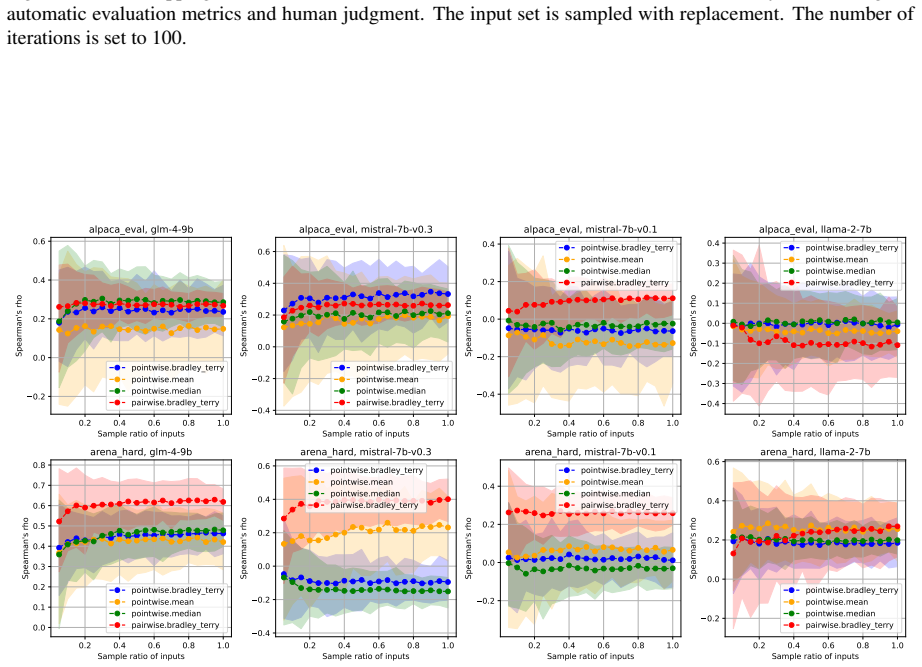
- [Section 3.3, Figure 2] The RQ2 conclusion that benchers' alignment with humans 'degrades quickly' for close-performing systems is not statistically supported. With 18 systems there are only 153 pairs total, and the 5% and 10% selection levels used in Section 3.3 retain approximately 8 and 15 pairs, respectively. These are further filtered by the non-overlapping-CI condition Q, which removes many close pairs as unreliable, so the remaining pairs are a highly selected subset. No confidence intervals or bootstrap or permutation intervals are reported for any τu curve, in contrast to the CI-based analyses in Figures 1 and 11–13. Many curves in Figures 15–16 are non-monotonic and cross zero, consistent with sampling noise. The paper should report the number of pairs at each threshold, add uncertainty quantification for τu, and test whether the apparent decline is statistically significant; without this, the headline negative finding of RQ2 is not established.
minor comments (4)
- [Section 2.2] The definition of τu states that it uses only pairs in Pu ∩ Q, but the paragraph immediately after the formula says 'Only the system pairs within the set Pu are used.' Please clarify whether Q is also applied consistently in the computation, and define the exact handling of ties in the denominator when the pair set size is small.
- [Section 1, Finding (3)] The claim that 'pointwise evaluation is slightly better than base pairwise evaluation for strong LLMs' is presented without noting the important condition of equalized total query budget. In Table 1, for gpt-4o and gpt-4-turbo on Alpaca Eval, pairwise_base with Bradley-Terry substantially outperforms pointwise mean (0.8838 vs. 0.8535 and 0.9112 vs. 0.8493). The finding is only justified under the fixed-total-query scenario of Figure 1; this conditioning should be stated in the summary of findings.
- [Section 3.1 / Limitations] The paper's own Limitations section appropriately notes that observations depend on the selected datasets and LLMs and cannot be guaranteed to generalize. This caveat should be carried into the abstract and conclusion, particularly for the component recommendations, so that readers do not take them as universal prescriptions.
- [Appendix A] The conversion rules for 5-point pairwise judgments weight a 'significantly better' outcome as six pairwise wins and a 'slightly better' as two wins. This weighting changes the distribution of the effective pairwise sample and can affect Bradley-Terry estimates, especially for close systems; a sentence justifying this weighting or citing a source would help.
Circularity Check
No significant circularity: the paper is an empirical meta-evaluation whose claims are measured against an external ground truth (Chatbot Arena), not derived from its own inputs.
full rationale
The paper's central claims are empirical correlations of automatic bencher rankings with Chatbot Arena system ratings. RQ1 recommendations are selected by maximizing Spearman correlation against that external ground truth; using the same ground truth for selection and evaluation is standard meta-evaluation practice and does not make the recommendation equivalent to the input by construction. RQ2's controllable Kendall's tau deliberately restricts to pairs with small Arena rating differences and then measures agreement with the same Arena ratings; the decline in agreement is a substantive empirical finding about signal-to-noise, not an artifact of the metric's definition. RQ3 compares rankings of evaluators under independent settings (system-level vs instance-level human judgments) and reports mismatches, which is an empirical result. The only self-citations (Gao et al. 2024 and Liu et al. 2024b) appear in related-work summaries and do not carry any load-bearing premise; no uniqueness theorem or ansatz is imported from the authors' prior work. The Limitations passage explicitly acknowledges dependence on the datasets and selected LLMs, a generalizability caveat rather than a circular step. The RQ2 curves lack confidence intervals, a statistical robustness concern, but that is not circularity under the criteria used here.
Assumptions & free parameters
free parameters (3)
- Controllable Kendall's tau threshold u =
swept over 5%, 10%, ..., 100% of system pairs
- 95% confidence interval non-overlap filter =
95% confidence level (alpha = 0.05)
- Open-source inference cost model =
$0.17/kWh electricity, 700W H100, vLLM throughput (8B: 5370 tokens/s; 70B: 2685 tokens/s)
assumptions (5)
- domain assumption Chatbot Arena system ratings are a valid ground truth for human preference alignment.
- domain assumption The chosen 18 systems, 10 evaluation models, and two input sets are representative enough for component recommendations to generalize.
- domain assumption Swapping presentation order in pairwise evaluation fully addresses position bias.
- standard math Standard rank correlation and Bradley-Terry aggregation are appropriate for evaluating bencher rankings.
- domain assumption Unparseable judge outputs can be replaced with random judgments without biasing bencher comparisons.
Cite this review
Pith. "Pith review of Re-evaluating Automatic LLM System Ranking for Alignment with Human Preference." pith.science (2026). https://pith.science/paper/7P3J5G7G
@misc{pith2026250100560,
  author       = {Pith},
  title        = {Pith review of: Re-evaluating Automatic LLM System Ranking for Alignment with Human Preference},
  year         = {2026},
  howpublished = {\url{https://pith.science/paper/7P3J5G7G}},
  note         = {Machine review of arXiv:2501.00560}
}
read the original abstract
Evaluating and ranking the capabilities of different LLMs is crucial for understanding their performance and alignment with human preferences. Due to the high cost and time-consuming nature of human evaluations, an automatic LLM bencher (i.e., an automatic evaluation framework that aims to rank LLMs based on their alignment with human preferences) is indispensable. An automatic LLM bencher consists of four components: the input set (e.g., a user instruction), the evaluation model (e.g., an LLM), the evaluation type (e.g., pairwise comparison), and the aggregation method (e.g., the ELO rating system). However, previous work has not thoroughly explored how to select these components or how their different combinations influence the results. In this work, through controlled experiments, we provide a series of recommendations on how to choose each component to better automate the evaluation of LLMs. Furthermore, we discovered that when evaluating LLMs with similar performance, the performance of the automatic LLM bencher declines sharply, underscoring the limitations of current benchers and calling for future work. Lastly, we found that the evaluation models' performance at the instance level (e.g., the accuracy of selecting the best output) does not always align with their effectiveness when used as a component of a bencher, highlighting the importance of dedicated system-level evaluation of benchers.
Figures


Figures from the paper (13 more)




Reference graph
Works this paper leans on
-
[1]
Output (a) is significantly better
-
[2]
Output (a) is slightly better
-
[3]
Tie, relatively the same
-
[4]
LLM comparative assessment: Zero-shot NLG evaluation through pairwise comparisons using large language models. In Proceedings of the 18th Con- ference of the European Chapter of the Association for Computational Linguistics, EACL 2024 - Volume 1: Long Papers, St. Julian’s, Malta, March 17-22, 2024, pages 139–151. Association for Computational Linguistics....
work page 2024
-
[5]
Mixeval: Deriving wisdom of the crowd from LLM benchmark mixtures. CoRR, abs/2406.06565. OpenAI. 2023. GPT-4 technical report. CoRR, abs/2303.08774. Long Ouyang, Jeffrey Wu, Xu Jiang, Diogo Almeida, Carroll L. Wainwright, Pamela Mishkin, Chong Zhang, Sandhini Agarwal, Katarina Slama, Alex Ray, John Schulman, Jacob Hilton, Fraser Kelton, Luke Miller, Maddi...
arXiv 2023
-
[11]
Consequently, the cost of different combina- tions of evaluation models, evaluation types, and aggregation methods across input sets of different sizes can be estimated. Figures 9 and 10 illustrate the best-performing combinations under varying budget constraints. From these results, we observe that open-source models demonstrate a significant advantage w...
work page 1930
-
[12]
Output (b) is slightly better
-
[13]
Output (b) is significantly better. Here are some rules of the evaluation: (1) You should prioritize evaluating whether the output honestly/precisely/closely executes the instruction, then consider its helpfulness, accuracy, level of detail, harmlessness, etc. (2) Outputs should NOT contain more/less than what the instruction asks for, as such outputs do ...
Show all 12 references
-
[1952]
Biometrika, 39(3-4):324–345
RANK ANALYSIS OF INCOMPLETE BLOCK DESIGNS: THE METHOD OF PAIRED COMPARISONS. Biometrika, 39(3-4):324–345. Wei-Lin Chiang, Lianmin Zheng, Ying Sheng, Anas- tasios Nikolas Angelopoulos, Tianle Li, Dacheng Li, Banghua Zhu, Hao Zhang, Michael I. Jordan, Joseph E. Gonzalez, and Ion...
2024 arXiv
-
[2022]
Training language models to follow instruc- tions with human feedback. In Advances in Neural Information Processing Systems 35: Annual Confer- ence on Neural Information Processing Systems 2022, NeurIPS 2022, New Orleans, LA, USA, November 28 - December 9, 2022. Maxime Peyrard...
2024 arXiv
-
[2024]
CoRR, abs/2403.13787
Rewardbench: Evaluating reward models for language modeling. CoRR, abs/2403.13787. Junlong Li, Shichao Sun, Weizhe Yuan, Run-Ze Fan, Hai Zhao, and Pengfei Liu. 2024a. Generative judge for evaluating alignment. In The Twelfth In- ternational Conference on Learning Representatio...
2024 arXiv
-
[6052]
Association for Computational Linguistics. Abhimanyu Dubey, Abhinav Jauhri, Abhinav Pandey, Abhishek Kadian, Ahmad Al-Dahle, Aiesha Letman, Akhil Mathur, Alan Schelten, Amy Yang, Angela Fan, Anirudh Goyal, Anthony Hartshorn, Aobo Yang, Archi Mitra, Archie Sravankumar, Artem Ko...
2024 arXiv
Reviewed August 10, 2026 · model on record in the stance chip above.
Discussion (0). Continue with ORCID to comment.