REVIEW 5 major objections 4 minor 46 references
Diffusion Prism: Enhancing Diversity and Morphology Consistency in Mask-to-Image Diffusion
T0 review · 5 major / 4 minor · reviewed 2026-08-10 · deepseek-v4-flash
Pith's one-line read A training-free pixel-space prism turns sparse binary masks into diverse, morphology-consistent images by injecting calibrated Gaussian noise and chromatic aberration before denoising.
desk verdict A plausible pixel-space pre-processing trick for mask-to-image diffusion, but the main metric's definitional contradiction leaves the central diversity claim unproven. read the letter →
The pith
A machine-rendered reading of the paper's core claim, the machinery that carries it, and where it could break.
The reading
What carries the argument
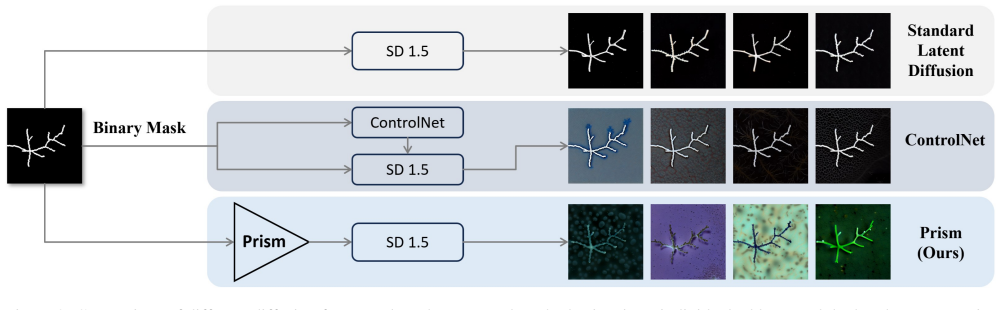
The load-bearing object is the pixel-space input perturber called Diffusion Prism: a training-free module that applies (i) mean/standard-deviation-matched Gaussian noise, $M' = (M\cdot\sigma + \mu) + n$ with $n \sim \mathcal{N}(\mu, \sigma)$, and (ii) channel-wise pixel shuffling (chromatic aberration) to the binary mask before it enters the VAE encoder of a latent diffusion model. Its working principle is the signal-leak bias of diffusion: artificial pixel-space signals survive the encode-denoise-decode loop and are reinterpreted as image content, shifting the predicted noise by a residual $\delta$ and hence the denoised latent by $-\hat{\alpha}\delta$ (equation 5), rather than being averaged away. Because the operation occurs before encoding, it avoids the domain-collapse risk of latent-space edits and requires no retraining or fine-tuning.
What would settle it
Generate 10,000 images from the same set of masks using Prism ($\sigma = 0.5$) and vanilla SD1.5 with identical seeds, denoising steps, and strength; then compute pairwise perceptual diversity (e.g., LPIPS) between outputs of the same mask and compute FID against the real EMDS-6 dendrite images rather than against a baseline model. If Prism's diversity is not statistically larger while SSIM stays comparable, the central claim fails.
Extended reading notes
Core claim
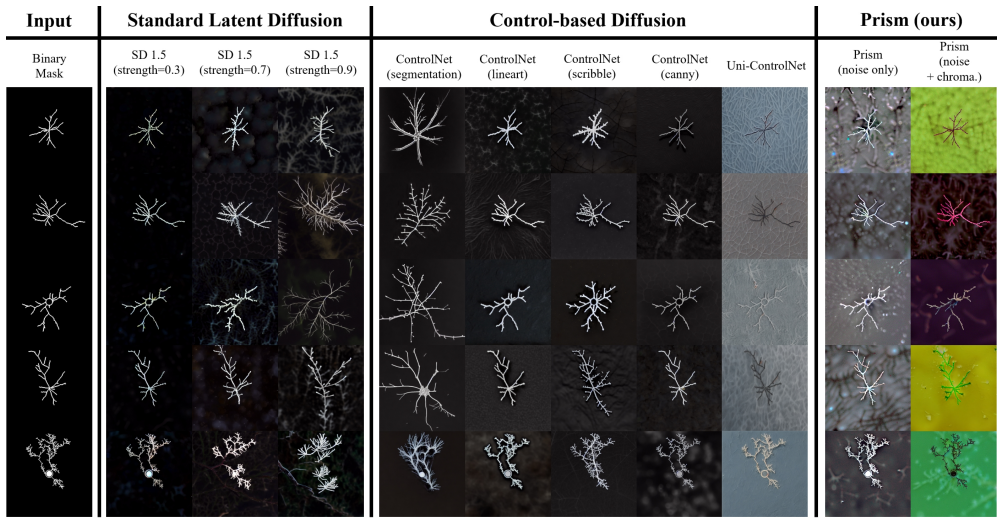
The central discovery is that the diversity bottleneck for sparse masks is not in the diffusion model itself but in the poverty of the input signal, and a deliberately corrupted pixel-space input remedies it. Prism takes a binary mask $M$, computes the mean $\mu$ and standard deviation $\sigma$ of a reference image (or of a random matrix), and produces $M'(x,y) = (M(x,y)\cdot\sigma + \mu) + n$ with $n \sim \mathcal{N}(\mu, \sigma)$; it further shuffles pixel values across RGB channels to simulate chromatic aberration. The paper argues, via the forward-diffusion equation $z_t = \alpha_t x_0 + \sqrt{1-\alpha_t}\,\epsilon$, that this injected signal $n$ perturbs the predicted noise by a residual $\delta$ and therefore shifts the denoised latent by $-\hat{\alpha}\delta$, adding controllable novel content without destroying the low-frequency mask structure. With denoising strength 0.3 and 10 steps on SD1.5, Prism improves nFID, CLIP score, and visual diversity compared with vanilla SD1.5, ControlNet, and Uni-ControlNet, with the best nFID at noise standard deviation 0.5.
Load-bearing premise
The reported diversity boost rests on the nFID score reliably measuring similarity to real dendrite patterns, which the paper's own metric definition does not clearly establish.
Editorial extensions
If this is right
- Pre-trained latent diffusion models can be turned into mask-to-image engines for data augmentation without any training: a scientist with masks and a reference image can generate large labeled datasets for segmentation or classification.
- The noise level $\sigma$ acts as a tunable diversity-fidelity dial; the paper's results suggest an optimum around $\sigma = 0.5$ beyond which excess noise erodes both quality and morphology.
- Because Prism does not touch the diffusion model's weights, it can be deployed on top of any existing SD1.5-based pipeline, including ControlNet-style conditioning, as a front-end preprocessing step.
- The method generalizes to other sparse biological and biometric masks—retina fundus, fingerprint, Purkinje neuron—evidencing that the diversity bottleneck is a general property of low-entropy inputs.
- Quantitatively, the best Prism setting improves nFID from 0.6039 to 0.4241 while keeping SSIM above 0.92, meaning the generated images are at once more realistic and still faithful to the input structure.
Reading between the lines
- The same pixel-space corruption principle should transfer to other pre-trained latent diffusion backbones, since the signal-leak argument is architecture-agnostic.
- Using a domain-matched reference image (rather than a random matrix) to set $\mu$ and $\sigma$ could turn Prism into a style-conditioning tool, shifting generated images toward a specific microscope or sensor's appearance.
- The ablation shows noise and chromatic aberration are synergistic; this opens the door to other optical-style corruptions—per-channel gain mismatch, radial distortion, mild blur—as further diversity knobs.
Editorial analysis
A structured set of objections, weighed in public.
Referee Report
Summary. The paper proposes Diffusion Prism, a training-free pixel-space add-on for Stable Diffusion v1.5 that perturbs input binary masks with Gaussian noise and chromatic aberration before image-to-image generation. The authors claim this increases the diversity of generated nano-dendritic samples while preserving morphological consistency with the input masks. The method is evaluated against vanilla SD1.5, ControlNet, and Uni-ControlNet using nFID, CLIP score, and SSIM, with ablations for the noise and chromatic-aberration components. Extensions to retina, fingerprint, and neuron masks are shown qualitatively.
Significance. If the reported results are reliable, the contribution is a simple, practical, training-free preprocessing module for mask-to-image diffusion, useful for data augmentation in specialized imaging domains such as dendritic-pattern biometrics and biomedical imaging. The paper's strengths are the lightness of the method, the direct comparison with several controllable diffusion baselines, the explicit ablation of the two proposed components, and the public code link. However, the quantitative backbone of the central claim is not yet interpretable because the nFID definition is contradictory, key table values are internally inconsistent, and no error bars are reported. The theoretical derivation in Section 3 is not load-bearing as written and is presented as a proof without actually proving a benefit.
major comments (5)
- [Section 4.2, Tables 1 and 2] The nFID definition is internally contradictory. The text states that nFID is computed 'by comparing the images generated using Prism and other diffusion approaches against those from a baseline model (SD 1.5)' and then states 'We utilize the EMDS-6 dataset ... to calculate the nFID.' These are two different reference distributions. If SD1.5 were the reference, the SD1.5 row in Table 1 would be about zero, not 0.6039. If EMDS-6 is the reference, the first sentence is wrong. Moreover, EMDS-6 is an environmental-microorganism dataset, and no evidence is given that it matches the distribution of real dendritic patterns. Because the headline diversity improvement (0.6039 to 0.4241) rests on this metric, the central quantitative claim is not currently established.
- [Tables 1 and 2] The best Prism configuration is reported inconsistently. Table 2 lists nFID = 0.4241 with SSIM = 0.9697 for 'SD+Prism (noise+chroma)', while Table 1 lists the same nFID = 0.4241 for 'Prism (noise Std. = 0.5)' with SSIM = 0.9254. The reader cannot determine which SSIM value corresponds to the best configuration, and the ablation deltas in Table 2 are therefore not reproducible from the values in Table 1.
- [Table 2] The ablation deltas in Table 2 have incorrect signs. For noise-only, CLIP 28.78 - 28.73 = +0.05, not -0.05, and SSIM 0.9718 - 0.9692 = +0.0026, not -0.0026. For chroma-only, CLIP 29.03 - 28.73 = +0.30, not -0.30, and SSIM 0.9726 - 0.9692 = +0.0034, not -0.0034. For noise+chroma, CLIP 29.47 - 28.73 = +0.74, not -0.74, and SSIM 0.9697 - 0.9692 = +0.0005, not -0.0005. All reported deltas are negative, which contradicts the table's own values and undermines the claim that both modules boost text-image alignment and morphology consistency.
- [Section 3, Eqs. (1)-(5)] The derivation in Section 3 is a rearrangement of the standard DDIM forward/reverse equations and does not prove that adding n to the input increases diversity or preserves morphology. Equation (5) merely expresses the perturbed prediction as z'_0 = z_0 - \hat\alpha \delta; no argument shows that this perturbation is beneficial, and no quantitative prediction is derived and tested. Consequently, the phrase 'As proved in Section 3.3' in Section 3.4 overstates what Section 3.3 actually establishes.
- [Section 4.2, Tables 1-2] No error bars, confidence intervals, or multiple seeds are reported for any quantitative result. With a single run per configuration, the nFID differences between SD1.5 (0.6039) and Prism (e.g., 0.5238 at sigma=0.01) cannot be distinguished from run-to-run sampling noise, so the diversity advantage is not statistically established.
minor comments (4)
- [Section 3.2, Eq. (5)] The symbol \hat\alpha in Eq. (5) is introduced without definition; the preceding line defines the factor as sqrt(1-\alpha_t)/sqrt(\alpha_t), and the notation should be reconciled.
- [Section 4.2] There are several typos in the experimental setup paragraph: 'we use 10 it in all experiments' should be 'we use 10 in all experiments', and 'value0.3 in the vallina SD 1.5' should be 'value 0.3 in the vanilla SD1.5'.
- [Section 4.2, SSIM description] The SSIM evaluation description is ambiguous: it first says SSIM is computed 'between the binary mask and the generated image' but Figure 10 describes computing SSIM between the random-forest prediction and the ground-truth mask; please clarify the exact comparison being made.
- [Table 1] Table 1 reports identical SSIM values of 0.9254 for noise std 0.5 and 1.0; if this is not a typo, the saturation should be explained in the text.
Circularity Check
No significant circularity: the central claim is supported by direct experiments, and the analytical equations are standard perturbation algebra rather than self-referential definitions.
full rationale
The derivation chain in Sections 3.1-3.4 consists of the standard DDIM forward noising equation z_t = alpha_t x0 + sqrt(1 - alpha_t) epsilon, the observation that encoding a perturbed input gives z'_t = E(x+n), and substitution into the DDIM denoising formula to obtain z'_0 = z0 - sqrt(1 - alpha_t)/sqrt(alpha_t) delta. These steps only state the algebraically true fact that a pixel-space perturbation propagates to the denoised latent; they do not define the target claim ('noise increases diversity while preserving morphology') into existence. The experimental result in Tables 1-2 compares Prism against external methods (SD1.5, ControlNet, Uni-ControlNet) and against an external reference distribution, and the noise standard deviation is swept from 0 to 1 and reported rather than fitted to the test set and then renamed a prediction. Self-citations [2,3,32-35] support background statements about dendritic patterns and prior author datasets, not the load-bearing diversity claim. The nFID definition in Section 4.2 is internally inconsistent (comparing to 'a baseline model (SD 1.5)' versus 'the EMDS-6 dataset'), and Table 2 contains arithmetic sign errors; these are correctness and validity defects, not circularity, because the reported conclusions do not reduce to the metric definition or to a self-citation by construction.
Assumptions & free parameters
free parameters (2)
- noise_std_sigma =
0.5 (optimal in experiments)
- denoising_strength =
0.3 for Prism and SD1.5
assumptions (3)
- domain assumption Pre-trained Stable Diffusion v1.5 latent space preserves pixel-space perturbations as image content
- domain assumption EMDS-6 dataset is a representative reference distribution for real dendrite images
- domain assumption Random forest mask extraction yields accurate ground-truth masks from generated images
Cite this review
Pith. "Pith review of Diffusion Prism: Enhancing Diversity and Morphology Consistency in Mask-to-Image Diffusion." pith.science (2026). https://pith.science/paper/LMQYHU7C
@misc{pith2026250100944,
  author       = {Pith},
  title        = {Pith review of: Diffusion Prism: Enhancing Diversity and Morphology Consistency in Mask-to-Image Diffusion},
  year         = {2026},
  howpublished = {\url{https://pith.science/paper/LMQYHU7C}},
  note         = {Machine review of arXiv:2501.00944}
}
read the original abstract
The emergence of generative AI and controllable diffusion has made image-to-image synthesis increasingly practical and efficient. However, when input images exhibit low entropy and sparse, the inherent characteristics of diffusion models often result in limited diversity. This constraint significantly interferes with data augmentation. To address this, we propose Diffusion Prism, a training-free framework that efficiently transforms binary masks into realistic and diverse samples while preserving morphological features. We explored that a small amount of artificial noise will significantly assist the image-denoising process. To prove this novel mask-to-image concept, we use nano-dendritic patterns as an example to demonstrate the merit of our method compared to existing controllable diffusion models. Furthermore, we extend the proposed framework to other biological patterns, highlighting its potential applications across various fields.
Figures


Figures from the paper (8 more)




Reference graph
Works this paper leans on
-
[1]
Lorenza Bonaldi, Andrea Pretto, Carmelo Pirri, Francesca Uccheddu, Chiara Giulia Fontanella, and Carla Stecco. Deep learning-based medical images segmentation of mus- culoskeletal anatomical structures: a survey of bottlenecks and strategies. Bioengineering, 10(2):137, 2023. 1
work page 2023
-
[2]
Xiwen Chen, Hao Wang, Abolfazl Razi, Michael Kozicki, and Christopher Mann. Dh-gan: a physics-driven untrained generative adversarial network for holographic imaging.Op- tics Express, 31(6):10114–10135, 2023. 2
work page 2023
-
[3]
Xiwen Chen, Hao Wang, Zhao Zhang, Zhenmin Li, Huayu Li, Tong Ye, and Abolfazl Razi. Enhancing digital holo- gram reconstruction using reverse-attention loss for un- trained physics-driven deep learning models with uncertain distance. In AI and Optical Data Sciences V, volume 12903, pages 132–141. SPIE, 2024. 2
work page 2024
-
[4]
Custom-edit: Text-guided image edit- ing with customized diffusion models
Jooyoung Choi, Yunjey Choi, Yunji Kim, Junho Kim, and Sungroh Yoon. Custom-edit: Text-guided image edit- ing with customized diffusion models. arXiv preprint arXiv:2305.15779, 2023. 1
arXiv 2023
-
[5]
Opti- mization principles of dendritic structure
Hermann Cuntz, Alexander Borst, and Idan Segev. Opti- mization principles of dendritic structure. Theoretical Biol- ogy and Medical Modelling, 4:1–8, 2007. 2
work page 2007
-
[6]
Martin Nicolas Everaert, Marco Bocchio, Sami Arpa, Sabine S¨usstrunk, and Radhakrishna Achanta. Diffusion in style. In Proceedings of the IEEE/CVF International Conference on Computer Vision, pages 2251–2261, 2023. 4, 6
work page 2023
-
[7]
Exploiting the signal-leak bias in diffusion models
Martin Nicolas Everaert, Athanasios Fitsios, Marco Bocchio, Sami Arpa, Sabine S ¨usstrunk, and Radhakrishna Achanta. Exploiting the signal-leak bias in diffusion models. In Pro- ceedings of the IEEE/CVF Winter Conference on Applica- tions of Computer Vision, pages 4025–4034, 2024. 3, 4
work page 2024
-
[8]
Fairness in face presentation attack de- tection
Meiling Fang, Wufei Yang, Arjan Kuijper, Vitomir Struc, and Naser Damer. Fairness in face presentation attack de- tection. Pattern Recognition, 147:110002, 2024. 2
work page 2024
Show all 46 references
-
[9]
Implementing improved perlin noise
Simon Green. Implementing improved perlin noise. GPU Gems, 2:409–416, 2005. 5
2005
-
[10]
Fast neural style transfer for motion data
Daniel Holden, Ikhsanul Habibie, Ikuo Kusajima, and Taku Komura. Fast neural style transfer for motion data. IEEE computer graphics and applications, 37(4):42–49, 2017. 1
2017
-
[11]
Maskdiffusion: Exploiting pre-trained diffusion models for semantic seg- mentation
Yasufumi Kawano and Yoshimitsu Aoki. Maskdiffusion: Exploiting pre-trained diffusion models for semantic seg- mentation. arXiv preprint arXiv:2403.11194, 2024. 2
2024 arXiv
-
[12]
Segment any- thing
Alexander Kirillov, Eric Mintun, Nikhila Ravi, Hanzi Mao, Chloe Rolland, Laura Gustafson, Tete Xiao, Spencer White- head, Alexander C Berg, Wan-Yen Lo, et al. Segment any- thing. arXiv preprint arXiv:2304.02643, 2023. 1, 2
2023 arXiv
-
[13]
Retinal vessel segmentation under extreme low annotation: A gan based semi-supervised approach
Avisek Lahiri, Vineet Jain, Arnab Mondal, and Prabir Ku- mar Biswas. Retinal vessel segmentation under extreme low annotation: A gan based semi-supervised approach. In 2020 IEEE international conference on image processing (ICIP) , pages 418–422. IEEE, 2020. 1
2020
-
[14]
Microstructure recon- struction using diffusion-based generative models
Kang-Hyun Lee and Gun Jin Yun. Microstructure recon- struction using diffusion-based generative models. Mechan- ics of Advanced Materials and Structures , 31(18):4443– 4461, 2024. 2
2024
-
[15]
Temimagenet training library and atom- segnet deep-learning models for high-precision atom seg- mentation, localization, denoising, and deblurring of atomic- resolution images
Ruoqian Lin, Rui Zhang, Chunyang Wang, Xiao-Qing Yang, and Huolin L Xin. Temimagenet training library and atom- segnet deep-learning models for high-precision atom seg- mentation, localization, denoising, and deblurring of atomic- resolution images. Scientific reports, 11(1):5...
2021
-
[16]
A deep transfer learning model with classi- cal data augmentation and cgan to detect covid-19 from chest ct radiography digital images
Mohamed Loey, Gunasekaran Manogaran, and Nour El- deen M Khalifa. A deep transfer learning model with classi- cal data augmentation and cgan to detect covid-19 from chest ct radiography digital images. Neural Computing and Appli- cations, pages 1–13, 2020. 1
2020
-
[17]
Segment anything in medical images
Jun Ma, Yuting He, Feifei Li, Lin Han, Chenyu You, and Bo Wang. Segment anything in medical images. Nature Communications, 15(1):654, 2024. 1
2024
-
[18]
mus musculus, purkinje neu- ron
Martone Maryann, Price Diana, Thor Andrea, Terada Masako, and Hakozaki Hiro. mus musculus, purkinje neu- ron. cil. dataset., 2002. CCDB:3687. 8
2002
-
[19]
Face gen- eration and editing with stylegan: A survey
Andrew Melnik, Maksim Miasayedzenkau, Dzianis Makar- avets, Dzianis Pirshtuk, Eren Akbulut, Dennis Holzmann, Tarek Renusch, Gustav Reichert, and Helge Ritter. Face gen- eration and editing with stylegan: A survey. IEEE Transac- tions on Pattern Analysis and Machine Intelligenc...
2024
-
[20]
Sdedit: Guided image synthesis and editing with stochastic differential equa- tions
Chenlin Meng, Yutong He, Yang Song, Jiaming Song, Jia- jun Wu, Jun-Yan Zhu, and Stefano Ermon. Sdedit: Guided image synthesis and editing with stochastic differential equa- tions. arXiv preprint arXiv:2108.01073, 2021. 1
2021 arXiv
-
[21]
Biometrics recog- nition using deep learning: A survey
Shervin Minaee, Amirali Abdolrashidi, Hang Su, Mo- hammed Bennamoun, and David Zhang. Biometrics recog- nition using deep learning: A survey. Artificial Intelligence Review, 56(8):8647–8695, 2023. 1
2023
-
[22]
Null-text inversion for editing real im- ages using guided diffusion models
Ron Mokady, Amir Hertz, Kfir Aberman, Yael Pritch, and Daniel Cohen-Or. Null-text inversion for editing real im- ages using guided diffusion models. In Proceedings of the IEEE/CVF Conference on Computer Vision and Pattern Recognition, pages 6038–6047, 2023. 1
2023
-
[23]
Un- supervised medical image translation with adversarial diffu- sion models
Muzaffer ¨Ozbey, Onat Dalmaz, Salman UH Dar, Hasan A Bedel, S ¸aban¨Ozturk, Alper G ¨ung¨or, and Tolga C ¸ ukur. Un- supervised medical image translation with adversarial diffu- sion models. IEEE Transactions on Medical Imaging, 2023. 1, 2
2023
-
[24]
Brain imaging generation with latent diffusion models
Walter HL Pinaya, Petru-Daniel Tudosiu, Jessica Dafflon, Pedro F Da Costa, Virginia Fernandez, Parashkev Nachev, Sebastien Ourselin, and M Jorge Cardoso. Brain imaging generation with latent diffusion models. In MICCAI Work- shop on Deep Generative Models, pages 117–126. Springer,
-
[25]
Learning transferable visual models from natural language supervi- sion
Alec Radford, Jong Wook Kim, Chris Hallacy, Aditya Ramesh, Gabriel Goh, Sandhini Agarwal, Girish Sastry, Amanda Askell, Pamela Mishkin, Jack Clark, et al. Learning transferable visual models from natural language supervi- sion. In International conference on machine learning, ...
2021
-
[26]
High-resolution image synthesis with latent diffusion models
Robin Rombach, Andreas Blattmann, Dominik Lorenz, Patrick Esser, and Bj ¨orn Ommer. High-resolution image synthesis with latent diffusion models. In Proceedings of the IEEE/CVF conference on computer vision and pattern recognition, pages 10684–10695, 2022. 1, 2, 3, 4, 5, 6, 7
2022
-
[27]
Denoising diffusion implicit models
Jiaming Song, Chenlin Meng, and Stefano Ermon. Denoising diffusion implicit models. arXiv preprint arXiv:2010.02502, 2020. 3
2010 arXiv
-
[28]
Pyramidal neurons: dendritic structure and synaptic integration
Nelson Spruston. Pyramidal neurons: dendritic structure and synaptic integration. Nature Reviews Neuroscience , 9(3):206–221, 2008. 2
2008
-
[29]
Staal, M.D
J. Staal, M.D. Abramoff, M. Niemeijer, M.A. Viergever, and B. van Ginneken. Ridge-based vessel segmentation in color images of the retina. IEEE Transactions on Medical Imag- ing, 23(4):501–509, 2004. 1, 8
2004
-
[30]
Rethinking the inception archi- tecture for computer vision
Christian Szegedy, Vincent Vanhoucke, Sergey Ioffe, Jon Shlens, and Zbigniew Wojna. Rethinking the inception archi- tecture for computer vision. In Proceedings of the IEEE con- ference on computer vision and pattern recognition , pages 2818–2826, 2016. 6
2016
-
[31]
Dp-cgan: Differentially private synthetic data and label generation
Reihaneh Torkzadehmahani, Peter Kairouz, and Benedict Paten. Dp-cgan: Differentially private synthetic data and label generation. In Proceedings of the IEEE/CVF Con- ference on Computer Vision and Pattern Recognition Work- shops, pages 0–0, 2019. 1
2019
-
[32]
Flame diffuser: Wildfire image synthesis using mask guided diffusion
Hao Wang, Sayed Pedram Haeri Boroujeni, Xiwen Chen, Ashish Bastola, Huayu Li, Wenhui Zhu, and Abolfazl Razi. Flame diffuser: Wildfire image synthesis using mask guided diffusion. arXiv preprint arXiv:2403.03463, 2024. 2
2024 arXiv
-
[33]
Fast Key Points Detection and Matching for Tree-Structured Images
Hao Wang, Xiwen Chen, Abolfazl Razi, and Rahul Amin. Fast Key Points Detection and Matching for Tree-Structured Images . In 2022 International Conference on Computa- tional Science and Computational Intelligence (CSCI), pages 1381–1387, Los Alamitos, CA, USA, Dec. 2022. IEEE C...
2022
-
[34]
Nano-resolution vi- sual identifiers enable secure monitoring in next-generation cyber-physical systems
Hao Wang, Xiwen Chen, Abolfazl Razi, Michael Kozicki, Rahul Amin, and Mark Manfredo. Nano-resolution vi- sual identifiers enable secure monitoring in next-generation cyber-physical systems. In 2022 International Conference on Computational Science and Computational Intelligenc...
2022
-
[35]
Rbad: A dataset and benchmark for retinal vessels branching angle detection
Hao Wang, Wenhui Zhu, Jiayou Qin, Xin Li, Oana Dumi- trascu, Xiwen Chen, Peijie Qiu, and Abolfazl Razi. Rbad: A dataset and benchmark for retinal vessels branching angle detection. arXiv preprint arXiv:2407.12271, 2024. 2
2024 arXiv
-
[36]
Artfid: Quantitative evaluation of neural style transfer
Matthias Wright and Bj ¨orn Ommer. Artfid: Quantitative evaluation of neural style transfer. In DAGM German Con- ference on Pattern Recognition , pages 560–576. Springer,
-
[37]
U-gan: Generative ad- versarial networks with u-net for retinal vessel segmentation
Cong Wu, Yixuan Zou, and Zhi Yang. U-gan: Generative ad- versarial networks with u-net for retinal vessel segmentation. In 2019 14th international conference on computer science & education (ICCSE), pages 642–646. IEEE, 2019. 1
2019
-
[38]
Medsegdiff-v2: Diffusion-based medical im- age segmentation with transformer
Junde Wu, Wei Ji, Huazhu Fu, Min Xu, Yueming Jin, and Yanwu Xu. Medsegdiff-v2: Diffusion-based medical im- age segmentation with transformer. In Proceedings of the AAAI Conference on Artificial Intelligence, volume 38, pages 6030–6038, 2024. 1
2024
-
[39]
Transparent image layer diffusion using latent transparency
Lvmin Zhang and Maneesh Agrawala. Transparent image layer diffusion using latent transparency. arXiv preprint arXiv:2402.17113, 2024. 1, 3
2024 arXiv
-
[40]
Adding conditional control to text-to-image diffusion models
Lvmin Zhang, Anyi Rao, and Maneesh Agrawala. Adding conditional control to text-to-image diffusion models. In Proceedings of the IEEE/CVF International Conference on Computer Vision, pages 3836–3847, 2023. 1, 3, 5, 6, 7
2023
-
[41]
Emds-6: Environmental microor- ganism image dataset sixth version for image denoising, seg- mentation, feature extraction, classification, and detection method evaluation
Peng Zhao, Chen Li, Md Mamunur Rahaman, Hao Xu, Pingli Ma, Hechen Yang, Hongzan Sun, Tao Jiang, Ning Xu, and Marcin Grzegorzek. Emds-6: Environmental microor- ganism image dataset sixth version for image denoising, seg- mentation, feature extraction, classification, and detect...
-
[42]
Uni-controlnet: All-in-one control to text-to-image diffusion models
Shihao Zhao, Dongdong Chen, Yen-Chun Chen, Jianmin Bao, Shaozhe Hao, Lu Yuan, and Kwan-Yee K Wong. Uni-controlnet: All-in-one control to text-to-image diffusion models. Advances in Neural Information Processing Sys- tems, 36, 2024. 1, 3, 5, 6, 7
2024
-
[43]
Denoising diffusion bridge models
Linqi Zhou, Aaron Lou, Samar Khanna, and Stefano Er- mon. Denoising diffusion bridge models. arXiv preprint arXiv:2309.16948, 2023. 1
2023 arXiv
-
[44]
Maskdiffusion: Boosting text- to-image consistency with conditional mask
Yupeng Zhou, Daquan Zhou, Zuo-Liang Zhu, Yaxing Wang, Qibin Hou, and Jiashi Feng. Maskdiffusion: Boosting text- to-image consistency with conditional mask. arXiv preprint arXiv:2309.04399, 2023. 2
2023 arXiv
-
[45]
Be- yond mobilenet: An improved mobilenet for retinal diseases
Wenhui Zhu, Peijie Qiu, Xiwen Chen, Huayu Li, Hao Wang, Natasha Lepore, Oana M Dumitrascu, and Yalin Wang. Be- yond mobilenet: An improved mobilenet for retinal diseases. In International Conference on Medical Image Computing and Computer-Assisted Intervention, pages 56–65. Springer,
-
[46]
Otre: where optimal trans- port guided unpaired image-to-image translation meets reg- ularization by enhancing
Wenhui Zhu, Peijie Qiu, Oana M Dumitrascu, Jacob M Sobczak, Mohammad Farazi, Zhangsihao Yang, Keshav Nandakumar, and Yalin Wang. Otre: where optimal trans- port guided unpaired image-to-image translation meets reg- ularization by enhancing. In International Conference on In- f...
2023
Reviewed August 10, 2026 · model on record in the stance chip above.
Discussion (0). Continue with ORCID to comment.