REVIEW 3 major objections 4 minor 1 cited by
A Link Between White Dwarf Pulsars and Polars: Multiwavelength Observations of the 9.36-Minute Period Variable Gaia22ayj
T0 review · 3 major / 4 minor · reviewed 2026-08-10 · deepseek-v4-flash
Pith's one-line read The 9.36-minute pulsations of Gaia22ayj are the spin of a magnetic, accreting white dwarf that is rapidly slowing down, placing it as a missing link between white dwarf pulsars and polars.
desk verdict A genuinely new object with a solid magnetic-accreting WD identification, but the spin-down and the 'missing link' interpretation rest on a timing measurement that needs a robustness check. read the letter →
The pith
A machine-rendered reading of the paper's core claim, the machinery that carries it, and where it could break.
The reading
What carries the argument
The central object is the binary Gaia22ayj, specifically the magnetic white dwarf's 9.36-minute pulse. The argument's load-bearing mechanism is the observed-minus-calculated (O$-$C) timing analysis: the paper folds archival and high-speed optical light curves on the pulse period, tracks the drift of the light-curve minimum from 2018 to 2024, and fits a parabola to obtain the period derivative $\dot{P}$. Supporting machinery includes the cyclotron harmonic formula $\lambda = (10710\,\AA/n)(100\,\mathrm{MG}/B)\sin\theta$, used with the absence of resolved harmonics to bound the field between roughly 5 and 15 MG; the spin equilibrium condition $P_{\rm eq} \propto B^{6/7}\dot{M}^{-3/7}$, used to set a lower limit on the accretion rate; and the donor evolutionary tracks used to constrain the orbital period to 3.5 to 5.2 hours.
What would settle it
Directly measure the orbital period, for example by detecting donor absorption or emission lines with a variable radial velocity, or by confirming a distinct X-ray spin period. If the 9.36-minute signal is the spin-orbit beat and the tentative 9.64-minute X-ray period is the spin, the orbital period would be about 5.37 hours, and the O$-$C drift would need to be reinterpreted as at least partly orbital in origin.
Extended reading notes
Core claim
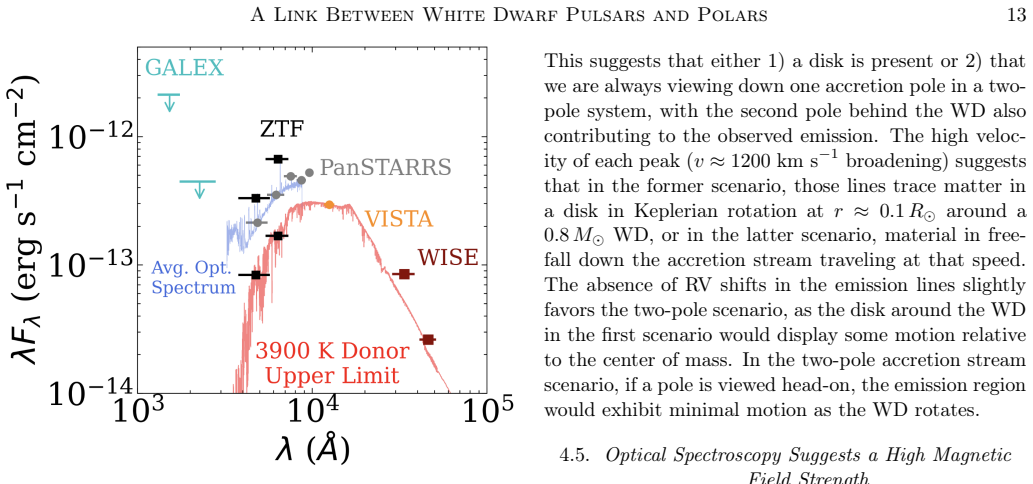
On the paper's own terms, Gaia22ayj is a magnetic accreting white dwarf in a close binary, and the 9.36-minute modulation is the white dwarf's spin period, or the spin-orbit beat period, rather than the orbital period. The white dwarf is spinning down, with $\dot{P} = (2.89 \pm 0.12)\times 10^{-12}$ s s$^{-1}$ and $P/\dot{P} = 6.1^{+0.3}_{-0.2}\times 10^6$ yr, closely matching the spin-down timescale of the white dwarf pulsar AR Sco. Accretion is supported by double-peaked Balmer and He emission lines, an X-ray luminosity of $2.7^{+6.2}_{-0.8}\times 10^{32}$ erg s$^{-1}$, and a brief optical outburst; magnetism is supported by 40% linear polarization and a broad cyclotron-hump-like spectral modulation between 4000 and 8000 \AA. The radio non-detection at a 3$\sigma$ limit of $15.8\,\mu$Jy differs from the known white dwarf pulsars, while the inferred orbital period of 3.5 to 5.2 hours overlaps both white dwarf pulsars and polars. The paper concludes that Gaia22ayj is an accreting analog of white dwarf pulsars and a plausible missing link that will evolve into a polar in roughly 40 Myr.
Load-bearing premise
The argument assumes the 9.36-minute pulse is the white dwarf's spin period; if it is actually the beat between spin and orbit, the measured period drift could be caused partly by orbital evolution rather than white-dwarf spin-down.
Editorial extensions
If this is right
- If the spin-down continues at roughly the measured rate, Gaia22ayj will synchronize with its orbit in about 40 Myr and become a polar.
- The 9.36-minute period cannot be an orbital period, so the system is not an ultracompact double-degenerate binary; its orbital period is probably 3.5 to 5.2 hours.
- Gaia22ayj occupies a previously empty region of spin-period versus optical-amplitude space, between intermediate polars and polars, and may define a new subclass of magnetic cataclysmic variables.
- The radio non-detection, at a level below what the known white dwarf pulsars would produce at that distance, suggests accretion suppresses or replaces the WD-pulsar radio emission mechanism.
- Deeper wide-field surveys should detect dozens of Gaia22ayj-like systems within a few years, making the proposed evolutionary phase testable as a population.
Reading between the lines
- If the 9.36-minute signal is really the spin-orbit beat and the tentative 9.64-minute X-ray period is the true spin, the orbital period would be roughly 5.37 hours, and the reported O$-$C drift would need to be partly attributed to orbital evolution rather than pure white-dwarf spin-down.
- The high linear polarization with two peaks and a swing in polarization angle suggests two accretion poles; future circular polarimetry could directly test this geometry and sharpen the field-strength estimate.
- The extreme polarization combined with absent radio emission hints that accretion quenches the coherent radio pulses seen in white dwarf pulsars, which could sharpen searches for long-period radio transients in accreting magnetic cataclysmic variables.
- Measuring higher-order period derivatives over the next few years would show whether the spin-down accelerates as the donor approaches Roche-lobe overflow, a prediction of the proposed WD-pulsar-to-polar evolution.
Signed reviews
Editorial analysis
A structured set of objections, weighed in public.
Referee Report
Summary. The paper presents a multiwavelength characterization of Gaia22ayj, a 9.36-min periodic variable that underwent a 2022 outburst. Combining ZTF/ATLAS/Gaia photometry, high-speed optical photometry, linear and circular polarimetry, phase-resolved spectroscopy, Swift X-ray spectroscopy and timing, VLA radio observations, and near-infrared photometry/spectroscopy, the authors argue that the system is a magnetic accreting white dwarf with a spin or spin-orbit beat period of 9.36 min. They report strong (40%) linear polarization, a broad cyclotron-like hump, double-peaked emission lines with v ~ 1200 km/s, and an X-ray luminosity of ~2.7e32 erg/s. From an O-C diagram spanning 2018-2024 they derive Pdot = 2.89e-12 s/s and P/Pdot = 6.1e6 yr, and propose Gaia22ayj as a missing link between rapidly spinning-down, non-accreting WD pulsars and synchronized accreting polars.
Significance. If the spin-down and period identification hold, Gaia22ayj would be the first accreting analog of the WD pulsars, with an evolutionary timescale compatible with the Schreiber et al. (2021) dynamo scenario, and would establish a new, empirically defined subclass bridging intermediate polars and polars. The paper's strengths are the breadth of independent observational evidence for magnetically channeled accretion (emission lines, X-rays, polarization, cyclotron hump) and the explicit caution about the Swift X-ray period. However, the central 'missing link' claim depends on the spin-down measurement, which currently lacks a demonstrated stable timing reference, and on the spin-vs-beat identification, which is acknowledged in the abstract but not propagated into the spin-down interpretation. The conclusion is therefore conditional rather than fully established.
major comments (3)
- [§4.7; Appendix A, Figs. 18–19] The O-C measurement uses the phase of the light-curve minimum as a stable clock, but Appendix A demonstrates that the pulse shape is unstable: in the CHIMERA g-band run (Fig. 18), the higher peak declines from a relative flux of ~4 at minute 7 to ~2.5 at minute 42, and the ULTRACAM run (Fig. 19) shows comparable peak-amplitude variations. For a double-peaked pulse modeled as a two-component sinusoid, the phase of the minimum is a function of the amplitude ratio and harmonic phase offset, so an amplitude change of this size can shift the fitted minimum by tens of seconds, comparable to the ~90 s drift in Fig. 12 that anchors Pdot. The paper does not report the O-C residuals versus the fitted amplitude ratio, nor does it fit per-epoch free amplitudes or phases. The fit is also based on a small number of high-speed epochs (2022–2024) plus ZTF folded photometry, so the formal covariance error in §4.7 does not capture shape-variability systematics. Until such a robustness test is provided, or the systematic uncertainty is folded into Pdot, the quoted Pdot = (2.89 ± 0.12) × 10^-12 s/s and P/Pdot = 6.1 × 10^6 yr are not established at the reported precision.
- [§4.7, §5.2, Table 2] The spin-down interpretation assumes that the 9.36-min optical period is the WD spin period, but the abstract and §5.2 explicitly allow that this period may instead be the spin-orbit beat period; if the 9.64-min X-ray period is the spin, the implied orbital period is 5.37 h. In the beat-period case, the observed O-C drift can be contributed by orbital period evolution, so the derived P/Pdot would not directly measure WD magnetic braking. The paper should propagate this ambiguity throughout: Table 2 lists Pdot and P/Pdot without qualification, and §5.1 uses the 40 Myr spin-down-to-synchronization timescale as a central evolutionary argument. Please either defend the spin identification with additional timing arguments or present the spin-down as conditional on that identification.
- [§4.5, Fig. 11] The lower limit B ≳ 5 MG is adopted from the assertion that n > 20 harmonics must be present at optical wavelengths, but this assertion is not derived from a cyclotron model or a comparison to observed polar spectra. The accretion-rate lower limit Mdot ≳ 5 × 10^-10 Msun/yr in Fig. 11 and the resulting orbital-period range 3.5–5.2 h in §5.2 depend on this field limit. Since the magnetic field is explicitly not measured (as the authors acknowledge), the orbital-period constraint should be presented as conditional on an assumed harmonic order rather than as a firm constraint, or the harmonic-order assumption should be justified quantitatively.
minor comments (4)
- [§2.1] In the second paragraph of Section 2.1, 'perations' should read 'operations'.
- [§2.3] The text 'The full light polarimetric light curve is shown in the Appendix Figure 20' should read 'The full polarimetric light curve is shown in the Appendix Figure 20'.
- [§4.5] The statement that the n = 7 feature is not seen at λ < 8800 Å should state the wavelength range actually covered by the LRIS spectra, since the figure does not mark this cutoff.
- [Fig. 12] The caption says the light-curve minimum has drifted over six years, but the high-speed O-C points are from 2022–2024; please clarify which data define the 2018–2024 baseline in the fit and whether outburst epochs were excluded.
Circularity Check
No significant circularity: the paper is an observational characterization whose spin-down, polarization, accretion, and X-ray/radio constraints come from independent data and external benchmarks, with the evolutionary framework cited as prior model rather than fitted to the target.
full rationale
The derivation chain is self-contained against external benchmarks. The spin-down measurement in Sec. 4.7 is a standard O–C timing analysis: a template is built from the ZTF light curve, high-speed light curves are fitted with the same two-component sinusoid, and the drift of the light-curve minimum yields Pdot. This is not a fitted parameter renamed as a prediction; the timing residuals are new information across a six-year baseline. The identification of the 9.36-min period as WD spin or spin-orbit beat is an interpretation supported by the hydrogen-dominated spectrum and the CV orbital-period minimum, not a definitional identity, and the paper explicitly acknowledges the spin-orbit-beat alternative when discussing the tentative X-ray period. The polarization (40%), cyclotron-like spectral hump, emission-line broadening, outburst behavior, X-ray luminosity, and radio upper limit are independent observational constraints. The use of Schreiber et al. (2021), Pelisoli et al. (2022a), and other prior work—some co-authored—is as published external measurements or published evolutionary models, not as inputs fitted to Gaia22ayj. The claimed agreement between the measured spin-down timescale and the Schreiber et al. prediction is a comparison, not a reduction to the model. The skeptical concern that variable peak amplitudes could bias the O–C minimum phase is a robustness question about systematic error, not circularity; it does not involve a quantity being defined in terms of the thing it is used to predict. No step in the paper's argument reduces by construction to its own inputs.
Assumptions & free parameters
free parameters (4)
- X-ray spectral model parameters (NH, photon index/kT, mkcflow Mdot) =
NH ~ 0.02-0.09 x 10^22 cm^-2; Mdot ~ 2.8-3.8 x 10^-11 Msun/yr
- Donor star effective temperature and radius =
Teff = 3900 K, R = 0.62 Rsun
- Magnetic pole viewing angle theta =
60 degrees (assumed lower limit)
- Cyclotron harmonic lower limit n > 20 =
20
assumptions (6)
- standard math Cyclotron harmonic wavelength relation (Eq. 1)
- standard math Magnetospheric radius and spin equilibrium formulas (Eqs. 2-3)
- domain assumption CV orbital period minimum ~78 min for hydrogen-rich donors
- domain assumption The system is accreting, not in a propeller phase
- domain assumption Schreiber et al. (2021) model that WD pulsars evolve into polars
- domain assumption Knigge et al. (2011) CV evolutionary tracks
Cite this review
Pith. "Pith review of A Link Between White Dwarf Pulsars and Polars: Multiwavelength Observations of the 9.36-Minute Period Variable Gaia22ayj." pith.science (2026). https://pith.science/paper/D5Y24QUF
@misc{pith2026250101490,
  author       = {Pith},
  title        = {Pith review of: A Link Between White Dwarf Pulsars and Polars: Multiwavelength Observations of the 9.36-Minute Period Variable Gaia22ayj},
  year         = {2026},
  howpublished = {\url{https://pith.science/paper/D5Y24QUF}},
  note         = {Machine review of arXiv:2501.01490}
}
abstract
White dwarfs (WDs) are the most abundant compact objects, and recent surveys have suggested that over a third of WDs in accreting binaries host a strong (B $\gtrsim$ 1 MG) magnetic field. However, the origin and evolution of WD magnetism remain under debate. Two WD pulsars, AR Sco and J191213.72-441045.1 (J1912), have been found, which are non-accreting binaries hosting rapidly spinning (1.97-min and 5.30-min, respectively) magnetic WDs. The WD in AR Sco is slowing down on a $P/\dot{P}\approx 5.6\times 10^6$ yr timescale. It is believed they will eventually become polars, accreting systems in which a magnetic WD (B $\approx 10-240$ MG) accretes from a Roche lobe-filling donor spinning in sync with the orbit ($\gtrsim 78$ min). Here, we present multiwavelength data and analysis of Gaia22ayj, which outbursted in March 2022. We find that Gaia22ayj is a magnetic accreting WD that is rapidly spinning down ($P/\dot{P} = 6.1^{+0.3}_{-0.2}\times 10^6$ yr) like WD pulsars, but shows clear evidence of accretion, like polars. Strong linear polarization (40%) is detected in Gaia22ayj; such high levels have only been seen in the WD pulsar AR Sco and demonstrate the WD is magnetic. High speed photometry reveals a 9.36-min period accompanying a high amplitude ($\sim 2$ mag) modulation. We associate this with a WD spin or spin-orbit beat period, not an orbital period as was previously suggested. Fast (60-s) optical spectroscopy reveals a broad ``hump'', reminiscent of cyclotron emission in polars, between 4000-8000 Angstrom. We find an X-ray luminosity of $L_X = 2.7_{-0.8}^{+6.2}\times10^{32} \textrm{ erg s}^{-1}$ in the 0.3-8 keV energy range, while two VLA radio campaigns resulted in a non-detection with a $F_r < 15.8\mu\textrm{Jy}$ 3$ \sigma$ upper limit. The shared properties of both WD pulsars and polars suggest that Gaia22ayj is a missing link between the two classes of magnetic WD binaries.
Figures


Figures from the paper (18 more)




Forward citations
Cited by 1 Pith paper
-
Spectroscopic Detection of a 2.9-hour Orbit in a Long Period Radio Transient
The 2.9-hour radio period of GLEAM-X J0704-37 is the orbital period of a compact white dwarf plus M dwarf binary at about 400 pc.
Reference graph
Works this paper leans on
-
[1]
2020, MNRAS, 492, L40, doi: 10.1093/mnrasl/slz181
Abril, J., Schmidtobreick, L., Ederoclite, A., & López-Sanjuan, C. 2020, MNRAS, 492, L40, doi: 10.1093/mnrasl/slz181
-
[2]
2011, in Astronomical Society of the Pacific Conference Series, Vol
Allard, F., Homeier, D., & Freytag, B. 2011, in Astronomical Society of the Pacific Conference Series, Vol. 448, 16th Cambridge Workshop on Cool Stars, Stellar Systems, and the Sun, ed. C. Johns-Krull, M. K. Browning, & A. A. West, 91, doi: 10.48550/arXiv.1011.5405 22 Rodriguez et al
-
[3]
Allen, D. A., Ward, M. J., & Hyland, A. R. 1982, MNRAS, 199, 969, doi: 10.1093/mnras/199.4.969
-
[4]
Arnaud, K. A. 1996, in Astronomical Society of the Pacific Conference Series, Vol. 101, Astronomical Data Analysis Software and Systems V, ed. G. H. Jacoby & J. Barnes, 17
1996
-
[5]
2021, AJ, 161, 147, doi: 10.3847/1538-3881/abd806
Demleitner, M., & Andrae, R. 2021, AJ, 161, 147, doi: 10.3847/1538-3881/abd806
-
[6]
H., Lott, B., & The Fermi-LAT collaboration
Ballet, J., Bruel, P., Burnett, T. H., Lott, B., & The Fermi-LAT collaboration. 2023, arXiv e-prints, arXiv:2307.12546, doi: 10.48550/arXiv.2307.12546
-
[7]
2023, MNRAS, 521, 4257, doi: 10.1093/mnras/stad836
Bao, T., Li, Z., & Cheng, Z. 2023, MNRAS, 521, 4257, doi: 10.1093/mnras/stad836
-
[8]
2024, MNRAS, 527, 7173, doi: 10.1093/mnras/stad3665
Bao, T., Li, Z., Cheng, Z., & Belloni, D. 2024, MNRAS, 527, 7173, doi: 10.1093/mnras/stad3665
Show all 98 references
-
[9]
C., Burke, C
Bellm, E. C., Burke, C. J., Coughlin, M. W., et al. 2022, ApJS, 258, 13, doi: 10.3847/1538-4365/ac4602
2022 doi
-
[10]
C., Kulkarni, S
Bellm, E. C., Kulkarni, S. R., Graham, M. J., et al. 2019a, PASP, 131, 018002, doi: 10.1088/1538-3873/aaecbe
-
[11]
C., Kulkarni, S
Bellm, E. C., Kulkarni, S. R., Barlow, T., et al. 2019b, PASP, 131, 068003, doi: 10.1088/1538-3873/ab0c2a
-
[12]
R., Pala, A
Belloni, D., Schreiber, M. R., Pala, A. F., et al. 2020, MNRAS, 491, 5717, doi: 10.1093/mnras/stz3413
2020 doi
-
[13]
B., Ivezic, Z., Jones, R
Bianco, F. B., Ivezic, Z., Jones, R. L., et al. 2022, ApJS, 258, 1, doi: 10.3847/1538-4365/ac3e72
2022 doi
-
[14]
Braithwaite, J., & Spruit, H. C. 2004, Nature, 431, 819, doi: 10.1038/nature02934
2004 doi
-
[15]
D., Buckley, D
Brink, J. D., Buckley, D. A. H., Nordsieck, K. H., & Potter, S. B. 2010, in Society of Photo-Optical Instrumentation Engineers (SPIE) Conference Series, Vol. 7735, Ground-based and Airborne Instrumentation for Astronomy III, ed. I. S. McLean, S. K. Ramsay, & H. Takami, 773517,...
2010 doi
-
[16]
Buckley, D. A. H., Meintjes, P. J., Potter, S. B., Marsh, T. R., & Gänsicke, B. T. 2017, Nature Astronomy, 1, 0029, doi: 10.1038/s41550-016-0029
2017 doi
-
[17]
Buckley, D. A. H., Sekiguchi, K., Motch, C., et al. 1995, MNRAS, 275, 1028, doi: 10.1093/mnras/275.4.1028
1995 doi
-
[18]
Buckley, D. A. H., Swart, G. P., & Meiring, J. G. 2006, in Proc. SPIE, Vol. 6267, Society of Photo-Optical Instrumentation Engineers (SPIE) Conference Series, 62670Z, doi: 10.1117/12.673750
2006 doi
-
[19]
B., Coughlin, M
Burdge, K. B., Coughlin, M. W., Fuller, J., et al. 2019, Nature, 571, 528, doi: 10.1038/s41586-019-1403-0
2019 doi
-
[20]
B., Nordsieck, K
Burgh, E. B., Nordsieck, K. H., Kobulnicky, H. A., et al. 2003, in Society of Photo-Optical Instrumentation Engineers (SPIE) Conference Series, Vol. 4841, Instrument Design and Performance for Optical/Infrared Ground-based Telescopes, ed. M. Iye & A. F. M. Moorwood, 1463–1471,...
2003 doi
-
[21]
R., Schreiber, M
Camisassa, M., Fuentes, J. R., Schreiber, M. R., et al. 2024, A&A, 691, L21, doi: 10.1051/0004-6361/202452539
2024 doi
-
[22]
Howell, S. B. 2008, ApJ, 672, 531, doi: 10.1086/523632
2008 doi
-
[23]
Clark, B. G. 1980, A&A, 89, 377
1980
-
[24]
2021, CARTA: The Cube Analysis and Rendering Tool for Astronomy, 2.0.0, Zenodo, doi: 10.5281/zenodo.4905459 de Jager, O
Comrie, A., Wang, K.-S., Hsu, S.-C., et al. 2021, CARTA: The Cube Analysis and Rendering Tool for Astronomy, 2.0.0, Zenodo, doi: 10.5281/zenodo.4905459 de Jager, O. C., Meintjes, P. J., O’Donoghue, D., &
2021 doi
-
[25]
Robinson, E. L. 1994, MNRAS, 267, 577, doi: 10.1093/mnras/267.3.577 de Ruiter, I., Rajwade, K. M., Bassa, C. G., et al. 2024, arXiv e-prints, arXiv:2408.11536, doi: 10.48550/arXiv.2408.11536
1994 doi
-
[26]
M., Riddle, R., et al
Dekany, R., Smith, R. M., Riddle, R., et al. 2020, PASP, 132, 038001, doi: 10.1088/1538-3873/ab4ca2
2020 doi
-
[27]
Delgado, F., & Reuter, M. A. 2016, in Society of Photo-Optical Instrumentation Engineers (SPIE) Conference Series, Vol. 9910, Observatory Operations:
2016
-
[28]
Strategies, Processes, and Systems VI, ed. A. B. Peck, R. L. Seaman, & C. R. Benn, 991013, doi: 10.1117/12.2233630
-
[29]
S., Marsh, T
Dhillon, V. S., Marsh, T. R., Stevenson, M. J., et al. 2007, MNRAS, 378, 825, doi: 10.1111/j.1365-2966.2007.11881.x
2007
-
[30]
S., Bezawada, N., Black, M., et al
Dhillon, V. S., Bezawada, N., Black, M., et al. 2021, MNRAS, 507, 350, doi: 10.1093/mnras/stab2130
2021 doi
-
[31]
2022, MNRAS, 517, 4916, doi: 10.1093/mnras/stac2945
El-Badry, K., Conroy, C., Fuller, J., et al. 2022, MNRAS, 517, 4916, doi: 10.1093/mnras/stac2945
2022 doi
-
[33]
A., Page, K
Evans, P. A., Page, K. L., Osborne, J. P., et al. 2020, ApJS, 247, 54, doi: 10.3847/1538-4365/ab7db9
2020 doi
-
[34]
1995, MNRAS, 273, 17, doi: 10.1093/mnras/273.1.17
Ferrario, L., Wickramasinghe, D., Bailey, J., & Buckley, D. 1995, MNRAS, 273, 17, doi: 10.1093/mnras/273.1.17
1995 doi
-
[35]
2020, Advances in Space Research, 66, 1025, doi: 10.1016/j.asr.2019.11.012 Gaia Collaboration, Vallenari, A., Brown, A
Ferrario, L., Wickramasinghe, D., & Kawka, A. 2020, Advances in Space Research, 66, 1025, doi: 10.1016/j.asr.2019.11.012 Gaia Collaboration, Vallenari, A., Brown, A. G. A., et al. 2023, A&A, 674, A1, doi: 10.1051/0004-6361/202243940
2020 doi
-
[36]
I., & Gilfanov, M
Galiullin, I. I., & Gilfanov, M. R. 2021, Astronomy Letters, 47, 587, doi: 10.1134/S1063773721090048 A Link Between White Dw arf Pulsars and Polars 23 Gänsicke, B. T., Dillon, M., Southworth, J., et al. 2009, MNRAS, 397, 2170, doi: 10.1111/j.1365-2966.2009.15126.x
2021
-
[37]
2012, ApJ, 749, 25, doi: 10.1088/0004-637X/749/1/25
Garcia-Berro, E., Loren-Aguilar, P., Aznar-Siguan, G., et al. 2012, ApJ, 749, 25, doi: 10.1088/0004-637X/749/1/25
2012 doi
-
[38]
2022, MNRAS, 514, 4111, doi: 10.1093/mnras/stac1363
Ginzburg, S., Fuller, J., Kawka, A., & Caiazzo, I. 2022, MNRAS, 514, 4111, doi: 10.1093/mnras/stac1363
2022 doi
-
[39]
R., Tyler, L
Goad, M. R., Tyler, L. G., Beardmore, A. P., et al. 2007, A&A, 476, 1401, doi: 10.1051/0004-6361:20078436
2007 doi
-
[40]
J., Kulkarni, S
Graham, M. J., Kulkarni, S. R., Bellm, E. C., et al. 2019, PASP, 131, 078001, doi: 10.1088/1538-3873/ab006c
2019 doi
-
[41]
2019, ApJ, 887, 93, doi: 10.3847/1538-4357/ab5362
Finkbeiner, D. 2019, ApJ, 887, 93, doi: 10.3847/1538-4357/ab5362
2019 doi
- [42]
-
[43]
M., & Lasota, J
Hameury, J. M., & Lasota, J. P. 2017, A&A, 602, A102, doi: 10.1051/0004-6361/201730760
2017 doi
-
[44]
M., Lasota, J
Hameury, J. M., Lasota, J. P., & Shaw, A. W. 2022, A&A, 664, A7, doi: 10.1051/0004-6361/202243727
2022 doi
-
[45]
K., Hallinan, G., Milburn, J., et al
Harding, L. K., Hallinan, G., Milburn, J., et al. 2016, MNRAS, 457, 3036, doi: 10.1093/mnras/stw094
2016 doi
-
[46]
Hellier, C., & Buckley, D. A. H. 1993, MNRAS, 265, 766, doi: 10.1093/mnras/265.3.766
1993 doi
-
[47]
J., et al
Hurley-Walker, N., Rea, N., McSweeney, S. J., et al. 2023, Nature, 619, 487, doi: 10.1038/s41586-023-06202-5
2023 doi
- [48]
-
[49]
2017, ApJL, 836, L28, doi: 10.3847/2041-8213/aa5eae
Isern, J., García-Berro, E., Külebi, B., & Lorén-Aguilar, P. 2017, ApJL, 836, L28, doi: 10.3847/2041-8213/aa5eae
2017 doi
-
[50]
M., Tyson, J
Ivezic, Z., Kahn, S. M., Tyson, J. A., et al. 2019, ApJ, 873, 111, doi: 10.3847/1538-4357/ab042c
2019 doi
-
[51]
2022, arXiv e-prints, arXiv:2203.13975
Kato, T. 2022, arXiv e-prints, arXiv:2203.13975. https://arxiv.org/abs/2203.13975
2022 arXiv
-
[52]
2011, ApJS, 194, 28, doi: 10.1088/0067-0049/194/2/28
Knigge, C., Baraffe, I., & Patterson, J. 2011, ApJS, 194, 28, doi: 10.1088/0067-0049/194/2/28
2011 doi
-
[53]
A., Nordsieck, K
Kobulnicky, H. A., Nordsieck, K. H., Burgh, E. B., et al. 2003, in Society of Photo-Optical Instrumentation Engineers (SPIE) Conference Series, Vol. 4841, Instrument Design and Performance for Optical/Infrared Ground-based Telescopes, ed. M. Iye & A. F. M. Moorwood, 1634–1644,...
2003 doi
-
[54]
A., van Roestel, J., et al
Kupfer, T., Prince, T. A., van Roestel, J., et al. 2021, MNRAS, 505, 1254, doi: 10.1093/mnras/stab1344
2021 doi
-
[55]
A., Garnavich, P., et al
Littlefield, C., Mason, P. A., Garnavich, P., et al. 2023, ApJL, 943, L24, doi: 10.3847/2041-8213/acaf04
2023 doi
-
[56]
Lomb, N. R. 1976, Ap&SS, 39, 447, doi: 10.1007/BF00648343
1976 doi
-
[57]
R., Gänsicke, B
Marsh, T. R., Gänsicke, B. T., Hümmerich, S., et al. 2016, Nature, 537, 374, doi: 10.1038/nature18620
2016 doi
-
[58]
L., Burles, S., Thompson, I
Marshall, J. L., Burles, S., Thompson, I. B., et al. 2008, in Society of Photo-Optical Instrumentation Engineers (SPIE) Conference Series, Vol. 7014, Ground-based and Airborne Instrumentation for Astronomy II, ed. I. S. McLean & M. M. Casali, 701454, doi: 10.1117/12.789972
2008 doi
-
[59]
J., Laher, R
Masci, F. J., Laher, R. R., Rusholme, B., et al. 2019, PASP, 131, 018003, doi: 10.1088/1538-3873/aae8ac
2019 doi
-
[60]
2007, in Astronomical Society of the Pacific Conference Series, Vol
Golap, K. 2007, in Astronomical Society of the Pacific Conference Series, Vol. 376, Astronomical Data Analysis Software and Systems XVI, ed. R. A. Shaw, F. Hill, & D. J. Bell, 127
2007
-
[61]
2017, PASP, 129, 062001, doi: 10.1088/1538-3873/aa6736
Mukai, K. 2017, PASP, 129, 062001, doi: 10.1088/1538-3873/aa6736
2017 doi
-
[62]
R., Hollands, M., et al
Munday, J., Marsh, T. R., Hollands, M., et al. 2023, MNRAS, 518, 5123, doi: 10.1093/mnras/stac3385
2023 doi
-
[63]
F., & Szymkowiak, A
Mushotzky, R. F., & Szymkowiak, A. E. 1988, in NATO Advanced Study Institute (ASI) Series C, Vol. 229, Cooling Flows in Clusters and Galaxies, ed. A. C. Fabian, 53, doi: 10.1007/978-94-009-2953-1_6 Nasa High Energy Astrophysics Science Archive Research Center (Heasarc). 2014, ...
1988 doi
-
[64]
B., Cohen, J
Oke, J. B., Cohen, J. G., Carr, M., et al. 1995, PASP, 107, 375, doi: 10.1086/133562 Paczyński, B., & Sienkiewicz, R. 1983, ApJ, 268, 825, doi: 10.1086/161004
1995 doi
-
[65]
F., Gänsicke, B
Pala, A. F., Gänsicke, B. T., Breedt, E., et al. 2020, MNRAS, 494, 3799, doi: 10.1093/mnras/staa764
2020 doi
-
[66]
G., Gänsicke, B
Parsons, S. G., Gänsicke, B. T., Schreiber, M. R., et al. 2021, MNRAS, 502, 4305, doi: 10.1093/mnras/stab284
2021 doi
-
[67]
1979, ApJ, 234, 978, doi: 10.1086/157582 —
Patterson, J. 1979, ApJ, 234, 978, doi: 10.1086/157582 —. 1994, PASP, 106, 209, doi: 10.1086/133375
1979 doi
-
[68]
Patterson, J., Branch, D., Chincarini, G., & Robinson, E. L. 1980, ApJL, 240, L133, doi: 10.1086/183339
1980 doi
-
[69]
2020, ApJ, 897, 70, doi: 10.3847/1538-4357/ab863d
Patterson, J., de Miguel, E., Kemp, J., et al. 2020, ApJ, 897, 70, doi: 10.3847/1538-4357/ab863d
2020 doi
-
[70]
R., Parsons, S
Pelisoli, I., Marsh, T. R., Parsons, S. G., et al. 2022a, MNRAS, 516, 5052, doi: 10.1093/mnras/stac2391
-
[71]
R., Dhillon, V
Pelisoli, I., Marsh, T. R., Dhillon, V. S., et al. 2022b, MNRAS, 509, L31, doi: 10.1093/mnrasl/slab116
-
[72]
R., Buckley, D
Pelisoli, I., Marsh, T. R., Buckley, D. A. H., et al. 2023, Nature Astronomy, 7, 931, doi: 10.1038/s41550-023-01995-x
2023 doi
-
[73]
2024, MNRAS, 527, 3826, doi: 10.1093/mnras/stad3442 24 Rodriguez et al
Pelisoli, I., Sahu, S., Lyutikov, M., et al. 2024, MNRAS, 527, 3826, doi: 10.1093/mnras/stad3442 24 Rodriguez et al
2024 doi
-
[74]
Perley, D. A. 2019, PASP, 131, 084503, doi: 10.1088/1538-3873/ab215d
2019 doi
-
[75]
2021, A&A, 647, A1, doi: 10.1051/0004-6361/202039313
Predehl, P., Andritschke, R., Arefiev, V., et al. 2021, A&A, 647, A1, doi: 10.1051/0004-6361/202039313
2021 doi
-
[76]
L., & Mukai, K
Pretorius, M. L., & Mukai, K. 2014, MNRAS, 442, 2580, doi: 10.1093/mnras/stu990
2014 doi
-
[77]
2021, ApJ, 913, 118, doi: 10.3847/1538-4357/abf7b0
Rappaport, S., Vanderburg, A., Schwab, J., & Nelson, L. 2021, ApJ, 913, 118, doi: 10.3847/1538-4357/abf7b0
2021 doi
-
[78]
R., et al
Schreiber, M. R., et al. 2012, MNRAS, 419, 806, doi: 10.1111/j.1365-2966.2011.19923.x
2012
-
[79]
2003, A&A, 404, 301, doi: 10.1051/0004-6361:20030330
Ritter, H., & Kolb, U. 2003, A&A, 404, 301, doi: 10.1051/0004-6361:20030330
2003 doi
-
[80]
Rodriguez, A. C. 2024, PASP, 136, 054201, doi: 10.1088/1538-3873/ad357c
2024 doi
-
[81]
C., Kulkarni, S
Rodriguez, A. C., Kulkarni, S. R., Prince, T. A., et al. 2023, ApJ, 945, 141, doi: 10.3847/1538-4357/acbb6f
2023 doi
- [82]
-
[83]
Scargle, J. D. 1982, ApJ, 263, 835, doi: 10.1086/160554
1982 doi
-
[84]
J., Knigge, C., et al
Scaringi, S., Groot, P. J., Knigge, C., et al. 2022, Nature, 604, 447, doi: 10.1038/s41586-022-04495-6
2022 doi
-
[85]
1992, A&A, 264, 529
Schaich, M., Wolf, D., Oestreicher, R., & Ruder, H. 1992, A&A, 264, 529
1992
-
[86]
D., & Stockman, H
Schmidt, G. D., & Stockman, H. S. 1991, ApJ, 371, 749, doi: 10.1086/169939
1991 doi
-
[87]
R., Belloni, D., Gänsicke, B
Schreiber, M. R., Belloni, D., Gänsicke, B. T., Parsons, S. G., & Zorotovic, M. 2021, Nature Astronomy, 5, 648, doi: 10.1038/s41550-021-01346-8
2021 doi
-
[88]
R., Marsh, T
Stanway, E. R., Marsh, T. R., Chote, P., et al. 2018, A&A, 611, A66, doi: 10.1051/0004-6361/201732380
2018 doi
-
[89]
1997, A&A, 320, 136
Stehle, R., Kolb, U., & Ritter, H. 1997, A&A, 320, 136
1997
-
[90]
F., Doroshenko, V., & Werner, K
Suleimanov, V. F., Doroshenko, V., & Werner, K. 2019, MNRAS, 482, 3622, doi: 10.1093/mnras/sty2952
2019 doi
-
[91]
2021, A&A, 656, A132, doi: 10.1051/0004-6361/202141179
Sunyaev, R., Arefiev, V., Babyshkin, V., et al. 2021, A&A, 656, A132, doi: 10.1051/0004-6361/202141179
2021 doi
-
[92]
Thorstensen, J. R. 2020, AJ, 160, 151, doi: 10.3847/1538-3881/aba7c7
2020 doi
-
[93]
L., Denneau, L., Heinze, A
Tonry, J. L., Denneau, L., Heinze, A. N., et al. 2018, PASP, 130, 064505, doi: 10.1088/1538-3873/aabadf
2018 doi
-
[94]
A., Wickramasinghe, D
Tout, C. A., Wickramasinghe, D. T., Liebert, J., Ferrario, L., & Pringle, J. E. 2008, MNRAS, 387, 897, doi: 10.1111/j.1365-2966.2008.13291.x
2008
- [95]
-
[96]
2016, gatspy: General tools for Astronomical Time Series in Python
VanderPlas, J. 2016, gatspy: General tools for Astronomical Time Series in Python. http://ascl.net/1610.007
2016
-
[97]
1995, Cataclysmic variable stars, Vol
Warner, B. 1995, Cataclysmic variable stars, Vol. 28
1995
-
[98]
T., Bailey, J., Meggitt, S
Wickramasinghe, D. T., Bailey, J., Meggitt, S. M. A., et al. 1991, MNRAS, 251, 28, doi: 10.1093/mnras/251.1.28
1991 doi
-
[99]
2000, ApJ, 542, 914, doi: 10.1086/317016 A Link Between White Dw arf Pulsars and Polars 25 Figure 18
Wilms, J., Allen, A., & McCray, R. 2000, ApJ, 542, 914, doi: 10.1086/317016 A Link Between White Dw arf Pulsars and Polars 25 Figure 18. P200/CHIMERA light curve from 13 Nov 2023. Ing band, the second peak of the spin phase (higher of the two peaks) steadily decreases over the...
2000 doi
Reviewed August 10, 2026 · model on record in the stance chip above.
Discussion (0). Continue with ORCID to comment.