REVIEW 3 major objections 4 minor 23 references
K-ARC: Adaptive Robot Coordination for Multi-Robot Kinodynamic Planning
T0 review · 3 major / 4 minor · reviewed 2026-08-10 · deepseek-v4-flash
Pith's one-line read K-ARC decomposes multi-robot kinodynamic planning into chained segments, achieving one to two orders of magnitude speed-ups and scaling to 32 simulated robots.
desk verdict A genuine extension of ARC with promising speedups, but the absence of a continuous-time collision check makes the core correctness claim only as strong as the discretization. read the letter →
The pith
A machine-rendered reading of the paper's core claim, the machinery that carries it, and where it could break.
The reading
What carries the argument
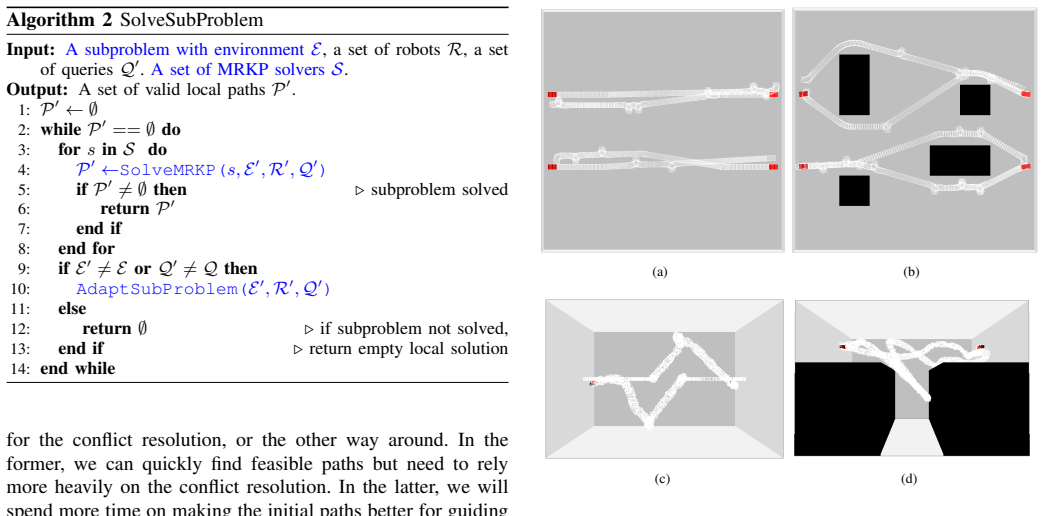
The central mechanism is segment-wise interleaving: a kinematic guide path is divided into m equal segments, each segment is passed to a trajectory optimizer that minimizes control effort and duration under hard dynamic constraints, and conflicts are then resolved locally by a subproblem solver. The subproblem follows the pattern of ARC, Adaptive Robot Coordination, in which only robots involved in a conflict are merged into a local multi-robot query, but with kinodynamic adaptations: the local environment is not shrunk, and the start and goal queries are expanded to previous and next segment goals. The solver hierarchy is the load-bearing part of conflict resolution: cheap prioritized optimization is tried first, and sampling-based Kinodynamic RRT variants provide fallback exploration when optimization cannot find a feasible local trajectory.
What would settle it
Run K-ARC on a pair of robots crossing paths with a coarse timestep and small clearance, then re-sample the returned trajectories at much finer temporal resolution; finding any pair of states closer than $d_{\min}$ between consecutive checked timesteps would show the returned plan is not collision-free.
Extended reading notes
Core claim
On its own terms, K-ARC establishes that multi-robot kinodynamic planning can be decomposed into a sequence of independent segment problems without losing feasibility. The algorithm first computes conflict-unaware kinematic paths with any sampling-based motion planner, splits them into m segments, and then for each segment runs a single-robot trajectory optimizer that respects dynamics and obstacle constraints. The resulting segment endpoints are chained as starts for the next segment, which solves the discontinuity problem that a direct extension of ARC would face. If two robots' optimized segments collide at a sampled timestep, K-ARC builds a local subproblem containing those robots and tries a hierarchy of solvers: prioritized trajectory optimization, then decoupled Kinodynamic RRT, then composite Kinodynamic RRT, expanding the local query only if all fail. In experiments, K-ARC is the only method to reach 32 robots in the open-cross scenario, and it reports one to two orders of magnitude runtime improvement over K-CBS and CB-MPC, a sampling-based and an optimization-based conflict-based-search planner respectively, on most tested configurations; it also succeeds in a constrained quadrotor inlet scenario where one baseline always fails.
Load-bearing premise
The whole safety argument rests on checking collisions only at the fixed timesteps of the discretized dynamics, with no verification that the continuous trajectories between those timesteps stay separated.
Editorial extensions
If this is right
- If the reported results hold, K-ARC-type segment decomposition gives a practical way to push multi-robot kinodynamic planning well beyond the roughly 8 to 16 robot limits of the tested whole-trajectory conflict-based-search planners.
- Because each segment optimizer handles only a short trajectory, the per-call nonlinear program is small, which is the stated reason optimization remains fast even as robot count grows.
- The solver hierarchy means the framework degrades gracefully: cheap optimization handles easy local conflicts, and sampling-based planners are invoked only when the optimizer fails.
- Sequential segment chaining makes the method applicable to any kinodynamic system for which a single-robot trajectory optimizer and a multi-robot kinodynamic planner exist.
Reading between the lines
- An implication the paper leaves implicit is that the number of segments is a direct computation-quality trade-off: more segments shrink optimization problems but create more segment boundaries and coordination overhead, so per-scenario tuning of this parameter is a natural next experiment.
- Because safety is only verified at discrete timesteps, a stress test with a deliberately coarse timestep and fine-grained post-sampling of returned trajectories would reveal whether the planner's guarantee covers continuous time.
- The hybrid pattern suggests a modular recipe: a kinematic guide planner, a dynamics-aware optimizer, and a conflict-resolution oracle can be mixed and matched, which could extend to heterogeneous teams where robots have different dynamics and different optimizers.
Signed reviews
Editorial analysis
A structured set of objections, weighed in public.
Referee Report
Summary. The paper presents K-ARC, a multi-robot kinodynamic planning algorithm that extends the authors' earlier ARC framework. K-ARC first computes individual kinematic paths, segments them into m pieces, and processes the segments sequentially. For each segment it uses a single-robot trajectory optimizer to obtain kinodynamically feasible trajectory segments, checks those segments for inter-robot conflicts at discrete timesteps, and resolves conflicts through a subproblem solver hierarchy that combines prioritized trajectory optimization with decoupled and composite kinodynamic RRT variants. The experiments compare K-ARC against reimplementations of K-CBS and CB-MPC in four scenarios (open cross, cluttered cross, quadrotor cross, quadrotor inlet) and report substantial runtime speedups, including scaling to 32 robots in the open cross scenario. The central claim is that the segment-wise interleaving of optimization and sampling yields an order-of-magnitude speedup while preserving feasibility.
Significance. The proposed segmentation idea is a genuinely useful way to combine optimization and sampling in multi-robot kinodynamic planning, and the empirical scaling to 32 robots in open environments is noteworthy. The paper also gives a clear account of why a direct ARC extension fails for kinodynamic problems, namely the exact-goal discontinuity problem, and the sequential segment construction is a sensible resolution. A strength of the experimental design is that all planners are implemented in a common open-source library, which facilitates head-to-head comparison if the code is released. However, the significance of the reported speedups depends on two conditions that are not currently established: the output trajectories must be collision-free in continuous time, and the baselines must be faithful to the published methods they represent. If these conditions are met, the work would be a solid contribution to multi-robot kinodynamic planning.
major comments (3)
- [§II-C, §IV-C, Algorithm 1] The formal problem definition in §II-C only imposes obstacle avoidance and inter-robot separation at discrete timesteps (constraints (5)-(6)), and the same discrete notion is used throughout: Algorithm 1 line 20 defines a conflict as a tuple (xi,k, xj,k), and the subproblem solvers in §IV-C enforce separation on individual states. No swept-volume check, interpolation bound, or continuous-time validation is described anywhere in the paper. Because the trajectory optimizer in §IV-B minimizes total time and can choose a coarse time step, two robots could pass through each other, or a robot could clip an obstacle, between consecutive samples while every discrete constraint is satisfied. This is load-bearing for the correctness of every reported success: the output is described as a set of 'valid, kinodynamically feasible paths' in Algorithm 1, so the reported speedups may be for trajectories that are not actually collision-free. The authors should add continuous-time collision checking or a formal bound on the interpolation error, and rerun or reanalyze the experiments with that check in place.
- [§V-A] The contribution statement claims speedups 'compared to baseline methods from recent literature,' but the baselines are reimplementations. Section V-A states that the implementations of K-CBS and CB-MPC follow the same high-level CBS framework and 'does not include the further improvements on the framework.' Without knowing which improvements from [6] and [5] are omitted, it is impossible to determine whether the comparison is against the published algorithms or against weakened versions of them. This directly affects the validity of the headline runtime comparison; the authors should either use the original implementations, or report precisely which components were omitted and justify why those omissions cannot materially change the comparison.
- [§V-A and §IV-C] Several experimental parameters and solver details that are essential for reproducing the claimed speedups are not reported. The number of path segments m (Algorithm 1 line 6), the discretization timestep ∆t, the local goal tolerance, and the cost weight β1 are never given in Section V, and the three subproblem solvers in Section IV-C are described only by name, with no termination criteria, sampling budgets, or success/failure thresholds. Since K-ARC's runtime and success rate are sensitive to these choices, the experimental section as written does not provide enough information to assess whether the comparison is fair or to reproduce the results. Please report these values and specify the subproblem solver configurations.
minor comments (4)
- [§II-C] The state transition equation contains a typo: 'xi,k+1 = xi,t + f (xi,k, ui,k)∆t' should reference xi,k on the right-hand side, not xi,t.
- [§IV-B] The cost function is written as J(xi,k, ui,k) = β1∥ui,k∥2 + ∆t, but the text says the optimizer minimizes ∆T; clarify whether the optimizer's time step is a decision variable and how it relates to the fixed simulation timestep ∆t defined in §II-C.
- [Algorithm 1, lines 16-23] The symbol glast is used to define qlocal before it is formally introduced; define the previous segment's terminal state before line 16.
- [Table I] The table caption contains a typo ('he quadrotor inlet' instead of 'the quadrotor inlet'). Also, since the runtime standard deviations are large (e.g., 81.98 for K-ARC in Table I), the paper should state whether the reported speedups are statistically significant.
Circularity Check
No significant circularity: the claims are empirical, measured against described baselines, and no prediction reduces to a fitted input or to a self-citation chain.
full rationale
The paper's central claims are experimental runtime and path-cost measurements for K-ARC versus K-CBS and CB-MPC. There is no analytical derivation in which an output quantity is defined in terms of the quantity it is supposed to predict, no fitted parameter is renamed as a prediction, and no uniqueness or existence theorem is imported from the authors' own prior work to force a choice. The only self-citation of note is to the authors' previous ARC framework [7], which K-ARC extends; the paper describes the relevant ARC-style subproblem mechanism in Algorithm 2 and explains the differences, so the citation is contextual rather than load-bearing. The use of the authors' own implementations of the baselines is a potential experimental fairness concern, but it is not circularity because the runtime comparison is measured directly and is not constructed to reproduce a target result. The discrete-time safety limitation (constraints (5)-(6) and conflicts checked only at sampled timesteps, without a continuous-time swept-volume guarantee) is a correctness risk for the reported solutions, not a circularity of the derivation. No specific circular step could be exhibited, so the score is zero.
Assumptions & free parameters
free parameters (4)
- Number of path segments m =
Unspecified; fixed by hand
- Local goal tolerance =
Unspecified; relaxed in Quadrotor Cross
- Cost weight beta_1 =
Unspecified
- Discretization timestep Delta t =
Unspecified
assumptions (5)
- domain assumption Euler integration with fixed Delta t accurately represents robot dynamics
- domain assumption Single-robot trajectory optimizer will find a feasible kinodynamic segment when one exists
- ad hoc to paper Discrete-time collision checking is sufficient for continuous-time safety
- domain assumption Concatenating per-segment solutions yields a globally feasible trajectory
- ad hoc to paper Adapting the subproblem by extending start and goal eventually produces a solution or a final failure
Cite this review
Pith. "Pith review of K-ARC: Adaptive Robot Coordination for Multi-Robot Kinodynamic Planning." pith.science (2026). https://pith.science/paper/FFKTZXSU
@misc{pith2026250101559,
  author       = {Pith},
  title        = {Pith review of: K-ARC: Adaptive Robot Coordination for Multi-Robot Kinodynamic Planning},
  year         = {2026},
  howpublished = {\url{https://pith.science/paper/FFKTZXSU}},
  note         = {Machine review of arXiv:2501.01559}
}
read the original abstract
This work presents Kinodynamic Adaptive Robot Coordination (K-ARC), a novel algorithm for multi-robot kinodynamic planning. Our experimental results show the capability of K-ARC to plan for up to 32 planar mobile robots, while achieving up to an order of magnitude of speed-up compared to previous methods in various scenarios. K-ARC is able to achieve this due to its two main properties. First, K-ARC constructs its solution iteratively by planning in segments, where initial kinodynamic paths are found through optimization-based approaches and the inter-robot conflicts are resolved through sampling-based approaches. The interleaving use of sampling-based and optimization-based approaches allows K-ARC to leverage the strengths of both approaches in different sections of the planning process where one is more suited than the other, while previous methods tend to emphasize on one over the other. Second, K-ARC builds on a previously proposed multi-robot motion planning framework, Adaptive Robot Coordination (ARC), and inherits its strength of focusing on coordination between robots only when needed, saving computation efforts. We show how the combination of these two properties allows K-ARC to achieve overall better performance in our simulated experiments with increasing numbers of robots, increasing degrees of problem difficulties, and increasing complexities of robot dynamics.
Figures


Reference graph
Works this paper leans on
-
[6]
Conflict-based search for multi-robot motion planning with kinodynamic constraints,
J. Kottinger, S. Almagor, and M. Lahijanian, “Conflict-based search for multi-robot motion planning with kinodynamic constraints,” in 2022 IEEE/RSJ International Conference on Intelligent Robots and Systems (IROS), pp. 13494–13499, 2022
work page 2022
-
[5]
Conflict-based model predictive control for scalable multi-robot motion planning,
A. Tajbakhsh, L. T. Biegler, and A. M. Johnson, “Conflict-based model predictive control for scalable multi-robot motion planning,” in 2024 IEEE International Conference on Robotics and Automation (ICRA) , pp. 14562–14568, 2024
work page 2024
-
[1]
Randomized kinodynamic planning,
S. LaValle and J. Kuffner, “Randomized kinodynamic planning,” in Proceedings 1999 IEEE International Conference on Robotics and Automation (Cat. No.99CH36288C) , vol. 1, pp. 473–479 vol.1, 1999
work page 1999
-
[2]
Conflict- based search for optimal multi-agent pathfinding,
G. Sharon, R. Stern, A. Felner, and N. R. Sturtevant, “Conflict- based search for optimal multi-agent pathfinding,” Artificial Intelligence, vol. 219, pp. 40–66, 2015
work page 2015
-
[3]
db- cbs: Discontinuity-bounded conflict-based search for multi-robot kin- odynamic motion planning,
A. Moldagalieva, J. Ortiz-Haro, M. Toussaint, and W. Hönig, “db- cbs: Discontinuity-bounded conflict-based search for multi-robot kin- odynamic motion planning,” in 2024 IEEE International Conference on Robotics and Automation (ICRA) , pp. 14569–14575, 2024
work page 2024
-
[4]
J. Li, M. Ran, and L. Xie, “Efficient trajectory planning for multiple non- holonomic mobile robots via prioritized trajectory optimization,” IEEE Robotics and Automation Letters , vol. 6, no. 2, pp. 405–412, 2021
work page 2021
-
[7]
Adaptive robot coordination: A subproblem-based approach for hybrid multi-robot motion planning,
I. Solis, J. Motes, M. Qin, M. Morales, and N. M. Amato, “Adaptive robot coordination: A subproblem-based approach for hybrid multi-robot motion planning,” IEEE Robotics and Automation Letters , vol. 9, no. 8, pp. 7238–7245, 2024
work page 2024
-
[8]
An algorithm for planning collision-free paths among polyhedral obstacles,
T. Lozano-Pérez and M. A. Wesley, “An algorithm for planning collision-free paths among polyhedral obstacles,” Communications ACM, vol. 22, pp. 560–570, October 1979
work page 1979
Show all 23 references
-
[9]
J. F. Canny, The Complexity of Robot Motion Planning . Cambridge, MA: MIT Press, 1988
1988
-
[10]
Probabilistic roadmaps for path planning in high-dimensional configuration spaces,
L. Kavraki, P. Svestka, J.-C. Latombe, and M. Overmars, “Probabilistic roadmaps for path planning in high-dimensional configuration spaces,” IEEE Transactions on Robotics and Automation, vol. 12, no. 4, pp. 566– 580, 1996
1996
-
[11]
Rapidly-exploring random trees : a new tool for path planning,
S. LA V ALLE, “Rapidly-exploring random trees : a new tool for path planning,” Research Report 9811 , 1998
1998
-
[12]
Optimal kinodynamic motion planning using incremental sampling-based methods,
S. Karaman and E. Frazzoli, “Optimal kinodynamic motion planning using incremental sampling-based methods,” in 49th IEEE Conference on Decision and Control (CDC) , pp. 7681–7687, 2010
2010
-
[13]
Kinodynamic rrt*: Optimal motion planning for systems with linear differential constraints,
D. J. Webb and J. van den Berg, “Kinodynamic rrt*: Optimal motion planning for systems with linear differential constraints,” 2012
2012
-
[14]
Asymptotically optimal planning by feasible kinodynamic planning in a state–cost space,
K. Hauser and Y . Zhou, “Asymptotically optimal planning by feasible kinodynamic planning in a state–cost space,” IEEE Transactions on Robotics, vol. 32, no. 6, pp. 1431–1443, 2016
2016
-
[15]
Stomp: Stochastic trajectory optimization for motion planning,
M. Kalakrishnan, S. Chitta, E. Theodorou, P. Pastor, and S. Schaal, “Stomp: Stochastic trajectory optimization for motion planning,” in 2011 IEEE International Conference on Robotics and Automation , pp. 4569– 4574, 2011
2011
-
[16]
Chomp: Gradient optimization techniques for efficient motion planning,
N. Ratliff, M. Zucker, J. A. Bagnell, and S. Srinivasa, “Chomp: Gradient optimization techniques for efficient motion planning,” in 2009 IEEE International Conference on Robotics and Automation , pp. 489–494, 2009
2009
-
[17]
Motion planning with sequential convex optimization and convex collision checking,
J. Schulman, Y . Duan, J. Ho, A. X. Lee, I. Awwal, H. Bradlow, J. Pan, S. Patil, K. Goldberg, and P. Abbeel, “Motion planning with sequential convex optimization and convex collision checking,” The International Journal of Robotics Research , vol. 33, pp. 1251 – 1270, 2014
2014
-
[18]
Mk-rrt*: Multi-robot kin- odynamic rrt trajectory planning,
B. Cain, M. Kalaitzakis, and N. Vitzilaios, “Mk-rrt*: Multi-robot kin- odynamic rrt trajectory planning,” in 2021 International Conference on Unmanned Aircraft Systems (ICUAS) , pp. 868–876, 2021
2021
-
[19]
Scalable and safe multi-agent motion planning with nonlinear dynamics and bounded disturbances,
J. Chen, J. Li, C. Fan, and B. Williams, “Scalable and safe multi-agent motion planning with nonlinear dynamics and bounded disturbances,” in Proceedings of the 35th AAAI Conference on Artificial Intelligence (AAAI), pp. 11237–11245, 2021
2021
-
[20]
Trajectory planning for quadrotor swarms,
W. Hönig, J. A. Preiss, T. K. S. Kumar, G. S. Sukhatme, and N. Ayanian, “Trajectory planning for quadrotor swarms,” IEEE Transactions on Robotics, vol. 34, no. 4, pp. 856–869, 2018
2018
-
[21]
Sipp: Safe interval path planning for dynamic environments,
M. Phillips and M. Likhachev, “Sipp: Safe interval path planning for dynamic environments,” in 2011 IEEE International Conference on Robotics and Automation , pp. 5628–5635, 2011
2011
-
[22]
Casadi: a software framework for nonlinear optimization and optimal control,
J. Andersson, J. Gillis, G. Horn, J. Rawlings, and M. Diehl, “Casadi: a software framework for nonlinear optimization and optimal control,” Mathematical Programming Computation , vol. 11, 07 2018
2018
-
[23]
Large-scale nonlinear programming using ipopt: An integrating framework for enterprise-wide dynamic optimization,
L. T. Biegler and V . M. Zavala, “Large-scale nonlinear programming using ipopt: An integrating framework for enterprise-wide dynamic optimization,” Comput. Chem. Eng. , vol. 33, pp. 575–582, 2009. 8
2009
Reviewed August 10, 2026 · model on record in the stance chip above.
Discussion (0). Continue with ORCID to comment.