REVIEW 4 major objections 4 minor 32 references
Dedicated Inference Engine and Binary-Weight Neural Networks for Lightweight Instance Segmentation
T0 review · 4 major / 4 minor · reviewed 2026-08-10 · deepseek-v4-flash
Pith's one-line read Binary-weight MACs can be rewritten as bitwise XNOR/AND sums, yielding an inference engine of 211K gates at 2GHz—roughly half the hardware of prior multipliers—that still runs instance segmentation.
desk verdict The math is sound and the dual-mode bitwise MAC is a real, if small, engineering contribution, but the headline 52% gate-count claim is not yet established because the comparison baselines are unreleased and the reduction may come mostly from folding a constant correction term that any XNOR accelerator could also fold into the bias. read the letter →
The pith
A machine-rendered reading of the paper's core claim, the machinery that carries it, and where it could break.
The reading
What carries the argument
The central object is the 'bitwise operation and accumulation array'—a bank of logical operation units, one per input, each carrying J bitwise gates. In mode m=0 each gate is an XNOR, in mode m=1 each gate is an AND; an adder array weights the per-bit results by powers of two and adds the bias plus the precomputed correction term. This array is what lets the engine claim 'only bitwise operations and add operations' and what achieves the reported gate counts.
What would settle it
An independent re-synthesis of the proposed bitwise operation and accumulation array and the two baseline multipliers from identical RTL, using the same cell library, synthesis effort, and 2GHz timing constraints, would settle the hardware claim: the saving is real only if the proposed design reproduces roughly 211K gates while the baselines sit near 404K and 356K.
Extended reading notes
Core claim
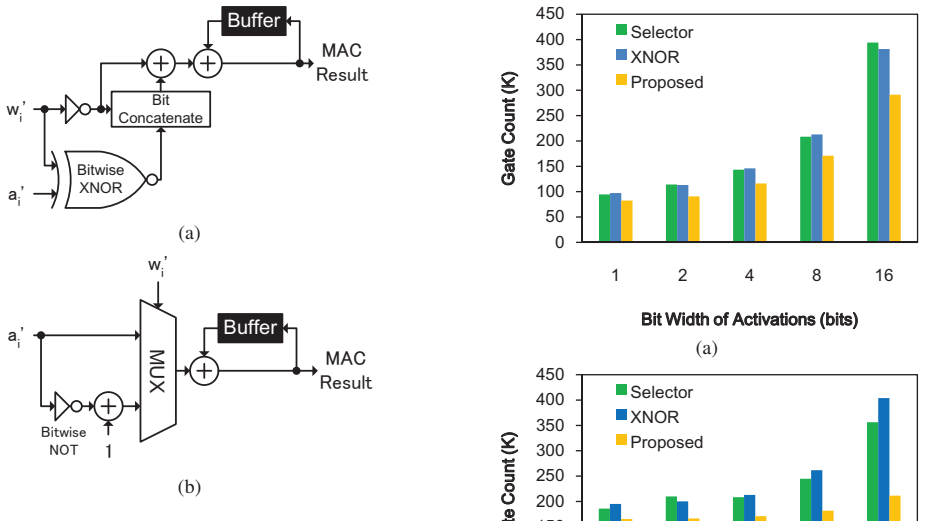
On its own terms, the paper's central discovery is that a multiply-accumulate for binary-weight networks can be replaced by a bit-serial XNOR/AND structure with no multiply units at all. Splitting an 8-bit activation $a'_i$ into bits $a'_{i,j}$ turns each product $a'_i w_i$ into a sum over bit positions $2^j(a'_{i,j}\odot w'_i)$ for $\pm1$ weights (mode m=0) or $2^j(a'_{i,j}\cdot w'_i)$ for $\{0,1\}$ weights (mode m=1). The correction term $\gamma = ((\sum_i w_i - I)/2)(2^J-1)$ depends only on weights and bit depth, so the design precomputes it and folds it into the batch-normalization/quantization bias $\beta$, leaving the inference datapath as bitwise gates plus adders. Synthesized at 2GHz with 8-bit activations, the resulting bitwise operation and accumulation array reports 211K gates against 404K for a modified XNOR-based multiplier and 356K for a selector-based multiplier, while handling both binary weight formats.
Load-bearing premise
The load-bearing premise is that the authors' re-implementations of the two comparison multipliers are fair, representative baselines; if those were under-optimized, the reported savings would be overstated.
Editorial extensions
If this is right
- Because the correction term depends only on weights and bit depth, it can be precomputed and merged into the bias, so the embedded device never computes it.
- Both binary weight formats $\{0,1\}$ and $\pm1$ are served by one circuit that switches between AND and XNOR modes, and the ablation credits this two-format support for the +18.6% Person MAP improvement.
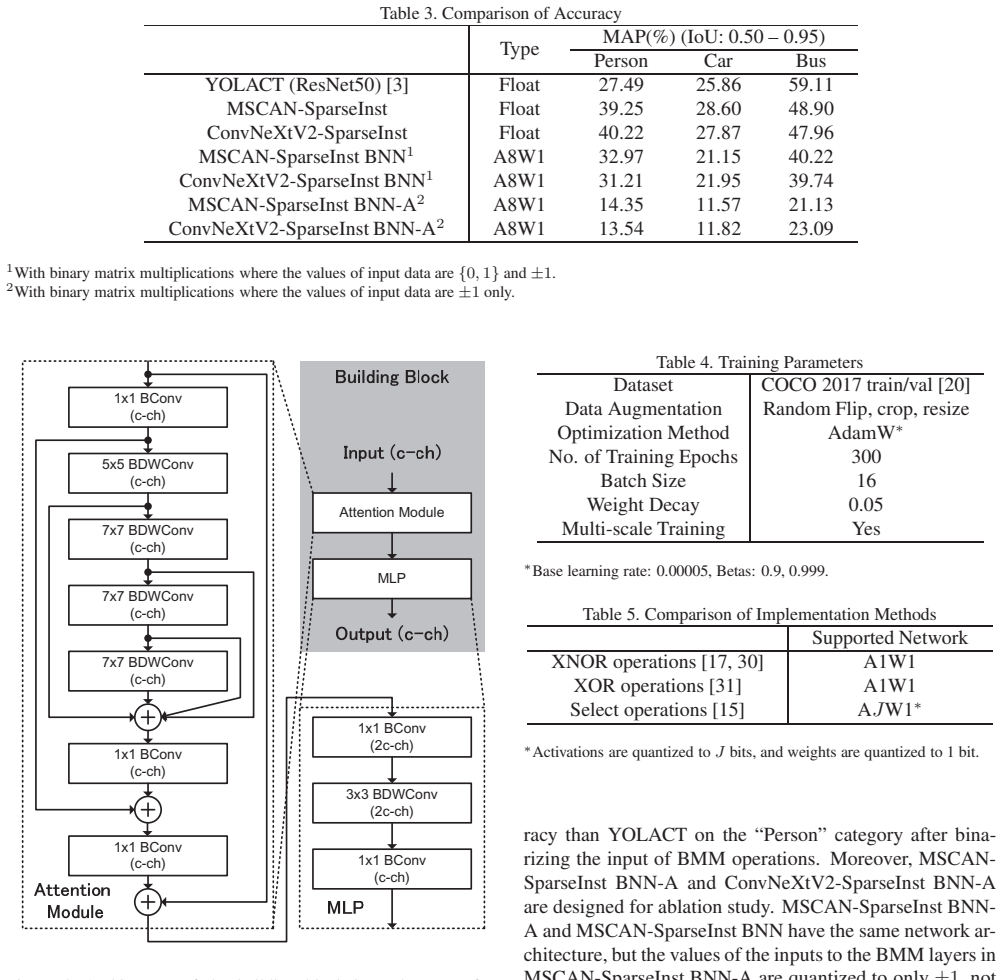
- The A8W1 instance-segmentation networks run with only 9.8% of YOLACT's MACs and a 77.7x smaller model, while exceeding YOLACT's MAP on the Person category.
- At 2GHz with 8-bit activations the proposed array synthesizes to 211K gates, versus 404K for the modified XNOR-based multiplier and 356K for the selector-based multiplier.
- The gate-count advantage grows as the operating frequency rises, so the design is most attractive for high-clock embedded implementations.
Reading between the lines
- If the 211K-gate figure survives independent re-synthesis, the same correction-term trick should transfer to any accelerator that binarizes weights: split multi-bit activations bit-serially, precompute all weight-only constants, and the datapath becomes gates plus adders.
- The $\{0,1\}$ AND-accumulate mode is a natural fit for attention-style matrix products such as queries, keys, or masks, so the engine could plausibly serve lightweight transformers for dense prediction, not just SparseInst's decoder; the paper does not test this.
- The +18.6% Person MAP gain from supporting $\{0,1\}$ alongside $\pm1$ inputs suggests a testable rule: sign-only encoding throws away information when one operand is a near-mask signal, so keeping $\{0,1\}$ in binary matmuls is worth more than extra bit width; an ablation on other dense tasks would show whether this generalizes.
Editorial analysis
A structured set of objections, weighed in public.
Referee Report
Summary. The paper presents a hardware-oriented reformulation of binary-weight neural network (BNN) inference. It decomposes multi-bit activations into bitplanes and replaces each multiplication of an activation bit by a ±1 weight with an XNOR operation plus a correction term γ (Eq. 5); because γ depends only on weights and not on activations, it is folded into the layer bias. The proposed 'bitwise operation and accumulation array' supports two binary-weight formats, {0,1} and ±1, using AND and XNOR operations. The authors report a 211K-gate synthesis at 2 GHz with 8-bit activations, stated as 52% of a re-implemented modified XNOR-based multiplier and 59% of a selector-based multiplier. They also design two lightweight instance-segmentation networks, MSCAN-SparseInst BNN and ConvNeXtV2-SparseInst BNN, combining SegNeXt/ConvNeXtV2 backbones with a SparseInst decoder, and report per-category COCO AP on Person, Car, and Bus, claiming higher Person AP than YOLACT with a 77.7x smaller model.
Significance. The mathematical identity in Eqs. 3-5 is correct and is a legitimate way to eliminate multiply operations from BNN MACs; this part of the paper is sound and not circular. The two-mode design that accommodates both {0,1} and ±1 binary weights is a useful feature for SparseInst-style BMM layers, and the experimental finding that the mixed binary format improves instance-segmentation accuracy over ±1-only binarization is informative. If the gate-count comparison is confirmed under controlled synthesis, a 52% reduction relative to prior BNN multipliers would be a practically valuable result. The main limitations are evidential: the hardware comparison is not yet reproducible or demonstrably fair, and the accuracy evaluation is too narrow to support the algorithm-level claims as currently stated.
major comments (4)
- [4.2, Eq. (5), Table 6] The paper attributes the gate-count reduction to removing the correction term γ from the MAC. Since γ is a per-layer constant that is independent of the activations, any implementation—including the modified XNOR-based multiplier [17,30]—can fold γ into the bias before inference. The current comparison does not show that the baseline re-implementations also use this folding. If the baseline instead computes the full product a'_{i,j}w_i with per-weight correction logic, the 52% figure is not an apples-to-apples measure of the proposed circuit. Please resynthesize the baselines with γ folded and release the RTL or provide a detailed gate-level description of all three implementations.
- [4.2, Fig. 7, Table 6] The gate counts are reported for 'multipliers,' but the proposed unit is called the 'bitwise operation and accumulation array,' and the number I of activations accumulated in the synthesized module is never stated. Absolute gate counts for an adder-accumulator tree depend strongly on I and on whether the reported number includes the mode-select logic, the adder array, and the bias add. Without this information, and without synthesis scripts or netlists, the quoted 211K/404K/356K numbers cannot be reproduced or checked even in principle. Please specify I, the exact module boundary, the synthesis tool and settings, and provide the RTL or netlists used for the comparison.
- [4.1, Table 3] The accuracy evaluation reports MAP for only three COCO categories with no stated evaluation split, input resolution, or common protocol for the YOLACT baseline, and no aggregate COCO mAP over the 80 categories. The headline 'higher accuracy than YOLACT' is based on a single category (Person), while the proposed BNNs are lower on Car and Bus. Please provide the full evaluation protocol and aggregate mAP, or explicitly and consistently frame the result as a class-selected comparison; as written, the comparison does not substantiate the general accuracy claim.
- [4.1, Table 4] The text states that the number of training epochs is 16 and the batch size is 16, but Table 4 reports 300 training epochs and the same batch size. This is a direct contradiction in a load-bearing part of the experimental setup. Please correct the number and specify the actual learning-rate schedule.
minor comments (4)
- [4.2] The description of the modified XNOR-based multiplier says 'to support multi-bit weights,' but the comparison is for A8W1 networks; this should read 'multi-bit activations.'
- [Table 2] The footnote is confusing: the Type column says 'Float' but the model size is evaluated with 8-bit weights; please clarify whether the reported sizes are for the deployed precision or for a nominal 8-bit storage format.
- [Figures 1, 2, 3, and 6] These figures are difficult to read due to small fonts and low image resolution; please provide vector or otherwise higher-resolution figures so that labels such as m, a'_{i,j}, and w'_i are legible.
- [4.2] Please state the synthesis tool, ASAP7 cell library version, voltage corner, and optimization effort in addition to the RVT device model, so that the gate counts can be interpreted.
Circularity Check
No load-bearing circularity; the derivation is an explicit bit-decomposition identity plus synthesis results, with only a non-load-bearing self-citation and an unverified baseline comparison.
full rationale
The claimed reduction of BNN MAC operations to bitwise and add operations is derived transparently in Eqs. 1-6 of Sec. 3. The correction term gamma in Eq. 5 is a weight-only and activation-count constant that is folded into the bias term before inference, and the hardware then computes only XNOR/AND-accumulate operations; this is an algebraic identity, not a conclusion that is assumed in its own inputs. The gate-count comparison in Table 6 and Fig. 7 is based on the authors' re-implementations of the XNOR- and selector-based multipliers from refs. [15,17,30], and the paper does not release the RTL, synthesis constraints, or the value of I used for Fig. 7. That is a legitimate reproducibility and benchmarking-fairness concern, because a fair baseline could also fold gamma into the bias offline, but it is not a circular derivation: the proposed circuit's arithmetic does not use the baseline gate counts as an input. The accuracy experiments are empirical measurements on COCO against the external YOLACT baseline, and the training uses HWGQ, PACT, LSQ, LSQ+, and PROFIT, none of which are defined in terms of the claimed results. The only self-citation, IFQ-Net [14], appears in the remark after Eq. 4 about simplifying computations after substituting beta with beta+gamma; that remark is not load-bearing because the hardware identity and the synthesis results stand independently of IFQ-Net's quantization algorithms. Overall, the central hardware and accuracy claims are self-contained, so the circularity score is low despite the non-load-bearing self-citation and the unverified baseline comparison.
Assumptions & free parameters
free parameters (2)
- Quantization training hyperparameters (LSQ step sizes, PACT clip thresholds) =
not reported (learned)
- Network weights of the proposed BNNs =
not reported
assumptions (3)
- domain assumption Activations are quantized to 8 bits and weights to 1 bit, and this quantization is compatible with the proposed MAC unit's two modes.
- standard math The identity in Eq. 4 correctly decomposes binary-weight MACs into XNOR-accumulate operations plus a precomputable correction term γ.
- domain assumption IFQ-Net's quantization framework allows the bias term β to be replaced by (β+γ) without loss of accuracy.
Cite this review
Pith. "Pith review of Dedicated Inference Engine and Binary-Weight Neural Networks for Lightweight Instance Segmentation." pith.science (2026). https://pith.science/paper/UYVN5WUF
@misc{pith2026250101841,
  author       = {Pith},
  title        = {Pith review of: Dedicated Inference Engine and Binary-Weight Neural Networks for Lightweight Instance Segmentation},
  year         = {2026},
  howpublished = {\url{https://pith.science/paper/UYVN5WUF}},
  note         = {Machine review of arXiv:2501.01841}
}
abstract
Reducing computational costs is an important issue for development of embedded systems. Binary-weight Neural Networks (BNNs), in which weights are binarized and activations are quantized, are employed to reduce computational costs of various kinds of applications. In this paper, a design methodology of hardware architecture for inference engines is proposed to handle modern BNNs with two operation modes. Multiply-Accumulate (MAC) operations can be simplified by replacing multiply operations with bitwise operations. The proposed method can effectively reduce the gate count of inference engines by removing a part of computational costs from the hardware system. The architecture of MAC operations can calculate the inference results of BNNs efficiently with only 52% of hardware costs compared with the related works. To show that the inference engine can handle practical applications, two lightweight networks which combine the backbones of SegNeXt and the decoder of SparseInst for instance segmentation are also proposed. The output results of the lightweight networks are computed using only bitwise operations and add operations. The proposed inference engine has lower hardware costs than related works. The experimental results show that the proposed inference engine can handle the proposed instance-segmentation networks and achieves higher accuracy than YOLACT on the "Person" category although the model size is 77.7$\times$ smaller compared with YOLACT.
Figures


Figures from the paper (3 more)

Reference graph
Works this paper leans on
-
[1]
Ankur Agrawal, Sae Kyu Lee, Joel Silberman, Matthew Ziegler, Mingu Kang, Swagath V enkataramani, Nianzheng Cao, Bruce Fleischer, Michael Guillorn, Matthew Cohen, Silvia Mueller, Jinwook Oh, Martin Lutz, Jinwook Jung, Siyu Koswatta, Ching Zhou, Vidhi Zalani, James Bonanno, Robert Casatuta, Chia-Y u Chen, Jungwook Choi, Howard Haynie, Alyssa Herbert, Radhik...
work page 2021
-
[2]
LSQ+: Improving low-bit quantization through learnable offsets and better initial iza- tion, 2020
Yash Bhalgat, Jinwon Lee, Markus Nagel, Tijmen Blankevoort, and Nojun Kwak. LSQ+: Improving low-bit quantization through learnable offsets and better initial iza- tion, 2020. CoRR, abs/2004.09576
arXiv 2020
-
[3]
YOLACT: real-time instance segmentation, 2019
Daniel Bolya, Chong Zhou, Fanyi Xiao, and Y ong Jae Lee. YOLACT: real-time instance segmentation, 2019. CoRR, abs/1904.02689
arXiv 2019
-
[4]
Deep learning with low precision by half-wave Gaussian quantization, 2017
Zhaowei Cai, Xiaodong He, Jian Sun, and Nuno V asconce- los. Deep learning with low precision by half-wave Gaussian quantization, 2017. CoRR, abs/1702.00953
arXiv 2017
- [5]
-
[6]
Tse-Wei Chen, Motoki Y oshinaga, Hongxing Gao, Wei Tao, Dongchao Wen, Junjie Liu, Kinya Osa, and Masami Kato. Condensation-Net: memory-efficient network architecture with cross-channel pooling layers and virtual feature maps ,
-
[7]
Sparse Instance Activation for Real-Time Instance Segmentation
Tianheng Cheng, Xinggang Wang, Shaoyu Chen, Wenqiang Zhang, Qian Zhang, Chang Huang, Zhaoxiang Zhang, and Wenyu Liu. Sparse instance activation for real-time instan ce segmentation, 2022. CoRR, abs/2203.12827v1
work page Pith review arXiv 2022
-
[8]
PACT: parameterized clipping acti- vation for quantized neural networks, 2018
Jungwook Choi, Zhuo Wang, Swagath V enkataramani, Pierce I-Jen Chuang, Vijayalakshmi Srinivasan, and Kailas h Gopalakrishnan. PACT: parameterized clipping acti- vation for quantized neural networks, 2018. CoRR, abs/1805.06085v2
arXiv 2018
Show all 32 references
-
[9]
A binary weight convolutional neural network hardware accelerator for analysis faults of the CNC machinery on FPGA
Ching-Che Chung, Y u-Pei Liang, Ya-Ching Chang, and Chen-Ming Chang. A binary weight convolutional neural network hardware accelerator for analysis faults of the CNC machinery on FPGA. In Proceedings of International VLSI Symposium on Technology, Systems and Applications (VLSI...
2023
-
[10]
BinaryConnect: training deep neural networks with binary weights during propagations, 2015
Matthieu Courbariaux, Y oshua Bengio, and Jean-Pierre David. BinaryConnect: training deep neural networks with binary weights during propagations, 2015. CoRR, abs/1511.00363
2015 arXiv
-
[11]
Se- mantic image segmentation: Two decades of research, 2023
Gabriela Csurka, Riccardo V olpi, and Boris Chidlovski i. Se- mantic image segmentation: Two decades of research, 2023. CoRR, abs/2302.06378
2023 arXiv
-
[12]
RetinaFace: Single-stage den se face localisation in the wild, 2019
Jiankang Deng, Jia Guo, Y uxiang Zhou, Jinke Y u, Irene Kot- sia, and Stefanos Zafeiriou. RetinaFace: Single-stage den se face localisation in the wild, 2019. CoRR, abs/1905.00641
2019 arXiv
-
[13]
Esser, Jeffrey L
Steven K. Esser, Jeffrey L. McKinstry, Deepika Bablani, Rathinakumar Appuswamy, and Dharmen- dra S. Modha. Learned step size quantization, 2019. CoRR, abs/1902.08153
2019 arXiv
-
[14]
IFQ-Net: integrated fixed- point quantization networks for embedded vision, 2019
Hongxing Gao, Wei Tao, Dongchao Wen, Tse-Wei Chen, Kinya Osa, and Masami Kato. IFQ-Net: integrated fixed- point quantization networks for embedded vision, 2019. CoRR, abs/1911.08076
2019 arXiv
-
[15]
Efficient binary weight convolu- tional network accelerator for speech recognition
Lunyi Guo, Shining Mu, Yijie Deng, Chaofan Shi, Bo Yan, and Zhuoling Xiao. Efficient binary weight convolu- tional network accelerator for speech recognition. Sensors, 23(3):1530, May 2023
2023
-
[16]
SegNeXt: rethink- ing convolutional attention design for semantic segmenta- tion, 2022
Meng-Hao Guo, Cheng-Ze Lu, Qibin Hou, Zhengning Liu, Ming-Ming Cheng, and Shi-Min Hu. SegNeXt: rethink- ing convolutional attention design for semantic segmenta- tion, 2022. CoRR, abs/2209.08575
2022 arXiv
-
[17]
A high-efficiency FPGA-based accelerator for binarized neu- ral network
Peng Guo, Hong Ma, Ruizhi Chen, and Donglin Wang. A high-efficiency FPGA-based accelerator for binarized neu- ral network. Journal of Circuits, Systems and Computers , 28(supp01), Apr. 2019
2019
-
[18]
BitFlow: Exploit- ing vector parallelism for binary neural networks on CPU
Y uwei Hu, Jidong Zhai, Dinghua Li, Yifan Gong, Y uhao Zhu, Wei Liu, Lei Su, and Jiangming Jin. BitFlow: Exploit- ing vector parallelism for binary neural networks on CPU. In Proceedings of International Parallel and Distributed Pro - cessing Symposium, pages 244–253, May 2018
2018
-
[19]
Jain, Albert Gural, Michael Wu, and Chris H
Sambhav R. Jain, Albert Gural, Michael Wu, and Chris H. Dick. Trained quantization thresholds for accurate and ef- ficient fixed-point inference of deep neural networks, 2020. CoRR, abs/1903.08066v3
2020 arXiv
-
[20]
Lawrence Zitnick, and Piotr Doll´ ar
Tsung-Yi Lin, Michael Maire, Serge Belongie, Lubomir Bourdev, Ross Girshick, James Hays, Pietro Perona, Deva Ramanan, C. Lawrence Zitnick, and Piotr Doll´ ar. Mi- crosoft COCO: common objects in context, 2014. CoRR, abs/1405.0312
2014 arXiv
-
[21]
PROFIT: a novel train- ing method for sub-4-bit MobileNet models, 2020
Eunhyeok Park and Sungjoo Y oo. PROFIT: a novel train- ing method for sub-4-bit MobileNet models, 2020. CoRR, abs/2008.04693
2020 arXiv
-
[22]
Binary neural networks: A survey, 2020
Haotong Qin, Ruihao Gong, Xianglong Liu, Xiao Bai, Jingkuan Song, and Nicu Sebe. Binary neural networks: A survey, 2020. CoRR, abs/2004.03333
2020 arXiv
-
[23]
Vision transformers for dense prediction, 2021
Ren¨ e Ranftl, Alexey Bochkovskiy, and Vladlen Koltun. Vision transformers for dense prediction, 2021. CoRR, abs/2103.13413v1
2021 arXiv
-
[24]
XNOR-Net: ImageNet classification us- ing binary convolutional neural networks, 2016
Mohammad Rastegari, Vicente Ordonez, Joseph Redmon, and Ali Farhadi. XNOR-Net: ImageNet classification us- ing binary convolutional neural networks, 2016. CoRR, abs/1603.05279v4
2016 arXiv
-
[25]
A comprehensiv e review of YOLO architectures in computer vision: From YOLOv1 to YOLOv8 and YOLO-NAS, 2024
Juan Terven and Diana Cordova-Esparza. A comprehensiv e review of YOLO architectures in computer vision: From YOLOv1 to YOLOv8 and YOLO-NAS, 2024. CoRR, abs/2304.00501v7
2024 arXiv
-
[26]
A CNN accelerator on FPGA using binary weight networks
Tsung-Han Tsai and Y uan-Chen Ho. A CNN accelerator on FPGA using binary weight networks. In Proceedings of IEEE International Conference on Consumer Electronics (ICCE), pages 1–2, Sept. 2020
2020
-
[27]
Vinay V ashishtha, Manoj V angala, and Lawrence T. Clark . ASAP7 predictive design kit development and cell design technology co-optimization: Invited paper. In Proceedings of The International Conference on Computer-Aided Design (ICCAD), pages 992–998, Nov. 2017
2017
-
[28]
Con- vNeXt V2: co-designing and scaling ConvNets with masked autoencoders, 2023
Sanghyun Woo, Shoubhik Debnath, Ronghang Hu, Xinlei Chen, Zhuang Liu, In So Kweon, and Saining Xie. Con- vNeXt V2: co-designing and scaling ConvNets with masked autoencoders, 2023. CoRR, abs/2301.00808
2023 arXiv
-
[29]
ReCU: reviving the dead weights in binary neural networks, 2021
Zihan Xu, Mingbao Lin, Jianzhuang Liu, Jie Chen, Ling Shao, Y ue Gao, Y onghong Tian, and Rongrong Ji. ReCU: reviving the dead weights in binary neural networks, 2021. CoRR, abs/2103.12369v2
2021 arXiv
-
[30]
On-chip mem- ory based binarized convolutional deep neural network ap- plying batch normalization free technique on an FPGA
Haruyoshi Y onekawa and Hiroki Nakahara. On-chip mem- ory based binarized convolutional deep neural network ap- plying batch normalization free technique on an FPGA. In Proceedings of IEEE International Parallel and Dis- tributed Processing Symposium W orkshops , pages 98–105,...
2017
-
[31]
Shien Zhu, Luan H. K. Duong, and Weichen Liu. XOR-Net: An efficient computation pipeline for binary neural network inference on edge devices. In Proceedings of International Conference on Parallel and Distributed Systems (ICPADS) , pages 124–131, Feb. 2020
2020
-
[2021]
CoRR, abs/2104.14124
Reviewed August 10, 2026 · model on record in the stance chip above.
Discussion (0). Continue with ORCID to comment.