REVIEW 4 major objections 4 minor 34 references
CarbonChat: Large Language Model-Based Corporate Carbon Emission Analysis and Climate Knowledge Q&A System
T0 review · 4 major / 4 minor · reviewed 2026-08-10 · deepseek-v4-flash
Pith's one-line read This paper claims that a self-prompting retrieval-generation architecture, combined with diversified document indexing and a Text2SQL module, lets a large language model answer corporate carbon-emission questions more accurately and with…
desk verdict A plausible RAG/Text2SQL system for carbon disclosure analysis, but the headline hallucination-reduction claim rests on a self-scoring loop and needs independent evaluation before I'd trust it. read the letter →
The pith
A machine-rendered reading of the paper's core claim, the machinery that carries it, and where it could break.
The reading
What carries the argument
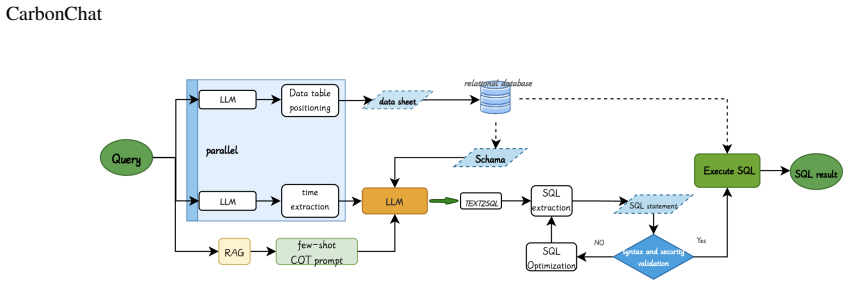
The load-bearing mechanism is the Self-Prompting Enhanced Retrieval-Generation architecture. It coordinates four modules: intent recognition (classifies whether a question needs policy knowledge, a database query, or both), structured chain-of-thought prompting (rewrites the query, produces a pre-answer from few-shot COT prompts, and extracts up to eight key sentences), hybrid retrieval (BM25 and BGE-M3 embeddings combined by rank with reranking by BGE-reranker-large), and a Text2SQL system with security validation and automatic SQL repair. A second mechanism is the diversified index module: document-tree chunking for structured reports, rule-based chunking for legal documents, semantic chunking via a sequence model with adaptive sliding windows, and dedicated handling of tables, images, and formulas. The paper also defines a 14-dimensional GHG-Protocol-based analysis framework and a hallucination-tagging prompt that asks the model to compare generated responses against retrieved evidence and mark unsupported content.
What would settle it
A concrete test: take a random sample of the system's generated answers from the 2,133 QA pairs and from the carbon-report analyses, run the paper's hallucination-tagging prompt (Appendix 1, P11) on them, and have human experts independently mark all unsupported or fabricated statements; if the model's tags miss statements the experts flag as unverifiable, the hallucination-reduction claim is falsified. Replacing the Qwen-Max relevance evaluator with an independent judge would similarly test whether the reported accuracy gains are an artifact of self-evaluation.
Extended reading notes
Core claim
The discovery the paper advances is that the quality gap in domain-specific LLM Q&A can be closed by a self-prompting retrieval pipeline rather than by retraining: rewrite and decompose the user query, generate a structured chain-of-thought pre-answer, extract key sentences, run hybrid BM25 plus embedding retrieval with reranking, and convert queries to SQL over a structured enterprise database when needed. The paper reports that this architecture outperforms standard RAG across the tested backbones, with its Qwen-Max configuration reaching ROUGE-1 0.592, ROUGE-2 0.450, ROUGE-L 0.540, and BERTScore F1 0.906, versus 0.529, 0.392, 0.468, and 0.831 for standard RAG, and Text2SQL execution accuracy of 89.2% with exact match 79.9%.
Load-bearing premise
The load-bearing premise is that the same LLM family that writes the answers can also reliably judge its own answers, because hallucination tagging and question-answer relevance scoring are both prompts run on Qwen-Max; if those self-evaluations are not trustworthy, the reported quality improvements are not established.
Editorial extensions
If this is right
- A standard LLM-plus-retrieval setup can be upgraded to handle complex policy-and-data questions without fine-tuning, by orchestrating prompts and retrieval steps.
- Sustainability teams could query a company's emissions database in natural language and receive traceable answers, shortening what is currently a manual reading process for reports that often exceed 30 pages.
- Text2SQL with few-shot chain-of-thought and schema-aware prompting can reach execution accuracy above 89% on real business databases, making natural-language querying of emissions data practical.
- The 14-dimension GHG Protocol framework yields compliance scores for reports, giving companies a concrete checklist to improve disclosure quality.
Reading between the lines
- An implication the paper leaves implicit: the self-prompting modules are largely model-agnostic, so the same architecture could transfer to other regulated disclosure domains such as financial reporting, ESG ratings, or supply-chain due diligence, where long documents mix narrative and structured data.
- A testable extension would be to run the same ablation with a small open-weights model instead of the commercial backbone; the reported gains suggest the architecture may compensate for weaker base models, but that hypothesis is not tested in the paper.
- Because the hallucination-tagging step is a self-evaluation prompt, the most informative validation would be a human-labeled hallucination benchmark; the current evidence does not separate architecture gains from the model's tendency to rate its own outputs favorably.
Editorial analysis
A structured set of objections, weighed in public.
Referee Report
Summary. The paper presents CarbonChat, an LLM-based system for analyzing corporate carbon emission reports and answering climate knowledge questions. It combines a diversified document-indexing module, a self-prompting RAG architecture (intent recognition, structured CoT, hybrid BM25/embedding retrieval, reranking, and Text2SQL), and a GHG-Protocol-based analysis scaffold with 14 reporting dimensions. The authors report internal ablation results showing consistent gains of Self-Prompting RAG over Standard RAG across six backbones, and a Text2SQL system with EX 89.2% and EM 79.9%. The paper also describes hallucination tagging via a prompt (Appendix 1, P11) and relevance evaluation via Qwen-Max scoring.
Significance. If the results held, the system would be a useful demonstration of domain-specific RAG and Text2SQL for sustainability documents. The internal ablation is internally consistent across backbones, the Text2SQL evaluation uses objective execution accuracy, and the appendix provides unusually detailed prompt templates. However, the absence of released data and code, the lack of external baselines, and the reliance on self-evaluation for the hallucination claim mean that the central contributions are not currently verifiable. The paper is best read as a system description; its quantitative claims require substantially stronger evidence to support a journal publication.
major comments (4)
- [Hallucination analysis / Appendix 1, P11] The abstract and Introduction claim that CarbonChat 'reduc[es] hallucination rates' and ensures 'accuracy and verifiability,' but the paper reports no hallucination-rate measurement at all. The only hallucination evidence is a prompt (Appendix 1, P11) that asks the LLM to mark unsupported content and produce a corrected response. Because the generator and verifier are the same model family (Qwen-Max), shared blind spots cannot be detected, and no precision or recall of the tagging against human annotation is provided. The Future Work section even states that future work will 'reduce hallucination issues,' which further undercuts the abstract's claim. This is load-bearing: the central claim is not established by the reported experiments. The authors should either report independent hallucination metrics (e.g., human annotation, SelfCheckGPT, HaluEval) or remove the hallucination-reduction claim.
- [Analysis report correlation analysis / Figure 7] The question-answer relevance evaluation also uses Qwen-Max as the evaluator of Qwen-Max-generated answers, creating a circular self-evaluation loop. The expert scoring is mentioned but reported only as a figure whose caption reads 'Text2SQL System Application Example Diagram.' No inter-annotator agreement, no numeric score summaries, and no correlation between LLM relevance scores and expert scores are given. Without an independent or at least properly reported expert evaluation, the claimed relevance and quality improvements are not supported.
- [Results and analysis / Table 2] Table 2 reports single runs without error bars, confidence intervals, or significance tests, yet the text states that the full method 'significantly outperform[s]' the ablations. The consistent monotone improvement across six backbones is encouraging, but with no variance estimates the observed differences (e.g., Qwen-Max ROUGE-1 0.529 to 0.592) could be within run-to-run noise. Multiple runs or significance tests are needed. Additionally, no external baselines are included despite the related work citing ChatClimate, ChatReport, MSRAG, and other systems; a comparison to at least one such system would substantially strengthen the evaluation.
- [Data construction / Data and Code availability] The 'Data and Code availability' section states that code and data 'will be made public after the paper is accepted,' so none of the datasets, prompts, or indexing configurations are currently available for reproducibility. The data description is also ambiguous: the text first mentions '1,180 QA pairs' for policy documents and later '2,133 high-quality QA pairs' for Text2SQL, without stating how these sets relate to each other or to the 100 collected reports. Without released data and code, the quantitative claims cannot be independently checked.
minor comments (4)
- [Table 3] The last row of Table 3 is mislabeled: 'Text2SQL System 82.8(↓) 72.8' should be 'Without SQL optimization,' since 82.8 = 89.2 − 6.4 and 72.8 = 79.9 − 7.1. The current label makes the ablation table ambiguous.
- [Figure 7] The caption of Figure 7 is 'Text2SQL System Application Example Diagram,' but the text describes the figure as showing expert-score results for the carbon emission analysis system. The caption and figure axes/units should be corrected.
- [Equation (1)] In Eq. (1), λ and c are free parameters; c is stated to be 60, but λ is never specified or tuned. The authors should report the chosen λ and ideally a sensitivity analysis.
- [Introduction / Contributions] Several sentences and bullet points contain grammatical errors or incomplete phrasing, for example 'y enhancing the retrieval quality of carbon emission-related information' in the contributions list. The text needs a careful proofreading pass.
Circularity Check
Hallucination-reduction claim rests on a self-evaluation loop: the same Qwen-Max model that generates answers also tags hallucinations and scores relevance; objective Text2SQL and ROUGE/BERTScore results remain independent.
-
self definitional
[Appendix 1, P11 (hallucination tagging); Abstract claim of 'reducing hallucination rates']
"You are a professional document verification assistant. Please verify all information about the company in the given response to ensure that all content can be traced back to its original source, avoiding any unverified speculative content. ... Check "Report Content" and "System Response" for any discrepancies or excess information and mark them as "hallucinations.""
The abstract's load-bearing claim that hallucination detection features reduce hallucination rates is supported only by P11, a prompt that asks the same Qwen-Max model used to generate answers to mark unsupported content. The tag is therefore defined as whatever the generator itself recognizes as unsupported; it cannot detect shared blind spots or measure semantic hallucination against an external ground truth. No hallucination rate, faithfulness metric, or independent verifier is reported, so the claimed reduction reduces to the model agreeing with itself by construction of the evaluation.
-
self definitional
[Experiments, 'Analysis report correlation analysis' (before Figure 7)]
"The question-answer relevance refers to the semantic association between the question and the generated answer, evaluated through Large Language Model. In our paper, Qwen-Max is used as the evaluator to assess the semantic correlation between the question and the generated answer."
Table 2's Qwen-Max answers are generated by the same model family that is then prompted (P10/P11) to score semantic relevance and to tag hallucinations. Thus the reported 'accuracy of the generated answer' is operationally defined as Qwen-Max's judgment of its own output, not as agreement with an independent gold standard. The expert scoring mentioned in the same section is not reported, so the central relevance/hallucination evidence is self-referential; only the Text2SQL execution-accuracy and ROUGE/BERTScore comparisons provide non-circular support.
full rationale
No self-citation chain or imported uniqueness theorem is present, and no fitted parameter is relabeled as a prediction. The system's objective Text2SQL EX/EM numbers and ROUGE/BERTScore comparisons against a standard RAG baseline are externally grounded. However, the central 'reducing hallucination rates' claim is not measured independently: the hallucination-tagging feature (P11) and relevance scoring both use Qwen-Max, the same model family that generates the answers, and no hallucination-rate numbers, external fact-checker, or detailed expert scores are provided. This makes the hallucination-reduction component partially circular and self-defined, while the overall system retains independent empirical content. The score of 4 reflects partial circularity confined to the self-evaluated quality claim, not an entirely construction-derived result.
Assumptions & free parameters
free parameters (5)
- lambda (BM25 weight in Eq. 1) =
not reported
- c (smoothing constant in Eq. 1) =
usual value is 60
- Top5 retrieval cutoff =
5
- answer_length in report analysis =
150
- chunk sizes and overlap for sliding window =
unspecified
assumptions (4)
- domain assumption The GHG Protocol accounting framework is the correct standard for evaluating corporate sustainability report disclosures.
- domain assumption BGE-M3 embeddings and BGE-reranker-large provide adequate semantic retrieval and ranking for carbon-related documents.
- domain assumption An LLM's self-check and self-scored relevance reflect true answer quality.
- standard math Reciprocal rank fusion of BM25 and embedding ranks is a valid retrieval score.
Cite this review
Pith. "Pith review of CarbonChat: Large Language Model-Based Corporate Carbon Emission Analysis and Climate Knowledge Q&A System." pith.science (2026). https://pith.science/paper/RECVTZGM
@misc{pith2026250102031,
  author       = {Pith},
  title        = {Pith review of: CarbonChat: Large Language Model-Based Corporate Carbon Emission Analysis and Climate Knowledge Q&A System},
  year         = {2026},
  howpublished = {\url{https://pith.science/paper/RECVTZGM}},
  note         = {Machine review of arXiv:2501.02031}
}
read the original abstract
As the impact of global climate change intensifies, corporate carbon emissions have become a focal point of global attention. In response to issues such as the lag in climate change knowledge updates within large language models, the lack of specialization and accuracy in traditional augmented generation architectures for complex problems, and the high cost and time consumption of sustainability report analysis, this paper proposes CarbonChat: Large Language Model-based corporate carbon emission analysis and climate knowledge Q&A system, aimed at achieving precise carbon emission analysis and policy understanding.First, a diversified index module construction method is proposed to handle the segmentation of rule-based and long-text documents, as well as the extraction of structured data, thereby optimizing the parsing of key information.Second, an enhanced self-prompt retrieval-augmented generation architecture is designed, integrating intent recognition, structured reasoning chains, hybrid retrieval, and Text2SQL, improving the efficiency of semantic understanding and query conversion.Next, based on the greenhouse gas accounting framework, 14 dimensions are established for carbon emission analysis, enabling report summarization, relevance evaluation, and customized responses.Finally, through a multi-layer chunking mechanism, timestamps, and hallucination detection features, the accuracy and verifiability of the analysis results are ensured, reducing hallucination rates and enhancing the precision of the responses.
Figures


Figures from the paper (4 more)



Reference graph
Works this paper leans on
-
[1]
O. J. et al. Achiam. Gpt-4 technical report. In ArXiv, 2023
work page 2023
-
[2]
Jinze Bai, Shuai Bai, Yunfei Chu, Zeyu Cui, Kai Dang, Xiaodong Deng, Yang Fan, Wenhang Ge, Yu Han, Fei Huang, Binyuan Hui, Luo Ji, Mei Li, Junyang Lin, Runji Lin, Dayiheng Liu, Gao Liu, Chengqiang Lu, K. Lu, Jianxin Ma, Rui Men, Xingzhang Ren, Xuancheng Ren, Chuanqi Tan, Sinan Tan, Jianhong Tu, Peng Wang, Shijie Wang, Wei Wang, Shengguang Wu, Benfeng Xu, ...
arXiv 2023
-
[3]
The Greenhouse Gas Protocol: A Corporate Accounting and Reporting Standard (Revised Edition)
World Resources Institute and World Business Council for Sustainable Development. The Greenhouse Gas Protocol: A Corporate Accounting and Reporting Standard (Revised Edition) . World Resources Institute, Washington, D.C., 2004
work page 2004
-
[4]
chatClimate: Grounding Conversational AI in Climate Science
Saeid Ashraf Vaghefi, Qian Wang, Veruska Muccione, Jingwei Ni, Mathias Kraus, Julia Anna Bingler, Tobias Schimanski, Chiara Colesanti-Senni, Nicolas Webersinke, Christrian Huggel, and Markus Leippold. chatclimate: Grounding conversational ai in climate science. ArXiv, abs/2304.05510, 2023
work page Pith review arXiv 2023
-
[5]
Chatreport: Democratizing sustainability disclosure analysis through llm-based tools
Jingwei Ni, Julia Anna Bingler, Chiara Colesanti-Senni, Mathias Kraus, Glen Gostlow, Tobias Schimanski, Dominik Stammbach, Saeid Ashraf Vaghefi, Qian Wang, Nicolas Webersinke, Tobias Wekhof, Ting Yu, and Markus Leippold. Chatreport: Democratizing sustainability disclosure analysis through llm-based tools. ArXiv, abs/2307.15770, 2023
arXiv 2023
-
[6]
Carbon price forecasting with llm-based refinement and transfer-learning
Haiqi Jiang, Ying Ding, Rui Chen, and Chenyou Fan. Carbon price forecasting with llm-based refinement and transfer-learning. In International Conference on Artificial Neural Networks, 2024
work page 2024
-
[7]
Llmcarbon: Modeling the end-to-end carbon footprint of large language models
Ahmad Faiz, Sotaro Kaneda, Ruhan Wang, Rita Osi, Parteek Sharma, Fan Chen, and Lei Jiang. Llmcarbon: Modeling the end-to-end carbon footprint of large language models. ArXiv, abs/2309.14393, 2023
arXiv 2023
-
[8]
Research on a science and technology policy and regulation q&a system driven by large models
Xiaowei Xiang, Yanguang Shen, Minghao Hu, Tianwei Yan, Wei Luo, and Zhuncheng Luo. Research on a science and technology policy and regulation q&a system driven by large models. Computer Science and Exploration, 18(09):2349–2360, 2024
work page 2024
Show all 34 references
-
[9]
Multi- strategy retrieval-enhanced generation method for knowledge q&a systems in military domains
Yanping Zhang, Meifang Chen, Changhai Tian, Zibo Yi, Wenpeng Hu, Wei Luo, and Zhuncheng Luo. Multi- strategy retrieval-enhanced generation method for knowledge q&a systems in military domains. Computer Applications, pages 1–12, 2024
2024
-
[10]
Agricultural policy q&a system based on chatglm2-6b.Data and Computing Frontier (Chinese and English), 6(04):116–127, 2024
Yijin Wei and Jingchao Fan. Agricultural policy q&a system based on chatglm2-6b.Data and Computing Frontier (Chinese and English), 6(04):116–127, 2024
2024
-
[11]
Survey of hallucination in natural language generation
Ziwei Ji, Nayeon Lee, Rita Frieske, Tiezheng Yu, Dan Su, Yan Xu, Etsuko Ishii, Yejin Bang, Delong Chen, Wenliang Dai, Andrea Madotto, and Pascale Fung. Survey of hallucination in natural language generation. ACM Computing Surveys, 55:1 – 38, 2022
2022
-
[12]
Selfcheckgpt: Zero-resource black-box halluci- nation detection for generative large language models
Potsawee Manakul, Adian Liusie, and Mark John Francis Gales. Selfcheckgpt: Zero-resource black-box halluci- nation detection for generative large language models. ArXiv, abs/2303.08896, 2023
2023 arXiv
-
[13]
Evaluating the factual consistency of large language models through news summarization
Derek Tam, Anisha Mascarenhas, Shiyue Zhang, Sarah Kwan, Mohit Bansal, and Colin Raffel. Evaluating the factual consistency of large language models through news summarization. In Annual Meeting of the Association for Computational Linguistics, 2022
2022
-
[14]
why is this misleading?
Jiaming Shen, Jialu Liu, Daniel Finnie, Negar Asgharipour Rahmati, Michael Bendersky, and Marc Najork. “why is this misleading?”: Detecting news headline hallucinations with explanations. Proceedings of the ACM Web Conference 2023, 2023
2023
-
[15]
Halueval: A large-scale hallucination evaluation benchmark for large language models
Junyi Li, Xiaoxue Cheng, Wayne Xin Zhao, Jianyun Nie, and Ji rong Wen. Halueval: A large-scale hallucination evaluation benchmark for large language models. ArXiv, abs/2305.11747, 2023
2023 arXiv
-
[16]
Fact-checking of ai-generated reports
Razi Mahmood, Ge Wang, Mannudeep Kalra, and Pingkun Yan. Fact-checking of ai-generated reports. ArXiv, abs/2307.14634, 2023
2023 arXiv
-
[17]
Bartscore: Evaluating generated text as text generation
Weizhe Yuan, Graham Neubig, and Pengfei Liu. Bartscore: Evaluating generated text as text generation. ArXiv, abs/2106.11520, 2021
2021 arXiv
-
[18]
Knowledge of knowledge: Exploring known-unknowns uncertainty with large language models
Alfonso Amayuelas, Liangming Pan, Wenhu Chen, and William Yang Wang. Knowledge of knowledge: Exploring known-unknowns uncertainty with large language models. InAnnual Meeting of the Association for Computational Linguistics, 2023
2023
-
[19]
Qinglin Zhang, Qian Chen, Yali Li, Jiaqing Liu, and Wen Wang. Sequence model with self-adaptive sliding window for efficient spoken document segmentation.2021 IEEE Automatic Speech Recognition and Understanding Workshop (ASRU), pages 411–418, 2021
2021
-
[20]
Qwen-vl: A frontier large vision-language model with versatile abilities
Jinze Bai, Shuai Bai, Shusheng Yang, Shijie Wang, Sinan Tan, Peng Wang, Junyang Lin, Chang Zhou, and Jingren Zhou. Qwen-vl: A frontier large vision-language model with versatile abilities. ArXiv, abs/2308.12966, 2023
2023 arXiv
-
[21]
Mathpix snip: A tool for converting handwritten and printed mathematics to latex, 2023
Mathpix Inc. Mathpix snip: A tool for converting handwritten and printed mathematics to latex, 2023. Accessed: 2023-12-31. 15 CarbonChat
2023
-
[22]
S. E. Robertson, H. Zaragoza, and M. J. Taylor. Okapi at trec-3. Proceedings of the Third Text REtrieval Conference (TREC-3), pages 109–126, 1995
1995
-
[23]
C-pack: Packaged resources to advance general chinese embedding
Shitao Xiao, Zheng Liu, Peitian Zhang, and Niklas Muennighoff. C-pack: Packaged resources to advance general chinese embedding. ArXiv, abs/2309.07597, 2023
2023 arXiv
-
[24]
Bge m3-embedding: Multi-lingual, multi-functionality, multi-granularity text embeddings through self-knowledge distillation
Jianlv Chen, Shitao Xiao, Peitian Zhang, Kun Luo, Defu Lian, and Zheng Liu. Bge m3-embedding: Multi-lingual, multi-functionality, multi-granularity text embeddings through self-knowledge distillation. In Annual Meeting of the Association for Computational Linguistics, 2024
2024
-
[25]
Din-sql: Decomposed in-context learning of text-to-sql with self-correction
Mohammad Reza Pourreza and Davood Rafiei. Din-sql: Decomposed in-context learning of text-to-sql with self-correction. ArXiv, abs/2304.11015, 2023
2023 arXiv
-
[26]
Cdp global climate change report 2023, 2023
Carbon Disclosure Project. Cdp global climate change report 2023, 2023. Accessed: 2024-01-01
2023
-
[27]
Rouge: A package for automatic evaluation of summaries
Chin-Yew Lin. Rouge: A package for automatic evaluation of summaries. In Annual Meeting of the Association for Computational Linguistics, 2004
2004
-
[28]
Weinberger, and Yoav Artzi
Tianyi Zhang, Varsha Kishore, Felix Wu, Kilian Q. Weinberger, and Yoav Artzi. Bertscore: Evaluating text generation with bert. ArXiv, abs/1904.09675, 2019
1904 arXiv
-
[29]
Tcsr-sql: Towards table content-aware text-to-sql with self-retrieval
Wenbo Xu, Liang Yan, Peiyi Han, Haifeng Zhu, Chuanyi Liu, Shaoming Duan, Cuiyun Gao, and Yingwei Liang. Tcsr-sql: Towards table content-aware text-to-sql with self-retrieval. ArXiv, abs/2407.01183, 2024
2024
-
[30]
Tao Yu, Rui Zhang, Kai-Chou Yang, Michihiro Yasunaga, Dongxu Wang, Zifan Li, James Ma, Irene Z Li, Qingning Yao, Shanelle Roman, Zilin Zhang, and Dragomir R. Radev. Spider: A large-scale human-labeled dataset for complex and cross-domain semantic parsing and text-to-sql task. ...
2018 arXiv
-
[31]
Chatglm: A family of large language models from glm-130b to glm-4 all tools
Team Glm Aohan Zeng, Bin Xu, Bowen Wang, Chenhui Zhang, Da Yin, Diego Rojas, Guanyu Feng, Hanlin Zhao, Hanyu Lai, Hao Yu, Hongning Wang, Jiadai Sun, Jiajie Zhang, Jiale Cheng, Jiayi Gui, Jie Tang, Jing Zhang, Juanzi Li, Lei Zhao, Lindong Wu, Lucen Zhong, Ming yue Liu, Minlie H...
2024 arXiv
-
[32]
Xinghuo: Ai platform by iflytek, 2024
Xinghuo. Xinghuo: Ai platform by iflytek, 2024. Accessed: 2024-01-01
2024
-
[33]
Baidu cloud, 2024
Baidu. Baidu cloud, 2024. Accessed: 2024-01-01
2024
-
[34]
This year
A. et al. Dubey. The llama 3 herd of models. ArXiv, abs/2407.21783, 2024. Appendix Appendix 1 P1: You are an expert in the dual-carbon field. Based on the background information, filter out the most relevant rules or content to answer the question, maintaining their integrity ...
2024 arXiv
Reviewed August 10, 2026 · model on record in the stance chip above.
Discussion (0). Continue with ORCID to comment.