REVIEW 4 major objections 4 minor 67 references
JOYS: The [D/H] abundance derived from protostellar outflows across the Galactic disk measured with JWST
T0 review · 4 major / 4 minor · reviewed 2026-08-10 · deepseek-v4-flash
Pith's one-line read JWST observations of protostellar outflows show gas-phase deuterium varying by a factor of four and running 2–4 times below predicted total D/H, suggesting much of the Galaxy's deuterium is locked in carbonaceous dust.
desk verdict New JWST/MIRI HD census with a load-bearing aperture-filling problem that its own maps contradict. read the letter →
The pith
A machine-rendered reading of the paper's core claim, the machinery that carries it, and where it could break.
The reading
What carries the argument
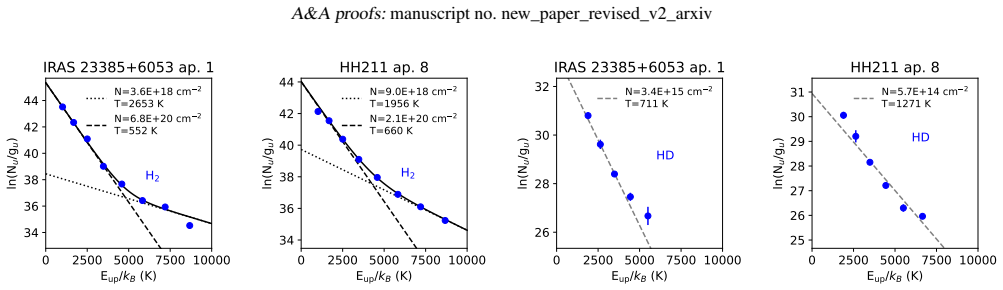
The analysis rests on rotation diagrams built from the rotational lines H$_2$ S(1)–S(8) and HD R(4)–R(9) detected with the JWST MIRI/MRS medium-resolution spectrometer. For optically thin, LTE gas, plotting $\ln(N_u/g_u)$ against $E_u/k$ gives the column density from the intercept and the excitation temperature from the slope, and the ratio $N_{\rm HD}/(2N_{\rm H_2})$ yields [D/H]. The H$_2$ diagrams are fitted with a warm plus hot component and an ortho-to-para ratio correction, the same extinction correction derived from the H$_2$ S(1)–S(4) lines is applied to HD, and the LTE [D/H] is multiplied by 2.45 to account for non-LTE excitation and for chemical conversion of HD to atomic D, following the cited Orion outflow analysis. The fixed 1-arcsecond extraction aperture is assumed to be equally filled by H$_2$ and HD, so the ratio is taken to be independent of source size.
What would settle it
Re-extract the spectra with apertures matched to the HD-bright knots instead of a fixed 1-arcsecond aperture and check whether [D/H] climbs toward the local-disk value; if it does, the low values are a filling-factor artefact rather than dust depletion. Alternatively, observe a supernova remnant with MIRI/MRS and test whether complete grain destruction raises gas-phase [D/H] to the level predicted by Galactic chemical evolution models.
Extended reading notes
Core claim
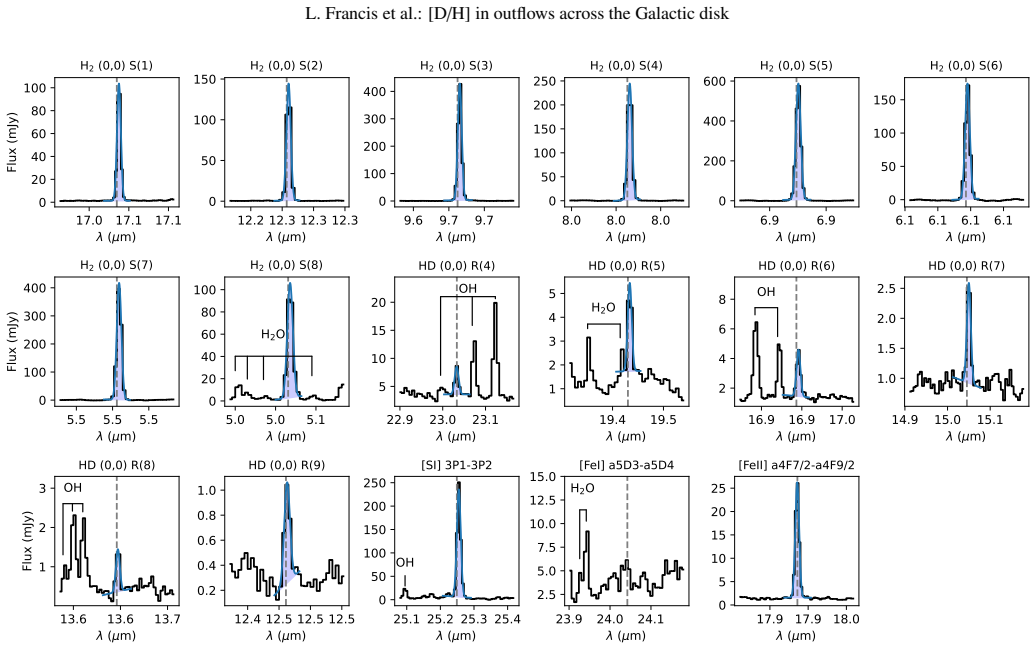
On the paper's own terms, the discovery is that gas-phase [D/H] derived from HD and H$_2$ rotation diagrams in protostellar outflows is systematically low and variable: detected values run from about $0.12\times10^{-5}$ to $2.27\times10^{-5}$ after the standard correction, with a factor-of-four spread among low-mass sources that cannot be explained by astration, and most measurements fall a factor of 2–4 below the total [D/H] expected from Galactic chemical evolution. HD emission is concentrated in the same high-velocity jet knots and bow shocks as high-excitation H$_2$, [S I], and [Fe I] lines, and in the HH 211 outflow the inner-jet positions with higher gas-phase iron also show higher [D/H]; this spatial pattern is the paper's tentative evidence that deuterium sequestered in dust returns to the gas when shocks destroy grains. The paper concludes that rotational-line observations of outflows are sensitive only to gas-phase deuterium, not the total reservoir, and that significant depletion onto carbonaceous dust is the plausible explanation.
Load-bearing premise
The load-bearing premise is that H$_2$ and HD emission fill the same 1-arcsecond extraction aperture to the same degree, so their column-density ratio is unaffected by source size; if HD is actually more compact than H$_2$, the derived [D/H] is systematically low and the scatter between positions could be partly artificial.
Editorial extensions
If this is right
- Most gas-phase [D/H] values from this paper and earlier molecular-line work sit at or below $1.0\times10^{-5}$, so any observationally grounded estimate of total deuterium in the disk must budget for deuterium hidden in dust.
- Because the spatial pattern in HH 211 ties higher [D/H] to positions with higher gas-phase iron, stronger shocks that destroy more dust should show systematically higher gas-phase [D/H] than quiescent outflow gas.
- The detection at 11 kpc and the constraining upper limits in the inner Galaxy mean that, once depletion is modelled, JWST can sample [D/H] across the Galactic disk rather than only in the local neighbourhood.
- The 2.45 correction for non-LTE excitation and chemical conversion is applied to every value; without it the discrepancy with Galactic chemical evolution models would be even larger.
Reading between the lines
- An untested consequence of the shared-solid-angle assumption is that any difference in how fully H$_2$ and HD fill the aperture translates directly into an offset in [D/H]; re-extracting on apertures matched to the HD knots would test whether part of the factor-of-four scatter is spatial resolution rather than dust depletion.
- If deuterium depletion onto carbonaceous grains is real, the low [D/H] values from ultraviolet H I/D I and D I/O I absorption may reflect the same grain reservoir, which would change the reading of the local-disk abundance debate.
- A clean extension would be MIRI/MRS observations of a supernova remnant, where complete grain destruction should push gas-phase [D/H] up toward the Galactic chemical evolution prediction; the paper notes an earlier HD detection in such a remnant.
- The strong correlation between HD R(6) line flux and high-excitation H$_2$ and [S I] suggests that HD could serve as a tracer of dust-destructive shocks, making deeper [D/H] maps a way to map dust processing across an outflow.
Editorial analysis
A structured set of objections, weighed in public.
Referee Report
Summary. The paper uses JWST/MIRI MRS observations of ten protostellar outflows (five low-mass, five high-mass) to measure gas-phase [D/H] from mid-IR H2 and HD rotational lines. It extracts 1"-radius aperture spectra, builds integrated line maps, fits two-temperature H2 rotation diagrams and single-temperature HD rotation diagrams, applies extinction and ortho-to-para corrections, and multiplies the derived LTE [D/H] by a correction factor for non-LTE excitation and chemical conversion taken from Bertoldi et al. 1999. The key results are that [D/H] varies by up to a factor ~4 among the low-mass sources and that most measured values are ~(0.1-1.8) x 10^-5, i.e. a factor 2-4 below Galactic chemical evolution predictions and below local UV absorption values. The authors interpret the scatter and low values as evidence for deuterium depletion onto carbonaceous dust grains, possibly with release in shocks, and report tentative support from enhanced [D/H] where gas-phase Fe is enhanced in HH 211.
Significance. The observational material is valuable: this is one of the first JWST studies to map HD emission in protostellar outflows across Galactocentric radii of 4-11 kpc, and the paper provides full tabulated line fluxes and rotation-diagram fit parameters that will be useful to the community. If the derived [D/H] values are robust, the conclusion that molecular-line measurements trace gas-phase rather than total deuterium would be an important constraint for Galactic chemical evolution studies and for the deuterium-depletion debate. The strengths of the paper include a diverse sample, careful Gaussian line fitting, and explicit handling of extinction and ortho-to-para corrections. However, the central quantitative claims rest on the assumptions that H2 and HD fill the same aperture and that the warm H2 component is the correct denominator for the HD column; neither assumption is established by the data as presented, and the manuscript contains an internal contradiction in the HH 211 trend that is used to support the depletion interpretation.
major comments (4)
- [§3.3] The aperture-filling assumption is load-bearing. The text states that 'the assumed emission solid angle is the same for both H2 and HD and thus there is no impact on any column density ratios or the derived [D/H]'. This is only true if H2 and HD have the same spatial extent. The integrated-line maps (Figs. 1, 2, C.1-C.8) show HD concentrated in bright knots and bow shocks, while H2 emission is extended over the outflow cavities. For a compact HD source with true solid angle Ω_HD < Ω_ap, converting the measured flux to intensity as F/Ω_ap underestimates I_HD, and hence N_HD, by a position-dependent factor Ω_HD/Ω_ap, while the more extended H2 suffers less dilution. The resulting [D/H] is therefore systematically low by a source- and position-dependent factor, which can produce both the factor-of-4 scatter and the low absolute values without any real variation in gas-phase D/H. This issue must be addressed, for example by measuring the emitting solid angles of HD and H2 separately, by restricting the analysis to a common compact region, or by propagating the beam-dilution ratio as a correlated systematic uncertainty on every [D/H] value.
- [§3.4 and Fig. 6] The use of the warm H2 column as the denominator is not justified for the gas traced by HD. [D/H] is computed as 0.5 N_HD/N_warm, where N_warm corresponds to the 400-900 K H2 component determined from S(1)-S(4). However, the flux correlations in Fig. 6 show that HD R(6) is most strongly correlated with the high-excitation H2 S(7) line (ρ=0.98) and less with S(1) (ρ=0.79), indicating that the HD emission traces the compact hot component rather than the extended warm component. If the HD-bearing gas is not well mixed with the warm gas used in the denominator, the derived ratio is not a measure of D/H in a single gas parcel and will vary with the local temperature structure. Please derive [D/H] also using the hot H2 component or otherwise demonstrate that the warm H2 column is the appropriate reservoir for the HD traced by the observed R(4)-R(6) transitions.
- [§4, §4.1, and Table 2] The HH 211 trend used to support the dust-depletion interpretation appears to be contradicted by the tabulated values. The text states that in HH 211 [D/H] is 'robustly lower in the bow-shock positions (apertures 1-3) than the jet positions (apertures 4-6)', and later that the data are consistent with an 'increased [D/H] in the inner jet (apertures 4-6) relative to the bow-shocks (apertures 1-3)'. Table 2 lists detected values of [D/H] = (1.30±0.49, 1.74±0.14, 1.78±0.47) x 10^-5 for apertures 1-3, while apertures 4-6 are upper limits that are mostly lower. This is the opposite trend to the one stated in the text and abstract. Please verify the aperture classification and either correct the text/abstract or explain how the stated trend is obtained.
- [§3.4, Table 2, and Fig. 5] The correction factor for non-LTE excitation and chemical conversion is both internally inconsistent and applied without a propagated uncertainty. The text says the LTE [D/H] estimates are multiplied by a factor of 2.45, whereas the Table 2 caption and Fig. 5 caption state a factor of 2.54. More substantively, the factor is imported from Bertoldi et al. (1999) for the Orion OMC-1 outflow, where the exact value depends on shock density, temperature, and dissociation fraction. Applying a single factor to all sources and positions sets the absolute scale for the claim that the observed [D/H] is a factor of 2-4 below GCE predictions. The expected spread of the correction factor should be propagated into the [D/H] uncertainties, or at least a plausible range should be quoted alongside the central values.
minor comments (4)
- [Summary bullet, §6] The bullet states that HD column densities are '∼ 105 orders magnitude smaller' than H2; this should read 'five orders of magnitude'.
- [Abstract and Introduction] The phrase 'polycyclic aromatic hydrocarbons' is misspelled as 'polcyclic aromatic hydrocarbons' in the Introduction; please correct the typo.
- [Throughout] There are several instances of broken spacing such as 'e ffect' and 'V oort' that should be corrected in the final typeset version.
- [Fig. 5 and Table 2] The correction factor is quoted as 2.45 in the main text and 2.54 in the table and figure captions; the inconsistency should be resolved in revision.
Circularity Check
No significant circularity: the [D/H] values are measured from independent H2 and HD rotation-diagram fits, with external correction factors and external benchmarks.
full rationale
The paper's derivation chain is self-contained in the sense required by the circularity audit: [D/H] is defined as (1/2) N_HD/N_H2, where N_HD and N_H2 come from separate LTE rotation-diagram fits to HD R(4)-R(9) and H2 S(1)-S(8) line fluxes. No parameter is fitted to the derived [D/H] itself, and no equation reduces the conclusion to its inputs by construction. The 2.45 correction factor for non-LTE excitation and chemical conversion of HD is imported from Bertoldi et al. (1999), an independent external study, not fitted to the present data; the paper explicitly notes the factor's sensitivity to shock conditions and treats it as a systematic correction. The aperture-filling assumption in Sect. 3.3 ('we assume that the H2 or HD emission fills the aperture' and 'the assumed emission solid angle is the same for both H2 and HD') makes the solid angle cancel in the column-density ratio, which is a modeling assumption that can bias the absolute ratio if violated, but this is a systematic observational uncertainty, not a circular step: the claimed factor-of-4 scatter is a measurement outcome, not a quantity defined to equal the fit. Comparisons with Galactic chemical evolution models, UV absorption-line values, and previous ISO measurements are external benchmarks rather than inputs to the derivation. Self-citations to JOYS data-reduction papers and previous target papers are data provenance and do not carry the load-bearing argument. The paper's own caveats about depletion, shock conditions, and the need for further modeling are acknowledged limitations, not circularity. Therefore the circularity score is 0.
Assumptions & free parameters
free parameters (9)
- AK extinction =
1.1 to 9.3 mag
- H2 warm component column density N_warm =
1.0e19 to 3.8e21 cm^-2
- H2 warm temperature =
395 to 900 K
- H2 hot component column density N_hot =
1.5e16 to 3.5e19 cm^-2
- H2 hot temperature =
1160 to 3000 K, often at fit limit
- ortho-to-para ratio OPR =
1.02 to 3.00
- HD column density =
5.1e14 to 3.8e15 cm^-2 for detections
- HD temperature =
472 to 1694 K
- correction factor for non-LTE and chemical conversion =
2.45 (text) / 2.54 (Table 2 and Fig. 5)
assumptions (5)
- domain assumption LTE and optically thin line emission for H2 and HD
- domain assumption H2 and HD emission fill the extraction aperture equally
- domain assumption Outflow gas is fully molecular except for a small atomic jet core
- domain assumption The Orion OMC-1 correction factor applies to all sources and shock conditions
- domain assumption HD rotational lines trace the same gas as the warm H2 component
Cite this review
Pith. "Pith review of JOYS: The [D/H] abundance derived from protostellar outflows across the Galactic disk measured with JWST." pith.science (2026). https://pith.science/paper/LKXK5O6S
@misc{pith2026250102085,
  author       = {Pith},
  title        = {Pith review of: JOYS: The [D/H] abundance derived from protostellar outflows across the Galactic disk measured with JWST},
  year         = {2026},
  howpublished = {\url{https://pith.science/paper/LKXK5O6S}},
  note         = {Machine review of arXiv:2501.02085}
}
abstract
The total deuterium abundance [D/H] in the universe is set by just two processes: the creation of deuterium in Big Bang Nucleosynthesis at an abundance of [D/H]$=2.58\pm0.13\times10^{-5}$, and its destruction within stellar interiors. Measurements of the total [D/H] abundance can potentially provide a probe of Galactic chemical evolution, however, most measurements of [D/H] are only sensitive to the gas-phase deuterium, and the amount of deuterium sequestered in carbonaceous dust grains is debated. With the launch of JWST, it is now possible to measure the gas-phase [D/H] at unprecedented sensitivity and distances through observation of mid-IR lines of H$_2$ and HD. We employ data from the JWST Observations of Young protoStars (JOYS) program to measure the gas-phase [D/H] abundance with a rotation diagram analysis towards 5 nearby low-mass and 5 distant high-mass protostellar outflows. The gas-phase [D/H] varies between low-mass sources by up to a factor of $\sim4$, despite these sources likely having formed in a region of the Galactic disk that would be expected to have nearly constant total [D/H]. Most measurements of gas-phase [D/H] from our work or previous studies produce [D/H] $\lesssim 1.0\times10^{-5}$, a factor of $2-4$ lower than found from local UV absorption lines and as expected from Galactic chemical evolution models. The variations in [D/H] between our low-mass sources and the low [D/H] with respect to Galactic chemical evolution models suggest that our observations are not sensitive to the total [D/H]. Significant depletion of deuterium onto carbonaceous dust grains is a possible explanation, and tentative evidence of enhanced [D/H] towards shock positions with higher gas-phase Fe abundance is seen in the HH 211 outflow. Deeper observations of HD and H$_2$ in shocked environments and modelling of dust-grain destruction are warranted to test for the effects of depletion.
Figures


Figures from the paper (4 more)


Reference graph
Works this paper leans on
-
[1]
, " * write output.state after.block = add.period write newline
ENTRY address archiveprefix author booktitle chapter edition editor howpublished institution eprint journal key month note number organization pages publisher school series title type volume year label extra.label sort.label short.list INTEGERS output.state before.all mid.sentence after.sentence after.block FUNCTION init.state.consts #0 'before.all := #1 ...
-
[2]
write newline
" write newline "" before.all 'output.state := FUNCTION n.dashify 't := "" t empty not t #1 #1 substring "-" = t #1 #2 substring "--" = not "--" * t #2 global.max substring 't := t #1 #1 substring "-" = "-" * t #2 global.max substring 't := while if t #1 #1 substring * t #2 global.max substring 't := if while FUNCTION word.in bbl.in " " * FUNCTION format....
-
[3]
Anderson , D. E., Bergin , E. A., Maret , S., & Wakelam , V. 2013, , 779, 141
work page 2013
- [4]
-
[5]
Bergin , E. A., Cleeves , L. I., Crockett , N. R., Favre , C., & Neill , J. L. 2013, in Astronomical Society of the Pacific Conference Series, Vol. 476, New Trends in Radio Astronomy in the ALMA Era: The 30th Anniversary of Nobeyama Radio Observatory, ed. R. Kawabe , N. Kuno , & S. Yamamoto , 185
work page 2013
-
[6]
Bertoldi , F., Timmermann , R., Rosenthal , D., Drapatz , S., & Wright , C. M. 1999, , 346, 267
work page 1999
-
[7]
Beuther , H., van Dishoeck , E. F., Tychoniec , L., et al. 2023, , 673, A121
work page 2023
-
[8]
2024, JWST Calibration Pipeline
Bushouse , H., Eisenhamer , J., Dencheva , N., et al. 2024, JWST Calibration Pipeline
2024
Show all 67 references
-
[9]
P., Kavanagh , P
Caratti o Garatti , A., Ray , T. P., Kavanagh , P. J., et al. 2024, , 691, A134
2024
-
[10]
2015, , 573, A82
Caratti o Garatti , A., Stecklum , B., Linz , H., Garcia Lopez , R., & Sanna , A. 2015, , 573, A82
2015
-
[11]
2014, in Protostars and Planets VI, ed
Ceccarelli , C., Caselli , P., Bockel \'e e-Morvan , D., et al. 2014, in Protostars and Planets VI, ed. H. Beuther , R. S. Klessen , C. P. Dullemond , & T. Henning , 859--882
2014
-
[12]
2001, , 554, 1044
Chiappini , C., Matteucci , F., & Romano , D. 2001, , 554, 1044
2001
-
[13]
2002, , 395, 789
Chiappini , C., Renda , A., & Matteucci , F. 2002, , 395, 789
2002
-
[14]
2023, The Journal of Open Source Software, 8, 4774
Christiaens , V., Gonzalez , C., Farkas , R., et al. 2023, The Journal of Open Source Software, 8, 4774
2023
-
[15]
J., Pettini , M., Jorgenson , R
Cooke , R. J., Pettini , M., Jorgenson , R. A., Murphy , M. T., & Steidel , C. C. 2014, , 781, 31
2014
-
[16]
H., Fields , B
Cyburt , R. H., Fields , B. D., Olive , K. A., & Yeh , T.-H. 2016, Reviews of Modern Physics, 88, 015004
2016
-
[17]
Draine , B. T. 2006, in Astronomical Society of the Pacific Conference Series, Vol. 348, Astrophysics in the Far Ultraviolet: Five Years of Discovery with FUSE, ed. G. Sonneborn , H. W. Moos , & B. G. Andersson , 58
2006
-
[18]
I., Lattimer , J
Epstein , R. I., Lattimer , J. M., & Schramm , D. N. 1976, , 263, 198
1976
-
[19]
D., Chayer , P., Jenkins , E
Friedman , S. D., Chayer , P., Jenkins , E. B., et al. 2023, , 946, 34
2023
-
[20]
2015, , 814, 52
Giannini , T., Antoniucci , S., Nisini , B., Bacciotti , F., & Podio , L. 2015, , 814, 52
2015
-
[21]
2008, , 481, 123
Giannini , T., Calzoletti , L., Nisini , B., et al. 2008, , 481, 123
2008
-
[22]
2011, in IAU Symposium, Vol
Giannini , T., Nisini , B., Neufeld , D., et al. 2011, in IAU Symposium, Vol. 280, The Molecular Universe, ed. J. Cernicharo & R. Bachiller , 329
2011
-
[23]
F., et al
Gieser , C., Beuther , H., van Dishoeck , E. F., et al. 2023, , 679, A108
2023
-
[24]
& Miller , T
Greenfield , P. & Miller , T. 2016, Astronomy and Computing, 16, 41
2016
-
[25]
2010, in Light Elements in the Universe, ed
H \'e brard , G. 2010, in Light Elements in the Universe, ed. C. Charbonnel , M. Tosi , F. Primas , & C. Chiappini , Vol. 268, 59--64
2010
-
[26]
& Moos , H
H \'e brard , G. & Moos , H. W. 2003, , 599, 297
2003
-
[27]
& McKee , C
Hollenbach , D. & McKee , C. F. 1989, , 342, 306
1989
-
[28]
G., Sembach , K
Hoopes , C. G., Sembach , K. R., H \'e brard , G., Moos , H. W., & Knauth , D. C. 2003, , 586, 1094
2003
-
[29]
Jenkins , E. B. 2009, , 700, 1299
2009
-
[30]
1982, in NASA Conference Publication, Vol
Jura , M. 1982, in NASA Conference Publication, Vol. 2238, NASA Conference Publication, ed. Y. Kondo , 54--60
1982
-
[31]
S., et al
Kama , M., Shorttle , O., Jermyn , A. S., et al. 2019, , 885, 114
2019
-
[32]
E., Godard , B., Guillard , P., Gusdorf , A., & Pineau des For \^e ts , G
Kristensen , L. E., Godard , B., Guillard , P., Gusdorf , A., & Pineau des For \^e ts , G. 2023, , 675, A86
2023
-
[33]
Le Gouellec , V. J. M., Lew , B. W. P., Greene , T. P., et al. 2024, arXiv e-prints, submitted to ApJ, arXiv:2410.11095
2024 arXiv
-
[34]
L., Draine , B
Linsky , J. L., Draine , B. T., Moos , H. W., et al. 2006, , 647, 1106
2006
-
[35]
A., Pasachoff , J
Lubowich , D. A., Pasachoff , J. M., Balonek , T. J., et al. 2000, , 405, 1025
2000
-
[36]
Mangum , J. G. & Shirley , Y. L. 2015, , 127, 266
2015
-
[37]
K., Bergin , E
McClure , M. K., Bergin , E. A., Cleeves , L. I., et al. 2016, , 831, 167
2016
-
[38]
2024, , 962, L16
Narang , M., Manoj , P., Tyagi , H., et al. 2024, , 962, L16
2024
-
[39]
A., Green , J
Neufeld , D. A., Green , J. D., Hollenbach , D. J., et al. 2006 a , , 647, L33
2006
-
[40]
A., Melnick , G
Neufeld , D. A., Melnick , G. J., & Harwit , M. 1998, , 506, L75
1998
-
[41]
A., Melnick , G
Neufeld , D. A., Melnick , G. J., Sonnentrucker , P., et al. 2006 b , , 649, 816
2006
-
[42]
2005, , 441, 159
Nisini , B., Bacciotti , F., Giannini , T., et al. 2005, , 441, 159
2005
-
[43]
J., Bauschlicher , C
Peeters , E., Allamandola , L. J., Bauschlicher , C. W., J., et al. 2004, , 604, 252
2004
-
[44]
2024, , 685, A74
Peeters , E., Habart , E., Bern \'e , O., et al. 2024, , 685, A74
2024
-
[45]
Penzias , A. A. 1979, , 228, 430
1979
-
[46]
A., Wannier , P
Penzias , A. A., Wannier , P. G., Wilson , R. H., & Linke , R. A. 1977, , 211, 108
1977
-
[47]
2006, , 456, 189
Podio , L., Bacciotti , F., Nisini , B., et al. 2006, , 456, 189
2006
-
[48]
T., Baluteau , J
Polehampton , E. T., Baluteau , J. P., Ceccarelli , C., Swinyard , B. M., & Caux , E. 2002, , 388, L44
2002
-
[49]
M., Evans , N., Bergner , J., & Yang , Y.-L
Pontoppidan , K. M., Evans , N., Bergner , J., & Yang , Y.-L. 2024, Research Notes of the American Astronomical Society, 8, 68
2024
-
[50]
1996, , 310, 106
Prantzos , N. 1996, , 310, 106
1996
-
[51]
Prodanovi \'c , T., Steigman , G., & Fields , B. D. 2010, , 406, 1108
2010
-
[52]
2006, , 369, 295
Romano , D., Tosi , M., Chiappini , C., & Matteucci , F. 2006, , 369, 295
2006
-
[53]
2003, , 346, 295
Romano , D., Tosi , M., Matteucci , F., & Chiappini , C. 2003, , 346, 295
2003
-
[54]
1996, Reports on Progress in Physics, 59, 1493
Sarkar , S. 1996, Reports on Progress in Physics, 59, 1493
1996
-
[55]
Tielens , A. G. G. M. 1983, , 119, 177
1983
-
[56]
Tielens , A. G. G. M. 2008, , 46, 289
2008
-
[57]
Tielens , A. G. G. M. 2013, Reviews of Modern Physics, 85, 1021
2013
-
[58]
2010, in Light Elements in the Universe, ed
Tosi , M. 2010, in Light Elements in the Universe, ed. C. Charbonnel , M. Tosi , F. Primas , & C. Chiappini , Vol. 268, 153--161
2010
-
[59]
2011, , 410, 2540
Tsujimoto , T. 2011, , 410, 2540
2011
-
[60]
Tsujimoto , T., Bland-Hawthorn , J., & Freeman , K. C. 2010, , 62, 447
2010
-
[61]
2018, , 477, 80
van de Voort , F., Quataert , E., Faucher-Gigu \`e re , C.-A., et al. 2018, , 477, 80
2018
-
[62]
van Dishoeck , E. F. 2004, , 42, 119
2004
-
[63]
F., Wright , C
van Dishoeck , E. F., Wright , C. M., Cernicharo , J., et al. 1998, , 502, L173
1998
-
[64]
1987, in Astrochemistry, ed
Wootten , A. 1987, in Astrochemistry, ed. M. S. Vardya & S. P. Tarafdar , Vol. 120, 311--319
1987
-
[65]
M., van Dishoeck , E
Wright , C. M., van Dishoeck , E. F., Cox , P., Sidher , S. D., & Kessler , M. F. 1999, , 515, L29
1999
-
[66]
& Neufeld , D
Yuan , Y. & Neufeld , D. A. 2011, , 726, 76
2011
-
[67]
A., Sonnentrucker , P., Melnick , G
Yuan , Y., Neufeld , D. A., Sonnentrucker , P., Melnick , G. J., & Watson , D. M. 2012, , 753, 126
2012
Reviewed August 10, 2026 · model on record in the stance chip above.
Discussion (0). Continue with ORCID to comment.