REVIEW 4 major objections 5 minor 2 cited by
Evidence of the open-flavor tetraquark $T_{c\bar{s}2}$ in the process $B^+\to D^{*-}D_s^+\pi^+$
T0 review · 4 major / 5 minor · reviewed 2026-08-10 · deepseek-v4-flash
Pith's one-line read This paper argues that a resonant-like structure near 2830 MeV in the D_s+ π+ mass distribution of B+ → D*- D_s+ π+, measured by LHCb, is the predicted open-flavor tetraquark T_cs2, the spin J=2 partner of T_cs0(2900).
desk verdict A useful and testable angular-moment proposal for the new LHCb channel, but the title-level claim of evidence is not supported by the analysis: no significance, no fit quality, and the resonance parameters are fixed to theory. read the letter →
The pith
A machine-rendered reading of the paper's core claim, the machinery that carries it, and where it could break.
The reading
What carries the argument
The central object is the amplitude T = ε_μ(D*−) P^μ_{B+} (a Y00 + b Y20 + c Y10), where a, b, c represent S-wave, D-wave, and P-wave resonance contributions and Y_l0 are spherical harmonics. This yields explicit expressions for the angular moments dΓ_l/dM in terms of |a|², |b|², |c|² and their interferences, so that measuring a few moments fixes which partial wave (and hence spin) is present. The resonance parameters are taken from the predicted T_cs2: M_R = 2834 MeV and Γ_R = 19 MeV.
What would settle it
A measurement of the moments in B+ → D*- D_s+ π+ that does not show the predicted J=2 pattern—for example, no dΓ4/dM signal or dΓ2 not exceeding dΓ0 near 2830 MeV—would rule out the T_cs2 interpretation, as would a higher-statistics analysis showing that the 2830 MeV excess disappears with improved background modeling.
Extended reading notes
Core claim
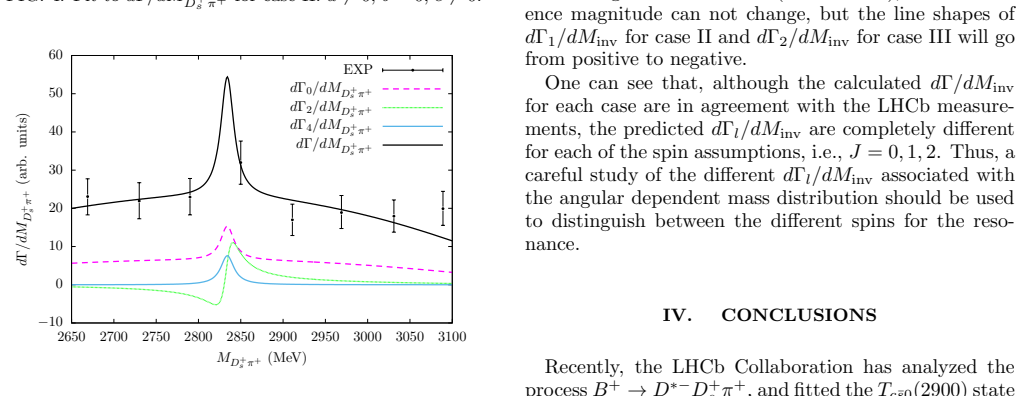
On the paper's own terms, the D_s+ π+ mass distribution from LHCb shows an event excess near 2830 MeV that the existing fit cannot describe. Adopting the prediction that the J^P = 2+ partner of T_cs0(2900) has mass 2834 MeV and width 19 MeV, the authors write the production amplitude for B+ → D*- D_s+ π+ as a tree-level term plus a resonance term in S-wave, P-wave, or D-wave, fit the free parameters to the LHCb data, and find all three fits succeed. They then decompose the squared amplitude into moments dΓ_l/dM (l = 0,...,4) using spherical harmonics. Each spin assumption yields a distinct pattern: J=0 contributes only dΓ0, J=1 contributes dΓ0, dΓ1, and dΓ2, and J=2 contributes dΓ0, dΓ2, and dΓ4. Since the angle-integrated spectrum cannot distinguish these cases, the moments are the discriminating observable; for the preferred J=2 case the dΓ2 moment is predicted to exceed the angle-integrated signal near the peak.
Load-bearing premise
The excess of events around 2830 MeV in the LHCb data is a genuine resonance rather than a statistical fluctuation, a kinematic reflection, or a background artifact; LHCb itself did not identify a resonance at this mass.
Editorial extensions
If this is right
- If LHCb measures the moments of the D_s+ π+ distribution, a nonzero dΓ4/dM with dΓ2 stronger than dΓ0 near 2830 MeV would establish the J=2 assignment and confirm T_cs2.
- The same moment analysis can be applied to the similar 2830 MeV peak in B+ → D*- D+K+, providing a cross-check of the resonance's spin.
- A confirmed J=2 partner would support the coupled-channel molecular interpretation of T_cs0(2900), in which the state emerges from D*K* and D*_s ρ interactions.
- The method offers a template for identifying the spin of exotic-state candidates in other three-body B decays.
Reading between the lines
- The paper assumes the 2830 MeV excess in B+ → D*- D_s+ π+ is the same object as the 2830 MeV peak in B+ → D*- D+K+; a combined simultaneous fit of both reactions could test whether the two peaks share one Breit-Wigner pole.
- The predicted moments assume the resonance mass and width are fixed at 2834 MeV and 19 MeV; a scan over M_R and Γ_R would show whether the discriminating power of the moments survives off-prediction values.
- Because the background parameters are refit for each spin case, part of the moment differences could be absorbed by different background shapes; dedicated amplitude analyses with full background uncertainty models would sharpen the spin discrimination.
- The moment-decomposition technique could be extended to other predicted spin partners of open-flavor tetraquarks in different B-decay channels.
Editorial analysis
A structured set of objections, weighed in public.
Referee Report
Summary. The manuscript analyzes the D_s^+π^+ invariant mass spectrum of the LHCb process B^+ → D^{*-}D_s^+π^+ and argues that a broad excess near 2830 MeV is the predicted J^P=2^+ tetraquark T_cs2, the spin partner of T_cs0(2900). The authors use a compact amplitude with an S-wave background plus a resonance term, fixing the resonance mass and width to the theoretical values M_R=2834 MeV and Γ_R=19 MeV from Ref. [30]. They fit two coefficients per spin hypothesis (J=0,1,2), compare the angular-integrated dΓ/dM_inv with LHCb data, and compute angular moments dΓ_l/dM_inv for l=0–4, finding that the moments differ markedly between the spin assignments. The paper concludes that the data give 'strong support' to the T_cs2 interpretation and calls for an experimental measurement of the moments.
Significance. The paper's positive contribution is to work out the angular-moment decomposition for the three spin hypotheses and to show, with a simple amplitude model, that these moments are sensitive to the spin of a possible resonance. It also takes the pole parameters from an independent coupled-channel prediction, which avoids fitting mass and width to the data. If the 2830 MeV excess is established as a genuine resonance, the predicted moments would provide a concrete test of the T_cs2 interpretation. The authors honestly note that the angular-integrated spectrum alone cannot distinguish the spins. The central limitation is that the manuscript does not quantify the statistical evidence for the excess, so the claim of 'evidence' is stronger than the analysis currently supports.
major comments (4)
- [Sec. III, Eqs. (10)–(12) and Figs. 3–5] The fits fix the resonance mass and width to the theoretical values M_R=2834 MeV and Γ_R=19 MeV from Ref. [30], and no fit-quality metric is reported: there is no χ²/ndof, no Δχ² relative to a no-resonance or alternative-background fit, and no estimate of the statistical significance of the 2830 MeV excess. Because the title and Sec. IV conclude that the LHCb data give 'strong support' for T_cs2, the analysis must demonstrate quantitatively that the excess is not a statistical fluctuation or background artifact; currently the agreement is only stated as 'fair agreement' without quantitative support.
- [Sec. II, Eq. (7) and Sec. III, Eqs. (10)–(12)] The angular moments dΓ_l/dM_inv are evaluated after fitting the coefficients (a0, a'0), (a1, c'), or (a2, b') to the same angular-integrated LHCb distribution. Therefore the moments are algebraically determined by the fitted amplitudes rather than being independent predictions; they can discriminate spin only if the resonance and background model are already assumed correct. The paper should explicitly describe these moments as conditional evaluations under the assumed model, not as predictions that can by themselves confirm the existence of T_cs2.
- [Sec. I and Sec. IV] The empirical basis for the claimed 2.83 GeV structure is a visual event excess in Fig. 9(b) of Ref. [39]; LHCb did not identify a resonance at this mass, and the present paper quotes no significance or compatibility test. The statement in Sec. IV that the same energy appearing in both B^+ → D^{*-}D^+K^+ and B^+ → D^{*-}D_s^+π^+ gives 'strong support' presupposes that both peaks are genuine resonances, which is exactly what needs to be established. The paper should either derive a local significance from the binned distribution or visibly temper this conclusion.
- [Sec. III, Eq. (13)] The background model ai → ãi k/M_B is introduced ad hoc, with no justification and no uncertainty. With only two fitted parameters per case and this flexible background, the fit can absorb smooth enhancements, so the apparent agreement with the data does not by itself validate the resonance hypothesis. The authors should motivate the background shape and show that the fitted resonance parameters are stable under plausible variations of the background model.
minor comments (5)
- [Abstract and Sec. II] The terms 'momenta of the angular mass distribution' and 'momentum magnitude' should be 'moments' and 'moment magnitude'; angular moments are meant, not momenta of particles.
- [Sec. II, text after Eq. (1)] The sentence introducing 'the term of bY20' to account for a J^P=1^- state coupling in P-wave is inconsistent with the amplitude decomposition, since bY20 is a D-wave (l=2) term; the P-wave piece is cY10. Please clarify the intended wording.
- [Sec. III, fit range] The choice of the fit window 2650–3150 MeV is not justified; the authors should state why this range is selected and whether the conclusions depend on the window boundaries.
- [Sec. III, figures] The plotted dΓ_l/dM_inv moments are in arbitrary units; the paper should specify how future experimental moments should be normalized to allow a quantitative comparison.
- [Sec. IV] The conclusion that a structure at 2830 MeV appears in two different final states would be strengthened by quoting the relevant mass and width values from Ref. [36] and by discussing the compatibility of the two measurements, rather than only noting the same energy.
Circularity Check
No significant circularity: the T_cs2 mass and width are imposed from an external prediction, the angular moments are genuine model outputs not fitted inputs, and the cited prior work by the authors is a peer-reviewed formalism rather than a self-justifying premise.
full rationale
The paper's derivation chain is not circular. The resonance mass and width are fixed from an external, non-self-cited prediction: 'we assume M_R = 2834 MeV and Γ_R = 19 MeV, taken from Ref. [30]' (Sec. III), with a comparable prediction in Ref. [26] that is also not the present work. The coefficients a0, a0', a1, c', a2, b' are fitted to the LHCb one-dimensional D_s^+ π^+ invariant mass distribution via dΓ/dM_inv = sqrt(4π) dΓ0/dM_inv, and the higher moments in Eq. (7) are then algebraic functions of those same fitted coefficients. This is a standard conditional model prediction for an unmeasured angular observable, not a case where a fitted parameter is relabeled as a prediction, because the moments are not used as input to the fit and the paper explicitly calls for future experimental determination of these magnitudes. The authors' prior Ref. [37] supplies the partial-wave amplitude and a previous interpretation of the B+ -> D*-D+K+ peak, but that self-citation is not the load-bearing justification for the existence of T_cs2: the identification rests on an external prediction of the mass and on two experimentally observed peaks at roughly the same energy (Refs. [36,39]). The main weaknesses of the paper—the 2830 MeV excess in LHCb data is not established as a resonance with a quoted significance, no comparison to a no-resonance hypothesis is given, and all three spin fits describe the same angle-integrated spectrum—are concerns about statistical evidence and discriminatory power, not about circularity. The conclusion is therefore over-strong relative to the evidence, but the reasoning is not self-referential.
Assumptions & free parameters
free parameters (6)
- tilde_a0 (case I S-wave background coefficient) =
8.93 MeV^-1
- a'_0 (case I S-wave resonance coupling) =
4.84 x 10^-4 MeV^-1
- tilde_a1 (case II S-wave coefficient) =
8.73 MeV^-1
- c' (case II P-wave resonance coupling) =
2.01 x 10^-2 MeV^-1
- tilde_a2 (case III S-wave coefficient, preferred J=2 case) =
8.73 MeV^-1
- b' (case III D-wave resonance coupling) =
1.44 x 10^-1 MeV^-1
assumptions (5)
- domain assumption D_s^+ pi^+ final state is produced by S-wave D*K* and D*_s rho interactions, with production amplitude T = epsilon_mu(D*) P^mu_B (a Y00 + b Y20 + c Y10).
- domain assumption The resonance parameters are M_R = 2834 MeV and Gamma_R = 19 MeV, taken from Ref [30].
- domain assumption The LHCb event excess around 2.83 GeV is a real resonance signal.
- ad hoc to paper The background can be represented by small terms with a_i replaced by tilde_a_i tilde_k / M_B.
- standard math The spherical harmonic integration formula in Eq. (6), taken from Rose, Ref [50].
Cite this review
Pith. "Pith review of Evidence of the open-flavor tetraquark $T_{c\bar{s}2}$ in the process $B^+\to D^{*-}D_s^+\pi^+$." pith.science (2026). https://pith.science/paper/ONISGB6Q
@misc{pith2026250102839,
  author       = {Pith},
  title        = {Pith review of: Evidence of the open-flavor tetraquark $T_c\bars2$ in the process $B^+\to D^*-D_s^+\pi^+$},
  year         = {2026},
  howpublished = {\url{https://pith.science/paper/ONISGB6Q}},
  note         = {Machine review of arXiv:2501.02839}
}
abstract
The newly observed open-flavor tetraquark $T_{c\bar{s}0}(2900)$ has attracted many attentions, and searching for its spin partners is crucial to exploring the internal structure of those states. In this work, we will show that, the $D_s^+\pi^+$ invariant mass distribution of the process $B^+\to D^{*-}D_s^+\pi^+$ measured by LHCb has a resonant-like structure around 2830~MeV, which could be associated with the predicted $T_{c\bar{s}2}$, the spin $J=2$ partner of $T_{c\bar{s}0}(2900)$. Furthermore, we have evaluated the momenta of the angular mass distribution, which are very different for each of the spin assumptions, and have larger strength at the resonant energy than the peaks seen in the angular integrated mass distribution. We make a call for the experimental determination of these magnitudes, which could be used to pin down the existence of the $T_{c\bar{s}2}$.
Figures


Figures from the paper (2 more)

Forward citations
Cited by 2 Pith papers
-
Searching for the $2^+$ partner of the $T_{cs0}(2870)$ in the $B^- \to D^- D^0 K^0_S$ reaction
The small D0 K0S mass bump near 2.73 GeV in B- -> D- D0 K0S could be a 2+ D* K* molecular state, and its angular moments should show a clear signal.
-
Discovering the Gell-Mann-Okubo Formula with Kolmogorov-Arnold Networks
A KAN network's fitted polynomials are hand-rearranged into the known Gell-Mann-Okubo mass relations, so the claimed autonomous rediscovery is not demonstrated.
Reference graph
Works this paper leans on
- [30]
- [39]
-
[1]
S. K. Choi et al. [Belle], Phys. Rev. Lett. 91 (2003), 262001
work page 2003
- [2]
- [3]
-
[4]
X. G. He, W. Wang and R. Zhu, Eur. Phys. J. C 80 (2020) no.11, 1026
work page 2020
- [5]
-
[6]
G. J. Wang, L. Meng, L. Y. Xiao, M. Oka and S. L. Zhu, Eur. Phys. J. C 81 (2021) no.2, 188
work page 2021
Show all 50 references
-
[7]
G. Yang, J. Ping and J. Segovia, Phys. Rev. D103 (2021) no.7, 074011
2021
-
[8]
Z. G. Wang, Int. J. Mod. Phys. A 35 (2020) no.30, 2050187
2020
-
[9]
Wang and S
B. Wang and S. L. Zhu, Eur. Phys. J. C 82, no.5, 419 (2022)
2022
-
[10]
Y. K. Chen, J. J. Han, Q. F. L¨ u, J. P. Wang and F. S. Yu, Eur. Phys. J. C 81, no.1, 71 (2021)
2021
-
[11]
Q. Y. Lin and X. Y. Wang, Eur. Phys. J. C 82, no.11, 1017 (2022)
2022
-
[12]
L. R. Dai, R. Molina and E. Oset, Phys. Lett. B 832, 137219 (2022)
2022
-
[13]
C. J. Xiao, D. Y. Chen, Y. B. Dong and G. W. Meng, Phys. Rev. D 103 (2021) no.3, 034004
2021
-
[14]
H. X. Chen, W. Chen, R. R. Dong and N. Su, Chin. Phys. Lett. 37 (2020) no.10, 101201
2020
-
[15]
Huang, J
Y. Huang, J. X. Lu, J. J. Xie and L. S. Geng, Eur. Phys. J. C 80 (2020) no.10, 973
2020
-
[16]
M. Z. Liu, J. J. Xie and L. S. Geng, Phys. Rev. D 102 (2020) no.9, 091502
2020
-
[17]
M. W. Hu, X. Y. Lao, P. Ling and Q. Wang, Chin. Phys. C 45, no.2, 021003 (2021)
2021
-
[18]
Molina and E
R. Molina and E. Oset, Phys. Lett. B 811, 135870 (2020)
2020
-
[19]
He and D
J. He and D. Y. Chen, Chin. Phys. C 45, no.6, 063102 (2021)
2021
-
[20]
X. H. Liu, M. J. Yan, H. W. Ke, G. Li and J. J. Xie, Eur. Phys. J. C 80, no.12, 1178 (2020)
2020
-
[21]
Aaij et al.[LHCb], Phys
R. Aaij et al.[LHCb], Phys. Rev. Lett. 131, no.4, 041902 (2023)
2023
-
[22]
Aaij et al
R. Aaij et al. [LHCb], Phys. Rev. D 108, no.1, 012017 (2023)
2023
-
[23]
D. K. Lian, W. Chen, H. X. Chen, L. Y. Dai and T. G. Steele, Eur. Phys. J. C 84 (2024) no.1, 1
2024
-
[24]
L. Meng, Y. K. Chen, Y. Ma and S. L. Zhu, Phys. Rev. D 108 (2023) no.11, 114016
2023
-
[25]
X. S. Yang, Q. Xin and Z. G. Wang, Int. J. Mod. Phys. A 38 (2023) no.11, 2350056
2023
-
[26]
M. Y. Duan, M. L. Du, Z. H. Guo, E. Wang and D. Y. Chen, Phys. Rev. D 108 (2023) no.7, 074006
2023
-
[27]
S. S. Agaev, K. Azizi and H. Sundu, J. Phys. G 50, no.5, 055002 (2023)
2023
-
[28]
F. K. Guo, C. Hanhart, U. G. Meißner, Q. Wang, Q. Zhao and B. S. Zou, Rev. Mod. Phys. 90 (2018) no.1, 015004 [erratum: Rev. Mod. Phys. 94 (2022) no.2, 029901]
2018
-
[29]
Matuschek, V
I. Matuschek, V. Baru, F. K. Guo and C. Hanhart, Eur. Phys. J. A 57 (2021) no.3, 101
2021
-
[31]
W. T. Lyu, M. Y. Duan, X. Wang, D. Y. Chen and E. Wang, [arXiv:2408.11454 [hep-ph]]
-
[32]
W. T. Lyu, Y. H. Lyu, M. Y. Duan, G. Y. Wang, D. Y. Chen and E. Wang, [arXiv:2310.11139 [hep-ph]]
-
[33]
W. T. Lyu, Y. H. Lyu, M. Y. Duan, D. M. Li, D. Y. Chen and E. Wang, Phys. Rev. D 109 (2024) no.1, 014008
2024
-
[34]
M. Y. Duan, E. Wang and D. Y. Chen, Eur. Phys. J. C 84 (2024) no.7, 681
2024
-
[35]
Molina, T
R. Molina, T. Branz and E. Oset, Phys. Rev. D 82 (2010), 014010
2010
-
[36]
Aaij et al.[LHCb], Phys
R. Aaij et al.[LHCb], Phys. Rev. Lett. 133 (2024) no.13, 131902
2024
-
[37]
W. T. Lyu, M. Y. Duan, C. W. Xiao, E. Wang and E. Oset, Eur. Phys. J. C 84 (2024) no.12, 1302
2024
-
[38]
J. Song, Z. Y. Yang and E. Oset, [arXiv:2411.02358 [hep- ph]]
-
[40]
W. Y. Liu, W. Hao, G. Y. Wang, Y. Y. Wang, E. Wang and D. M. Li, Phys. Rev. D 103 (2021) no.3, 034019
2021
-
[41]
Zhang, E
Y. Zhang, E. Wang, D. M. Li and Y. X. Li, Chin. Phys. C 44 (2020) no.9, 093107
2020
-
[42]
L. R. Dai, G. Y. Wang, X. Chen, E. Wang, E. Oset and D. M. Li, Eur. Phys. J. A 55 (2019) no.3, 36
2019
-
[43]
E. Wang, J. J. Xie, L. S. Geng and E. Oset, Phys. Rev. D 97 (2018) no.1, 014017
2018
-
[44]
X. Q. Li, L. J. Liu, E. Wang and L. L. Wei, Phys. Rev. D 109 (2024) no.9, 094014
2024
-
[45]
M. Z. Liu, X. Z. Ling, L. S. Geng, En-Wang and J. J. Xie, Phys. Rev. D 106 (2022) no.11, 114011 6
2022
-
[46]
L. L. Wei, H. S. Li, E. Wang, J. J. Xie, D. M. Li and Y. X. Li, Phys. Rev. D 103 (2021), 114013
2021
-
[47]
Bayar and E
M. Bayar and E. Oset, Phys. Lett. B 833 (2022), 137364
2022
-
[48]
Aaij et al
R. Aaij et al. [LHCb], Phys. Rev. D 94 (2016) no.7, 072001
2016
-
[49]
J. Y. Wang, M. Y. Duan, G. Y. Wang, D. M. Li, L. J. Liu and E. Wang, Phys. Lett. B 821 (2021), 136617
2021
-
[50]
M. E. Rose, Elementary theory of angular momentum, New York and London: J. Wiley and Sons, c1957
Reviewed August 10, 2026 · model on record in the stance chip above.
Discussion (0). Continue with ORCID to comment.