REVIEW 5 major objections 5 minor 37 references
IIMedGPT: Promoting Large Language Model Capabilities of Medical Tasks by Efficient Human Preference Alignment
T0 review · 5 major / 5 minor · reviewed 2026-08-10 · deepseek-v4-flash
Pith's one-line read IIMedGPT shows that supervised fine-tuning plus direct preference optimization outperforms existing Chinese medical dialogue models with less training data.
desk verdict A useful medical instruction dataset plus a standard DPO recipe, but the SOTA claim rests on unreadable bar charts, not numbers. read the letter →
The pith
A machine-rendered reading of the paper's core claim, the machinery that carries it, and where it could break.
The reading
What carries the argument
The load-bearing component is Direct Preference Optimization, which replaces the reward-model-plus-PPO loop of RLHF with a single classification objective that maximizes the log-likelihood margin between preferred and dispreferred responses under the policy/reference ratio. The second component is CMedINS, an instruction dataset of about 220,000 real clinical record excerpts reformatted into six medical task types, which supplies the SFT stage with diverse, doctor-verified instructions. Together they let the model learn both task competence (SFT) and human-value alignment (DPO) without a separate reward model or reinforcement-learning rollout.
What would settle it
Take a random sample of the 7,000 test dialogues, have a blinded panel of clinicians score IIMedGPT and Zhongjing responses under identical prompts and decoding settings, and compute the win rate; if IIMedGPT does not win at the reported margin, the state-of-the-art claim is refuted.
Extended reading notes
Core claim
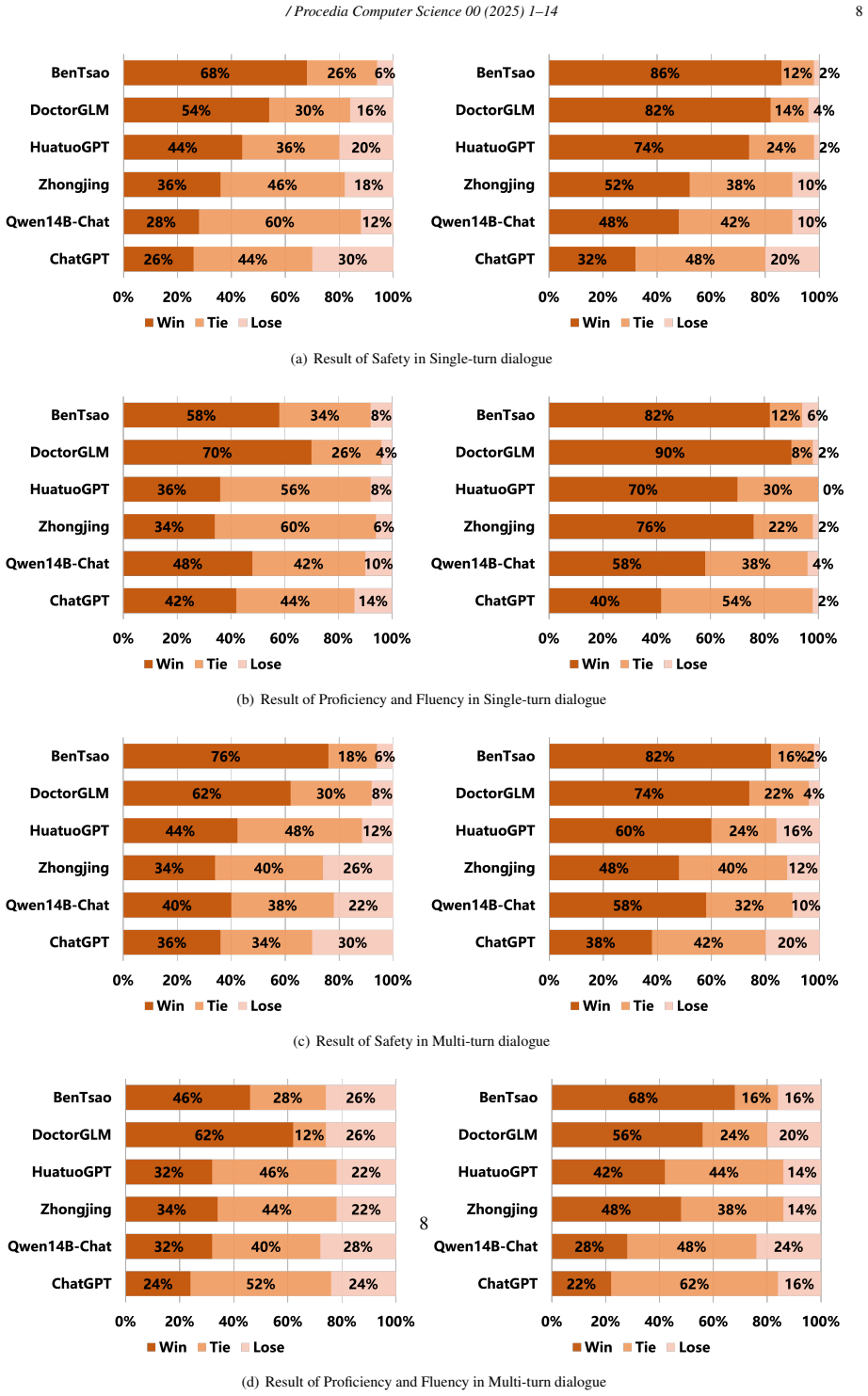
The central claim is that human-preference alignment for medical dialogue can be made dramatically cheaper without sacrificing quality: after SFT, a single DPO stage on doctor-annotated preference data turns a general 14-billion-parameter model into a medical assistant that outperforms existing open Chinese medical LLMs on the selected benchmarks. The authors report gains across all three evaluated dimensions—safety, professionalism, and fluency—in both single-turn and multi-turn dialogue, and they attribute the improvement specifically to DPO, since the ablation shows the model winning more often after the DPO stage than before. They also claim that this is achieved with a training corpus of only about 1 GB, in contrast to the larger data and two-stage RLHF training used by the previous best model.
Load-bearing premise
The central claim rests on the assumption that GPT-4's pairwise judgments of professionalism and fluency, plus a small set of doctors' safety ratings, accurately capture real-world medical dialogue quality, and that all baselines were scored under identical prompts and decoding settings.
Editorial extensions
If this is right
- Medical dialogue models can be built from a general base model plus 1 GB of curated instruction and preference data, lowering the entry cost for hospitals and research groups.
- DPO can replace reward-model training and PPO in specialized domains, reducing annotation and compute budgets while preserving alignment gains.
- The CMedINS instruction format (six tasks from real records) can be reused as a benchmark or training resource for other Chinese medical NLP systems.
- Because general-domain data is mixed into SFT, medical specialization need not degrade general chat and reasoning ability, according to the paper's general-benchmark results.
- The same two-stage SFT+DPO pipeline is claimed to be transferable to other fields that lack large pre-training corpora.
Reading between the lines
- Beyond the paper, the dependence on GPT-4 as judge means the reported win rates are probably sensitive to the judge prompt and model version; a replication with a different judge or a human panel could shift rankings even if the underlying responses are unchanged.
- Beyond the paper, the ablation only compares before/after DPO; a natural extension would be to test whether the DPO stage still helps when preference data is annotated on the SFT model rather than the base model, since annotation quality may depend on which policy generated the rejected responses.
- Beyond the paper, because CMedINS is drawn from hospital records and de-identified, it could serve as a seed for privacy-preserving multi-institution instruction datasets if other hospitals adopt the same six-task schema.
- Beyond the paper, if the efficiency claim transfers, preference alignment for specialized assistants in law, finance, or education could follow the same 1 GB SFT+DPO recipe rather than full RLHF.
Editorial analysis
A structured set of objections, weighed in public.
Referee Report
Summary. The paper introduces IIMedGPT, a Chinese medical dialogue model built in two stages: supervised fine-tuning on a newly constructed 220k-pair medical instruction dataset CMedINS together with existing dialogue and general-domain data, followed by Direct Preference Optimization (DPO) on 15k human-annotated preference samples. The authors claim that their final model outperforms existing Chinese medical LLMs in medical dialogue on safety, professionalism, and fluency, evaluated on Huatuo26M-test and CMtMedQA test sets via doctor ratings and GPT-4 judgments. The manuscript states this state-of-the-art claim in Section 5 but reports no numerical evaluation results anywhere, supporting it only with bar charts (Figures 4 and 5) and qualitative examples in Appendix A. Datasets, code, and checkpoints are promised to be released upon acceptance.
Significance. If the central claim were backed by quantitative evidence, the paper would be a useful contribution: it combines a large multi-task medical instruction dataset, a relatively cheap two-stage SFT+DPO pipeline, and a reported reduction in training resources compared with RLHF-based medical models such as Zhongjing. The dataset construction process includes ethical review, de-identification, and cross-annotation by medical personnel, which are concrete strengths. However, as presented, the paper is a system description whose headline 'state-of-the-art' claim cannot be checked, reproduced, or compared with prior work because no numeric scores, win/tie/loss counts, confidence intervals, or significance tests are reported. The significance of the contribution is therefore presently unassessable, and the claimed superiority must be treated as unverified.
major comments (5)
- [Section 5, Figures 4 and 5, Section 4.4] The central claim that 'our model surpasses all existing medical models in medical dialogue capability, achieving state-of-the-art outcomes' is not supported by any numerical result in the text. Section 4.4 describes evaluations of safety (by doctors) and professionalism/fluency (by GPT-4), but Section 5 only references bar charts, and the bar values are not tabulated or stated. There are no win/tie/loss counts, no mean scores, no confidence intervals, no significance tests, and no inter-annotator reliability for the doctor ratings. Without these numbers, the SOTA claim cannot be verified or reproduced. The authors should add complete result tables, including per-model scores, sample sizes, statistical tests, and doctor-rating reliability, and should release the evaluation logs if possible.
- [Sections 3.1.2 and 4.3] The training and evaluation data provenance raises a possible leakage concern. Section 3.1.2 states that the training set integrates the CMtMedQA multi-turn dialogue dataset and the ChatMed single-turn dialogue dataset. Section 4.3 then evaluates on Huatuo26M-test and on CMtMedQA test dialogues described as 'not exposed to the model during the training process.' The manuscript does not specify the exact train/test split of CMtMedQA or demonstrate that no overlap exists, and it does not clarify whether ChatMed is derived from Huatuo26M, which would contaminate the Huatuo26M-test evaluation. The authors should state the provenance of each training file, provide the precise split, and report overlap checks between training and test sets.
- [Appendix B and Section 4.4] The GPT-4-based pairwise evaluation is used as the primary evidence for professionalism and fluency, but the prompt in Table B.2 rewards thorough, structured answers and the manuscript gives no validation that GPT-4 judgments agree with expert medical opinion. In addition, no decoding settings (temperature, top-p, max tokens, system prompt) are reported for any model, and the paper does not state that all baselines were evaluated under identical generation conditions. Differences in response length or formatting could therefore drive the reported wins. The authors should report exact decoding parameters for every model, run all models with identical settings, and provide a validation of the GPT-4 judge against a sample of doctor judgments (e.g., agreement rates and kappa coefficients).
- [Section 4.1] The training details are incomplete. The text says 'we delineate the definitive parameters for each phase of the training process in the table,' but no hyperparameter table appears in the manuscript. The reader cannot see the learning rate, batch size, number of epochs, LoRA rank and alpha, DPO beta, or the exact composition of the training mixture beyond the stated 1:1 single-to-multi-turn ratio. These values are necessary both for reproducibility and for evaluating the 'low resources but high performance' claim. The authors should add a complete hyperparameter table for both the SFT and DPO stages.
- [Section 8] The limitation section acknowledges hallucinations and the text-only nature of the model but does not mention the most immediate limitation of the paper: the absence of quantitative evaluation and the unvalidated use of GPT-4 as a medical dialogue judge. For a medical-safety claim, the evaluation protocol itself should be discussed as a limitation, including the small scale and the lack of inter-annotator agreement information for doctor safety ratings. Adding this would align the stated limitations with the actual evidence presented.
minor comments (5)
- [Abstract and general text] There are several typos and grammatical slips, including 'Datsets' in the abstract, 'hignlighted' in Section 2.1, 'resualtting' and 'speciallized' in Section 1, and 'direct policy optimization' where the acronym DPO is defined. A thorough language edit is needed.
- [Figures 2 and 3] The captions appear to be mismatched with the content: Figure 2 is captioned as 'The distribution of CMedINS dataset' but shows an instruction pair example, while Figure 3 is captioned as 'Example of the instruction pair' but is referenced as if it shows the distribution. The authors should swap or correct the captions and ensure the in-text references point to the correct figure.
- [Figure 1] The abbreviation 'CMeDINS' appears in Figure 1 while the text consistently uses 'CMedINS'; the label should be unified.
- [Abstract and Section 1] The 'Keywords:' line after the abstract is empty. The authors should provide the intended keywords.
- [Appendix A] The example response of IIMedGPT in Figure A.6 recommends specific drug classes (ACEI/ARB, metformin, glipizide) but does not emphasize that the patient should see a doctor promptly; in a medical safety evaluation, such a response would require a caution. This is a content observation rather than a formatting issue, and it should be considered when interpreting the qualitative claim of superiority.
Circularity Check
No significant circularity: training and evaluation are distinct, DPO is an external method, and no fitted parameter is renamed as a prediction.
full rationale
The paper's derivation chain is a standard two-stage alignment pipeline: supervised fine-tuning on a mixed medical instruction/dialogue/general dataset, followed by DPO on a 15k human-annotated preference set. The DPO objective (Eq. 4) is quoted from Rafailov et al. [24] and is not derived from the paper's own outputs. The preference labels are produced by medical postgraduates/clinical doctors using stated SPF criteria and are distinct from the GPT-4/doctor evaluation on Huatuo26M-test and CMtMedQA test; the CMtMedQA test split is explicitly described as 'not exposed to the model during the training process.' No parameter is fitted to the evaluation set and then reported as a prediction, and no central claim is justified solely by a citation to the present authors' prior work. The paper also does not rely on a self-citation chain: the cited medical baselines and benchmarks, including Zhongjing, HuatuoGPT, and Huatuo-26M, are from other research groups. The main weakness is that the SOTA claim rests on bar charts without tabulated numerical scores and the GPT-4 judge prompt lacks decoding details; that is an evidence/reproducibility concern, not a circular-reasoning defect.
Assumptions & free parameters
free parameters (4)
- DPO beta =
not reported
- LoRA rank =
not reported
- Learning rate and schedule =
not reported (cosine annealing mentioned, concrete values absent)
- Single-turn to multi-turn dialogue mix ratio =
1:1
assumptions (4)
- domain assumption Bradley-Terry preference model
- domain assumption Qwen-14B base model is a suitable foundation
- ad hoc to paper GPT-4 is a valid judge of medical professionalism and fluency
- domain assumption Huatuo26M-test and CMtMedQA are appropriate held-out medical benchmarks
Cite this review
Pith. "Pith review of IIMedGPT: Promoting Large Language Model Capabilities of Medical Tasks by Efficient Human Preference Alignment." pith.science (2026). https://pith.science/paper/MRS4WZ24
@misc{pith2026250102869,
  author       = {Pith},
  title        = {Pith review of: IIMedGPT: Promoting Large Language Model Capabilities of Medical Tasks by Efficient Human Preference Alignment},
  year         = {2026},
  howpublished = {\url{https://pith.science/paper/MRS4WZ24}},
  note         = {Machine review of arXiv:2501.02869}
}
read the original abstract
Recent researches of large language models(LLM), which is pre-trained on massive general-purpose corpora, have achieved breakthroughs in responding human queries. However, these methods face challenges including limited data insufficiency to support extensive pre-training and can not align responses with users' instructions. To address these issues, we introduce a medical instruction dataset, CMedINS, containing six medical instructions derived from actual medical tasks, which effectively fine-tunes LLM in conjunction with other data. Subsequently, We launch our medical model, IIMedGPT, employing an efficient preference alignment method, Direct preference Optimization(DPO). The results show that our final model outperforms existing medical models in medical dialogue.Datsets, Code and model checkpoints will be released upon acceptance.
Figures


Figures from the paper (2 more)

Reference graph
Works this paper leans on
-
[1]
URL https://openai.com/blog/chatgpt
OpenAI, Introducing ChatGPT. URL https://openai.com/blog/chatgpt
-
[2]
URL https://arxiv.org/abs/2303.08774
OpenAI, GPT-4 Technical Report, ArXiv preprint abs/2303.08774. URL https://arxiv.org/abs/2303.08774
-
[3]
H. Touvron, T. Lavril, G. Izacard, X. Martinet, M.-A. Lachaux, T. Lacroix, B. Rozière, N. Goyal, E. Hambro, F. Azhar, A. Rodriguez, A. Joulin, E. Grave, G. Lample, LLaMA: Open and Efficient Foundation Language Models, ArXiv preprint abs/2302.13971. URL https://arxiv.org/abs/2302.13971
-
[4]
T. L. Scao, A. Fan, C. Akiki, E. Pavlick, S. Ili´c, D. Hesslow, R. Castagné, A. S. Luccioni, et al., BLOOM: A 176B-Parameter Open-Access Multilingual Language Model, ArXiv preprint abs/2211.05100. URL https://arxiv.org/abs/2211.05100
-
[5]
E. Almazrouei, H. Alobeidli, A. Alshamsi, A. Cappelli, R.-A. Cojocaru, D. Hesslow, J. Launay, Q. Malartic, D. Mazzotta, B. Noune, B. Pannier, G. Penedo, The falcon series of open language models, ArXiv preprint abs/2311.16867. URL https://arxiv.org/abs/2311.16867
-
[6]
Y . Cui, Z. Yang, X. Yao, Efficient and Effective Text Encoding for Chinese LLaMA and Alpaca, ArXiv preprint abs/2304.08177. URL https://arxiv.org/abs/2304.08177
-
[7]
J. Bai, S. Bai, Y . Chu, Z. Cui, K. Dang, X. Deng, Y . Fan, W. Ge, et al., Qwen technical report, ArXiv preprint abs/2309.16609. URL https://arxiv.org/abs/2309.16609
-
[8]
A. Yang, B. Xiao, B. Wang, B. Zhang, C. Bian, C. Yin, C. Lv, D. Pan, et al., Baichuan 2: Open Large-scale Language Models, ArXiv preprint abs/2309.10305. URL https://arxiv.org/abs/2309.10305
Show all 37 references
-
[9]
W. X. Zhao, K. Zhou, J. Li, T. Tang, X. Wang, Y . Hou, Y . Min, B. Zhang, et al., A Survey of Large Language Models, ArXiv preprint abs/2303.18223. URL https://arxiv.org/abs/2303.18223
-
[10]
Singhal, S
K. Singhal, S. Azizi, T. Tu, S. S. Mahdavi, J. Wei, H. W. Chung, N. Scales, A. Tanwani, et al., Large language models encode clinical knowledge, Nature 620 (7972) (2023) 172–180. doi:10.1038/s41586-023-06291-2
2023 doi
-
[11]
Xiong, S
H. Xiong, S. Wang, Y . Zhu, Z. Zhao, Y . Liu, L. Huang, Q. Wang, D. Shen, DoctorGLM: Fine-tuning your Chinese Doctor is not a Herculean Task, ArXiv preprint abs/2304.01097. URL https://arxiv.org/abs/2304.01097
-
[12]
H. Wang, C. Liu, N. Xi, Z. Qiang, S. Zhao, B. Qin, T. Liu, HuaTuo: Tuning LLaMA Model with Chinese Medical Knowledge, ArXiv preprint abs/2304.06975. URL https://arxiv.org/abs/2304.06975
-
[13]
Zhang, J
H. Zhang, J. Chen, F. Jiang, F. Yu, Z. Chen, J. Li, G. Chen, X. Wu, et al., HuatuoGPT, towards Taming Language Model to Be a Doctor, ArXiv preprint abs/2305.15075. URL https://arxiv.org/abs/2305.15075
-
[14]
S. Yang, H. Zhao, S. Zhu, G. Zhou, H. Xu, Y . Jia, H. Zan, Zhongjing: Enhancing the Chinese Medical Capabilities of Large Language Model through Expert Feedback and Real-world Multi-turn Dialogue, ArXiv preprint abs/2308.03549. URL https://arxiv.org/abs/2308.03549
-
[15]
X. Han, Z. Zhang, N. Ding, Y . Gu, X. Liu, Y . Huo, J. Qiu, L. Zhang, et al., Pre-trained models: Past, present and future, ArXiv preprint abs/2106.07139. URL https://arxiv.org/abs/2106.07139
-
[16]
C. Zhou, P. Liu, P. Xu, S. Iyer, J. Sun, Y . Mao, X. Ma, A. Efrat, et al., LIMA: Less Is More for Alignment, ArXiv preprint abs/2305.11206. URL https://arxiv.org/abs/2305.11206 10 / Procedia Computer Science 00 (2025) 1–14 11
2025 arXiv
-
[17]
X. Dong, A. T. Luu, M. Lin, S. Yan, H. Zhang, How should pre-trained language models be fine-tuned towards adversarial robustness?, in: M. Ranzato, A. Beygelzimer, Y . N. Dauphin, P. Liang, J. W. Vaughan (Eds.), Advances in Neural Information Processing Systems 34: Annual Conf...
2021
-
[18]
Howard, S
J. Howard, S. Ruder, Universal language model fine-tuning for text classification, in: Proceedings of the 56th Annual Meeting of the Association for Computational Linguistics (V olume 1: Long Papers), Association for Computational Linguistics, Melbourne, Australia, 2018, pp. 3...
2018 doi
-
[19]
C. Lee, K. Cho, W. Kang, Mixout: Effective regularization to finetune large-scale pretrained language models, in: 8th International Conference on Learning Representations, ICLR 2020, Addis Ababa, Ethiopia, April 26-30, 2020, OpenReview.net, 2020. URL https://openreview.net/for...
2020
-
[20]
Touvron, L
H. Touvron, L. Martin, K. Stone, P. Albert, A. Almahairi, Y . Babaei, N. Bashlykov, S. Batra, et al., Llama 2: Open foundation and fine-tuned chat modelsarXiv:2307.09288
-
[21]
Z. Li, T. Xu, Y . Yu, Policy Optimization in RLHF: The Impact of Out-of-preference Data, ArXiv preprint abs/2312.10584. URL https://arxiv.org/abs/2312.10584
-
[22]
Y . Bai, A. Jones, K. Ndousse, A. Askell, A. Chen, N. DasSarma, D. Drain, S. Fort, et al., Training a helpful and harmless assistant with reinforcement learning from human feedback, ArXiv preprint abs/2204.05862. URL https://arxiv.org/abs/2204.05862
-
[23]
Schulman, F
J. Schulman, F. Wolski, P. Dhariwal, A. Radford, O. Klimov, Proximal policy optimization algorithms, ArXiv preprint abs/1707.06347. URL https://arxiv.org/abs/1707.06347
-
[24]
Rafailov, A
R. Rafailov, A. Sharma, E. Mitchell, S. Ermon, C. D. Manning, C. Finn, Direct Preference Optimization: Your Language Model is Secretly a Reward Model, ArXiv preprint abs/2305.18290. URL https://arxiv.org/abs/2305.18290
-
[25]
Zhang, R
J. Zhang, R. Gan, J. Wang, Y . Zhang, L. Zhang, P. Yang, X. Gao, Z. Wu, et al., Fengshenbang 1.0: Being the foundation of chinese cognitive intelligence, ArXiv preprint abs/2209.02970. URL https://arxiv.org/abs/2209.02970
-
[26]
Z. Du, Y . Qian, X. Liu, M. Ding, J. Qiu, Z. Yang, J. Tang, GLM: General language model pretraining with autoregressive blank infilling, in: Proceedings of the 60th Annual Meeting of the Association for Computational Linguistics (V olume 1: Long Papers), Association for Comput...
2022 doi
-
[27]
T. Sun, X. Zhang, Z. He, P. Li, Q. Cheng, H. Yan, X. Liu, Y . Shao, et al., Moss: Training conversational language models from synthetic data
-
[28]
T. Han, L. C. Adams, J.-M. Papaioannou, P. Grundmann, T. Oberhauser, A. Löser, D. Truhn, K. K. Bressem, Medalpaca - an open-source collection of medical conversational ai models and training data, ArXiv preprint abs/2304.08247. URL https://arxiv.org/abs/2304.08247
-
[29]
Y . Li, Z. Li, K. Zhang, R. Dan, S. Jiang, Y . Zhang, Chatdoctor: A medical chat model fine-tuned on a large language model meta-ai (llama) using medical domain knowledgearXiv:2303.14070
-
[30]
V . Sanh, A. Webson, C. Raffel, S. H. Bach, L. Sutawika, Z. Alyafeai, A. Chaffin, A. Stiegler, A. Raja, M. Dey, M. S. Bari, C. Xu, U. Thakker, S. S. Sharma, E. Szczechla, T. Kim, G. Chhablani, N. V . Nayak, D. Datta, J. Chang, M. T. Jiang, H. Wang, M. Manica, S. Shen, Z. X. Yo...
2022
-
[31]
Shumailov, Z
I. Shumailov, Z. Shumaylov, Y . Zhao, Y . Gal, N. Papernot, R. Anderson, The Curse of Recursion: Training on Generated Data Makes Models Forget, ArXiv preprint abs/2305.17493. URL https://arxiv.org/abs/2305.17493
-
[32]
Aghajanyan, A
A. Aghajanyan, A. Gupta, A. Shrivastava, X. Chen, L. Zettlemoyer, S. Gupta, Muppet: Massive multi-task representations with pre-finetuning, in: Proceedings of the 2021 Conference on Empirical Methods in Natural Language Processing, Association for Computational Linguistics, On...
2021 doi
-
[33]
E. J. Hu, Y . Shen, P. Wallis, Z. Allen-Zhu, Y . Li, S. Wang, L. Wang, W. Chen, Lora: Low-rank adaptation of large language models, in: The Tenth International Conference on Learning Representations, ICLR 2022, Virtual Event, April 25-29, 2022, OpenReview.net, 2022. URL https:...
2022
-
[34]
Loshchilov, F
I. Loshchilov, F. Hutter, Decoupled weight decay regularization, in: 7th International Conference on Learning Representations, ICLR 2019, New Orleans, LA, USA, May 6-9, 2019, OpenReview.net, 2019. URL https://openreview.net/forum?id=Bkg6RiCqY7
2019
-
[35]
J. Li, X. Wang, X. Wu, Z. Zhang, X. Xu, J. Fu, P. Tiwari, X. Wan, B. Wang, Huatuo-26M, a Large-scale Chinese Medical QA Dataset, ArXiv preprint abs/2305.01526. URL https://arxiv.org/abs/2305.01526 Appendix A. Conversation Cases The Chinese answers from the five baseline models...
2025 arXiv
-
[36]
- Clearly and concisely explain complex medical knowledge
Professionalism: - Accurately understand patient questions and provide relevant answers. - Clearly and concisely explain complex medical knowledge. - Proactively inquire about the patient’s condition when necessary
-
[37]
Answer1” relative to “Answer2
Fluency: - Ensure semantic coherence with no logical errors or irrelevant information. - Maintain consistency in style and content. - Maintain a friendly, enthusiastic answering attitude. Note:Evaluate based on the importance of Professionalism > fluency. If there’s a conflict...
Reviewed August 10, 2026 · model on record in the stance chip above.
Discussion (0). Continue with ORCID to comment.