REVIEW 3 major objections 6 minor 2 cited by
OpenLKA: an open dataset of lane keeping assist from market autonomous vehicles
T0 review · 3 major / 6 minor · reviewed 2026-08-10 · deepseek-v4-flash
Pith's one-line read This paper introduces OpenLKA, an open dataset, and uses it to argue that commercial lane-keeping assist fails predictably on sharp curves, low-contrast markings, and lane transitions.
desk verdict Valuable new LKA dataset, but the headline deviation numbers rest on an unvalidated vision-based measurement that needs independent checking before they're trusted. read the letter →
The pith
A machine-rendered reading of the paper's core claim, the machinery that carries it, and where it could break.
The reading
What carries the argument
The central mechanism is the OpenLKA collection pipeline built around a Comma Three-X device mounted at the windshield center and run in dash-cam mode, so it passively reads CAN messages without touching the vehicle's controls. Openpilot's vision detection supplies the distances to the left and right lane lines, and the paper defines LKA error as $E = (L_{\text{left}} + L_{\text{right}})/2$, a continuous lane-deviation measure. The quantitative argument is carried by the curvature–deviation regression, with fitted slope $-8.33$, and by the lateral-acceleration identity $a_{\text{lateral}} = \kappa v^2 - \text{roll}\cdot g$, which links path curvature $\kappa$, speed $v$, and roll angle to the steering torque the LKA must produce.
What would settle it
Collect independent lane-position ground truth on a subset of the same Tampa routes, for example centimeter-level GNSS/INS with mapped lane centerlines or manually annotated video, and compare it with the OpenPilot-derived LKA error. If the deviations at curvature above 0.05 are much smaller or uncorrelated with the fitted slope of -8.33, the paper's central quantitative claim is refuted.
Extended reading notes
Core claim
On the paper's own terms, the central discovery is that commercial LKA performance degrades in a predictable, module-by-module way. In perception, low-contrast pavement and marking combinations, heavy rain, glare, and worn markings make lane detection flicker or disappear. In planning, lane transitions such as merges, diverges, and intersections make the system lock onto the wrong line or disengage. In control, torque-limited steering cannot supply the lateral acceleration required on sharp turns, so the vehicle drifts from lane center. The paper quantifies this control failure by regressing lane deviation against curvature, obtaining a slope of -8.33, and states that beyond curvature 0.05 the deviation reaches almost 1.5 meters. It further argues that LKA's rigid lane-centering behavior contrasts with human corner-apexing and obstacle-avoidance strategies, and it demonstrates that a vision-language model fine-tuned on human driving logs produces steering outputs closer to human choices.
Load-bearing premise
The whole measurement depends on the aftermarket vision system's lane detection being an unbiased ruler for lane position; if that detection is biased or fails on these roads, the reported deviations describe the measuring device, not the car's lane-keeping system.
Editorial extensions
If this is right
- Roadway agencies can use the dataset and fitted models to set marking-maintenance priorities, with model results recommending LKA deviation warnings where curvature exceeds 0.006 and speed guidance near 60.7 mph.
- LKA developers gain a public, synchronized CAN-plus-video corpus of over 130 hours from 15 models, covering perception, planning, and control failure modes, enabling standardized benchmarking.
- A fine-tuned vision-language model with chain-of-thought prompting outputs steering decisions closer to human drivers than the base model, suggesting a concrete path to more adaptive lane-keeping.
- Because deviation grows with curvature and reaches about 1.5 meters above curvature 0.05, vehicles with torque-limited steering may predictably depart the lane on sharp curves unless speed is reduced or torque authority increased.
Reading between the lines
- Editorial inference: because the lane-deviation measurement comes from Openpilot's own vision, the reported errors may combine native LKA control error with measurement-system perception error; an independent ground-truth comparison would be needed to separate the two.
- Editorial inference: the torque-derivative equations imply a testable road-design rule: transition-curve length, not just final radius, controls LKA failure, so shortening spiral transitions at constant radius should increase deviation even when curvature at the apex is unchanged.
- Editorial inference: the synchronized CAN-video-human dataset could support a departure early-warning model that predicts the 1.5-meter regime before it occurs, something the paper only gestures at through its disengagement prediction models.
Signed reviews
Editorial analysis
A structured set of objections, weighed in public.
Referee Report
Summary. This paper presents OpenLKA, an open multi-modal dataset of lane keeping assist (LKA) driving collected from rental vehicles in Tampa, Florida, comprising over 130 hours of CAN-bus data, synchronized video, OpenPilot perception outputs, trajectory data, and GPT-4o-based scene annotations. The authors use the dataset to characterize LKA performance under normal and challenging conditions, reporting that LKA is vulnerable to faint markings and low contrast, struggles in lane transitions, deviates on sharp curves due to torque limits, and rigidly centers the lane without the flexibility of human drivers. The paper also proposes infrastructure recommendations (e.g., a curvature warning threshold of 0.006 and a recommended LKA speed limit of 60.7 mph) and demonstrates a VLM-based planner, iLKA, fine-tuned on human driving data.
Significance. If the measurement methodology is sound, OpenLKA would be a valuable community resource: it combines CAN, video, perception, and VLM-annotated metadata across a diverse fleet, which is rare in the LKA/ADAS literature. The qualitative findings about perception, planning, and control limitations are plausible and actionable for infrastructure planning and LKA development. However, the load-bearing quantitative claims—especially the curvature–deviation regression (slope −8.33, deviation approaching 1.5 m at curvature >0.05) and the Section 5.2 thresholds—rest on lane-deviation measurements derived from OpenPilot's vision system without independent validation, and the regression statistics are not reported. The paper's strength is its dataset and annotation pipeline rather than validated safety conclusions; with additional validation and reframing, the contribution could be significant.
major comments (3)
- [§4.1.2 and §4.2] The lane-deviation metric is defined as LKA Error = (Lleft_lane + Lright_lane)/2 using OpenPilot's vision-based left_laneline and right_laneline values. This is the same type of perception system whose failures are the subject of the study, and no independent ground truth (differential GPS, surveyed lane geometry, human-annotated boundaries) is provided anywhere in the paper. Since OpenPilot's detection is known to degrade under the same challenging conditions tested (faint markings, glare, rain), the reported deviations and the Section 4.2 regression slope of −8.33 conflate perception errors with native LKA control errors. The authors should validate the deviation metric against an independent reference on a subset of data, report the number of trips/vehicles, R², confidence intervals, and the handling of frames with missing or low-confidence lane detections, and otherwise reframe the quantitative claims as 'OpenPilot-observed deviations' rather than native LKA performance.
- [§4.3.1, Fig. 16(d)] The text states that in the worn-marking case 'the left and right edges are not detected due to wear and tear' and simultaneously reports that 'the lane deviation reaches 0.8 at one point.' This is internally inconsistent with the Section 4.1.2 formula, which requires both left_laneline and right_laneline to compute the deviation. If neither line is detected, the LKA Error cannot be computed as specified. The paper must explain how missing or undetected lane lines are handled in the deviation computation and clarify what quantity the 0.8 m value represents.
- [§5.2] The recommended thresholds—a curvature warning at 0.006 and a speed limit of 60.7 mph—are derived by fitting Random Forest and XGBoost models to the OpenLKA data and then presented as prescriptive judgments ('we get the judgment that...'). These are descriptive summaries of the dataset, not independent predictions; no cross-validation, uncertainty measures, or external validation are reported. The paper should present these as preliminary data-driven suggestions with appropriate caveats, or provide out-of-sample validation before recommending them to transportation authorities.
minor comments (6)
- [§4.2] The regression in Fig. 14 is described by a single slope (−8.33) without the number of observations, number of vehicles/trips, R², or confidence intervals; given the temporal autocorrelation of driving data, the effective sample size should also be discussed.
- [§5.1, Eq. (10)] The approximation R'(x) = (Rc − ∞)/L in Eq. (10) is not a valid finite-difference expression; the derivation of the torque-rate design principle should be rewritten using a finite transition length and a concrete radius profile.
- [§5.3] The iLKA demonstration fine-tunes GPT-4o on human steering data and then shows that the fine-tuned model's outputs are close to human outputs; this is a fit-to-training-data demonstration and should be explicitly labeled as such, with no claim of generalization to unseen drivers or scenarios.
- [§3.4] The VLM annotation validation reports an accuracy rate of over 95% on 2,000+ images, but the sampling procedure and per-category agreement are not given; a category-wise breakdown or Cohen's kappa would make the reliability claim more interpretable.
- [Throughout] There are numerous typographical errors and placeholder artifacts, e.g., 'safty problems issues' (§4.2), 'V olkswagen' (§4.3.3), 'sensoring cmera' (§4.3.2), 'disinterment' (§5.2), 'comparision' (start of Section 4), and 'Figure X' references (§3.4 and §4.3.4).
- [§2 and §3.3] The dataset size is inconsistently reported: Section 2 states 'over 100 hours', Section 3.3 states 'over 130 hours', and Table 1 states '150+'; the fleet description says 'more than a dozen' while the contribution list says 15 models. These numbers should be reconciled.
Circularity Check
Partial circularity: the iLKA illustration is fine-tuned on human steering and then showcased as human-like by construction, while the lane-deviation metric used for the central LKA-limitation claims is defined through OpenPilot perception that fails in the same scenarios it is used to quantify.
-
fitted input called prediction
[Section 5.3, 'LLM-based Human-like LKA Planner' (Figs. 26-28)]
"we select an entire segment of driving from the Human dataset in OpenLKA ... use it as a fine-tuning dataset. ... Through fine-tuning of more than 600+ combined picture-control information datasets, the results, shown in Fig 26, training loss and validation loss, indicate that the model's output is very close to what a human driver would test next."
The claim that fine-tuned GPT-4o 'output[s] steering angles that are very close to those of humans' is supported by fine-tuning on the human driver's CAN steering-angle sequence and then comparing against that same human driver's next steering angle, with only training/validation loss shown. No held-out segment or independent driver is described for the comparison. Because the model is trained to predict exactly this target, matching the human steering output is expected by construction; the 'human-like iLKA' demonstration is therefore a back-fit of the training labels rather than an independent prediction of human driving behavior.
-
self definitional
[Section 4.1.2 (LKA Error formula) and Section 4.3.1 (Fig. 16(d))]
"The LKA error is calculated using the formula: LKA Error = (Lleft_lane + Lright_lane)/2. ... Figure 16(d) illustrates a case where the edge lines are not detected because the road markings are worn out. In this case, the left and right edges are not detected due to wear and tear, and the lane deviation reaches 0.8 at one point."
The paper's central outcome variable, 'lane deviation,' is defined as the average of OpenPilot's left_laneline and right_laneline outputs. In the worn-marking case it simultaneously states that the left and right edge lines are not detected and reports a lane deviation of 0.8 m. If the lane lines are not detected, the inputs to the stated formula are unavailable, so the reported deviation cannot be computed as specified. More broadly, every downstream quantitative claim about native LKA error—including the Section 4.2 slope of -8.33 and the 'curvature larger than 0.05 ...
full rationale
Most of the paper is a dataset paper with descriptive statistics: the curvature-deviation regression slope (-8.33), the Random Forest/XGBoost thresholds (curvature warning at 0.006, speed limit at 60.7 mph), and the qualitative failure taxonomy are summaries of the collected data, not independent predictions being tested, so they do not by themselves constitute circularity. The physical torque-rate derivation in Section 5.1 is standard kinematics with stated assumptions and does not smuggle in the conclusions. There is no load-bearing self-citation chain or imported uniqueness theorem. The two genuine circularity concerns are localized but consequential: (1) the iLKA demonstration is fine-tuned on human steering output and then showcased as matching human steering, which reduces by construction; and (2) the lane-deviation metric is defined through OpenPilot's perception, which is the same subsystem that fails in the scenarios used to quantify native-LKA error, creating the internal contradiction where a deviation of 0.8 m is reported even though the lane lines were 'not detected.' Because these issues affect the paper's demonstration and the core measurement behind its central empirical claim, while the released raw CAN/video dataset retains independent value, the appropriate score is 5.
Assumptions & free parameters
free parameters (4)
- Curvature-lane deviation regression slope =
-8.33
- LKA deviation warning threshold =
0.25 m
- Curvature warning threshold =
0.006 /m
- Recommended LKA speed limit =
60.7 mph
assumptions (4)
- domain assumption OpenPilot's lane line detection provides accurate ground truth for lane deviation
- domain assumption Reverse-engineered DBC files correctly decode LKA-related CAN messages across vehicle models
- domain assumption The rental fleet sampled at Tampa airport is representative of the U.S. market
- domain assumption GPT-4o VLM annotations are reliable for downstream analysis
Cite this review
Pith. "Pith review of OpenLKA: an open dataset of lane keeping assist from market autonomous vehicles." pith.science (2026). https://pith.science/paper/VZM7BT7C
@misc{pith2026250103287,
  author       = {Pith},
  title        = {Pith review of: OpenLKA: an open dataset of lane keeping assist from market autonomous vehicles},
  year         = {2026},
  howpublished = {\url{https://pith.science/paper/VZM7BT7C}},
  note         = {Machine review of arXiv:2501.03287}
}
read the original abstract
The Lane Keeping Assist (LKA) system has become a standard feature in recent car models. While marketed as providing auto-steering capabilities, the system's operational characteristics and safety performance remain underexplored, primarily due to a lack of real-world testing and comprehensive data. To fill this gap, we extensively tested mainstream LKA systems from leading U.S. automakers in Tampa, Florida. Using an innovative method, we collected a comprehensive dataset that includes full Controller Area Network (CAN) messages with LKA attributes, as well as video, perception, and lateral trajectory data from a high-quality front-facing camera equipped with advanced vision detection and trajectory planning algorithms. Our tests spanned diverse, challenging conditions, including complex road geometry, adverse weather, degraded lane markings, and their combinations. A vision language model (VLM) further annotated the videos to capture weather, lighting, and traffic features. Based on this dataset, we present an empirical overview of LKA's operational features and safety performance. Key findings indicate: (i) LKA is vulnerable to faint markings and low pavement contrast; (ii) it struggles in lane transitions (merges, diverges, intersections), often causing unintended departures or disengagements; (iii) steering torque limitations lead to frequent deviations on sharp turns, posing safety risks; and (iv) LKA systems consistently maintain rigid lane-centering, lacking adaptability on tight curves or near large vehicles such as trucks. We conclude by demonstrating how this dataset can guide both infrastructure planning and self-driving technology. In view of LKA's limitations, we recommend improvements in road geometry and pavement maintenance. Additionally, we illustrate how the dataset supports the development of human-like LKA systems via VLM fine-tuning and Chain of Thought reasoning.
Figures


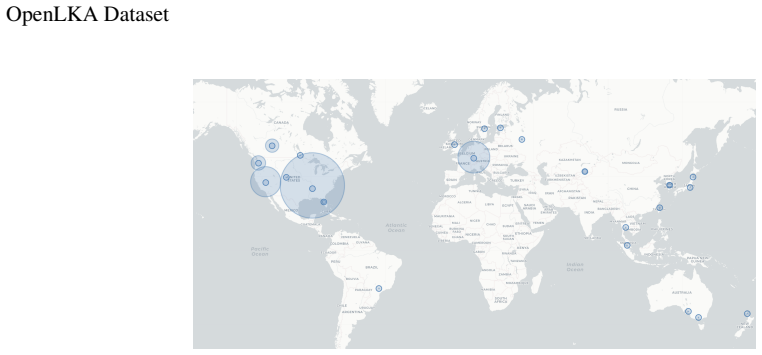
Figures from the paper (28 more)


Forward citations
Cited by 2 Pith papers
-
Bridging Human Oversight and Black-box Driver Assistance: Vision-Language Models for Predictive Alerting in Lane Keeping Assist Systems
LKAlert, a VLM fine-tuned with LoRA and lane-segmentation masks, classifies frames as pre-failure or normal, reporting 69.8% accuracy and 71.7 ROUGE-L explanations, but the test does not actually demonstrate temporal ...
-
AI-CDA4All: Democratizing Cooperative Autonomous Driving for All Drivers via Affordable Dash-cam Hardware and Open-source AI Software
An open-source cooperative driving platform costing under $1000 that pairs dash-cam vision with a Jetson edge computer, MQTT-based V2X messaging, and a local LLM controlled through a MetaAction API.
Reference graph
Works this paper leans on
-
[1]
Jaswanth Nidamanuri, Chinmayi Nibhanupudi, Rolf Assfalg, and Hrishikesh Venkataraman. A progressive re- view: Emerging technologies for adas driven solutions.IEEE Transactions on Intelligent Vehicles, 7(2):326–341, 2021
work page 2021
-
[2]
A survey of autonomous driving: Common practices and emerging technologies
Ekim Yurtsever, Jacob Lambert, Alexander Carballo, and Kazuya Takeda. A survey of autonomous driving: Common practices and emerging technologies. IEEE access, 8:58443–58469, 2020
2020
-
[3]
Mpc- based haptic shared steering system: A driver modeling approach for symbiotic driving
Andrea Michelle Rios Lazcano, Tenghao Niu, Xabier Carrera Akutain, David Cole, and Barys Shyrokau. Mpc- based haptic shared steering system: A driver modeling approach for symbiotic driving. IEEE/ASME Transac- tions on Mechatronics, 26(3):1201–1211, 2021
work page 2021
-
[4]
Speeding behavior while using adaptive cruise control and lane centering in free flow traffic
Samuel S Monfort, Ian J Reagan, Jessica B Cicchino, Wen Hu, Pnina Gershon, Bruce Mehler, and Bryan Reimer. Speeding behavior while using adaptive cruise control and lane centering in free flow traffic. Traffic injury prevention, 23(2):85–90, 2022
work page 2022
-
[5]
Estimating the real-world benefits of lane departure warning and lane keeping assist
Morgan E Dean and Luke E Riexinger. Estimating the real-world benefits of lane departure warning and lane keeping assist. Technical report, SAE Technical Paper, 2022
work page 2022
-
[6]
A comprehensive rule-based control strategy for automated lane centering system
Mayur Rajendra Waghchoure, Adhip Shukla, Sai Kamal Sree Veepuri, and Aniruddha Dorle. A comprehensive rule-based control strategy for automated lane centering system. SAE International Journal of Connected and Automated Vehicles, 6(12-06-01-0004):31–49, 2022
work page 2022
-
[7]
Driver mon- itoring based lane keeping aid for improved user acceptance
Daban Rizgary, Niklas Strand, Victor Brandt, Erik Larsson, Ebba Davidsson, and Fabian Burman. Driver mon- itoring based lane keeping aid for improved user acceptance. In THE 9TH INTERNATIONAL CONFERENCE ON DRIVER DISTRACTION AND INATTENTION, page 19, 2024
work page 2024
-
[8]
Impacts of automated vehicles on highway infrastructure
Deepak Gopalakrishna, Paul J Carlson, Peter Sweatman, Deepak Raghunathan, Les Brown, Nayel Urena Serulle, et al. Impacts of automated vehicles on highway infrastructure. 2021
work page 2021
Show all 51 references
-
[9]
The future of autonomous vehicles in the us urban landscape: a review: analyzing implications for traffic, urban planning, and the environment
Omamode Henry Orieno, Ndubuisi Leonard Ndubuisi, Valentine Ikenna Ilojianya, Preye Winston Biu, and Beryl Odonkor. The future of autonomous vehicles in the us urban landscape: a review: analyzing implications for traffic, urban planning, and the environment. Engineering Scienc...
2024
-
[10]
Assessing pavement markings for automated vehicle readiness
Adam Pike, Maryam Shirinzad, Abhishek Nayak, Sivakumar Rathinam, et al. Assessing pavement markings for automated vehicle readiness. Technical report, Minnesota. Department of Transportation. Office of Research & Innovation, 2024
2024
-
[11]
Safety of the intended functionality of lane-centering and lane-changing maneuvers of a generic level 3 highway chauffeur system
Christopher Becker, John C Brewer, Larry Yount, et al. Safety of the intended functionality of lane-centering and lane-changing maneuvers of a generic level 3 highway chauffeur system. Technical report, United States. National Highway Traffic Safety Administration. Electronic ...
2020
-
[12]
Automated lane change strategy using proximal policy optimization-based deep reinforcement learning
Fei Ye, Xuxin Cheng, Pin Wang, Ching-Yao Chan, and Jiucai Zhang. Automated lane change strategy using proximal policy optimization-based deep reinforcement learning. In 2020 IEEE Intelligent Vehicles Symposium (IV), pages 1746–1752. IEEE, 2020
2020
-
[13]
Hierarchical reinforcement learning for self-driving decision-making without reliance on labelled driving data
Jingliang Duan, Shengbo Eben Li, Yang Guan, Qi Sun, and Bo Cheng. Hierarchical reinforcement learning for self-driving decision-making without reliance on labelled driving data. IET Intelligent Transport Systems, 14(5): 297–305, 2020
2020
-
[14]
Michail Makridis, Konstantinos Mattas, Aikaterini Anesiadou, and Biagio Ciuffo. Openacc. an open database of car-following experiments to study the properties of commercial acc systems. Transportation research part C: emerging technologies, 125:103047, 2021
2021
-
[15]
Lane detection and tracking under rainy weather challenges
Samia Sultana and Boshir Ahmed. Lane detection and tracking under rainy weather challenges. In 2021 IEEE Region 10 Symposium (TENSYMP), pages 1–6. IEEE, 2021
2021
-
[16]
Testing and analysis of lane departure warning and lane keeping assist system response
Benjamin Nguyen, Nicholas Famiglietti, Omar Khan, Ryan Hoang, Omair Siddiqui, and Jon Landerville. Testing and analysis of lane departure warning and lane keeping assist system response. SAE International Journal of Advances and Current Practices in Mobility, 3(2021-01-0885):2...
2021
-
[17]
Evaluation of level 2 automated driving safety on curved sections
Iljoon Chang, Jaeduk Lee, and Seyoung Ahn. Evaluation of level 2 automated driving safety on curved sections. KSCE Journal of Civil Engineering, pages 1–9, 2024
2024
-
[18]
Habits, attitudes, and expectations of regular users of partial driving automation systems
Alexandra S Mueller, Jessica B Cicchino, and Joseph V Calvanelli Jr. Habits, attitudes, and expectations of regular users of partial driving automation systems. Journal of safety research, 88:125–134, 2024
2024
-
[19]
Testing the robustness of commercial lane departure warning systems
Fabrizio Re, Akos Kriston, Dalia Broggi, and Fabrizio Minarini. Testing the robustness of commercial lane departure warning systems. Transportation research record, 2675(12):385–400, 2021
2021
-
[20]
Identifying critical test scenarios for lane keeping assistance system using analytic hierarchy process and hierarchical clustering
Rui Song, Xuan Li, Xiangmo Zhao, Mingyang Liu, Jianhua Zhou, and Fei-Yue Wang. Identifying critical test scenarios for lane keeping assistance system using analytic hierarchy process and hierarchical clustering. IEEE Transactions on Intelligent Vehicles, 2023
2023
-
[21]
Comma three-x
comma.ai. Comma three-x. https://comma.ai/shop/products/comma-three, 2024. Accessed: 2024-08- 28
2024
-
[22]
Large language models for data annotation and synthesis: A survey
Zhen Tan, Dawei Li, Song Wang, Alimohammad Beigi, Bohan Jiang, Amrita Bhattacharjee, Mansooreh Karami, Jundong Li, Lu Cheng, and Huan Liu. Large language models for data annotation and synthesis: A survey. In Proceedings of the 2024 Conference on Empirical Methods in Natural L...
2024
-
[23]
Data- free multi-label image recognition via llm-powered prompt tuning
Shuo Yang, Zirui Shang, Yongqi Wang, Derong Deng, Hongwei Chen, Qiyuan Cheng, and Xinxiao Wu. Data- free multi-label image recognition via llm-powered prompt tuning. arXiv preprint arXiv:2403.01209, 2024
2024 arXiv
-
[24]
Incorporating driver relaxation into factory adaptive cruise control to reduce lane-change disruptions
Hao Zhou, Anye Zhou, Jorge Laval, Yongyang Liu, and Srinivas Peeta. Incorporating driver relaxation into factory adaptive cruise control to reduce lane-change disruptions. Transportation research record, 2676(9):13– 27, 2022
2022
-
[25]
Path-tracking and lateral stabilisation for au- tonomous vehicles by using the steering angle envelope
Qingjia Cui, Rongjun Ding, Chongfeng Wei, and Bing Zhou. Path-tracking and lateral stabilisation for au- tonomous vehicles by using the steering angle envelope. Vehicle System Dynamics, 59(11):1672–1696, 2021
2021
-
[26]
Gonultas, O
Pratik Mukherjee, Burak M. Gonultas, O. Goktug Poyrazoglu, and V olkan Isler. Neural l1 adaptive control of vehicle lateral dynamics. arXiv preprint arXiv:2405.16358, May 2024. URL https://arxiv.org/abs/2405. 16358
2024 arXiv
-
[27]
steer-by-angle
Timo Stubler, Matthias Niegl, Martin Förster, Peter E Pfeffer, and Ravi Abhishek. Development and model- based calibration of the lateral controllers “steer-by-angle” and “steer-by-torque” of a lane keeping assistance system. Proceedings of the Institution of Mechanical Engine...
2021
-
[28]
Toward trustworthy and comfortable lane keeping assis- tance system: an empirical study of the level of haptic authority
Kyudong Park, Sung H Han, and Jiyoung Kwahk. Toward trustworthy and comfortable lane keeping assis- tance system: an empirical study of the level of haptic authority. International Journal of Human–Computer Interaction, 37(14):1347–1363, 2021. 28 OpenLKA Dataset
2021
-
[29]
Matthias Becker, Manuel Höfer, and Peter E. Pfeffer. Steering feel of lane keeping assist systems. In Proceed- ings of the 11th International Munich Chassis Symposium 2020 , pages 353–366. Springer, 2021. doi: 10.1007/ 978-3-662-63193-5_25. URL https://link.springer.com/chapte...
2020 doi
-
[30]
A cooperative control strategy for yaw rate and sideslip angle control combining torque vectoring with rear wheel steering
M Vignati and E Sabbioni. A cooperative control strategy for yaw rate and sideslip angle control combining torque vectoring with rear wheel steering. Vehicle system dynamics, 60(5):1668–1701, 2022
2022
-
[31]
A real-time nmpc strategy for electric vehicle stabil- ity improvement combining torque vectoring with rear-wheel steering
Hanghang Liu, Lin Zhang, Ping Wang, and Hong Chen. A real-time nmpc strategy for electric vehicle stabil- ity improvement combining torque vectoring with rear-wheel steering. IEEE Transactions on Transportation Electrification, 8(3):3825–3835, 2022
2022
-
[32]
Han, Hojin Lee, and Jiyoung Kwahk
Kyudong Park, Sung H. Han, Hojin Lee, and Jiyoung Kwahk. Shared steering control: How strong and how prompt should the intervention be for a better driving experience? International Journal of Industrial Ergonomics, 86:103213, 2021. ISSN 0169-8141. doi: https://doi.org/10.1016...
2021
-
[33]
Torque control of electric power steering systems based on improved active disturbance rejection control
Shaodan Na, Zhipeng Li, Feng Qiu, and Chao Zhang. Torque control of electric power steering systems based on improved active disturbance rejection control. Mathematical Problems in Engineering, 2020(1):6509607, 2020
2020
-
[34]
Vehicle ride comfort and stability performance evaluation
Shawky Hegazy and Corina Sandu. Vehicle ride comfort and stability performance evaluation. Technical report, SAE Technical Paper, 2009
2009
-
[35]
Vehicle speed preview control with road curvature information for safety and comfort promotion
Hongliang Zhou, Jinwu Gao, and Haifeng Liu. Vehicle speed preview control with road curvature information for safety and comfort promotion. Proceedings of the Institution of Mechanical Engineers, Part D: Journal of Automobile Engineering, 235(6):1527–1538, 2021
2021
-
[36]
Rolling horizon control framework for driver assistance systems
Meng Wang, Winnie Daamen, Serge P Hoogendoorn, and Bart van Arem. Rolling horizon control framework for driver assistance systems. part i: Mathematical formulation and non-cooperative systems. Transportation research part C: emerging technologies, 40:271–289, 2014
2014
-
[37]
A research on autonomous vehicle control in track beyond its limits of handling
Jaeyong Park, Youngil Koh, and Eunhyek Joa. A research on autonomous vehicle control in track beyond its limits of handling. Technical report, SAE Technical Paper, 2021
2021
-
[38]
Exploring driver responses to authoritative control interventions in highly automated driving
Liza Dixon, Norbert Schneider, Marcel Usai, Nicolas Daniel Herzberger, Frank O Flemisch, and Martin Bau- mann. Exploring driver responses to authoritative control interventions in highly automated driving. InProceed- ings of the 15th International Conference on Automotive User...
2023
-
[39]
Volkswagen Driver Assistance Systems , 2024
V olkswagen AG. Volkswagen Driver Assistance Systems , 2024. URL https://www.vwannarbor.com/ driver-assistance-features.html . Technical Documentation
2024
-
[40]
Self-driving cars: A survey
Claudine Badue, Rânik Guidolini, Raphael Vivacqua Carneiro, Pedro Azevedo, Vinicius B Cardoso, Avelino Forechi, Luan Jesus, Rodrigo Berriel, Thiago M Paixao, Filipe Mutz, et al. Self-driving cars: A survey. Expert systems with applications, 165:113816, 2021
2021
-
[41]
Extracting topographic data from online sources to generate a digital elevation model for highway preliminary geometric design
Sikai Chen, Zongxin Tang, Hao Zhou, and Jianchuan Cheng. Extracting topographic data from online sources to generate a digital elevation model for highway preliminary geometric design. Journal of Transportation Engineering, Part A: Systems, 145(4):04019003, 2019
2019
-
[42]
The more (sharp) curves, the lower the risk
Rune Elvik. The more (sharp) curves, the lower the risk. Accident Analysis & Prevention, 133:105322, 2019
2019
-
[43]
The enhancement of handling stability for driver- combined-vehicle systems through adaptive steering controller
Jing-Hong Li, Qiang Wang, Gao-Hong Yu, and Chuan-Yu Wu. The enhancement of handling stability for driver- combined-vehicle systems through adaptive steering controller. International Journal of Control, Automation and Systems, 19:459–470, 2021
2021
-
[44]
Vehicle lateral control using machine learning for automated vehicle guidance
Akash Fogla, Kanish Kumar, Sunnay Saurav, et al. Vehicle lateral control using machine learning for automated vehicle guidance. arXiv preprint arXiv:2303.08187, 2023
2023 arXiv
-
[45]
Neural network based robust lateral control for an autonomous vehicle
Subrat Kumar Swain, Jagat J Rath, and Kalyana C Veluvolu. Neural network based robust lateral control for an autonomous vehicle. Electronics, 10(4):510, 2021
2021
-
[46]
Cooperative perception for estimating and predicting microscopic traffic states to manage connected and automated traffic
Tao Li, Xu Han, and Jiaqi Ma. Cooperative perception for estimating and predicting microscopic traffic states to manage connected and automated traffic. IEEE Transactions on Intelligent Transportation Systems , 23(8): 13694–13707, 2021
2021
-
[47]
Evalu- ating roadside perception for autonomous vehicles: Insights from field testing.arXiv preprint arXiv:2401.12392, 2024
Rusheng Zhang, Depu Meng, Shengyin Shen, Tinghan Wang, Tai Karir, Michael Maile, and Henry X Liu. Evalu- ating roadside perception for autonomous vehicles: Insights from field testing.arXiv preprint arXiv:2401.12392, 2024. 29 OpenLKA Dataset
2024 arXiv
-
[48]
Fedrsu: Federated learning for scene flow estimation on roadside units.arXiv preprint arXiv:2401.12862, 2024
Shaoheng Fang, Rui Ye, Wenhao Wang, Zuhong Liu, Yuxiao Wang, Yafei Wang, Siheng Chen, and Yanfeng Wang. Fedrsu: Federated learning for scene flow estimation on roadside units.arXiv preprint arXiv:2401.12862, 2024
2024 arXiv
-
[49]
Optimized deployment strategy for roadside units based on accident risk assessment and simulation validation.IEEE Access, 12:83330– 83339, 2024
Sinan Zhang, Shaohua Wang, Shan Huang, Xiaofeng Liu, Xulong Wang, and Ning Chen. Optimized deployment strategy for roadside units based on accident risk assessment and simulation validation.IEEE Access, 12:83330– 83339, 2024
2024
-
[50]
Bi-directional safety protection for vulnerable road users: A roadside unit-based cooperative perception network
Guangzong Si and Qing Ding. Bi-directional safety protection for vulnerable road users: A roadside unit-based cooperative perception network. In 2024 27th International Conference on Computer Supported Cooperative Work in Design (CSCWD), pages 630–636. IEEE, 2024
2024
-
[51]
Unified multi-modal multi-agent cooperative perception framework for intelligent transportation systems
Zonglin Meng, Xin Xia, Zhaoliang Zheng, Letian Gao, Wei Liu, Jiaqi Zhu, and Jiaqi Ma. Unified multi-modal multi-agent cooperative perception framework for intelligent transportation systems. Technical report, SAE Technical Paper, 2024. 30
2024
Reviewed August 10, 2026 · model on record in the stance chip above.
Discussion (0). Continue with ORCID to comment.