REVIEW 3 major objections 5 minor 3 cited by
The properties of GSN 069 accretion disk from a joint X-ray and UV spectral analysis: stress-testing quasi-periodic eruption models
T0 review · 3 major / 5 minor · reviewed 2026-08-10 · deepseek-v4-flash
Pith's one-line read Joint X-ray and ultraviolet spectra show that GSN 069 hosts a compact accretion disk that cooled and expanded between 2014 and 2018, evidence for a tidal disruption origin that challenges current quasi-periodic eruption models.
desk verdict Solid multi-wavelength analysis with a genuine soft spot in the claimed disk expansion—worth a serious referee, but the expansion claim needs a direct demonstration. read the letter →
The pith
A machine-rendered reading of the paper's core claim, the machinery that carries it, and where it could break.
The reading
What carries the argument
The central object is the finite-disk spectral model \texttt{diskSED} and its relativistic extension \texttt{kerrSED}: a standard thin-disk spectrum in which the outer radius $R_{\rm out}$ is a free parameter alongside the peak temperature $T_p$, inner radius, spin, and inclination. \texttt{kerrSED} adds numerical ray tracing through Kerr spacetime, which breaks the degeneracy between inclination and spin present in the Newtonian limit and lets the paper convert the fitted $R_{\rm out}/R_{\rm in}$ into $R_{\rm out}$ in units of gravitational radii. The UV spectrum carries the argument: the observed $\nu L_\nu \propto \nu^{4/3}$ mid-frequency disk shape means the data sit near the outer cutoff, so comparing the two epochs tracks how the disk cooled and expanded.
What would settle it
A measurement of the 2018 outer disk radius that does not rely on the relativistic model—for example, UV/optical photometry that brackets the predicted spectral break, or a time-dependent disk fit—would settle whether $R_{\rm out}^{2018}$ is truly about 15 percent larger than $R_{\rm out}^{2014}$ or is instead a lower limit. If the 2018 radius is only a lower limit, the expansion claim weakens to a cooling-driven shift in the SED break.
Extended reading notes
Core claim
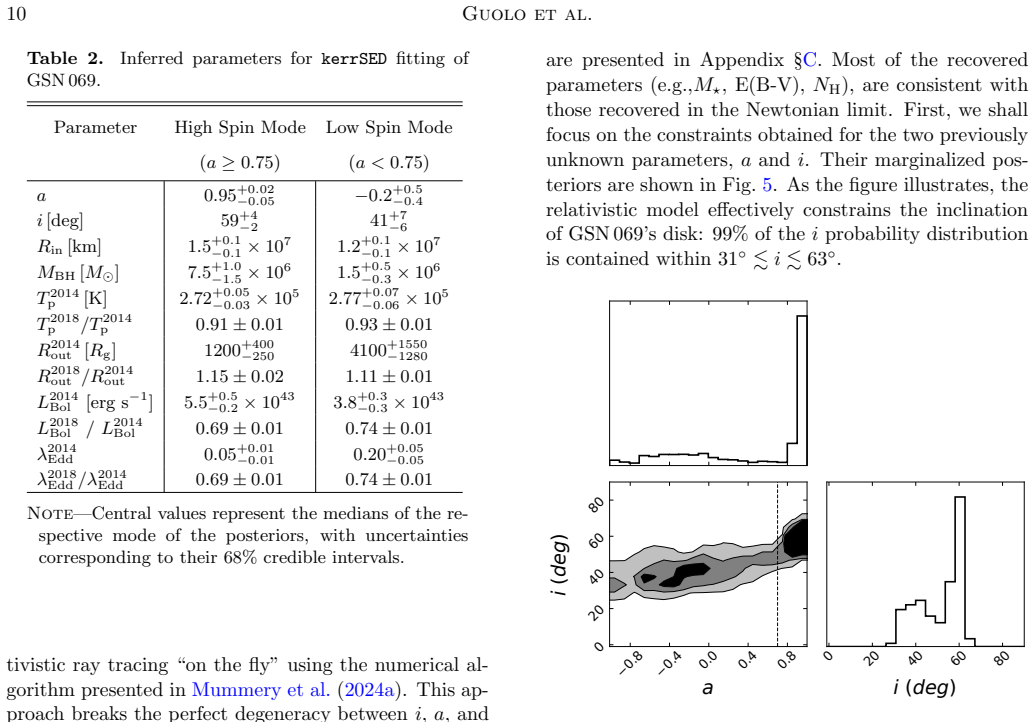
On the paper's own terms, the discovery is that the broad-band 2014 and 2018 spectra of GSN 069 are jointly described by a color-corrected thin accretion disk with a finite outer radius: $R_{\rm out}^{2014} = 1208^{+424}_{-250}\,R_g$ (high-spin mode) and $R_{\rm out}^{2014} = 4096^{+1548}_{-1280}\,R_g$ (low-spin mode), with $R_{\rm out}^{2018}/R_{\rm out}^{2014} = 1.15 \pm 0.02$ and $P(R_{\rm out}^{2018} > R_{\rm out}^{2014}\,|\,{\rm data}) = 1.0$. The peak disk temperature drops by about 10 percent over the same interval, with $P(T_p^{2014} > T_p^{2018}\,|\,{\rm data}) = 1.0$. This simultaneous cooling and expansion is the signature of a viscously spreading, non-steady accretion flow fed close to the black hole, which the paper reads as strong evidence that the disk formed in a tidal disruption event. The same fits place the disk inclination between about $31^\circ$ and $63^\circ$, leave spin bimodal, and give black hole masses of roughly $7.5\times10^6\,M_\odot$ or $1.5\times10^6\,M_\odot$ depending on the spin mode.
Load-bearing premise
The load-bearing premise is that the observed ultraviolet bands actually constrain the outer disk radius in both epochs, so the 2018 disk is measured to be larger rather than merely being unconstrained above a lower limit.
Editorial extensions
If this is right
- The ultraviolet point source in GSN 069 is dominated by the accretion disk, with the host stellar population contributing at most 5 percent of the inner FUV flux.
- An outer radius of order $10^3\,R_g$ is far smaller than a long-lived AGN disk and is consistent with a tidal disruption disk observed years after formation.
- The inferred cooling and expansion are the signature of a non-steady disk whose mass is decreasing with time, supporting the TDE interpretation.
- No published disk-instability model for QPEs can satisfy both a stable disk in 2014 and an unstable disk in 2018 with the observed eruption recurrence.
- Orbiter/disk collision models can accommodate the 2018 eruptions only if the disk surface density evolved so that collisions became photon-starved by 2018, a fine-tuning the paper does not rule out but cannot confirm.
Reading between the lines
- Inference: If the 2018 $R_{\rm out}$ is only a lower limit, the expansion ratio $1.15 \pm 0.02$ may be an artifact of the cooling spectrum pushing the SED break out of the observed band; later ultraviolet-to-optical coverage bracketing the break would directly test this.
- Inference: The photon-starvation rescue for orbiter models predicts that 2014 collisions would emit in the extreme ultraviolet near 10 eV; archival EUV or soft-X-ray limits could falsify or support that fine-tuning.
- Inference: Applying the same joint X-ray/UV fitting to other QPE sources with multi-epoch data would show whether a stable-then-unstable disk pattern is common to the class.
- Inference: A fully time-dependent disk model fit to the whole GSN 069 light curve, not just two epochs, could break the spin-inclination bimodality and independently measure the viscous timescale that sets the expansion rate.
Editorial analysis
A structured set of objections, weighed in public.
Referee Report
Summary. The paper analyzes archival HST UV/optical imaging and STIS UV spectra of GSN 069 together with two epochs of XMM-Newton X-ray spectra, and fits the broad-band data with thin-disk models that include a finite outer radius. The authors decompose the nuclear emission into a dominant point source and a minor stellar component, measure a ~10% FUV flux decline between 2014 and 2018, and show that the X-ray and UV spectra can be described self-consistently by a compact disk with outer radius of order 10^3 Rg. They further argue that the disk cooled and expanded between the two epochs and use the inferred parameters to test quasi-periodic eruption (QPE) models, concluding that published disk-instability models cannot explain the absence of QPEs in 2014 and their presence in 2018, and that orbiter/disk interaction models face a similar timing problem.
Significance. If the central claims hold, this is a valuable and unusually complete multi-wavelength study of a QPE host: it ties the UV excess to the accretion disk, independently recovers host extinction consistent with the Balmer decrement, and turns two epochs of X-ray and UV data into sharp constraints on QPE model parameters. The analysis is carefully executed in its imaging decomposition, extinction treatment, and simultaneous X-ray/UV fitting, and the use of public data with reproducible Bayesian tools is a clear strength. The cooling of the disk is robust and consistent with earlier X-ray-only work, and the comparison of the two epochs against instability and orbiter models is a useful stress test. However, the expansion claim, which is central to the TDE interpretation and to the QPE-model discussion, rests on a 2018 outer-radius constraint that the Newtonian fit itself shows to be only a lower limit; the relativistic fit does not yet demonstrate that it restores a two-sided constraint. The significance of the paper is therefore high if that gap is closed, but the expansion result is currently not fully supported.
major comments (3)
- [§3.1 and §3.2] The paper does not establish that the kerrSED model recovers a two-sided constraint on the 2018 outer radius, which is required for the expansion claim. Section 3.1 states that in the diskSED fit the 2018 Rout/Rin posterior is 'essentially flat for Rout/Rin ≳ 330', so only a lower limit is obtained. Section 3.2 then reports in Table 2 a tight ratio R2018out/R2014out = 1.15 ± 0.02 and P(R2018out > R2014out | data) = 1.0, but no posterior for Rout/Rin from the kerrSED fit is shown, and no argument is given for how relativistic ray tracing breaks the physical degeneracy when the spectral break has moved below the observed UV band. I ask the authors to present the 2018 Rout/Rin posterior for kerrSED explicitly and to demonstrate, analytically or numerically, that the UV data constrain both sides of the posterior. Without this, the apparent 1.15 ratio may simply reflect that the 2018 posterior is a lower limit, making the inequality P(R2018out > R2014out) = 1.0 trivially satisfied.
- [§3.2, Fig. 6, Table 2] The claimed probability P(R2018out > R2014out | data) = 1.0 is quoted as 'overwhelming evidence' for expansion, but this probability is computed from posteriors in which the 2018 parameter may be unconstrained from above. If the 2018 Rout is only a lower limit, the posterior comparison reports a prior-dependent and essentially uninformative probability; the same caveat applies to the ratio R2018out/R2014out in Table 2. The authors should either demonstrate that the full 2018 posterior is proper and two-sided, or soften the expansion conclusion and rephrase the evidence as a one-sided constraint consistent with, but not requiring, expansion.
- [§4.2.1] The conclusion that no disk-instability model can explain stability in 2014 and instability in 2018 depends directly on the 2018 outer-radius and Eddington-ratio values, and through Equation (7) on the assumed p0 scaling. The argument is internally consistent for the quoted parameters, but because the 2018 Rout lower-limit issue feeds into the same parameter set, the strongest version of this conclusion should be presented conditionally on the kerrSED Rout constraint being two-sided. The instability analysis itself is a useful stress test, but its headline claim inherits the uncertainty from the expansion evidence.
minor comments (5)
- [§1] The phrase 'The reader is refereed to' should read 'The reader is referred to'.
- [§2.1] In the caption of Figure 1, 'F6060W' should be 'F606W'.
- [§2.2] The footnote markers and text around 'calSTIS3' and 'HST Geo-Coronal Airglow4' appear as raw footnote placeholders; these should be formatted as proper footnotes.
- [§3.2] The sentence 'This bimodal posterior can be improve' should read 'can be improved'.
- [§5] In the conclusions bullet, 'though not value of the parameter space can be excluded' appears to be a typo for 'though no value of the parameter space can be excluded'.
Circularity Check
No significant circularity: the disk parameters and their evolution are data-driven inferences with external anchors.
full rationale
The paper's central claims are inferences from a joint fit of two epochs of X-ray and UV spectra, not derivations that reduce to model inputs. The diskSED and kerrSED models, although introduced in the authors' prior work (Guolo & Mummery 2024), are physical thin-disk models with stated assumptions (null-stress inner boundary, color correction, Kerr ray tracing); applying them to new XMM-Newton and HST data makes the posterior distributions functions of the observed fluxes. The 'cooling' and 'expansion' statements are comparisons of independently fitted per-epoch parameters (Tp, Rout) with flat priors, so P=1.0 is a property of the data/model combination, not an identity. The 2018 Rout lower-limit degeneracy noted in Sec. 3.1 is a data-constraint limitation, not a circular construction; the paper's external anchors (Balmer-decrement E(B-V), MBH-sigma* relations, STIS calibration, independent literature spectra) provide checks outside the fitted model. Self-citations are present but not load-bearing in a circular sense.
Assumptions & free parameters
free parameters (9)
- Tp (peak disk temperature) =
2014: 2.72e5 K, 2018: 2.47e5 K (varies by mode)
- Rin (disk inner radius) =
1.5e7 km (high spin), 1.2e7 km (low spin)
- Rout/Rin (dimensionless disk size) =
2014: ~280 in diskSED; ~1200 Rg in kerrSED high-spin mode; ~4100 Rg low-spin mode
- a (black hole spin) =
0.95 (high-spin mode) or -0.2 (low-spin mode)
- i (disk inclination) =
59 deg (high-spin mode) or 41 deg (low-spin mode)
- E(B-V) intrinsic host extinction =
0.11 +/- 0.01
- NH (intrinsic neutral hydrogen column) =
about 20.8 in log NH (cm^-2)
- M_star,100, M_star,200, M_star,300 (stellar population masses) =
Total log(M_star) ~ 7.4 +/- 0.1 Msun
- p0 (magnetic pressure scaling in Kaur et al. model) =
Derived from Eq. 7 using TQPE=9 hr
assumptions (6)
- domain assumption Standard Shakura-Sunyaev thin disk with zero-stress boundary condition at the inner edge.
- domain assumption The X-ray and UV emission originate from the same thin accretion disk.
- domain assumption The disk inner edge is at the ISCO, which allows conversion of Rin to MBH via Eq. 4.
- domain assumption The Calzetti dust attenuation law with E(B-V) from Balmer decrement applies to the nuclear region.
- domain assumption The color correction factor fc from electron scattering and metal opacity is applicable to the TDE disk.
- domain assumption The stellar population in the inner 0.5 arcsec region can be modeled with a superposition of 100, 200, and 300 Myr Maraston (2005) SSPs.
Cite this review
Pith. "Pith review of The properties of GSN 069 accretion disk from a joint X-ray and UV spectral analysis: stress-testing quasi-periodic eruption models." pith.science (2026). https://pith.science/paper/DI2CPIY7
@misc{pith2026250103333,
  author       = {Pith},
  title        = {Pith review of: The properties of GSN 069 accretion disk from a joint X-ray and UV spectral analysis: stress-testing quasi-periodic eruption models},
  year         = {2026},
  howpublished = {\url{https://pith.science/paper/DI2CPIY7}},
  note         = {Machine review of arXiv:2501.03333}
}
abstract
We present an analysis of Hubble Space Telescope (HST) and XMM-Newton data of the tidal disruption event (TDE) candidate and quasi-periodic eruption (QPE) source GSN 069. Using ultraviolet (UV) and optical images at HST resolution, we show that GSN 069's emission consists of a point source superimposed on a diffuse stellar component. The latter accounts for $\leq 5\%$ of the UV emission in the inner 0.5"$\times$0.5" region, while the luminosity of the former cannot be attributed to stars. Analyzing the 2014/2018 \hst UV spectra, we show that to leading order the intrinsic spectral shape is $\nu\,L_{\nu}\propto\nu^{4/3}$, with $\sim10\%$ far UV flux variability between epochs. The contemporaneous X-ray and UV spectra can be modeled self-consistently in a thin disk framework. At observed epochs, the disk had an outer radius ($R_{\rm out}$) of $\mathcal{O}(10^3R_{\rm g})$, showing both cooling and expansion over four years. Incorporating relativistic effects via numerical ray tracing, we constrain the disk inclination angle ($i$) to be $30^\circ\,\lesssim\,i\,\lesssim\,65^\circ$ and identify a narrow region of spin-inclination parameter space that describes the observations. These findings confirm that GSN 069 hosts a compact, viscously expanding accretion disk likely formed after a TDE. Implications for QPE models are: (i) No published disk instability model can explain the disk's stability in 2014 (no QPEs) and its instability in 2018 (QPEs present); (ii) While the disk size in 2018 allows for orbiter/disk interactions to produce QPEs, in 2014 the disk was already sufficiently extended, yet no QPEs were present. These findings pose challenges to existing QPE models.
Figures


Figures from the paper (11 more)





Forward citations
Cited by 3 Pith papers
-
Time-resolved Hubble Space Telescope UV observations of an X-ray quasi-periodic eruption source
Time-resolved HST far-UV observations of the QPE source eRO-QPE2 reveal a steady bright FUV point source consistent with a compact TDE-like accretion disk, ruling out classic AGN-disk and no-disk interpretations.
-
Prospects for EMRI/MBH parameter estimation using Quasi-Periodic Eruption timings: short-timescale analysis
QPE arrival times from an EMRI-disk collision model can recover black hole mass and orbital size/eccentricity to about 10% over tens of orbits, while spin and disk precession properties are much harder to constrain.
-
Multimessenger prospects of quasi-periodic eruptions
Known quasi-periodic eruptions are unlikely to have LISA-detectable gravitational-wave counterparts, so future searches should focus on rare short-period “golden” QPEs.
Reference graph
Works this paper leans on
-
[1]
, " * write output.state after.block = add.period write newline
ENTRY address archivePrefix author booktitle chapter doi edition editor eprint howpublished institution journal key month number organization pages publisher school series title misctitle type volume year version url label extra.label sort.label short.list INTEGERS output.state before.all mid.sentence after.sentence after.block FUNCTION init.state.consts ...
-
[2]
write newline
" write newline "" before.all 'output.state := FUNCTION format.url url empty "" new.block "" url * "" * if FUNCTION format.eprint eprint empty "" archivePrefix empty "" archivePrefix "arXiv" = new.block " " eprint * " " * new.block " " eprint * " " * if if if FUNCTION format.doi doi empty "" " " doi * " " * if FUNCTION format.pid doi empty eprint empty ur...
-
[3]
_H,|w g] />b.f+.߾ R|YK>G3EP㿿|o
thebibliography [1] 20pt to REFERENCES 6pt =0pt -12pt 10pt plus 3pt =0pt =0pt =1pt plus 1pt =0pt =0pt -12pt =13pt plus 1pt =20pt =13pt plus 1pt \@M =10000 =-1.0em =0pt =0pt 0pt =0pt =1.0em @enumiv\@empty 10000 10000 `\.\@m \@noitemerr \@latex@warning Empty `thebibliography' environment \@ifnextchar \@reference \@latexerr Missing key on reference command E...
arXiv 2021
-
[4]
Agol , E., & Krolik , J. H. 2000, , 528, 161, 10.1086/308177
doi:10.1086/308177 2000
-
[5]
2010, arXiv e-prints, arXiv:1012.3754, 10.48550/arXiv.1012.3754
Andrae , R., Schulze-Hartung , T., & Melchior , P. 2010, arXiv e-prints, arXiv:1012.3754, 10.48550/arXiv.1012.3754
-
[6]
Angles-Alcazar , D., Quataert , E., Hopkins , P. F., et al. 2021, , 917, 53, 10.3847/1538-4357/ac09e8
-
[7]
1993, , 31, 473, 10.1146/annurev.aa.31.090193.002353
Antonucci , R. 1993, , 31, 473, 10.1146/annurev.aa.31.090193.002353
arXiv 1993
-
[8]
2012, Astronomical and Astrophysical Transactions, 27, 557, 10.48550/arXiv.1210.2716
---. 2012, Astronomical and Astrophysical Transactions, 27, 557, 10.48550/arXiv.1210.2716
Show all 104 references
-
[9]
2021, , 592, 704, 10.1038/s41586-021-03394-6
Arcodia , R., Merloni , A., Nandra , K., et al. 2021, , 592, 704, 10.1038/s41586-021-03394-6
2021 doi
-
[10]
2022, , 662, A49, 10.1051/0004-6361/202243259
Arcodia , R., Miniutti , G., Ponti , G., et al. 2022, , 662, A49, 10.1051/0004-6361/202243259
2022 doi
-
[11]
2024, , 684, A64, 10.1051/0004-6361/202348881
Arcodia , R., Liu , Z., Merloni , A., et al. 2024, , 684, A64, 10.1051/0004-6361/202348881
2024 doi
-
[12]
Arnaud , K. A. 1996, in Astronomical Society of the Pacific Conference Series, Vol. 101, Astronomical Data Analysis Software and Systems V, ed. G. H. Jacoby & J. Barnes , 17
1996
-
[13]
2014, , 568, A14, 10.1051/0004-6361/201323324
Arribas , S., Colina , L., Bellocchi , E., Maiolino , R., & Villar-Mart \' n , M. 2014, , 568, A14, 10.1051/0004-6361/201323324
2014 doi
-
[14]
M., Press , W
Bardeen , J. M., Press , W. H., & Teukolsky , S. A. 1972, , 178, 347, 10.1086/151796
1972 doi
-
[15]
K., Heckman , T., S \'a nchez , S
Barrera-Ballesteros , J. K., Heckman , T., S \'a nchez , S. F., et al. 2021, , 909, 131, 10.3847/1538-4357/abd855
2021 doi
-
[16]
2019, , 488, L1, 10.1093/mnrasl/slz080
Bianchi , S., Antonucci , R., Capetti , A., et al. 2019, , 488, L1, 10.1093/mnrasl/slz080
2019 doi
-
[17]
C., Deustua , S
Bohlin , R. C., Deustua , S. E., & de Rosa , G. 2019, , 158, 211, 10.3847/1538-3881/ab480c
2019 doi
-
[18]
2019, , 131, 108005, 10.1088/1538-3873/aae7fc
Buchner , J. 2019, , 131, 108005, 10.1088/1538-3873/aae7fc
2019 doi
- [19]
-
[20]
2014, , 564, A125, 10.1051/0004-6361/201322971
Buchner , J., Georgakakis , A., Nandra , K., et al. 2014, , 564, A125, 10.1051/0004-6361/201322971
2014 doi
-
[21]
M., Bentz , M
Cackett , E. M., Bentz , M. C., & Kara , E. 2021, iScience, 24, 102557, 10.1016/j.isci.2021.102557
2021
-
[22]
C., et al
Calzetti , D., Armus , L., Bohlin , R. C., et al. 2000, , 533, 682, 10.1086/308692
2000 doi
- [23]
-
[24]
A., Clayton , G
Cardelli , J. A., Clayton , G. C., & Mathis , J. S. 1989, , 345, 245, 10.1086/167900
1989 doi
-
[25]
2021, , 921, L40, 10.3847/2041-8213/ac313b
Chakraborty , J., Kara , E., Masterson , M., et al. 2021, , 921, L40, 10.3847/2041-8213/ac313b
2021 doi
-
[26]
2024, , 965, 12, 10.3847/1538-4357/ad2941
Chakraborty , J., Arcodia , R., Kara , E., et al. 2024, , 965, 12, 10.3847/1538-4357/ad2941
2024 doi
-
[27]
B., et al
Charalampopoulos , P., Leloudas , G., Malesani , D. B., et al. 2022, , 659, A34, 10.1051/0004-6361/202142122
2022 doi
- [28]
-
[29]
2024, The Hubble Advanced Spectral Product (HASP) Program , Instrument Science Report COS 2024-01, 31 pages
Debes , J., Sankrit , R., Fischer , T., et al. 2024, The Hubble Advanced Spectral Product (HASP) Program , Instrument Science Report COS 2024-01, 31 pages
2024
-
[30]
A., Nixon , C
Evans , P. A., Nixon , C. J., Campana , S., et al. 2023, Nature Astronomy, 7, 1368, 10.1038/s41550-023-02073-y
2023 doi
-
[31]
2023, , 675, A100, 10.1051/0004-6361/202346565
Franchini , A., Bonetti , M., Lupi , A., et al. 2023, , 675, A100, 10.1051/0004-6361/202346565
2023 doi
-
[32]
D., Wevers , T., Law-Smith , J., Graur , O., & Zabludoff , A
French , K. D., Wevers , T., Law-Smith , J., Graur , O., & Zabludoff , A. I. 2020, , 216, 32, 10.1007/s11214-020-00657-y
2020 doi
-
[33]
J., et al
Gabriel , C., Denby , M., Fyfe , D. J., et al. 2004, in Astronomical Society of the Pacific Conference Series, Vol. 314, Astronomical Data Analysis Software and Systems (ADASS) XIII, ed. F. Ochsenbein , M. G. Allen , & D. Egret , 759
2004
-
[34]
2021, , 59, 21, 10.1146/annurev-astro-111720-030029
Gezari , S. 2021, , 59, 21, 10.1146/annurev-astro-111720-030029
2021 doi
-
[35]
Giustini , M., Miniutti , G., & Saxton , R. D. 2020, , 636, L2, 10.1051/0004-6361/202037610
2020 doi
- [36]
-
[37]
2017, , 603, A110, 10.1051/0004-6361/201629672
Grzedzielski , M., Janiuk , A., Czerny , B., & Wu , Q. 2017, , 603, A110, 10.1051/0004-6361/201629672
2017 doi
-
[39]
2024 b , , 966, 160, 10.3847/1538-4357/ad2f9f
---. 2024 b , , 966, 160, 10.3847/1538-4357/ad2f9f
2024 doi
- [40]
-
[41]
2014, HEAsoft: Unified Release of FTOOLS and XANADU
Heasarc . 2014, HEAsoft: Unified Release of FTOOLS and XANADU . 1408.004
2014
-
[42]
2016, , 594, A116, 10.1051/0004-6361/201629178
HI4PI Collaboration , Ben Bekhti , N., Fl \"o er , L., et al. 2016, , 594, A116, 10.1051/0004-6361/201629178
2016 doi
-
[43]
Hopkins , P. F. 2024, arXiv e-prints, arXiv:2407.00160, 10.48550/arXiv.2407.00160
2024 doi
-
[44]
F., Grudic , M
Hopkins , P. F., Grudic , M. Y., Su , K.-Y., et al. 2024 a , The Open Journal of Astrophysics, 7, 18, 10.21105/astro.2309.13115
2024
-
[45]
F., Squire , J., Su , K.-Y., et al
Hopkins , P. F., Squire , J., Su , K.-Y., et al. 2024 b , The Open Journal of Astrophysics, 7, 19, 10.21105/astro.2310.04506
2024
-
[46]
H., & Agol , E
Hubeny , I., Blaes , O., Krolik , J. H., & Agol , E. 2001, , 559, 680, 10.1086/322344
2001 doi
-
[47]
S., & Bleeker , J
Kaastra , J. S., & Bleeker , J. A. M. 2016, , 587, A151, 10.1051/0004-6361/201527395
2016 doi
-
[48]
C., & Gilbaum , S
Kaur , K., Stone , N. C., & Gilbaum , S. 2023, , 524, 1269, 10.1093/mnras/stad1894
2023 doi
-
[49]
Kennicutt , Jr., R. C. 1998, , 498, 541, 10.1086/305588
1998 doi
-
[50]
J., Dopita , M
Kewley , L. J., Dopita , M. A., Sutherland , R. S., Heisler , C. A., & Trevena , J. 2001, , 556, 121, 10.1086/321545
2001 doi
-
[51]
2022, , 515, 4344, 10.1093/mnras/stac1641
King , A. 2022, , 515, 4344, 10.1093/mnras/stac1641
2022 doi
-
[52]
R., Belfiore , F., Bershady , M
Law , D. R., Belfiore , F., Bershady , M. A., et al. 2022, , 928, 58, 10.3847/1538-4357/ac5620
2022 doi
-
[53]
Linial , I., & Metzger , B. D. 2023, , 957, 34, 10.3847/1538-4357/acf65b
2023 doi
-
[54]
2023, , 945, 86, 10.3847/1538-4357/acbd3d
Linial , I., & Sari , R. 2023, , 945, 86, 10.3847/1538-4357/acbd3d
2023 doi
-
[55]
2023, , 524, 6247, 10.1093/mnras/stad2203
Lu , W., & Quataert , E. 2023, , 524, 6247, 10.1093/mnras/stad2203
2023 doi
-
[56]
2005, , 362, 799, 10.1111/j.1365-2966.2005.09270.x
Maraston , C. 2005, , 362, 799, 10.1111/j.1365-2966.2005.09270.x
2005
-
[57]
2023 a , , 674, L1, 10.1051/0004-6361/202346653
Miniutti , G., Giustini , M., Arcodia , R., et al. 2023 a , , 674, L1, 10.1051/0004-6361/202346653
2023 doi
-
[58]
2023 b , , 670, A93, 10.1051/0004-6361/202244512
---. 2023 b , , 670, A93, 10.1051/0004-6361/202244512
2023 doi
-
[59]
D., Rodr \' guez-Pascual , P
Miniutti , G., Saxton , R. D., Rodr \' guez-Pascual , P. M., et al. 2013, , 433, 1764, 10.1093/mnras/stt850
2013 doi
-
[60]
D., Giustini , M., et al
Miniutti , G., Saxton , R. D., Giustini , M., et al. 2019, , 573, 381, 10.1038/s41586-019-1556-x
2019 doi
- [61]
-
[62]
Mummery , A., & Balbus , S. A. 2020, , 492, 5655, 10.1093/mnras/staa192
2020 doi
- [63]
- [64]
-
[65]
2024, Monthly Notices of the Royal Astronomical Society, 531, 366, 10.1093/mnras/stae1160
Mummery, A., Ingram, A., Davis, S., & Fabian, A. 2024, Monthly Notices of the Royal Astronomical Society, 531, 366, 10.1093/mnras/stae1160
2024 doi
- [66]
-
[67]
2024 b , , 527, 2452, 10.1093/mnras/stad3001
Mummery , A., van Velzen , S., Nathan , E., et al. 2024 b , , 527, 2452, 10.1093/mnras/stad3001
2024 doi
-
[68]
2023, , 519, 5828, 10.1093/mnras/stac3798
Mummery , A., Wevers , T., Saxton , R., & Pasham , D. 2023, , 519, 5828, 10.1093/mnras/stac3798
2023 doi
-
[69]
2010, , 725, 904, 10.1088/0004-637X/725/1/904
Nakar , E., & Sari , R. 2010, , 725, 904, 10.1088/0004-637X/725/1/904
2010 doi
-
[70]
J., van Duinen , R., et al
Neugebauer , G., Habing , H. J., van Duinen , R., et al. 1984, , 278, L1, 10.1086/184209
1984 doi
-
[71]
2020, , 28, 4, 10.1007/s00159-020-00125-0
Neumayer , N., Seth , A., & B \"o ker , T. 2020, , 28, 4, 10.1007/s00159-020-00125-0
2020 doi
- [72]
-
[73]
2023, , 952, 32, 10.3847/1538-4357/acd180
Pan , X., Li , S.-L., & Cao , X. 2023, , 952, 32, 10.3847/1538-4357/acd180
2023 doi
-
[75]
2022 b , , 928, L18, 10.3847/2041-8213/ac5faf
---. 2022 b , , 928, L18, 10.3847/2041-8213/ac5faf
2022 doi
- [76]
-
[77]
2021, , 650, A134, 10.1051/0004-6361/202140733
Pessa , I., Schinnerer , E., Belfiore , F., et al. 2021, , 650, A134, 10.1051/0004-6361/202140733
2021 doi
-
[78]
M., Ferrarese , L., Gilbert , K
Peterson , B. M., Ferrarese , L., Gilbert , K. M., et al. 2004, , 613, 682, 10.1086/423269
2004 doi
-
[79]
A., Guillot , S., et al
Quintin , E., Webb , N. A., Guillot , S., et al. 2023, , 675, A152, 10.1051/0004-6361/202346440
2023 doi
-
[80]
A., Steidel , C
Reddy , N. A., Steidel , C. C., Pettini , M., & Bogosavljevi \'c , M. 2016, , 828, 107, 10.3847/0004-637X/828/2/107
2016 doi
-
[81]
Rees , M. J. 1988, , 333, 523, 10.1038/333523a0
1988 doi
-
[82]
G., Yuan , W., Macri , L
Riess , A. G., Yuan , W., Macri , L. M., et al. 2022, , 934, L7, 10.3847/2041-8213/ac5c5b
2022 doi
-
[83]
2018, Impacts of focus on aspects of STIS UV Spectroscopy , Instrument Science Report STIS 2018-6, 25 pages
Riley , A., Monroe , T., & Lockwood , S. 2018, Impacts of focus on aspects of STIS UV Spectroscopy , Instrument Science Report STIS 2018-6, 25 pages
2018
-
[84]
Roychowdhury , S., Huang , M.-L., Kauffmann , G., Wang , J., & Chengalur , J. N. 2015, , 449, 3700, 10.1093/mnras/stv515
2015 doi
-
[85]
Saxton , R., Komossa , S., Auchettl , K., & Jonker , P. G. 2020, , 216, 85, 10.1007/s11214-020-00708-4
2020 doi
- [86]
-
[87]
F., & Finkbeiner , D
Schlafly , E. F., & Finkbeiner , D. P. 2011, , 737, 103, 10.1088/0004-637X/737/2/103
2011 doi
-
[88]
C., Dalcanton , J
Seth , A. C., Dalcanton , J. J., Hodge , P. W., & Debattista , V. P. 2006, , 132, 2539, 10.1086/508994
2006 doi
-
[89]
I., & Sunyaev , R
Shakura , N. I., & Sunyaev , R. A. 1973, , 24, 337
1973
-
[90]
2021, , 920, L25, 10.3847/2041-8213/ac2251
Sheng , Z., Wang , T., Ferland , G., et al. 2021, , 920, L25, 10.3847/2041-8213/ac2251
2021 doi
-
[91]
1995, , 445, 780, 10.1086/175740
Shimura , T., & Takahara , F. 1995, , 445, 780, 10.1086/175740
1995 doi
-
[92]
W., Wang , S
Shu , X. W., Wang , S. S., Dou , L. M., et al. 2018, , 857, L16, 10.3847/2041-8213/aaba17
2018 doi
-
[93]
M., Stevans , M., & Danforth , C
Shull , J. M., Stevans , M., & Danforth , C. W. 2012, , 752, 162, 10.1088/0004-637X/752/2/162
2012 doi
-
[94]
2023, , 672, A19, 10.1051/0004-6361/202243828
\'S niegowska , M., Grz e dzielski , M., Czerny , B., & Janiuk , A. 2023, , 672, A19, 10.1051/0004-6361/202243828
2023 doi
-
[95]
L., Shull , J
Stevans , M. L., Shull , J. M., Danforth , C. W., & Tilton , E. M. 2014, , 794, 75, 10.1088/0004-637X/794/1/75
2014 doi
-
[96]
2019, Nature Astronomy, 3, 48, 10.1038/s41550-018-0611-0
Storchi-Bergmann , T., & Schnorr-M \"u ller , A. 2019, Nature Astronomy, 3, 48, 10.1038/s41550-018-0611-0
2019 doi
-
[97]
2001, , 365, L18, 10.1051/0004-6361:20000066
Str \"u der , L., Briel , U., Dennerl , K., et al. 2001, , 365, L18, 10.1051/0004-6361:20000066
2001 doi
-
[98]
2023, , 526, 69, 10.1093/mnras/stad2616
Tagawa , H., & Haiman , Z. 2023, , 526, 69, 10.1093/mnras/stad2616
2023 doi
-
[99]
C., Metzger , B
van Velzen , S., Stone , N. C., Metzger , B. D., et al. 2019, , 878, 82, 10.3847/1538-4357/ab1844
2019 doi
-
[100]
J., Haggard , D., et al
Vieira , N., Ruan , J. J., Haggard , D., et al. 2023, , 944, 123, 10.3847/1538-4357/acae72
2023 doi
-
[101]
Vurm , I., Linial , I., & Metzger , B. D. 2024, arXiv e-prints, arXiv:2410.05166. 2410.05166
2024 arXiv
-
[102]
2025, , 980, L1, 10.3847/2041-8213/adace9
Wevers , T., Guolo , M., Lockwood , S., et al. 2025, , 980, L1, 10.3847/2041-8213/adace9
2025 doi
-
[103]
R., Jalan , P., Rakshit , S., & Arcodia , R
Wevers , T., Pasham , D. R., Jalan , P., Rakshit , S., & Arcodia , R. 2022, , 659, L2, 10.1051/0004-6361/202243143
2022 doi
-
[104]
D., Zabludoff , A
Wevers , T., French , K. D., Zabludoff , A. I., et al. 2024, , 970, L23, 10.3847/2041-8213/ad5f1b
2024 doi
- [105]
-
[106]
Y., Wang , Y
Zhao , Z. Y., Wang , Y. Y., Zou , Y. C., Wang , F. Y., & Dai , Z. G. 2022, , 661, A55, 10.1051/0004-6361/202142519
2022 doi
Reviewed August 10, 2026 · model on record in the stance chip above.
Discussion (0). Continue with ORCID to comment.