REVIEW 3 major objections 5 minor 45 references
Enabling high mass accretion rates onto massive main sequence stars by outer envelope mass removal
T0 review · 3 major / 5 minor · reviewed 2026-08-10 · deepseek-v4-flash
Pith's one-line read Main-sequence stars can net-accrete roughly 10% of their mass without expanding, if jets strip the outer envelope.
desk verdict Proof-of-concept for jet-regulated accretion: the ~10% mass gain is conditional on an imposed mass-removal scheme, not a demonstrated jet feedback loop. read the letter →
The pith
A machine-rendered reading of the paper's core claim, the machinery that carries it, and where it could break.
The reading
What carries the argument
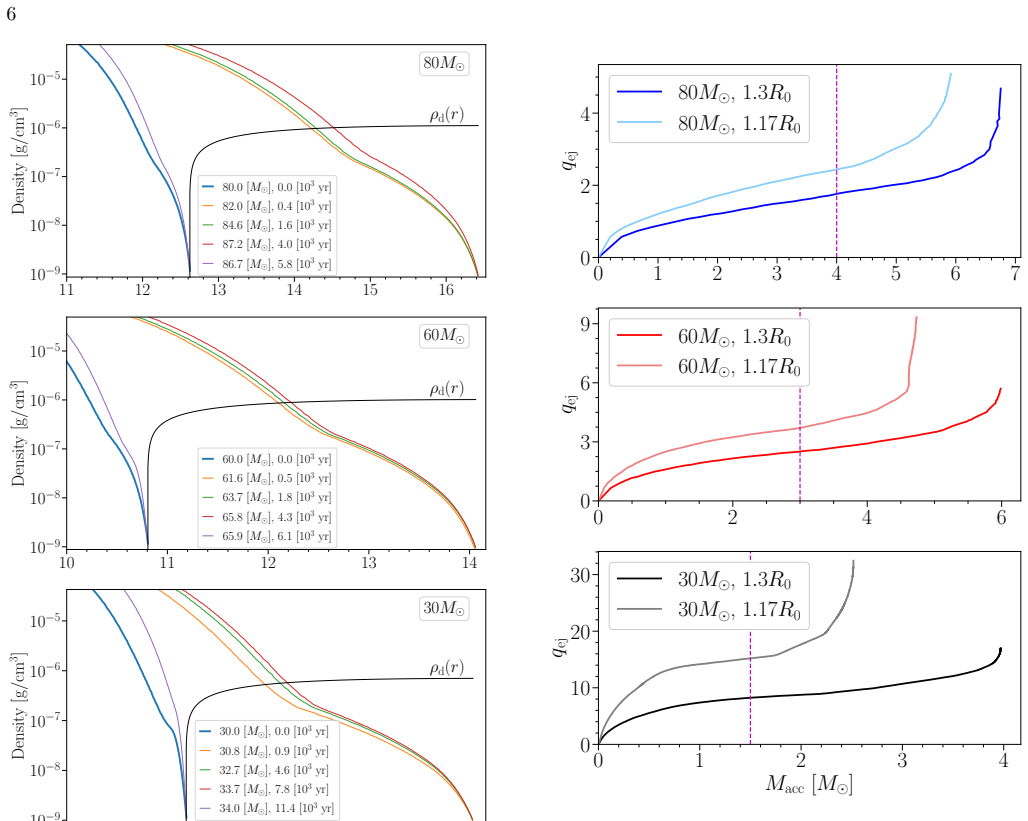
The mechanism is a two-part accretion pulse in the MESA stellar-evolution code: add mass at $1.5\times10^{-2}\,M_\odot\,\mathrm{yr}^{-1}$ together with a fraction $\eta_{\rm acc}$ of the accretion energy into the outer 10% by radius until the star expands to $R_{\rm add} = k_R R_0$, then remove mass at $1\times10^{-2}\,M_\odot\,\mathrm{yr}^{-1}$ until the star contracts back to $R_0$. The high-entropy, loosely bound outer layers created by energy deposition are exactly the layers removed, so the star keeps a deep potential well. A scaled density estimate for a Shakura-Sunyaev disk shows the disk is denser than the inflated envelope's outer layers, supporting the assumption that the disk survives and can launch jets there.
What would settle it
Run a three-dimensional hydrodynamical simulation of an accretion disk embedded in an inflated main-sequence envelope, with a jet duty cycle and power matching the 1D removal rate; if the jets cannot expel the outer ~10% of the radius before the envelope engulfs the disk, or if the disk is destroyed by the inflated envelope, the ~10% net accretion would not occur.
Extended reading notes
Core claim
The central claim is that imposing a radius cap—allowing the star to swell to only $k_R = 1.3$ times its initial radius between mass-addition episodes—lets a $30$–$80\,M_\odot$ main-sequence star asymptotically accumulate up to about 10% of its mass, because the high-entropy outer layers added during accretion are stripped away before they force runaway expansion. The accumulated mass grows with the allowed radius cap and with lower stellar mass, while the energy-injection efficiency $\eta_{\rm acc}$ has little effect. Without the removal phase, adding mass even without extra energy inflates the star, and constant-rate accretion without removal leads to unstable expansion, as earlier work found.
Load-bearing premise
The scenario assumes the jets actually strip the outer envelope at the rate and in the manner imposed by the 1D mass-removal prescription; this jet–envelope interaction is never simulated in three dimensions.
Editorial extensions
If this is right
- A 30–80 solar-mass main-sequence star can asymptotically net-accrete about 10% of its initial mass without a final radius increase when its radius is capped at 1.3 R0.
- Lower-mass stars and larger allowed radius caps yield larger fractional mass growth and higher net accretion rates.
- The accretion disk's density exceeds the inflated envelope's outer-layer density by roughly an order of magnitude, so jets can plausibly be launched inside the envelope.
- The scenario can supply the ~4 solar masses accreted by the proposed companion during Eta Carinae's Great Eruption, and power ILOTs and luminous red novae.
- The ejected mass is several times the net accreted mass, so the ejecta's average terminal velocity is well below the stellar escape velocity.
Reading between the lines
- If the mechanism works, the accreting star acts mainly as a mass processor: for every solar mass it keeps, it must eject several through jets (qej up to ~30 at early times for the 30-solar-mass model), so the inflowing envelope gas is recycled rather than accumulated.
- The imposed radius cap resembles tidal truncation by an orbiting companion; real systems without such truncation may not achieve the same net accretion, so applying this scenario to isolated stars or wide binaries is not automatic.
- Because the removal targets high-entropy regions, other removal agents such as line-driven winds or a common-envelope interaction might also prevent radius inflation; the jet is one concrete realization.
- A direct observational test could search ILOT light curves and ejecta for the predicted low terminal velocities (well below escape velocity) and large ejected-to-accreted mass ratios.
Editorial analysis
A structured set of objections, weighed in public.
Referee Report
Summary. This paper uses the one-dimensional stellar evolution code MESA to simulate rapid mass accretion onto 30, 60, and 80 M_sun main-sequence stars under a 'jetted-mass-removal accretion' scenario. In the model, mass is added at 1.5e-2 M_sun/yr with accretion energy deposited in the outer 10% by radius; when the stellar radius reaches k_R R_0 (k_R = 1.17 or 1.3), mass addition is stopped and mass is removed at 1e-2 M_sun/yr until the radius returns to R_0. The reported result is that the stars reach an asymptotic net mass increase of up to about 10% (Table 1) while the final radius returns to R_0. The paper also compares the density of an alpha-disk to the outer envelope density (Section 4) and estimates the removed-to-accreted mass ratio and ejecta velocity (Section 5), arguing that the scenario is relevant to ILOTs, grazing envelope evolution, and the Great Eruption of Eta Carinae.
Significance. If the assumed jet-driven removal of the outer envelope is physically realizable, the scenario would provide a mechanism for massive main-sequence stars to accrete substantial mass at high rates without runaway expansion, which is relevant to several classes of eruptive transients. The MESA models are internally consistent and the paper includes a useful parameter sweep over initial mass, k_R, and eta_acc, with quantitative results in Table 1 and Figures 1-5. The paper is transparent about its central assumption: the jets that remove the envelope are mimicked by imposed mass removal rather than modeled. The main value is as a proof-of-concept; the physical feasibility of the feedback loop remains to be demonstrated.
major comments (3)
- [Section 2, Eq. (1)] The radius bound is imposed by construction: mass addition stops when R reaches Radd = k_R R_0 and removal continues until R returns to R_0. Consequently, the statement in Section 3 that the star accretes mass 'without an increase in their final stellar radius' is not an emergent result of the physics; it is a boundary condition of the numerical scheme. The nontrivial output is the asymptotic accreted mass for this protocol, and the paper should state this explicitly and avoid presenting the radius constraint as a finding. It would strengthen the paper to vary the removal efficiency (e.g., Mdot_rem) and show how the net accreted mass degrades if removal is slower than assumed.
- [Sections 4-5] The physical mechanism for the imposed mass removal is not demonstrated. The density comparison in Section 4 (Eq. 2 vs. envelope density) establishes only a static necessary condition for a disk to exist inside the inflated envelope; it does not show that the disk can survive the inflow and jet-envelope interaction, nor that the jets can unbind the outer layers at the imposed Mdot_rem ~ 1e-2 M_sun/yr. The energy argument in Section 5 assumes that a fraction zeta ~ 1 of the accretion energy is converted into ejection of the removed mass, but no model or simulation of this coupling is presented. This is the load-bearing assumption of the paper, and it should be labeled as such throughout, with a concrete feasibility estimate or an explicit statement that the result is conditional on this assumption.
- [Section 2, energy deposition] The accretion energy is deposited uniformly per unit mass in the outer 0.1 by radius. This radial distribution is not derived from a physical model of where the accreted gas shocks or where the jet energy is thermalized, and it directly controls the expansion that triggers the mass-removal phase. The paper varies eta_acc but not the deposition zone or its profile; a test of the sensitivity to this choice (or a physical justification) is needed before the ~10% result can be considered robust.
minor comments (5)
- [Section 2] In the description of the mass-removal part, the rate is written as Mdot_add = -1e-2; this should be Mdot_rem to avoid confusion with the addition rate.
- [Figure 2 caption] The explanation that the thickness of each curve is not the line width but results from dense pulse spacing is confusing; consider plotting the envelope of the mass range or sampled pulse extrema.
- [Section 5, Eq. (5)] The derivation of Eq. (5) is too terse: please define q_ej and zeta in the same paragraph and state clearly that the removed mass is assumed to be ejected with no net energy contribution.
- [Table 1] Macc,f is called the asymptotic accreted mass, but no criterion for asymptotic convergence is given; please state the tolerance or the time at which the value is read.
- [Section 3] The phrase 'the outer parts have very high entropy' should refer to Figure 3 and specify that this refers to the newly accreted outer envelope.
Circularity Check
The 'no radius expansion' half of the headline is imposed by the pulse control rule, but the asymptotic ~10% net mass gain is a genuine MESA output; no load-bearing self-citation.
-
self definitional
[Section 2 (Method, eq. 1) and Section 3 (Results, main conclusion)]
"When the star expands to a radius of Radd = kRR0, (1) we start the second part of the pulse of mass removal; ... Once the star contracts back to the initial radius R0, we stop mass removal and start mass and energy addition of the next pulse."
The claimed headline result 'without an increase in their final stellar radius' is exactly the control rule: mass addition is stopped at Radd = kRR0 and removal is continued until R = R0. The radius is therefore forced to lie between R0 and kRR0 by construction, so the 'star does not expand much' part of the conclusion is an input, not an emergent prediction. The paper is transparent about this ('we keep the maximum and minimum stellar radii constant') and even calls it a 'demand' in Section 6, but the abstract and Section 3 nevertheless present it as a finding. The non-trivial ~10% asymptotic accreted mass is not directly imposed: it emerges from the MESA structural response, so the circularity is partial rather than total.
full rationale
The paper's central quantitative claim -- that a massive MS star can net-accrete ~10% of its mass when outer layers are removed to cap the radius -- does not reduce to a fitted parameter or to a self-citation. The asymptotic mass Macc,f is a MESA output determined by how much mass must be added to inflate from R0 to kRR0 and how much must be removed to contract back to R0; this depends on the entropy structure and is not equal to any input by construction. The main circular element is the radius statement: 'without an increase in their final stellar radius' is guaranteed by the stopping condition at R0, and the maximum radius kRR0 is an imposed threshold. The authors explicitly label the radius cap a 'demand' and state that the star radius stays at ~kRR0 by the assumed simultaneous inflow/outflow, so this is a modeling constraint rather than a hidden re-use of data. The jet-envelope removal mechanism is assumed, not demonstrated by hydrodynamics; that is an unvalidated assumption (correctness risk), not circularity. Self-citations to Bear & Soker 2025 are not load-bearing: the entropy argument is independently shown in Figure 3, and the no-removal expansion behaviour is grounded in the external study of Schürmann & Langer 2024. Score 5 reflects one prediction-by-construction in an otherwise independent derivation.
Assumptions & free parameters
free parameters (5)
- k_R (maximum radius factor) =
1.17 and 1.3
- eta_acc (energy deposition efficiency) =
0.025, 0.1, 0.25
- Mdot_add (mass addition rate) =
1.5e-2 Msun/yr
- Mdot_rem (mass removal rate) =
1e-2 Msun/yr
- Energy deposition zone (outer 0.1 by radius) =
uniform power per unit mass
assumptions (3)
- ad hoc to paper Jets remove the outer envelope layers at the imposed rate and timing.
- domain assumption The Shakura-Sunyaev disk density formula (Frank et al. 2002, Eq. 5.49) applies to a disk embedded in an inflated envelope.
- domain assumption Accretion energy is deposited uniformly in the outer 10% by radius.
Cite this review
Pith. "Pith review of Enabling high mass accretion rates onto massive main sequence stars by outer envelope mass removal." pith.science (2026). https://pith.science/paper/YKN7NQWL
@misc{pith2026250103947,
  author       = {Pith},
  title        = {Pith review of: Enabling high mass accretion rates onto massive main sequence stars by outer envelope mass removal},
  year         = {2026},
  howpublished = {\url{https://pith.science/paper/YKN7NQWL}},
  note         = {Machine review of arXiv:2501.03947}
}
read the original abstract
Using the one-dimensional numerical code MESA, we simulate mass accretion at very high rates onto massive main sequence stars, M=30, 60, 80 Mo, and find that these stars can accrete up to 10% of their mass without expanding much if we consider a simultaneous mass removal by jets. In this jetted-mass-removal accretion scenario, the accretion is through an accretion disk that launches jets. When the star expands due to rapid mass accretion, it engulfs the inner zones of the accretion disk and the jets it launches. We assume that these jets remove the outer layers of the envelope. We mimic this in the one-dimensional numerical code by alternating mass addition and mass removal parts. We add mass and energy, the accretion energy, to the outer layers of the envelope, leading to rapid stellar expansion. When the star expands by a few tens of percent, we stop mass addition and start mass removal until the star returns to its initial radius. We also show that the density of the accretion disk is larger than the density of the outer layers of the inflated envelope, allowing the disk to launch jets inside the outer inflated envelope layers. Our results show that main sequence stars can accrete mass at high rates while maintaining the deep potential well, as some models of eruptive systems require, e.g., some luminous red novae, the grazing envelope evolution, and the 1837-1856 Great Eruption of Eta Carinae.
Figures


Figures from the paper (1 more)
Reference graph
Works this paper leans on
-
[1]
J., Erasmus N., Jones D., Mogawana O., 2022, MNRAS, 517,
Addison H., Blagorodnova N., Groot P. J., Erasmus N., Jones D., Mogawana O., 2022, MNRAS, 517,
work page 2022
-
[2]
Kashi A., Soker N., 2010, ApJ, 723,
work page 2010
-
[3]
Banerjee, D. P. K., Geballe, T. R., Evans, A., Shahbandeh, M., Woodward, C. E., Gehrz, R. D., Eyres, S. P. S., Starrfield, S. & Zijlstra, A. 2020, ApJL, 904, L23. Bear, E. & Soker, N. 2025, Research in Astronomy and Astrophysics, 25, 025010. Berger, E., Soderberg, A. M., Chevalier, R. A., et al. 2009, ApJ, 699, 1850 Blagorodnova, N., Karambelkar, V., Adam...
work page 2020
-
[5]
Metzger B. D., Giannios D., Spiegel D. S., 2012, MNRAS, 425,
work page 2012
-
[12]
2019, MNRAS, 482, 4233 Grichener A., 2024, arXiv, arXiv:2410.18813
Gilkis, A., Soker, N., & Kashi, A. 2019, MNRAS, 482, 4233 Grichener A., 2024, arXiv, arXiv:2410.18813. Grichener A., Soker N., 2019, ApJ, 878,
arXiv 2019
-
[15]
2020, Reviews in Frontiers of Modern Astrophysics; From Space Debris to Cosmology,
Jones, D. 2020, Reviews in Frontiers of Modern Astrophysics; From Space Debris to Cosmology,
work page 2020
-
[16]
Soker N., 2020, ApJ, 893,
work page 2020
-
[20]
Soker N., 2023, OJAp, 6,
work page 2023
Show all 45 references
-
[24]
Gurevich O., Bear E., Soker N., 2022, MNRAS, 511,
2022
-
[29]
2017, ApJ, 835, 282 MacLeod, M., Ostriker, E
doi:10.3847/1538-4357/ab89b6 MacLeod, M., Macias, P., Ramirez-Ruiz, E., Grindlay, J., Batta, A., & Montes, G. 2017, ApJ, 835, 282 MacLeod, M., Ostriker, E. C., & Stone, J. M. 2018, ApJ, 868,
2017 doi
- [32]
-
[33]
2018, MNRAS, 475, 1198 Soker N., Kaplan N., 2021, RAA, 21,
Soker, N., & Gilkis, A. 2018, MNRAS, 475, 1198 Soker N., Kaplan N., 2021, RAA, 21,
2018
-
[46]
Boian, I., & Groh, J. H. 2019, A&A, 621, A109. Bond, H. E., Henden, A., Levay, Z. G., et al. 2003, Nature, 422, 405 Cai Y.-Z., Pastorello A., Fraser M., Prentice S. J., Reynolds T. M., Cappellaro E., Benetti S., et al., 2019, A&A, 632, L6. Cai Y.-Z., Pastorello A., Fraser M., ...
2019
-
[55]
W., Alexander, D
Ferguson, J. W., Alexander, D. R., Allard, F., Barman, T., Bodnarik, J. G., Hauschildt, P. H., Heffner-Wong, A., & Tamanai, A. 2005, ApJ, 623,
2005
-
[59]
Potekhin, A. Y. & Chabrier, G. 2010, Contributions to Plasma Physics, 50,
2010
-
[72]
S., Bauer, E
Jermyn, A. S., Bauer, E. B., Schwab, J., et al. 2023, ApJS, 265,
2023
-
[82]
2017, ApJ, 835,
Poutanen, J. 2017, ApJ, 835,
2017
-
[90]
D., Taddia F., Fraser M., Tauris T
Stritzinger M. D., Taddia F., Fraser M., Tauris T. M., Contreras C., Drybye S., Galbany L., et al., 2020a, A&A, 639, A104. Stritzinger M. D., Taddia F., Fraser M., Tauris T. M., Suntzeff N. B., Contreras C., Drybye S., et al., 2020b, A&A, 639, A103. Timmes, F. X. & Swesty, F. ...
2000
-
[99]
doi:10.1088/1674-4527/16/6/099 Kashi A., Soker N., 2016, ApJ, 825,
2016 doi
-
[105]
Kasliwal, M. M. 2011, Bulletin of the Astronomical Society of India, 39, 375 Kasliwal, M. M., Kulkarni, S. R., Gal-Yam, A., et al. 2012, ApJ, 755, 161 Klencki, J., Nelemans, G., Istrate, A. G., & Chruslinska, M., 2021, A&A, 645, A54. doi:10.1051/0004-6361/202038707 Langanke, K...
2011 doi
-
[119]
Qian S.-B., Zhu L.-Y., Liu L., Zhang X.-D., Shi X.-D., He J.-J., Zhang J., 2020, RAA, 20,
2020
-
[123]
Kami´ nski, T., Mason, E., Tylenda, R., & Schmidt, M
Kaminski T., 2024, arXiv, arXiv:2401.03919. Kami´ nski, T., Mason, E., Tylenda, R., & Schmidt, M. R. 2015, A&A, 580, A34 Kami´ nski, T., Menten, K. M., Tylenda, R., et al. 2020, A&A, 644, A59. doi:10.1051/0004-6361/202038648 Kami´ nski T., Schmidt M., Hajduk M., Kiljan A., Izv...
2024 arXiv
-
[128]
1994, Atomic Data and Nuclear Data Tables, 56,
Oda, T., Hino, M., Muto, K., Takahara M., & Sato K. 1994, Atomic Data and Nuclear Data Tables, 56,
1994
-
[136]
E., Preston, G., & Bensby, T
Mason, E., Diaz, M., Williams, R. E., Preston, G., & Bensby, T. 2010, A&A, 516, A108 Matsumoto T., Metzger B. D., 2022, ApJ, 938,
2010
-
[137]
M., & Feigin, L
Kashi, A., Michaelis, A. M., & Feigin, L. 2019, Galaxies, 8,
2019
-
[163]
R., Ofek, E
Rau, A., Kulkarni, S. R., Ofek, E. O., & Yan, L. 2007, ApJ, 659, 1536 Retter, A., & Marom, A. 2003, MNRAS, 345, L25 Rogers, F. J. & Nayfonov, A. 2002, ApJ, 576,
2007
-
[231]
O., Kulkarni, S
Ofek, E. O., Kulkarni, S. R., Rau, A., et al. 2008, ApJ, 674, 447 Pastorello, A., & Fraser, M. 2019, Nature Astronomy, 3, 676 Pastorello, A., Mason, E., Taubenberger, S., et al. 2019, A&A, 630, A75 Pastorello A., Valerin G., Fraser M., Elias-Rosa N., Valenti S., Reguitti A., M...
2008
-
[240]
E., Chakrabarty D., Conroy C., Dekany R., et al., 2023, Natur, 617,
8 De K., MacLeod M., Karambelkar V., Jencson J. E., Chakrabarty D., Conroy C., Dekany R., et al., 2023, Natur, 617,
2023
-
[398]
Cambridge, UK: Cambridge University Press, February 2002., 398 Fuller, G
ISBN 0521620538. Cambridge, UK: Cambridge University Press, February 2002., 398 Fuller, G. M., Fowler, W. A., & Newman, M. J. 1985, ApJ, 293,
2002
-
[411]
L., & Lombardi, J
Ivanova, N., Justham, S., Avendano Nandez, J. L., & Lombardi, J. C. 2013, Science, 339, 433 Jencson, J. E., Kasliwal, M. M., Adams, S. M., et al. 2019, ApJ, 886, 40 Jermyn, A. S., Schwab, J., Bauer, E., Timmes F. X., & Potekhin A. Y. 2021, ApJ, 913,
2013
-
[481]
& Loeb, A
MacLeod, M. & Loeb, A. 2020, ApJ, 895,
2020
-
[493]
Y., Pietrinferni, A., Catelan, M., & Salaris, M
Cassisi, S., Potekhin, A. Y., Pietrinferni, A., Catelan, M., & Salaris, M. 2007, ApJ, 661,
2007
-
[501]
2011, A&A, 528, A114 Tylenda, R., Kami´ nski, T., & Smolec, R
Tylenda, R., Hajduk, M., Kami´ nski, T., et al. 2011, A&A, 528, A114 Tylenda, R., Kami´ nski, T., & Smolec, R. 2024, A&A, 685, A49. doi:10.1051/0004-6361/202244896 Tylenda, R., Kami´ nski, T., Udalski, A., et al. 2013, A&A, 555, A16 Wadhwa S. S., De Horta A., Filipovi´ c M. D....
2011 doi
-
[585]
Frank, J., King, A., & Raine, D. J. 2002, Accretion Power in Astrophysics, by Juhan Frank and Andrew King and Derek Raine, pp
2002
-
[602]
Kashi A., Soker N., 2016, RAA, 16,
2016
-
[713]
L., MacLeod, M., Loeb, A., Vigna-G´ omez, A., & Mandel, I
Schrøder, S. L., MacLeod, M., Loeb, A., Vigna-G´ omez, A., & Mandel, I. 2020, arXiv:1906.04189 Schreier, R., Hillel, S., Shiber, S., & Soker, N. 2021, MNRAS. Sch¨urmann, C. & Langer, N. 2024, A&A, 691, A174. Segev, R., Sabach, E., & Soker, N. 2019, ApJ, 884, 58 Soker N., 2001,...
2020 arXiv
-
[752]
Iglesias, C. A. & Rogers, F. J. 1996, ApJ, 464,
1996
-
[943]
Irwin, Alan. W. (2004). The FreeEOS Code for Calculating the Equation of State for Stellar Interiors (cit. on p. xxi). Itoh, N., Hayashi, H., Nishikawa, A., Kohyama, Y. 1996, ApJS, 102,
2004
-
[1064]
Saumon, D., Chabrier, G., & van Horn, H. M. 1995, ApJS, 99,
1995
-
[1094]
I., Dewitt, H
Chugunov, A. I., Dewitt, H. E., & Yakovlev, D. G. 2007, PhRvD, 76, 025028. Cyburt, R. H., Amthor, A. M., Ferguson, R., et al. 2010, ApJS, 189,
2007
-
[1330]
2020, MNRAS, 492, 3229 Hubov´ a, D., & Pejcha, O
Howitt, G., Stevenson, S., Vigna-G´ omez, A., et al. 2020, MNRAS, 492, 3229 Hubov´ a, D., & Pejcha, O. 2019, MNRAS, 489, 891 Iglesias, C. A. & Rogers, F. J. 1993, ApJ, 412,
2020
-
[1421]
Z., Kami´ nski, T., Matter, A., Wittkowski M., Monnier J
Mobeen, M. Z., Kami´ nski, T., Matter, A., Wittkowski M., Monnier J. D., Kraus S., Le Bouquin J.-B., et al., 2024, A&A, 686, A260. doi:10.1051/0004-6361/202347322 Zhu C.-H., L ¨u G.-L., Lu X.-Z., He J., 2023, RAA, 23, 025021
2024 doi
-
[1884]
1999, NuPhA, 656,
Angulo, C., Arnould, M., Rayet, M., et al. 1999, NuPhA, 656,
1999
-
[2778]
D., & Pejcha, O
Metzger, B. D., & Pejcha, O. 2017, MNRAS, 471, 3200 Mobeen M. Z., Kami´ nski T., Matter A., Wittkowski M., Paladini C., 2021, A&A, 655, A100. Mould, J., Cohen, J., Graham, J. R., et al. 1990, ApJL, 353, L35 Muthukrishna, D., Narayan, G., Mandel, K. S., Biswas, R., & Hloˇ zek, ...
2017
-
[5503]
M., Bond H
doi:10.1093/mnras/staa1872 Blagorodnova N., Klencki J., Pejcha O., Vreeswijk P. M., Bond H. E., Burdge K. B., De K., et al., 2021, A&A, 653, A134. doi:10.1051/0004-6361/202140525 Blagorodnova, N., Kotak, R., Polshaw, J., et al. 2017, ApJ, 834, 107 Blouin, S., Shaffer, N. R., S...
2021 doi
Reviewed August 10, 2026 · model on record in the stance chip above.
Discussion (0). Continue with ORCID to comment.