REVIEW 4 major objections 6 minor 1 cited by
Spherical Double K-Means: a co-clustering approach for text data analysis
T0 review · 4 major / 6 minor · reviewed 2026-08-10 · deepseek-v4-flash
Pith's one-line read This paper introduces Spherical Double K-Means (SDKM), a co-clustering method that partitions documents and terms simultaneously by maximizing the cosine similarity between a term-document matrix and its block-centroid approximation.
desk verdict The reader's report is right: SDKM is a genuinely new combination and the case study is clearly presented, but Algorithm 1 does not maximize the cosine objective the paper claims, so the central theoretical and convergence arguments do not hold as written. read the letter →
The pith
A machine-rendered reading of the paper's core claim, the machinery that carries it, and where it could break.
The reading
What carries the argument
The load-bearing object is the row-normalized block-centroid matrix $$Y=\frac{(U'U)^{-1}U'XV(V'V)^{-1}}{\|(U'U)^{-1}U'XV(V'V)^{-1}\|},$$ updated inside an alternating scheme that also reassigns term memberships $U$ and document memberships $V$. The objective being maximized is the normalized trace of $X' U Y V'$, a cosine-like similarity between the observed term-document matrix and its block-centroid reconstruction $U Y V'$. This centroid matrix, normalized by rows but not by columns, is what carries the spherical part of SDKM, and the paper's monotonicity proof rests on each of the four update steps increasing or preserving the same trace objective.
What would settle it
Run SDKM twice on the same TF-IDF matrix, once exactly as Algorithm 1 prints it and once with every row and every column normalized to unit length before the iterations. If the two runs produce different cluster assignments or objective trajectories, the inner-product steps in Algorithm 1 are not equivalent to cosine similarity, and the paper's central premise fails.
Extended reading notes
Core claim
SDKM is a co-clustering method built on the double k-means model $X = U Y V' + E$, where $U$ and $V$ are binary membership matrices for terms and documents and $Y$ is a $K \times Q$ matrix of block centroids. The paper maximizes the normalized trace objective $f(U,V,Y)=\frac{\mathrm{tr}(X' U Y V')}{\sqrt{\mathrm{tr}(X'X)\,\mathrm{tr}(U Y V' V Y' U')}}$ and claims that this quantity is at most 1, reaching 1 only when the reconstructed matrix $U Y V'$ equals $X$. The algorithm cycles through four updates: assign each term to the cluster whose combined profile has the largest inner product, recompute $Y$ as a row-normalized block average, assign each document similarly, and recompute $Y$ again. The authors argue that these inner-product assignments are cosine comparisons after normalization, and Appendix A proves that each sub-step cannot decrease the objective. On the inaugural-address corpus the method yields $K=3$ term clusters and $Q=2$ document clusters, with the document split falling between 1861 and 1865 and Lincoln's 1865 address placed with the modern group.
Load-bearing premise
The paper assumes that comparing documents and terms by raw inner products is the same as comparing them by angle, even though the TF-IDF matrix is not normalized before the assignment steps, and that the row-normalized centroid update really maximizes the stated objective.
Editorial extensions
If this is right
- Users get a two-way partition: each document cluster is directly characterized by the term cluster(s) it draws on, so topic and keyword extraction happen in the same run.
- Cosine geometry has a visible effect on borderline documents: Lincoln's 1865 inaugural moves to the modern cluster under SDKM, illustrating that relative word proportions, not raw frequency, drive assignment.
- The pseudo-F index can select K and Q automatically, but it undercounts clusters as noise grows; in the application the authors chose K=3, Q=2 for interpretability even though the index's top value was K=2, Q=2.
- Twenty random starts were enough in the authors' simulations to avoid local maxima, so SDKM can be used with that restart policy in practice.
- The objective is monotonically non-decreasing across iterations, giving a well-defined stopping rule and a convergence guarantee to a local maximum.
Reading between the lines
- If the normalization gap is closed by explicitly normalizing document vectors before the inner-product assignments, SDKM would become a literal spherical co-clustering method; a symmetric column-normalized variant could be tested against the current row-normalized version on the inaugural corpus.
- Because SDKM's objective is a normalized trace, it is close in spirit to low-rank approximation with angle-based fit; comparing it against a topic model on the same data using held-out coherence would show whether the two-way partition adds information beyond LDA.
- The DKM-versus-SDKM discrepancy on Lincoln's 1865 speech is a natural probe: synthetic corpora with intermediate vocabulary proportions should switch clusters under SDKM but not under DKM, offering a controlled test of the cosine mechanism.
- A fuzzy or soft-membership version, which the authors name as future work, would turn the hard binary assignments into degrees of membership and could be obtained by replacing the arg-max updates with normalized similarities.
Editorial analysis
A structured set of objections, weighed in public.
Referee Report
Summary. The paper introduces Spherical Double K-Means (SDKM), a co-clustering method intended to combine Double K-Means (DKM) with Spherical K-Means (SKM) in order to simultaneously partition terms and documents using cosine similarity. The method is formalized as a low-rank approximation X ≈ U Y V' with a cosine-based objective, and Algorithm 1 alternates between updating row memberships U, the centroid matrix Y, column memberships V, and Y again. The authors report simulation studies of cluster recovery and of the pseudo-F index for selecting K and Q, then apply SDKM to US presidential inaugural addresses. The application yields two document clusters (roughly pre- and post-Civil War) and three word clusters, which the authors interpret historically. A comparison with DKM shows a largely similar document partition except for Lincoln's 1865 address. The paper claims that SDKM inherits SKM's benefits---robustness to high dimensionality, sparsity, and noise---and provides a monotonicity proof in Appendix A.
Significance. If the paper's central claim were correct, SDKM would be a useful extension of DKM to cosine geometry for text co-clustering, and the application would provide a suggestive demonstration. The paper also ships simulation code (MATLAB, per Section 4.1) and reports detailed simulation results, which is a strength. However, the central technical claim is not sound: Algorithm 1 does not actually optimize the stated cosine objective, and the monotonicity proof in Appendix A does not apply to the normalized objective introduced in Section 3. The methodological contribution is therefore not established, and the application, while historically interesting, cannot compensate for the mismatch between the proposed method and its implementation.
major comments (4)
- [Section 3, Algorithm 1] The algorithm's assignment steps are not cosine assignments. Step 1 assigns row i to cluster k by maximizing x_i (Y V') I_k, and Step 3 assigns column j by maximizing x'_j (U Y) W_q; these are unnormalized inner products. The data matrix in the application is the TF-IDF matrix described in Section 5, and no row normalization of X is performed. Section 3.1 explicitly states that only the centroid matrix Y is normalized by rows, and Section 7 lists simultaneous normalization of rows and columns as an open issue. Therefore Algorithm 1 does not implement cosine similarity despite the paper's repeated claims that SDKM is based on cosine geometry, and the claimed advantages over DKM are unsupported.
- [Section 3, centroid update] The centroid update Y = (U'U)^-1 U' X V (V'V)^-1 / ||(U'U)^-1 U' X V (V'V)^-1|| is the DKM least-squares formula (cf. Equation (2) in Section 2.2.1), not the maximizer of the stated cosine objective. For fixed U and V, maximizing tr(X' U Y V') over row-unit-norm Y gives, for each row k, Y_k proportional to the k-th column of V' X' U, without the cluster-size scaling matrices (U'U)^-1 and (V'V)^-1. Thus the claim in Section 3 that this Y maximizes the cosine of the angle between rows of X and X_t is not supported by the derivation, which does not account for the normalization constraint correctly.
- [Appendix A and Section 3 (normalized objective)] The monotonicity proof in Appendix A only treats the unnormalized trace f(U,Y,V) = tr(X' U Y V'). The normalized objective introduced in Section 3, f(U,Y,V) = tr(X' U Y V') / sqrt(tr(X'X) tr(U Y V' V Y' U')), is never used in the proof or in the algorithm. Moreover, the proof's inequalities (A.1)–(A.4) assume that each substep maximizes the trace objective; as noted in the two previous comments, Steps 1 and 3 maximize inner products rather than cosine similarities, and Steps 2 and 4 use a least-squares centroid update that does not maximize the trace under the stated normalization. Consequently, the claimed monotonic convergence guarantee does not hold for the stated objective, and the statement in Section 3 that 'the algorithm guarantees that the objective function's value increases monotonically' is unsupported.
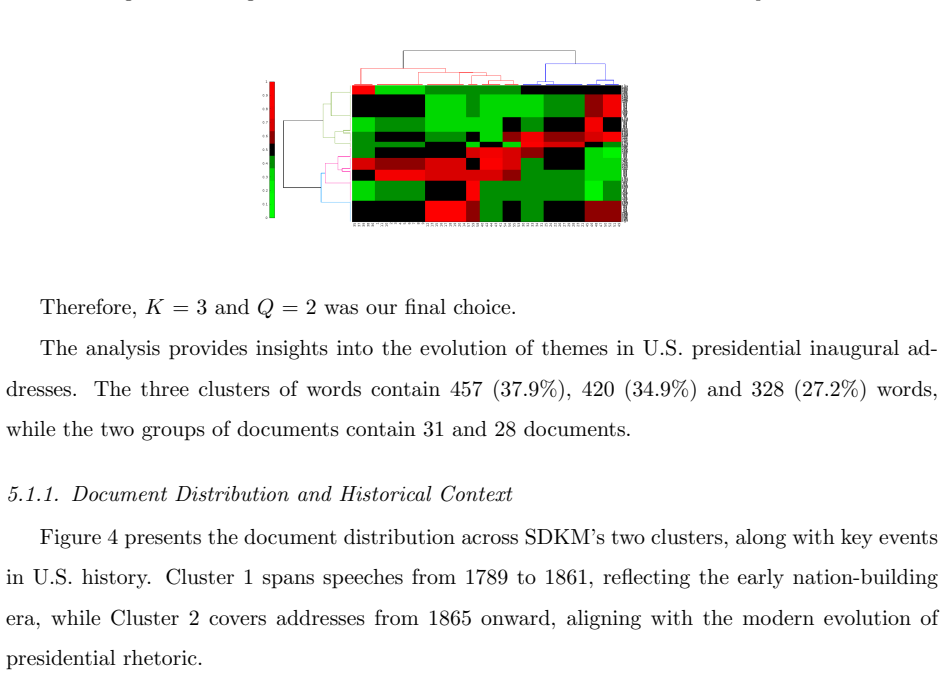
- [Section 5.1, cluster selection] The selection of K=3 and Q=2 is circular as presented. Table 4 shows the highest pseudo-F value at K=2, Q=2; the authors reject this in favor of K=3, Q=2 because the latter is more interpretable, and then use the interpretability of the resulting clusters (Sections 5.1.1 and 5.1.2, Figures 4–7) as evidence of the method's success. Additionally, the clustergram of a K=10, Q=10 solution (Figures 2 and 3) is used to conclude that 'K=3 distinct clusters of words and Q=2 distinct clusters of documents' emerge, but no explanation is given for why a hierarchical clustering of the 10x10 centroid matrix should determine the true number of clusters in the original data. These issues weaken the empirical evidence for the method's practical value.
minor comments (6)
- [Section 2.2.2, Equation (3)] The denominator of the cosine dissimilarity is written '|b∥' in several places; it should be '∥a∥∥b∥'.
- [Section 2.2.2, notation] The matrix X is used for both the data and the centroid matrix in the derivation of SKM (e.g., 'the centroids matrix X'), which makes the row-normalization arguments hard to follow.
- [Section 3, Algorithm 1] The sentence 'Here, I and W denote the identity matrices of dimensions K and Q' is confusing because Step 1 uses I_k and Step 3 uses W_q; W is also used as a diagonal norm matrix in Section 2.2.2, so the notation should be clarified.
- [Section 5, TF-IDF formula] The TF-IDF formula x_ij = n_ij / n_j log10(M/m) does not define n_j; presumably it is the total token count in document j, but this should be stated explicitly.
- [Section 4.4, Table 2] The text states that RndStarts takes values in [1, 5, 20, 30, 40, 50, 70, 100], but Table 2 also includes 10; the list in the text should match the table.
- [Title and Abstract] The method is called 'Spherical Double K-Means' in the title and abstract but 'Double Spherical K-means' in Algorithm 1; the terminology should be made consistent.
Circularity Check
Core SDKM derivation is not circular; the application has a mild fitted-input circularity because the cluster count is chosen for interpretability and interpretability is then offered as evidence of success.
-
fitted input called prediction
[Section 5.1, Table 4 and surrounding text; echoed in Section 7]
"The highest Pseudo-F value occurs at K = 2 and Q = 2, suggesting that the optimal number of clusters for both words and documents is 2. However, as discussed in Section 4.3, the Pseudo-F index can tend to underestimate the number of clusters. The second highest Pseudo-F value occurs at K = 3 and Q = 2. The observed patterns in the clusters indicate that the choice of K = 3 and Q = 2 produces clusters with greater interpretability... Therefore, K = 3 and Q = 2 was our final choice."
The number of clusters is not selected by the stated statistical criterion (pseudo-F; its maximum is K=2, Q=2) but by inspecting that K=3, Q=2 produces clusters with greater interpretability. The paper then presents those same clusters as evidence that SDKM uncovers distinct thematic clusters and yields more semantically coherent clusters. Because the model complexity was chosen precisely so that the resulting clusters would look interpretable, the interpretability-based validation is assured by the selection step and does not independently confirm the method. This is a fitted-input-called-validation circularity. It does not make the algorithm's update equations self-referential, and the core derivation remains non-circular.
full rationale
The central methodological derivation of SDKM is not circular: the objective function, the update steps, and the monotonicity appendix are internal mathematical claims, and even if some of those claims are incorrect or unsupported, they do not reduce to the paper's own inputs. The pseudo-F index is cited from prior work by the authors, but it is used as a standard model-selection tool and is not a fitted parameter renamed as a prediction. The simulation study generates data from the SDKM model and then tests recovery; this is a self-consistency check rather than a circular derivation, since recovery can fail, and indeed fails at high noise. The one genuine circularity is in the application: K=3,Q=2 is chosen after inspecting cluster interpretability, and then the interpretability of those clusters is cited as evidence that the method works. That loop is real but partial, so the overall circularity score is moderate rather than high. The more serious issues with the paper, such as the mismatch between the stated cosine objective and the unnormalized inner-product assignments, are correctness concerns, not circularity.
Assumptions & free parameters
free parameters (4)
- Number of term clusters K =
3 in the application; Pseudo-F optimum was 2
- Number of document clusters Q =
2 in the application
- Number of random starts RndStarts =
20
- Term frequency pruning threshold =
terms with frequency 11 or less removed
assumptions (4)
- ad hoc to paper Rows and columns of the document-term matrix have equal norm or are normalized, so unnormalized inner products in Algorithm 1 equal cosine similarities.
- ad hoc to paper The row-normalized least-squares centroid formula maximizes the stated normalized cosine objective at each iteration.
- domain assumption Data follow X = U Y V' + E with Gaussian errors in the simulation study.
- domain assumption TF-IDF weighted term-document representation is an adequate input representation for the clustering task.
Cite this review
Pith. "Pith review of Spherical Double K-Means: a co-clustering approach for text data analysis." pith.science (2026). https://pith.science/paper/644INTVN
@misc{pith2026250104562,
  author       = {Pith},
  title        = {Pith review of: Spherical Double K-Means: a co-clustering approach for text data analysis},
  year         = {2026},
  howpublished = {\url{https://pith.science/paper/644INTVN}},
  note         = {Machine review of arXiv:2501.04562}
}
read the original abstract
In text analysis, Spherical K-means (SKM) is a specialized k-means clustering algorithm widely utilized for grouping documents represented in high-dimensional, sparse term-document matrices, often normalized using techniques like TF-IDF. Researchers frequently seek to cluster not only documents but also the terms associated with them into coherent groups. To address this dual clustering requirement, we introduce Spherical Double K-Means (SDKM), a novel methodology that simultaneously clusters documents and terms. This approach offers several advantages: first, by integrating the clustering of documents and terms, SDKM provides deeper insights into the relationships between content and vocabulary, enabling more effective topic identification and keyword extraction. Additionally, the two-level clustering assists in understanding both overarching themes and specific terminologies within document clusters, enhancing interpretability. SDKM effectively handles the high dimensionality and sparsity inherent in text data by utilizing cosine similarity, leading to improved computational efficiency. Moreover, the method captures dynamic changes in thematic content over time, making it well-suited for applications in rapidly evolving fields. Ultimately, SDKM presents a comprehensive framework for advancing text mining efforts, facilitating the uncovering of nuanced patterns and structures that are critical for robust data analysis. We apply SDKM to the corpus of US presidential inaugural addresses, spanning from George Washington in 1789 to Joe Biden in 2021. Our analysis reveals distinct clusters of words and documents that correspond to significant historical themes and periods, showcasing the method's ability to facilitate a deeper understanding of the data. Our findings demonstrate the efficacy of SDKM in uncovering underlying patterns in textual data.
Figures


Figures from the paper (5 more)


Forward citations
Cited by 1 Pith paper
-
Generative AI for Industrial Contour Detection: A Language-Guided Vision System
A GAN-plus-VLM pipeline improves industrial remnant contour extraction, with GPT-image-1 outperforming Gemini 2.0 Flash on SSIM, LPIPS, and Hausdorff distance.
Reference graph
Works this paper leans on
-
[1]
write newline
" write newline "" before.all 'output.state := FUNCTION n.dashify 't := "" t empty not t #1 #1 substring "-" = t #1 #2 substring "--" = not "--" * t #2 global.max substring 't := t #1 #1 substring "-" = "-" * t #2 global.max substring 't := while if t #1 #1 substring * t #2 global.max substring 't := if while FUNCTION word.in bbl.in ":" * " " * FUNCTION f...
-
[2]
author Aggarwal, C. C. , & author Zhai, C. ( year 2012 ). title Mining text data . In booktitle Springer US \/ . :https://doi.org/10.1007/978-1-4614-3223-4
-
[3]
author Benoit, K. , author Watanabe, K. , author Wang, H. , author Nulty, P. , author Obeng, A. , author Müller, S. , & author Matsuo, A. ( year 2018 ). title quanteda: An r package for the quantitative analysis of textual data . journal Journal of Open Source Software \/ , volume 3 \/ , pages 774 . https://quanteda.io. :10.21105/joss.00774
-
[4]
author Blei, D. M. , author Ng, A. Y. , & author Jordan, M. I. ( year 2003 ). title Latent dirichlet allocation . journal Journal of machine Learning research \/ , volume 3 \/ , pages 993--1022 . :10.5555/944919.944937
arXiv 2003
-
[5]
author Bouveyron, C. , author Celeux, G. , author Murphy, T. B. , & author Raftery, A. E. ( year 2019 ). title Model-Based Clustering and Classification for Data Science: With Applications in R \/ . Cambridge Series in Statistical and Probabilistic Mathematics. address Cambridge, England : publisher Cambridge University Press . :10.1017/9781108644181
-
[6]
author Caliński, T. , & author Harabasz, J. ( year 1974 ). title A dendrite method for cluster analysis . journal Communications in Statistics \/ , volume 3 \/ , pages 1--27 . https://www.tandfonline.com/doi/abs/10.1080/03610927408827101. :10.1080/03610927408827101
-
[7]
author Celardo, L. , author Iezzi, D. F. , & author Vichi, M. ( year 2016 ). title Multi-mode partitioning for text clustering to reduce dimensionality and noises . In booktitle JADT 2016-Statistical Analysis of Textual Data \/ (pp. pages 181--192 ). publisher Presses de FacImprimeur volume volume 1
work page 2016
-
[8]
author Churchill, R. , & author Singh, L. ( year 2022 ). title The evolution of topic modeling . journal ACM Comput. Surv. \/ , volume 54 \/ . :10.1145/3507900
doi:10.1145/3507900 2022
Show all 33 references
-
[9]
, & author Ferraro, M
author Cozzolino, I. , & author Ferraro, M. B. ( year 2022 ). title Document clustering . journal Wiley Interdisciplinary Reviews: Computational Statistics \/ , volume 14 \/ , pages e1588 . :https://doi.org/10.1002/wics.1588
2022 doi
-
[10]
author Dhillon, I. S. , & author Modha, D. S. ( year 2001 ). title Concept decompositions for large sparse text data using clustering . journal Machine learning \/ , volume 42 \/ , pages 143--175 . :10.1023/A:1007612920971
2001 doi
-
[11]
, & author Abu-Rahmeh, M
author Duwairi, R. , & author Abu-Rahmeh, M. ( year 2015 ). title A novel approach for initializing the spherical k-means clustering algorithm . journal Simulation Modelling Practice and Theory \/ , volume 54 \/ , pages 49--63 . :10.1016/j.simpat.2015.03.007
2015 doi
-
[12]
, & author Raftery, A
author Fraley, C. , & author Raftery, A. E. ( year 1998 ). title How Many Clusters? Which Clustering Method? Answers Via Model-Based Cluster Analysis . journal The Computer Journal \/ , volume 41 \/ , pages 578--588 . :10.1093/comjnl/41.8.578
1998 doi
-
[13]
, author Feinerer, I
author Hornik, K. , author Feinerer, I. , author Kober, M. , & author Buchta, C. ( year 2012 ). title Spherical k-means clustering . journal Journal of statistical software \/ , volume 50 \/ , pages 1--22 . :10.18637/jss.v050.i10
2012 doi
-
[14]
, & author Arabie, P
author Hubert, L. , & author Arabie, P. ( year 1985 ). title Comparing partitions . journal Journal of classification \/ , volume 2 \/ , pages 193--218
1985
-
[15]
author Iezzi, D. F. ( year 2012 ). title Centrality measures for text clustering . journal Communications in Statistics - Theory and Methods \/ , volume 41 \/ , pages 3179--3197 . :10.1080/03610926.2011.633729
2012
-
[16]
author Iezzi, D. F. , & author Celardo, L. ( year 2020 ). title Text analytics: Present, past and future . In editor D. F. Iezzi , editor D. Mayaffre , & editor M. Misuraca (Eds.), booktitle Text Analytics \/ (pp. pages 3--15 ). address Cham : publisher Springer International ...
2020 doi
-
[17]
, author Kim, H
author Kim, H. , author Kim, H. K. , & author Cho, S. ( year 2020 ). title Improving spherical k-means for document clustering: Fast initialization, sparse centroid projection, and efficient cluster labeling . journal Expert Systems with Applications \/ , volume 150 \/ , pages...
2020
-
[18]
, & author Niu, T
author Liang, M. , & author Niu, T. ( year 2022 ). title Research on text classification techniques based on improved tf-idf algorithm and lstm inputs . journal Procedia Computer Science \/ , volume 208 \/ , pages 460--470 . https://www.sciencedirect.com/science/article/pii/S1...
2022 doi
-
[19]
, author Saunders, C
author Lodhi, H. , author Saunders, C. , author Shawe-Taylor, J. , author Cristianini, N. , & author Watkins, C. ( year 2002 ). title Text classification using string kernels . journal Journal of machine learning research \/ , volume 2 \/ , pages 419--444 . :https://doi.org/10...
2002 doi
-
[20]
, & author Joshi, M
author Maher, K. , & author Joshi, M. S. ( year 2016 ). title Effectiveness of different similarity measures for text classification and clustering . journal International Journal of Computer Science and Information Technologies \/ , volume 7 \/ , pages 1715--1720
2016
-
[21]
author Manning, C. D. ( year 2009 ). title An introduction to information retrieval \/ . publisher Cambridge university press
2009
-
[22]
, & author Vichi, M
author Rocci, R. , & author Vichi, M. ( year 2008 ). title Two-mode multi-partitioning . journal Computational Statistics & Data Analysis \/ , volume 52 \/ , pages 1984--2003 . :https://doi.org/10.1016/j.csda.2007.06.025
2008 doi
-
[23]
, author Karypis, G
author Steinbach, M. , author Karypis, G. , & author Kumar, V. ( year 2000 ). title A Comparison of Document Clustering Techniques \/ . type Technical Report University of Minnesota. https://www.stat.cmu.edu/ rnugent/PCMI2016/papers/DocClusterComparison.pdf
2000
-
[24]
( year 2001 )
author Vichi, M. ( year 2001 ). title Double k-means clustering for simultaneous classification of objects and variables . In editor S. Borra , editor R. Rocci , editor M. Vichi , & editor M. Schader (Eds.), booktitle Advances in Classification and Data Analysis \/ (pp. pages ...
2001
-
[25]
( year 2015 )
author Vichi, M. ( year 2015 ). title Two-mode partitioning and multipartitioning . In booktitle Handbook of Cluster Analysis \/ (pp. pages 540--565 ). publisher Chapman and Hall/CRC
2015
-
[26]
, & author Karypis, G
author Zhao, Y. , & author Karypis, G. ( year 2004 ). title Empirical and theoretical comparisons of selected criterion functions for document clustering . journal Machine learning \/ , volume 55 \/ , pages 311--331 . :10.1023/B:MACH.0000027785.44527.d6
2004
-
[27]
write newline
" write newline "" before.all 'output.state := FUNCTION n.dashify 't := "" t empty not t #1 #1 substring "-" = t #1 #2 substring "--" = not "--" * t #2 global.max substring 't := t #1 #1 substring "-" = "-" * t #2 global.max substring 't := while if t #1 #1 substring * t #2 gl...
-
[28]
write newline
" write newline "" before.all 'output.state := FUNCTION n.dashify 't := "" t empty not t #1 #1 substring "-" = t #1 #2 substring "--" = not "--" * t #2 global.max substring 't := t #1 #1 substring "-" = "-" * t #2 global.max substring 't := while if t #1 #1 substring * t #2 gl...
-
[29]
write newline
" write newline "" before.all 'output.state := FUNCTION n.dashify 't := "" t empty not t #1 #1 substring "-" = t #1 #2 substring "--" = not "--" * t #2 global.max substring 't := t #1 #1 substring "-" = "-" * t #2 global.max substring 't := while if t #1 #1 substring * t #2 gl...
-
[30]
write newline
" write newline "" before.all 'output.state := FUNCTION n.dashify 't := "" t empty not t #1 #1 substring "-" = t #1 #2 substring "--" = not "--" * t #2 global.max substring 't := t #1 #1 substring "-" = "-" * t #2 global.max substring 't := while if t #1 #1 substring * t #2 gl...
-
[31]
write newline
" write newline "" before.all 'output.state := FUNCTION n.dashify 't := "" t empty not t #1 #1 substring "-" = t #1 #2 substring "--" = not "--" * t #2 global.max substring 't := t #1 #1 substring "-" = "-" * t #2 global.max substring 't := while if t #1 #1 substring * t #2 gl...
-
[32]
write newline
" write newline "" before.all 'output.state := FUNCTION n.dashify 't := "" t empty not t #1 #1 substring "-" = t #1 #2 substring "--" = not "--" * t #2 global.max substring 't := t #1 #1 substring "-" = "-" * t #2 global.max substring 't := while if t #1 #1 substring * t #2 gl...
-
[33]
write newline
" write newline "" before.all 'output.state := FUNCTION n.dashify 't := "" t empty not t #1 #1 substring "-" = t #1 #2 substring "--" = not "--" * t #2 global.max substring 't := t #1 #1 substring "-" = "-" * t #2 global.max substring 't := while if t #1 #1 substring * t #2 gl...
Reviewed August 10, 2026 · model on record in the stance chip above.
Discussion (0). Continue with ORCID to comment.