REVIEW 4 major objections 5 minor 2 cited by
MobileH2R: Learning Generalizable Human to Mobile Robot Handover Exclusively from Scalable and Diverse Synthetic Data
T0 review · 4 major / 5 minor · reviewed 2026-08-10 · deepseek-v4-flash
Pith's one-line read A mobile robot can learn to receive objects from people using only synthetic training data, beating fixed-base baselines by at least 15 percentage points in every test setting.
desk verdict A solid synthetic-data pipeline for mobile handover with a plausible central claim, but the sim-to-real bridge rests on a small, unquantified perception gap. read the letter →
The pith
A machine-rendered reading of the paper's core claim, the machinery that carries it, and where it could break.
The reading
What carries the argument
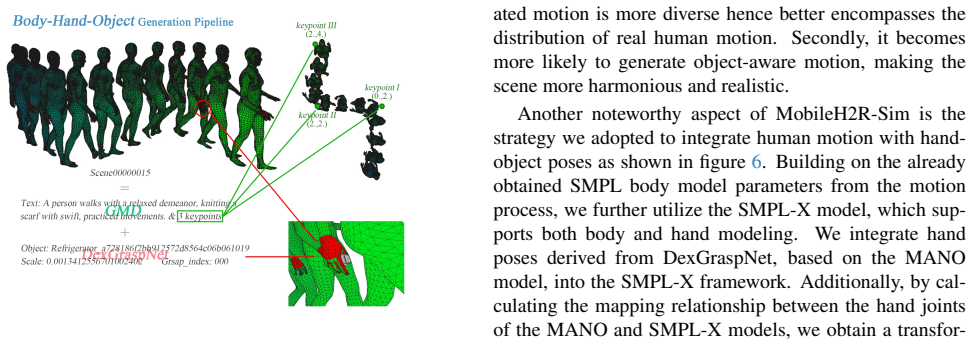
The paper's apparatus has three linked parts. The simulation environment is a two-phase human-motion synthesizer: a controllable motion-diffusion model produces diverse full-body pre-handover movement, a kinematic optimizer plus randomized handover pose sampling produces the arm motion that transfers the object, and an interactive trigger switches phases when the robot comes within reach, yielding over 100,000 scenes. Demonstration generation is a gradient-based trajectory optimizer with three custom losses: future obstacle avoidance over a foresee window, a final-pose constraint that stops the robot face-to-face with the person, and a vision-neural loss that penalizes states from which a learned pose predictor cannot recover the object pose, so the vision-to-action map stays learnable. The policy is a 4D imitation network: segmented point clouds of body, hand, and object from head and wrist cameras are enriched with flow computed by point-cloud registration between frames, encoded by set-abstraction layers with different sampling radii for body vs hand-object scales, and decoded by one MLP into simultaneous SE(2) base and SE(3) arm actions plus an auxiliary grasp-pose prediction.
What would settle it
Deploy the same synthetic-trained policy on real users whose handover style falls clearly outside the simulated distribution (e.g., handing over while walking backward, holding the object at hip height, or letting the torso occlude the hand) and compare success rates with the reported 80%/63%; a return to baseline-level success would show the claimed generality is bounded by the simulated motion distribution.
Extended reading notes
Core claim
On the paper's own terms, the discovery is that a generalizable handover skill can be produced entirely in simulation: with no real demonstrations and no motion-capture assets, the pipeline generates diverse synthetic full-body human behavior, plans safe and imitation-friendly robot trajectories from oracle state knowledge, and distills them into a closed-loop visuomotor policy that moves base and arm together. The paper reports that this policy outperforms all baselines by at least 15 percentage points in simulation, and in a real-world user study succeeds in 80% of simple handovers and 63.3% of complex ones, versus 40% and 30% for a reproduced fixed-base baseline. It also reports that scaling demonstrations from 10k to 100k improves average success, while training on a small real motion-capture dataset substantially hurts performance, supporting the claim that synthetic scale and diversity are the active ingredient.
Load-bearing premise
The load-bearing premise is that point clouds segmented from real depth cameras are similar enough to the simulated point clouds used in training that the policy's behavior transfers; the paper itself notes that segmentation errors and depth-camera inaccuracies remain deployment issues.
Editorial extensions
If this is right
- If the reported numbers hold, imitation-friendly demonstration generation is as important as the policy itself: removing the vision-neural loss reduces success by 11.6% on average.
- Scaling demonstration count from 10k to 100k adds roughly 3.3% success on average, while cutting to 1k costs about 13.9%, so the framework's advantage is tied to cheap, large-scale synthetic generation.
- Training on a small real motion-capture dataset instead of the large synthetic set drops average success by about 34.6%, suggesting synthetic diversity can outweigh real-data volume for this task.
- The policy's use of full-body human point clouds, temporal flow, and simultaneous base-arm decoding each contributes 12-18 percentage points of success; removing any of them harms generalization.
- Real-world transfer, if reproduced by others, would mean the same synthetic pipeline can produce deployable handover skills without any human-collected demonstrations.
Reading between the lines
- The vision-neural loss is a general recipe: any demonstration generator whose states are differentiable could be steered toward easy vision-to-action learning, not just handover; this may transfer to other closed-loop visuomotor tasks.
- Because the policy consumes egocentric segmented point clouds rather than robot-specific state, the same synthetic data pipeline could plausibly train a different mobile manipulator with no extra data collection, though the paper only evaluates one robot.
- A direct test of the 'exclusively synthetic' claim is to remove the manual first-frame annotation used in real-world segmentation; the paper's deployment currently depends on that annotation, so an automatic-only version would probe how much of the transfer is due to the synthetic pipeline itself.
Editorial analysis
A structured set of objections, weighed in public.
Referee Report
Summary. The paper presents MobileH2R, a framework for learning vision-based human-to-mobile-robot handover entirely from synthetic data. It introduces three components: a pipeline that synthesizes diverse full-body human handover motions by combining a diffusion-based motion generator, LLM-generated prompts, and grasp/object asset libraries; an automatic demonstration generator built on a state-based planner with future obstacle avoidance, final-pose constraints, and a learned 'vision neural loss' intended to make demonstrations imitation-friendly; and a 4D imitation-learning policy that consumes segmented human-body, hand, and object point clouds and outputs coordinated base-arm actions. The method is evaluated in simulation across three test sets and in real-world user studies on a Galbot G1 robot, reporting at least +15% success-rate improvements over baselines in all compared settings.
Significance. If the claims hold, the paper would make a meaningful contribution: it is the first full-body mobile handover framework trained exclusively on synthetic demonstrations, and its simulation evaluation is unusually thorough, with consistent success rates across simple, complex, and mocap-derived test sets (Tables 1-4) and a detailed set of ablations isolating the contributions of data scale, human-motion diversity, safety losses, flow features, human-body input, and coordinated action decoding. The proposed demonstration-generation pipeline and the 4D imitation architecture are well motivated and the simulation evidence is internally coherent. The main weakness is the real-world validation, which is small and does not quantify the perception gap that is load-bearing for the 'exclusively synthetic data' claim. This is a fixable limitation, not a fundamental flaw.
major comments (4)
- [Section 4.5, Tables 5 and 9] The real-world evidence is too thin to support the headline transfer claim. The user study consists of 30 trials per condition across 5 users and 6 objects, with no confidence intervals, no per-user or per-object breakdown of variance, and no statistical significance test. The gap between 80% and 40% (simple) and 63.3% and 30% (complex) is large, but the clustered design means it could be driven by a small number of users or objects. Because the paper's central claim is that synthetic-only training transfers to the real world, the comparison should be accompanied by at least a paired significance test and ideally per-object/per-user success counts.
- [Section 4.5, Section C.1, Section D] The sim-to-real bridge relies on an unquantified match between real SAM2-based segmentation plus depth and the perfect segmentation used at training time, yet no perception diagnostic is reported. The policy is trained on clean point clouds (Section 3.3), while deployment uses SAM2 masks initialized manually on the first frame and real depth streams (Section C.1), and Section D concedes that 'occasional segmentation errors with SAM2 or inaccuracies in depth camera perception' are significant challenges. The manuscript should report per-trial segmentation quality or, failing that, a synthetic perturbation study that corrupts the training-time point clouds with realistic mask noise and depth noise to show the policy's robustness. Without this, the real-world success rates cannot separate the contribution of the learned policy from the contribution of favorable perception.
- [Section 3.2, Figure 3] The vision neural loss has a potential circularity risk that is not addressed. The estimator E is trained to predict the loss of the pose-prediction network P on rendered observations from the same simulation distribution used to generate demonstrations; E then guides the state-based trajectory optimization, and the resulting demonstrations train the final policy. The manuscript does not state whether E and P are evaluated on held-out states, nor does it show how well E's predicted loss correlates with P's actual loss on the optimized trajectories. If E merely selects states that are easy for the estimator rather than genuinely informative for the policy, the 'imitation-friendly' claim is not independently established. Please add a held-out correlation analysis between E's predictions and P's actual errors, and clarify the training/evaluation split for both networks.
- [Section A.2.2, Section A.2.3, Section 4 Dataset] Several load-bearing demonstration-generation hyperparameters are fixed empirically without sensitivity analysis, and one value is internally inconsistent. The main text (Section 4, Dataset) states that the human transitions to the handover phase when the human-robot distance is below 1m, while Appendix A.1 states a threshold of 0.5m. In addition, the foresee time (1.5s), replan interval (1.5s), and the grasping-pose ranking by distance from the human hand are presented as fixed choices with no ablation or sensitivity study. Since these parameters shape the entire demonstration distribution, at least a consistency fix and a brief empirical justification or sensitivity table are needed to support reproducibility.
minor comments (5)
- [Table 9 caption] The caption says the results are presented in 'Table 1 of the manuscript,' but the table being referenced is Table 5; this cross-reference should be corrected.
- [Tables 5 and 9] The baseline is labeled 'GenH2R(reprod.)' in Table 5 but 'GenH2R[49]' in Table 9; the two labels should be unified so readers know the same reproduction is being compared.
- [Section 3.2, page 5] There is a typo 'effe ctively' in the paragraph motivating the vision-state recovery estimator, and the sentence beginning 'If the vision input accurately recovers...' would be clearer if split into two sentences.
- [Section 4, Metrics] The definition of AS in Eq. (1) uses Success(t) as 'success rate considering only successful cases within t * Tmax,' but it is not immediately clear whether the integral is over success as a step function or over a smoothed rate; a one-line formal definition would remove ambiguity.
- [Section 4.1] The comparison with reinforcement learning methods is acknowledged as missing in Section D, but the main text does not mention this limitation when discussing baselines; adding a sentence there would make the evaluation scope clearer.
Circularity Check
No significant circularity: the central sim-to-real claim is supported by held-out synthetic scenes, external mocap data, and real-robot trials, with no load-bearing reduction to fitted quantities or self-citations.
full rationale
The claimed chain is: (1) synthesize diverse full-body human motion using GMD, LLM prompts, ShapeNet/Acronym/DexGraspNet assets; (2) generate safe, imitation-friendly demonstrations with a CHOMP-based planner under obstacle, final-pose, and vision-neural losses; (3) distill these into a 4D policy with PointNet++ features and coordinated base-arm/SE(3) outputs; (4) evaluate on held-out scenes from the same generators ('m0','n0'), on real mocap data from DexYCB ('s0'), and on a real Galbot G1 robot with SAM2 segmentation. The vision neural loss is the only element that might look self-referential: E is a learned estimator of P's pose-recovery loss, trained on simulation renderings, and used as a differentiable surrogate to optimize demonstration trajectories. But this is an auxiliary data-generation heuristic; the paper's success metric is task success (secure grasp, no collision, no timeout), and the policy is not trained or scored with E or P. The eval is therefore not equal by construction to the demonstration-generation objective. Baselines are trained on the same demonstration data, and the real-world user study is an independent empirical check, with the SAM2/depth gap explicitly acknowledged in Section D as a deployment challenge rather than hidden in the metric. Self-citations to GenH2R are prior-work/baseline references, not uniqueness arguments that make the framework's choice forced. No circular step meets the quote-and-reduction bar.
Assumptions & free parameters
free parameters (5)
- foresee_time =
1.5 s
- replan_interval =
1.5 s
- handover_phase_duration =
1.05 s
- pre-handover_duration =
6 s
- phase_transition_distance =
1 m (main), 0.5 m (appendix)
assumptions (3)
- domain assumption GMD, trained on AMASS, is used as the motion prior for generating diverse full-body human motions.
- domain assumption The real-world policy can rely on SAM2 segmentation plus manual first-frame annotation to produce point clouds similar enough to the simulated training point clouds.
- domain assumption The physics simulation in PyBullet and the grasping poses from Acronym/DexGraspNet provide a sufficiently accurate model of real grasping and handover dynamics.
invented entities (1)
-
Vision-State Recovery Estimator E
Cite this review
Pith. "Pith review of MobileH2R: Learning Generalizable Human to Mobile Robot Handover Exclusively from Scalable and Diverse Synthetic Data." pith.science (2026). https://pith.science/paper/T7UX4SU2
@misc{pith2026250104595,
  author       = {Pith},
  title        = {Pith review of: MobileH2R: Learning Generalizable Human to Mobile Robot Handover Exclusively from Scalable and Diverse Synthetic Data},
  year         = {2026},
  howpublished = {\url{https://pith.science/paper/T7UX4SU2}},
  note         = {Machine review of arXiv:2501.04595}
}
read the original abstract
This paper introduces MobileH2R, a framework for learning generalizable vision-based human-to-mobile-robot (H2MR) handover skills. Unlike traditional fixed-base handovers, this task requires a mobile robot to reliably receive objects in a large workspace enabled by its mobility. Our key insight is that generalizable handover skills can be developed in simulators using high-quality synthetic data, without the need for real-world demonstrations. To achieve this, we propose a scalable pipeline for generating diverse synthetic full-body human motion data, an automated method for creating safe and imitation-friendly demonstrations, and an efficient 4D imitation learning method for distilling large-scale demonstrations into closed-loop policies with base-arm coordination. Experimental evaluations in both simulators and the real world show significant improvements (at least +15% success rate) over baseline methods in all cases. Experiments also validate that large-scale and diverse synthetic data greatly enhances robot learning, highlighting our scalable framework.
Figures


Figures from the paper (5 more)



Forward citations
Cited by 2 Pith papers
-
DexH2R: A Benchmark for Dynamic Dexterous Grasping in Human-to-Robot Handover
DexH2R provides the first real-world, multi-view dataset for dynamic dexterous grasping in human-to-robot handover, together with a benchmark and a three-stage grasping method.
-
A Survey: Learning Embodied Intelligence from Physical Simulators and World Models
Embodied intelligence learning is reviewed through the complementary lenses of physical simulators and world models, with a proposed IR-L0 to IR-L4 robot capability taxonomy.
Reference graph
Works this paper leans on
-
[1]
Shapenet: An information-rich 3d model repository
Angel X Chang, Thomas Funkhouser, Leonidas Guibas, Pat Hanrahan, Qixing Huang, Zimo Li, Silvio Savarese, Manolis Savva, Shuran Song, Hao Su, et al. Shapenet: An information-rich 3d model repository. arXiv preprint arXiv:1512.03012, 2015. 4, 6
arXiv 2015
-
[2]
Dexycb: A benchmark for capturing hand grasping of objects
Yu-Wei Chao, Wei Yang, Yu Xiang, Pavlo Molchanov, Ankur Handa, Jonathan Tremblay, Yashraj S Narang, Karl Van Wyk, Umar Iqbal, Stan Birchfield, et al. Dexycb: A benchmark for capturing hand grasping of objects. In Pro- ceedings of the IEEE/CVF Conference on Computer Vision and Pattern Recognition, pages 9044–9053, 2021. 1, 2, 6
work page 2021
-
[3]
Handoversim: A simulation framework and benchmark for human-to-robot object han- dovers
Yu-Wei Chao, Chris Paxton, Yu Xiang, Wei Yang, Bal- akumar Sundaralingam, Tao Chen, Adithyavairavan Murali, Maya Cakmak, and Dieter Fox. Handoversim: A simulation framework and benchmark for human-to-robot object han- dovers. In 2022 International Conference on Robotics and Automation (ICRA), pages 6941–6947. IEEE, 2022. 1, 2, 6
work page 2022
-
[4]
Sammy Christen, Lan Feng, Wei Yang, Yu-Wei Chao, Ot- mar Hilliges, and Jie Song. Synh2r: Synthesizing hand- object motions for learning human-to-robot handovers.arXiv preprint arXiv:2311.05599, 2023. 2, 4
arXiv 2023
-
[5]
Learning human-to-robot handovers from point clouds
Sammy Christen, Wei Yang, Claudia P ´erez-D’Arpino, Ot- mar Hilliges, Dieter Fox, and Yu-Wei Chao. Learning human-to-robot handovers from point clouds. In Proceed- ings of the IEEE/CVF Conference on Computer Vision and Pattern Recognition, pages 9654–9664, 2023. 2, 5
work page 2023
-
[6]
Nonlinear model pre- dictive control for human-robot handover with application to the aerial case
Gianluca Corsini, Martin Jacquet, Hemjyoti Das, Amr Afifi, Daniel Sidobre, and Antonio Franchi. Nonlinear model pre- dictive control for human-robot handover with application to the aerial case. In 2022 IEEE/RSJ International Conference on Intelligent Robots and Systems (IROS), pages 7597–7604. IEEE, 2022. 2
work page 2022
-
[7]
Pybullet, a python mod- ule for physics simulation for games, robotics and machine learning
Erwin Coumans and Yunfei Bai. Pybullet, a python mod- ule for physics simulation for games, robotics and machine learning. http://pybullet.org, 2016–2021. 5
2016
-
[8]
Imitating task and motion planning with visuomotor transformers
Murtaza Dalal, Ajay Mandlekar, Caelan Garrett, Ankur Handa, Ruslan Salakhutdinov, and Dieter Fox. Imitating task and motion planning with visuomotor transformers. arXiv preprint arXiv:2305.16309, 2023. 3
arXiv 2023
Show all 69 references
-
[9]
Objaverse: A universe of annotated 3d objects
Matt Deitke, Dustin Schwenk, Jordi Salvador, Luca Weihs, Oscar Michel, Eli VanderBilt, Ludwig Schmidt, Kiana Ehsani, Aniruddha Kembhavi, and Ali Farhadi. Objaverse: A universe of annotated 3d objects. In Proceedings of the IEEE/CVF Conference on Computer Vision and Pattern Rec...
2023
-
[10]
Objaverse-xl: A universe of 10m+ 3d objects
Matt Deitke, Ruoshi Liu, Matthew Wallingford, Huong Ngo, Oscar Michel, Aditya Kusupati, Alan Fan, Christian Laforte, Vikram V oleti, Samir Yitzhak Gadre, et al. Objaverse-xl: A universe of 10m+ 3d objects. Advances in Neural Informa- tion Processing Systems, 36, 2024. 2
2024
-
[11]
Hu- man–robot object handover: Recent progress and future di- rection
Haonan Duan, Yifan Yang, Daheng Li, and Peng Wang. Hu- man–robot object handover: Recent progress and future di- rection. Biomimetic Intelligence and Robotics, 4(1):100145,
-
[12]
Acronym: A large-scale grasp dataset based on simulation
Clemens Eppner, Arsalan Mousavian, and Dieter Fox. Acronym: A large-scale grasp dataset based on simulation. In 2021 IEEE International Conference on Robotics and Au- tomation (ICRA), pages 6222–6227. IEEE, 2021. 4, 5, 6, 14
2021
-
[13]
Arctic: A dataset for dexterous bimanual hand- object manipulation
Zicong Fan, Omid Taheri, Dimitrios Tzionas, Muhammed Kocabas, Manuel Kaufmann, Michael J Black, and Otmar Hilliges. Arctic: A dataset for dexterous bimanual hand- object manipulation. In Proceedings of the IEEE/CVF Con- ference on Computer Vision and Pattern Recognition, pages...
2023
-
[14]
Graspnet-1billion: A large-scale benchmark for general ob- ject grasping
Hao-Shu Fang, Chenxi Wang, Minghao Gou, and Cewu Lu. Graspnet-1billion: A large-scale benchmark for general ob- ject grasping. In Proceedings of the IEEE/CVF Conference on Computer Vision and Pattern Recognition(CVPR), pages 11444–11453, 2020. 6
2020
-
[15]
Robust grasping across diverse sensor qualities: The graspnet-1billion dataset
Hao-Shu Fang, Minghao Gou, Chenxi Wang, and Cewu Lu. Robust grasping across diverse sensor qualities: The graspnet-1billion dataset. The International Journal of Robotics Research, 2023. 6
2023
-
[16]
Anygrasp: Robust and efficient grasp perception in spa- tial and temporal domains
Hao-Shu Fang, Chenxi Wang, Hongjie Fang, Minghao Gou, Jirong Liu, Hengxu Yan, Wenhai Liu, Yichen Xie, and Cewu Lu. Anygrasp: Robust and efficient grasp perception in spa- tial and temporal domains. IEEE Transactions on Robotics,
-
[17]
Integrated task and motion planning
Caelan Reed Garrett, Rohan Chitnis, Rachel Holladay, Beomjoon Kim, Tom Silver, Leslie Pack Kaelbling, and Tom´as Lozano-P´erez. Integrated task and motion planning. Annual review of control, robotics, and autonomous systems, 4:265–293, 2021. 3
2021
-
[18]
Ego4d: Around the world in 3,000 hours of egocentric video
Kristen Grauman, Andrew Westbury, Eugene Byrne, Zachary Chavis, Antonino Furnari, Rohit Girdhar, Jackson Hamburger, Hao Jiang, Miao Liu, Xingyu Liu, et al. Ego4d: Around the world in 3,000 hours of egocentric video. InPro- ceedings of the IEEE/CVF Conference on Computer Vision...
2022
-
[19]
Scaling up and dis- tilling down: Language-guided robot skill acquisition
Huy Ha, Pete Florence, and Shuran Song. Scaling up and dis- tilling down: Language-guided robot skill acquisition. arXiv preprint arXiv:2307.14535, 2023. 3
2023 arXiv
-
[20]
Human-to-robot han- dover control of an autonomous mobile robot based on hand- masked object pose estimation
Yu-Yun Huang and Kai-Tai Song. Human-to-robot han- dover control of an autonomous mobile robot based on hand- masked object pose estimation. IEEE Robotics and Automa- tion Letters, 9(9):7851–7858, 2024. 2
2024
-
[21]
Human3.6m: Large scale datasets and predic- tive methods for 3d human sensing in natural environments
Catalin Ionescu, Dragos Papava, Vlad Olaru, and Cristian Sminchisescu. Human3.6m: Large scale datasets and predic- tive methods for 3d human sensing in natural environments. IEEE Transactions on Pattern Analysis and Machine Intelli- gence, 36(7):1325–1339, 2014. 3
2014
-
[22]
Robot learning of mobile manipulation with reachability behavior priors
Snehal Jauhri, Jan Peters, and Georgia Chalvatzaki. Robot learning of mobile manipulation with reachability behavior priors. IEEE Robotics and Automation Letters , 7(3):8399– 8406, 2022. 3 9
2022
-
[23]
Guided motion diffusion for controllable human motion synthesis, 2023
Korrawe Karunratanakul, Konpat Preechakul, Supasorn Suwajanakorn, and Siyu Tang. Guided motion diffusion for controllable human motion synthesis, 2023. 2, 3, 12, 13
2023
-
[24]
Hrl4in: Hierarchical reinforcement learning for interactive navigation with mobile manipulators
Chengshu Li, Fei Xia, Roberto Martin-Martin, and Silvio Savarese. Hrl4in: Hierarchical reinforcement learning for interactive navigation with mobile manipulators. In Confer- ence on Robot Learning, pages 603–616. PMLR, 2020. 3
2020
-
[25]
Deepim: Deep iterative matching for 6d pose estimation
Yi Li, Gu Wang, Xiangyang Ji, Yu Xiang, and Dieter Fox. Deepim: Deep iterative matching for 6d pose estimation. In Proceedings of the European Conference on Computer Vi- sion (ECCV), pages 683–698, 2018. 14
2018
-
[26]
Motion-x: A large- scale 3d expressive whole-body human motion dataset, 2024
Jing Lin, Ailing Zeng, Shunlin Lu, Yuanhao Cai, Ruimao Zhang, Haoqian Wang, and Lei Zhang. Motion-x: A large- scale 3d expressive whole-body human motion dataset, 2024. 2, 3
2024
-
[27]
Visual whole- body control for legged loco-manipulation
Minghuan Liu, Zixuan Chen, Xuxin Cheng, Yandong Ji, Ri- Zhao Qiu, Ruihan Yang, and Xiaolong Wang. Visual whole- body control for legged loco-manipulation. arXiv preprint arXiv:2403.16967, 2024. 3
2024 arXiv
-
[28]
Hoi4d: A 4d egocentric dataset for category-level human- object interaction
Yunze Liu, Yun Liu, Che Jiang, Kangbo Lyu, Weikang Wan, Hao Shen, Boqiang Liang, Zhoujie Fu, He Wang, and Li Yi. Hoi4d: A 4d egocentric dataset for category-level human- object interaction. In Proceedings of the IEEE/CVF Con- ference on Computer Vision and Pattern Recognition,...
2022
-
[29]
Matthew Loper, Naureen Mahmood, Javier Romero, Ger- ard Pons-Moll, and Michael J. Black. SMPL: A skinned multi-person linear model. ACM Trans. Graphics (Proc. SIGGRAPH Asia), 34(6):248:1–248:16, 2015. 13
2015
-
[30]
Troje, Ger- ard Pons-Moll, and Michael J
Naureen Mahmood, Nima Ghorbani, Nikolaus F. Troje, Ger- ard Pons-Moll, and Michael J. Black. AMASS: Archive of motion capture as surface shapes. In International Confer- ence on Computer Vision, pages 5442–5451, 2019. 2, 3
2019
-
[31]
Isaac gym: High performance gpu-based physics sim- ulation for robot learning, 2021
Viktor Makoviychuk, Lukasz Wawrzyniak, Yunrong Guo, Michelle Lu, Kier Storey, Miles Macklin, David Hoeller, Nikita Rudin, Arthur Allshire, Ankur Handa, and Gavriel State. Isaac gym: High performance gpu-based physics sim- ulation for robot learning, 2021. 5
2021
-
[32]
Guided imitation of task and motion planning
Michael James McDonald and Dylan Hadfield-Menell. Guided imitation of task and motion planning. In Confer- ence on Robot Learning, pages 630–640. PMLR, 2022. 3
2022
-
[33]
The role of robots in the service industry: Factors affecting human-robot inter- actions
Emi Moriuchi and Samantha Murdy. The role of robots in the service industry: Factors affecting human-robot inter- actions. International Journal of Hospitality Management , 118:103682, 2024. 2
2024
-
[34]
Towards robots that know when they need help: Affordance-based uncer- tainty for large language model planners
James F Mullen Jr and Dinesh Manocha. Towards robots that know when they need help: Affordance-based uncer- tainty for large language model planners. arXiv preprint arXiv:2403.13198, 2024. 3
2024 arXiv
-
[35]
Ai and human-robot interaction: A review of recent advances and challenges
Alexander Obaigbena, Oluwaseun Augustine Lottu, Ejike David Ugwuanyi, Boma Sonimitiem Jacks, Enoch Oluwademilade Sodiya, and Obinna Donald Daraojimba. Ai and human-robot interaction: A review of recent advances and challenges. GSC Advanced Research and Reviews, 18(2):321–330, 2024. 2
2024
-
[36]
Open x-embodiment: Robotic learning datasets and rt-x models
Abby O’Neill, Abdul Rehman, Abhinav Gupta, Abhiram Maddukuri, Abhishek Gupta, Abhishek Padalkar, Abraham Lee, Acorn Pooley, Agrim Gupta, Ajay Mandlekar, et al. Open x-embodiment: Robotic learning datasets and rt-x models. arXiv preprint arXiv:2310.08864, 2023. 3
-
[37]
Gpt-4, 2023
OpenAI. Gpt-4, 2023. Accessed: 2024-11-15. 4, 13
2023
-
[38]
Georgios Pavlakos, Vasileios Choutas, Nima Ghorbani, Timo Bolkart, Ahmed A. A. Osman, Dimitrios Tzionas, and Michael J. Black. Expressive body capture: 3D hands, face, and body from a single image. In Proceedings IEEE Conf. on Computer Vision and Pattern Recognition (CVPR), pa...
2019
-
[39]
Pointnet++: Deep hierarchical feature learning on point sets in a metric space
Charles Ruizhongtai Qi, Li Yi, Hao Su, and Leonidas J Guibas. Pointnet++: Deep hierarchical feature learning on point sets in a metric space. Advances in neural information processing systems, 30, 2017. 5
2017
-
[40]
Chomp: Gradient optimization tech- niques for efficient motion planning
Nathan Ratliff, Matt Zucker, J Andrew Bagnell, and Sid- dhartha Srinivasa. Chomp: Gradient optimization tech- niques for efficient motion planning. In 2009 IEEE inter- national conference on robotics and automation, pages 489–
2009
-
[41]
Sam 2: Segment anything in images and videos
Nikhila Ravi, Valentin Gabeur, Yuan-Ting Hu, Ronghang Hu, Chaitanya Ryali, Tengyu Ma, Haitham Khedr, Roman R¨adle, Chloe Rolland, Laura Gustafson, Eric Mintun, Junt- ing Pan, Kalyan Vasudev Alwala, Nicolas Carion, Chao- Yuan Wu, Ross Girshick, Piotr Doll´ar, and Christoph Feic...
2024 arXiv
-
[42]
Javier Romero, Dimitrios Tzionas, and Michael J. Black. Embodied hands: Modeling and capturing hands and bod- ies together. ACM Transactions on Graphics, (Proc. SIG- GRAPH Asia), 36(6), 2017. 13
2017
-
[43]
Efficient variants of the icp algorithm
Szymon Rusinkiewicz and Marc Levoy. Efficient variants of the icp algorithm. In Proceedings third international confer- ence on 3-D digital imaging and modeling , pages 145–152. IEEE, 2001. 15
2001
-
[44]
Grasping in the wild: Learning 6dof closed- loop grasping from low-cost demonstrations
Shuran Song, Andy Zeng, Johnny Lee, and Thomas Funkhouser. Grasping in the wild: Learning 6dof closed- loop grasping from low-cost demonstrations. IEEE Robotics and Automation Letters, 5(3):4978–4985, 2020. 3
2020
-
[45]
Quadwbg: Generalizable quadrupedal whole-body grasping, 2024
Jilong Wang, Javokhirbek Rajabov, Chaoyi Xu, Yiming Zheng, and He Wang. Quadwbg: Generalizable quadrupedal whole-body grasping, 2024. 3
2024
-
[46]
Gensim: Generating robotic simulation tasks via large language models
Lirui Wang, Yiyang Ling, Zhecheng Yuan, Mohit Shridhar, Chen Bao, Yuzhe Qin, Bailin Wang, Huazhe Xu, and Xiao- long Wang. Gensim: Generating robotic simulation tasks via large language models. arXiv preprint arXiv:2310.01361 ,
-
[47]
Dexgraspnet: A large-scale robotic dexterous grasp dataset for general ob- jects based on simulation, 2023
Ruicheng Wang, Jialiang Zhang, Jiayi Chen, Yinzhen Xu, Puhao Li, Tengyu Liu, and He Wang. Dexgraspnet: A large-scale robotic dexterous grasp dataset for general ob- jects based on simulation, 2023. 4, 13
2023
-
[48]
Robogen: Towards unleashing infi- nite data for automated robot learning via generative simula- tion
Yufei Wang, Zhou Xian, Feng Chen, Tsun-Hsuan Wang, Yian Wang, Katerina Fragkiadaki, Zackory Erickson, David Held, and Chuang Gan. Robogen: Towards unleashing infi- nite data for automated robot learning via generative simula- tion. arXiv preprint arXiv:2311.01455, 2023. 3
2023 arXiv
-
[49]
Genh2r: Learning generalizable human- to-robot handover via scalable simulation demonstration and 10 imitation
Zifan Wang, Junyu Chen, Ziqing Chen, Pengwei Xie, Rui Chen, and Li Yi. Genh2r: Learning generalizable human- to-robot handover via scalable simulation demonstration and 10 imitation. In Proceedings of the IEEE/CVF Conference on Computer Vision and Pattern Recognition (CVPR) , ...
2024
-
[50]
Relmogen: Leverag- ing motion generation in reinforcement learning for mobile manipulation
Fei Xia, Chengshu Li, Roberto Mart ´ın-Mart´ın, Or Litany, Alexander Toshev, and Silvio Savarese. Relmogen: Leverag- ing motion generation in reinforcement learning for mobile manipulation. arXiv preprint arXiv:2008.07792, 2020. 3
2008 arXiv
-
[51]
Language models meet world models: Embodied experiences enhance lan- guage models
Jiannan Xiang, Tianhua Tao, Yi Gu, Tianmin Shu, Zirui Wang, Zichao Yang, and Zhiting Hu. Language models meet world models: Embodied experiences enhance lan- guage models. Advances in neural information processing systems, 36, 2024. 3
2024
-
[52]
Harmonic mobile manipulation
Ruihan Yang, Yejin Kim, Rose Hendrix, Aniruddha Kemb- havi, Xiaolong Wang, and Kiana Ehsani. Harmonic mobile manipulation. arXiv preprint arXiv:2312.06639, 2023. 3
2023 arXiv
-
[53]
Reactive human-to-robot handovers of arbitrary objects
Wei Yang, Chris Paxton, Arsalan Mousavian, Yu-Wei Chao, Maya Cakmak, and Dieter Fox. Reactive human-to-robot handovers of arbitrary objects. In 2021 IEEE International Conference on Robotics and Automation (ICRA) , pages 3118–3124. IEEE, 2021. 2, 5
2021
-
[54]
H2o: A benchmark for visual human-human object handover analysis
Ruolin Ye, Wenqiang Xu, Zhendong Xue, Tutian Tang, Yan- feng Wang, and Cewu Lu. H2o: A benchmark for visual human-human object handover analysis. In Proceedings of the IEEE/CVF International Conference on Computer Vi- sion, pages 15762–15771, 2021. 2
2021
-
[55]
Asc: Adaptive skill coordination for robotic mobile manipulation
Naoki Yokoyama, Alex Clegg, Joanne Truong, Eric Under- sander, Tsung-Yen Yang, Sergio Arnaud, Sehoon Ha, Dhruv Batra, and Akshara Rai. Asc: Adaptive skill coordination for robotic mobile manipulation. IEEE Robotics and Automa- tion Letters, 9(1):779–786, 2023. 3
2023
-
[56]
Flexible handover with real-time robust dynamic grasp tra- jectory generation
Gu Zhang, Hao-Shu Fang, Hongjie Fang, and Cewu Lu. Flexible handover with real-time robust dynamic grasp tra- jectory generation. arXiv preprint arXiv:2308.15622, 2023. 2 11 MobileH2R: Learning Generalizable Human to Mobile Robot Handover Exclusively from Scalable and Diverse ...
2023 arXiv
-
[57]
Human-to-Robot Handovers
Related Work 2 2.1. Human-to-Robot Handovers . . . . . . . . . 2 2.2. Mobile Robot Manipulation . . . . . . . . . 3 2.3. Scaling up Demonstrations for Imitation . . . 3
-
[58]
MobileH2R-Sim
Method 3 3.1. MobileH2R-Sim . . . . . . . . . . . . . . . 3 3.2. Safe and Imitation-friendly Demonstration . 4 3.3. Imitation for Coordinated Base-Arm Actions 5
-
[59]
Evaluation on Different Methods
Experiments 6 4.1. Evaluation on Different Methods . . . . . . . 6 4.2. Evaluation on Data Scaling . . . . . . . . . . 7 4.3. Evaluation on Demonstration Strategies . . . 7 4.4. Ablations . . . . . . . . . . . . . . . . . . . 7 4.5. Real World Experiments . . . . . . . . . . . 8
-
[60]
as if",
Conclusion 8 Appendix 12 A . More Method Details 12 A.1 . MobileH2R-Sim . . . . . . . . . . . . . . . 12 A.2 . Demonstration Workflow . . . . . . . . . . . 14 A.3 . Imitation for coordinated Based-Arm Actions 14 B . Simulation Experiments Details 15 B.1. Training Details . . ....
-
[61]
The trajectory buffer is empty
-
[62]
The replan interval elapses
-
[63]
s0” results in a significant average drop in the success rate by 34.6%. When trained on the simpler human- involved “m0
Reactive behavior occurs (e.g., transitioning from the pre-handover phase to the handover phase). If replanning is required, proceed to Step 3; otherwise, execute the current trajectory in Step 4. In our experiments, we set the replan interval to 1.5 seconds. This interval rep...
-
[64]
m0”. In the complex setting, users may sit, go downstairs, or perform adversarial actions to mimic “n0
to obtain segmentation masks in our real-world exper- iments. Specifically, we manually annotate the object, the human hand, and the human body in the first RGB image using our control panel as shown in Figure 8, and then leverage the tracking capability of the SAM2 model to g...
-
[65]
mini cocoa crisps 2 / 5 5 / 5 2 / 5 3 / 5
-
[66]
adhesive tape 3 / 5 4 / 5 2 / 5 3 / 5 3.chewing gum container 1 / 5 3 / 5 1 / 5 3 / 5
-
[67]
instant noodles 1 / 5 4 / 5 1 / 5 4 / 5
-
[68]
chicken jerky 3 / 5 4 / 5 1 / 5 4 / 5
-
[69]
User study for sim-to-real experiments
bottled iced tea 2 / 5 4 / 5 2 / 5 2 / 5 total 12 / 30 (40%) 24 / 30 (80%) 9 / 30 (30%) 19 / 30 (63%) Table 9. User study for sim-to-real experiments. our method and GenH2R(reprod.) method were evaluated by five individuals for six objects in both the simple and complex settin...
Reviewed August 10, 2026 · model on record in the stance chip above.
Discussion (0). Continue with ORCID to comment.