REVIEW 5 major objections 4 minor 27 references
Extraordinary manifestation of near electrostatic field caused by macroscopic quantum shell effects in submicron hemispherical clusters
T0 review · 5 major / 4 minor · reviewed 2026-08-11 · deepseek-v4-flash
Pith's one-line read An isolated, uncharged hemispherical metal cluster develops a strong electrostatic field near its flat face because quantum shell effects break the spherical symmetry of the electron density.
desk verdict A genuinely new prediction: uncharged hemispherical metal clusters should produce a strong near-field, with preliminary DFT support; the causal link to shell effects needs a cleaner test. read the letter →
The pith
A machine-rendered reading of the paper's core claim, the machinery that carries it, and where it could break.
The reading
What carries the argument
The argument rests on two linked objects. First, the semiclassical periodic-orbit picture of shell structure: in a spherical potential well, electron density oscillations with spatial scale of the cluster radius are generated by closed periodic orbits, labelled $(3,1)$ and $(4,1)$, and have amplitude $\Delta n_e \approx n_e/\sqrt{N_e}$ with extrema at $R/4$, $R/2$, and $R/\sqrt{2}$; in a hemisphere these orbits reflect off the flat face rather than vanish. Second, the 'layers model': the oscillating density is approximated by five uniformly charged disks of alternating sign placed at the extremum radii, and the electrostatic field is obtained by summing the field of each disk analytically. This model supplies the linear near-field decay, the quadratic far-field decay, and the $R^{-1/2}$ scaling, all of which the density functional calculations reproduce.
What would settle it
Measure the electric force or potential gradient above a film of hemispherical metal islands of known radius, for instance by tracking the deflection of a polar molecular beam or the frequency shift of a scanning probe tip: if the field is absent, or if it falls off faster than $E \sim R^{-1/2}$ as the radius is varied, the claimed macroscopic shell effect near the flat surface is not present.
Extended reading notes
Core claim
The central claim is that the large-scale oscillatory structure of the electron density in a submicron metal cluster—the same macroscopic shell structure known in spherical clusters—produces a nonzero electrostatic field when the cluster is a hemisphere. The closed periodic electron orbits that generate the density oscillations survive the hemispherical cut by reflecting off the flat face, so the oscillation amplitude and extremum positions (at $R/4$, $R/2$, and $R/\sqrt{2}$ from the flat surface) are preserved, but the distribution is no longer spherically symmetric. The resulting alternating charge layers give a field near the flat surface of order $10^8$ V/m that decreases linearly with distance close to the cluster and quadratically far away, with an overall scaling $E \sim R^{-1/2}$. The same physics does not occur for a full sphere, where the shell-effect density oscillations are spherically symmetric and produce only a short-range electronic 'aura' field.
Load-bearing premise
The prediction assumes that the amplitude and the extremum positions of the electron density oscillations in the hemisphere are exactly those derived for a sphere, merely reflected at the flat face; any substantial change in that amplitude caused by the flat boundary, the truncated lattice, or the surface dipole layer would change the field strength and distance law.
Editorial extensions
If this is right
- A hemispherical metal cluster of radius $R$ has a near-surface field that acts over distances comparable to $R$, decaying linearly for $r \ll R$ and quadratically for $r \gg R$.
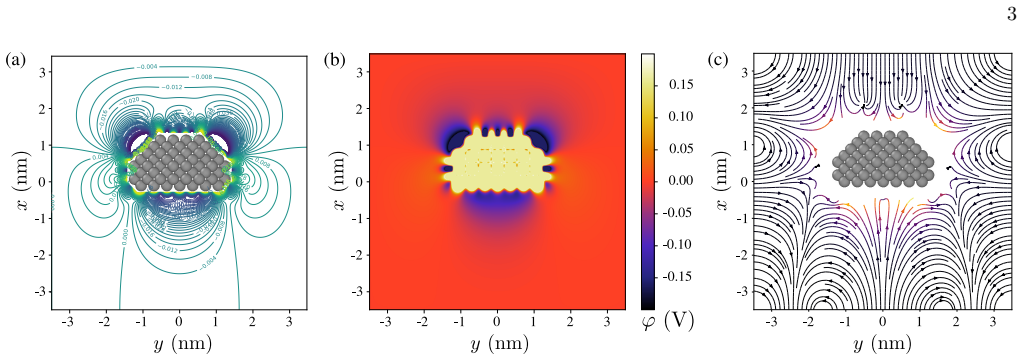
- The field strengthens as the cluster shrinks: the model and simulations give $E \sim R^{-1/2}$, so a $1$ nm hemisphere produces roughly $10^6$ V/cm while a $100$ nm hemisphere still produces $10^5$ V/cm.
- For a full sphere of the same material and radius, the shell-effect field is essentially absent; the residual electronic 'aura' field is an order of magnitude smaller and confined to about $1$ nm.
- The predicted field requires no external voltage, which suggests passive applications: attracting polar molecules to the flat face, enhancing Raman signals, and modifying local conductivity in semiconductor devices.
- The DFT results for lithium hemispheres of radii $1.4$, $2$, and $2.5$ nm are consistent with the layers model once near-surface electron spreading is taken into account.
Reading between the lines
- If the effect is generic, other symmetry-broken mesoscopic Fermi systems with shell structure—such as truncated metal islands, quantum-dot shells, or trapped ion clouds—should also develop a near-field potential gradient along the broken symmetry axis.
- The layers model neglects ionic relaxation and the surface dipole layer; including these could shift the oscillation amplitude and put an upper bound on the realizable field for a given material.
- A quantitative experimental check could use an array of hemispherical metallic islands as a field source and measure the force on a polar molecule or the shift in a scanning-probe-microscope resonance as a function of hemisphere radius and distance.
- The predicted scaling $E \sim R^{-1/2}$ implies that the field cannot be made arbitrarily large by shrinking the cluster; below some radius the jellium and continuum assumptions break down, placing a lower size limit on the effect.
Editorial analysis
A structured set of objections, weighed in public.
Referee Report
Summary. The paper argues that an isolated, uncharged submicron hemispherical metal cluster develops a strong electrostatic field near its flat face, with E ~ 10^8 V/m, and attributes this field to macroscopic quantum shell effects acting on the electron density. The argument is developed in two parts: first, a 'layers model' in which the shell-induced density oscillations of a spherical cluster are reflected onto a hemisphere and represented as five uniformly charged disks; second, real-space DFT simulations (GPAW, PBE, PAW) for Li hemispheres of R = 1.4, 2, and 2.5 nm, which show a long-range potential/field around the hemisphere and a much smaller field around a spherical cluster of the same radius. The paper also gives an R^{-1/2} scaling law and extrapolates the field to R = 10 and 100 nm, then sketches applications in electrostatic tweezers, SERS, and nanoelectronics.
Significance. If established, the reported effect would be a striking new manifestation of shell structure in mesoscopic systems and could have practical relevance for molecule manipulation and plasmonics. The DFT calculations are a genuine first-principles effort with real-space zero boundary conditions, and the authors include a domain-size check. The comparison between spherical and hemispherical clusters makes the existence of a long-range field plausible. However, the manuscript does not currently isolate the shell-effect mechanism from the conventional electrostatic field produced by the hemispherical geometry itself, and the quantitative layers model contains algebraic errors in Eqs. (2) and (4). Because the central causal claim and the quantitative predictions depend on these points, the paper needs substantial revision before the results can be considered established.
major comments (5)
- [Theoretical model, Eq. (2)] Equation (2) is dimensionally inconsistent as printed: the left-hand side contains a factor (R/2)^2, while the right-hand side is proportional to R^3. The natural reading is that the volume factor should be (4π/3)(R/2)^3, in which case the right-hand side coefficient 1/16 would indeed give (π/12)e n_e R^3/√N_e. As written, however, the equation mixes length^2 on the left with length^3 on the right, and this error propagates into ΔQe, σ±, and the predicted field magnitude. The authors should correct the formula and re-evaluate all numerical values that follow from it.
- [Theoretical model, Eq. (4)] Equation (4) violates the electroneutrality that the authors explicitly invoke. With charges -Q1, Q2, -Q3, Q4, -Q5 on the five disks, the total negative area is S_- = (1 + 3/4 + 1/16)πR^2 = 29πR^2/16 and the total positive area is S_+ = (15/16 + 1/2)πR^2 = 23πR^2/16. Electroneutrality requires |σ-| S_- = σ+ S_+, i.e. σ+ = 16ΔQe/(23πR^2) and |σ-| = 16ΔQe/(29πR^2). As printed, σ+ and σ- are interchanged, so the model's net charge is not zero. This is a load-bearing error because the surface charge densities determine the field magnitude in Eqs. (5)-(7).
- [DFT results and Fig. 3] The causal attribution of the field to quantum shell effects is not isolated from the ordinary electrostatic field of a truncated metal particle. A hemisphere necessarily has a flat face, an edge, and a surface-dipole distribution different from that of a sphere; even in a classical jellium model without shell oscillations, such a shape generates a net dipole/quadrupole field. The comparison with a spherical cluster (Fig. 3) does not control for this geometric contribution. To support the claim that the field is 'caused by' shell effects, the authors should add a no-shell control, for example a Thomas-Fermi or otherwise density-averaged calculation for the same hemispherical geometry, or subtract a smooth background from the DFT density and show that the residual oscillatory component produces the long-range field.
- [Scaling and extrapolation, Eqs. (1)-(9)] The theoretical scaling E ~ R^{-1/2} and the extrapolations to R = 10 and 100 nm rest on the assumption that the amplitude Δn_e ≈ n_e/√N_e and the extremum positions (R/4, R/2, R/√2) derived for spherical clusters in Refs. [7,8] transfer unchanged to the hemisphere. The manuscript does not test these assumptions against the hemispherical DFT: no comparison of the DFT density oscillations with the assumed amplitude and radii is provided, and the DFT covers only three sizes, so the R^{-1/2} law is not directly verified. The authors should either quantify how well the DFT density matches the assumed oscillations or explicitly label the scaling and the large-R extrapolation as model-dependent estimates.
- [DFT numerical methods] The quantitative claim E ~ 10^8 V/m needs a real-space grid convergence study. The manuscript reports a domain-size check (L = 9, 12, 16 nm) but no test of the grid spacing, despite stating that 'quite dense grids' are required; the results for R = 1.4 nm use a 700^3 grid, and it is unclear whether 600^3 or 800^3 would change the field values. In addition, ionic positions are kept fixed at the bulk bcc lattice and no ionic relaxation is considered, which may affect the electron spill-out and the field magnitude. Please add a grid-convergence test and discuss the effect of relaxation.
minor comments (4)
- [Abstract and text] The units of the field are inconsistent between the abstract and the body: the abstract states E ~ 10^8 V/m, while the text reports E ~ 10^7 V/cm for the model (equal to 10^9 V/m) and E ~ 2.0 × 10^6 V/cm for the DFT value (equal to 2 × 10^8 V/m). Please harmonize the units and clarify which number corresponds to which calculation.
- [Eq. (6)] The expansion in Eq. (6) treats the second disk as contributing a term proportional to 1 - (r + 0.25R)/R, but the exact expression in Eq. (5) contains (r - x_i) with x_2 = R/4; for r < R/4 the sign of the term matters. Please define r as a distance measured from the flat surface with a consistent positive direction and specify how the direction of each disk's field is handled when r is smaller than the disk's center coordinate.
- [Eq. (9)] Equation (9) writes E ~ 1/√R without a proportionality constant; since the left side has units of V/m and the right side has units of m^{-1/2}, the expression as printed is not dimensionally homogeneous. Please replace it with E = C/√R and state the value of C used in the extrapolations.
- [Applications and typos] There are minor language issues that should be corrected: 'demostrate' in the nanoelectronics paragraph, 'descent' in the description of Fig. 3c, and 'the field nears the flat surface' should read 'near the flat surface.' These do not affect the science but should be fixed in a revision.
Circularity Check
The theoretical magnitude and 1/sqrt(R) scaling are imported from the authors' earlier spherical-cluster results via self-citation, but the existence of the near field is independently tested by DFT, so circularity is partial.
-
self citation load bearing
[Theoretical model, Eqs. (1)–(4) and (9)]
"The following dependencies has been obtained for the amplitude of the electron density disturbance inside the cluster in Refs. [7, 8]: ∆ne ∼= ne/√Ne (1) ... The result (9), obtained from theoretical analysis, agrees with the numerical calculations presented in Fig.3c: the field near the flat surface of the hemisphere acts on the scale of the radius and decreases in magnitude according to Eq. (4)."
The quantitative prediction of the field magnitude and the size scaling E ~ 1/sqrt(R) (Eq. 9) is not derived in this paper from first principles; it is an algebraic consequence of the self-cited spherical-cluster amplitude ∆n_e ~ n_e/sqrt(N_e) (Eq. 1), together with N_e ~ R^3 and the assumed transfer of spherical extrema to the hemisphere. Because sigma ~ ∆Q/R^2 ~ R^{-1/2}, Eq. (9) is just Eq. (1) rearranged. The paper also states that the hemisphere density oscillations are obtained from the sphere 'by reflection,' without a derivation. Thus the large-cluster predictions (R = 10–100 nm) reduce to the authors' earlier spherical results [7,8]. The central existence claim is still independently supported by DFT, so the circularity is partial.
-
ansatz smuggled in via citation
[Semiclassical extension to hemisphere, Fig. 1a paragraph and Eq. (3)]
"This can be understood using the semiclassical Green’s function method similarly to Refs. [6–8] as follows. The closed periodic classical trajectories in a hemisphere are obtained similar to the ones in the sphere by reflection with respect to the flat part of the hemisphere as shown in Fig. 1a. This circumstance leads to the fact that the semiclassical theory applied for a sphere can be extended also to a hemisphere."
The extension of the spherical semiclassical density oscillations to the hemisphere is asserted by citing Refs. [6–8], which treat spherical systems, and by claiming reflection symmetry of closed orbits. The three extremum positions (R/4, R/2, R/sqrt(2)) used to place the five charged disks in Eq. (3) are taken from the authors' earlier spherical work without re-derivation for the hemisphere. Consequently, the 'layers model' prediction rests on an ansatz imported through self-citation rather than on a calculation performed in this paper. The independent DFT simulation provides partial external support, but the theoretical derivation itself is not self-contained.
full rationale
The paper's central empirical claim — that an isolated, uncharged submicron hemispherical metal cluster generates a strong electrostatic field near its flat surface — is verified by independent GPAW DFT simulations (Figs. 2, 3), which compute the electrostatic potential from the nuclear positions and the Hartree potential without using the layers model. This means the existence of the field is not circularly derived from the model. However, the quantitative 'theoretical analysis' is not self-contained: Eq. (1) for the shell-effect density amplitude and the three extrema positions are imported verbatim from the authors' own prior Refs. [7,8], and the extension to the hemisphere is asserted by reflection. Equations (2)–(9) are then algebraic consequences of that imported amplitude (N_e ∝ R^3 ⇒ σ ∝ R^{-1/2} ⇒ E ∝ R^{-1/2}), so the size scaling and large-cluster extrapolations reduce to the earlier self-cited result. No adjustable parameters are fitted to the DFT, and no uniqueness theorem is invoked, so the circularity is partial rather than total. The main unaddressed threat is the absence of a classical no-shell hemisphere control to separate the shell-effect field from ordinary spill-out/dipole fields; that is a correctness/control issue, not a circularity.
Assumptions & free parameters
free parameters (2)
- Electron density disturbance amplitude Δn_e = n_e/√N_e =
n_e/√N_e (adopted from Refs [7,8])
- Layer model radii and positions =
R1=R at x=0, R2=√(15/16)R at x=R/4, R3=√(3/4)R at x=R/2, R4=R/√2 at x=R/√2, R5=R/4 at x=√(15/16)R
assumptions (4)
- domain assumption Semiclassical closed-orbit picture for a hemispherical well is obtained from the sphere by mirror reflection at the flat face, preserving the dominant (3,1) and (4,1) orbits.
- domain assumption The electron density disturbance amplitude and extremum positions from spherical clusters (Eq. (1) and Eq. (3)) apply unchanged in magnitude to the hemispherical cluster.
- domain assumption DFT-PBE with a PAW pseudopotential for Li at these cluster sizes accurately captures the shell-effect density oscillations and the electrostatic potential outside the cluster.
- domain assumption Ionic positions remain fixed at the ideal bcc lattice; no relaxation, thermal motion, or surface reconstruction is included.
Cite this review
Pith. "Pith review of Extraordinary manifestation of near electrostatic field caused by macroscopic quantum shell effects in submicron hemispherical clusters." pith.science (2026). https://pith.science/paper/ZKGHPS7M
@misc{pith2026250104708,
  author       = {Pith},
  title        = {Pith review of: Extraordinary manifestation of near electrostatic field caused by macroscopic quantum shell effects in submicron hemispherical clusters},
  year         = {2026},
  howpublished = {\url{https://pith.science/paper/ZKGHPS7M}},
  note         = {Machine review of arXiv:2501.04708}
}
abstract
The existence of macroscopic shell structure of submicron metal clusters is known for several decades. Since the most studies provide theoretical analysis for clusters of spherical shape, the electron density inhomogeneities caused by shell effects are spherically symmetric and do not provide long range electrostatic fields. However, similar shell structure should exist in a hemispherical cluster which conserves the closed periodic orbits of electrons, but not the spherical symmetry of electron distribution. As a result, we demonstrate that a strong electrostatic field ($E \sim 10^8$~V/m) exists in the vicinity of the flat surface of an isolated, uncharged metal nanocluster of hemispherical shape using modern approaches for electronic structure evaluation. This physical phenomenon is a consequence of the large-scale spatial inhomogeneity in distribution of electrons related to quantum shell effects in submicron metal clusters, which may find numerous applications in various fields of science and technology.
Figures


Reference graph
Works this paper leans on
-
[1]
the jellium model for ions and the quantum me- chanical models (HF, DFT, etc.) for electrons
-
[2]
inVASP[3]andotherwell-knownDFT packages)
the direct numerical simulation of the self- consistent field of electrons and ions (as imple- mentede.g. inVASP[3]andotherwell-knownDFT packages)
-
[3]
theanalyticalmethodofsemiclassicalGreen’sfunc- tions (trace formula [4]). As shown in Ref. [2], Approach 1 is extensively applied for spherically symmetric clusters, as soon as the prob- lem is reduced to the one-dimensional case. This allows to evaluate some properties of large clusters up to tens of thousands of atoms. Approach 2 in general is related t...
work page Pith review arXiv 2025
-
[4]
W. A. De Heer, Rev. Mod. Phys.65, 611 (1993)
work page 1993
- [5]
- [6]
-
[7]
M. C. Gutzwiller,Chaos in Classical and Quantum Me- chanics, Vol. 1 (Springer Science & Business Media, 2013)
work page 2013
- [8]
Show all 27 references
-
[9]
Roccia, M
J. Roccia, M. Brack, and A. Koch, Phys. Rev. E 81, 011118 (2010)
2010
-
[10]
S. E. Kuratov, D. S. Shidlovski, and S. I. Blinnikov, Physics of Plasmas26, 022709 (2019)
2019
-
[11]
S. E. Kuratov, D. S. Shidlovski, S. I. Blinnikov, and S. Y. Igashov, Phys. Usp.64, 836 (2021)
2021
-
[12]
S. E. Kuratov, I. S. Menshov, S. Y. Igashov, E. M. Urvachev, S. I. Blinnikov, D. S. Shidlovski, and S. I. Glazyrin, Phys. Rev. E108, 045203 (2023)
2023
-
[13]
S. E. Kuratov, Y. E. Lozovik, and S. Y. Igashov, J. Appl. Phys. 136, 083105 (2024)
2024
-
[14]
J. H. Stenlid, A. J. Johansson, and T. Brinck, Phys. Chem. Chem. Phys.21, 17001 (2019)
2019
-
[15]
Enkovaara, C
J. Enkovaara, C. Rostgaard, J. J. Mortensen, J. Chen, M. Du lak, L. Ferrighi, J. Gavnholt, C. Glinsvad, V. Haikola, and H. A. H. et al., Journal of Physics: Condensed Matter 22, 253202 (2010)
2010
-
[16]
P. E. Bl¨ ochl, Phys. Rev. B50, 17953 (1994)
1994
-
[17]
J. P. Perdew, M. Ernzerhof, and K. Burke, The Journal of Chemical Physics105, 9982 (1996)
1996
-
[18]
De Vlaminck and C
I. De Vlaminck and C. Dekker, Annual review of bio- physics 41, 453 (2012)
2012
-
[19]
Zhang, L
W. Zhang, L. Huang, C. Santschi, and O. J. Martin, Nano letters 10, 1006 (2010)
2010
-
[20]
D. Fan, F. Zhu, R. Cammarata, and C. Chien, Nano Today 6, 339 (2011)
2011
-
[21]
J. Xu, Z. Lei, J. Guo, J. Huang, W. Wang, U. Reibetanz, and S. Xu, Nano-Micro Letters8, 270 (2016)
2016
-
[22]
Sharma, R
B. Sharma, R. R. Frontiera, A.-I. Henry, E. Ringe, and R. P. Van Duyne, Materials today15, 16 (2012)
2012
-
[23]
F.P.Zamborini, L.Bao, andR.Dasari,Analyticalchem- istry 84, 541 (2012)
2012
-
[24]
R. E. Estrada-Salas, H. Barr´ on, A. A. Valladares, and M. Jos´ e-Yacam´ an, International Journal of Quantum Chemistry 112, 3033 (2012)
2012
-
[25]
Chen and H
Y. Chen and H. Ming, Photonic Sensors2, 37 (2012)
2012
-
[26]
Hossain, M
N. Hossain, M. H. Mobarak, M. A. Mimona, M. A. Islam, A.Hossain, F.T.Zohura, andM.A.Chowdhury,Results in Engineering 19, 101347 (2023)
2023
-
[27]
Z. Ma, Z. Li, K. Liu, C. Ye, and V. J. Stoger, Nanopho- tonics 4, 198 (2015)
2015
Reviewed August 11, 2026 · model on record in the stance chip above.
Discussion (0). Continue with ORCID to comment.