REVIEW 4 major objections 5 minor 31 references
LSEBMCL: A Latent Space Energy-Based Model for Continual Learning
T0 review · 4 major / 5 minor · reviewed 2026-08-10 · deepseek-v4-flash
Pith's one-line read Energy-based replay lifts continual NLP learning to 77.3
desk verdict A plausible new combination of latent EBM and generative replay for NLP continual learning, but the method as written is not reproducible: the replay loop is unspecified, the energy equations are inconsistent, and hyperparameters are tuned on test sets. read the letter →
The pith
A machine-rendered reading of the paper's core claim, the machinery that carries it, and where it could break.
The reading
What carries the argument
The central mechanism is the latent-space EBM layer acting as an outer-generator. An energy-based model assigns low energy to likely inputs and high energy to unlikely ones; here it defines a prior $p_\alpha(z)$ over dense latent vectors $z$ as an energy-based correction of a Gaussian, with the energy function given by $E(z)=F_\alpha(z)-\frac{1}{2\sigma^2}\|z\|^2$, where $F_\alpha$ is a small MLP. After each task, short-run Langevin dynamics (equation 14) draw latent samples from this prior, and a generative decoder maps them to pseudo-inputs of previous tasks, which are then replayed during training on the next task. This replay signal is what carries the anti-forgetting argument: old knowledge is preserved because the model keeps seeing generated versions of its earlier data.
What would settle it
Train LSEBMCL on the five DecaNLP tasks but replace the EBM-generated samples with samples generated by the base Mistral model itself at the same 5% ratio; if the average score does not drop meaningfully, the EBM prior is not the load-bearing component, and the reported gains could come from the QA format or replay fraction.
Extended reading notes
Core claim
LSEBMCL claims that catastrophic forgetting in continual NLP learning can be substantially reduced by training an energy-based model in the latent space of the pretrained language model after each task, then drawing pseudo-samples of earlier tasks from this EBM prior via short-run Langevin dynamics and mixing them into the training data of the next task. The energy function is defined as a sum over tasks of negative log-likelihood terms, and the EBM prior takes the form $p_\alpha(z) \propto \exp[F_\alpha(z)]p_0(z)$, an energy-based correction of an isotropic Gaussian reference. The authors report state-of-the-art results across all experiments, including 77.3 average on five DecaNLP tasks (SQuAD 2.0, WikiSQL, SST, QA-SRL, WOZ) and 80.2 average accuracy on the four text classification orders, outperforming replay, regularization, and parameter-isolation baselines.
Load-bearing premise
The method assumes that pseudo-samples drawn from the latent EBM prior faithfully represent previous tasks well enough that replaying them preserves old-task performance.
Editorial extensions
If this is right
- Continual NLP models can be trained over long task sequences without storing raw user data, since the EBM prior and its parameters are the only retained trace of previous tasks.
- The reported 5% sampling ratio reaching near-upper-bound performance suggests generative replay can be highly sample-efficient, reducing memory and compute relative to large exemplar buffers.
- Because the method relies on no task-specific parameters, it can be applied to task-agnostic continual learning settings where task identity is not available during inference.
- The same outer-generator EBM pattern could extend to other sequence modalities, such as speech or code, provided a generative decoder for latent vectors exists.
Reading between the lines
- The paper does not ablate the EBM against the base language model's own generated samples at the same sampling ratio; a natural test is whether replacing the EBM with the LM's own generation changes the reported scores.
- Because the experiments are task-incremental with known task boundaries, an open extension is whether LSEBMCL handles boundary-agnostic or class-incremental continual learning, where the EBM would need to be updated online.
- One could test the memory claim directly by measuring how the EBM-generated samples' text quality changes as the task sequence grows, and whether quality predicts forgetting.
- The latent-space EBM is trained per task; sharing a single continuously updated EBM across tasks could remove the need to keep per-task model copies.
Signed reviews
Editorial analysis
A structured set of objections, weighed in public.
Referee Report
Summary. The manuscript proposes LSEBMCL, a continual learning method for natural language processing tasks that uses a latent-space energy-based model (EBM) as a generative replay mechanism. The method is built on a Mistral 7B backbone and casts all tasks as question answering. After each task, the EBM is said to generate pseudo-samples of previous tasks, which are replayed when training on new tasks. The paper reports experiments on three small datasets under permuted task orders, on five DecaNLP tasks, and on four text classification datasets, claiming state-of-the-art results across all setups and near-multitask upper-bound performance. The central claim is that the EBM-based replay prevents catastrophic forgetting and outperforms prior replay, regularization, and architecture-based baselines.
Significance. If the proposed mechanism were fully specified and the empirical results were reproducible, the work would be a meaningful contribution: it applies latent-space EBMs to continual learning for NLP, addresses a broad set of tasks in a unified QA format, and reports low replay ratios with strong average performance. The paper also compares against multiple baselines and examines robustness to task order in the small-scale experiment. However, the significance is conditional on the method being implementable as described and on the reported gains being statistically credible. The manuscript currently lacks a complete specification of the replay loop, provides no code, and selects hyperparameters on test sets, so the central empirical claim cannot be credited in its present form. The stress-test concern about the missing link between sampling the latent variable and generating replay pairs is substantiated by the text.
major comments (4)
- [III-D, Eqs. (14)-(15)] The generative replay mechanism is not specified. Section III-D states that after training each task, the EBM generates samples based on data from previous tasks, and Eq. (14) draws z from the EBM prior pα(z) via short-run Langevin dynamics. However, no equation or procedure maps z to a previous-task replay pair (x, y). The decoder pβ(x|z) appears in Eq. (10), but it is never connected to the conditional distribution p(ym|xm) used in Eq. (6), and the answer component y is not generated at all. Moreover, no training objective is given for the prior parameters α: Eq. (11) trains β by maximum likelihood, but the parameters of pα(z) are never optimized. As written, the replay loop cannot be run, so the gains reported in Tables II-IV cannot be attributed to EBM-generated replay rather than to the Mistral initialization, the QA formatting, or the replay fraction γ.
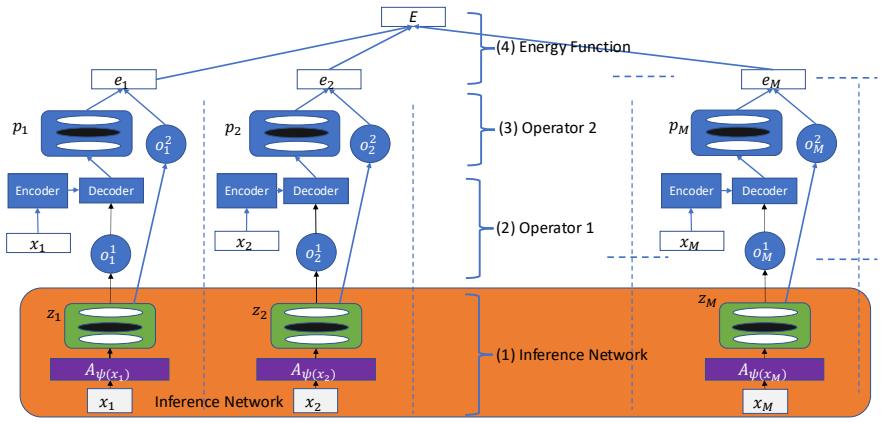
- [III-B, III-C, III-D, Eqs. (4)-(6)] The energy function is internally inconsistent. Eq. (4) defines em(x, y) = −o2(zm) log pΘ(·|o1(zm), xm), while Eq. (6) defines em(x, y) = −log p(ym|xm). It is unclear which definition is actually minimized, how the softmax operators o1 and o2 are applied, and why both definitions appear in the same section. Eq. (5) also sums em over the task index m inside EΘ(x, y) for a single example, which conflates task identity with example identity. These ambiguities prevent a reader from reproducing the energy function or the training objective.
- [IV-A, Table I; IV-B, Tables II-IV] The experimental evaluation selects hyperparameters on the test sets. Table I explicitly states, "AS THIS WORK USES NO DEVELOPMENT SET, ONLY THE TRAINING AND TEST DATASETS ARE SHOWN." The results in Tables II-IV compare LSEBMCL across sampling ratios γ (0, 0.05, 0.2) and report the best configuration as the main result. Without a development set, there is no evidence that the reported γ values were not chosen based on test-set performance. Additionally, no confidence intervals or significance tests are provided, and Table IV reports averages over only two runs. The claim of state-of-the-art performance is therefore not statistically supported.
- [III-D, IV-B] There is no ablation that isolates the contribution of the EBM replay. The paper's core premise is that latent-space EBMs produce pseudo-samples of previous tasks that prevent forgetting, but it never evaluates sample quality, shows example generations, or compares against LAMOL's language-model-generated replay at the same replay ratio. Without such an ablation, the reported improvements cannot be attributed to the energy-based prior rather than to other components such as the QA formatting, the choice of Mistral 7B as the backbone, or the increased replay fraction.
minor comments (5)
- [III-D, Eq. (8)] The notation in Eq. (8) is confusing: pα(z) is written as "exp[Fα(z) − 1/2σ²∥z∥²] = exp E(z)" without specifying the normalization constant in the equality, and the definition of E(z) is then given separately. Please make the proportionality explicit and define E(z) before writing the exponent.
- [III-D, Eq. (9)] Eq. (9) assumes x ∈ R^D and uses a Gaussian noise model, yet the text models are autoregressive over discrete tokens. The relationship between the continuous latent-space assumption and the discrete text generation model should be clarified.
- [III-A, Figure 1] The inference network in Eq. (2) is defined as AΨ(x) ≈ argmin_y EΘ(x, y), i.e., it predicts labels, but the Figure 1 caption describes it as generating encoded representations z. These two roles should be reconciled.
- [IV-B, Table II] The column headers of Table II list all six task permutations but are not labeled as distinct orders, making the table difficult to interpret. Please add clear headers or a legend.
- [Abstract and I] The abstract and introduction claim "state-of-the-art results in all experiments," but the comparisons are limited to specific baselines and the statistical support is weak. A more measured claim would be appropriate.
Circularity Check
No circular reduction found; the underspecified replay loop and test-set hyperparameter selection are non-circular concerns.
full rationale
We find no circular step of the kind the analysis targets. The energy in Eqs. (5)-(6) is an ordinary negative log-likelihood, and the inference network in Eq. (3) is trained to minimize that same energy, which is a standard MLE classification objective rather than a quantity defined in terms of the reported results. The latent-space EBM prior of Eq. (8) is adopted from the cited work of Pang et al. [2], and the Langevin dynamics of Eqs. (14)-(15) are standard MCMC updates; no fitted constant or self-citation secretly encodes the Table III or Table IV scores. The empirical claims are benchmarked against external methods using the same Mistral 7B backbone, so the central comparison is not forced by construction. Two genuine concerns do arise, but both are non-circular. First, the paper states in Section III-D that the EBM 'generates samples based on data from previous tasks,' yet no equation maps a sampled latent z to a replay pair (x,y); the replay loop is underspecified, so the attribution of the reported gains to EBM-generated replay cannot be verified. Second, the Table I caption explicitly notes that 'this work uses no development set, only the training and test datasets are shown,' meaning hyperparameters such as the sampling ratio gamma are effectively selected on the test sets, which adds selection pressure to the reported state-of-the-art scores. Neither concern is a circular reduction of the form Eq. X = Eq. Y by construction, and neither is a load-bearing self-citation chain; therefore the circularity score is 0.
Assumptions & free parameters
free parameters (4)
- sampling ratio gamma (GEN) =
0, 0.05, 0.2
- Langevin step size s and number of steps K =
s unspecified; K = 20
- EBM MLP F_alpha and sigma^2 =
unspecified
- top-k sampling parameter =
k=1 for LSEBMCL; k=20 for LAMOL
assumptions (5)
- domain assumption Short-run Langevin dynamics with a fixed number of steps approximates samples from the EBM prior/posterior well enough for replay.
- domain assumption The pretrained Mistral 7B backbone provides a base that makes replay-based continual fine-tuning effective.
- domain assumption Converting all tasks to a unified QA format loses no task-relevant information.
- ad hoc to paper Test-set scores can be used to select hyperparameters because no development set is used.
- ad hoc to paper The energy function in Eq. (5)-(6) correctly represents the generative model used for replay.
Cite this review
Pith. "Pith review of LSEBMCL: A Latent Space Energy-Based Model for Continual Learning." pith.science (2026). https://pith.science/paper/52PUJH7T
@misc{pith2026250105495,
  author       = {Pith},
  title        = {Pith review of: LSEBMCL: A Latent Space Energy-Based Model for Continual Learning},
  year         = {2026},
  howpublished = {\url{https://pith.science/paper/52PUJH7T}},
  note         = {Machine review of arXiv:2501.05495}
}
read the original abstract
Continual learning has become essential in many practical applications such as online news summaries and product classification. The primary challenge is known as catastrophic forgetting, a phenomenon where a model inadvertently discards previously learned knowledge when it is trained on new tasks. Existing solutions involve storing exemplars from previous classes, regularizing parameters during the fine-tuning process, or assigning different model parameters to each task. The proposed solution LSEBMCL (Latent Space Energy-Based Model for Continual Learning) in this work is to use energy-based models (EBMs) to prevent catastrophic forgetting by sampling data points from previous tasks when training on new ones. The EBM is a machine learning model that associates an energy value with each input data point. The proposed method uses an EBM layer as an outer-generator in the continual learning framework for NLP tasks. The study demonstrates the efficacy of EBM in NLP tasks, achieving state-of-the-art results in all experiments.
Figures
Reference graph
Works this paper leans on
-
[1]
Continual lifelong learning with neural networks: A review,
G. I. Parisi, R. Kemker, J. L. Part, C. Kanan, and S. Wermter, “Continual lifelong learning with neural networks: A review,” Neural Networks, vol. 113, pp. 54–71, 2019
2019
-
[2]
Learning latent space energy-based prior model,
B. Pang, T. Han, E. Nijkamp, S.-C. Zhu, and Y . N. Wu, “Learning latent space energy-based prior model,” Advances in Neural Information Processing Systems, vol. 33, pp. 21 994–22 008, 2020
work page 2020
-
[3]
Energy-based models for continual learning,
S. Li, Y . Du, G. van de Ven, and I. Mordatch, “Energy-based models for continual learning,” in Conference on Lifelong Learning Agents. PMLR, 2022, pp. 1–22
work page 2022
-
[4]
Prompt conditioned vae: Enhancing generative replay for lifelong learning in task-oriented dialogue,
Y . Zhao, Y . Zheng, Z. Tian, C. Gao, B. Yu, H. Yu, Y . Li, J. Sun, and N. L. Zhang, “Prompt conditioned vae: Enhancing generative replay for lifelong learning in task-oriented dialogue,” arXiv preprint arXiv:2210.07783, 2022
-
[5]
V . Varshney, M. Patidar, R. Kumar, L. Vig, and G. Shroff, “Prompt augmented generative replay via supervised contrastive learning for life- long intent detection,” in Findings of the Association for Computational Linguistics: NAACL 2022 , 2022, pp. 1113–1127
work page 2022
-
[6]
Overcoming catastrophic forgetting during domain adaptation of seq2seq language generation,
D. Li, Z. Chen, E. Cho, J. Hao, X. Liu, F. Xing, C. Guo, and Y . Liu, “Overcoming catastrophic forgetting during domain adaptation of seq2seq language generation,” in Proceedings of the 2022 Conference of the North American Chapter of the Association for Computational Linguistics: Human Language Technologies , 2022, pp. 5441–5454
work page 2022
-
[7]
Continual few-shot intent detection,
G. Li, Y . Zhai, Q. Chen, X. Gao, J. Zhang, and Y . Zhang, “Continual few-shot intent detection,” in Proceedings of the 29th International Conference on Computational Linguistics , 2022, pp. 333–343
work page 2022
-
[8]
Continual prompt tuning for dialog state tracking,
Q. Zhu, B. Li, F. Mi, X. Zhu, and M. Huang, “Continual prompt tuning for dialog state tracking,” arXiv preprint arXiv:2203.06654 , 2022
arXiv 2022
Show all 31 references
-
[9]
LFPT5: A unified framework for lifelong few-shot language learning based on prompt tuning of t5,
C. Qin and S. Joty, “LFPT5: A unified framework for lifelong few-shot language learning based on prompt tuning of t5,” in International Conference on Learning Representations , 2022. [Online]. Available: https://openreview.net/forum?id=HCRVf71PMF
2022
-
[10]
icarl: Incremental classifier and representation learning,
S.-A. Rebuffi, A. Kolesnikov, G. Sperl, and C. H. Lampert, “icarl: Incremental classifier and representation learning,” in Proceedings of the IEEE conference on Computer Vision and Pattern Recognition, 2017, pp. 2001–2010
2017
-
[11]
Gradient episodic memory for continual learning,
D. Lopez-Paz and M. Ranzato, “Gradient episodic memory for continual learning,” Advances in neural information processing systems , vol. 30, pp. 6467–6476, 2017
2017
-
[12]
Lamol: Language modeling for lifelong language learning,
F.-K. Sun, C.-H. Ho, and H.-Y . Lee, “Lamol: Language modeling for lifelong language learning,” arXiv preprint arXiv:1909.03329 , 2019
1909 arXiv
-
[13]
Learning without forgetting,
Z. Li and D. Hoiem, “Learning without forgetting,” IEEE transactions on pattern analysis and machine intelligence , vol. 40, no. 12, pp. 2935– 2947, 2017
2017
-
[14]
Memory aware synapses: Learning what (not) to forget,
R. Aljundi, F. Babiloni, M. Elhoseiny, M. Rohrbach, and T. Tuytelaars, “Memory aware synapses: Learning what (not) to forget,” inProceedings of the European Conference on Computer Vision (ECCV) , 2018, pp. 139–154
2018
-
[15]
Continual learning for text classification with information disentanglement based regularization,
Y . Huang, Y . Zhang, J. Chen, X. Wang, and D. Yang, “Continual learning for text classification with information disentanglement based regularization,” arXiv preprint arXiv:2104.05489 , 2021
2021 arXiv
-
[16]
Lpc: A logits and parameter calibration framework for continual learning,
X. Li, Z. Wang, D. Li, L. Khan, and B. Thuraisingham, “Lpc: A logits and parameter calibration framework for continual learning,” in Findings of the Association for Computational Linguistics: EMNLP 2022 , 2022, pp. 7142–7155
2022
-
[17]
Packnet: Adding multiple tasks to a single network by iterative pruning,
A. Mallya and S. Lazebnik, “Packnet: Adding multiple tasks to a single network by iterative pruning,” in Proceedings of the IEEE conference on Computer Vision and Pattern Recognition , 2018, pp. 7765–7773
2018
-
[18]
Overcoming catas- trophic forgetting with hard attention to the task,
J. Serra, D. Suris, M. Miron, and A. Karatzoglou, “Overcoming catas- trophic forgetting with hard attention to the task,” in International Conference on Machine Learning . PMLR, 2018, pp. 4548–4557
2018
-
[19]
A tutorial on energy-based learning,
Y . LeCun, S. Chopra, R. Hadsell, M. Ranzato, and F. Huang, “A tutorial on energy-based learning,” Predicting structured data , vol. 1, no. 0, 2006
2006
-
[20]
A theory of generative convnet,
J. Xie, Y . Lu, S.-C. Zhu, and Y . Wu, “A theory of generative convnet,” in International Conference on Machine Learning . PMLR, 2016, pp. 2635–2644
2016
-
[21]
Learning non-convergent non-persistent short-run mcmc toward energy-based model,
E. Nijkamp, M. Hill, S.-C. Zhu, and Y . N. Wu, “Learning non-convergent non-persistent short-run mcmc toward energy-based model,” Advances in Neural Information Processing Systems , vol. 32, 2019
2019
-
[22]
Joint energy- based model training for better calibrated natural language understanding models,
T. He, B. McCann, C. Xiong, and E. Hosseini-Asl, “Joint energy- based model training for better calibrated natural language understanding models,” arXiv preprint arXiv:2101.06829 , 2021
2021 arXiv
-
[23]
Energy-based models for anomaly detection: A manifold diffusion recovery approach,
S. Yoon, Y .-U. Jin, Y .-K. Noh, and F. C. Park, “Energy-based models for anomaly detection: A manifold diffusion recovery approach,” arXiv preprint arXiv:2310.18677, 2023
2023 arXiv
-
[24]
Mistral 7b,
A. Q. Jiang, A. Sablayrolles, A. Mensch, C. Bamford, D. S. Chaplot, D. d. l. Casas, F. Bressand, G. Lengyel, G. Lample, L. Saulnier et al., “Mistral 7b,” arXiv preprint arXiv:2310.06825 , 2023
2023 arXiv
-
[25]
The natural language decathlon: Multitask learning as question answering,
B. McCann, N. S. Keskar, C. Xiong, and R. Socher, “The natural language decathlon: Multitask learning as question answering,” arXiv preprint arXiv:1806.08730, 2018
2018 arXiv
-
[26]
Episodic memory in lifelong language learning,
C. de Masson D’Autume, S. Ruder, L. Kong, and D. Yogatama, “Episodic memory in lifelong language learning,” Advances in Neural Information Processing Systems , vol. 32, 2019
2019
-
[27]
Rvae-lamol: Residual variational autoencoder to enhance lifelong language learning,
H. Wang, R. Fu, X. Zhang, and J. Zhou, “Rvae-lamol: Residual variational autoencoder to enhance lifelong language learning,” in 2022 International Joint Conference on Neural Networks (IJCNN) . IEEE, 2022, pp. 1–9
2022
-
[28]
Gener- ative replay inspired by hippocampal memory indexing for continual language learning,
A. Maekawa, H. Kamigaito, K. Funakoshi, and M. Okumura, “Gener- ative replay inspired by hippocampal memory indexing for continual language learning,” in Proceedings of the 17th Conference of the European Chapter of the Association for Computational Linguistics , 2023, pp. 930–942
2023
-
[29]
Prototype-guided memory replay for continual learning,
S. Ho, M. Liu, L. Du, L. Gao, and Y . Xiang, “Prototype-guided memory replay for continual learning,” IEEE Transactions on Neural Networks and Learning Systems , 2023
2023
-
[30]
Progress & compress: A scalable framework for continual learning,
J. Schwarz, W. Czarnecki, J. Luketina, A. Grabska-Barwinska, Y . W. Teh, R. Pascanu, and R. Hadsell, “Progress & compress: A scalable framework for continual learning,” in International conference on ma- chine learning. PMLR, 2018, pp. 4528–4537
2018
-
[31]
Progressive prompts: Continual learning for language models,
A. Razdaibiedina, Y . Mao, R. Hou, M. Khabsa, M. Lewis, and A. Alma- hairi, “Progressive prompts: Continual learning for language models,” arXiv preprint arXiv:2301.12314 , 2023
2023 arXiv
Reviewed August 10, 2026 · model on record in the stance chip above.
Discussion (0). Continue with ORCID to comment.