REVIEW 3 major objections 5 minor 38 references
Exploring Pose-Based Anomaly Detection for Retail Security: A Real-World Shoplifting Dataset and Benchmark
T0 review · 3 major / 5 minor · reviewed 2026-08-10 · deepseek-v4-flash
Pith's one-line read This paper introduces PoseLift, a real-store CCTV dataset of anonymized pose sequences for shoplifting, and shows that pose-based unsupervised anomaly detectors can flag genuine concealment behavior, with the best model reaching 67.46%…
desk verdict PoseLift is a genuinely useful privacy-preserving real-world shoplifting pose dataset, but the benchmark results don't support the 'high accuracy' claim and need a statistically honest evaluation. read the letter →
The pith
A machine-rendered reading of the paper's core claim, the machinery that carries it, and where it could break.
The reading
What carries the argument
The load-bearing object is the PoseLift extraction pipeline: YOLOv8 detects people, ByteTrack assigns persistent person IDs, HRNet produces COCO17 2D keypoints, linear interpolation fills missing poses, and an 8-frame window smooths the tracks. Frame-level annotations (0/1) mark shoplifting as any frame with item concealment into pockets, bags, or clothing. The evaluation machinery is the unsupervised training/test split, with 53,353 normal frames for training and a test set balanced between 1,500 anomalous and 2,221 normal frames, scored by AUC-ROC, AUC-PR, and EER.
What would settle it
Run the best STG-NF model trained on PoseLift's training split on a second, independently collected set of shoplifting videos from the same store; if its AUC-ROC drops to near chance while humans viewing the same pose sequences can still identify the concealment frames, the dataset does not preserve the behavioral signal the paper claims.
Extended reading notes
Core claim
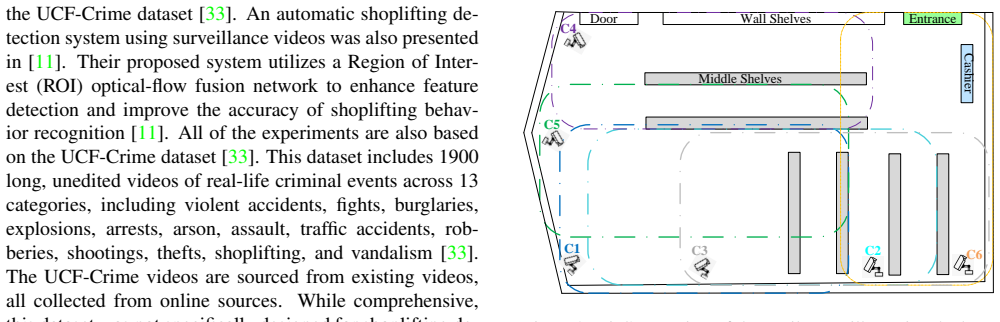
PoseLift is among the first shoplifting datasets drawn from real store CCTV rather than staged actors, and it is the first to release pose sequences instead of raw pixels. The paper's central claim is that this abstract body-keypoint representation preserves enough of the concealing motion that unsupervised pose-based anomaly detectors, trained only on normal shopping behavior, can separate shoplifting from routine activity. Evidence is the benchmark of three models: STG-NF (normalizing flows) reaches 67.46% AUC-ROC and 84.06% AUC-PR; TSGAD (variational autoencoder, pose branch) reaches 63.35% AUC-ROC; GEPC (graph embedded pose clustering) reaches 60.61% AUC-ROC, all with EER near 0.38–0.41. The paper also claims the dataset addresses privacy and bias by design, and documents a false-positive case where normal actions such as phone use from a pocket are scored as anomalous.
Load-bearing premise
The load-bearing premise is that the automated pose-extraction pipeline—YOLOv8, ByteTrack, HRNet keypoints, interpolation, and the 8-frame smoothing window—keeps the behavioral signal of shoplifting intact despite high-angle views, shelf occlusions, and 15 fps capture; if the pose tracks become too noisy or lose the concealment motion, the benchmark cannot support conclusions about pose-based shoplifting detection.
Editorial extensions
If this is right
- If pose-based unsupervised detection works on PoseLift, retail security systems can analyze body-keypoint streams in real time without storing or transmitting identifiable video.
- Shoplifting detection can be treated as an anomaly detection problem: a model trained on a store's normal shopping patterns can flag unusual concealment behavior without labeled theft examples.
- The benchmark establishes STG-NF as the reference baseline for future work on PoseLift.
- Because the dataset contains six camera views and multiple concealment styles, models trained on it may generalize across aisle layouts better than single-view staged datasets.
- PoseLift's public release gives the research community a way to compare methods on genuine shoplifting data while avoiding the privacy restrictions that block raw video sharing.
Reading between the lines
- A natural next test is to run the same models on raw video from the same store under identical train/test splits; if raw-video models substantially exceed 67.46% AUC-ROC, then pose extraction is discarding behavior the benchmark cannot see.
- The false-positive example hints that pocket-related normal actions such as phone use resemble concealment; an extension would add hand-object interaction cues or trajectory-level context to reduce this confusion.
- Because training uses only normal frames, PoseLift could support continual adaptation: a store could retrain on its own normal footage and deploy without any theft labels.
- The imbalance between 43 shoplifting scenarios and 19 normal test scenarios means the reported EER should be read with care; a larger normal test set would tighten the estimate.
Editorial analysis
A structured set of objections, weighed in public.
Referee Report
Summary. The paper introduces PoseLift, a privacy-preserving dataset of human pose sequences extracted from real CCTV footage of a retail store, with frame-level labels for normal shopping and shoplifting. It frames shoplifting detection as unsupervised pose-based anomaly detection and benchmarks three existing models (STG-NF, TSGAD, GEPC) with AUC-ROC, AUC-PR, and EER. The best result is STG-NF with AUC-ROC 67.46%, AUC-PR 84.06%, and EER 0.39 on a test set of 2,221 normal and 1,500 anomalous frames from 19 normal and 43 shoplifting scenarios.
Significance. If the claims are supported, PoseLift would be a useful community resource because it is one of the first real-world retail shoplifting datasets in pose form, with six camera views and de-identified annotations, and it directly addresses privacy concerns that limit raw-video datasets. The benchmark is a reasonable starting point: the models are from prior work, the training/test separation is described, and the authors include a failure-case analysis. The dataset contribution is therefore credible, but the paper's headline accuracy claim currently exceeds what the evidence shows.
major comments (3)
- [Abstract; Sec. 6, Table 3] The abstract states that pose-based approaches “achieve high detection accuracy,” but the best measured results are AUC-ROC 67.46% and EER 0.39. At the EER operating point, 39% of frames are misclassified, and the AUC-ROC is only modestly above the 50% chance level, with no chance-level baseline or confidence interval reported. Please either soften the claim to “feasibility” or support “high accuracy” with per-scenario results and statistical intervals.
- [Sec. 6, Table 2] The evaluation uses frame-level metrics over 2,221 normal and 1,500 anomalous frames, but these frames are strongly autocorrelated within the 19 normal and 43 shoplifting scenarios. The effective independent sample size is therefore dozens, not thousands. Reporting AUC-ROC, AUC-PR, and EER without bootstrap confidence intervals, multiple seeds, or scenario-level aggregation makes it impossible to determine whether the best model is above chance. Please add a random baseline, per-scenario scores, and confidence intervals.
- [Sec. 3.2] The pose extraction pipeline is a central assumption of the benchmark: YOLOv8 plus ByteTrack plus HRNet with linear interpolation, an 8-frame smoothing window, and per-camera region-of-interest masks. The paper provides no validation that this pipeline preserves the concealment motion at 15 fps under high-angle views and shelf occlusions. Please report pose quality statistics, example tracking failures, or an ablation of the smoothing and interpolation choices; otherwise the benchmark result may be an artifact of pose noise.
minor comments (5)
- [Sec. 5.1] The statement that AUC-ROC does not take the false negative rate into account is incorrect; the ROC curve uses TPR = 1 - FNR, so FNR is accounted for by TPR.
- [Sec. 6] There is a typo: “all models, except STG-NG, used the Adam optimizer” should read “except STG-NF,” and “Adamx” should likely be “AdamW.”
- [Sec. 4, Table 1] The UCF-Crime row lists a total length of 460,800 seconds and a dash for camera count; since UCF-Crime is an online video collection, it would be helpful to clarify that its length and camera count are not directly comparable to store-captured datasets.
- [Sec. 3.2] The dataset release URL is given, but there is no license, documentation of annotation redundancy, or inter-annotator agreement measure; please specify the annotation quality assurance process.
- [Fig. 7] The “normality score” used in the false-positive example is not defined in Section 5; please define it or refer to the relevant model output.
Circularity Check
No circularity: the benchmark compares external models on a new dataset, and the best-performing model is not the authors' own.
full rationale
The paper is a dataset-and-benchmark contribution, not a derivation of a prediction from fitted constants. The claimed result is that pose-based anomaly detection models perform reasonably on the PoseLift dataset, and the evidence is a head-to-head comparison of three models: STG-NF, TSGAD, and GEPC. The best model, STG-NF, is external prior work (Hirschorn and Avidan, ICCV 2023), and the evaluation uses the default training settings from the original papers rather than parameters tuned to make a favored model win. The one model that is the authors' own work, TSGAD, ranks second in AUC-ROC and does not achieve the headline numbers, which weakens any self-promotion concern. The dataset labels are frame-level human annotations of shoplifting versus normal behavior, and the models are trained only on normal frames; comparing model outputs with human ground truth is standard evaluation, not circular definition. The annotation-extraction pipeline is cited to prior work and uses external components (YOLOv8, ByteTrack, HRNet), so no fitted input is renamed as a prediction. There is no uniqueness theorem, no ansatz smuggled in via citation, and no known result merely renamed. The abstract's 'high detection accuracy' claim is statistically debatable given the small number of test scenarios and the absence of confidence intervals, but that is a correctness or evidence concern, not circularity. The score is therefore 0.
Assumptions & free parameters
free parameters (2)
- 8-frame smoothing window =
8 frames
- Per-camera region-of-interest masks =
not provided
assumptions (3)
- domain assumption Frame-level annotations by trained annotators are correct
- domain assumption COCO17 pose keypoints extracted by HRNet from high-angle 15 fps CCTV preserve the behavioral cues needed for shoplifting detection
- domain assumption Unsupervised anomaly detection models can learn normal shopping behavior from pose sequences alone
Cite this review
Pith. "Pith review of Exploring Pose-Based Anomaly Detection for Retail Security: A Real-World Shoplifting Dataset and Benchmark." pith.science (2026). https://pith.science/paper/PE2HS2GZ
@misc{pith2026250106591,
  author       = {Pith},
  title        = {Pith review of: Exploring Pose-Based Anomaly Detection for Retail Security: A Real-World Shoplifting Dataset and Benchmark},
  year         = {2026},
  howpublished = {\url{https://pith.science/paper/PE2HS2GZ}},
  note         = {Machine review of arXiv:2501.06591}
}
read the original abstract
Shoplifting poses a significant challenge for retailers, resulting in billions of dollars in annual losses. Traditional security measures often fall short, highlighting the need for intelligent solutions capable of detecting shoplifting behaviors in real time. This paper frames shoplifting detection as an anomaly detection problem, focusing on the identification of deviations from typical shopping patterns. We introduce PoseLift, a privacy-preserving dataset specifically designed for shoplifting detection, addressing challenges such as data scarcity, privacy concerns, and model biases. PoseLift is built in collaboration with a retail store and contains anonymized human pose data from real-world scenarios. By preserving essential behavioral information while anonymizing identities, PoseLift balances privacy and utility. We benchmark state-of-the-art pose-based anomaly detection models on this dataset, evaluating performance using a comprehensive set of metrics. Our results demonstrate that pose-based approaches achieve high detection accuracy while effectively addressing privacy and bias concerns inherent in traditional methods. As one of the first datasets capturing real-world shoplifting behaviors, PoseLift offers researchers a valuable tool to advance computer vision ethically and will be publicly available to foster innovation and collaboration. The dataset is available at https://github.com/TeCSAR-UNCC/PoseLift.
Figures


Figures from the paper (4 more)


Reference graph
Works this paper leans on
-
[1]
Llm- assisted physical invariant extraction for cyber-physical sys- tems anomaly detection
Danial Abshari, Chenglong Fu, and Meera Sridhar. Llm- assisted physical invariant extraction for cyber-physical sys- tems anomaly detection. arXiv preprint arXiv:2411.10918,
-
[2]
Understanding the challenges and opportunities of pose-based anomaly detection
Ghazal Alinezhad Noghre, Armin Danesh Pazho, Vinit Katariya, and Hamed Tabkhi. Understanding the challenges and opportunities of pose-based anomaly detection. In Pro- ceedings of the 8th international Workshop on Sensor-Based Activity Recognition and Artificial Intelligence , pages 1–9,
-
[3]
An expert video surveillance system to identify and mitigate shoplift- ing in megastores
Mohd Aquib Ansari and Dushyant Kumar Singh. An expert video surveillance system to identify and mitigate shoplift- ing in megastores. Multimedia Tools and Applications , 81(16):22497–22525, 2022. 1, 2, 5, 6
work page 2022
-
[4]
Opti- mized parameter tuning in a recurrent learning process for shoplifting activity classification
Mohd Aquib Ansari and Dushyant Kumar Singh. Opti- mized parameter tuning in a recurrent learning process for shoplifting activity classification. Cybernetics and Informa- tion Technologies, 23(1):141–160, 2023. 1, 2
work page 2023
-
[5]
Expert video-surveillance system for real-time detection of suspicious behaviors in shopping malls
Roberto Arroyo, J Javier Yebes, Luis M Bergasa, Iv ´an G Daza, and Javier Almaz´an. Expert video-surveillance system for real-time detection of suspicious behaviors in shopping malls. Expert systems with Applications, 42(21):7991–8005,
-
[6]
Racial categories in machine learning
Sebastian Benthall and Bruce D Haynes. Racial categories in machine learning. In Proceedings of the conference on fairness, accountability, and transparency , pages 289–298,
-
[7]
Anomaly detection us- ing autoencoders in high performance computing systems
Andrea Borghesi, Andrea Bartolini, Michele Lombardi, Michela Milano, and Luca Benini. Anomaly detection us- ing autoencoders in high performance computing systems. In Proceedings of the AAAI Conference on artificial intelli- gence, volume 33, pages 9428–9433, 2019. 2
work page 2019
-
[8]
Towards fair unsupervised learning
Francois Buet-Golfouse and Islam Utyagulov. Towards fair unsupervised learning. In Proceedings of the 2022 ACM Conference on Fairness, Accountability, and Transparency , pages 1399–1409, 2022. 2
work page 2022
Show all 38 references
-
[9]
Chad: Charlotte anomaly dataset
Armin Danesh Pazho, Ghazal Alinezhad Noghre, Babak Rahimi Ardabili, Christopher Neff, and Hamed Tabkhi. Chad: Charlotte anomaly dataset. In Scandinavian Confer- ence on Image Analysis, pages 50–66. Springer, 2023. 4
2023
-
[10]
A study of real-time information on user behaviors during search and rescue (sar) training of firefighters
Shahin Doroudian, Zekun Wu, Weichao Wang, Alexia Galati, and Aidong Lu. A study of real-time information on user behaviors during search and rescue (sar) training of firefighters. In 2022 IEEE Conference on Virtual Reality and 3D User Interfaces Abstracts and Workshops (VRW) ,...
2022
-
[11]
An automatic shoplifting detection from surveillance videos (student abstract)
U-Ju Gim, Jae-Jun Lee, Jeong-Hun Kim, Young-Ho Park, and Aziz Nasridinov. An automatic shoplifting detection from surveillance videos (student abstract). In Proceedings of the AAAI Conference on Artificial Intelligence, volume 34, pages 13795–13796, 2020. 3
2020
-
[12]
Glinsky and Ultralytics
P. Glinsky and Ultralytics. Yolov5: A state-of-the-art object detection model (version 5.0), 2020. 2
2020
-
[13]
Normalizing flows for human pose anomaly detection
Or Hirschorn and Shai Avidan. Normalizing flows for human pose anomaly detection. In Proceedings of the IEEE/CVF International Conference on Computer Vision, pages 13545– 13554, 2023. 2, 6, 7
2023
-
[14]
Graph-based time-series anomaly detection: A survey
Thi Kieu Khanh Ho, Ali Karami, and Narges Armanfard. Graph-based time-series anomaly detection: A survey. arXiv preprint arXiv:2302.00058, 2023. 2
2023 arXiv
-
[15]
Dasvdd: Deep autoen- coding support vector data descriptor for anomaly detection
Hadi Hojjati and Narges Armanfard. Dasvdd: Deep autoen- coding support vector data descriptor for anomaly detection. IEEE Transactions on Knowledge and Data Engineering , 36(8):3739–3750, 2024. 2
2024
-
[16]
Ultralytics yolov8, 2023
Glenn Jocher, Ayush Chaurasia, and Jing Qiu. Ultralytics yolov8, 2023. 4
2023
-
[17]
Detection of shoplifting on video using a hybrid network
Lyudmyla Kirichenko, Tamara Radivilova, Bohdan Sydorenko, and Sergiy Yakovlev. Detection of shoplifting on video using a hybrid network. Computation, 10(11):199,
-
[18]
Video surveillance shoplifting recognition based on a hybrid neural network
Lyudmyla Kirichenko, Bohdan Sydorenko, Tamara Radivilova, and Petro Zinchenko. Video surveillance shoplifting recognition based on a hybrid neural network. In 2022 IEEE 17th International Conference on Computer Sciences and Information Technologies (CSIT) , pages 44–47. IEEE, 2022. 1
2022
-
[19]
Unveiling the flaws: A critical analysis of initialization effect on time 8 series anomaly detection
Alex Koran, Hadi Hojjati, and Narges Armanfard. Unveiling the flaws: A critical analysis of initialization effect on time 8 series anomaly detection. arXiv preprint arXiv:2408.06620,
-
[20]
Microsoft coco: Common objects in context
Tsung-Yi Lin, Michael Maire, Serge Belongie, James Hays, Pietro Perona, Deva Ramanan, Piotr Doll´ar, and C Lawrence Zitnick. Microsoft coco: Common objects in context. In Computer Vision–ECCV 2014: 13th European Conference, Zurich, Switzerland, September 6-12, 2014, Proceeding...
2014
-
[21]
W. Liu, D. Lian W. Luo, and S. Gao. Future frame pre- diction for anomaly detection – a new baseline. In 2018 IEEE Conference on Computer Vision and Pattern Recog- nition (CVPR), 2018. 4
2018
-
[22]
Graph embedded pose clustering for anomaly detection
Amir Markovitz, Gilad Sharir, Itamar Friedman, Lihi Zelnik- Manor, and Shai Avidan. Graph embedded pose clustering for anomaly detection. In Proceedings of the IEEE/CVF Conference on Computer Vision and Pattern Recognition , pages 10539–10547, 2020. 2, 6, 7
2020
-
[23]
Shoplifting detection using hybrid neural network cnn-bilsmt and development of benchmark dataset
Iqra Muneer, Mubbashar Saddique, Zulfiqar Habib, and Heba G Mohamed. Shoplifting detection using hybrid neural network cnn-bilsmt and development of benchmark dataset. Applied Sciences, 13(14):8341, 2023. 1, 2, 5, 6
2023
-
[24]
Deep learning for face recognition: Pride or preju- diced? arXiv preprint arXiv:1904.01219, 2019
Shruti Nagpal, Maneet Singh, Richa Singh, and Mayank Vatsa. Deep learning for face recognition: Pride or preju- diced? arXiv preprint arXiv:1904.01219, 2019. 2
1904 arXiv
-
[25]
Suspicious behavior detection with temporal feature extraction and time-series classification for shoplifting crime prevention
Amril Nazir, Rohan Mitra, Hana Sulieman, and Firuz Ka- malov. Suspicious behavior detection with temporal feature extraction and time-series classification for shoplifting crime prevention. Sensors, 23(13):5811, 2023. 2
2023
-
[26]
An exploratory study on human-centric video anomaly detection through variational autoencoders and trajectory prediction
Ghazal Alinezhad Noghre, Armin Danesh Pazho, and Hamed Tabkhi. An exploratory study on human-centric video anomaly detection through variational autoencoders and trajectory prediction. In Proceedings of the IEEE/CVF Winter Conference on Applications of Computer Vision , pages ...
2024
-
[27]
Pheva: A privacy-preserving human- centric video anomaly detection dataset
Ghazal Alinezhad Noghre, Shanle Yao, Armin Danesh Pazho, Babak Rahimi Ardabili, Vinit Katariya, and Hamed Tabkhi. Pheva: A privacy-preserving human- centric video anomaly detection dataset. arXiv preprint arXiv:2408.14329, 2024. 2, 4
2024 arXiv
-
[28]
Anomaly detection for http using convolutional autoen- coders
Seungyoung Park, Myungjin Kim, and Seokwoo Lee. Anomaly detection for http using convolutional autoen- coders. IEEE Access, 6:70884–70901, 2018. 2
2018
-
[29]
Ancilia: Scalable intelligent video surveillance for the artificial intelligence of things
Armin Danesh Pazho, Christopher Neff, Ghazal Alinezhad Noghre, Babak Rahimi Ardabili, Shanle Yao, Moham- madreza Baharani, and Hamed Tabkhi. Ancilia: Scalable intelligent video surveillance for the artificial intelligence of things. IEEE Internet of Things Journal , 10(17):149...
2023
-
[30]
A survey of graph-based deep learning for anomaly detection in distributed systems
Armin Danesh Pazho, Ghazal Alinezhad Noghre, Arnab A Purkayastha, Jagannadh Vempati, Otto Martin, and Hamed Tabkhi. A survey of graph-based deep learning for anomaly detection in distributed systems. IEEE Transactions on Knowledge and Data Engineering, 36(1):1–20, 2023. 2
2023
-
[31]
Accessed: 2024-11-20
National retail federation, 2024. Accessed: 2024-11-20. 1
2024
-
[32]
Accessed: 2024-11-20
Capital One Shopping, 2024. Accessed: 2024-11-20. 1
2024
-
[33]
Real-world anomaly detection in surveillance videos
Waqas Sultani, Chen Chen, and Mubarak Shah. Real-world anomaly detection in surveillance videos. In Proceedings of the IEEE conference on computer vision and pattern recog- nition, pages 6479–6488, 2018. 1, 2, 3, 5, 6
2018
-
[34]
Deep high-resolution representation learning for human pose es- timation
Ke Sun, Bin Xiao, Dong Liu, and Jingdong Wang. Deep high-resolution representation learning for human pose es- timation. In Proceedings of the IEEE/CVF conference on computer vision and pattern recognition, pages 5693–5703,
-
[35]
Simple online and realtime tracking with a deep association metric
Nicolai Wojke, Alex Bewley, and Dietrich Paulus. Simple online and realtime tracking with a deep association metric. In 2017 IEEE international conference on image processing (ICIP), pages 3645–3649. IEEE, 2017. 2
2017
-
[36]
Unsupervised online anomaly de- tection with parameter adaptation for kpi abrupt changes
Guang Yu, Zhiping Cai, Siqi Wang, Haiwen Chen, Fang Liu, and Anfeng Liu. Unsupervised online anomaly de- tection with parameter adaptation for kpi abrupt changes. IEEE Transactions on Network and Service Management , 17(3):1294–1308, 2019. 2
2019
-
[37]
Bytetrack: Multi-object tracking by associating every detection box
Yifu Zhang, Peize Sun, Yi Jiang, Dongdong Yu, Fucheng Weng, Zehuan Yuan, Ping Luo, Wenyu Liu, and Xinggang Wang. Bytetrack: Multi-object tracking by associating every detection box. In European conference on computer vision, pages 1–21. Springer, 2022. 4
2022
-
[38]
A comprehensive survey on the security of smart grid: Challenges, mitigations, and future research opportunities
Arastoo Zibaeirad, Farnoosh Koleini, Shengping Bi, Tao Hou, and Tao Wang. A comprehensive survey on the security of smart grid: Challenges, mitigations, and future research opportunities. arXiv preprint arXiv:2407.07966, 2024. 2 9
2024 arXiv
Reviewed August 10, 2026 · model on record in the stance chip above.
Discussion (0). Continue with ORCID to comment.