REVIEW 3 major objections 6 minor 31 references
Harnessing Large Language Models for Disaster Management: A Survey
T0 review · 3 major / 6 minor · reviewed 2026-08-10 · deepseek-v4-flash
Pith's one-line read This survey maps large language models onto every phase of disaster management—mitigation, preparedness, response, and recovery—and distills the field's open problems.
desk verdict Useful taxonomy and dataset catalog, but the 'systematic review' claim needs a documented search protocol and a table audit before I would trust the counts. read the letter →
The pith
A machine-rendered reading of the paper's core claim, the machinery that carries it, and where it could break.
The reading
What carries the argument
The load-bearing structure is the taxonomy that maps each paper to a cell in a multi-axis grid: disaster phase, application scenario, task type, and model architecture. The four task types—classification, estimation, extraction, and generation—are the common downstream operations, and the three architecture families are encoder-based LLMs (for example BERT), decoder-based LLMs (for example GPT), and multimodal LLMs. This grid does the argument's work: it turns a long reference list into a coverage map from which the authors read both the field's concentration in response-phase classification and the gaps in mitigation, preparedness, and recovery.
What would settle it
Run a reproducible literature search with specified databases, query terms for each disaster phase and LLM architecture, and explicit inclusion rules, then compare the retrieved corpus with the papers in Table 1; if the search finds a material cluster of LLM-disaster studies the survey omits, or if a nontrivial share of Table 1 entries turn out not to be about disaster management (for example, a multilingual language model paper listed as a novel disaster method), the comprehensiveness and accuracy claims fail.
Extended reading notes
Core claim
On its own terms, the paper's central claim is that a coherent field exists and that it has a recognizable shape: most LLM work in disasters concentrates on the response phase, especially classifying social media posts, while mitigation, preparedness, and recovery are comparatively sparse. The authors propose a taxonomy that assigns every surveyed study to a cell defined by disaster phase, application scenario (such as vulnerability assessment, disaster prediction, evacuation planning, or damage assessment), a task type among classification, estimation, extraction, and generation, and an architecture among encoder-based, decoder-based, and multimodal models. They further provide a table of publicly available datasets organized by the same task types, and they enumerate four open problems: biased and classification-heavy datasets, efficiency for real-time use, hallucination in generated content, and the absence of a unified evaluation protocol.
Load-bearing premise
The survey's conclusions stand on the assumption that its selection of papers is representative and its phase, task, and architecture labels are accurate, yet the paper describes no search strategy or inclusion criteria, leaving the taxonomy vulnerable to arbitrary or mistaken assignments.
Editorial extensions
If this is right
- A researcher can use the taxonomy to locate the sparse cells—estimation and generation outside the response phase—and target new work where the survey shows little competition.
- Practitioners can treat the dataset tables as a starting point for building or evaluating disaster LLMs, with the caveat that most listed resources are text-only and classification-oriented.
- The paper's four challenge areas (data quality, efficiency, hallucination, and unified evaluation) define a concrete agenda; if the survey's map is accurate, progress in disaster LLMs will come from fixing these rather than from inventing new architectures.
- The survey's own statistics show that most studies apply existing models and cluster in the response phase, so the near-term bottleneck is task formulation and data rather than model design.
Reading between the lines
- The same phase-task-architecture grid would likely transfer to adjacent crisis domains such as man-made disasters, public-health emergencies, or climate adaptation, making the taxonomy more general than the natural-disaster scope it is presented under.
- Because relevance classification dominates the literature, benchmark saturation is plausible; a testable prediction is that fine-tuned encoder models will continue to match or beat prompt-based LLMs on those benchmarks, pushing the field's value toward multimodal and generation tasks.
- The hallucination risk the paper identifies points to a missing shared resource: a safety-oriented evaluation set in which generated evacuation routes, warnings, and recovery plans are checked against authoritative ground truth.
Editorial analysis
A structured set of objections, weighed in public.
Referee Report
Summary. This manuscript surveys applications of large language models across the four disaster-management phases of mitigation, preparedness, response, and recovery. It proposes a taxonomy organized by application scenario, specific task, and model architecture (encoder-based, decoder-based, and multimodal), compiles a list of publicly available datasets, and discusses challenges and future directions. The central claims are that this is the first systematic review of LLM applications in disaster management and that the proposed taxonomy provides a reliable map of the field.
Significance. If its contents are accurate, the survey is a useful resource for the disaster-informatics and NLP communities: it organizes a scattered literature, offers a reasonable task/architecture taxonomy, and collects many relevant datasets in one place. The authors are also candid in the Limitations section about the focus on natural disasters and the subset of datasets included. However, the value of the survey rests on the correctness of its corpus and categorizations, and the concrete reliability problems detailed below currently prevent me from treating the map as trustworthy. The paper does not provide code or machine-checked artifacts, but the detailed appendix tables and the explicit limitations statement are positive features.
major comments (3)
- [Section 1 and Limitations] The Introduction claims to provide the 'first systematical review' of LLM applications in disaster management, but the manuscript gives no search strategy, databases, query terms, date range, or inclusion/exclusion criteria. Without an auditable methodology, the comprehensiveness claim cannot be verified and the selection of surveyed papers is unanchored. Please add a methodology subsection describing how papers were retrieved and screened, or explicitly temper the systematic/comprehensive claim.
- [Table 1, Conneau (2019) row] Table 1 lists Conneau (2019), the XLM-RoBERTa model paper, as a Response-phase Need Classification study with a novel method. In Section 3.3.3 the citation is used only as the embedding model in a cosine-similarity retrieval approach, not as a disaster-management paper. This is a demonstrable mis-categorization: it means Table 1 is not a reliable inventory of the surveyed literature, and it also affects the phase/task distribution reported in Figure 1.
- [Section 3.3.3, Lei et al. citations] The sentences 'augmentation strategies such as manual hashtag annotation ... and self-training with soft labeling ... are employed to enhance classification performance (Lei et al., 2025)' and 'Multimodal LLMs can integrate rich data from social media ... (Lei et al., 2022)' cite Lei et al. (2025), which is the ST-FIT spatial-temporal forecasting paper, and Lei et al. (2022), which is the BIC Twitter bot-detection paper. Neither paper addresses disaster tweet classification or disaster information coordination. These citations should be removed or replaced with the intended disaster-related works; as written, they indicate that source verification is lacking.
minor comments (6)
- [Section 3.3.1] The heading 'Relevance Classification with Encoder-based LLMs' appears twice; the second occurrence should read '(Encoder-)Decoder LLMs' to match the text that follows.
- [Section 3.3.2] The sentence 'encoder-based LLMs have been fine-tuned to for binary classification' contains a stray 'to for' and should be 'fine-tuned for binary classification.'
- [Section 3.3.3] The phrase 'encoder-base LLMs' should be 'encoder-based LLMs.'
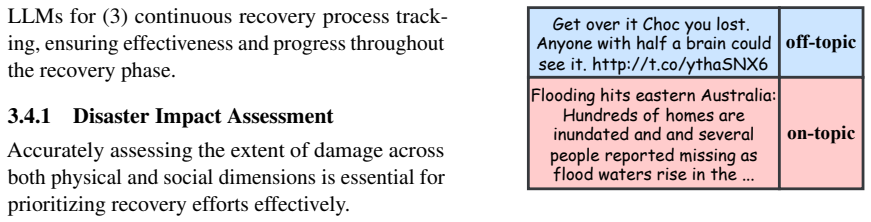
- [Figure 2] The example tweets from CrisisLexT6 appear as body text immediately before Figure 2; if they are part of the figure, they should be placed inside it, and if they are intended as text, they need proper formatting and a citation.
- [Table 2] CrisisFACTS is labeled with Application 'DIC' (Disaster Issue Consultation), but it is a summarization/timeline dataset and should be categorized under Disaster Information Coordination; please verify all Application labels in Table 2.
- [Table 2] The 'Did You Feel It' dataset entry is cited as '(Mousavi et al., 2024)', though the dataset originates from Atkinson and Wald (2007); cite the original source and use the 'Used in' column for Mousavi et al.
Circularity Check
No circularity: this is a survey whose taxonomy and phase/task assignments are authorial interpretations of external literature, not a derivation that reduces to its own inputs.
full rationale
This paper is a literature survey, not a derivation. Its central claims are that it provides the first systematical review of LLM applications in disaster management and that its taxonomy integrates application scenarios, tasks, and architectures. Nothing in the paper fits a parameter, generates a prediction from a fitted quantity, or derives a result from an equation that is definitionally equivalent to its output. The taxonomy is an organizational choice applied to external papers, and the phase/task distributions in Figure 1 are descriptive statistics over the authors' categorization choices rather than predictions. The paper's own Limitations section explicitly acknowledges that the scope is constrained and that categorization is one possible perspective, which further confirms that the taxonomy is presented as an interpretive frame rather than a forced mathematical consequence. The self-citations in Section 3.3.3, namely Lei et al. (2025) and Lei et al. (2022), appear to be citation errors because those works concern spatial-temporal forecasting and bot detection, not disaster tweet classification. However, a mis-citation is not circular reasoning: the survey's claims do not depend on those two papers for their logical validity, and removing them would not collapse the taxonomy or any other derivation. Similarly, the inclusion of Conneau (2019), the XLM-RoBERTa model paper, in Table 1 as a disaster Need Classification study is a substantive accuracy problem that threatens the reliability of the survey corpus, but it is not circularity because the paper does not use that entry as an input to derive anything else. Since the survey makes no fitted predictions and invokes no uniqueness theorem or self-citation chain as a load-bearing premise, the appropriate circularity score is 0. Concerns about missing search methodology and demonstrable mis-categorizations are correctness and reproducibility risks, not circularity.
Assumptions & free parameters
assumptions (2)
- domain assumption The set of surveyed papers, selected without a documented search protocol, is representative and comprehensive.
- domain assumption Each paper can be cleanly categorized into one disaster phase, application scenario, task, and architecture as shown in Table 1.
Cite this review
Pith. "Pith review of Harnessing Large Language Models for Disaster Management: A Survey." pith.science (2026). https://pith.science/paper/YZYBC6KO
@misc{pith2026250106932,
  author       = {Pith},
  title        = {Pith review of: Harnessing Large Language Models for Disaster Management: A Survey},
  year         = {2026},
  howpublished = {\url{https://pith.science/paper/YZYBC6KO}},
  note         = {Machine review of arXiv:2501.06932}
}
read the original abstract
Large language models (LLMs) have revolutionized scientific research with their exceptional capabilities and transformed various fields. Among their practical applications, LLMs have been playing a crucial role in mitigating threats to human life, infrastructure, and the environment. Despite growing research in disaster LLMs, there remains a lack of systematic review and in-depth analysis of LLMs for natural disaster management. To address the gap, this paper presents a comprehensive survey of existing LLMs in natural disaster management, along with a taxonomy that categorizes existing works based on disaster phases and application scenarios. By collecting public datasets and identifying key challenges and opportunities, this study aims to guide the professional community in developing advanced LLMs for disaster management to enhance the resilience against natural disasters.
Figures


Figures from the paper (2 more)


Reference graph
Works this paper leans on
-
[6]
Natural Hazards, 111(1):851–875
Early detection of emergency events from so- cial media: A new text clustering approach. Natural Hazards, 111(1):851–875. Muhammad Imran, Carlos Castillo, Fernando Diaz, and Sarah Vieweg. 2015. Processing social media mes- sages in mass emergency: A survey. ACM Comput- ing Surveys (CSUR), 47(4):1–38. Muhammad Imran, Carlos Castillo, Ji Lucas, Patrick Meie...
work page 2015
-
[8]
In 2024 International Conference on Emerging Sys- tems and Intelligent Computing (ESIC), pages 151–
Classification of humanitarian crisis response through unimodal multi-class textual classification. In 2024 International Conference on Emerging Sys- tems and Intelligent Computing (ESIC), pages 151–
work page 2024
-
[10]
Fusion of multimodal textual and visual de- scriptors for analyzing disaster response. In 2023 5th International Conference on Smart Systems and Inventive Technology (ICSSIT) , pages 1614–1619. IEEE. A Krishna Kanth, P Chitra, and G Gayathri Sowmya
work page 2023
-
[11]
Stochastic Environ- mental Research and Risk Assessment , 36(2):473– 493
Deep learning-based assessment of flood sever- ity using social media streams. Stochastic Environ- mental Research and Risk Assessment , 36(2):473– 493. Rishav Karanjit, Vidya Samadi, Amanda Hughes, Pamela Murray-Tuite, and Keri Stephens. 2024. Con- verging human intelligence with ai systems to ad- vance flood evacuation decision making. Natural Hazards a...
work page 2024
-
[12]
Multimodal combination of text and image tweets for disaster response assessment. In D2R2. Pranath Reddy Kumbam and Kshitij Maruti Vejre. 2024. Floodlense: A framework for chatgpt-based real-time flood detection. arXiv preprint arXiv:2401.15501. Prashant Lakhera. 2024. Leveraging large language models (llms) for enhanced disaster recovery in aws. Authorea...
work page Pith review arXiv 2024
-
[16]
Zero-Shot Classification of Crisis Tweets Using Instruction-Finetuned Large Language Models
Zero-shot classification of crisis tweets using instruction-finetuned large language models. arXiv preprint arXiv:2410.00182. Riadh Meghatria, Safa Ferrah, and Hadjer Belhenniche
-
[17]
Harnessing social media for natural disaster detection. In 2024 8th International Conference on Image and Signal Processing and their Applications (ISPA), pages 1–7. IEEE. Ayaz Mehmood, Muhammad Tayyab Zamir, Muham- mad Asif Ayub, Nasir Ahmad, and Kashif Ah- mad. 2024. A named entity recognition and topic modeling-based solution for locating and better as...
work page Pith review arXiv 2024
-
[18]
Relevance Classification of Flood-related Twitter Posts via Multiple Transformers
Relevance classification of flood-related twit- ter posts via multiple transformers. arXiv preprint arXiv:2301.00320. Sumera Naaz, Zain Ul Abedin, and Danish Raza Rizvi
Show all 31 references
-
[19]
EAI Endorsed Transactions on Scalable Information Systems, 8(31):e8–e8
Sequence classification of tweets with transfer learning via bert in the field of disaster management. EAI Endorsed Transactions on Scalable Information Systems, 8(31):e8–e8. Thi Huyen Nguyen and Koustav Rudra. 2022a. Ra- tionale aware contrastive learning based approach to cl...
2022
-
[21]
In 2024 IEEE Con- ference on Artificial Intelligence (CAI), pages 851–
Llm-assisted crisis management: Building advanced llm platforms for effective emergency re- sponse and public collaboration. In 2024 IEEE Con- ference on Artificial Intelligence (CAI), pages 851–
2024
-
[23]
arXiv preprint arXiv:2212.10735
Nadbenchmarks–a compilation of benchmark datasets for machine learning tasks related to natural disasters. arXiv preprint arXiv:2212.10735. Maryam Rahnemoonfar, Tashnim Chowdhury, Argho Sarkar, Debvrat Varshney, Masoud Yari, and Robin Roberson Murphy. 2021. Floodnet: A high re...
2021 arXiv
-
[24]
In Proceedings of the Joint Workshop on Linguistic An- notation, Multiword Expressions and Constructions (LAW-MWE-CxG-2018), pages 133–143
Developing and evaluating annotation pro- cedures for twitter data during hazard events. In Proceedings of the Joint Workshop on Linguistic An- notation, Multiword Expressions and Constructions (LAW-MWE-CxG-2018), pages 133–143. Wenjuan Sun, Paolo Bocchini, and Brian D Davison
2018
-
[26]
arXiv preprint arXiv:2110.08010
Transformer-based multi-task learning for disaster tweet categorisation. arXiv preprint arXiv:2110.08010. Gelan Wang, Yu Liu, Shukai Liu, Ling Zhang, and Liqun Yang. 2024. Remflow: Rag-enhanced multi- factor rainfall flooding warning in sponge airports via large language model...
2024 arXiv
-
[27]
In Proceedings of the Workshop on Human-In-the-Loop Data Analytics, pages 1–7
Camera-first form filling: Reducing the fric- tion in climate hazard reporting. In Proceedings of the Workshop on Human-In-the-Loop Data Analytics, pages 1–7. Zhengrong Wu, Haibo Yang, Yingchun Cai, Bo Yu, Chuangheng Liang, Zheng Duan, and Qiuhua Liang
-
[28]
Remote Sensing, 16(21):4056
Intelligent monitoring applications of land- slide disaster knowledge graphs based on chatglm2. Remote Sensing, 16(21):4056. Yongqi Xia, Yi Huang, Qianqian Qiu, Xueying Zhang, Lizhi Miao, and Yixiang Chen. 2024. A question and answering service of typhoon disasters based on th...
2024 arXiv
-
[29]
In Proceedings of the International AAAI Conference on Web and Social Media, volume 18, pages 1713–1726
Detection and categorization of needs during crises based on twitter data. In Proceedings of the International AAAI Conference on Web and Social Media, volume 18, pages 1713–1726. Kai Yin, Chengkai Liu, Ali Mostafavi, and Xia Hu
-
[30]
arXiv preprint arXiv:2406.15477
Crisissense-llm: Instruction fine-tuned large language model for multi-label social media text classification in disaster informatics. arXiv preprint arXiv:2406.15477. Chen Yu and Zhiguo Wang. 2024. Multimodal social sensing for the spatio-temporal evolution and assess- ment o...
2024 arXiv
-
[31]
#earthquake
Multi-class multi-label classification of so- cial media texts for typhoon damage assessment: a two-stage model fully integrating the outputs of the hidden layers of bert. International Journal of Digi- tal Earth, 17(1):2348668. Encoder Classifier EncoderImage Flood happens at...
2014
-
[156]
Youngsun Jang, Maryam Moshrefizadeh, Abir Moham- mad Hadi, Kwanghee Won, and John Kim
IEEE. Youngsun Jang, Maryam Moshrefizadeh, Abir Moham- mad Hadi, Kwanghee Won, and John Kim. 2024. Multimodal fusion of heterogeneous representations for anomaly classification in satellite imagery. In Proceedings of the 39th ACM/SIGAPP Symposium on Applied Computing, pages 10...
2024
-
[859]
Tejit Pabari, Beth Tellman, Giannis Karamanolakis, Mitchell Thomas, Max Mauerman, Eugene Wu, Up- manu Lall, Marco Tedesco, Michael S Steckler, Paolo Colosio, et al
IEEE. Tejit Pabari, Beth Tellman, Giannis Karamanolakis, Mitchell Thomas, Max Mauerman, Eugene Wu, Up- manu Lall, Marco Tedesco, Michael S Steckler, Paolo Colosio, et al. 2023. Flood event extraction from news media to support satellite-based flood insurance. arXiv preprint ar...
2023 arXiv
-
[2004]
American behavioral scientist, 48(3):295–313
Coordination in rapidly evolving disaster re- sponse systems: The role of information. American behavioral scientist, 48(3):295–313. A Conneau. 2019. Unsupervised cross-lingual rep- resentation learning at scale. arXiv preprint arXiv:1911.02116. Diana CONTRERAS, Dimosthenis AN...
2019 arXiv
-
[2015]
In Proceedings of the 18th ACM conference on com- puter supported cooperative work & social comput- ing, pages 994–1009
What to expect when the unexpected hap- pens: Social media communications across crises. In Proceedings of the 18th ACM conference on com- puter supported cooperative work & social comput- ing, pages 994–1009. Hakan T Otal and M Abdullah Canbaz. 2024. Ai- powered crisis respon...
2024
-
[2016]
In Proceedings of the Tenth International Conference on Language Resources and Evaluation (LREC’16), pages 1638–1643, Portorož, Slovenia
Twitter as a lifeline: Human-annotated Twit- ter corpora for NLP of crisis-related messages. In Proceedings of the Tenth International Conference on Language Resources and Evaluation (LREC’16), pages 1638–1643, Portorož, Slovenia. European Lan- guage Resources Association (ELR...
2023
-
[2018]
World Bank
Building back better: achieving resilience through stronger, faster, and more inclusive post- disaster reconstruction. World Bank. Jin Han, Zhe Zheng, Xin-Zheng Lu, Ke-Yin Chen, and Jia-Rui Lin. 2024a. Enhanced earthquake impact analysis based on social media texts via large l...
2023 arXiv
-
[2019]
Emma McDaniel, Samuel Scheele, and Jeff Liu
Trec incident streams: Finding actionable information on social media. Emma McDaniel, Samuel Scheele, and Jeff Liu
-
[2020]
Natural Hazards, 103(3):2631– 2689
Applications of artificial intelligence for dis- aster management. Natural Hazards, 103(3):2631– 2689. Yimin Sun, Chao Wang, and Yan Peng. 2023. Unleash- ing the potential of large language model: Zero-shot vqa for flood disaster scenario. In Proceedings of the 4th Internation...
2023 arXiv
-
[2021]
In The 18th interna- tional conference on information systems for crisis response and management (ISCRAM 2021)
Combining self-training with deep learning for disaster tweet classification. In The 18th interna- tional conference on information systems for crisis response and management (ISCRAM 2021). Rong Li, Lei Zhao, ZhiQiang Xie, Chunhou Ji, Jiamin Mo, Zhibing Yang, and Yuyun Feng. 2...
2021 arXiv
-
[2022]
did you feel it?
In MediaEval. Gail M Atkinson and David J Wald. 2007. “did you feel it?” intensity data: A surprisingly good measure of earthquake ground motion. Seismological Research Letters, 78(3):362–368. Mohammad Basit, Bashir Alam, Zubaida Fatima, and Salman Shaikh. 2023. Natural disast...
2007
-
[2023]
In 2023 IEEE Applied Imagery Pattern Recognition Work- shop (AIPR), pages 1–9
Tweetace: A fine-grained classification of disaster tweets using transformer model. In 2023 IEEE Applied Imagery Pattern Recognition Work- shop (AIPR), pages 1–9. IEEE. Temitope Akinboyewa, Huan Ning, M Naser Lessani, and Zhenlong Li. 2024. Automated floodwater depth estimatio...
2023 arXiv
-
[2024]
Information, 15(3):149
Drowning in the information flood: Machine- learning-based relevance classification of flood- related tweets for disaster management. Information, 15(3):149. Emanuela Boros, Gaël Lejeune, Mickaël Coustaty, and Antoine Doucet. 2022. Adapting transformers for detecting emergency...
2022 arXiv
-
[2025]
In Proceedings of the AAAI Conference on Artificial Intelligence, vol- ume 39, pages 12031–12039
St-fit: Inductive spatial-temporal forecast- ing with limited training data. In Proceedings of the AAAI Conference on Artificial Intelligence, vol- ume 39, pages 12031–12039. Zhenyu Lei, Herun Wan, Wenqian Zhang, Shangbin Feng, Zilong Chen, Jundong Li, Qinghua Zheng, and Minna...
2022 arXiv
Reviewed August 10, 2026 · model on record in the stance chip above.
Discussion (0). Continue with ORCID to comment.