REVIEW 4 major objections 4 minor 50 references
ADKGD: Anomaly Detection in Knowledge Graphs with Dual-Channel Training
T0 review · 4 major / 4 minor · reviewed 2026-08-10 · deepseek-v4-flash
Pith's one-line read A dual-channel scoring model ranks erroneous knowledge-graph triplets above correct ones more sharply than prior detectors.
desk verdict The dual-channel extension over CAGED is real and the ablations are careful, but the 'outperforms SOTA' claim is contradicted by the paper's own Table 2, so the paper needs a claim revision and a proper validation split before it is publishable. read the letter →
The pith
A machine-rendered reading of the paper's core claim, the machinery that carries it, and where it could break.
The reading
What carries the argument
The central mechanism is a dual-channel cross-layer encoder. Channel I, the entity-view, applies a BI-LSTM that preserves input dimensions and concatenates the outputs into $q_i = [\tilde{e}_h; \tilde{e}_r; \tilde{e}_t]$; Channel II, the triplet-view, applies a dimension-reducing BI-LSTM-D whose last hidden state $q'_i = \tilde{e}_{h,r,t}$ represents the entire triplet. Both channels aggregate over head and tail neighbor triplets using softmax-weighted dot-product similarities to produce $z_1,z_2$ and $z_3,z_4$. A KL-divergence consistency loss $\mathcal{L}_{\mathrm{KL,score}}+\mathcal{L}_{\mathrm{KL,head}}+\mathcal{L}_{\mathrm{KL,tail}}$ aligns the channel scores, and a margin loss $\max(0, \mathrm{loss}_n - \mathrm{loss}_p + \gamma)$ separates positive from negative triplets, where negatives are generated by random head or tail replacement. At inference the model ranks triplets by the weighted sum above, without needing negatives or the KL term.
What would settle it
Run ADKGD on a benchmark of naturally occurring KG errors, such as human-annotated wrong statements in Wikidata or YAGO, where corruptions are not produced by uniform random head or tail replacement. If Precision@K on the top-K scores falls to near the base rate or drops below rule-based or text-based detectors while remaining high on random head/tail corruption, the paper's claim of general state-of-the-art anomaly detection would be contradicted.
Extended reading notes
Core claim
On the paper's own terms, the discovery is that viewing each triplet simultaneously as an entity sequence and as a compressed triplet-level sequence, while tying the two score distributions together with a KL-divergence consistency loss, produces a scoring function that separates injected noisy triplets from correct ones more sharply than a single-view model or a two-view model without alignment. The entity-view BI-LSTM preserves per-entity structure in $q_i$, while the dimension-reducing BI-LSTM-D summarizes the whole triplet in $q'_i$, and both channels aggregate head and tail neighbor triplets through softmax-weighted similarities. The KL loss enforces agreement between the channels' scores on the triplet itself and on its neighbor aggregations, and a margin loss then ranks positive triplets below their random-corruption negatives. The final anomaly score is $\alpha(f_{\mathrm{BI-LSTM}}+f_{\mathrm{BI-LSTM-D}})+(1-\alpha)\frac{1}{2}(\mathrm{sim}(z_1,z_2)+\mathrm{sim}(z_3,z_4))$.
Load-bearing premise
The evaluation assumes that the noisy triplets used as ground truth are representative of the random head/tail corruption used to create training negatives, so the reported detection performance does not measure generalization to real-world error patterns if those patterns differ.
Editorial extensions
If this is right
- If the claim holds, ADKGD is the best structure-only scorer among the compared methods for ranking erroneous triplets under the 5%-noise benchmark protocol.
- The KL consistency loss is a direct source of gain: ablations on WN18RR show the full two-view model with KL surpasses the entity-view alone and the two-view model without KL by about 14% precision and 16% recall on average.
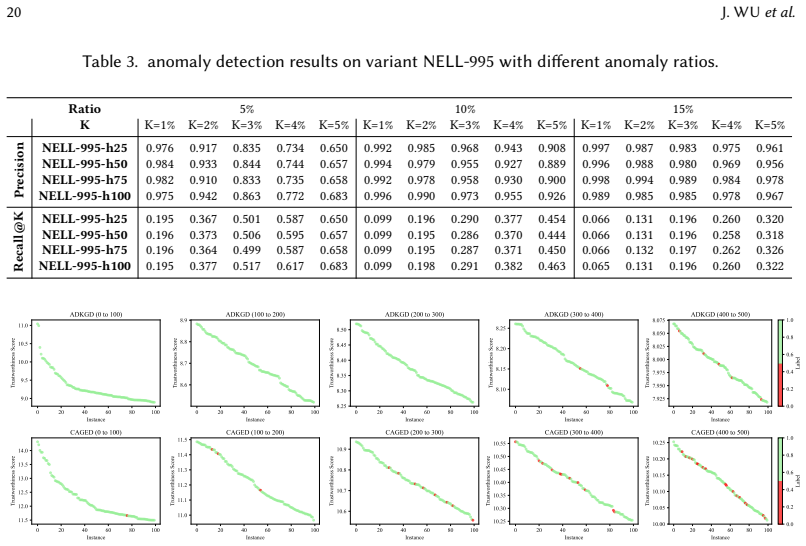
- Precision at K improves as the injected noise ratio rises from 5% to 15%, suggesting the method is robust to increasingly corrupted graphs, while recall at K declines.
- The structure-only approach trails text-based methods (SeSICL, CCA) on recall at larger K on some datasets, so the claimed superiority is specifically over graph-structure baselines in that regime.
- Training cost is dominated by $O(|T|\,n^2)$, so with the embedding dimension fixed at 100 the framework remains feasible on the tested graphs; scalability to very large KGs is left open.
Reading between the lines
- Because the injected test anomalies are generated by the same random head/tail replacement that builds training negatives, the reported numbers most plausibly measure ranking within that single corruption class; an unaligned test set with semantically plausible corruptions (same entity type or relation) would be a stricter generalization check.
- The two views are likely encoding different inductive biases, entity-local structure versus whole-triplet semantics, so a probing study of which view drives detection on low-degree versus high-degree entities would clarify the source of the gain.
- Following the paper's own future-work suggestion, a hybrid that feeds textual embeddings into the neighbor-aggregation step could recover the recall gap at higher K values; this is an editorial projection, not a result the paper claims.
Editorial analysis
A structured set of objections, weighed in public.
Referee Report
Summary. The paper proposes ADKGD, a dual-channel anomaly detection method for knowledge graphs that combines entity-view and triplet-view representations via BI-LSTM encoders, neighbor aggregation, cross-layer learning, and a KL-divergence consistency loss. The method is evaluated on WN18RR, FB15K, NELL-995, and three additional datasets with injected noisy triplets at 5%, 10%, and 15% ratios, and compared against KG-embedding baselines, graph-based anomaly detection methods (CKRL, KGTtm, KGIst, CAGED), and text-based methods (SeSICL, CCA). The abstract and introduction claim that ADKGD outperforms state-of-the-art anomaly detection algorithms; the paper also reports an ablation study, hyperparameter analysis, and time-efficiency experiments.
Significance. If the headline claim were supported, ADKGD would be a meaningful contribution to KG error detection and to improving the reliability of KG-augmented LLM pipelines. The method itself is a reasonable extension of CAGED that introduces a dual-channel architecture and a KL-based consistency loss, and the paper includes an ablation study, hyperparameter analysis, and complexity analysis that partially help assess the design. However, the paper's own reported numbers contradict the central claim: in Table 2, the text-based baselines SeSICL and CCA achieve higher Precision@K and Recall@K than ADKGD on virtually every dataset and K value, and the text in §5.3 explicitly admits that ADKGD 'still falls short compared to text-based methods such as SeSICL and CCA.' In addition, the experimental protocol has circularity issues: hyperparameters are tuned by grid search on the test datasets, and the injected anomalies are likely generated by the same random head/tail corruption used to create training negatives. These issues undermine the validity of the reported performance as an independent measure of generalization.
major comments (4)
- [Abstract and §5.3, Table 2] The central claim that ADKGD 'outperforms the state-of-the-art anomaly detection algorithms' is contradicted by the paper's own results. In Table 2, SeSICL and CCA achieve higher Precision@K and Recall@K than ADKGD on all three main datasets (FB15K, WN18RR, NELL-995-h25) at nearly every K; for example, at K=5% on FB15K, ADKGD Precision@K is 0.659 while CCA attains 0.709, and on WN18RR ADKGD attains 0.560 versus CCA's 0.660. Section 5.3 itself states that ADKGD 'still falls short compared to text-based methods such as SeSICL and CCA.' The abstract and introduction therefore overstate the findings. If the intended claim is that ADKGD outperforms graph-structure-only KG anomaly detection baselines, that claim is plausible from the table, but it is not what the paper states.
- [§5.2, Hyper-parameter analysis (§5.5)] The experimental setup performs grid search for the hyperparameters α, β, and γ on the test datasets (WN18RR, FB15K, NELL-995) and then reports the best Precision@K and Recall@K values on those same datasets. Selecting hyperparameters on the test set means the reported metrics are fitted values, not independent predictions, and the comparison against baselines is not a fair evaluation of generalization. The paper needs a separate validation split or nested cross-validation, or it must clearly state that the reported numbers are oracle-tuned and thus not directly comparable to baseline numbers obtained under their own tuning protocols.
- [§4.1 and §5.1] The paper does not specify how the injected noisy triplets used as ground truth are generated, but §4.1 describes creating negative samples by replacing the head or tail entity with a random entity. If the noisy triplets are generated by the same random corruption process, then the test distribution exactly matches the training negative distribution by construction, so the reported detection performance does not measure generalization to real-world error patterns. The authors should state the anomaly injection mechanism explicitly and, if it matches the negative-sampling procedure, discuss why the evaluation is not circular.
- [Definition 3.5, Eq. (20), Definition 3.4, Eq. (28)-(32)] The KL divergence is applied to quantities that are not probability distributions: L_KL, score = KL(f_entity || f_triplet), where f_entity and f_triplet are raw score vectors. KL divergence is defined for normalized probability distributions; using it on arbitrary non-negative scores is not justified. In addition, the scoring convention is inconsistent: Definition 3.4 defines the score via φ(e_h,e_r,e_t) = -||e_h+e_r-e_t||_2 and states that higher values indicate anomalies, yet Eq. (28) and Eq. (32) use the positive norm ||h+r-t||_2 as the score, meaning higher values now indicate anomalies. The signs and definitions of the loss and scoring functions need to be reconciled.
minor comments (4)
- [Table 4] In the ablation table, the row labeled 'Entity-view w/o internal learning' is duplicated; the second occurrence should presumably be for the triplet-view component, but as printed it repeats the entity-view configuration.
- [Table 2 and §5.1] The dataset name is given as FB15K-237 in §5.1 and Table 1, but as FB15K in Table 2 and the surrounding text; the notation should be consistent. Also, the baseline name appears as both 'KGttm' (Table 2) and 'KGTtm' (text and references); please unify.
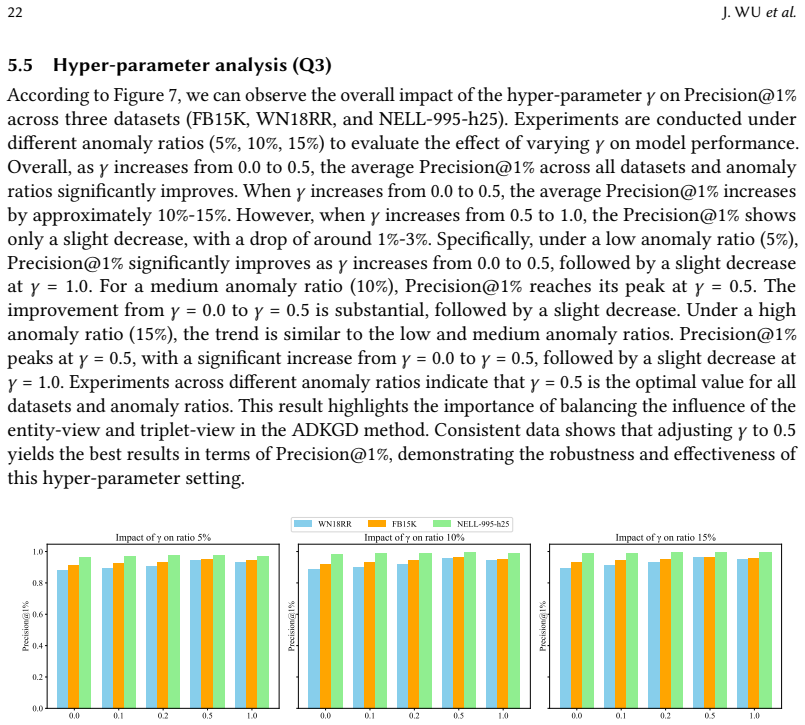
- [§5.5, Figure 7] The hyperparameter analysis reports that γ=0.5 is optimal across datasets and anomaly ratios, but the text in §5.5 says 'adjusting γ to 0.5 yields the best results,' without a clear connection to the earlier claim that γ ranges from 0 to 1; please clarify how γ relates to the margin in Eq. (28), which is described in §5.2 as ranging from 0 to 1.
- [§5.3, Table 3] The claim that precision improves with anomaly ratio is partly mechanical because Precision@K measures the fraction of anomalies in the top-K, and a higher anomaly ratio increases the expected precision even for a random ranking; the paper should discuss this baseline effect.
Circularity Check
Evaluation is partially self-referential: hyperparameters are tuned on the reported test metrics, and the injected anomalies are drawn from the same random-corruption distribution used to create training negatives.
-
fitted input called prediction
[Section 5.2 (Experiment setting), Section 5.5 (Parameter analysis, Figure 8), Tables 2-3]
"We apply a grid search for hyperparameter tuning. The margin parameter 𝛾 from 0 to 1, the trade-off parameters 𝛼 between 0.1 and 0.9 and 𝛽 between 0.1 and 0.9. ... The optimal values were 𝛼 = 0.9 and 𝛽 = 0.3, resulting in the highest precision for each dataset."
The reported headline metric (Precision@K/Recall@K in Tables 2 and 3) is exactly the objective used to select alpha, beta, and gamma. The paper does not describe a separate validation split in Section 5.2, and Figure 8 explicitly chooses values giving the highest precision on the evaluation datasets. The final 'outperforms the state-of-the-art' numbers are therefore selected maxima of the reported evaluation function, not independent predictions. The comparison against CAGED, SeSICL, and CCA partly measures grid-search effort over the reported metric, so the empirical claim is statistically forced on that metric.
-
self definitional
[Section 4.1 (Data preparation) and Section 5.1 (Datasets and evaluation metrics)]
"Following the previous studies [15, 31, 45], we employ three real-world datasets constructed with noisy triplets. ... we create negative samples by either replacing the head entity h or the tail entity t with a random entity from the KG."
The paper defines only one corruption process for false triplets: random head/tail replacement for training negatives. The evaluation anomalies are adopted from the same benchmark recipe ('previous studies') without any alternative construction stated in the paper. Under that recipe, the injected noisy triplets are random head/tail corruptions, so the ground truth is drawn from the same distribution the margin loss is trained to rank above observed triplets. Precision/Recall on these injected anomalies therefore measure the model's fit to its own negative-sampling prior rather than generalization to independently occurring real-world KG errors. The test objective is the training objective by construction.
full rationale
ADKGD is an empirical architecture paper rather than a formal derivation, so circularity has to be assessed on the evaluation chain that supports the headline claim. Two evaluation-side reductions are visible in the text. First, hyperparameters (alpha, beta, gamma) are selected by grid search on the same Precision@K values that are then reported as evidence of superiority, with no stated validation split. Second, the benchmark anomalies are 'noisy triplets' imported from the same family of previous studies whose synthetic labels are created by naive negative sampling; the only corruption mechanism defined in this paper is random head/tail replacement, the same operation used to create training negatives. Together these make the reported detection numbers partially fitted to the test objective. I am not scoring the internal contradiction between the abstract ('outperforms the state-of-the-art') and Section 5.3 ('still falls short compared to text-based methods such as SeSICL and CCA') as circularity; that is a correctness/claim-scope problem. The paper's self-citations [38, 39] are related-work surveys and are not load-bearing for the method, so they do not raise the score. The architectural contribution (dual-channel entity/triplet views with KL consistency) is independent of these evaluation issues, which is why the score is 6 rather than higher.
Assumptions & free parameters
free parameters (7)
- alpha (trade-off between internal and neighbor aggregation) =
0.9
- beta (trade-off between margin loss and consistency loss) =
0.3
- gamma (margin) =
0.5
- embedding dimension =
100
- batch size =
256
- learning rate =
0.01
- number of neighbors =
average degree of dataset
assumptions (4)
- domain assumption Randomly replacing head or tail entities produces useful negative samples for training.
- domain assumption All observed triplets in the KG are treated as positive during unsupervised training.
- ad hoc to paper KL divergence is treated as a valid loss between score vectors that are not probability distributions.
- domain assumption Dot-product attention over neighbor triplets captures useful context for anomaly detection.
Cite this review
Pith. "Pith review of ADKGD: Anomaly Detection in Knowledge Graphs with Dual-Channel Training." pith.science (2026). https://pith.science/paper/4IUB4ID5
@misc{pith2026250107078,
  author       = {Pith},
  title        = {Pith review of: ADKGD: Anomaly Detection in Knowledge Graphs with Dual-Channel Training},
  year         = {2026},
  howpublished = {\url{https://pith.science/paper/4IUB4ID5}},
  note         = {Machine review of arXiv:2501.07078}
}
read the original abstract
In the current development of large language models (LLMs), it is important to ensure the accuracy and reliability of the underlying data sources. LLMs are critical for various applications, but they often suffer from hallucinations and inaccuracies due to knowledge gaps in the training data. Knowledge graphs (KGs), as a powerful structural tool, could serve as a vital external information source to mitigate the aforementioned issues. By providing a structured and comprehensive understanding of real-world data, KGs enhance the performance and reliability of LLMs. However, it is common that errors exist in KGs while extracting triplets from unstructured data to construct KGs. This could lead to degraded performance in downstream tasks such as question-answering and recommender systems. Therefore, anomaly detection in KGs is essential to identify and correct these errors. This paper presents an anomaly detection algorithm in knowledge graphs with dual-channel learning (ADKGD). ADKGD leverages a dual-channel learning approach to enhance representation learning from both the entity-view and triplet-view perspectives. Furthermore, using a cross-layer approach, our framework integrates internal information aggregation and context information aggregation. We introduce a kullback-leibler (KL)-loss component to improve the accuracy of the scoring function between the dual channels. To evaluate ADKGD's performance, we conduct empirical studies on three real-world KGs: WN18RR, FB15K, and NELL-995. Experimental results demonstrate that ADKGD outperforms the state-of-the-art anomaly detection algorithms. The source code and datasets are publicly available at https://github.com/csjywu1/ADKGD.
Figures


Figures from the paper (8 more)




Reference graph
Works this paper leans on
-
[1]
Garima Agrawal, Kuntal Pal, Yuli Deng, Huan Liu, and Ying-Chih Chen. 2024. CyberQ: Generating Questions and Answers for Cybersecurity Education Using Knowledge Graph-Augmented LLMs. In The AAAI Conference on Artificial Intelligence, Vol. 38. 23164–23172
work page 2024
-
[2]
Ivana Balazevic, Carl Allen, and Timothy Hospedales. 2019. Multi-relational poincaré graph embeddings. Advances in Neural Information Processing Systems 32 (2019)
2019
-
[3]
Caleb Belth, Xinyi Zheng, Jilles Vreeken, and Danai Koutra. 2020. What is normal, what is strange, and what is missing in a knowledge graph: Unified characterization via inductive summarization. In The Web Conference. 1115–1126
work page 2020
-
[4]
Antoine Bordes, Nicolas Usunier, Alberto Garcia-Duran, Jason Weston, and Oksana Yakhnenko. 2013. Translating embeddings for modeling multi-relational data. Advances in Neural Information Processing Systems 26 (2013)
work page 2013
-
[5]
Lei Cai, Jundong Li, Jie Wang, and Shuiwang Ji. 2021. Line graph neural networks for link prediction.IEEE Transactions on Pattern Analysis and Machine Intelligence 44, 9 (2021), 5103–5113
2021
-
[6]
Tim Dettmers, Pasquale Minervini, Pontus Stenetorp, and Sebastian Riedel. 2018. Convolutional 2D knowledge graph embeddings. In The AAAI Conference on Artificial Intelligence , Vol. 32
work page 2018
-
[7]
Hao Fei, Yafeng Ren, Yue Zhang, Donghong Ji, and Xiaohui Liang. 2021. Enriching contextualized language model from knowledge graph for biomedical information extraction. Briefings in Bioinformatics 22, 3 (2021), bbaa110
work page 2021
-
[8]
Hao Fei, Shengqiong Wu, Yafeng Ren, and Meishan Zhang. 2022. Matching structure for dual learning. In International Conference on Machine Learning . PMLR, 6373–6391
work page 2022
Show all 50 references
-
[9]
Congcong Ge, Xiaoze Liu, Lu Chen, Yunjun Gao, and Baihua Zheng. 2021. LargeEA: aligning entities for large-scale knowledge graphs. The VLDB Endowment 15, 2 (2021), 237–245
2021
-
[10]
Shu Guo, Quan Wang, Lihong Wang, Bin Wang, and Li Guo. 2018. Knowledge graph embedding with iterative guidance from soft rules. In The AAAI Conference on Artificial Intelligence , Vol. 32
2018
-
[11]
Xianxu Hou, Linlin Shen, Ke Sun, and Guoping Qiu. 2017. Deep feature consistent variational autoencoder. In IEEE Conference on Applications of Computer Vision . IEEE, 1133–1141
2017
-
[12]
Lei Huang, Weijiang Yu, Weitao Ma, Weihong Zhong, Zhangyin Feng, Haotian Wang, Qianglong Chen, Weihua Peng, Xiaocheng Feng, Bing Qin, et al. 2025. A survey on hallucination in large language models: Principles, taxonomy, challenges, and open questions. ACM Transactions on Info...
2025
-
[13]
Xiao Huang, Jingyuan Zhang, Dingcheng Li, and Ping Li. 2019. Knowledge graph embedding based question answering. In The ACM International Conference on Web Search and Data Mining . 105–113
2019
-
[14]
Bin Jia, Cailing Dong, Zhijiang Chen, Kuo-Chu Chang, Nichole Sullivan, and Genshe Chen. 2018. Pattern discovery and anomaly detection via knowledge graph. In The International Conference on Information Fusion . IEEE, 2392–2399
2018
-
[15]
Shengbin Jia, Yang Xiang, Xiaojun Chen, and Kun Wang. 2019. Triple trustworthiness measurement for knowledge graph. In The World Wide Web Conference. 2865–2871
2019
-
[16]
Patrick Lewis, Ethan Perez, Aleksandra Piktus, Fabio Petroni, Vladimir Karpukhin, Naman Goyal, Heinrich Küttler, Mike Lewis, Wen-tau Yih, Tim Rocktäschel, et al. 2020. Retrieval-augmented generation for knowledge-intensive nlp tasks. Advances in Neural Information Processing S...
2020
-
[17]
Chen Li, Yang Cao, Ye Zhu, Debo Cheng, Chengyuan Li, and Yasuhiko Morimoto. 2024. Ripple knowledge graph convolutional networks for recommendation systems. Machine Intelligence Research (2024), 1–14
2024
-
[18]
Shiyang Li, Yifan Gao, Haoming Jiang, Qingyu Yin, Zheng Li, Xifeng Yan, Chao Zhang, and Bing Yin. 2023. Graph Reasoning for Question Answering with Triplet Retrieval. In Findings of the Association for Computational Linguistics . 3366–3375
2023
-
[19]
Bill Yuchen Lin, Xinyue Chen, Jamin Chen, and Xiang Ren. 2019. KagNet: Knowledge-Aware Graph Networks for Commonsense Reasoning. In The Conference on Empirical Methods in Natural Language Processing and the International Joint Conference on Natural Language Processing . 2829–2839
2019
-
[20]
Yankai Lin, Zhiyuan Liu, Maosong Sun, Yang Liu, and Xuan Zhu. 2015. Learning entity and relation embeddings for knowledge graph completion. In The AAAI Conference on Artificial Intelligence , Vol. 29
2015
-
[21]
Xiangyu Liu, Yang Liu, and Wei Hu. 2024. Knowledge Graph Error Detection with Contrastive Confidence Adaption. In The AAAI Conference on Artificial Intelligence , Vol. 38. 8824–8831
2024
-
[22]
Xingyu Liu, Jielong Tang, Mengyang Li, Junmei Han, Gang Xiao, and Jianchun Jiang. 2024. SeSICL: Semantic and Structural Integrated Contrastive Learning for Knowledge Graph Error Detection. IEEE Access (2024)
2024
-
[23]
Yixin Liu, Kaize Ding, Jianling Wang, Vincent Lee, Huan Liu, and Shirui Pan. 2023. Learning strong graph neural networks with weak information. InThe ACM SIGKDD Conference on Knowledge Discovery and Data Mining. 1559–1571
2023
-
[24]
Zhenfei Luo, Yixiang Dong, Qinghua Zheng, Huan Liu, and Minnan Luo. 2023. Dual-channel graph contrastive learning for self-supervised graph-level representation learning. Pattern Recognition 139 (2023), 109448
2023
-
[25]
André Melo and Heiko Paulheim. 2017. Detection of relation assertion errors in knowledge graphs. In The 9th Knowledge Capture Conference. 1–8. ACM Trans. Asian Low-Resour. Lang. Inf. Process., Vol. 1, No. 1, Article . Publication date: January 2025. ADKGD: Anomaly Detection in...
2017
-
[26]
Long Ouyang, Jeffrey Wu, Xu Jiang, Diogo Almeida, Carroll Wainwright, Pamela Mishkin, Chong Zhang, Sandhini Agarwal, Katarina Slama, Alex Ray, et al. 2022. Training language models to follow instructions with human feedback. Advances in Neural Information Processing Systems 35...
2022
-
[27]
Thomas Pellissier Tanon, Daria Stepanova, Simon Razniewski, Paramita Mirza, and Gerhard Weikum. 2017. Completeness-aware rule learning from knowledge graphs. In The International Semantic Web Conference. Springer, 507–525
2017
-
[28]
Fabio Petroni, Tim Rocktäschel, Sebastian Riedel, Patrick Lewis, Anton Bakhtin, Yuxiang Wu, and Alexander Miller
-
[29]
Joseph P Robinson, Ming Shao, Yue Wu, and Yun Fu. 2016. Families in the wild (FIW) large-scale kinship image database and benchmarks. In The ACM International Conference on Multimedia . 242–246
2016
-
[30]
Apoorv Saxena, Aditay Tripathi, and Partha Talukdar. 2020. Improving multi-hop question answering over knowledge graphs using knowledge base embeddings. In The Annual Meeting of the Association for Computational Linguistics . 4498–4507
2020
-
[31]
Yingchun Shan, Chenyang Bu, Xiaojian Liu, Shengwei Ji, and Lei Li. 2018. Confidence-aware negative sampling method for noisy knowledge graph embedding. In IEEE International Conference on Big Knowledge . IEEE, 33–40
2018
-
[32]
Amit Sheth, Swati Padhee, and Amelie Gyrard. 2019. Knowledge graphs and knowledge networks: the story in brief. IEEE Internet Computing 23, 4 (2019), 67–75
2019
-
[33]
Fabian M Suchanek, Gjergji Kasneci, and Gerhard Weikum. 2007. YAGO: a core of semantic knowledge. In The 16th International Conference on World Wide Web. 697–706
2007
-
[34]
Kristina Toutanova, Danqi Chen, Patrick Pantel, Hoifung Poon, Pallavi Choudhury, and Michael Gamon. 2015. Rep- resenting text for joint embedding of text and knowledge bases. In The Conference on Empirical Methods in Natural Language Processing. 1499–1509
2015
-
[35]
Hung Nghiep Tran and Atsuhiro Takasu. 2019. Exploring scholarly data by semantic query on knowledge graph embedding space. In The 23rd International Conference on Theory and Practice of Digital Libraries . Springer, 154–162
2019
-
[36]
Théo Trouillon, Johannes Welbl, Sebastian Riedel, Éric Gaussier, and Guillaume Bouchard. 2016. Complex embeddings for simple link prediction. In International Conference on Machine Learning . PMLR, 2071–2080
2016
-
[37]
Jianing Wang, Qiushi Sun, Nuo Chen, Xiang Li, and Ming Gao. 2023. Boosting language models reasoning with chain-of-knowledge prompting. arXiv preprint arXiv:2306.06427 (2023)
2023 arXiv
-
[38]
Jiayang Wu, Wensheng Gan, Zefeng Chen, Shicheng Wan, and Hong Lin. 2023. Ai-generated content (AIGC): A survey. arXiv preprint arXiv:2304.06632 (2023)
2023 arXiv
-
[39]
Jiayang Wu, Wensheng Gan, Zefeng Chen, Shicheng Wan, and Philip S Yu. 2023. Multimodal large language models: A survey. In IEEE International Conference on Big Data . IEEE, 2247–2256
2023
-
[40]
Zonghan Wu, Shirui Pan, Fengwen Chen, Guodong Long, Chengqi Zhang, and Philip S Yu. 2020. A comprehensive survey on graph neural networks. IEEE Transactions on Neural Networks and Learning Systems 32, 1 (2020), 4–24
2020
-
[41]
Ziwei Xu, Sanjay Jain, and Mohan Kankanhalli. 2024. Hallucination is inevitable: An innate limitation of large language models. arXiv preprint arXiv:2401.11817 (2024)
2024 arXiv
-
[42]
Yuchen Yan, Lihui Liu, Yikun Ban, Baoyu Jing, and Hanghang Tong. 2021. Dynamic knowledge graph alignment. In The AAAI Conference on Artificial Intelligence , Vol. 35. 4564–4572
2021
-
[43]
Bishan Yang, Scott Wen-tau Yih, Xiaodong He, Jianfeng Gao, and Li Deng. 2015. Embedding Entities and Relations for Learning and Inference in Knowledge Bases. In the International Conference on Learning Representations
2015
-
[44]
Zijun Yao, Yuanyong Chen, Xin Lv, Shulin Cao, Amy Xin, Jifan Yu, Hailong Jin, Jianjun Xu, Peng Zhang, Lei Hou, et al
-
[45]
Qinggang Zhang, Junnan Dong, Keyu Duan, Xiao Huang, Yezi Liu, and Linchuan Xu. 2022. Contrastive knowledge graph error detection. In The 31st ACM International Conference on Information & Knowledge Management . 2590–2599
2022
-
[46]
Zehua Zhang, Shilin Sun, Guixiang Ma, and Caiming Zhong. 2023. Line graph contrastive learning for link prediction. Pattern Recognition 140 (2023), 109537
2023
-
[47]
Yujia Zheng, Siyi Liu, Zekun Li, and Shu Wu. 2020. DGTN: Dual-channel graph transition network for session-based recommendation. In International Conference on Data Mining Workshops . IEEE, 236–242
2020
-
[48]
Peng Zhou, Wei Shi, Jun Tian, Zhenyu Qi, Bingchen Li, Hongwei Hao, and Bo Xu. 2016. Attention-based bidirectional long short-term memory networks for relation classification. InThe Association for Computational Linguistics. 207–212. ACM Trans. Asian Low-Resour. Lang. Inf. Proc...
2016
-
[2019]
In The Conference on Empirical Methods in Natural Language Processing and the 9th International Joint Conference on Natural Language Processing
Language Models as Knowledge Bases?. In The Conference on Empirical Methods in Natural Language Processing and the 9th International Joint Conference on Natural Language Processing . 2463–2473
-
[2023]
In The Annual Meeting of the Association for Computational Linguistic
VisKoP: Visual Knowledge oriented Programming for Interactive Knowledge Base Question Answering. In The Annual Meeting of the Association for Computational Linguistic . 179–189
Reviewed August 10, 2026 · model on record in the stance chip above.
Discussion (0). Continue with ORCID to comment.