REVIEW 2 major objections 5 minor 104 references
"Near Data" and "Far Data" for Urban Sustainability: How Do Community Advocates Envision Data Intermediaries?
T0 review · 2 major / 5 minor · reviewed 2026-08-10 · deepseek-v4-flash
Pith's one-line read Community advocates envision data intermediaries as connectors of “near” and “far” data, not neutral data providers.
desk verdict A solid qualitative study with a genuinely useful near/far data framing; the main risk is whether one map-based probe can stand in for data intermediaries as a class, but that is a limitation to address, not a fatal flaw. read the letter →
The pith
A machine-rendered reading of the paper's core claim, the machinery that carries it, and where it could break.
The reading
What carries the argument
The central conceptual object is the near/far data distinction: near data are close to everyday life and embodied experience, while far data are distant, processed, and often institutional. The paper operationalizes this distinction through a technology probe, Curbcut Toronto, a map-based urban data visualization tool that represents a common type of data intermediary product. The probe elicits advocates’ reactions and reflections, from which the three pathways are derived. Data feminism principles (examine power, challenge power, elevate emotion and embodiment, rethink binaries, embrace pluralism, consider context, make labor visible) serve as the interpretive frame for turning those reflections into design guidance.
What would settle it
A replication study in which community advocates interact with a non-map-based intermediary, such as a human data-help desk or a text-based data service, and do not express the need to connect near and far data, would undermine the claim that the near/far vision is a general vision for data intermediaries rather than a response to map dashboards.
Extended reading notes
Core claim
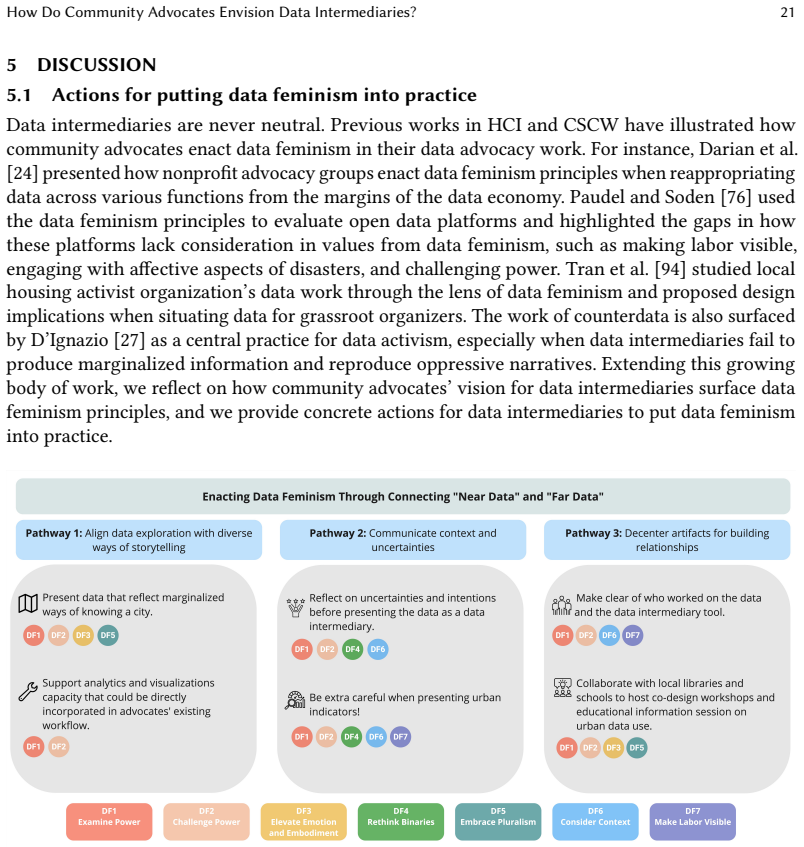
The paper’s central claim is that community advocates, as expert data practitioners, envision data intermediaries as bridges between near data and far data. Advocates treat near data as essential for making sense of, enriching, questioning, and challenging far data: lived experience gives meaning to abstract statistics, and self-collected counterdata exposes what official datasets miss. The three pathways—aligning data exploration with diverse storytelling, communicating context and uncertainties, and decentering artifacts for relationship building—are presented as concrete ways for intermediaries to act on this vision. The paper grounds these pathways in the advocates’ own practices and connects them to data feminism principles.
Load-bearing premise
The load-bearing premise is that one map-based visualization tool, Curbcut Toronto, can stand in for data intermediaries in general, so that advocates’ reactions to it reveal their visions for the whole class of intermediary practices.
Editorial extensions
If this is right
- If the vision is correct, data intermediaries should design for storytelling: supporting flexible exploration of far data while also surfacing marginalized and experiential ways of knowing.
- Intermediaries should communicate the context, uncertainties, and intentions behind data, rather than presenting indicators as neutral facts.
- Intermediaries should decenter their own tools and invest in relationship building, local networks, and capacity building, because data use is embedded in social relationships.
- The near/far distinction offers data intermediaries a concrete way to attend to data settings and to enact data feminism principles in their design choices.
- Adopting these pathways would position data intermediaries as contributors to the Right to the City rather than mere facilitators of data access.
Reading between the lines
- The near/far framing could be extended beyond urban sustainability into any domain where citizens encounter institutional data, such as health, education, or environmental justice; the same relational design principles may apply.
- A testable extension would be to build a data intermediary tool with explicit support for uploading or attaching near data (e.g., lived-experience annotations, community-collected counterdata) and measuring whether advocates’ trust, engagement, and narrative power increase.
- The paper’s emphasis on relationship building suggests that the success of data intermediaries might be better measured by the strength and growth of local networks, not by tool usage statistics—a shift that would change how civic tech is evaluated.
- The single-probe design implies that future work could compare reactions to different genres of intermediary artifacts, such as human-mediated data help desks versus map dashboards, to test whether the near/far vision is specific to visualization tools or generalizes across intermediary forms.
Signed reviews
Editorial analysis
A structured set of objections, weighed in public.
Referee Report
Summary. This paper reports a qualitative interview study with 17 community advocates working with 23 grassroots and nonprofit organizations in Toronto. The authors use semi-structured interviews in which a map-based urban data visualization tool (Curbcut Toronto) is introduced as a technology probe. From a thematic analysis, they propose that community advocates distinguish 'near data' (self-collected, lived-experience, conversational) from 'far data' (heavily processed open government or academic data), and that the advocates' central vision for data intermediaries is to connect these two types of data. The paper articulates three pathways to pursue this vision: aligning data exploration with storytelling, communicating context and uncertainties, and decentering artifacts for relationship building. It then interprets these findings through data feminism and argues that the vision contributes to the Right to the City.
Significance. If the central claim holds, this is a useful contribution to CSCW and HCI. The near/far distinction provides a language for thinking about data provenance and relationality in urban data work, and the three pathways are concrete enough to guide design of data intermediary tools. The study's strengths include a reasonably large qualitative sample for this domain, rich illustrative quotes that give the reader direct access to the advocates' perspectives, and a transparent description of the transcription and scaffolding procedures. The paper also makes an explicit effort to connect the findings to data feminism, and the actionable items in Figure 6 are a welcome translation of the themes into design guidance. The main weakness is that the central claim may be partly an artifact of the specific technology probe, a concern that needs to be addressed before the general conclusion about data intermediaries as a class can be accepted.
major comments (2)
- [Section 3.3 and Section 4.1] The claim that Curbcut Toronto 'represents in many ways a common type of data intermediary tool' (Section 3.3) is not supported by evidence, and this assumption is load-bearing for the paper's central conclusion. The entire near/far vision, and especially Pathway 2 (communicate context and uncertainties), is inferred in part from participants' reactions to a tool that presents only far data (open government and census data). The paper does not separate statements made in the pre-probe portions of the interviews (protocol parts 1 and 2, Section 3.2) from statements made while or after using the probe, so it cannot rule out that the near/far dichotomy is a contrast effect produced by the probe's specific absence of near data. To support the claim that advocates envision this for data intermediaries generally, the paper should either (a) report a sensitivity analysis comparing pre-probe and probe-elicited responses, (b) triangulate with participants' experiences of other intermediary types catalogued in Section 2.2 (e.g., BikeSpace, No More Noise Toronto, which are near-data-centric), or (c) explicitly narrow the contribution to map-based data exploration tools of the Curbcut genre. Without one of these, the central claim is overgeneralized relative to the evidence presented.
- [Section 3.4 and Section 4] The paper's member-check procedure is described too confidently as validation of the themes. Section 3.4 states that participants were given their own quotes and related insights and that 'no corrections were made,' but this checks quote accuracy and participant-specific insights, not the cross-participant synthesis (the near/far vision and the three pathways) that constitutes the paper's central contribution. Moreover, the thematic analysis was conducted entirely by the first two authors, and the mapping of data feminism principles to quotes was done by the first author and reviewed only by the last author; no independent coding, audit trail, negative case analysis, or inter-coder agreement is reported. Because the central claim is an interpretive generalization across 17 participants, the paper should either provide a more substantive form of corroboration (e.g., a negative case analysis or a member-check in which participants respond to the synthesized pathways) or explicitly discuss this as a limitation in a dedicated limitations subsection. As written, the inference from individual quotes to a shared vision is undersupported.
minor comments (5)
- [Abstract] The abstract contains a typographical spacing error before a closing quotation mark ('far data. ”'), which should be corrected.
- [Section 4.1.1] The sentence 'Almost all participants mentioned their various ways of using census data' contrasts with later uses of 'all participants' and 'nearly all participants' elsewhere; please check the intended quantifier for consistency.
- [Section 5.3] The citation to Bhardwaj et al. [11] appears to be a manuscript without a clear venue or preprint identifier; please provide a complete citation or mark it as in preparation.
- [General] The paper has no explicit limitations subsection; adding one that addresses the single-city sample, the recruitment from the first author's network, and the probe-centered method would help readers calibrate the scope of the claims.
- [Section 3.4] The phrase 'the first and second author would first watch recordings' uses a singular noun with a compound subject; it should be 'the first and second authors.'
Circularity Check
No significant circularity: the near/far vision is an interpretive finding from interview data, not a fitted or self-citational derivation.
full rationale
This paper does not derive its central claim from a fitted parameter or from the same authors' prior results. The 'near data' and 'far data' distinction is introduced as an analytic category grounded in participants' accounts (self-collected data, lived experiences, conversations versus heavily processed open data) and in established feminist data literature (Haraway, D'Ignazio and Klein), not defined by the paper's conclusions. The three pathways (storytelling, context and uncertainties, decentering artifacts) are presented as themes from inductive thematic analysis with participant quotes as evidence; no equation or quantitative model is fitted, so no prediction reduces by construction to an input. The self-citations (Bhardwaj et al. [11], McCord and Becker [70], Walker and Becker [98]) support background claims about psychological distance, relational civic tech, and green mapping; they are not invoked as a uniqueness theorem or as the sole justification for the near/far framework, and the framework does not depend on their being true. The main validity risk, that the Curbcut Toronto probe ('in many ways a common type of data intermediary tool') may have elicited responses specific to a map-based far-data tool, is a generalizability concern about the empirical sampling, not a circularity: even if the probe influenced responses, the claimed vision is still an interpretation of those responses rather than an arithmetic or definitional consequence of the probe. The member check confirmed quotes but not cross-participant generalization, which is likewise a validity limitation, not a circular step. Overall, the derivation chain is self-contained qualitative analysis; no specific reduction to inputs or self-citations is present.
Assumptions & free parameters
assumptions (4)
- domain assumption Participants' self-reports during interviews are reliable evidence of advocates' data practices and visions.
- domain assumption Curbcut Toronto is representative of a common type of data intermediary tool.
- domain assumption Data feminism principles are an appropriate and sufficient lens for organizing the findings.
- domain assumption Inductive thematic analysis with 17 interviews yields stable enough themes for design implications.
invented entities (2)
-
Near data
-
Far data
Cite this review
Pith. "Pith review of "Near Data" and "Far Data" for Urban Sustainability: How Do Community Advocates Envision Data Intermediaries?." pith.science (2026). https://pith.science/paper/TSJ5OGCQ
@misc{pith2026250107661,
  author       = {Pith},
  title        = {Pith review of: "Near Data" and "Far Data" for Urban Sustainability: How Do Community Advocates Envision Data Intermediaries?},
  year         = {2026},
  howpublished = {\url{https://pith.science/paper/TSJ5OGCQ}},
  note         = {Machine review of arXiv:2501.07661}
}
read the original abstract
In the densifying data ecosystem of today's cities, data intermediaries are crucial stakeholders in facilitating data access and use. Community advocates live in these sites of social injustices and opportunities for change. Highly experienced in working with data to enact change, they offer distinctive insights on data practices and tools. This paper examines the unique perspectives that community advocates offer on data intermediaries. Based on interviews with 17 advocates working with 23 grassroots and nonprofit organizations, we propose the quality of "near" and "far" to be seriously considered in data intermediaries' works and articulate advocates' vision of connecting "near data" and "far data." To pursue this vision, we identified three pathways for data intermediaries: align data exploration with ways of storytelling, communicate context and uncertainties, and decenter artifacts for relationship building. These pathways help data intermediaries to put data feminism into practice, surface design opportunities and tensions, and raise key questions for supporting the pursuit of the Right to the City.
Figures


Figures from the paper (3 more)


Reference graph
Works this paper leans on
-
[1]
BikeSpace - Toronto’s Bike Parking App
2023. BikeSpace - Toronto’s Bike Parking App . https://bikespace.ca/
2023
-
[2]
HealthyPlan
2023. HealthyPlan. https://healthyplan.city/en
2023
-
[3]
Open Water Data
2023. Open Water Data. https://www.openwaterdata.com/
2023
-
[4]
OpenStreetMap
2023. OpenStreetMap. https://www.openstreetmap.org/
2023
-
[5]
Manhattan Population Explorer
2024. Manhattan Population Explorer. http://manpopex.us/
2024
-
[6]
Obead Alhadreti and Pam Mayhew. 2018. Rethinking Thinking Aloud: A Comparison of Three Think-Aloud Protocols. In Proceedings of the 2018 CHI Conference on Human Factors in Computing Systems . ACM, Montreal QC Canada, 1–12. https://doi.org/10.1145/3173574.3173618
arXiv 2018
-
[7]
Irina Anastasiu. 2019. Unpacking the Smart City Through the Lens of the Right to the City: A Taxonomy as a Way Forward in Participatory City-Making. In The Hackable City: Digital Media and Collaborative City-Making in the Network Society, Michiel de Lange and Martijn de Waal (Eds.). Springer, Singapore, 239–260. https://doi.org/10.1007/ 978-981-13-2694-3_13
2019
-
[8]
Cecilia Aragon, Clayton Hutto, Andy Echenique, Brittany Fiore-Gartland, Yun Huang, Jinyoung Kim, Gina Neff, Wanli Xing, and Joseph Bayer. 2016. Developing a Research Agenda for Human-Centered Data Science. InProceedings of the 19th ACM Conference on Computer Supported Cooperative Work and Social Computing Companion (CSCW ’16 Companion). ACM, New York, NY,...
Show all 104 references
-
[9]
Jo Bates, Yu-Wei Lin, and Paula Goodale. 2016. Data journeys: Capturing the socio-material constitution of data objects and flows. Big Data & Society 3, 2 (Dec. 2016), 2053951716654502. https://doi.org/10.1177/2053951716654502 Publisher: SAGE Publications Ltd
2016 doi
-
[10]
Ruha Benjamin. 2019. Race after technology: abolitionist tools for the New Jim Code . Polity Press, Cambridge, UK
2019
-
[11]
Eshta Bhardwaj, Han Qiao, and Christoph Becker. 2024. Limits at a Distance: Design Directions to Address Psycho- logical Distance in Policy Decisions Affecting Planetary Boundaries. , Vol. 1, No. 1, Article . Publication date: January 2025. 26 Qiao, et al
2024
-
[12]
Kirsten Boehner, Janet Vertesi, Phoebe Sengers, and Paul Dourish. 2007. How HCI interprets the probes. InProceedings of the SIGCHI Conference on Human Factors in Computing Systems . ACM, San Jose California USA, 1077–1086. https://doi.org/10.1145/1240624.1240789
2007
-
[14]
Chris Bopp, Ellie Harmon, and Amy Voida. 2017. Disempowered by Data: Nonprofits, Social Enterprises, and the Consequences of Data-Driven Work. In Proceedings of the 2017 CHI Conference on Human Factors in Computing Systems (Denver, Colorado, USA) (CHI ’17). Association for Com...
2017
-
[15]
Virginia Braun and Victoria Clarke. 2006. Using thematic analysis in psychology. Qualitative Research in Psychology 3, 2 (Jan. 2006), 77–101. https://doi.org/10.1191/1478088706qp063oa Publisher: Routledge _eprint: https://www.tandfonline.com/doi/pdf/10.1191/1478088706qp063oa
2006 doi
-
[16]
CANUE. 2023. The Canadian Urban Environmental Health Research Consortium. https://canue.ca/
2023
-
[17]
Matthews, Marjory S
Ramya Chari, Luke J. Matthews, Marjory S. Blumenthal, Amanda F. Edelman, and Therese Marie Jones. 2017. The Promise of Community Citizen Science . Technical Report. RAND Corporation. https://www.rand.org/pubs/ perspectives/PE256.html
2017
-
[18]
Joohee Choi and Yla Tausczik. 2017. Characteristics of Collaboration in the Emerging Practice of Open Data Analysis. In Proceedings of the 2017 ACM Conference on Computer Supported Cooperative Work and Social Computing . ACM, Portland Oregon USA, 835–846. https://doi.org/10.11...
2017
-
[19]
CMHC. [n. d.]. Canada Mortgage and Housing Corporation. https://www.cmhc-schl.gc.ca/
-
[20]
Jacqueline Corbett, Mathieu Templier, and Hirotoshi Takeda. 2018. The Making of a ’Top’ Open Data City: A Case Study of Edmonton’s Open Data Initiative. https://doi.org/10.24251/HICSS.2018.308
2018 doi
-
[21]
Roderic Crooks. 2019. Accesso Libre: Equity of Access to Information through the Lens of Neoliberal Responsiblization. Journal of Critical Library and Information Studies 2, 1 (March 2019). https://doi.org/10.24242/jclis.v2i1.91 Number: 1
2019 doi
-
[22]
Roderic Crooks and Morgan Currie. 2021. Numbers will not save us: Agonistic data practices.The Information Society 37, 4 (2021), 201–213. https://doi.org/10.1080/01972243.2021.1920081 arXiv:https://doi.org/10.1080/01972243.2021.1920081
2021
-
[23]
Morgan Currie (Ed.). 2022. Data Justice and the Right to the City . Edinburgh University Press, Edinburgh. https: //doi.org/doi:10.1515/9781474492973
2022 doi
-
[24]
Shiva Darian, Aarjav Chauhan, Ricky Marton, Janet Ruppert, Kathleen Anderson, Ryan Clune, Madeline Cupchak, Max Gannett, Joel Holton, Elizabeth Kamas, Jason Kibozi-Yocka, Devin Mauro-Gallegos, Simon Naylor, Meghan O’Malley, Mehul Patel, Jack Sandberg, Troy Siegler, Ryan Tate, ...
-
[25]
Lina Dencik. 2022. Foreword. In Data Justice and the Right to the City . Edinburgh University Press, XV – XVii
2022
-
[26]
Lina Dencik, Fieke Jansen, and Philippa Metcalfe. 2018. A conceptual framework for approaching social justice in an age of datafication. (2018)
2018
-
[27]
Catherine D’Ignazio. 2022. Counting Feminicide: Data Feminism in Action . PubPub. https://mitpressonpubpub. mitpress.mit.edu/counting-feminicide Book Title: Counting Feminicide: Data Feminism in Action
2022
-
[28]
Catherine D’Ignazio and Lauren Klein. 2021. Who Collects the Data? A Tale of Three Maps. MIT Case Studies in Social and Ethical Responsibilities of Computing Winter 2021 (Feb. 2021). https://doi.org/10.21428/2c646de5.fc6a97cc Publisher: MIT Schwarzman College of Computing
2021 doi
-
[29]
Catherine D’Ignazio and Lauren F. Klein. 2020. Data Feminism. The MIT Press, Cambridge, Massachusetts
2020
-
[30]
Gayatri Doctor and Prajakta Joshi. 2022. Empowering Cities through Open Data - Open Government Data Initiatives in India. In Proceedings of the 14th International Conference on Theory and Practice of Electronic Governance (ICEGOV ’21). Association for Computing Machinery, New ...
2022
-
[31]
Paul Dourish. 2007. Seeing like an interface. In Proceedings of the 19th Australasian conference on Computer-Human Interaction: Entertaining User Interfaces . ACM, Adelaide Australia, 1–8. https://doi.org/10.1145/1324892.1324894
2007
-
[32]
Graham Dove, Jack Shanley, Camillia Matuk, and Oded Nov. 2023. Open Data Intermediaries: Motivations, Barriers and Facilitators to Engagement. Proc. ACM Hum.-Comput. Interact. 7, CSCW1, Article 78 (apr 2023), 22 pages. https://doi.org/10.1145/3579511
2023 doi
-
[33]
Sheena Erete, Emily Ryou, Geoff Smith, Khristina Marie Fassett, and Sarah Duda. 2016. Storytelling with Data: Examining the Use of Data by Non-Profit Organizations. In Proceedings of the 19th ACM Conference on Computer- Supported Cooperative Work & Social Computing . ACM, San ...
2016
-
[34]
Virginia Eubanks. 2018. Automating Inequality: How High-Tech Tools Profile, Police, and Punish the Poor . St. Martin’s Press, Inc., USA
2018
-
[35]
Fainstein
Susan S. Fainstein. 2014. The just city. International Journal of Urban Sciences 18, 1 (2014), 1–18. https://doi.org/10. 1080/12265934.2013.834643 arXiv:https://doi.org/10.1080/12265934.2013.834643
2014
-
[36]
Kim Fortun. 2001. Advocacy after Bhopal: Environmentalism, Disaster, New Global Orders . University of Chicago Press, Chicago, IL. https://press.uchicago.edu/ucp/books/book/chicago/A/bo3641096.html
2001
-
[37]
Mark Frank and Johanna Walker. 2016. User Centred Methods for Measuring the Value of Open Data. The Journal of Community Informatics 12, 2 (June 2016). https://doi.org/10.15353/joci.v12i2.3221 Number: 2
2016 doi
-
[38]
Peter Frumkin. 2005. On Being Nonprofit: A Conceptual and Policy Primer . Harvard University Press, Cambridge, MA
2005
-
[39]
Funk, Matthew Lakier, Marcel O’Gorman, and Daniel Vogel
Julie M. Funk, Matthew Lakier, Marcel O’Gorman, and Daniel Vogel. 2021. Exploring Smartphone Relationships through Roland Barthes using an Instrumented Pillow Technology Probe. In Proceedings of the 2021 CHI Conference on Human Factors in Computing Systems (CHI ’21) . Associat...
2021
-
[40]
Bill Gaver, Tony Dunne, and Elena Pacenti. 1999. Design: Cultural probes. Interactions 6, 1 (Jan. 1999), 21–29. https://doi.org/10.1145/291224.291235
1999
-
[41]
Elisabeth Gebka, Jonathan Crusoe, and Karin Ahlin. 2021. Methods to Capture User Information Needs: Design Principles for Open Data Intermediaries and Data Providers. Data Science Journal 20, 1 (Dec. 2021), 37. https: //doi.org/10.5334/dsj-2021-037
2021 doi
-
[42]
Gill and Blair Nonnecke
Amy M. Gill and Blair Nonnecke. 2012. Think aloud: effects and validity. In Proceedings of the 30th ACM international conference on Design of communication . ACM, Seattle Washington USA, 31–36. https://doi.org/10.1145/2379057. 2379065
2012 doi
-
[43]
Raw Data
Lisa Gitelman. 2013. "Raw Data" Is an Oxymoron . The MIT Press
2013
-
[44]
Statistics Canada Government of Canada. 2001. Census of Population. https://www12.statcan.gc.ca/census- recensement/index-eng.cfm Last Modified: 2023-09-12
2001
-
[45]
Ben Green. 2019. The smart enough city: putting technology in its place to reclaim our urban future . The MIT Press, Cambridge, Massachusetts
2019
-
[46]
Daniel Greene. 2021. The Promise of Access: Technology, Inequality, and the Political Economy of Hope . The MIT Press, Cambridge, Massachusetts
2021
-
[47]
Gurstein
Michael B. Gurstein. 2011. Open data: Empowering the empowered or effective data use for everyone? First Monday (Jan. 2011). https://doi.org/10.5210/fm.v16i2.3316
2011 doi
-
[48]
Byung-Chul Han. 2017. Psychopolitics: Neoliberalism and New Technologies of Power . Verso, London ; New York
2017
-
[49]
Donna Haraway. 1988. Situated Knowledges: The Science Question in Feminism and the Privilege of Partial Perspective. Feminist Studies 14, 3 (1988), 575–599. https://doi.org/10.2307/3178066 Publisher: Feminist Studies, Inc
1988 doi
-
[50]
David Harvey. 2013. Rebel Cities: From the Right to the City to the Urban Revolution (reprint edition ed.). Verso, London
2013
-
[51]
Tali Hatuka, Eran Toch, Michael Birnhack, and Hadas Zur. 2020. The Digital City: Critical Dimensions in Implementing the Smart City. https://doi.org/10.2139/ssrn.3766782
2020 doi
-
[52]
Sara Heitlinger, Nick Bryan-Kinns, and Rob Comber. 2019. The Right to the Sustainable Smart City. In Proceedings of the 2019 CHI Conference on Human Factors in Computing Systems . ACM, Glasgow Scotland Uk, 1–13. https: //doi.org/10.1145/3290605.3300517
2019
-
[53]
Yen-Chia Hsu, Jennifer Cross, Paul Dille, Michael Tasota, Beatrice Dias, Randy Sargent, Ting-Hao (Kenneth) Huang, and Illah Nourbakhsh. 2019. Smell Pittsburgh: community-empowered mobile smell reporting system. In Proceedings of the 24th International Conference on Intelligent...
2019
-
[54]
Yen-Chia Hsu, Paul Dille, Jennifer Cross, Beatrice Dias, Randy Sargent, and Illah Nourbakhsh. 2018. Community- Empowered Air Quality Monitoring System. arXiv:1804.03293 [cs.HC]
2018 arXiv
-
[55]
Hilary Hutchinson, Wendy Mackay, Bosse Westerlund, Benjamin B Bederson, Allison Druin, Catherine Plaisant, Michel Beaudouin-Lafon, Stéphane Conversy, Helen Evans, Heiko Hansen, Nicolas Roussel, Björn Eiderbäck, Sinna Lindquist, and Yngve Sundblad. 2003. Technology Probes: Insp...
2003
-
[56]
Johansen, Nicolai Brodersen Hansen, Ashna Mahmood Zada, and Peter Axel Nielsen
Rikke Hagensby Jensen, Stine S. Johansen, Nicolai Brodersen Hansen, Ashna Mahmood Zada, and Peter Axel Nielsen
-
[57]
Sefidgar, Talie Massachi, Jina Suh, and Gonzalo Ramos
Matthew Jörke, Yasaman S. Sefidgar, Talie Massachi, Jina Suh, and Gonzalo Ramos. 2023. Pearl: A Technology Probe for Machine-Assisted Reflection on Personal Data. In Proceedings of the 28th International Conference on Intelligent User Interfaces (IUI ’23) . Association for Com...
2023
-
[58]
Proceedings of the ACM on Human-Computer Interaction 7, CSCW2 (Oct
Tensions in Data Journey Activities: Mobilising, Processing, Producing, and Re-purposing Data in Environmental Assessment Practice. Proceedings of the ACM on Human-Computer Interaction 7, CSCW2 (Oct. 2023), 363:1–363:22. https://doi.org/10.1145/3610212
2023 doi
-
[59]
Rob Kitchin. 2014. The Data Revolution: Big Data, Open Data, Data Infrastructures & Their Consequences . SAGE Publications Ltd. https://doi.org/10.4135/9781473909472
2014 doi
-
[60]
Maxat Kassen. 2013. A promising phenomenon of open data: A case study of the Chicago open data project. Government Information Quarterly 30, 4 (Oct. 2013), 508–513. https://doi.org/10.1016/j.giq.2013.05.012
2013 doi
-
[61]
Rob Kitchin and Niamh Moore-Cherry. 2021. Fragmented governance, the urban data ecosystem and smart city- regions: the case of Metropolitan Boston. Regional Studies 55, 12 (Dec. 2021), 1913–1923. https://doi.org/10.1080/ 00343404.2020.1735627 Publisher: RSA Website _eprint: ht...
2021
-
[62]
Lauriault, and Gavin McArdle
Rob Kitchin, Tracey P. Lauriault, and Gavin McArdle. 2015. Knowing and governing cities through urban indicators, city benchmarking and real-time dashboards. Regional Studies, Regional Science 2, 1 (Jan. 2015), 6–28. https: //doi.org/10.1080/21681376.2014.983149 Publisher: Rou...
2015
-
[63]
Chang Liu, Arif Usta, Jian Zhao, and Semih Salihoglu. 2023. Governor: Turning Open Government Data Portals into Interactive Databases. In Proceedings of the 2023 CHI Conference on Human Factors in Computing Systems (Hamburg, Germany) (CHI ’23). Association for Computing Machin...
2023
-
[64]
Henri Lefebvre. 1968. The Right to the City . https://theanarchistlibrary.org/library/henri-lefebvre-right-to-the-city
1968
-
[65]
Gustavo Magalhaes, Catarina Roseira, and Sharon Strover. 2013. Open government data intermediaries: a terminology framework. In Proceedings of the 7th International Conference on Theory and Practice of Electronic Governance . ACM, Seoul Republic of Korea, 330–333. https://doi....
2013
-
[66]
Yanni Alexander Loukissas. 2019. All Data Are Local: Thinking Critically in a Data-Driven Society (1 ed.). MIT Press, Cambridge, MA, USA. https://doi.org/10.7551/mitpress/11543.001.0001
2019 doi
-
[67]
Ricardo Matheus, José Carlos Vaz, and Manuella Maia Ribeiro. 2014. Open government data and the data usage for improvement of public services in the Rio de Janeiro City. In Proceedings of the 8th International Conference on Theory and Practice of Electronic Governance (ICEGOV ...
2014
-
[68]
Samuel Mann, Oliver Emile Glaves Bates, and Raymond Maher. 2018. Shifting the maturity needle of ICT for Sustainability, Birgit Penzenstadler, Steve Easterbrook, Colin Venters, and Syed Ishtiaque Ahmed (Eds.). EasyChair, CAN, 209–226. https://doi.org/10.29007/d6g3 Meeting Name...
2018 doi
-
[69]
Shannon Mattern. 2017. A City Is Not a Computer. Places Journal (Feb. 2017). https://doi.org/10.22269/170207
2017 doi
-
[70]
Shannon Mattern. 2015. History of the Urban Dashboard. https://placesjournal.org/article/mission-control-a-history- of-the-urban-dashboard]/#ref_38
2015
-
[71]
Milagros Miceli, Tianling Yang, Laurens Naudts, Martin Schuessler, Diana Serbanescu, and Alex Hanna. 2021. Doc- umenting Computer Vision Datasets: An Invitation to Reflexive Data Practices. In Proceedings of the 2021 ACM Conference on Fairness, Accountability, and Transparency...
2021
-
[72]
McCord and Christoph Becker
Curtis W. McCord and Christoph Becker. 2023. Beyond Transactional Democracy: A Study of Civic Tech in Canada. Proceedings of the ACM on Human-Computer Interaction 7, CSCW1 (April 2023), 1–37. https://doi.org/10.1145/3579462
2023 doi
-
[73]
Safiya Umoja Noble. 2018. Algorithms of Oppression: How Search Engines Reinforce Racism (illustrated edition ed.). NYU Press, New York
2018
-
[74]
Gina Neff, Anissa Tanweer, Brittany Fiore-Gartland, and Laura Osburn. 2017. Critique and Contribute: A Practice- Based Framework for Improving Critical Data Studies and Data Science. Big Data 5, 2 (June 2017), 85–97. https: //doi.org/10.1089/big.2016.0050
2017
-
[75]
Cathy O’Neil. 2016. Weapons of Math Destruction: How Big Data Increases Inequality and Threatens Democracy . Crown, New York
2016
-
[76]
City of Toronto. 2017. Toronto Open Data. https://www.toronto.ca/city-government/data-research-maps/open-data/ Archive Location: Toronto, Ontario, Canada Publisher: City of Toronto Scroll: yes
2017
-
[77]
Paulos, R
E. Paulos, R. Honicky, and B. Hooker. 2008. Citizen science: Enabling participatory urbanism. Handbook of Research on Urban Informatics (Jan. 2008), 414–436. https://doi.org/10.4018/978-1-60566-152-0.ch028
2008 doi
-
[78]
Shreyasha Paudel and Robert Soden. 2023. Reimagining Open Data during Disaster Response: Applying a Feminist Lens to Three Open Data Projects in Post-Earthquake Nepal. Proceedings of the ACM on Human-Computer Interaction 7, CSCW1 (April 2023), 1–25. https://doi.org/10.1145/3579519
2023 doi
-
[79]
Lucy Pei, Benedict Salazar Olgado, and Roderic Crooks. 2022. Narrativity, Audience, Legitimacy: Data Practices of Community Organizers. In CHI Conference on Human Factors in Computing Systems Extended Abstracts . ACM, New Orleans LA USA, 1–6. https://doi.org/10.1145/3491101.35...
2022
-
[80]
Rosamund Pearce. 2017. Mapped: How the US generates electricity. https://www.carbonbrief.org/mapped-how-the- us-generates-electricity/
2017
-
[81]
Mark Purcell. 2014. Possible Worlds: Henri Lefebvre and the Right to the City. Journal of Urban Affairs 36, 1 (Feb. 2014), 141–154. https://doi.org/10.1111/juaf.12034 Publisher: Routledge _eprint: https://doi.org/10.1111/juaf.12034
2014 doi
-
[82]
Jennifer Preece, Daniel Pauw, and Tamara Clegg. 2019. Interaction design of community-driven environmental projects (CDEPs): A case study from the Anacostia Watershed. Proceedings of the National Academy of Sciences 116, 6 (2019), 1886–1893. https://doi.org/10.1073/pnas.180863...
2019 doi
-
[83]
SoYon Rim, Jochim Hansen, and Yaacov Trope. 2013. What happens why? Psychological distance and focusing on causes versus consequences of events. 104, 3 (2013), 457–472. https://doi.org/10.1037/a0031024
2013 doi
-
[84]
Johnson, Kyle Montague, Philip James, and Peter Wright
Aare Puussaar, Ian G. Johnson, Kyle Montague, Philip James, and Peter Wright. 2018. Making Open Data Work for Civic Advocacy. Proc. ACM Hum.-Comput. Interact. 2, CSCW, Article 143 (nov 2018), 20 pages. https://doi.org/10. 1145/3274412
2018
-
[85]
Sawicki and William J
David S. Sawicki and William J. Craig. 1996. The Democratization of Data: Bridging the Gap for Community Groups. Journal of the American Planning Association 62, 4 (Dec. 1996), 512–523. https://doi.org/10.1080/01944369608975715
1996 doi
-
[86]
Lost Rivers. 2024. Lost Rivers of Toronto Map. https://www.lostrivers.ca/disappearing.html
2024
-
[87]
Cathrine Seidelin, Yvonne Dittrich, and Erik Grönvall. 2020. Co-designing Data Experiments: Domain Experts’ Exploration and Experimentation with self-selected Data Sources. In Proceedings of the 11th Nordic Conference on Human-Computer Interaction: Shaping Experiences, Shaping...
2020
-
[88]
James C. Scott. 1999. Seeing Like a State : How Certain Schemes to Improve the Human Condition Have Failed - University of Toronto. Yale University Press. https://librarysearch.library.utoronto.ca/discovery/fulldisplay?docid= alma991106970410406196&context=L&vid=01UTORONTO_INS...
1999
-
[89]
Joe Shaw and Mark Graham. 2017. An Informational Right to the City? Code, Content, Control, and the Urbanization of Information. Antipode 49, 4 (2017), 907–927. https://doi.org/10.1111/anti.12312 _eprint: https://onlinelibrary.wiley.com/doi/pdf/10.1111/anti.12312
2017 doi
-
[90]
Ashraf Shaharudin, Bastiaan van Loenen, and Marijn Janssen. 2023. Towards a Common Definition of Open Data Intermediaries. Digit. Gov.: Res. Pract. 4, 2, Article 6 (jun 2023), 21 pages. https://doi.org/10.1145/3585537
2023 doi
-
[91]
Linnet Taylor. 2017. What is data justice? The case for connecting digital rights and freedoms globally. Big Data & Society 4, 2 (Dec. 2017), 2053951717736335. https://doi.org/10.1177/2053951717736335 Publisher: SAGE Publications Ltd
2017 doi
-
[92]
Koepfler, and Kenneth R
Katie Shilton, Jes A. Koepfler, and Kenneth R. Fleischmann. 2014. How to see values in social computing: methods for studying values dimensions. In Proceedings of the 17th ACM conference on Computer supported cooperative work & social computing. ACM, 426–435. http://dl.acm.org...
2014
-
[93]
Le Dantec, and Carl DiSalvo
Anh-Ton Tran, Ashley Boone, Christopher A. Le Dantec, and Carl DiSalvo. 2022. Careful Data Tinkering. Proc. ACM Hum.-Comput. Interact. 6, CSCW2, Article 431 (nov 2022), 29 pages. https://doi.org/10.1145/3555532
2022 doi
-
[94]
No More Noise Toronto. 2024. No More Noise Toronto. https://www.nomorenoisetoronto.com/
2024
-
[95]
Yaacov Trope and Nira Liberman. 2010-04. Construal-Level Theory of Psychological Distance. 117, 2 (2010-04), 440–463. https://doi.org/10.1037/a0018963
2010 doi
-
[96]
Anh-Ton Tran, Grace Guo, Jordan Taylor, Katsuki Andrew Chan, Elora Lee Raymond, and Carl Disalvo. 2024. Situating Datasets: Making Public Eviction Data Actionable for Housing Justice. In Proceedings of the CHI Conference on Human Factors in Computing Systems . ACM, Honolulu HI...
2024
-
[97]
Amy Voida, Ellie Harmon, and Ban Al-Ani. 2011. Homebrew Databases: Complexities of Everyday Information Management in Nonprofit Organizations. In Proceedings of the SIGCHI Conference on Human Factors in Computing Systems (Vancouver, BC, Canada) (CHI ’11). Association for Compu...
2011
-
[98]
Le Dantec, Eric Gordon, Pete Wright, and Patrick Olivier
Vasillis Vlachokyriakos, Clara Crivellaro, Christopher A. Le Dantec, Eric Gordon, Pete Wright, and Patrick Olivier
-
[99]
James Merricks White. 2017. Following data threads. In Data and the City . Routledge. Num Pages: 13
2017
-
[100]
Wong, Michael A
Richmond Y. Wong, Michael A. Madaio, and Nick Merrill. 2023. Seeing Like a Toolkit: How Toolkits Envision the Work of AI Ethics. Proceedings of the ACM on Human-Computer Interaction 7, CSCW1 (April 2023), 1–27. https://doi.org/10.1145/3579621
2023 doi
-
[101]
Green Map
Dawn Walker and Christoph Becker. 2016. Sustainability Design: Lessons from Designing A "Green Map". Atlantis Press, 167–176. https://doi.org/10.2991/ict4s-16.2016.20 ISSN: 2352-538X
2016 doi
-
[102]
Ayoung Yoon, Andrea Copeland, and Paula Jo McNally. 2018. Empowering communities with data: Role of data intermediaries for communities’ data utilization. Proceedings of the Association for Information Science and Technology 55, 1 (Jan. 2018), 583–592. https://doi.org/10.1002/...
2018
-
[104]
Johanna Ylipulli and João Hämäläinen. 2023. Towards Practice-oriented Framework for Digital Inequality in Smart Cities. In The 11th International Conference on Communities and Technologies (C&T) . ACM, Lahti Finland, 180–190. , Vol. 1, No. 1, Article . Publication date: Januar...
2023
-
[2016]
In Proceedings of the 2016 CHI Conference Extended Abstracts on Human Factors in Computing Systems
Digital Civics: Citizen Empowerment With and Through Technology. In Proceedings of the 2016 CHI Conference Extended Abstracts on Human Factors in Computing Systems . ACM, San Jose California USA, 1096–1099. https: //doi.org/10.1145/2851581.2886436
2016
-
[2023]
Enacting Data Feminism in Advocacy Data Work. Proc. ACM Hum.-Comput. Interact. 7, CSCW1, Article 47 (apr 2023), 28 pages. https://doi.org/10.1145/3579480
2023 doi
Reviewed August 10, 2026 · model on record in the stance chip above.
Discussion (0). Continue with ORCID to comment.