REVIEW 5 major objections 8 minor 52 references
Leveraging Metamemory Agent for Enhanced Data-Free Code Generation in Large Language Models
T0 review · 5 major / 8 minor · reviewed 2026-08-10 · deepseek-v4-flash
Pith's one-line read The paper claims that a confidence-gated metamemory workflow lets LLMs improve one-time code generation using only self-recalled examples, outperforming normal, chain-of-thought, analogical, and retrieval-based few-shot prompting on…
desk verdict A useful prompting pipeline with consistent gains, but the confidence-selection mechanism is untested; the paper needs a random-selection control and reported hyperparameters before the central claim is solid. read the letter →
The pith
A machine-rendered reading of the paper's core claim, the machinery that carries it, and where it could break.
The reading
What carries the argument
The load-bearing object is the confidence evaluation stage: after recall, the LLM is prompted to rate each recalled problem, its steps, and its code with a score C_i in [0,100] and to select the top M examples. This gate is what distinguishes M2WF from recitation and analogical prompting; the paper claims it makes recalled content reliable enough to guide planning and final code generation.
What would settle it
A calibration experiment would settle it: collect the recalled examples and confidence scores the model produces for a set of HumanEval prompts, check whether the examples that actually pass their own doctests receive higher confidence than those that do not, and compare M2WF against a version that selects the top M examples at random. If random selection matches confidence selection, or if confidence does not track correctness, the evaluation stage is not doing the claimed work.
Extended reading notes
Core claim
M2WF is a prompted workflow that turns the LLM into a metamemory agent. In the recall stage the model is asked to produce K related programming problems complete with implementation steps and Python code; in the evaluation stage it assigns each recalled item a confidence score from 0 to 100 and keeps the top M; in the planning stage it writes a tutorial and implementation plan for the original problem based on those selected examples; in the guidance stage it writes the final code. The paper's central claim is that this self-contained pipeline reliably improves one-time code generation quality over normal prompting, chain-of-thought, analogical prompting, and a retrieval-based few-shot method, with the confidence-based selection being the mechanism that filters out invented or inaccurate recalled content.
Load-bearing premise
The method assumes that an LLM's self-reported confidence score for a recalled problem reflects whether that recalled problem and its code are actually correct and useful, and the paper provides no calibration evidence connecting confidence scores to correctness.
Editorial extensions
If this is right
- LLM code generation can be improved purely from the model's own knowledge, with no need for a training set or external retrieval.
- The workflow transfers across models and languages, since reported improvements appear for models from 7B to 236B parameters and for six programming languages in MultiPL-E.
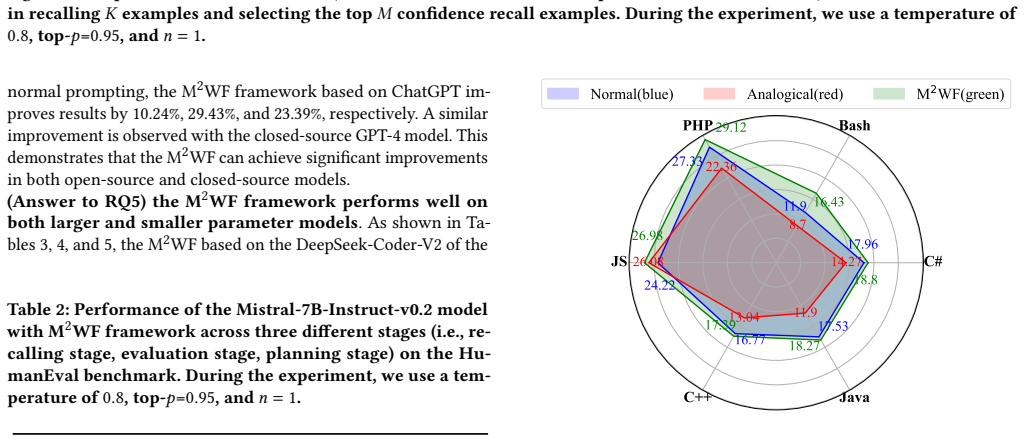
- Benchmarks without any training set (HumanEval, HumanEval+, StudentEval, Codeforces) become addressable by self-recall prompting, with pass@1 gains up to 29.43% in the reported settings.
- The four-stage one-prompt design keeps the number of API calls at one per problem, at the cost of substantially larger input and output token counts.
- Against retrieval-based few-shot prompting (AceCoder) on Codeforces, M2WF reaches a higher average accuracy than several configurations of the same model with retrieved examples.
Reading between the lines
- The confidence-score gate is a proxy for verification; replacing it with execution-based checks, such as running recalled code against its own doctests, would likely strengthen reliability, though the paper does not test this.
- Because the whole workflow runs in one prompt, the model's own output is fed back as context, which can be seen as a cheap form of self-conditioning that may degrade as context length grows, making token budgets a practical concern.
- The same recall-evaluate-plan-guidance pattern could be tested on natural-language reasoning or summarization tasks where recalled content is also hard to verify; the paper only evaluates code generation.
Editorial analysis
A structured set of objections, weighed in public.
Referee Report
Summary. The paper proposes M2WF, a four-stage prompting workflow (recall, evaluation, planning, guidance) for one-time code generation in data-free settings. The LLM first recalls K related programming problems with implementation steps and code, then assigns each a confidence score C_i in [0,100], selects the top M examples, produces an implementation plan for the target problem, and finally generates Python code under that plan. The method is evaluated against normal prompting, CoT prompting, analogical prompting, and (on Codeforces) the retrieval-based AceCoder baseline, using GPT-4, ChatGPT, DeepSeek-Coder-V2, and Mistral-7B-Instruct-v0.2 on HumanEval, StudentEval, HumanEval+, MultiPL-E, and Codeforces. The reported results show consistent average improvements over the baselines, with a headline relative gain of 29.43% on StudentEval, and the central claimed contribution is that the evaluation stage makes self-recalled examples reliable through confidence-based selection.
Significance. The proposed workflow is simple, model-agnostic, and targets a genuine limitation of retrieval-based few-shot prompting in scenarios without training sets. If the evaluation-stage mechanism were properly validated, the method would be a practical plug-and-play alternative. The breadth of models and benchmarks is a strength, and the paper includes ablation studies and an explicit limitations section. However, the central distinctive mechanism—confidence-based selection—is not directly validated, the exact hyperparameter settings for the main results are not disclosed, and several experimental claims lack statistical support, so the current evidence does not yet substantiate the reliability claim. The code is announced but not yet publicly available.
major comments (5)
- [§4.2, §5.5 (Eqs. 2-3, Table 2)] The paper's central claim is that the evaluation stage makes self-recalled examples reliable through confidence-based selection (Eqs. 2-3). The only ablation relevant to this claim is Table 2, but it contrasts the full pipeline with conditions that remove the entire evaluation stage, not with a control that selects M examples at random or uses all K examples. Moreover, no calibration analysis is reported: the paper never shows that a recalled example's confidence score C_i predicts its actual correctness or usefulness, e.g., by correlating C_i with whether the recalled code compiles or passes tests on a validation sample. Without such a control or calibration check, the experimental gains cannot be attributed to the confidence-selection mechanism as opposed to the extra self-recall, planning, or prompt length. Please add a random-selection control, an all-examples control, and a calibration analysis (or an oracle-selection analysis) to isolate the contribution of the evaluation stage.
- [§5.5 (Figure 5), Tables 3-6] The exact values of K and M used to produce the main results in Tables 3-6 are never reported. Figure 5 is a sensitivity study of K and M on HumanEval, but the paper does not say which (K, M) pair was used for each model and benchmark in the main tables, nor whether these were fixed in advance. If the (K, M) pairs were selected by inspecting HumanEval results and then the same HumanEval numbers are reported as the method's performance, the improvement on HumanEval is optimistically biased. Please disclose the (K, M) settings per model and benchmark, state whether they were tuned on a validation split, and show that the reported improvements are stable across a range of reasonable (K, M) values rather than peaked at a single chosen point.
- [§5.5 (Table 2)] The stage-level ablation is under-specified: the text says noise is added 'every 10 characters, with a noise level set to 0.5' but never defines the noise operation (e.g., random character substitution, insertion, deletion, or token-level replacement) or the random seed, so the experiment is not reproducible. In addition, with n=1 on 164 problems, the pass@1 differences between conditions (e.g., 32.32 vs. 30.11 vs. 28.45) correspond to 3-7 problems and are close to the binomial standard error; the paper reports no error bars, no repeated runs, and no statistical test. The conclusion that 'each stage plays a crucial role' is therefore stronger than the evidence supports.
- [§4.2, §5.5] Because the method runs in one input/output pass, the 'selection of the top M examples' is an instruction to the LLM, not a deterministically enforced filter: §5.5 states that M2WF 'involves inputting all instructions at once and producing results for each stage at one-time.' The paper does not parse the generated confidence scores and verify that the examples used in planning are actually those with the highest C_i, nor does it check how often the model follows the selection instruction. As a result, the implemented mechanism may deviate from the formalization in Eqs. (2)-(3). Please either enforce selection with a deterministic post-processing step or provide evidence that the model's in-prompt selection matches the stated top-M criterion.
- [Abstract, Section 1 (Contributions), Section 5.6 (RQ4, Table 4)] The headline claim 'pass@1 score sometimes increasing by over 29.43%' is not accurately described. The 29.43% figure (Table 4, ChatGPT on StudentEval) is the relative improvement in the average of the four StudentEval subcategories (First Failure, First Success, Last Failure, Last Success), not a pass@1 score; StudentEval is not scored with pass@1 in that table. The abstract and the contributions bullet in Section 1 should state the metric precisely (e.g., 'average StudentEval subcategory score') to avoid overstating the result.
minor comments (8)
- [Table 1] Table 1 contains garbled text in the 'Source' column for DeepSeek-Coder-V2 (a long string of '/uni0000...' tokens) and the 'Open-source' column uses an ambiguous '!' character; the table should be regenerated so all model attributes and URLs are legible.
- [Table 5 caption] The caption of Table 5 says 'StudentEval benchmark,' but the table reports results on HumanEval+ (as stated in the Section 5.6 text); please correct the caption.
- [Title and metadata] The paper uses inconsistent names for the proposed method: the arXiv title says 'Metamemory Agent,' while the manuscript title, abstract, and Section 4 use 'Metamemory Workflow (M2WF)'; please align the terminology across the paper and the metadata.
- [Throughout] Several typos and inconsistent notations remain: 'metamemory morkflow' in Section 1, 'Evalution examples' in Section 4.2, 'codeforces' vs. 'Codeforces' in Section 5.1, and the undefined 'n@k' metric in the caption of Table 6.
- [§5.1, Table 6] The description of the Codeforces experiment is incomplete: Section 5.1 says Level-A problems are used as the test set following [48], but Table 6 only mentions Level B and Level C as retrieval data; please state explicitly what the test set is and where the Level-A results are reported.
- [Figure 5] Figure 5 has three subfigures labeled (a), (b), (c), but the main text never refers to them individually; please add subfigure references and clarify which model and which M value each panel shows.
- [§5.4, Eq. (6)] Equation (6) is the standard pass@k estimator, but the surrounding text should define n and c exactly once and note that n=15, 3, or 1 depending on the table; currently the reader must infer the sample size from each table caption.
- [References and Table 1] Some references are incomplete or mis-cited, e.g., the model row for DeepSeek-Coder-V2 cites [10], but the reference list entry gives the 2024 preprint for DeepSeek-Coder (not V2); please verify all citations against the reference list.
Circularity Check
The benchmark pass@1 results are externally measured, but the central reliability claim equates reliability with the LLM's self-assigned confidence by construction.
-
self definitional
[Section 4.2 (Eqs. 2-3) and Section 1 Contributions]
"Subsequently, the evaluation stage assesses the confidence level of each recalled programming problem and its associated code, selecting the top M examples with the highest confidence. ... the M2WF ensures reliability by carefully evaluating the recalled examples and adaptively tailoring such recall&evaluation process for each programming problem."
Eq. (2) defines evaluation as asking the same LLM to output a confidence score C_i in [0,100] for each recalled problem, and Eq. (3) selects the top M by that self-score; no independent correctness check, calibration, or external correctness signal is reported. The contribution claims this evaluation stage 'ensures reliability' of recalled examples. Under the method's own operationalization, 'reliable' examples are by construction the examples the LLM is most confident about, so the reliability guarantee restates the selection criterion rather than validating it.
full rationale
The paper is an empirical prompting study, not a derivation, and its headline pass@1 numbers are measured against external benchmarks (HumanEval, StudentEval, HumanEval+, Codeforces, MultiPL-E) with normal/CoT/analogical baselines, so the central quantitative claim is not a fitted constant renamed as a prediction. Self-citations [43,44] appear only in related-work surveys and are not load-bearing. The main circularity concern is narrower: the paper's distinctive mechanism—evaluation making self-recalled examples 'reliable'—is operationalized entirely as the same LLM's self-assigned confidence, with no external correctness signal or calibration; the claim that evaluation ensures reliability is therefore true by construction if 'reliable' means 'high self-confidence.' This affects the interpretation of the contribution but not the benchmark comparisons, which remain externally falsifiable. A secondary risk, that K and M may have been selected on HumanEval before reporting HumanEval results, is not stated explicitly and is therefore not counted as a demonstrated circular step.
Assumptions & free parameters
free parameters (2)
- K (number of recalled programming problems) =
not reported; swept on HumanEval in Figure 5
- M (number of selected high-confidence examples) =
not reported; swept on HumanEval in Figure 5
assumptions (3)
- domain assumption LLM self-assigned confidence scores correlate with the actual correctness of recalled programming examples and code.
- domain assumption A single one-time prompt can make an LLM perform recall, evaluation, planning, and final code generation without format errors or cross-contamination.
- domain assumption LLMs can recall relevant, accurate programming problems from their parametric memory in data-free settings.
Cite this review
Pith. "Pith review of Leveraging Metamemory Agent for Enhanced Data-Free Code Generation in Large Language Models." pith.science (2026). https://pith.science/paper/5CFP2QB4
@misc{pith2026250107892,
  author       = {Pith},
  title        = {Pith review of: Leveraging Metamemory Agent for Enhanced Data-Free Code Generation in Large Language Models},
  year         = {2026},
  howpublished = {\url{https://pith.science/paper/5CFP2QB4}},
  note         = {Machine review of arXiv:2501.07892}
}
read the original abstract
Large language models (LLMs) have shown strong performance in automated code generation, with few-shot prompting widely used for its simplicity and effectiveness. However, few-shot methods depend on curated or manually crafted reference examples, limiting their applicability in data-free coding scenarios such as real-world data-free coding scenarios and benchmarks without training sets. Existing methods that generate reference examples via recitation or analogy cannot guarantee their authenticity or accuracy. Inspired by human metamemory, we propose a novel metamemory agent to enhance one-time code generation in data-free coding scenarios. The agent guides LLMs to recall relevant prior knowledge, evaluate confidence in recalled information, and selectively exploit reliable content for problem solving. This agent removes the need for external reference examples, improves the authenticity and accuracy of recalled knowledge, and adaptively tailors the recall\&evaluation process to each task. Extensive experiments demonstrate that the proposed metamemory agent significantly improves one-time code generation quality across data-free coding scenarios. The AI contribution is the metamemory agent, which makes self-recalled examples reliable through confidence evaluation and selection; the engineering application is data-free automated code generation, validated on eight public benchmarks.
Figures


Figures from the paper (3 more)


Reference graph
Works this paper leans on
-
[1]
Josh Achiam, Steven Adler, Sandhini Agarwal, Lama Ahmad, Ilge Akkaya, Floren- cia Leoni Aleman, Diogo Almeida, Janko Altenschmidt, Sam Altman, Shyamal 2https://www.tiobe.com/tiobe-index/ Conference acronym ’XX, June 03–05, 2018, Woodstock, NY Trovato et al. Table 7: An overview of input and output tokens for LLMs using different methods on the HumanEval b...
arXiv 2023
-
[2]
Hannah McLean Babe, Sydney Nguyen, Yangtian Zi, Arjun Guha, Molly Q Feldman, and Carolyn Jane Anderson. 2023. StudentEval: a benchmark of student-written prompts for large language models of code. arXiv preprint arXiv:2306.04556 (2023)
arXiv 2023
-
[3]
John Backus. 1973. Programming language semantics and closed applicative languages. In Proceedings of the 1st annual ACM SIGACT-SIGPLAN symposium on principles of programming languages . 71–86
work page 1973
-
[4]
Patrick Bareiß, Beatriz Souza, Marcelo d’Amorim, and Michael Pradel. 2022. Code generation tools (almost) for free? a study of few-shot, pre-trained language models on code. arXiv preprint arXiv:2206.01335 (2022)
arXiv 2022
-
[5]
Federico Cassano, John Gouwar, Daniel Nguyen, Sydney Nguyen, Luna Phipps- Costin, Donald Pinckney, Ming-Ho Yee, Yangtian Zi, Carolyn Jane Anderson, Molly Q Feldman, et al. 2023. MultiPL-E: a scalable and polyglot approach to benchmarking neural code generation. IEEE Transactions on Software Engineering 49, 7 (2023), 3675–3691
work page 2023
-
[6]
Mark Chen, Jerry Tworek, Heewoo Jun, Qiming Yuan, Henrique Ponde De Oliveira Pinto, Jared Kaplan, Harri Edwards, Yuri Burda, Nicholas Joseph, Greg Brockman, et al. 2021. Evaluating large language models trained on code. arXiv preprint arXiv:2107.03374 (2021)
arXiv 2021
-
[7]
Yangruibo Ding, Marcus J Min, Gail Kaiser, and Baishakhi Ray. 2024. Cycle: Learn- ing to self-refine the code generation. Proceedings of the ACM on Programming Languages 8, OOPSLA1 (2024), 392–418
work page 2024
-
[8]
John H Flavell and Henry M Wellman. 1975. Metamemory. (1975)
work page 1975
Show all 52 references
-
[9]
Mingyang Geng, Shangwen Wang, Dezun Dong, Haotian Wang, Ge Li, Zhi Jin, Xiaoguang Mao, and Xiangke Liao. 2024. Large language models are few- shot summarizers: Multi-intent comment generation via in-context learning. In Proceedings of the 46th IEEE/ACM International Conference...
2024
-
[10]
Daya Guo, Qihao Zhu, Dejian Yang, Zhenda Xie, Kai Dong, Wentao Zhang, Guanting Chen, Xiao Bi, YK Li, et al. 2024. DeepSeek-Coder: When the Large Language Model Meets Programming–The Rise of Code Intelligence. arXiv preprint arXiv:2401.14196 (2024)
2024 arXiv
-
[11]
SU Hongjin, Jungo Kasai, Chen Henry Wu, Weijia Shi, Tianlu Wang, Jiayi Xin, Rui Zhang, Mari Ostendorf, Luke Zettlemoyer, Noah A Smith, et al. 2022. Selective annotation makes language models better few-shot learners. In The Eleventh International Conference on Learning Representations
2022
-
[12]
Xinyi Hou, Yanjie Zhao, Yue Liu, Zhou Yang, Kailong Wang, Li Li, Xiapu Luo, David Lo, John Grundy, and Haoyu Wang. 2023. Large language models for software engineering: A systematic literature review. ACM Transactions on Software Engineering and Methodology (2023)
2023
-
[13]
Xue Jiang, Yihong Dong, Lecheng Wang, Zheng Fang, Qiwei Shang, Ge Li, Zhi Jin, and Wenpin Jiao. 2024. Self-planning code generation with large language models. ACM Transactions on Software Engineering and Methodology 33, 7 (2024), 1–30
2024
-
[14]
Takeshi Kojima, Shixiang Shane Gu, Machel Reid, Yutaka Matsuo, and Yusuke Iwasawa. 2022. Large language models are zero-shot reasoners. Advances in neural information processing systems 35 (2022), 22199–22213
2022
-
[15]
Sumith Kulal, Panupong Pasupat, Kartik Chandra, Mina Lee, Oded Padon, Alex Aiken, and Percy S Liang. 2019. Spoc: Search-based pseudocode to code.Advances in Neural Information Processing Systems 32 (2019)
2019
-
[16]
Hongxin Li, Jingran Su, Yuntao Chen, Qing Li, and ZHAO-XIANG ZHANG. 2024. SheetCopilot: Bringing software productivity to the next level through large language models. Advances in Neural Information Processing Systems 36 (2024)
2024
-
[17]
Jia Li, Ge Li, Yongmin Li, and Zhi Jin. 2023. Structured chain-of-thought prompt- ing for code generation. arXiv preprint arXiv:2305.06599 (2023)
2023 arXiv
-
[18]
Jia Li, Yunfei Zhao, Yongmin Li, Ge Li, and Zhi Jin. 2023. Acecoder: Utilizing existing code to enhance code generation. arXiv preprint arXiv:2303.17780 (2023)
2023 arXiv
-
[19]
Yujia Li, David Choi, Junyoung Chung, Nate Kushman, Julian Schrittwieser, Rémi Leblond, Tom Eccles, James Keeling, Felix Gimeno, Agustin Dal Lago, et al. 2022. Competition-level code generation with alphacode. Science 378, 6624 (2022), 1092–1097
2022
-
[20]
Jiawei Liu, Chunqiu Steven Xia, Yuyao Wang, and Lingming Zhang. 2024. Is your code generated by chatgpt really correct? rigorous evaluation of large language models for code generation. Advances in Neural Information Processing Systems 36 (2024)
2024
-
[21]
Eugene A Lovelace. 1984. Metamemory: monitoring future recallability during study. Journal of Experimental Psychology: Learning, Memory, and Cognition 10, 4 (1984), 756
1984
-
[22]
Ali Madani, Ben Krause, Eric R Greene, Subu Subramanian, Benjamin P Mohr, James M Holton, Jose Luis Olmos, Caiming Xiong, Zachary Z Sun, Richard Socher, et al. 2023. Large language models generate functional protein sequences across diverse families. Nature Biotechnology 41, 8...
2023
-
[23]
Justin M Mittelstädt, Julia Maier, Panja Goerke, Frank Zinn, and Michael Her- mes. 2024. Large language models can outperform humans in social situational judgments. Scientific Reports 14, 1 (2024), 27449
2024
-
[24]
Kentaro Miyamoto, Takahiro Osada, Rieko Setsuie, Masaki Takeda, Keita Tamura, Yusuke Adachi, and Yasushi Miyashita. 2017. Causal neural network of metamem- ory for retrospection in primates. Science 355, 6321 (2017), 188–193
2017
-
[25]
Noor Nashid, Mifta Sintaha, and Ali Mesbah. 2023. Retrieval-based prompt selection for code-related few-shot learning. In 2023 IEEE/ACM 45th International Conference on Software Engineering (ICSE) . IEEE, 2450–2462
2023
-
[26]
Thomas O Nelson. 1990. Metamemory: A theoretical framework and new findings. In Psychology of learning and motivation . Vol. 26. Elsevier, 125–173
1990
-
[27]
Jasmeet K Pannu and Alfred W Kaszniak. 2005. Metamemory experiments in neurological populations: A review. Neuropsychology review 15 (2005), 105–130
2005
-
[28]
Arkil Patel, Siva Reddy, Dzmitry Bahdanau, and Pradeep Dasigi. 2023. Eval- uating In-Context Learning of Libraries for Code Generation. arXiv preprint arXiv:2311.09635 (2023)
2023 arXiv
-
[29]
Keqin Peng, Liang Ding, Yancheng Yuan, Xuebo Liu, Min Zhang, Yuanxin Ouyang, and Dacheng Tao. 2024. Revisiting demonstration selection strategies in in- context learning. arXiv preprint arXiv:2401.12087 (2024)
2024 arXiv
-
[30]
Keqin Peng, Liang Ding, Qihuang Zhong, Li Shen, Xuebo Liu, Min Zhang, Yuanxin Ouyang, and Dacheng Tao. 2023. Towards Making the Most of ChatGPT for Machine Translation. In Findings of the Association for Computational Linguistics: EMNLP 2023. 5622–5633
2023
-
[31]
Baptiste Roziere, Jonas Gehring, Fabian Gloeckle, Sten Sootla, Itai Gat, Xiao- qing Ellen Tan, Yossi Adi, Jingyu Liu, Tal Remez, Jérémy Rapin, et al. 2023. Code llama: Open foundation models for code. arXiv preprint arXiv:2308.12950 (2023)
2023 arXiv
-
[32]
Max Schäfer, Sarah Nadi, Aryaz Eghbali, and Frank Tip. 2023. An empirical evaluation of using large language models for automated unit test generation. IEEE Transactions on Software Engineering (2023)
2023
-
[33]
Bennett L Schwartz and Anastasia Efklides. 2012. Metamemory and memory efficiency: Implications for student learning. Journal of Applied Research in Memory and Cognition 1, 3 (2012), 145–151
2012
-
[34]
Zhenwei Shao, Zhou Yu, Meng Wang, and Jun Yu. 2023. Prompting large language models with answer heuristics for knowledge-based visual question answering. In Proceedings of the IEEE/CVF Conference on computer vision and pattern recognition . 14974–14983
2023
-
[35]
Noah Shinn, Federico Cassano, Ashwin Gopinath, Karthik Narasimhan, and Shunyu Yao. 2024. Reflexion: Language agents with verbal reinforcement learning. Advances in Neural Information Processing Systems 36 (2024)
2024
-
[36]
James WA Strachan, Dalila Albergo, Giulia Borghini, Oriana Pansardi, Eugenio Scaliti, Saurabh Gupta, Krati Saxena, Alessandro Rufo, Stefano Panzeri, Guido Leveraging Metamemory Mechanisms for Enhanced Data-Free Code Generation in LLMs Conference acronym ’XX, June 03–05, 2018, ...
2024
-
[37]
Zhiqing Sun, Xuezhi Wang, Yi Tay, Yiming Yang, and Denny Zhou. 2023. Recitation-Augmented Language Models. InThe Eleventh International Conference on Learning Representations. https://openreview.net/forum?id=-cqvvvb-NkI
2023
-
[38]
Alex Tamkin, Miles Brundage, Jack Clark, and Deep Ganguli. 2021. Understanding the capabilities, limitations, and societal impact of large language models. arXiv preprint arXiv:2102.02503 (2021)
2021 arXiv
-
[39]
Robert D. Tennent. 1976. The denotational semantics of programming languages. Commun. ACM 19, 8 (1976), 437–453
1976
-
[40]
Eva AM Van Dis, Johan Bollen, Willem Zuidema, Robert Van Rooij, and Claudi L Bockting. 2023. ChatGPT: five priorities for research. Nature 614, 7947 (2023), 224–226
2023
-
[41]
Dave Van Veen, Cara Van Uden, Louis Blankemeier, Jean-Benoit Delbrouck, Asad Aali, Christian Bluethgen, Anuj Pareek, Malgorzata Polacin, Eduardo Pontes Reis, Anna Seehofnerová, et al. 2024. Adapted large language models can outperform medical experts in clinical text summariza...
2024
-
[42]
Ashish Vaswani, Noam Shazeer, Niki Parmar, Jakob Uszkoreit, Llion Jones, Aidan N Gomez, Łukasz Kaiser, and Illia Polosukhin. 2017. Attention is all you need. Advances in neural information processing systems 30 (2017)
2017
-
[43]
Shuai Wang, Liang Ding, Li Shen, Yong Luo, Bo Du, and Dacheng Tao. 2024. OOP: Object-Oriented Programming Evaluation Benchmark for Large Language Models. arXiv preprint arXiv:2401.06628 (2024)
2024 arXiv
-
[44]
Shuai Wang, Liang Ding, Li Shen, Yong Luo, Zheng He, Wei Yu, and Dacheng Tao. 2024. USCD: Improving Code Generation of LLMs by Uncertainty-Aware Selective Contrastive Decoding. arXiv preprint arXiv:2409.05923 (2024)
2024 arXiv
-
[45]
Zejun Wang, Jia Li, Ge Li, and Zhi Jin. 2023. ChatCoder: Chat-based Refine Requirement Improves LLMs’ Code Generation. arXiv preprint arXiv:2311.00272 (2023)
2023 arXiv
-
[46]
Zhiyong Wu, Yaoxiang Wang, Jiacheng Ye, and Lingpeng Kong. 2023. Self- Adaptive In-Context Learning: An Information Compression Perspective for In-Context Example Selection and Ordering. In Proceedings of the 61st Annual Meeting of the Association for Computational Linguistics...
2023
-
[47]
Zhen Yang, Jacky Wai Keung, Zeyu Sun, Yunfei Zhao, Ge Li, Zhi Jin, Shuo Liu, and Yishu Li. 2024. Improving domain-specific neural code generation with few-shot meta-learning. Information and Software Technology 166 (2024), 107365
2024
-
[48]
Chi, and Denny Zhou
Michihiro Yasunaga, Xinyun Chen, Yujia Li, Panupong Pasupat, Jure Leskovec, Percy Liang, Ed H. Chi, and Denny Zhou. 2024. Large Language Models as Analogical Reasoners. In The Twelfth International Conference on Learning Repre- sentations. https://openreview.net/forum?id=AgDICX1h50
2024
-
[49]
Xiao Yu, Baolin Peng, Michel Galley, Jianfeng Gao, and Zhou Yu. 2024. Teaching Language Models to Self-Improve through Interactive Demonstrations. In Pro- ceedings of the 2024 Conference of the North American Chapter of the Association for Computational Linguistics: Human Lang...
2024
-
[50]
Biao Zhang, Barry Haddow, and Alexandra Birch. 2023. Prompting large language model for machine translation: A case study. In International Conference on Machine Learning. PMLR, 41092–41110
2023
-
[51]
Qihuang Zhong, Liang Ding, Juhua Liu, Bo Du, and Dacheng Tao. 2023. Can chatgpt understand too? a comparative study on chatgpt and fine-tuned bert. arXiv preprint arXiv:2302.10198 (2023)
2023 arXiv
-
[52]
Qihuang Zhong, Kang Wang, Ziyang Xu, Juhua Liu, Liang Ding, Bo Du, and Dacheng Tao. 2024. Achieving> 97% on GSM8K: Deeply Understanding the Problems Makes LLMs Perfect Reasoners. arXiv preprint arXiv:2404.14963 (2024)
2024 arXiv
Reviewed August 10, 2026 · model on record in the stance chip above.
Discussion (0). Continue with ORCID to comment.