REVIEW 2 major objections 5 minor 49 references
Self-supervised Transformation Learning for Equivariant Representations
T0 review · 2 major / 5 minor · reviewed 2026-08-10 · deepseek-v4-flash
Pith's one-line read This paper proposes replacing transformation labels with learned, image-invariant transformation representations, and reports gains on 7 of 11 classification benchmarks and on object detection.
desk verdict STL is a genuinely label-free step for equivariant SSL that deserves review, but the image-invariance claim is under-tested and the main results lack error bars. read the letter →
The pith
A machine-rendered reading of the paper's core claim, the machinery that carries it, and where it could break.
The reading
What carries the argument
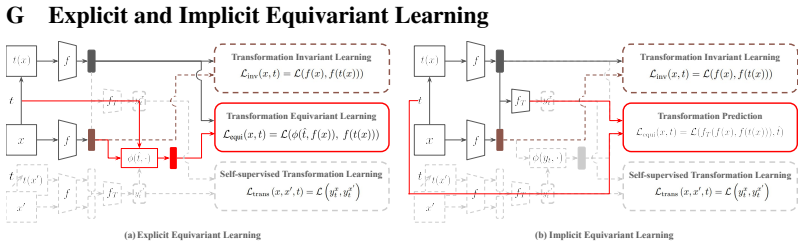
The central object is the transformation representation $y_x^t = f_T(f(x), f(t(x)))$, produced by an auxiliary encoder $f_T$ from the representation pair of an image and its transformed version. Its defining property is image-invariance: $y_x^t = y_{x'}^t$ for the same $t$, enforced by the self-supervised transformation loss $L_{\mathrm{trans}}$ using InfoNCE. The second mechanism is the equivariant transformation $\phi(y_{x'}^t, f(x))$, a hypernetwork-parameterized map that applies a transformation code obtained from another image $x'$ to the representation of $x$, so that the equivariant branch cannot cheat by copying the input pair. Together they replace discrete transformation labels with continuous codes that can represent composed transformations such as AugMix.
What would settle it
Train STL with transformations seen during pretraining, then probe held-out images and transformations: if the transformation representation $y_x^t$ changes substantially when the same $t$ is applied to different images, so that intra-transformation variance across images exceeds inter-transformation separation, the image-invariance premise fails. A direct test is to measure whether $\phi(y_{x'}^t, f(x))$ aligns with $f(t(x))$ when $x$ and $x'$ are drawn from a distribution very different from the pretraining data; if alignment error grows sharply, the equivariant branch is not actually transferring transformations.
Extended reading notes
Core claim
The central claim is that a learned vector $y_x^t = f_T(f(x), f(t(x)))$ can serve as a continuous, label-free code for the transformation $t$ itself, provided it is trained to be invariant to the choice of image $x$. STL enforces this with a contrastive loss that aligns $y_x^t$ and $y_{x'}^t$ for identical transformations applied to different images, so the representation encodes the transformation rather than the image content. The equivariant branch then applies $\phi(y_{x'}^t, f(x))$ to a different image $x$, avoiding the trivial solution where the equivariant map would just copy the representation it saw, and aligns the result with $f(t(x))$. On ImageNet100-pretrained ResNet-50, STL reaches 64.18% mean accuracy over 11 downstream classification tasks and 51.95 AP on VOC07+12 detection, outperforming label-based equivariant baselines while keeping batch construction at the same complexity as SimCLR.
Load-bearing premise
The approach rests on the assumption that a transformation representation computed from one image pair actually encodes the transformation independently of the image content, and that contrastively aligning same-transformation pairs across different images is enough to make that true in practice.
Editorial extensions
If this is right
- Equivariant learning can be applied to transformations that have no discrete label space, such as AugMix, because the transformation is represented by a learned vector rather than a category or parameter vector.
- Transformation representations organize by type and intensity in the learned space, so similar color transformations sit close together and intensity levels order continuously, giving a structured transformation geometry.
- The same batch configuration as standard contrastive learning suffices, with roughly 10% higher per-iteration cost, so the method can be dropped into existing pipelines without enlarged batches.
- STL improves transfer performance across the base models SimCLR, BYOL, SimSiam, and Barlow Twins, meaning the transformation-learning module is a portable addition rather than a redesign.
- Object detection also benefits, with STL reaching 51.95 AP_all and 52.70 with AugMix, so the equivariant signal helps downstream tasks that demand precise localization.
Reading between the lines
- The image-invariance hypothesis suggests a continuous transformation algebra: if $y_t$ encodes $t$ independently of $x$, operations like composition and interpolation of transformations could be performed in representation space and probed with arithmetic tests, which the paper does not run.
- The paper's limitation statement implies that multi-image transformations such as mixup are out of reach; a natural extension would be an encoder over sets of representations that produces a transformation code from more than two images.
- The same contrastive-alignment idea could transfer to other modalities where transformations are hard to label, such as audio pitch shifting or time stretching, though the paper only evaluates images.
- Because transformation representations are continuous, they could be used as goals in reinforcement learning or as supervisory signals for controllable generation, a use the paper does not explore.
Signed reviews
Editorial analysis
A structured set of objections, weighed in public.
Referee Report
Summary. The paper introduces Self-supervised Transformation Learning (STL), a method for learning equivariant representations without transformation labels. STL uses an auxiliary encoder f_T that maps a pair of representations (f(x), f(t(x))) to a transformation representation y_x^t. The training objective combines three InfoNCE losses: an invariant loss (Eq. 11) aligning f(x) and f(t(x)); an equivariant loss (Eq. 12) aligning phi(y_{x'}^t, f(x)) with f(t(x)), using a transformation representation from a different image x' to avoid trivial solutions; and a transformation alignment loss (Eq. 13) that pulls y_x^t and y_{x'}^t together for the same transformation t on different images. The paper reports linear transfer results on 11 downstream datasets, object detection on VOC, transformation prediction quality, and ablations, and claims improvements over existing equivariant SSL methods in 7 of 11 classification tasks.
Significance. The core idea is timely and potentially useful: replacing discrete transformation labels with learned continuous transformation representations could handle composite transformations such as AugMix and capture interdependencies among simple transformations, which label-based equivariant methods cannot. The paper provides a clean formulation, an aligned-batch implementation that keeps computational overhead at about 1.11x, compatibility with several base SSL models, and a set of ablations that show each loss term contributes. The code is released. The main reservations are that the key image-invariance property (Eq. 8) is not directly tested and that the ImageNet100 benchmark tables lack variance information; both concerns are addressable with additional experiments.
major comments (2)
- [§4.1, Tables 2–4] The main ImageNet100 results are reported as single accuracy numbers without standard deviations or seed counts, while the STL10 results in Table 11 include mean±std over three seeds. The headline claim of outperforming existing methods in 7 of 11 datasets is sensitive to small differences: for example, in Table 2 STL improves over AugSelf on CIFAR100 by 0.75 points (66.84 vs 66.09), while it is lower on MIT67 (56.64 vs 57.16) and SUN397 (44.69 vs 45.24), and the mean improvement over SimCLR with AugMix is only 0.09 points (64.18 vs 64.09). Without variance information, the 7-of-11 claim cannot be distinguished from run-to-run noise. The authors should report mean±std over at least three seeds for the ImageNet100 experiments, or explicitly state the number of seeds, and discuss whether the reported differences are significant.
- [§3.2, Eqs. (8), (12), (13); Table 7] The image-invariance of the transformation representation is the load-bearing assumption of the method, but it is not directly verified. The loss in Eq. (13) aligns y_x^t and y_{x'}^t only for same-transformation pairs sampled in the aligned batch; because f_T also sees f(x), nothing in the InfoNCE objective prevents y_x^t from encoding image identity or collapsing to a constant. The claim in the abstract that the method 'ensures transformation representation is image-invariant' is therefore not established by the reported experiments. The ablation in Table 7 shows that adding Ltrans improves transformation classification from 69.57 to 93.67, but this demonstrates the importance of the loss term, not that the learned representation satisfies Eq. (8) on unseen images. I ask the authors to add a direct invariance test, such as the variance of y_x^t across many images x for a fixed t, or the accuracy of the equivariant transfer Eq. (6) when y is drawn from held-out images, compared with an image-specific or random baseline. If Eq. (8) fails on unseen images, the equivariant objective in Eq. (12) no longer aligns with true transformations, and the reported gains could reflect an auxiliary regularization effect rather than the proposed mechanism.
minor comments (5)
- [Appendix B, Table 10] ImageNet100 is listed as having 1,000 classes; the ImageNet100 split used in this paper (from [42]) contains 100 classes. This is a typo but should be corrected.
- [Appendix C] The sentence 'we usetrainval set for training' is missing a space, and 'pre-taining' in Appendix B should be 'pretraining'.
- [§3.3, Eq. (10)] The InfoNCE denominator is written as a sum over y_i ≠ y, but the negative set should be explicitly the other batch elements; the shorthand used in Eqs. (11)–(13) is not defined until later. Please clarify the notation.
- [§3.3, Figure 3] For stochastic transformations such as random crop and color jitter, it is not specified how 'identical transformations' are synchronized across paired images (e.g., shared crop coordinates and jitter parameters). This detail matters for the correctness of Ltrans and Lequi and should be stated explicitly, ideally with a reference to the code.
- [§4.3, Table 7] The ablation study reports only single runs for the STL10-pretrained model; while Table 11 gives mean±std for the full STL, the ablations would be more convincing with repeated seeds.
Circularity Check
No circularity found: the transformation representation is trained by contrastive alignment on image pairs, and all central benchmark claims are evaluated on held-out downstream tasks.
full rationale
The derivation chain is self-contained against external benchmarks. The transformation representation y_x^t is defined from image pairs (Eq. 5) and trained with the contrastive objective (Eqs. 9 and 13); the same-transformation pairing is constructed by applying identical transformations t to two images, so t is known to the data pipeline. This is a standard use of augmentation identity to form positives and does not make the learned representation a regression target or a label-conditioned prediction. The equivariant objective (Eqs. 7 and 12) is trained to align phi(y_{x'}^t, f(x)) with f(t(x)), and its evaluation in Table 6 uses held-out transformations; downstream transfer results (Tables 2-4, 8-9) are independent of transformation labels. The only self-referential element is the semantic overstatement that the method "replaces" transformation labels, when the pipeline still uses t to define positive pairs; this is a wording caveat, not a circular reduction. The image-invariance hypothesis (Eq. 8) is an empirical assumption that could fail, but the paper tests it on test images (Table 5, Figures 1 and 4), and failure would be a robustness issue, not circularity. No load-bearing self-citations or imported uniqueness theorems appear.
Assumptions & free parameters
free parameters (3)
- lambda_inv, lambda_equi, lambda_trans =
1, 1, 0.2
- tau_inv, tau_equi, tau_trans =
not reported; 0.2 used for base SimCLR in Appendix E
- transformation representation dimension =
128
assumptions (3)
- domain assumption Transformation representation f_T(f(x), f(t(x))) encodes t independently of image content (image-invariance hypothesis).
- domain assumption InfoNCE contrastive alignment between same-transformation pairs from different images is sufficient to enforce image-invariance and prevent collapse.
- ad hoc to paper Equivariant transformation networks trained with a transformation vector from a different image transfer to the target image.
invented entities (1)
-
Transformation representation y_x^t
Cite this review
Pith. "Pith review of Self-supervised Transformation Learning for Equivariant Representations." pith.science (2026). https://pith.science/paper/5XIO6KD5
@misc{pith2026250108712,
  author       = {Pith},
  title        = {Pith review of: Self-supervised Transformation Learning for Equivariant Representations},
  year         = {2026},
  howpublished = {\url{https://pith.science/paper/5XIO6KD5}},
  note         = {Machine review of arXiv:2501.08712}
}
read the original abstract
Unsupervised representation learning has significantly advanced various machine learning tasks. In the computer vision domain, state-of-the-art approaches utilize transformations like random crop and color jitter to achieve invariant representations, embedding semantically the same inputs despite transformations. However, this can degrade performance in tasks requiring precise features, such as localization or flower classification. To address this, recent research incorporates equivariant representation learning, which captures transformation-sensitive information. However, current methods depend on transformation labels and thus struggle with interdependency and complex transformations. We propose Self-supervised Transformation Learning (STL), replacing transformation labels with transformation representations derived from image pairs. The proposed method ensures transformation representation is image-invariant and learns corresponding equivariant transformations, enhancing performance without increased batch complexity. We demonstrate the approach's effectiveness across diverse classification and detection tasks, outperforming existing methods in 7 out of 11 benchmarks and excelling in detection. By integrating complex transformations like AugMix, unusable by prior equivariant methods, this approach enhances performance across tasks, underscoring its adaptability and resilience. Additionally, its compatibility with various base models highlights its flexibility and broad applicability. The code is available at https://github.com/jaemyung-u/stl.
Figures


Figures from the paper (2 more)

Reference graph
Works this paper leans on
- [1]
-
[2]
L. Bossard, M. Guillaumin, and L. Van Gool. Food-101–mining discriminative components with random forests. In Computer Vision–ECCV 2014: 13th European Conference, Zurich, Switzerland, September 6-12, 2014, Proceedings, Part VI 13, pages 446–461. Springer, 2014
work page 2014
- [3]
-
[4]
T. Chen, S. Kornblith, M. Norouzi, and G. Hinton. A simple framework for contrastive learning of visual representations. In International conference on machine learning, pages 1597–1607. PMLR, 2020
2020
-
[5]
X. Chen and K. He. Exploring simple siamese representation learning. In Proceedings of the IEEE/CVF conference on computer vision and pattern recognition, pages 15750–15758, 2021
work page 2021
-
[6]
Cimpoi, S
M. Cimpoi, S. Maji, I. Kokkinos, S. Mohamed, and A. Vedaldi. Describing textures in the wild. In Proceedings of the IEEE conference on computer vision and pattern recognition, pages 3606–3613, 2014
2014
-
[7]
Coates, A
A. Coates, A. Ng, and H. Lee. An analysis of single-layer networks in unsupervised feature learning. In Proceedings of the fourteenth international conference on artificial intelligence and statistics, pages 215–223. JMLR Workshop and Conference Proceedings, 2011
2011
-
[8]
R. Dangovski, L. Jing, C. Loh, S. Han, A. Srivastava, B. Cheung, P. Agrawal, and M. Soljaˇci´c. Equivariant contrastive learning. arXiv preprint arXiv:2111.00899, 2021
arXiv 2021
Show all 49 references
-
[9]
Devillers and M
A. Devillers and M. Lefort. Equimod: An equivariance module to improve self-supervised learning. arXiv preprint arXiv:2211.01244, 2022
2022 arXiv
-
[10]
Doersch, A
C. Doersch, A. Gupta, and A. A. Efros. Unsupervised visual representation learning by context prediction. In Proceedings of the IEEE international conference on computer vision, pages 1422–1430, 2015
2015
-
[11]
Everingham, L
M. Everingham, L. Van Gool, C. K. Williams, J. Winn, and A. Zisserman. The pascal visual object classes (voc) challenge. International journal of computer vision, 88:303–338, 2010
2010
-
[12]
Fei-Fei, R
L. Fei-Fei, R. Fergus, and P. Perona. Learning generative visual models from few training examples: An incremental bayesian approach tested on 101 object categories. In 2004 conference on computer vision and pattern recognition workshop, pages 178–178. IEEE, 2004
2004
-
[13]
Garrido, L
Q. Garrido, L. Najman, and Y . Lecun. Self-supervised learning of split invariant equivariant representations. arXiv preprint arXiv:2302.10283, 2023
2023 arXiv
-
[14]
T. Geng, T. Wang, Y . Zhang, J. Duan, W. Guan, and F. Zheng. Uniav: Unified audio-visual perception for multi-task video localization. arXiv preprint arXiv:2404.03179, 2024
2024
-
[15]
Gidaris, P
S. Gidaris, P. Singh, and N. Komodakis. Unsupervised representation learning by predicting image rotations. arXiv preprint arXiv:1803.07728, 2018
2018 arXiv
-
[16]
Girshick
R. Girshick. Fast r-cnn. In Proceedings of the IEEE international conference on computer vision, pages 1440–1448, 2015
2015
-
[17]
Goyal, P
P. Goyal, P. Dollár, R. Girshick, P. Noordhuis, L. Wesolowski, A. Kyrola, A. Tulloch, Y . Jia, and K. He. Accurate, large minibatch sgd: Training imagenet in 1 hour. arXiv preprint arXiv:1706.02677, 2017
2017 arXiv
-
[18]
Grill, F
J.-B. Grill, F. Strub, F. Altché, C. Tallec, P. Richemond, E. Buchatskaya, C. Doersch, B. Avila Pires, Z. Guo, M. Gheshlaghi Azar, et al. Bootstrap your own latent-a new approach to self-supervised learning. Advances in neural information processing systems, 33:21271–21284, 2020
2020
-
[19]
X. Guo, E. Zhu, X. Liu, and J. Yin. Affine equivariant autoencoder. In IJCAI, pages 2413–2419, 2019
2019
-
[20]
Gupta, J
S. Gupta, J. Robinson, D. Lim, S. Villar, and S. Jegelka. Structuring representation geometry with rotationally equivariant contrastive learning. arXiv preprint arXiv:2306.13924, 2023
2023 arXiv
-
[21]
Hashemi, Y
A. Hashemi, Y . Feng, and H. Sabet. Spherical cnn for medical imaging applications: Importance of equivariance in image reconstruction and denoising. ArXiv, 2023. 11
2023
-
[22]
K. He, X. Zhang, S. Ren, and J. Sun. Deep residual learning for image recognition. In Proceedings of the IEEE conference on computer vision and pattern recognition, pages 770–778, 2016
2016
-
[23]
Hendrycks, N
D. Hendrycks, N. Mu, E. D. Cubuk, B. Zoph, J. Gilmer, and B. Lakshminarayanan. Augmix: A simple data processing method to improve robustness and uncertainty. arXiv preprint arXiv:1912.02781, 2019
1912 arXiv
-
[24]
Ioffe and C
S. Ioffe and C. Szegedy. Batch normalization: Accelerating deep network training by reducing internal covariate shift. In International conference on machine learning, pages 448–456. pmlr, 2015
2015
-
[25]
Kornblith, J
S. Kornblith, J. Shlens, and Q. V . Le. Do better imagenet models transfer better? InProceedings of the IEEE/CVF conference on computer vision and pattern recognition, pages 2661–2671, 2019
2019
-
[26]
Krause, M
J. Krause, M. Stark, J. Deng, and L. Fei-Fei. 3d object representations for fine-grained categorization. In Proceedings of the IEEE international conference on computer vision workshops, pages 554–561, 2013
2013
-
[27]
Krizhevsky, G
A. Krizhevsky, G. Hinton, et al. Learning multiple layers of features from tiny images. 2009
2009
-
[28]
H. Lee, K. Lee, K. Lee, H. Lee, and J. Shin. Improving transferability of representations via augmentation- aware self-supervision. Advances in Neural Information Processing Systems, 34:17710–17722, 2021
2021
-
[29]
J. Lee, J. Kim, H. Shon, B. Kim, S. H. Kim, H. Lee, and J. Kim. Uniclip: Unified framework for contrastive language-image pre-training. Advances in Neural Information Processing Systems, 35:1008–1019, 2022
2022
-
[30]
Loshchilov and F
I. Loshchilov and F. Hutter. Sgdr: Stochastic gradient descent with warm restarts. arXiv preprint arXiv:1608.03983, 2016
2016 arXiv
-
[31]
S. Maji, E. Rahtu, J. Kannala, M. Blaschko, and A. Vedaldi. Fine-grained visual classification of aircraft. arXiv preprint arXiv:1306.5151, 2013
2013 arXiv
-
[32]
McInnes, J
L. McInnes, J. Healy, and J. Melville. Umap: Uniform manifold approximation and projection for dimension reduction. arXiv preprint arXiv:1802.03426, 2018
2018 arXiv
-
[33]
Nilsback and A
M.-E. Nilsback and A. Zisserman. Automated flower classification over a large number of classes. In 2008 Sixth Indian conference on computer vision, graphics & image processing, pages 722–729. IEEE, 2008
2008
-
[34]
Noroozi and P
M. Noroozi and P. Favaro. Unsupervised learning of visual representations by solving jigsaw puzzles. In European conference on computer vision, pages 69–84. Springer, 2016
2016
-
[35]
A. v. d. Oord, Y . Li, and O. Vinyals. Representation learning with contrastive predictive coding.arXiv preprint arXiv:1807.03748, 2018
2018 arXiv
-
[36]
J. Y . Park, O. Biza, L. Zhao, J. W. van de Meent, and R. Walters. Learning symmetric embeddings for equivariant world models. arXiv preprint arXiv:2204.11371, 2022
2022 arXiv
-
[37]
O. M. Parkhi, A. Vedaldi, A. Zisserman, and C. Jawahar. Cats and dogs. In 2012 IEEE conference on computer vision and pattern recognition, pages 3498–3505. IEEE, 2012
2012
-
[38]
Quattoni and A
A. Quattoni and A. Torralba. Recognizing indoor scenes. In 2009 IEEE conference on computer vision and pattern recognition, pages 413–420. IEEE, 2009
2009
-
[39]
Russakovsky, J
O. Russakovsky, J. Deng, H. Su, J. Krause, S. Satheesh, S. Ma, Z. Huang, A. Karpathy, A. Khosla, M. Bernstein, et al. Imagenet large scale visual recognition challenge. International journal of computer vision, 115:211–252, 2015
2015
-
[40]
Shakerinava, A
M. Shakerinava, A. K. Mondal, and S. Ravanbakhsh. Structuring representations using group invariants. Advances in Neural Information Processing Systems, 35:34162–34174, 2022
2022
-
[41]
C. Sun, A. Shrivastava, S. Singh, and A. Gupta. Revisiting unreasonable effectiveness of data in deep learning era. In Proceedings of the IEEE international conference on computer vision, pages 843–852, 2017
2017
-
[42]
Y . Tian, D. Krishnan, and P. Isola. Contrastive multiview coding. In Computer Vision–ECCV 2020: 16th European Conference, Glasgow, UK, August 23–28, 2020, Proceedings, Part XI 16, pages 776–794. Springer, 2020
2020
-
[43]
Y . Tian, C. Sun, B. Poole, D. Krishnan, C. Schmid, and P. Isola. What makes for good views for contrastive learning? Advances in neural information processing systems, 33:6827–6839, 2020
2020
-
[44]
D. Wang, M. Jia, X. Zhu, R. Walters, and R. Platt. On-robot learning with equivariant models. arXiv preprint arXiv:2203.04923, 2022. 12
2022 arXiv
-
[45]
Y . Wang, Z. Geng, F. Jiang, C. Li, Y . Wang, J. Yang, and Z. Lin. Residual relaxation for multi-view representation learning. Advances in Neural Information Processing Systems, 34:12104–12115, 2021
2021
-
[46]
Winter, M
R. Winter, M. Bertolini, T. Le, F. Noé, and D.-A. Clevert. Unsupervised learning of group invariant and equivariant representations. Advances in Neural Information Processing Systems, 35:31942–31956, 2022
2022
-
[47]
J. Xiao, J. Hays, K. A. Ehinger, A. Oliva, and A. Torralba. Sun database: Large-scale scene recognition from abbey to zoo. In 2010 IEEE computer society conference on computer vision and pattern recognition, pages 3485–3492. IEEE, 2010
2010
-
[48]
Zbontar, L
J. Zbontar, L. Jing, I. Misra, Y . LeCun, and S. Deny. Barlow twins: Self-supervised learning via redundancy reduction. In International Conference on Machine Learning, pages 12310–12320. PMLR, 2021
2021
-
[49]
H. Zhang. mixup: Beyond empirical risk minimization. arXiv preprint arXiv:1710.09412, 2017. 13 A STL Formulations for Various Base Invariant Models A.1 STL Extension on BYOL In adapting STL to BYOL [ 18], we utilize dissimilarity loss of BYOL to define the invariant, equivaria...
2017 arXiv
Reviewed August 10, 2026 · model on record in the stance chip above.
Discussion (0). Continue with ORCID to comment.