REVIEW 3 major objections 5 minor 42 references
Tessellated Linear Model for Age Prediction from Voice
T0 review · 3 major / 5 minor · reviewed 2026-08-10 · deepseek-v4-flash
Pith's one-line read The paper claims that a piecewise-linear tessellation of voice features predicts age on TIMIT with mean absolute error 3.97 years, the lowest reported for that dataset, outperforming deep-learning baselines.
desk verdict A modest tree-based method with a nice feature-fine-tuning twist, but the SOTA claim is built on an uncontrolled baseline table and no error bars. read the letter →
The pith
A machine-rendered reading of the paper's core claim, the machinery that carries it, and where it could break.
The reading
What carries the argument
The Tessellated Linear Model (TLM) is a piecewise-linear regressor that partitions the feature space $\mathcal{F}\subset\mathbb{R}^d$ into disjoint convex polytope cells and fits an affine model $\hat{y}(f)=r_\theta^\top f+b$ in each cell. The tree is grown greedily: at each node a logistic-regression classifier splits the current data into two sides of a hyperplane, with the split threshold selected by minimizing the summed squared error of the two child regressors. Because every component is linear and differentiable, the feature extractor can then be fine-tuned by backpropagation with the tree frozen. Inference can be hard, routing each input to a single leaf, or soft, blending the predictions along the routing path by classifier probabilities.
What would settle it
Run TLM and the previous best method on identical TIMIT train/test folds and identical TitaNet embeddings with the same augmentation, and test whether the MAE gap of 0.16 years persists; if TLM no longer finishes below 4.13, the headline result fails.
Extended reading notes
Core claim
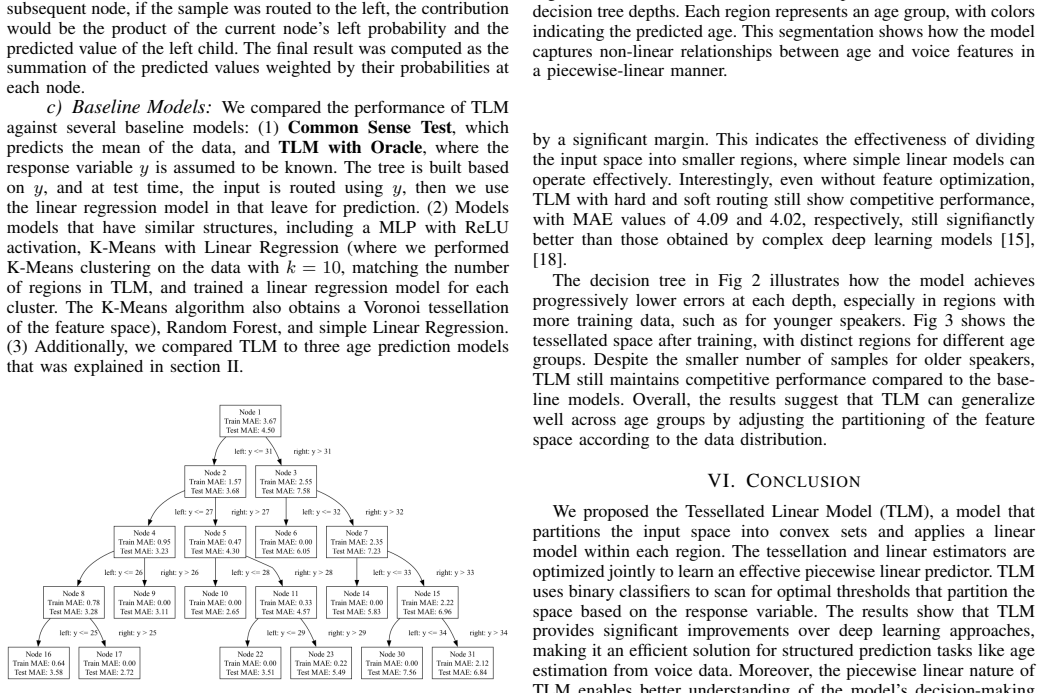
The central discovery is the TLM itself: a hierarchical tessellation in which each cell contains an unconstrained linear regressor, with boundaries and regressors chosen by a greedy recursive search over candidate age thresholds. The paper reports that this model, using 192-dimensional TitaNet speaker embeddings, achieves a mean absolute error of 3.97 and RMSE of 5.36 on TIMIT, below the best prior reported MAE of 4.13. It also reports that even without feature optimization, hard and soft routing versions reach 4.09 and 4.02, respectively, both below the prior best; the gap is attributed to relaxing the continuity-at-boundaries constraint of ReLU networks and to directly optimizing all components for the regression objective. The feature-optimization step freezes the learned tree and updates the embedding network by backpropagation through the differentiable classifiers and regressors.
Load-bearing premise
The claim of beating all prior TIMIT results assumes the earlier published numbers were obtained under the same data split, feature set, and training conditions; if they were not, the 0.16-year margin over the previous best is not a controlled comparison.
Editorial extensions
If this is right
- If the reported result holds, practitioners with small labeled datasets can get accurate age regression from voice using a tessellated linear model instead of a large deep network.
- The feature-optimization step makes the embedding extractor learn from the tree's routing and regression losses, so model and features are adapted to the same objective.
- The soft-routing variant, which weights leaf predictions by classifier probabilities, improves MAE from 4.09 to 4.02 over hard routing, showing that smoothing at boundaries helps.
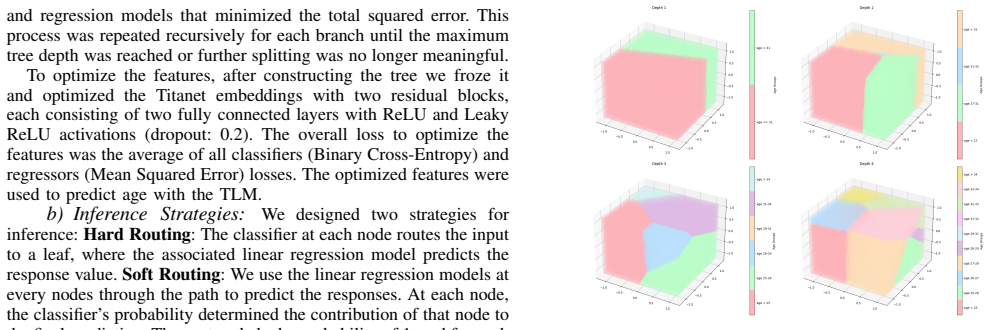
- The learned tree partitions the feature space into regions that correspond to age bands, giving a visual and interpretable account of how voice features relate to age.
Reading between the lines
- The same greedy partition-plus-backprop recipe should transfer to other small-data regression tasks with differentiable embeddings, though the paper only demonstrates it on voice age.
- The oracle experiment (0.49 MAE when true age routes the tree) suggests most residual error is routing error, so better split classifiers could yield larger gains than better leaf regressors.
- Iterating tree construction and feature optimization beyond the single pass used here is a natural next test, as is varying the maximum tree depth.
Signed reviews
Editorial analysis
A structured set of objections, weighed in public.
Referee Report
Summary. The paper proposes the Tessellated Linear Model (TLM), a piecewise-linear regression model that recursively partitions the feature space with binary hyperplane classifiers and fits a linear regressor within each leaf. The method is applied to age prediction from voice on the TIMIT dataset using TitaNet-Large embeddings, and the authors also fine-tune the feature representation with two residual blocks after the tree is built. The central claim is that TLM with feature optimization achieves an MAE of 3.97 on TIMIT, which the paper describes as 'the lowest error ever obtained on these data' and as outperforming all prior reported results.
Significance. If the empirical claim is substantiated, the paper would demonstrate that a simple, interpretable, piecewise-linear model can outperform deep neural networks in a low-data regression setting, which is a meaningful result for voice biometrics and for tabular/small-data regression more broadly. The model design is clearly presented, the oracle baseline is explicitly labeled as such, and the source code is promised. However, the strength of the paper currently rests on an uncontrolled comparison that mixes feature extractors and protocols, and the lack of error bars or significance tests leaves the 'significant margin' unsupported.
major comments (3)
- [Table I and Section V] The claim that TLM achieves 'the lowest error ever obtained on these data, by a significant margin' rests on a comparison with previously published results (Singh et al. [8], NRT [41], Manav et al. [15], Gupta et al. [18]) without evidence that those works used the same TIMIT train/test split, the same feature extractor, or the same augmentation. Since the TLM pipeline uses TitaNet-Large embeddings and additionally fine-tunes them with two residual blocks, the 0.16 MAE improvement over Gupta et al. (4.13 vs 3.97) could be due to the feature representation rather than the TLM architecture. A controlled comparison in which all baselines are re-run on identical TitaNet features and the same split, with multiple seeds and error bars, is needed to support the SOTA claim.
- [Algorithm 1] In the pseudocode, the line 'total reduction ← errornp − errornl + errornr' appears to be a bug: the reduction should be errornp − (errornl + errornr). As written, the criterion does not measure the decrease in squared error, and because 'best reduction' is initialized to −∞, the algorithm would accept any split, including one that increases error. This contradicts the objective stated in Section III-A and affects the correctness of the core greedy splitting procedure.
- [Section IV-B] The statement that 'a single iteration [of alternating optimization] is sufficient' is asserted without sensitivity analysis, and the feature-optimization procedure is underspecified: the two residual blocks are described, but the loss weighting between classifier and regressor terms, the optimizer, learning rate, number of epochs, and the specific value of the maximum tree depth D are not reported. Because feature optimization is a component of the reported method, these details are needed for reproducibility and to assess the contribution of each algorithmic step. Please report results with 0, 1, and 2 iterations of alternating optimization and provide full hyperparameter settings.
minor comments (5)
- [Section III] The word 'polytops' should be 'polytopes'.
- [Section IV-C] 'V oronoi' should be 'Voronoi'.
- [Section V] 'signifiantly' should be 'significantly'.
- [Section IV-B] The model name is written as 'Titanet-Large' but the reference [24] uses 'TitaNet'; please standardize the spelling.
- [Abstract and footnotes] The source code link is provided, but the repository was not accessible at review time; please ensure the code is publicly available upon publication.
Circularity Check
No circular derivation: TLM is trained on labeled data and evaluated on held-out test data; self-cited baselines are not load-bearing, and the SOTA comparison issue is a protocol concern, not circularity.
full rationale
The paper's derivation chain is self-contained and non-circular. The TLM loss is defined over labeled training data, and both the tessellation and the per-cell linear regressors are optimized by minimizing squared regression error. The greedy splitting procedure uses response-variable thresholds to define supervised binary classification problems, then fits logistic classifiers on the voice features; at test time, routing is performed by those learned classifiers, not by the true age labels. This is standard supervised learning, not a self-definitional or fitted-input-as-prediction scheme. The 'TLM with oracle' row in Table I is explicitly labeled an oracle and is not claimed as a result, so it does not constitute a disguised fitted prediction. The central SOTA claim rests on comparing TLM's MAE of 3.97 against previously published results in Table I, and the paper does not establish that prior works used the same TIMIT train/test split, the same TitaNet-Large embeddings, or the same mixup augmentation; it also reports no confidence intervals. However, this is a correctness and comparability risk, not circularity, because the prior numbers are external results rather than outputs of the present model's fitted parameters. The self-cited baselines [8] and [41] include authors of this paper, but they are not load-bearing: the strongest reported competitor is Gupta et al. [18], which is not self-cited, and the self-cited baselines are outperformed without determining the outcome. No uniqueness theorem, ansatz-via-citation, or renaming of a known result as a prediction appears in the paper. Therefore the derivation is not circular, and the minor self-citation presence is not load-bearing.
Assumptions & free parameters
free parameters (5)
- Maximum tree depth D =
not reported
- Candidate age thresholds for splits =
not reported
- Modified mixup strength and mix neighborhood =
not reported
- Dropout rate in feature-optimization blocks =
0.2
- Number of residual blocks =
2
assumptions (5)
- standard math A convex tessellation of the feature space into disjoint cells can be represented by hyperplanes (polytopes).
- domain assumption Age is approximately linear in each convex cell of the TitaNet embedding space.
- domain assumption TitaNet-Large embeddings contain age-relevant information sufficient for linear separability by age thresholds.
- ad hoc to paper A single iteration of alternating optimization (fit TLM, then update features with TLM frozen) is sufficient.
- domain assumption True age labels used to propose split thresholds do not leak into test-time routing.
Cite this review
Pith. "Pith review of Tessellated Linear Model for Age Prediction from Voice." pith.science (2026). https://pith.science/paper/I5IJKL5P
@misc{pith2026250109229,
  author       = {Pith},
  title        = {Pith review of: Tessellated Linear Model for Age Prediction from Voice},
  year         = {2026},
  howpublished = {\url{https://pith.science/paper/I5IJKL5P}},
  note         = {Machine review of arXiv:2501.09229}
}
read the original abstract
Voice biometric tasks, such as age estimation require modeling the often complex relationship between voice features and the biometric variable. While deep learning models can handle such complexity, they typically require large amounts of accurately labeled data to perform well. Such data are often scarce for biometric tasks such as voice-based age prediction. On the other hand, simpler models like linear regression can work with smaller datasets but often fail to generalize to the underlying non-linear patterns present in the data. In this paper we propose the Tessellated Linear Model (TLM), a piecewise linear approach that combines the simplicity of linear models with the capacity of non-linear functions. TLM tessellates the feature space into convex regions and fits a linear model within each region. We optimize the tessellation and the linear models using a hierarchical greedy partitioning. We evaluated TLM on the TIMIT dataset on the task of age prediction from voice, where it outperformed state-of-the-art deep learning models.
Figures

Reference graph
Works this paper leans on
-
[8]
Short-term analysis for estimating physical parameters of speakers,
R. Singh, B. Raj, and J. Baker, “Short-term analysis for estimating physical parameters of speakers,” in 2016 4th International Conference on Biometrics and Forensics (IWBF) , pp. 1–6, IEEE, 2016
work page 2016
-
[41]
S. A. Memon, W. Zhao, B. Raj, and R. Singh, “Neural regression trees,” in 2019 International Joint Conference on Neural Networks (IJCNN) , pp. 1–8, IEEE, 2019
work page 2019
-
[15]
End-to-end speaker age and height estimation using attention mechanism and triplet loss,
M. Kaushik, T. T. Anh, E. S. Chng, et al. , “End-to-end speaker age and height estimation using attention mechanism and triplet loss,” in 2021 Asia-Pacific Signal and Information Processing Association Annual Summit and Conference (APSIPA ASC) , pp. 1–8, IEEE, 2021
work page 2021
-
[18]
Estimation of speaker age and height from speech signal using bi-encoder transformer mixture model
T. Gupta, D.-T. Truong, T. T. Anh, and C. E. Siong, “Estimation of speaker age and height from speech signal using bi-encoder transformer mixture model,” arXiv preprint arXiv:2203.11774 , 2022
work page Pith review arXiv 2022
-
[1]
Singh, Profiling humans from their voice , vol
R. Singh, Profiling humans from their voice , vol. 41. Springer, 2019
work page 2019
-
[2]
Explaining predictions of the x-vector speaker age and gender classifier,
D. Kwa ´sny, P. Jemioło, and D. Hemmerling, “Explaining predictions of the x-vector speaker age and gender classifier,” in International Con- ference on Dependability and Complex Systems , pp. 234–243, Springer, 2021
work page 2021
-
[3]
H. A. S ´anchez-Hevia, R. Gil-Pita, M. Utrilla-Manso, and M. Rosa- Zurera, “Age group classification and gender recognition from speech with temporal convolutional neural networks,” Multimedia Tools and Applications, vol. 81, no. 3, pp. 3535–3552, 2022
work page 2022
-
[4]
V oxceleb1: speaker age-group classification using probabilistic neural network.,
A. Badr and A. A. Hassan, “V oxceleb1: speaker age-group classification using probabilistic neural network.,” Int. Arab J. Inf. Technol. , vol. 19, no. 6, pp. 854–860, 2022
work page 2022
Show all 42 references
-
[5]
Darpa timit acoustic-phonetic continous speech corpus cd-rom. nist speech disc 1-1.1,
J. S. Garofolo, L. F. Lamel, W. M. Fisher, J. G. Fiscus, and D. S. Pallett, “Darpa timit acoustic-phonetic continous speech corpus cd-rom. nist speech disc 1-1.1,” NASA STI/Recon technical report n , vol. 93, p. 27403, 1993
1993
-
[6]
Speaker age estimation on conversational telephone speech using senone posterior based i-vectors,
S. O. Sadjadi, S. Ganapathy, and J. W. Pelecanos, “Speaker age estimation on conversational telephone speech using senone posterior based i-vectors,” in 2016 IEEE International Conference on Acoustics, Speech and Signal Processing (ICASSP) , pp. 5040–5044, IEEE, 2016
2016
-
[7]
Age estimation from telephone speech using i-vectors,
M. H. Bahari, M. McLaren, D. A. van Leeuwen, et al., “Age estimation from telephone speech using i-vectors,” 2012
2012
-
[9]
Automatic estimation of perceptual age using speaker modeling techniques.,
N. Minematsu, K. Yamauchi, and K. Hirose, “Automatic estimation of perceptual age using speaker modeling techniques.,” in INTERSPEECH, pp. 3005–3008, 2003
2003
-
[10]
Age estimation based on speech features and support vector machine,
D. Mahmoodi, H. Marvi, M. Taghizadeh, A. Soleimani, F. Razzazi, and M. Mahmoodi, “Age estimation based on speech features and support vector machine,” in 2011 3rd Computer Science and Electronic Engineering Conference (CEEC) , pp. 60–64, IEEE, 2011
2011
-
[11]
Analyzing features for automatic age estimation on cross-sectional data,
W. Spiegl, G. Stemmer, E. Lasarcyk, V . Kolhatkar, A. Cassidy, B. Potard, S. Shum, Y . C. Song, P. Xu, P. Beyerlein, et al. , “Analyzing features for automatic age estimation on cross-sectional data,” in Tenth Annual Conference of the International Speech Communication Associa...
2009
-
[12]
Automatic speaker age and gender recognition using acoustic and prosodic level information fusion,
M. Li, K. J. Han, and S. Narayanan, “Automatic speaker age and gender recognition using acoustic and prosodic level information fusion,” Computer Speech & Language , vol. 27, no. 1, pp. 151–167, 2013
2013
-
[13]
Combining short-term cepstral and long-term pitch features for automatic recognition of speaker age.,
C. A. M ¨uller and F. Burkhardt, “Combining short-term cepstral and long-term pitch features for automatic recognition of speaker age.,” in Interspeech, pp. 2277–2280, Citeseer, 2007
2007
-
[14]
A novel scheme for speaker recognition using a phonetically-aware deep neural network,
Y . Lei, N. Scheffer, L. Ferrer, and M. McLaren, “A novel scheme for speaker recognition using a phonetically-aware deep neural network,” in 2014 IEEE international conference on acoustics, speech and signal processing (ICASSP), pp. 1695–1699, IEEE, 2014
2014
-
[16]
Joint gender and age estimation based on speech signals using x-vectors and transfer learning,
D. Kwasny and D. Hemmerling, “Joint gender and age estimation based on speech signals using x-vectors and transfer learning,” arXiv preprint arXiv:2012.01551, 2020
2012 arXiv
-
[17]
Learning speaker representation with semi-supervised learning approach for speaker profiling,
S. Rajaa, P. Van Tung, and C. E. Siong, “Learning speaker representation with semi-supervised learning approach for speaker profiling,” arXiv preprint arXiv:2110.13653, 2021
2021 arXiv
-
[19]
wav2vec: Unsupervised pre-training for speech recognition,
S. Schneider, A. Baevski, R. Collobert, and M. Auli, “wav2vec: Unsupervised pre-training for speech recognition,” arXiv preprint arXiv:1904.05862, 2019
1904 arXiv
-
[20]
Wavlm: Large-scale self-supervised pre- training for full stack speech processing,
S. Chen, C. Wang, Z. Chen, Y . Wu, S. Liu, Z. Chen, J. Li, N. Kanda, T. Yoshioka, X. Xiao, et al. , “Wavlm: Large-scale self-supervised pre- training for full stack speech processing,” IEEE Journal of Selected Topics in Signal Processing , vol. 16, no. 6, pp. 1505–1518, 2022
2022
-
[21]
Deep neural network embeddings for text-independent speaker verification.,
D. Snyder, D. Garcia-Romero, D. Povey, and S. Khudanpur, “Deep neural network embeddings for text-independent speaker verification.,” in Interspeech, vol. 2017, pp. 999–1003, 2017
2017
-
[22]
X- vectors: Robust dnn embeddings for speaker recognition,
D. Snyder, D. Garcia-Romero, G. Sell, D. Povey, and S. Khudanpur, “X- vectors: Robust dnn embeddings for speaker recognition,” in 2018 IEEE international conference on acoustics, speech and signal processing (ICASSP), pp. 5329–5333, IEEE, 2018
2018
-
[23]
Generalized end-to-end loss for speaker verification,
L. Wan, Q. Wang, A. Papir, and I. L. Moreno, “Generalized end-to-end loss for speaker verification,” in 2018 IEEE International Conference on Acoustics, Speech and Signal Processing (ICASSP) , pp. 4879–4883, IEEE, 2018
2018
-
[24]
Titanet: Neural model for speaker representation with 1d depth-wise separable convolutions and global context,
N. R. Koluguri, T. Park, and B. Ginsburg, “Titanet: Neural model for speaker representation with 1d depth-wise separable convolutions and global context,” in ICASSP 2022-2022 IEEE International Conference on Acoustics, Speech and Signal Processing (ICASSP) , pp. 8102–8106, IEEE, 2022
2022
-
[25]
Agenet-at: An end-to-end model for robust joint speaker age estimation and gender recognition based on attention mechanism and titanet,
M. Z. Tarashandeh, A. Torkanloo, and M. H. Moattar, “Agenet-at: An end-to-end model for robust joint speaker age estimation and gender recognition based on attention mechanism and titanet,” in 2023 13th International Conference on Computer and Knowledge Engineering (ICCKE), pp...
2023
-
[26]
End-to-end deep neural network age estimation.,
P. Ghahremani, P. S. Nidadavolu, N. Chen, J. Villalba, D. Povey, S. Khudanpur, and N. Dehak, “End-to-end deep neural network age estimation.,” in Interspeech, vol. 2018, pp. 277–281, 2018
2018
-
[27]
Speaker age and gender recognition using 1d and 2d convolutional neural networks,
E. Y ¨ucesoy, “Speaker age and gender recognition using 1d and 2d convolutional neural networks,” Neural Computing and Applications , vol. 36, no. 6, pp. 3065–3075, 2024
2024
-
[28]
Gender and age estimation methods based on speech using deep neural networks,
D. Kwasny and D. Hemmerling, “Gender and age estimation methods based on speech using deep neural networks,” Sensors, vol. 21, no. 14, p. 4785, 2021
2021
-
[29]
Timit speaker profiling: A comparison of multi-task learning and single-task learning approaches,
R. Wang and K. Sun, “Timit speaker profiling: A comparison of multi-task learning and single-task learning approaches,” arXiv preprint arXiv:2404.12077, 2024
2024 arXiv
-
[30]
A deep neural network based end to end model for joint height and age estimation from short duration speech,
S. B. Kalluri, D. Vijayasenan, and S. Ganapathy, “A deep neural network based end to end model for joint height and age estimation from short duration speech,” in ICASSP 2019-2019 IEEE International Conference on Acoustics, Speech and Signal Processing (ICASSP) , pp. 6580–6584...
2019
-
[31]
Hypothesis testing when a nuisance parameter is present only under the alternative,
R. B. Davies, “Hypothesis testing when a nuisance parameter is present only under the alternative,” Biometrika, vol. 74, no. 1, pp. 33–43, 1987
1987
-
[32]
Opti- mal change-point detection and localization,
N. Verzelen, M. Fromont, M. Lerasle, and P. Reynaud-Bouret, “Opti- mal change-point detection and localization,” The Annals of Statistics , vol. 51, no. 4, pp. 1586–1610, 2023
2023
-
[33]
Optimal partitions of data in higher dimensions.,
B. W. Jackson, J. D. Scargle, C. Cusanza, D. Barnes, D. Kanygin, R. Sarmiento, S. Subramaniam, and T.-W. Chuang, “Optimal partitions of data in higher dimensions.,” in CIDU, pp. 98–108, 2010
2010
-
[34]
Classification and regression trees,
W.-Y . Loh, “Classification and regression trees,” Wiley interdisciplinary reviews: data mining and knowledge discovery , vol. 1, no. 1, pp. 14–23, 2011
2011
-
[35]
A tree-structured approach to nonparametric multiple regression,
J. H. Friedman, “A tree-structured approach to nonparametric multiple regression,” in Smoothing Techniques for Curve Estimation: Proceedings of a Workshop held in Heidelberg, April 2–4, 1979 , pp. 5–22, Springer, 2006
1979
-
[36]
Fast linear model trees by pilot,
J. Raymaekers, P. J. Rousseeuw, T. Verdonck, and R. Yao, “Fast linear model trees by pilot,” arXiv preprint arXiv:2302.03931 , 2023
2023 arXiv
-
[37]
Regression using classification algorithms,
L. Torgo and J. Gama, “Regression using classification algorithms,” Intelligent Data Analysis , vol. 1, no. 4, pp. 275–292, 1997
1997
-
[38]
Rectified linear units improve restricted boltz- mann machines,
V . Nair and G. E. Hinton, “Rectified linear units improve restricted boltz- mann machines,” in Proceedings of the 27th international conference on machine learning (ICML-10) , pp. 807–814, 2010
2010
-
[39]
Convex polytopes,
P. M. Gruber, “Convex polytopes,” Convex and discrete geometry , pp. 243–351, 2007
2007
-
[40]
Convex polytopes,
B. Gr ¨unbaum and G. C. Shephard, “Convex polytopes,” Bulletin of the London Mathematical Society , vol. 1, no. 3, pp. 257–300, 1969
1969
-
[42]
mixup: Beyond empirical risk minimization,
H. Zhang, “mixup: Beyond empirical risk minimization,” arXiv preprint arXiv:1710.09412, 2017
2017 arXiv
Reviewed August 10, 2026 · model on record in the stance chip above.
Discussion (0). Continue with ORCID to comment.