REVIEW 5 major objections 4 minor 1 cited by
AugRefer: Advancing 3D Visual Grounding via Cross-Modal Augmentation and Spatial Relation-based Referring
T0 review · 5 major / 4 minor · reviewed 2026-08-10 · deepseek-v4-flash
Pith's one-line read AugRefer claims that generating synthetic text-3D pairs and injecting spatial relations into decoder attention lifts 3D visual grounding accuracy by up to 9.81 points on Nr3D and 6.58 points on Sr3D over the BUTD-DETR baseline.
desk verdict Useful cross-modal augmentation for 3DVG, but a potential test-set leakage in the augmentation source pool must be resolved before the reported gains can be trusted. read the letter →
The pith
A machine-rendered reading of the paper's core claim, the machinery that carries it, and where it could break.
The reading
What carries the argument
The load-bearing mechanism is the Language-Spatial Adaptive Decoder (LSAD), a transformer decoder layer whose attention is augmented with spatial biases. Pairwise spatial relations between object proposals—Euclidean distance plus horizontal and vertical sine/cosine components of the connecting line—are MLP-mapped and added to the attention logits; global spatial relations are the normalized coordinates of the object center in the scene, injected the same way. The companion data mechanism is the cross-modal augmentation pipeline: stander objects are inserted on the ground plane with collision-free placement, rendered from three angles at three granularities (object, local, scene), and captioned by BLIP2 with prompts tailored to each level, then corrected and rephrased by GPT-3.5.
What would settle it
A concrete check: take the augmented pairs and test whether a strong vision-language model can re-locate the inserted object from the generated caption in the rendered image; a low re-grounding hit rate would indicate the captions are not aligned with the inserted object and would undermine the data-side claim. A cheaper quantitative version is to train the baseline on original pairs plus the same number of caption-object pairings randomly shuffled; if accuracy matches the AugRefer gain, the benefit is quantity rather than semantic alignment.
Extended reading notes
Core claim
The central claim is that 3D visual grounding can be advanced by combining two mechanisms: data-side, synthetic text-3D pairs generated by inserting objects into scenes and captioning the resulting renders with foundation models; and model-side, a decoder that explicitly injects spatial relations into attention. The paper demonstrates the claim by appending both components to two transformer-based baselines and showing accuracy improvements on every one of the three benchmarks. The decoder carries the model-side argument: LSAD applies cross-attention to language first, then pairwise spatial attention over object proposals, then global spatial attention over scene-wide position, with spatial features added to the attention logits. The augmentation carries the data-side argument: multi-angle, multi-level rendering plus BLIP2/GPT-3.5 captioning produces about 22.5k extra pairs, and the authors identify three generated pairs per scene and level as the best working point.
Load-bearing premise
The load-bearing premise is that the captions produced by BLIP2 and GPT-3.5 are accurate and semantically aligned with the inserted object; if they are noisy, the extra pairs mislead training—and the paper's own ablation shows accuracy falling when the number of generated pairs per scene rises from three to five.
Editorial extensions
If this is right
- Any transformer-based 3DVG model can take the generated text-3D pairs without changing its architecture; training time grows but inference time does not.
- Explicit spatial attention should help most in 'multiple' splits, where distractors of the same category must be told apart by relation to anchors or scene position.
- The three caption granularities are complementary: each alone helps less than the combination, so descriptions should mix object attributes, local anchors, and scene-level context.
- Language-first ordering in the decoder matters: grounding with text before spatial aggregation works better than spatial-first alternatives.
- Adding too many generated pairs per scene (five instead of three) hurts accuracy, so augmentation quantity should be balanced against caption noise.
Reading between the lines
- Inference: The augmentation recipe appears portable beyond grounding: unlabeled 3D scenes plus an object bank could generate paired data for navigation instruction, spatial QA, or scene-graph tasks, as long as a captioner can reliably describe the inserted object.
- Inference: The ceiling on augmentation benefit is caption fidelity. A consistency filter—e.g., trying to re-ground each generated caption to the inserted object and dropping failures—would likely let models use more than three pairs per scene before noise dominates.
- Inference: The spatial-bias-in-attention design suggests a generic recipe: encode relative geometry as MLP-mapped vectors and add to QK^T, which could be applied to other relation-sensitive tasks beyond 3D, such as video grounding or multi-object tracking.
- Inference: Because the paper only tests two baselines (the strongest open one and an older one), the claim that the pairs are universally usable remains open; testing on the not-open-source strong model or future ones would be the natural next check.
Signed reviews
Editorial analysis
A structured set of objections, weighed in public.
Referee Report
Summary. The paper proposes AugRefer, a method for 3D visual grounding with two components: (1) a cross-modal augmentation pipeline that inserts external 3D objects into scenes, renders them at multiple angles and granularities, and uses BLIP2 and GPT-3.5 to generate new text-3D training pairs; and (2) a Language-Spatial Adaptive Decoder (LSAD) that injects global and pairwise spatial relations into cross-modal attention. The method is integrated into BUTD-DETR and EDA and evaluated on ScanRefer, Nr3D, and Sr3D, reporting consistent accuracy gains and SOTA or near-SOTA results, along with ablations in Tables 3-7.
Significance. If the reported results are valid, the cross-modal augmentation is a valuable plug-and-play contribution that can enrich text-3D training data for existing 3DVG methods, and the LSAD decoder provides a concrete way to exploit spatial relations in transformer decoders. The paper's extensive ablations (Tables 3-7) support both components individually and in combination, and the proposed augmentation is clearly described at a conceptual level. The main risk to significance is the unresolved possibility of train/test leakage in the augmentation source pool, which could invalidate the reported gains; this must be addressed before the results can be accepted as evidence for the method.
major comments (5)
- [Algorithm 1 (Appendix A) and Sec. 3.1] Algorithm 1 samples the object to insert by 'randomly choosing another scene Sj' from '3D indoor dataset S' (the ScanNet dataset), with no statement that Sj is restricted to the training split. The main text similarly says the external object is 'randomly selected from other scenes.' Since ScanRefer, Nr3D, and Sr3D are all built from ScanNet, this creates a concrete risk that a point cloud from a test scene is inserted into a training scene, giving the model direct access to test-set geometry during training. If this is the case, the reported gains (e.g., +9.81 on Nr3D, +6.58 on Sr3D) are not valid evidence for the method. The authors must specify explicitly that the augmentation source pool is restricted to the training split, and if it is not, they must rerun the experiments with a split-restricted pool and report the new numbers.
- [Sec. 4.3, Table 5] The augmentation quantity n is chosen as 3 based on the overall Acc@0.25 values reported in Table 5, which appear to be test-set results on ScanRefer. The text says 'we set n to 3' directly from these results, but there is no statement that this decision was made on a held-out validation split. If Table 5 reports test-set performance, this is test-set tuning of a central hyperparameter, which inflates the reported effectiveness of the augmentation component. The authors should clarify the split used for model selection, or provide validation-based selection.
- [Sec. 4.1 and Tables 1-3] All reported numbers are single-run point estimates with no error bars, variance, significance tests, or multiple-seed averages. Since the claimed improvements over the baselines are often in the 2-4 percentage-point range (e.g., +2.10 on ScanRefer, +4.41 on Nr3D), run-to-run variance could be a substantial fraction of these differences. The authors should provide at least three independent runs with mean and standard deviation for the main comparisons, or otherwise justify that the gains are outside training noise.
- [Sec. 3.1 and Implementation Details] The augmentation pipeline contains several hyperparameters that are never specified, most notably the value of M used to select the top CLIP images for captioning, and the exact number of rendered images per insertion level. Without these values, the augmentation pipeline is not fully reproducible. Please report all thresholds and counts used in the final experiments.
- [Appendix A, Pairwise Spatial Attention] The pairwise spatial relation vector rp_ij is defined only by reference to 'Chen et al. 2022' rather than being specified in the paper. To make the LSAD module self-contained and reproducible, the paper should give the exact formula for the five-dimensional relation vector (distance, sine and cosine of horizontal and vertical angles) in the main text or appendix.
minor comments (4)
- [Table 2] The row labeled 'SAT (Roh et al. 2022)' appears to cite the wrong reference: SAT is Yang et al. 2021b, while LanguageRefer is Roh et al. 2022. Please correct the citation.
- [Sec. 4.3] The text says 'our cross-model augmentation' where 'cross-modal' is intended; there are also inconsistent capitalizations of 'SR3D' and 'NR3D' across the manuscript.
- [Fig. 3 and Sec. 3.1] The description of the multi-angle camera placement states cameras are positioned at 0, 45, and 90 degrees and rotated around the object, but Fig. 3(a) shows only 'Angle1, Angle2, Angle3'; clarifying the exact camera trajectories would help reproducibility.
- [References] The reference 'Yang et al. 2024a' is listed as NeurIPS 2023 in the bibliography but '2024a' in the citations; please standardize the year and venue information.
Circularity Check
No significant circularity: AugRefer's gains are empirical against held-out benchmarks, and no derivation reduces to its own inputs.
full rationale
The central claims of AugRefer are empirical: cross-modal augmentation and the language-spatial adaptive decoder are evaluated on the ScanRefer, Nr3D, and Sr3D benchmarks against external baselines BUTD-DETR and EDA, with ablations on held-out splits. No equation or fitted parameter is relabeled as a prediction, and no result is defined in terms of the quantity it is said to predict. The only self-citation, Zhao et al. (2022) for 2D-floor collision detection, is a non-load-bearing implementation detail, and the technique is described in the text (erosion on a floor map), so the argument does not rest on an unverified self-citation. The n=3 augmentation quantity is selected by validation, and the paper itself reports degradation at n=5 due to generated-pair noise (Table 5), which is a robustness limitation rather than circularity. One validity concern is flagged: Algorithm 1 samples the inserted object from '3D indoor dataset S' without stating that S is restricted to the training split; if S included evaluation scenes, test geometry could leak into augmented training data. That would undermine the benchmark comparison, but it is a data-hygiene or correctness issue, not a circular definition or fitted-prediction issue, and the manuscript provides no explicit confirmation that leakage occurs.
Assumptions & free parameters
free parameters (3)
- n (number of augmented pairs per scene per level) =
3
- M (top CLIP images selected for captioning) =
not reported
- Number of inserted objects per scene =
10
assumptions (3)
- domain assumption Captions generated by BLIP2 and GPT-3.5 from rendered images are accurate enough to describe the inserted object's category, attributes, and spatial relations.
- domain assumption Multi-angle and multi-level rendering, followed by CLIP filtering, produces 2D views that reliably capture the inserted object's 3D identity, appearance, and placement in the scene.
- domain assumption The ScanNet scenes and object categories used for insertion are representative enough that inserting objects from other scenes yields plausible training examples for the target benchmarks.
Cite this review
Pith. "Pith review of AugRefer: Advancing 3D Visual Grounding via Cross-Modal Augmentation and Spatial Relation-based Referring." pith.science (2026). https://pith.science/paper/GAFZ5UYC
@misc{pith2026250109428,
  author       = {Pith},
  title        = {Pith review of: AugRefer: Advancing 3D Visual Grounding via Cross-Modal Augmentation and Spatial Relation-based Referring},
  year         = {2026},
  howpublished = {\url{https://pith.science/paper/GAFZ5UYC}},
  note         = {Machine review of arXiv:2501.09428}
}
read the original abstract
3D visual grounding (3DVG), which aims to correlate a natural language description with the target object within a 3D scene, is a significant yet challenging task. Despite recent advancements in this domain, existing approaches commonly encounter a shortage: a limited amount and diversity of text3D pairs available for training. Moreover, they fall short in effectively leveraging different contextual clues (e.g., rich spatial relations within the 3D visual space) for grounding. To address these limitations, we propose AugRefer, a novel approach for advancing 3D visual grounding. AugRefer introduces cross-modal augmentation designed to extensively generate diverse text-3D pairs by placing objects into 3D scenes and creating accurate and semantically rich descriptions using foundation models. Notably, the resulting pairs can be utilized by any existing 3DVG methods for enriching their training data. Additionally, AugRefer presents a language-spatial adaptive decoder that effectively adapts the potential referring objects based on the language description and various 3D spatial relations. Extensive experiments on three benchmark datasets clearly validate the effectiveness of AugRefer.
Figures


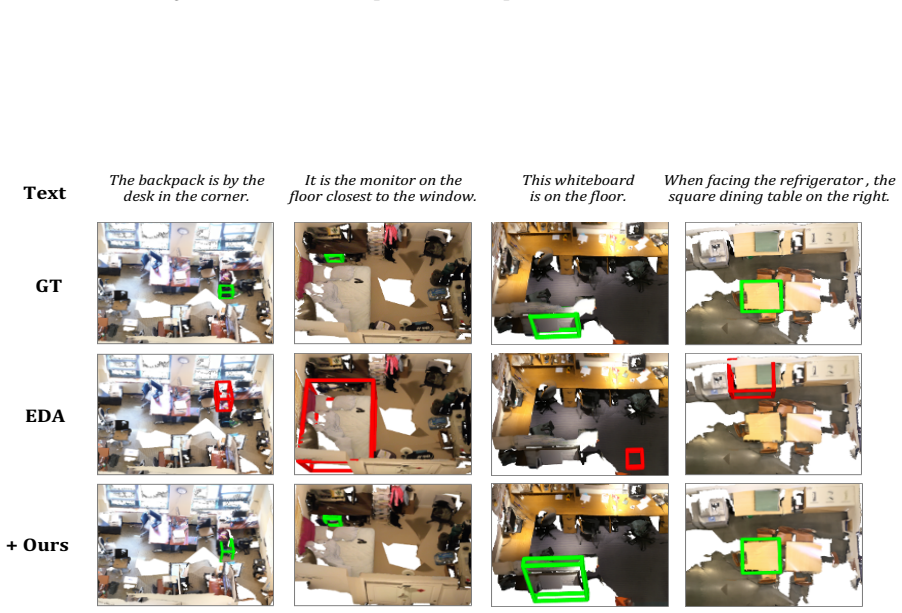
Figures from the paper (7 more)



Forward citations
Cited by 1 Pith paper
-
3DResT: A Strong Baseline for Semi-Supervised 3D Referring Expression Segmentation
3DResT applies teacher-student semi-supervised learning to 3D referring expression segmentation, promoting high-agreement pseudo-labels into the labeled set and dynamically weighting low-agreement ones, and reports a ...
Reference graph
Works this paper leans on
-
[1]
L.; Almeida, D.; Altenschmidt, J.; Altman, S.; Anadkat, S.; et al
Achiam, J.; Adler, S.; Agarwal, S.; Ahmad, L.; Akkaya, I.; Aleman, F. L.; Almeida, D.; Altenschmidt, J.; Altman, S.; Anadkat, S.; et al. 2023. Gpt-4 technical report. arXiv preprint arXiv:2303.08774
arXiv 2023
-
[2]
Achlioptas, P.; Abdelreheem, A.; Xia, F.; Elhoseiny, M.; and Guibas, L. 2020. Referit3d: Neural listeners for fine-grained 3d object identification in real-world scenes. In Computer Vision--ECCV 2020: 16th European Conference, Glasgow, UK, August 23--28, 2020, Proceedings, Part I 16, 422--440. Springer
work page 2020
-
[3]
D.; Dhariwal, P.; Neelakantan, A.; Shyam, P.; Sastry, G.; Askell, A.; et al
Brown, T.; Mann, B.; Ryder, N.; Subbiah, M.; Kaplan, J. D.; Dhariwal, P.; Neelakantan, A.; Shyam, P.; Sastry, G.; Askell, A.; et al. 2020. Language models are few-shot learners. Advances in neural information processing systems
work page 2020
-
[4]
Chen, D. Z.; Chang, A. X.; and Nie ner, M. 2020. Scanrefer: 3d object localization in rgb-d scans using natural language. In European conference on computer vision, 202--221. Springer
work page 2020
-
[5]
Chen, S.; Guhur, P.-L.; Tapaswi, M.; Schmid, C.; and Laptev, I. 2022. Language conditioned spatial relation reasoning for 3d object grounding. Advances in neural information processing systems, 35: 20522--20535
work page 2022
-
[6]
X.; Savva, M.; Halber, M.; Funkhouser, T.; and Nie ner, M
Dai, A.; Chang, A. X.; Savva, M.; Halber, M.; Funkhouser, T.; and Nie ner, M. 2017. Scannet: Richly-annotated 3d reconstructions of indoor scenes. In Proceedings of the IEEE conference on computer vision and pattern recognition, 5828--5839
2017
-
[7]
Ding, R.; Yang, J.; Jiang, L.; and Qi, X. 2022. Doda: Data-oriented sim-to-real domain adaptation for 3d semantic segmentation. In European Conference on Computer Vision, 284--303. Springer
work page 2022
-
[8]
Ding, R.; Yang, J.; Xue, C.; Zhang, W.; Bai, S.; and Qi, X. 2023. Pla: Language-driven open-vocabulary 3d scene understanding. In Proceedings of the IEEE/CVF Conference on Computer Vision and Pattern Recognition, 7010--7019
work page 2023
Show all 45 references
-
[9]
Feng, M.; Li, Z.; Li, Q.; Zhang, L.; Zhang, X.; Zhu, G.; Zhang, H.; Wang, Y.; and Mian, A. 2021. Free-form description guided 3d visual graph network for object grounding in point cloud. In Proceedings of the IEEE/CVF International Conference on Computer Vision, 3722--3731
2021
-
[10]
Ge, Y.; Yu, H.-X.; Zhao, C.; Guo, Y.; Huang, X.; Ren, L.; Itti, L.; and Wu, J. 2024. 3D Copy-Paste: Physically Plausible Object Insertion for Monocular 3D Detection. Advances in Neural Information Processing Systems, 36
2024
-
[11]
Guo, Z.; Tang, Y.; Zhang, R.; Wang, D.; Wang, Z.; Zhao, B.; and Li, X. 2023. Viewrefer: Grasp the multi-view knowledge for 3d visual grounding. In Proceedings of the IEEE/CVF International Conference on Computer Vision
2023
-
[12]
T.; and Zhang, H
Han, Y.; Zhao, N.; Chen, W.; Ma, K. T.; and Zhang, H. 2024. Dual-Perspective Knowledge Enrichment for Semi-supervised 3D Object Detection. In Proceedings of the AAAI Conference on Artificial Intelligence
2024
-
[13]
Hong, Y.; Zhen, H.; Chen, P.; Zheng, S.; Du, Y.; Chen, Z.; and Gan, C. 2023. 3d-llm: Injecting the 3d world into large language models. Advances in Neural Information Processing Systems, 36: 20482--20494
2023
-
[14]
Huang, P.-H.; Lee, H.-H.; Chen, H.-T.; and Liu, T.-L. 2021. Text-guided graph neural networks for referring 3d instance segmentation. In Proceedings of the AAAI Conference on Artificial Intelligence, volume 35, 1610--1618
2021
-
[15]
Huang, S.; Chen, Y.; Jia, J.; and Wang, L. 2022. Multi-view transformer for 3d visual grounding. In Proceedings of the IEEE/CVF Conference on Computer Vision and Pattern Recognition, 15524--15533
2022
-
[16]
Jain, A.; Gkanatsios, N.; Mediratta, I.; and Fragkiadaki, K. 2022. Bottom up top down detection transformers for language grounding in images and point clouds. In European Conference on Computer Vision, 417--433. Springer
2022
-
[17]
Jiao, P.; Zhao, N.; Chen, J.; and Jiang, Y.-G. 2024. Unlocking textual and visual wisdom: Open-vocabulary 3d object detection enhanced by comprehensive guidance from text and image. In European Conference on Computer Vision, 376--392. Springer
2024
-
[18]
Li, J.; Li, D.; Savarese, S.; and Hoi, S. 2023. Blip-2: Bootstrapping language-image pre-training with frozen image encoders and large language models. In International conference on machine learning, 19730--19742. PMLR
2023
-
[19]
Liu, Y.; Ott, M.; Goyal, N.; Du, J.; Joshi, M.; Chen, D.; Levy, O.; Lewis, M.; Zettlemoyer, L.; and Stoyanov, V. 2019. Roberta: A robustly optimized bert pretraining approach. arXiv preprint arXiv:1907.11692
2019 arXiv
-
[20]
Liu, Z.; Zhang, Z.; Cao, Y.; Hu, H.; and Tong, X. 2021. Group-free 3d object detection via transformers. In Proceedings of the IEEE/CVF International Conference on Computer Vision, 2949--2958
2021
-
[21]
Luo, C.; Di, D.; Yang, X.; Ma, Y.; Xue, Z.; Wei, C.; and Liu, Y. 2025. TrAME: Trajectory-Anchored Multi-View Editing for Text-Guided 3D Gaussian Splatting Manipulation. IEEE Transactions on Multimedia
2025
-
[22]
Luo, J.; Fu, J.; Kong, X.; Gao, C.; Ren, H.; Shen, H.; Xia, H.; and Liu, S. 2022. 3d-sps: Single-stage 3d visual grounding via referred point progressive selection. In Proceedings of the IEEE/CVF Conference on Computer Vision and Pattern Recognition, 16454--16463
2022
-
[23]
Nekrasov, A.; Schult, J.; Litany, O.; Leibe, B.; and Engelmann, F. 2021. Mix3d: Out-of-context data augmentation for 3d scenes. In 2021 international conference on 3d vision (3dv), 116--125. IEEE
2021
-
[24]
Pan, H.; Cao, Y.; Wang, X.; Yang, X.; and Wang, M. 2024. Finding and Editing Multi-Modal Neurons in Pre-Trained Transformers. In Findings of the Association for Computational Linguistics ACL 2024, 1012--1037
2024
-
[25]
R.; Yi, L.; Su, H.; and Guibas, L
Qi, C. R.; Yi, L.; Su, H.; and Guibas, L. J. 2017. Pointnet++: Deep hierarchical feature learning on point sets in a metric space. Advances in neural information processing systems, 30
2017
-
[26]
W.; Hallacy, C.; Ramesh, A.; Goh, G.; Agarwal, S.; Sastry, G.; Askell, A.; Mishkin, P.; Clark, J.; et al
Radford, A.; Kim, J. W.; Hallacy, C.; Ramesh, A.; Goh, G.; Agarwal, S.; Sastry, G.; Askell, A.; Mishkin, P.; Clark, J.; et al. 2021. Learning transferable visual models from natural language supervision. In International conference on machine learning, 8748--8763. PMLR
2021
-
[27]
Roh, J.; Desingh, K.; Farhadi, A.; and Fox, D. 2022. Languagerefer: Spatial-language model for 3d visual grounding. In Conference on Robot Learning, 1046--1056. PMLR
2022
-
[28]
Sheng, H.; Cai, S.; Zhao, N.; Deng, B.; Huang, J.; Hua, X.-S.; Zhao, M.-J.; and Lee, G. H. 2022. Rethinking IoU-based optimization for single-stage 3D object detection. In European Conference on Computer Vision, 544--561. Springer
2022
-
[29]
N.; Kaiser, .; and Polosukhin, I
Vaswani, A.; Shazeer, N.; Parmar, N.; Uszkoreit, J.; Jones, L.; Gomez, A. N.; Kaiser, .; and Polosukhin, I. 2017. Attention is all you need. Advances in neural information processing systems, 30
2017
-
[30]
Wang, Z.; Huang, H.; Zhao, Y.; Li, L.; Cheng, X.; Zhu, Y.; Yin, A.; and Zhao, Z. 2023. Distilling coarse-to-fine semantic matching knowledge for weakly supervised 3d visual grounding. In Proceedings of the IEEE/CVF International Conference on Computer Vision, 2662--2671
2023
-
[31]
Wu, Y.; Cheng, X.; Zhang, R.; Cheng, Z.; and Zhang, J. 2023. Eda: Explicit text-decoupling and dense alignment for 3d visual grounding. In Proceedings of the IEEE/CVF Conference on Computer Vision and Pattern Recognition, 19231--19242
2023
-
[32]
Yang, L.; Zhang, Z.; Qi, Z.; Xu, Y.; Liu, W.; Shan, Y.; Li, B.; Yang, W.; Li, P.; Wang, Y.; et al. 2024 a . Exploiting Contextual Objects and Relations for 3D Visual Grounding. Advances in Neural Information Processing Systems, 36
2024
-
[33]
Yang, X.; Feng, F.; Ji, W.; Wang, M.; and Chua, T.-S. 2021 a . Deconfounded video moment retrieval with causal intervention. In Proceedings of the 44th International ACM SIGIR Conference on Research and Development in Information Retrieval, 1--10
2021
-
[34]
Yang, X.; Wang, S.; Dong, J.; Dong, J.; Wang, M.; and Chua, T.-S. 2022. Video moment retrieval with cross-modal neural architecture search. IEEE Transactions on Image Processing, 31: 1204--1216
2022
-
[35]
Yang, X.; Zeng, J.; Guo, D.; Wang, S.; Dong, J.; and Wang, M. 2024 b . Robust Video Question Answering via Contrastive Cross-Modality Representation Learning. SCIENCE CHINA Information Sciences, 67: 1--16
2024
-
[36]
Yang, Z.; Zhang, S.; Wang, L.; and Luo, J. 2021 b . Sat: 2d semantics assisted training for 3d visual grounding. In Proceedings of the IEEE/CVF International Conference on Computer Vision, 1856--1866
2021
-
[37]
Yuan, Z.; Yan, X.; Liao, Y.; Zhang, R.; Wang, S.; Li, Z.; and Cui, S. 2021. Instancerefer: Cooperative holistic understanding for visual grounding on point clouds through instance multi-level contextual referring. In Proceedings of the IEEE/CVF International Conference on Comp...
2021
-
[38]
Zhang, W.; Wang, Z.; and Loy, C. C. 2020. Exploring data augmentation for multi-modality 3d object detection. arXiv preprint arXiv:2012.12741
2020 arXiv
-
[39]
Zhang, Y.; Gong, Z.; and Chang, A. X. 2023. Multi3drefer: Grounding text description to multiple 3d objects. In Proceedings of the IEEE/CVF International Conference on Computer Vision, 15225--15236
2023
-
[40]
Zhao, L.; Cai, D.; Sheng, L.; and Xu, D. 2021. 3DVG-Transformer: Relation modeling for visual grounding on point clouds. In Proceedings of the IEEE/CVF International Conference on Computer Vision, 2928--2937
2021
-
[41]
Zhao, N.; Chua, T.-S.; and Lee, G. H. 2020. Sess: Self-ensembling semi-supervised 3d object detection. In Proceedings of the IEEE/CVF Conference on Computer Vision and Pattern Recognition, 11079--11087
2020
-
[42]
Zhao, N.; and Lee, G. H. 2022. Static-dynamic co-teaching for class-incremental 3d object detection. In Proceedings of the AAAI Conference on Artificial Intelligence, volume 36, 3436--3445
2022
-
[43]
Zhao, Y.; Zhao, N.; and Lee, G. H. 2022. Synthetic-to-Real Domain Generalized Semantic Segmentation for 3D Indoor Point Clouds. arXiv preprint arXiv:2212.04668
2022 arXiv
-
[44]
, " * write output.state after.block = add.period write newline
ENTRY address archivePrefix author booktitle chapter edition editor eid eprint howpublished institution isbn journal key month note number organization pages publisher school series title type volume year label extra.label sort.label short.list INTEGERS output.state before.all...
-
[45]
write newline
" write newline "" before.all 'output.state := FUNCTION n.dashify 't := "" t empty not t #1 #1 substring "-" = t #1 #2 substring "--" = not "--" * t #2 global.max substring 't := t #1 #1 substring "-" = "-" * t #2 global.max substring 't := while if t #1 #1 substring * t #2 gl...
Reviewed August 10, 2026 · model on record in the stance chip above.
Discussion (0). Continue with ORCID to comment.