REVIEW 1 major objections 5 minor 1 cited by
Mining the time axis with TRON. I. Millisecond pulsars in Omega Centauri, Terzan 5 and 47 Tucanae detected through MeerKAT interferometric imaging
T0 review · 1 major / 5 minor · reviewed 2026-08-10 · deepseek-v4-flash
Pith's one-line read A prototype pipeline called TRON recovers known eclipsing millisecond pulsars from archival MeerKAT images, demonstrating a blind image-plane search for minute-to-hour transients.
desk verdict TRON is a promising prototype with real detections of known MSPs, but the lack of a false-positive/injection test means the blind-search claim is not yet demonstrated. read the letter →
The pith
A machine-rendered reading of the paper's core claim, the machinery that carries it, and where it could break.
The reading
What carries the argument
The central mechanism is a residual-image time cube. Before running TRON, the calibrated visibilities are differenced against model visibilities of a deep, full-track multi-frequency synthesis image, so that persistent source structure is removed; TRON then Fourier-transforms the residual visibilities into one snapshot image per 8-second integration without deconvolution, stacks the snapshots into a time cube, and smooths the cube to timescales of 15–960 seconds in powers of two. Detection is done by Breifast, a peak-finding algorithm that searches each smoothed cube against a local noise estimate at a $7\sigma$ threshold (reduced to $6\sigma$ at the two longest timescales) and applies a minimum 10 percent excursion relative to the deep-image flux, plus heuristics that reject primary beam rotation, residual calibration artifacts, and low-level radio interference. Source positions in the deep image are found with PyBDSF, and for candidates of interest TRON extracts light curves while DynSpecMS synthesizes frequency-time dynamic spectra at native resolution. The whole design hangs on one property: the residual visibilities are dominated by noise rather than unsubtracted source structure, so a fixed $\sigma$ threshold in the snapshots is a meaningful significance measure.
What would settle it
Inject synthetic point-source transients with known fluxes, positions, and timescales into the calibrated visibilities of one of these archival datasets before running TRON, then measure recovery fraction versus injected flux and timescale; alternatively run the default Breifast settings on residual positions in a field containing no known transients and count the $7\sigma$ candidates. If plausible injected sources are routinely lost or blank-sky positions produce comparable candidate rates, the claim that TRON is a blind search tool for medium-timescale transients is falsified.
Extended reading notes
Core claim
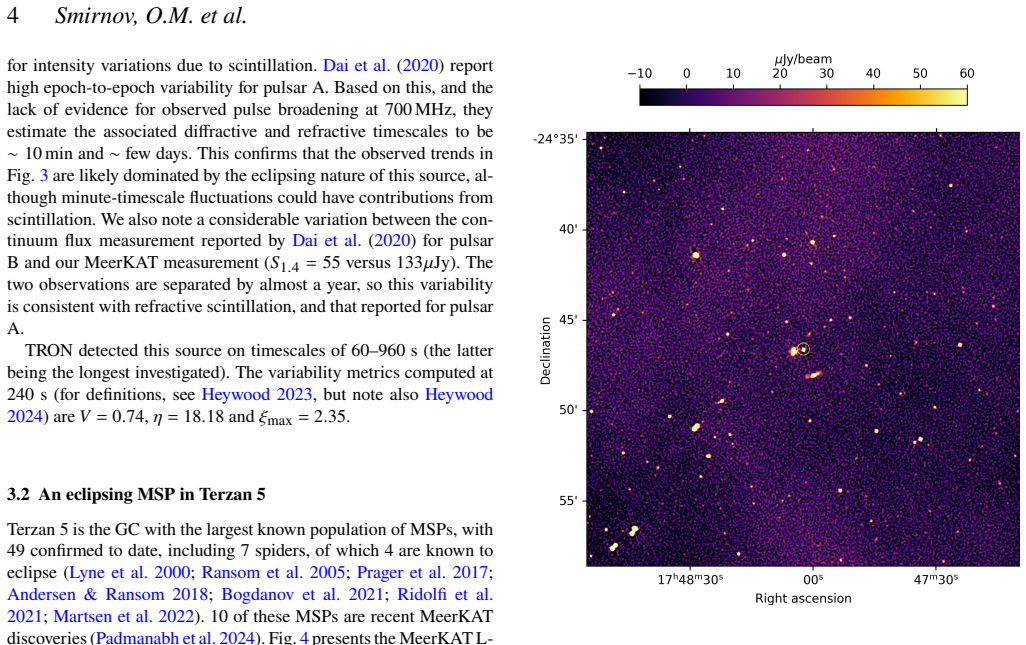
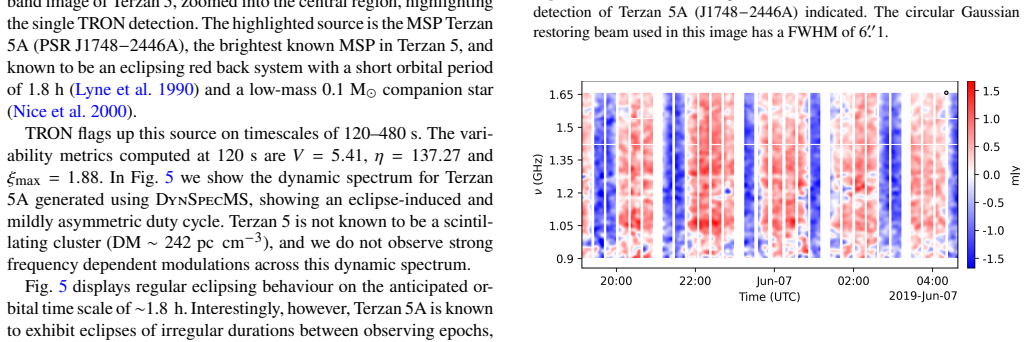
On the paper's own terms, the discovery is that a blind, image-plane search of routine MeerKAT synthesis data finds astrophysical variability on timescales that conventional long-track synthesis hides. TRON detects PSR J1326−4728B in $\Omega$ Centauri, the brightest millisecond pulsar in that cluster and a suspected black widow, on timescales of 60–960 seconds, with a mean-subtracted light curve showing repeated flux dips whose largely achromatic dynamic spectrum marks them as eclipses rather than scintillation; the light curve spans 11.5 hours and shows peaks separated by 0.75–1.9 hours, consistent with irregular eclipses around the known 2.15-hour orbit. In Terzan 5 it detects Terzan 5A on 120–480 second timescales, and its dynamic spectrum shows regular, mildly asymmetric eclipses matching the known 1.8-hour redback orbit. In 47 Tuc it detects MSPs C and J plus the candidate χ; the two confirmed pulsars show chromatic variability characteristic of scintillation while χ shows two broad peaks about four hours apart, a hint of eclipsing. The paper takes the match between these blind detections and independent pulsar timing and beamformer results as evidence that the method works.
Load-bearing premise
The load-bearing premise is that after subtracting the deep image model, the leftover visibility data are mostly noise, so the local noise level in each snapshot image is an honest error bar and a detection threshold of seven times that noise, plus the filtering heuristics, separates real astrophysical variability from calibration leftovers and radio interference; the paper states this but gives no quantitative false-positive-rate or injection-recovery test.
Editorial extensions
If this is right
- If TRON works as claimed, roughly six years of existing MeerKAT synthesis observations become a searchable sample for minute-to-hour transients and variables, with no new observing time required.
- The detections in these three clusters demonstrate that eclipsing and scintillation are recoverable image-plane signatures, so pulsar searches need not rely solely on folded beamformed data.
- The non-detection of the other twelve known eclipsing spider pulsars in these fields implies TRON's current sensitivity, set by snapshot noise after model subtraction, misses many such systems; the paper says a follow-up study will use this to refine the approach.
- Adding a fine-grained search along the frequency axis, which the current wideband light curves wash out, should make the pipeline more sensitive to chromatic effects such as scintillation.
Reading between the lines
- Because TRON is agnostic to the calibration workflow and works purely on residual image cubes, the same prototype should transfer to any archival MeerKAT field, not just globular clusters, where compact sources vary on similar timescales.
- The sensitivity ceiling is set by how completely the deep image models the field, so fields with extended Galactic emission or bright confusing sources, like Terzan 5, will have higher false-positive floors; direction-dependent calibration or frequency-split residuals would likely improve completeness.
- The four-hour spacing of the two broad peaks in candidate χ's dynamic spectrum, if real, is exactly the kind of signature a spider-pulsar binary would produce, making it a high-priority timing target.
- A quantitative false-positive audit, running the same Breifast thresholds on off-source residual positions or on a field with no known transients, would turn TRON from a proof of concept into a calibrated survey instrument.
Signed reviews
Editorial analysis
A structured set of objections, weighed in public.
Referee Report
Summary. The paper presents TRON, a prototype image-plane transient and variability search pipeline for MeerKAT. The pipeline subtracts a deep model from calibrated visibilities, images the residuals at 8-second cadence, smooths the resulting cubes to timescales of 15 to 960 seconds, and detects candidates with a peak-finding algorithm (Breifast) using a 7-sigma threshold (6 at the longest timescales) plus heuristic filters. Applied to archival observations of Omega Centauri, Terzan 5, and 47 Tucanae, the pipeline recovers the known eclipsing MSPs PSR J1326-4728B and Terzan 5A, two known MSPs in 47 Tuc, and the previously reported candidate 'chi' from Heywood (2023). Light curves and dynamic spectra are shown to be consistent with established eclipsing and scintillation behavior. The paper frames this as a proof of concept for systematic mining of archival MeerKAT synthesis images.
Significance. If the pipeline performs as claimed, this is a valuable proof of concept for blind medium-timescale transient searches in MeerKAT synthesis images. The main strengths are the positional cross-identification with known pulsars, the consistency of the extracted light curves and dynamic spectra with established eclipsing behavior, and the independent confirmation of Terzan 5A's eclipses against contemporaneous beamformer data. The pipeline is largely calibration-agnostic and the data are public, so the result is checkable. The paper is appropriately cautious in calling TRON a prototype and in deferring full technical details to a follow-up paper. Its significance is as a demonstration that per-integration residual imaging can recover variability signatures of individual MSPs, motivating further technical development and archival mining.
major comments (1)
- [Section 2, 'Detection of candidates using Breifast'] The central claim that TRON is a blind search tool suitable for systematic archival mining is not supported by a quantitative false-positive-rate measurement or an injection/recovery test. Section 2 states that the 7-sigma threshold and heuristic filters 'served to exclude any false-positives' induced by primary beam rotation, calibration residuals, and RFI, but no candidate statistics are reported: the reader cannot tell how many peaks passed the filters, how many were rejected, or how many did not coincide with known sources. Because all three fields were selected because they host known MSPs, the positional coincidences demonstrate sensitivity to bright known variables but do not constrain the false-positive rate on blank sky. This is load-bearing because the abstract's statement that TRON can 'systematically mine archival synthesis imaging data' presumes that the heuristic filters control artifacts; without a measurement, the reported detection significances (7-sigma/6-sigma with respect to local r.m.s.) are only upper limits on true astrophysical significance. I request at least one of: an end-to-end injection/recovery test into the residual visibilities, a measurement of the candidate rate in the same fields after time-ordering is scrambled, or an explicit statement that the false-positive rate has not yet been established and that TRON is currently a sensitivity demonstration rather than a fully validated blind search.
minor comments (5)
- [Section 3.3 and Figure 8 (bottom panel)] The interpretation of candidate 'chi' as showing 'hints of eclipsing behaviour' is somewhat stronger than the evidence supports. The two broad peaks separated by about 4 hours appear in a dynamic spectrum of a cluster known to be scintillating (DM about 24 pc cm^-3), and no orbital ephemeris or eclipse-phased profile is presented. Please soften this to 'quasi-periodic variability of unknown origin' or state explicitly that the 4-hour separation is only suggestive and could be a scintillation timescale.
- [Section 2, 'Smoothing'] The timescale grid is described as '15 s to 960 s in successive increments of x2'; listing the explicit values (15, 30, 60, 120, 240, 480, 960 s) would remove ambiguity about whether the last step from 480 to 960 is a doubling.
- [Section 3.1, Figure 2 caption] The caption states that 'Four-sigma deviations are indicated in red' while the detection threshold is 7-sigma; clarify why the light-curve plot uses a 4-sigma display threshold and how this relates to the Breifast detection threshold.
- [Section 3.3, Table 1] The variability metrics V, eta, and xi_max are taken from Heywood (2023, 2024) but are not defined in this paper; a one-sentence definition or a reference to the equation numbers in those papers would help the reader interpret Table 1.
- [Section 4, Conclusions] The phrase 'blind detections' in the 47 Tuc paragraph is misleading because all three sources were already reported in the literature (two known MSPs and one candidate from Heywood 2023) and were in a field selected for its known MSP population. Suggest replacing 'blind' with 'unsupervised' or 'pipeline-based' in this context.
Circularity Check
No significant circularity: TRON's detections are externally validated against known MSPs; pipeline thresholds and variability metrics are not fitted to the targets, so the central claim does not reduce to its inputs.
full rationale
The paper's central claim is that the TRON pipeline can blindly detect medium-timescale transients and variables in archival MeerKAT imaging data. Walking the derivation chain, the detections are produced from residual visibility data after deep-image model subtraction, followed by per-integration imaging and a peak-finding heuristic with a fixed 7-sigma default threshold. No parameter is fitted to the detected sources: the targets were already known in the literature (PSR J1326-4728B, Terzan 5A, PSRs J0024-7204C/J, and the Heywood 2023 candidate), so the detections serve as external benchmarks rather than outputs forced by construction. The paper's self-citations (Smirnov et al. 2024a for HTC imaging and dynamic spectra, Heywood 2023/2024 for variability metric definitions, Smirnov et al. 2024b for Stimela, Tasse et al. 2025 for DynSpecMS) are tool/method references and are not load-bearing for the detection claim: the variability metrics are computed after detection and are explicitly said to be secondary to the peak-finding heuristics, and the known-source recoveries are compared against independent pulsar-timing and beamformer results. There is no uniqueness theorem imported from the authors' prior work, and no ansatz is smuggled in via citation to force the chosen detections. The absence of a quantitative false-positive-rate test or injection/recovery test is a genuine validation limitation, but it is a correctness/robustness concern, not circularity: the absence of a test does not make the detections equivalent to the pipeline's inputs. Accordingly, no specific circular step can be quoted, and the internal circularity burden is minimal.
Assumptions & free parameters
free parameters (3)
- Breifast peak detection threshold =
7 sigma, decreasing to 6 sigma at the longest two timescales
- Minimum flux excursion =
10%
- Smoothing timescale grid =
15, 30, 60, 120, 240, 480, 960 s
assumptions (3)
- domain assumption Local image r.m.s. is a valid estimate of snapshot noise after model subtraction.
- domain assumption Subtracting the deep MFS image model does not remove the time-variable signal of interest.
- domain assumption The manual calibration of Terzan 5 using the secondary calibrator yields a valid flux scale and phase solutions.
Cite this review
Pith. "Pith review of Mining the time axis with TRON. I. Millisecond pulsars in Omega Centauri, Terzan 5 and 47 Tucanae detected through MeerKAT interferometric imaging." pith.science (2026). https://pith.science/paper/RRZDP34W
@misc{pith2026250109488,
  author       = {Pith},
  title        = {Pith review of: Mining the time axis with TRON. I. Millisecond pulsars in Omega Centauri, Terzan 5 and 47 Tucanae detected through MeerKAT interferometric imaging},
  year         = {2026},
  howpublished = {\url{https://pith.science/paper/RRZDP34W}},
  note         = {Machine review of arXiv:2501.09488}
}
read the original abstract
Medium-timescale (minutes to hours) radio transients are a relatively unexplored population. The wide field-of-view and high instantaneous sensitivity of instruments such as MeerKAT provides an opportunity to probe this class of sources, using image-plane detection techniques. We aim to systematically mine archival synthesis imaging data in order to search for medium-timescale transients and variables that are not detected by conventional long-track image synthesis techniques. We deploy a prototype blind transient and variable search pipeline named TRON. This processes calibrated visibility data, constructs high-time cadence images, performs a search for variability on multiple timescales, and extracts lightcurves for detected sources. As proof of concept, we apply it to three MeerKAT observations of globular clusters, known to host transient or variable sources. We detect a previously known eclipsing MSP suspected to be a `black widow' system, in the globular cluster Omega Centauri, with a light curve confirming the eclipsing nature of the emission. We detect a previously known `red back' eclipsing MSP in the globular cluster Terzan 5. Using observations of the globular cluster 47 Tucanae, we detect two known millisecond pulsars (MSPs), and one previously reported MSP candidate, with hints of eclipsing behaviour.
Figures


Figures from the paper (4 more)


Forward citations
Cited by 1 Pith paper
-
Pulsars in Globular Clusters With the SKAO
SKA-MID and SKA-LOW are predicted to discover 150–1700 new pulsars in Galactic globular clusters, more than doubling the current population of 345.
Reference graph
Works this paper leans on
-
[1]
write newline
" write newline "" before.all 'output.state := FUNCTION fin.entry write newline FUNCTION new.block output.state before.all = 'skip after.block 'output.state := if FUNCTION new.sentence output.state after.block = 'skip output.state before.all = 'skip after.sentence 'output.state := if if FUNCTION not #0 #1 if FUNCTION and 'skip pop #0 if FUNCTION or pop #1...
-
[2]
Abbate F., et al., 2023, @doi [ ] 10.1093/mnras/stac3248 , https://ui.adsabs.harvard.edu/abs/2023MNRAS.518.1642A 518, 1642
-
[3]
Andersen B. C., Ransom S. M., 2018, @doi [ ] 10.3847/2041-8213/aad59f , https://ui.adsabs.harvard.edu/abs/2018ApJ...863L..13A 863, L13
-
[4]
Andersson A., et al., 2022, @doi [ ] 10.1093/mnras/stac1002 , https://ui.adsabs.harvard.edu/abs/2022MNRAS.513.3482A 513, 3482
-
[5]
Andersson A., et al., 2023, @doi [ ] 10.1093/mnras/stad1298 , https://ui.adsabs.harvard.edu/abs/2023MNRAS.523.2219A 523, 2219
-
[6]
Bilous A. V., Ransom S. M., Demorest P., 2019, @doi [ ] 10.3847/1538-4357/ab16dd , 877, 125
-
[7]
Bogdanov S., Grindlay J. E., van den Berg M., 2005, @doi [ ] 10.1086/432249 , https://ui.adsabs.harvard.edu/abs/2005ApJ...630.1029B 630, 1029
-
[8]
Bogdanov S., Bahramian A., Heinke C. O., Freire P. C. C., Hessels J. W. T., Ransom S. M., Stairs I. H., 2021, @doi [ ] 10.3847/1538-4357/abee78 , https://ui.adsabs.harvard.edu/abs/2021ApJ...912..124B 912, 124
Show all 54 references
-
[9]
R., et al., 2021, @doi [A&A] 10.1051/0004-6361/202039144 , 648, A13
Callingham J. R., et al., 2021, @doi [A&A] 10.1051/0004-6361/202039144 , 648, A13
2021 doi
-
[10]
R., Freire P., Lyne A
Camilo F., Lorimer D. R., Freire P., Lyne A. G., Manchester R. N., 2000, @doi [ ] 10.1086/308859 , https://ui.adsabs.harvard.edu/abs/2000ApJ...535..975C 535, 975
2000 doi
-
[11]
I., van der Horst A
Chastain S. I., van der Horst A. J., Rowlinson A., Rhodes L., Andersson A., Diretse R., Fender R. P., Woudt P. A., 2023, @doi [ ] 10.1093/mnras/stad2714 , https://ui.adsabs.harvard.edu/abs/2023MNRAS.526.1888C 526, 1888
2023 doi
-
[12]
Chen W., et al., 2023, @doi [ ] 10.1093/mnras/stad029 , 520, 3847
2023 doi
-
[13]
Czech D., et al., 2021, @doi [ ] 10.1088/1538-3873/abf329 , https://ui.adsabs.harvard.edu/abs/2021PASP..133f4502C 133, 064502
2021 doi
-
[14]
Dai S., Johnston S., Kerr M., Camilo F., Cameron A., Toomey L., Kumamoto H., 2020, @doi [ ] 10.3847/2041-8213/ab621a , https://ui.adsabs.harvard.edu/abs/2020ApJ...888L..18D 888, L18
2020 doi
-
[15]
Dai S., Johnston S., Kerr M., Berteaud J., Bhattacharyya B., Camilo F., Keane E., 2023, @doi [ ] 10.1093/mnras/stad704 , 521, 2616–2622
2023 doi
-
[16]
Dobie D., et al., 2023, @doi [ ] 10.1093/mnras/stac3731 , https://ui.adsabs.harvard.edu/abs/2023MNRAS.519.4684D 519, 4684
2023 doi
-
[17]
N., et al., 2020, @doi [ ] 10.1093/mnras/stz3027 , https://ui.adsabs.harvard.edu/abs/2020MNRAS.491..560D 491, 560
Driessen L. N., et al., 2020, @doi [ ] 10.1093/mnras/stz3027 , https://ui.adsabs.harvard.edu/abs/2020MNRAS.491..560D 491, 560
2020 doi
-
[18]
N., et al., 2022, @doi [ ] 10.1093/mnras/stac756 , https://ui.adsabs.harvard.edu/abs/2022MNRAS.512.5037D 512, 5037
Driessen L. N., et al., 2022, @doi [ ] 10.1093/mnras/stac756 , https://ui.adsabs.harvard.edu/abs/2022MNRAS.512.5037D 512, 5037
2022 doi
-
[19]
N., Sarkissian J., Lyne A
D’Amico N., Possenti A., Manchester R. N., Sarkissian J., Lyne A. G., Camilo F., 2001, @doi [The Astrophysical Journal] 10.1086/324562 , 561, L89–L92
2001 doi
-
[20]
D., Gilliland R
Edmonds P. D., Gilliland R. L., Camilo F., Heinke C. O., Grindlay J. E., 2002, @doi [ ] 10.1086/342985 , https://ui.adsabs.harvard.edu/abs/2002ApJ...579..741E 579, 741
2002 doi
-
[21]
Fijma S., et al., 2024, @doi [ ] 10.1093/mnras/stae382 , https://ui.adsabs.harvard.edu/abs/2024MNRAS.528.6985F 528, 6985
2024 doi
-
[22]
C., Camilo F., Lorimer D
Freire P. C., Camilo F., Lorimer D. R., Lyne A. G., Manchester R. N., D'Amico N., 2001, @doi [ ] 10.1046/j.1365-8711.2001.04493.x , https://ui.adsabs.harvard.edu/abs/2001MNRAS.326..901F 326, 901
2001
-
[23]
C., Camilo F., Kramer M., Lorimer D
Freire P. C., Camilo F., Kramer M., Lorimer D. R., Lyne A. G., Manchester R. N., D'Amico N., 2003, @doi [ ] 10.1046/j.1365-8711.2003.06392.x , https://ui.adsabs.harvard.edu/abs/2003MNRAS.340.1359F 340, 1359
2003
-
[24]
Freire P. C. C., et al., 2017, @doi [ ] 10.1093/mnras/stx1533 , https://ui.adsabs.harvard.edu/abs/2017MNRAS.471..857F 471, 857
2017 doi
-
[25]
R., Heinke C
Hebbar P. R., Heinke C. O., Kandel D., Romani R. W., Freire P. C. C., 2021, @doi [ ] 10.1093/mnras/staa3072 , https://ui.adsabs.harvard.edu/abs/2021MNRAS.500.1139H 500, 1139
2021 doi
-
[26]
M., Haggard D., Heinke C., Callanan P., Zhao Y., 2018, , 479, 2834
Henleywillis S., Cool A. M., Haggard D., Heinke C., Callanan P., Zhao Y., 2018, , 479, 2834
2018
-
[27]
Heywood I., 2020, oxkat: Semi-automated imaging of MeerKAT observations , Astrophysics Source Code Library, record ascl:2009.003
2020
-
[28]
Heywood I., 2023, @doi [ ] 10.1093/mnrasl/slad094 , https://ui.adsabs.harvard.edu/abs/2023MNRAS.525L..76H 525, L76
2023 doi
-
[29]
Heywood I., 2024, @doi [ ] 10.1093/mnrasl/slae075 , 534, L21
2024 doi
-
[30]
Heywood I., et al., 2022, @doi [ ] 10.1093/mnras/stab3021 , https://ui.adsabs.harvard.edu/abs/2022MNRAS.509.2150H 509, 2150
2022 doi
-
[31]
P., 2023, Master's thesis, University of Cape Town, University Ave, Rondebosch, Cape Town, 7700
Lekomola S. P., 2023, Master's thesis, University of Cape Town, University Ave, Rondebosch, Cape Town, 7700
2023
-
[32]
Li D., Bilous A., Ransom S., Main R., Yang Y.-P., 2023, @doi [Nature] 10.1038/s41586-023-05983-z , 618, 484–488
2023 doi
-
[33]
G., et al., 1990, @doi [ ] 10.1038/347650a0 , https://ui.adsabs.harvard.edu/abs/1990Natur.347..650L 347, 650
Lyne A. G., et al., 1990, @doi [ ] 10.1038/347650a0 , https://ui.adsabs.harvard.edu/abs/1990Natur.347..650L 347, 650
1990 doi
-
[34]
G., Mankelow S
Lyne A. G., Mankelow S. H., Bell J. F., Manchester R. N., 2000, @doi [ ] 10.1046/j.1365-8711.2000.03517.x , https://ui.adsabs.harvard.edu/abs/2000MNRAS.316..491L 316, 491
2000
-
[35]
R., Mol J
Malenta M., et al., 2020, in Pizzo R., Deul E. R., Mol J. D., de Plaa J., Verkouter H., eds, Astronomical Society of the Pacific Conference Series Vol. 527, Astronomical Society of the Pacific Conference Series. p. 457
2020
-
[36]
N., Lyne A
Manchester R. N., Lyne A. G., Robinson C., D'Amico N., Bailes M., Lim J., 1991, @doi [ ] 10.1038/352219a0 , https://ui.adsabs.harvard.edu/abs/1991Natur.352..219M 352, 219
1991 doi
-
[37]
R., et al., 2022, @doi [ ] 10.3847/1538-4357/aca156 , https://ui.adsabs.harvard.edu/abs/2022ApJ...941...22M 941, 22
Martsen A. R., et al., 2022, @doi [ ] 10.3847/1538-4357/aca156 , https://ui.adsabs.harvard.edu/abs/2022ApJ...941...22M 941, 22
2022 doi
-
[38]
Mohan N., Rafferty D., 2015, PyBDSF: Python Blob Detection and Source Finder , Astrophysics Source Code Library, record ascl:1502.007 ( @eprint ascl 1502.007 )
2015
-
[39]
J., Arzoumanian Z., Thorsett S
Nice D. J., Arzoumanian Z., Thorsett S. E., 2000, in Kramer M., Wex N., Wielebinski R., eds, Astronomical Society of the Pacific Conference Series Vol. 202, IAU Colloq. 177: Pulsar Astronomy - 2000 and Beyond. p. 67 ( @eprint arXiv astro-ph/9911211 ), @doi 10.48550/arXiv.astro...
-
[40]
V., et al., 2024, @doi [ ] 10.1051/0004-6361/202449303 , https://ui.adsabs.harvard.edu/abs/2024A&A...686A.166P 686, A166
Padmanabh P. V., et al., 2024, @doi [ ] 10.1051/0004-6361/202449303 , https://ui.adsabs.harvard.edu/abs/2024A&A...686A.166P 686, A166
2024 doi
-
[41]
Pan Z., Hobbs G., Li D., Ridolfi A., Wang P., Freire P., 2016, @doi [ ] 10.1093/mnrasl/slw037 , https://ui.adsabs.harvard.edu/abs/2016MNRAS.459L..26P 459, L26
2016 doi
-
[42]
J., Ransom S
Prager B. J., Ransom S. M., Freire P. C. C., Hessels J. W. T., Stairs I. H., Arras P., Cadelano M., 2017, @doi [ ] 10.3847/1538-4357/aa7ed7 , https://ui.adsabs.harvard.edu/abs/2017ApJ...845..148P 845, 148
2017 doi
-
[43]
J., Bryant J
Rajwade K., et al., 2020, in Evans C. J., Bryant J. J., Motohara K., eds, Society of Photo-Optical Instrumentation Engineers (SPIE) Conference Series Vol. 11447, Ground-based and Airborne Instrumentation for Astronomy VIII. p. 114470J ( @eprint arXiv 2103.08410 ), @doi 10.1117...
2020 arXiv
-
[44]
M., Hessels J
Ransom S. M., Hessels J. W. T., Stairs I. H., Freire P. C. C., Camilo F., Kaspi V. M., Kaplan D. L., 2005, @doi [Science] 10.1126/science.1108632 , https://ui.adsabs.harvard.edu/abs/2005Sci...307..892R 307, 892
2005 doi
-
[45]
Ridolfi A., et al., 2016, @doi [ ] 10.1093/mnras/stw1850 , https://ui.adsabs.harvard.edu/abs/2016MNRAS.462.2918R 462, 2918
2016 doi
-
[46]
Ridolfi A., et al., 2021, @doi [ ] 10.1093/mnras/stab790 , https://ui.adsabs.harvard.edu/abs/2021MNRAS.504.1407R 504, 1407
2021 doi
-
[47]
G., Manchester R
Robinson C., Lyne A. G., Manchester R. N., Bailes M., D'Amico N., Johnston S., 1995, @doi [ ] 10.1093/mnras/274.2.547 , https://ui.adsabs.harvard.edu/abs/1995MNRAS.274..547R 274, 547
1995 doi
-
[48]
M., et al., 2024a, @doi [ ] 10.1093/mnras/stae303 , https://ui.adsabs.harvard.edu/abs/2024MNRAS.528.6517S 528, 6517
Smirnov O. M., et al., 2024a, @doi [ ] 10.1093/mnras/stae303 , https://ui.adsabs.harvard.edu/abs/2024MNRAS.528.6517S 528, 6517
-
[49]
M., Makhathini S., Kenyon J
Smirnov O. M., Makhathini S., Kenyon J. S., Bester H. L., Perkins S. J., Ramaila A. J. T., Hugo B. V., 2024b, Astronomy and Computing, submitted, arXiv:2412.10080
-
[50]
Tasse C., et al., 2025, Nature, submitted
2025
-
[51]
Urquhart R., et al., 2020, @doi [ ] 10.3847/1538-4357/abb6fc , https://ui.adsabs.harvard.edu/abs/2020ApJ...904..147U 904, 147
2020 doi
-
[52]
Wang Y., et al., 2023, @doi [ ] 10.1093/mnras/stad1727 , https://ui.adsabs.harvard.edu/abs/2023MNRAS.523.5661W 523, 5661
2023 doi
-
[53]
P., et al., 2017, @doi [Acta Astronautica] 10.1016/j.actaastro.2017.06.008 , https://ui.adsabs.harvard.edu/abs/2017AcAau.139...98W 139, 98
Worden S. P., et al., 2017, @doi [Acta Astronautica] 10.1016/j.actaastro.2017.06.008 , https://ui.adsabs.harvard.edu/abs/2017AcAau.139...98W 139, 98
2017 doi
-
[54]
S., Rowlinson A., Shimwell T
de Ruiter I., Meyers Z. S., Rowlinson A., Shimwell T. W., Ruhe D., Wijers R. A. M. J., 2024, @doi [ ] 10.1093/mnras/stae1458 , https://ui.adsabs.harvard.edu/abs/2024MNRAS.531.4805D 531, 4805
2024 doi
Reviewed August 10, 2026 · model on record in the stance chip above.
Discussion (0). Continue with ORCID to comment.