REVIEW 2 major objections 5 minor 1 cited by
GOTO065054+593624: a 8.5 mag amplitude dwarf nova identified in real time via Kilonova Seekers
T0 review · 2 major / 5 minor · reviewed 2026-08-10 · deepseek-v4-flash
Pith's one-line read GOTO0650 is a WZ Sge-type dwarf nova with an 8.5-mag outburst, ten echo outbursts, and a likely 90-minute orbit, making it a candidate period bouncer.
desk verdict A well-observed new WZ Sge dwarf nova with a secure classification, but the 73-year recurrence rests on a single plate whose astrometric association is not rigorously established. read the letter →
The pith
A machine-rendered reading of the paper's core claim, the machinery that carries it, and where it could break.
The reading
What carries the argument
The central mechanism that carries the classification is the accretion-disk thermal-viscous instability as it plays out in an extremely low mass-transfer binary: the main superoutburst, the superhump signal from the 3:1 tidal resonance, and the train of echo outbursts are all read as repeated disk instability events. The paper uses the 3:1 resonance superhump relation to convert the ~91-minute superhump period to an orbital period of about 90 minutes, and white-dwarf model grids to convert the quiescent colours to an effective temperature of $11100^{+2200}_{-1500}$ K. The echo outburst train is the identifying mechanism: short-duration rebrightenings after a WZ Sge superoutburst are seen in only a small set of systems, and their shortening recurrence intervals here are compared with the behaviour of the best-known echo-outburst system.
What would settle it
Measure the orbital period directly from a quiescent radial-velocity curve: if it is not near the 88.5-90.4 minutes inferred from superhumps, or if the implied mass ratio is not as low as a post-minimum donor requires, the period-bouncer classification fails. Alternatively, deep UV photometry that resolves the Balmer jump would reveal whether the quiescent spectral energy distribution is really a single ~11,000 K white dwarf.
Extended reading notes
Core claim
The paper claims that GOTO0650 is a WZ Sge-type dwarf nova, a low-mass-transfer cataclysmic variable whose outbursts exceed about 6 magnitudes and recur on timescales of years to decades. Its 2024 superoutburst rose to V = 13.04, an amplitude of roughly 8.5 magnitudes over the quiescent g = 21.84 level, and was followed by a steady plateau decline, a short achromatic dip at day +14, and the appearance of ordinary superhumps at day +13.8 with a period near 91 minutes; converting that superhump period to an orbital period gives about 90 minutes. The post-outburst phase produced ten echo outbursts with recurrence times shortening from 13.5 to 6.5 days, and an archival photographic plate from 1951 appears to record a previous superoutburst, implying a recurrence time of roughly 73 years. In quiescence the spectrum shows narrow Balmer emission with weak He II, and the quiescent colours fit a white-dwarf-atmosphere model with effective temperature about 11,000 K, a value the authors compare with known period-bouncer candidates. The paper therefore identifies GOTO0650 as a candidate period bouncer—a system that has evolved past the orbital-period minimum—pending radial-velocity confirmation.
Load-bearing premise
The period-bouncer interpretation assumes the quiescent light is overwhelmingly the white dwarf; if the accretion disk or accretion column contributes much of the quiescent flux, the 11,000 K white-dwarf temperature and the analogy to other period bouncers break down.
Editorial extensions
If this is right
- If confirmed as a period bouncer, GOTO0650 joins the small set of post-period-minimum binaries, providing a direct test of the prediction that 40-70% of cataclysmic variables should be bouncers.
- The ten echo outbursts with decreasing recurrence intervals give a rare empirical sequence against which accretion-disk instability and mass-retention models can be compared.
- A 73-year recurrence from the 1951 archival detection implies that many high-amplitude WZ Sge systems may be missed by surveys that do not cover decades; future outbursts of GOTO0650 can be predicted from this cadence.
- The high-state spectrum (pure Balmer absorption, no emission) and quiescent spectrum (narrow Balmer emission, weak He II) provide a template for classifying similar high-amplitude transients found by ongoing surveys.
Reading between the lines
- One extension the paper leaves open is to model the echo sequence as a relaxation oscillator: the observed shrinkage from 13.5 to 6.5 days between outbursts, followed by a longer 16.0-day gap before the tenth echo, could be tested against a simple critical-surface-density threshold in the outer disk, using the published burst times as a time series.
- If the 11,000 K white-dwarf temperature is confirmed, GOTO0650 lies near the cool edge of the white-dwarf instability strip; high-speed photometry in deep quiescence could search for non-radial pulsations that would make it a laboratory for white-dwarf cooling in cataclysmic variables.
- The 1951 plate detection is a single point; searching other archival plate collections for independent detections would confirm the 73-year recurrence and could reveal whether the system's outbursts are strictly periodic or clustered.
Editorial analysis
A structured set of objections, weighed in public.
Referee Report
Summary. The paper reports the real-time discovery and multi-wavelength follow-up of GOTO065054+593624 (GOTO0650), a dwarf nova with a measured outburst amplitude of about 8.5 mag. Using GOTO, LCO, TTT, pt5m, Swift/UVOT, Einstein Probe/FXT, AAVSO, and archival photometry, the authors characterize the 2024 superoutburst: a bright plateau, a shallow dip, ten echo outbursts, superhumps first detected about 13.8 d after discovery, and a clear spectral transition from high-state Balmer absorption to quiescent Balmer emission with very weak He II. The quiescent SED is modelled as a ~11,000 K white dwarf, and the authors use the superhump period and evolutionary models to infer a ~90 min orbital period. They identify GOTO0650 as a WZ Sge type dwarf nova and a candidate period bouncer, and they interpret a candidate 1951 DASCH plate detection as a historical superoutburst, implying a recurrence time of 73 years.
Significance. If the central claims hold, GOTO0650 is a valuable addition to the small sample of well-observed WZ Sge systems, and it is among the few candidate period bouncers with comprehensive outburst coverage. The dataset is genuinely rich: dense multi-facility photometry, contemporaneous spectroscopy, UV and X-ray monitoring, and a machine-readable photometry table are all provided. The paper also makes a clear and credible case that citizen-scientist involvement (Kilonova Seekers) enabled the rapid follow-up. However, two load-bearing assumptions need attention: the identification of the 1951 DASCH source as GOTO0650, which underpins the 73-year recurrence-time claim, and the assumption that the quiescent Pan-STARRS SED is dominated by the white dwarf, which underpins the period-bouncer candidacy via the 11,000 K temperature and the comparison to QZ Lib and EZ Lyn.
major comments (2)
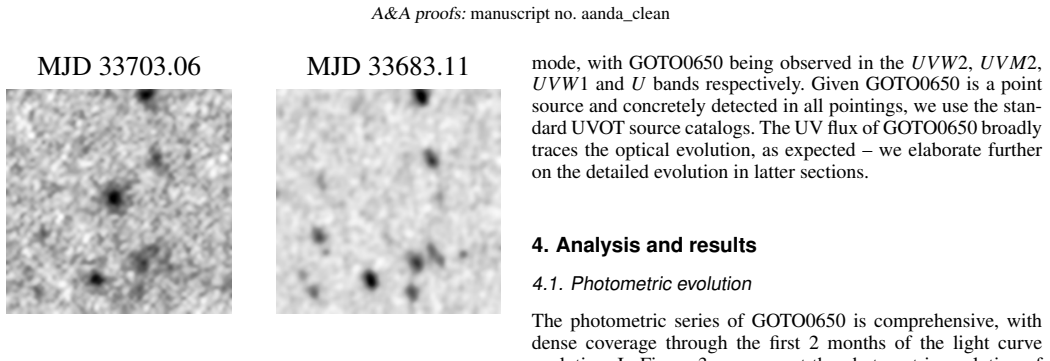
- [§3.1 and §5] The identification of the 1951 DASCH detection as a superoutburst of GOTO0650 is not established with sufficient rigor. The initial positional offset is 13 arcsec on a plate with 4 arcsec/pix scale; the re-fit with a smaller cutout yields 'better concordance (≈2 pixels)' but no quoted uncertainty, no astrometric solution RMS, and no distortion model. This association is then used in §5 to state that there was an outburst 73 years ago and to infer a recurrence time of 'many years or decades.' I request a quantitative astrometric analysis—including the uncertainties in the plate solution and source centroid—or, failing that, a clear downgrading of the claim to a tentative candidate with the recurrence-time statement revised accordingly.
- [§4.5] The white-dwarf temperature derived from the quiescent SED (Teff = 11,100 K) and the resulting comparison to the period-bouncer candidates QZ Lib and EZ Lyn rest on the assumption that the Pan-STARRS fluxes are dominated by the white dwarf. The paper itself states 'We here assume that we are indeed seeing the WD, when components from the disk and accretion column may be present,' but it does not test the sensitivity of the inference to a possible disk or accretion contribution. Since the period-bouncer candidacy leans on this temperature, the authors should either estimate the maximum plausible non-WD contribution from the existing photometry and spectral limits, or explicitly reframe the temperature and the period-bouncer comparison as a hypothesis requiring NUV or higher-resolution spectroscopic confirmation.
minor comments (5)
- [Abstract and §5] The phrasing 'a 8.5 mag' (abstract) and 'an WZ Sge type' (§5) should be corrected to 'an 8.5 mag' and 'a WZ Sge type'.
- [Figure 2 caption] The caption reads 'MJD 33,3703.06' with an extra comma; it should be 'MJD 33703.06'.
- [§4.2] The sentence 'Between E2 and E9 the recurrence time decreases from 13.5 d to 6.5, with an increase between E10 and E9 of 16.0 d' is confusingly worded; I suggest 'The interval between E9 and E10 increased to 16.0 d' for clarity.
- [§4.5] The text 'the Bergeron 10 model grids' should be expanded to identify the grid as the Montreal white-dwarf model atmospheres (Holberg & Bergeron 2006; Tremblay et al. 2011) to avoid ambiguity.
- [§3.1] The abbreviation for the American Association of Variable Star Observers appears with variable spacing ('AA VSO' and 'AAVSO'); please standardize throughout.
Circularity Check
No significant circularity: the WZ Sge classification and period-bouncer candidacy rest on external calibrations and independently obtained data, with only minor non-load-bearing self-citations.
full rationale
This is an observational characterization paper rather than a derivation. The central classification of GOTO0650 as a WZ Sge-type dwarf nova is based on measured outburst amplitude (~8.5 mag), a superhump period of ~91 min converted to an orbital period via the external Kato & Osaki (2013) relation, and the observed train of ten echo outbursts compared with independent WZ Sge literature (Patterson et al. 1998; Kato 2015). These are external calibrations applied to new data, not inputs defined by the paper. The distance is obtained from the Patterson (2011) peak-MV relation for WZ Sge systems and is then used to derive X-ray luminosity and quiescent absolute magnitude; this is a standard external calibration and, while uncertain, is not a fitted parameter renamed as a prediction. The SED modelling uses PanSTARRS colors against Bergeron/Bedard model grids to infer an 11,000 K white dwarf temperature, with the authors explicitly flagging the assumption that the flux is WD-dominated: 'We here assume that we are indeed seeing the WD, when components from the disk and accretion column may be present.' This weakens the period-bouncer interpretation but is not circular. The 1951 DASCH detection is a fragile astrometric association (13 arcsec initial offset, reduced to about 2 pixels by a qualitative re-fit with no quoted uncertainty), but the inference of a 73-year recurrence time is an empirical claim about an external plate archive, not a result forced by the paper's own construction. Self-citations to the Kilonova Seekers project and GOTO instrument papers document data provenance and discovery methodology; they do not supply the physical classification criteria. No uniqueness theorem or ansatz is imported from the authors' prior work. Therefore no Eq. X = Eq. Y by construction, and no fitted-input-as-prediction step is present. The score of 1 reflects minor self-citations and acknowledged fragility in the historical-outburst association and SED assumptions, not circularity.
Assumptions & free parameters
free parameters (4)
- White dwarf effective temperature (Teff) =
11100 +2200 -1500 K
- White dwarf surface gravity (log g) =
unconstrained
- Distance to GOTO0650 =
510 +80 -60 pc
- Foreground reddening E(B-V) =
0.056
assumptions (6)
- domain assumption Peak absolute magnitude MV = 4.5 +/- 0.3 for WZ Sge systems (Patterson 2011)
- domain assumption The quiescent SED is dominated by the white dwarf
- domain assumption Superhump period excess follows the 3:1 resonance relation of Kato & Osaki (2013)
- domain assumption Knigge et al. (2011) evolutionary tracks correctly map mass ratio to pre/post-period-minimum status
- domain assumption The 1951 DASCH detection is the same object as GOTO0650
- domain assumption Foreground reddening E(B-V)=0.056 from Lallement/Vergely 3D maps
Cite this review
Pith. "Pith review of GOTO065054+593624: a 8.5 mag amplitude dwarf nova identified in real time via Kilonova Seekers." pith.science (2026). https://pith.science/paper/CECD7QUZ
@misc{pith2026250111524,
  author       = {Pith},
  title        = {Pith review of: GOTO065054+593624: a 8.5 mag amplitude dwarf nova identified in real time via Kilonova Seekers},
  year         = {2026},
  howpublished = {\url{https://pith.science/paper/CECD7QUZ}},
  note         = {Machine review of arXiv:2501.11524}
}
read the original abstract
Dwarf novae are astrophysical laboratories for probing the nature of accretion, binary mass transfer, and binary evolution -- yet their diverse observational characteristics continue to challenge our theoretical understanding. We here present the discovery of, and subsequent observing campaign on GOTO065054+593624 (hereafter GOTO0650), a dwarf nova of the WZ Sge type, discovered in real-time by citizen scientists via the Kilonova Seekers citizen science project, which has an outburst amplitude of 8.5 mag. An extensive dataset charts the photometric and spectroscopic evolution of this object, covering the 2024 superoutburst. GOTO0650 shows an absence of visible emission lines during the high state, strong H and barely-detected HeII emission, and high-amplitude echo outbursts with a rapidly decreasing timescale. The comprehensive dataset presented here marks GOTO0650 as a candidate period bouncer, and highlights the important contribution that citizen scientists can make to the study of Galactic transients.
Figures


Figures from the paper (9 more)





Forward citations
Cited by 1 Pith paper
-
Bridging the Gap: OPTICAM Reveals the Hidden Spin of the WZ Sge Star GOTO 065054.49+593624.51
A 148.5 second periodic modulation in the g-band of GOTO 0650 during outburst decline is interpreted as the white dwarf spin period.
Reference graph
Works this paper leans on
-
[1]
2010, ApJ, 711, 389 Bédard, A., Bergeron, P., Brassard, P., & Fontaine, G
Aviles, A., Zharikov, S., Tovmassian, G., et al. 2010, ApJ, 711, 389 Bédard, A., Bergeron, P., Brassard, P., & Fontaine, G. 2020, ApJ, 901, 93
work page 2010
-
[2]
C., Kulkarni, S
Bellm, E. C., Kulkarni, S. R., Graham, M. J., et al. 2019, PASP, 131, 018002
2019
-
[3]
R., Pala, A
Belloni, D., Schreiber, M. R., Pala, A. F., et al. 2020, MNRAS, 491, 5717
2020
-
[4]
2016, Photutils: Photometry tools, Astrophysics Source Code Library, record ascl:1609.011
Bradley, L., Sipocz, B., Robitaille, T., et al. 2016, Photutils: Photometry tools, Astrophysics Source Code Library, record ascl:1609.011
work page 2016
-
[5]
Bridging the Gap: OPTICAM Reveals the Hidden Spin of the WZ Sge Star GOTO 065054.49+593624.51
Brown, T. M., Baliber, N., Bianco, F. B., et al. 2013, PASP, 125, 1031 Castro Segura, N., Irving, Z. A., Vincentelli, F. M., et al. 2025, arXiv e-prints, arXiv:2501.11669
work page Pith review arXiv 2013
-
[6]
Chambers, K. C., Magnier, E. A., Metcalfe, N., et al. 2016, arXiv e-prints, arXiv:1612.05560
arXiv 2016
-
[7]
J., Lang, D., et al
Dey, A., Schlegel, D. J., Lang, D., et al. 2019, AJ, 157, 168
2019
-
[8]
J., Ackley, K., Jiménez-Ibarra, F., et al
Dyer, M. J., Ackley, K., Jiménez-Ibarra, F., et al. 2024, in Society of Photo- Optical Instrumentation Engineers (SPIE) Conference Series, V ol. 13094, Ground-based and Airborne Telescopes X, ed. H. K. Marshall, J. Spyromilio, & T. Usuda, 130941X
work page 2024
Show all 64 references
-
[9]
J., Dhillon, V
Dyer, M. J., Dhillon, V . S., Littlefair, S., et al. 2018, in Society of Photo-Optical Instrumentation Engineers (SPIE) Conference Series, V ol. 10704, Observa- tory Operations: Strategies, Processes, and Systems VII, 107040C
2018
-
[10]
Fitzpatrick, E. L. 1999, PASP, 111, 63
1999
-
[11]
W., Lang, D., & Goodman, J
Foreman-Mackey, D., Hogg, D. W., Lang, D., & Goodman, J. 2013, PASP, 125, 306 Gaia Collaboration, Montegriffo, P., Bellazzini, M., et al. 2023, A&A, 674, A33
2013
-
[12]
L., Kemper, E., & Suntzeff, N
Gilliland, R. L., Kemper, E., & Suntzeff, N. 1986, ApJ, 301, 252
1986
-
[13]
M., Cheng, F., et al
Godon, P., Sion, E. M., Cheng, F., et al. 2006, ApJ, 642, 1018
2006
-
[14]
& Nelson, L
Goliasch, J. & Nelson, L. 2015, ApJ, 809, 80
2015
-
[15]
& Weare, J
Goodman, J. & Weare, J. 2010, Communications in Applied Mathematics and Computational Science, 5, 65
2010
-
[16]
2012, in IAU Symposium, V ol
Grindlay, J., Tang, S., Los, E., & Servillat, M. 2012, in IAU Symposium, V ol. 285, New Horizons in Time Domain Astronomy, ed. E. Gri ffin, R. Hanisch, & R. Seaman, 29–34
2012
-
[17]
K., Butterley, T., Dhillon, V
Hardy, L. K., Butterley, T., Dhillon, V . S., Littlefair, S. P., & Wilson, R. W. 2015, MNRAS, 454, 4316
2015
-
[18]
2009, PASJ, 61, 697
Hiroi, K., Moritani, Y ., Nogami, D., et al. 2009, PASJ, 61, 697
2009
-
[19]
Holberg, J. B. & Bergeron, P. 2006, AJ, 132, 1221
2006
-
[20]
& Marsh, T
Horne, K. & Marsh, T. R. 1986, MNRAS, 218, 761
1986
-
[21]
B., Nelson, L
Howell, S. B., Nelson, L. A., & Rappaport, S. 2001, ApJ, 550, 897
2001
-
[22]
T., Breedt, E., et al
Inight, K., Gänsicke, B. T., Breedt, E., et al. 2023, MNRAS, 524, 4867
2023
-
[23]
T., Poyner, G., van Cauteren, P., & Vanmunster, T
Jensen, L. T., Poyner, G., van Cauteren, P., & Vanmunster, T. 1995, The Messen- ger, 80, 43
1995
-
[24]
2004, PASJ, 56, S109
Kato, T., Nogami, D., Matsumoto, K., & Baba, H. 2004, PASJ, 56, S109
2004
-
[25]
& Osaki, Y
Kato, T. & Osaki, Y . 2013, PASJ, 65, 115
2013
-
[26]
2011, ApJS, 194, 28
Knigge, C., Baraffe, I., & Patterson, J. 2011, ApJS, 194, 28
2011
-
[27]
S., Shappee, B
Kochanek, C. S., Shappee, B. J., Stanek, K. Z., et al. 2017, PASP, 129, 104502
2017
-
[28]
L., Babusiaux, C., & Cox, N
Lallement, R., Vergely, J. L., Babusiaux, C., & Cox, N. L. J. 2022, A&A, 661, A147
2022
-
[29]
W., Mierle, K., Blanton, M., & Roweis, S
Lang, D., Hogg, D. W., Mierle, K., Blanton, M., & Roweis, S. 2010, AJ, 139, 1782
2010
-
[30]
Lomb, N. R. 1976, Ap&SS, 39, 447
1976
-
[31]
J., Laher, R
Masci, F. J., Laher, R. R., Rusholme, B., et al. 2023, arXiv e-prints, arXiv:2305.16279
2023 arXiv
-
[32]
H., Harbeck, D.-R., et al
McCully, C., V olgenau, N. H., Harbeck, D.-R., et al. 2018, in Society of Photo- Optical Instrumentation Engineers (SPIE) Conference Series, V ol. 10707, Software and Cyberinfrastructure for Astronomy V , ed. J. C. Guzman & J. Ib- sen, 107070K
2018
-
[33]
& Meyer-Hofmeister, E
Meyer, F. & Meyer-Hofmeister, E. 2015, PASJ, 67, 52
2015
-
[34]
V ., Page, K
Neustroev, V . V ., Page, K. L., Kuulkers, E., et al. 2018, A&A, 611, A13
2018
-
[35]
& Meyer, F
Osaki, Y . & Meyer, F. 2002, A&A, 383, 574
2002
-
[36]
F., Gänsicke, B
Pala, A. F., Gänsicke, B. T., Breedt, E., et al. 2020, MNRAS, 494, 3799
2020
-
[37]
F., Gänsicke, B
Pala, A. F., Gänsicke, B. T., Townsley, D., et al. 2017, MNRAS, 466, 2855 Article number, page 12 of 14 Killestein et al.: GOTO0650: a high amplitude dwarf nova
2017
-
[38]
F., Schmidtobreick, L., Tappert, C., Gänsicke, B
Pala, A. F., Schmidtobreick, L., Tappert, C., Gänsicke, B. T., & Mehner, A. 2018, MNRAS, 481, 2523
2018
-
[39]
2011, MNRAS, 411, 2695
Patterson, J. 2011, MNRAS, 411, 2695
2011
-
[40]
A., et al
Patterson, J., Augusteijn, T., Harvey, D. A., et al. 1996, PASP, 108, 748
1996
-
[41]
R., et al
Patterson, J., Kemp, J., Skillman, D. R., et al. 1998, PASP, 110, 1290
1998
-
[42]
W., et al
Patterson, J., Masi, G., Richmond, M. W., et al. 2002, PASP, 114, 721
2002
-
[43]
S., Steele, I
Piascik, A. S., Steele, I. A., Bates, S. D., et al. 2014, in Society of Photo-Optical Instrumentation Engineers (SPIE) Conference Series, V ol. 9147, Ground- based and Airborne Instrumentation for Astronomy V , ed. S. K. Ramsay, I. S. McLean, & H. Takami, 91478H
2014
-
[44]
2020, The Journal of Open Source Software, 5, 2308
Prochaska, J., Hennawi, J., Westfall, K., et al. 2020, The Journal of Open Source Software, 5, 2308
2020
-
[45]
E., Garnavich, P., et al
Ridden-Harper, R., Tucker, B. E., Garnavich, P., et al. 2019, MNRAS, 490, 5551
2019
-
[46]
Roming, P. W. A., Kennedy, T. E., Mason, K. O., et al. 2005, Space Sci. Rev., 120, 95
2005
-
[47]
Scargle, J. D. 1982, ApJ, 263, 835
1982
-
[48]
R., Belloni, D., & Schwope, A
Schreiber, M. R., Belloni, D., & Schwope, A. D. 2024, A&A, 682, L7
2024
-
[49]
J., Prieto, J
Shappee, B. J., Prieto, J. L., Grupe, D., et al. 2014, ApJ, 788, 48
2014
-
[50]
2018, Journal of the British Astronomical Association, 128, 75
Shears, J. 2018, Journal of the British Astronomical Association, 128, 75
2018
-
[51]
W., Young, D
Shingles, L., Smith, K. W., Young, D. R., et al. 2021, Transient Name Server AstroNote, 7, 1
2021
-
[52]
K., Ackley, K., et al
Steeghs, D., Galloway, D. K., Ackley, K., et al. 2022, MNRAS, 511, 2405
2022
-
[53]
A., Smith, R
Steele, I. A., Smith, R. J., Rees, P. C., et al. 2004, in Society of Photo-Optical In- strumentation Engineers (SPIE) Conference Series, V ol. 5489, Ground-based Telescopes, ed. J. Oschmann, Jacobus M., 679–692
2004
-
[54]
2004, AJ, 128, 1882
Szkody, P., Henden, A., Fraser, O., et al. 2004, AJ, 128, 1882
2004
-
[55]
2021, PASJ, 73, 753
Tampo, Y ., Isogai, K., Kojiguchi, N., et al. 2021, PASJ, 73, 753
2021
-
[56]
2023, PASJ, 75, 619
Tampo, Y ., Kato, T., Kojiguchi, N., et al. 2023, PASJ, 75, 619
2023
-
[57]
L., Denneau, L., Heinze, A
Tonry, J. L., Denneau, L., Heinze, A. N., et al. 2018, PASP, 130, 064505
2018
-
[58]
L., Stubbs, C
Tonry, J. L., Stubbs, C. W., Lykke, K. R., et al. 2012, ApJ, 750, 99
2012
-
[59]
T., Echevarria, J., Zharikov, S., & Ramirez, A
Tovmassian, G., Gänsicke, B. T., Echevarria, J., Zharikov, S., & Ramirez, A. 2022, ApJ, 939, 14
2022
-
[60]
E., Bergeron, P., & Gianninas, A
Tremblay, P. E., Bergeron, P., & Gianninas, A. 2011, ApJ, 730, 128 Van Grootel, V ., Dupret, M. A., Fontaine, G., et al. 2012, A&A, 539, A87
2011
-
[61]
L., Lallement, R., & Cox, N
Vergely, J. L., Lallement, R., & Cox, N. L. J. 2022, A&A, 664, A174 V oges, W., Aschenbach, B., Boller, T., et al. 1999, A&A, 349, 389
2022
-
[62]
2003, Cataclysmic Variable Stars (Cambridge University Press)
Warner, B. 2003, Cataclysmic Variable Stars (Cambridge University Press)
2003
-
[63]
F., Sion, E
Welsh, W. F., Sion, E. M., Godon, P., et al. 2003, ApJ, 599, 509
2003
-
[64]
2022, in Handbook of X-ray and Gamma-ray Astrophysics, ed
Yuan, W., Zhang, C., Chen, Y ., & Ling, Z. 2022, in Handbook of X-ray and Gamma-ray Astrophysics, ed. C. Bambi & A. Sangangelo, 86 1 Department of Physics & Astronomy, University of Turku, Vesilin- nantie 5, Turku, FI-20014, Finland. 2 Department of Physics, University of Warw...
2022
Reviewed August 10, 2026 · model on record in the stance chip above.
Discussion (0). Continue with ORCID to comment.