REVIEW 4 major objections 6 minor 40 references
Technical Report for the Forgotten-by-Design Project: Targeted Obfuscation for Machine Learning
T0 review · 4 major / 6 minor · reviewed 2026-08-10 · deepseek-v4-flash
Pith's one-line read Instance-specific gradient obfuscation during training prevents sensitive data from being embedded, reducing membership-inference risk by an order of magnitude while preserving accuracy.
desk verdict The paper's core idea is plausible and the authors are honest about limits, but the headline 'order of magnitude' claim is not yet supported because the defense and the evaluation both operate on the same LIRA statistic. read the letter →
The pith
A machine-rendered reading of the paper's core claim, the machinery that carries it, and where it could break.
The reading
What carries the argument
The load-bearing object is the instance-specific gradient update $$\theta_{t+1} = \theta_t - \eta \frac{1}{|B|}\sum_{j\in B}(w_j g_j + u_j),$$ in which each data point contributes a weight $w_j$ and a Gaussian noise $u_j \sim \mathcal{N}(0,\sigma_j^2 I)$. The weight is a clipped exponential of the privacy vulnerability t-score $$t_j = \frac{$m^{{\mathrm{IN}}$}_j - $m^{{\mathrm{OUT}}$}_j}{\sqrt{$V^{{\mathrm{IN}}$}_j + $V^{{\mathrm{OUT}}$}_j}},$$ computed from LIRA shadow-model fits of scaled logits, so a point with a higher vulnerability score receives a lower weight $w_{\mathrm{exp}}(t) = e^{-\max(0,\alpha t - \beta)}$. This redirects the gradient update away from points LIRA can identify, while uniform noise blurs whatever signal remains, and the paper shows the two effects compound in the privacy-utility trade-off.
What would settle it
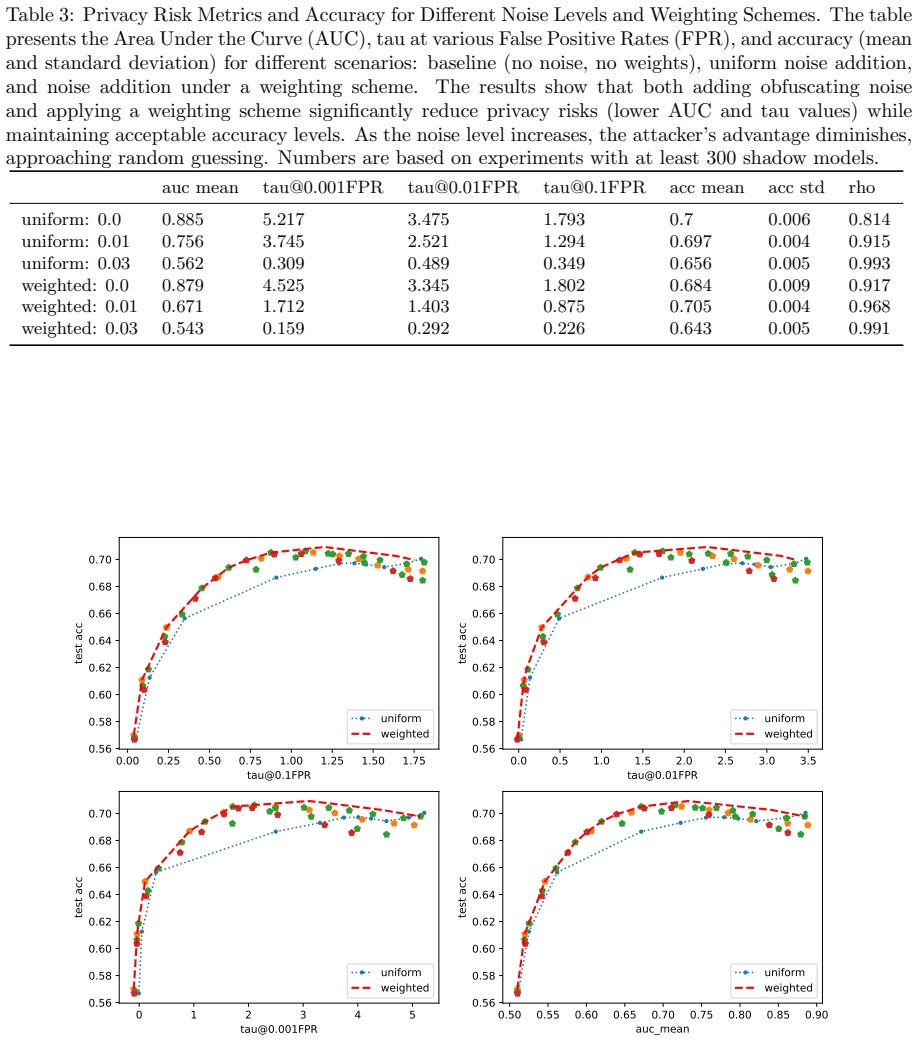
Run the stronger RMIA attack on the protected weighted sigma=0.01 checkpoints from Table 3; if its true positive rate at 0.001 false positive rate is materially higher than the LIRA-derived tau near 1.7 implies, the order-of-magnitude claim holds only against LIRA, not against membership inference in general.
Extended reading notes
Core claim
The paper claims that a model can be made to forget sensitive data during training rather than after it, by obfuscating the gradients of the data points a membership-inference adversary would most reliably identify. On CIFAR-10 with ResNet-18, combining additive Gaussian noise with instance-specific down-weighting based on LIRA vulnerability scores reduces LIRA's tau at 0.001 FPR from 5.217 to 1.712 at sigma = 0.01, with test accuracy statistically unchanged, and at sigma = 0.03 drives AUC to about 0.54-0.56 and tau toward zero, close to the random-guessing baseline. The authors conclude that non-inference under a strong membership-inference test is a workable operational definition of forgetting, satisfying a practical reading of the right to be forgotten.
Load-bearing premise
The entire guarantee is measured and targeted through LIRA's Gaussian approximation of shadow-model losses, so if LIRA is not a representative proxy for membership inference, the weighting protects the wrong points and the reported reduction may not transfer to stronger attacks.
Editorial extensions
If this is right
- At sigma=0.01 with the exponential weighting, LIRA's tau at 0.001 FPR drops from 5.217 to 1.712 while test accuracy stays at 0.705, so the attacker's success per false positive falls by more than an order of magnitude.
- At sigma=0.03, both schemes push AUC to about 0.54-0.56 and tau near 0.2-0.3, close to the random-guessing baseline where the attacker has little advantage over chance.
- The weighted scheme sits on a more favorable privacy-utility frontier than noise-only obfuscation: at intermediate risk levels it achieves the same accuracy with lower tau at every FPR level tested.
- Even at the strongest obfuscation tested, accuracy remains in the sixties, far above the roughly 10 percent random-label floor for CIFAR-10.
- Because the obfuscation is applied during training, no post-training unlearning step is needed for the protected data points.
Reading between the lines
- The method's practicality depends on the t-score ranking produced by a first round of shadow models; a natural test is whether the same ranking can be reused across architectures, datasets, or data splits without retraining shadow models.
- One unstated direction is combining the instance-specific weights with DP-SGD's gradient clipping; the paper does not claim formal guarantees, but applying weights before clipping might preserve some of the targeted forgetting while recovering a bound.
- Equating forgetting with non-inference implies that a model passing an accepted membership-inference audit could be treated as having forgotten a data point; that regulatory equivalence is the authors' framing, not a legal result, and would need regulator acceptance.
- The strongest untested risk is attack transferability: if a stronger attack exploits different signals than LIRA, the reported reduction could shrink, so re-running the evaluation with RMIA would delimit the claim.
Editorial analysis
A structured set of objections, weighed in public.
Referee Report
Summary. This technical report proposes 'Forgotten by Design,' a training-time defense that combines per-example Gaussian gradient noise with a LIRA-derived weighting of vulnerable samples. The authors define a privacy vulnerability t-score from shadow-model Gaussian fits (Eq. 7), assign each sample a weight w(t)=exp(-max(0,alpha t - beta)) (Eq. 12), and add noise to the gradient sum (Eq. 8). On CIFAR-10 with ResNet-18, they report that the weighted scheme at sigma=0.01 reduces LIRA tau@0.001FPR from 5.217 to 1.712 and AUC from 0.885 to 0.671 while accuracy remains around 70-70.5%, and that stronger noise pushes AUC toward 0.5. They interpret these results as preventing sensitive data from being embedded and as an order-of-magnitude privacy improvement, and they frame the approach in terms of motivated forgetting and the right to be forgotten.
Significance. The idea of targeting gradient obfuscation to samples that are individually vulnerable to a specified membership-inference attack is a reasonable engineering step, and the paper has several strengths: it uses at least 300 shadow models per configuration, reports ROC curves with confidence bands, visualizes the privacy-utility frontier, and explicitly lists its limitations. If the claims were restricted to LIRA-measured leakage, the results would be a useful empirical data point for privacy audit practice. However, the main claim that the method 'prevents sensitive data from being embedded' is not established: the defense and the evaluation share the same LIRA statistic, no comparison to stronger attacks (e.g., RMIA) or DP-SGD is provided, and no confidence intervals are given for the headline privacy metrics. As it stands, the paper reads as a feasibility study rather than a validated privacy guarantee.
major comments (4)
- [Sections 3.2 and 3.4, Eqs. (4), (7), (12)] The reported privacy reduction is partly engineered because the defense uses the same LIRA statistic that defines the evaluation. The vulnerability weight w(t)=exp(-max(0,alpha t - beta)) suppresses samples with the largest normalized IN-OUT gap t_j (Eq. 7), while the attack metrics tau and AUC are computed by thresholding the LIRA log-likelihood ratio of precisely that gap (Eq. 4). Down-weighting high-t points therefore lowers the measured leakage by construction, independently of whether a different adversary would still succeed. The paper's own Section 5.1 cites Aerni et al. [40] as showing that empirical defenses evaluated against the attacks they are designed against can overstate privacy, and Section 5.2 concedes that RMIA is untested. I request an evaluation with RMIA (or a simple non-LIRA threshold attack) and a DP-SGD baseline; absent that, the abstract's 'prevents sensitive data from being embedded' should be replaced by 'reduces LIRA-measured membership leakage.'
- [Abstract and Table 3] The abstract's claim of 'at 95% significance' is not supported by any confidence interval, p-value, or hypothesis test for AUC or tau in the main text. Section 3.2 explains how shadow models can provide confidence bands, and Figure 7 displays such bands, but Table 3 reports only point estimates for AUC and tau, with standard deviations only for accuracy. With at least 300 shadow models per configuration, the authors should report bootstrap or shadow-model-based confidence intervals for AUC and tau, and a test for the key comparison (e.g., tau@0.001FPR = 5.217 at baseline versus 1.712 for weighted sigma=0.01). Without this, the headline statistical claim is unverifiable.
- [Section 4.1 and Table 2] The headline operating point (alpha=2, beta=2, sigma=0.01) was selected after inspecting the privacy-utility trade-off curves, so the reported tau of 1.712 and 70.5% accuracy are in-sample point estimates for a chosen configuration. The order-of-magnitude claim is sensitive to this choice: Table 3 shows weighted-row tau values ranging from 4.525 to 0.159 depending on sigma. Please report a sensitivity analysis over alpha, beta, and sigma, or a pre-specified selection rule with a validation split, so that the reader can assess whether the improvement is robust rather than an artifact of post-hoc parameter choice.
- [Section 5.2, Table 3, and Conclusions] The conclusion that the method 'prevents sensitive data from being embedded' is not supported by the evidence even for the LIRA adversary. At the headline setting (weighted sigma=0.01), AUC is 0.671 and tau@0.001FPR is 1.712, so the attacker's TPR/FPR ratio is still around exp(1.712) approximately 5.5; only at sigma=0.03-0.05 does AUC approach 0.5, at the cost of a 5-13 percentage-point accuracy drop. Moreover, membership inference is only one type of privacy harm, so the absolute wording claims more than the experiments can show. I recommend reporting residual leakage at each operating point and rewording the abstract and conclusions to describe a reduction in LIRA-measured leakage rather than the prevention of sensitive-data embedding.
minor comments (6)
- [Section 2.7 and References] References [34] and [40] are the same paper (Aerni, Zhang, and Tramèr, CCS 2024); please consolidate the duplicate entry.
- [Figure 2 caption] The caption says 'uniform noise addition (0.01 and 0.02)' but the legend and the text refer to 0.01 and 0.03; the caption should match the plotted curves.
- [Table 4] The 'weighted: 0.007' row is duplicated; one copy should be removed.
- [Section 3.1] The phrase 'the cross-entropy loss nor the logits' should be 'the cross-entropy loss or the logits'; the definition of p_j as exp(-ell) also appears only later, so an early forward reference would improve readability.
- [Section 4.1 and Table 3] Accuracies are reported as fractions in Table 3 (e.g., 0.7) and as percentages in Table 4 (e.g., 70.043); please use one convention consistently.
- [General / Reproducibility] The paper does not provide the full training setup (epochs, batch size, learning-rate schedule, optimizer, and number of gradient steps) needed to reproduce the experiments; adding a reproducibility appendix would strengthen the report.
Circularity Check
The defense and the audit share the LIRA Gaussian IN-OUT statistic, so the headline order-of-magnitude privacy reduction is partly engineered by construction rather than independently measured.
-
fitted input called prediction
[Section 3.2 (Eqs. 2-4; tau definition), Section 3.3 (Eq. 7), Section 3.4 (Eq. 12), Section 4 (Main experiment set-up)]
"In the LIRA attack, these metrics are estimated by thresholding the likelihood ratio. ... For this purpose, we define the privacy vulnerability t-score tj = ... ... The weighted scenarios use the exponential weighting scheme defined in equation (12) based on the privacy vulnerability t-score calculated as in equation (7), that is, weights falling off exponentially fast with the (non-negative) distance between the estimated center of the IN and OUT distributions of the LIRA attack model. ... tau: For this work we introduce tau, which is simply the logarithm of the ratio of TPR to FPR."
The t-score (Eq. 7) is the standardized IN-OUT gap of the LIRA Gaussian fits; the attack statistic lambda (Eq. 4) is the log ratio of those same Gaussian densities; the weights (Eq. 12) are a monotone non-increasing function of t; and the headline metrics (AUC, tau) are computed by thresholding lambda. Down-weighting high-t points therefore suppresses precisely the signal the evaluation measures. A lower tau/AUC is the expected consequence of any scheme that down-weights the points LIRA flags, so the claimed order-of-magnitude reduction in privacy risk is not an independent measurement of membership leakage; it is partly a consequence of using the same sufficient statistic for both the defense and the audit.
-
self definitional
[Section 2.3 and Section 5.2]
"In short, if there is no reliable (i.e., better than random) way of determining that a data point was part of the training data set, then we consider that the AI model has forgotten that data point during or after training. ... The study primarily focuses on membership inference attacks (and specifically only LIRA)."
Forgetting is defined as the absence of any reliable membership-inference signal, but the only signal tested is LIRA. Thus 'the model has forgotten' is established whenever the LIRA statistic that the defense was calibrated to suppress is reduced. The acknowledged omission of RMIA and other attacks means the definition is never tested against an independent inference procedure, so the criterion and the measured quantity coincide by construction.
full rationale
The central claim--that instance-specific gradient obfuscation prevents sensitive data from being embedded and reduces privacy risk by at least an order of magnitude--is evaluated with the same LIRA Gaussian machinery used to define the vulnerability weights. The t-score (Eq. 7) and the likelihood-ratio metrics (Eqs. 2-4, tau) are derived from the same IN/OUT Gaussian fits, and the exponential weights (Eq. 12) monotonically suppress large-t points, so the reported drop in tau from 5.2 to 1.7 is substantially engineered by construction. This is partial, not total, circularity: accuracy is an independent utility measure, the ROC curves' approach to random guessing is a real behavioral change in the retrained models, and the paper openly concedes that stronger attacks such as RMIA and DP-SGD baselines are out of scope (Sections 5.1-5.2). Those concessions also mean the strongest claim is not externally falsified in the paper. Score 6 reflects one or more predictions that reduce by construction while leaving independent content in the accuracy and ROC-to-random results.
Assumptions & free parameters
free parameters (3)
- alpha (weight steepness) =
alpha = 2
- beta (weight cutoff) =
beta = 2
- sigma (noise standard deviation) =
sigma in {0.001, ..., 0.05}; headline uses 0.01 and 0.03
assumptions (5)
- domain assumption Logit-scaled per-point losses are approximately Gaussian.
- domain assumption Shadow models trained on random subsets are faithful surrogates for the target model's IN/OUT loss distributions.
- domain assumption Attacker advantage under LIRA is an adequate measure of whether a model has forgotten a data point.
- domain assumption Gradient noise without DP-SGD clipping still provides meaningful privacy protection.
- domain assumption Results on CIFAR-10 with ResNet-18 generalize to other datasets and models relevant to the right to be forgotten.
Cite this review
Pith. "Pith review of Technical Report for the Forgotten-by-Design Project: Targeted Obfuscation for Machine Learning." pith.science (2026). https://pith.science/paper/USSKE4KB
@misc{pith2026250111525,
  author       = {Pith},
  title        = {Pith review of: Technical Report for the Forgotten-by-Design Project: Targeted Obfuscation for Machine Learning},
  year         = {2026},
  howpublished = {\url{https://pith.science/paper/USSKE4KB}},
  note         = {Machine review of arXiv:2501.11525}
}
read the original abstract
The right to privacy, enshrined in various human rights declarations, faces new challenges in the age of artificial intelligence (AI). This paper explores the concept of the Right to be Forgotten (RTBF) within AI systems, contrasting it with traditional data erasure methods. We introduce Forgotten by Design, a proactive approach to privacy preservation that integrates instance-specific obfuscation techniques during the AI model training process. Unlike machine unlearning, which modifies models post-training, our method prevents sensitive data from being embedded in the first place. Using the LIRA membership inference attack, we identify vulnerable data points and propose defenses that combine additive gradient noise and weighting schemes. Our experiments on the CIFAR-10 dataset demonstrate that our techniques reduce privacy risks by at least an order of magnitude while maintaining model accuracy (at 95% significance). Additionally, we present visualization methods for the privacy-utility trade-off, providing a clear framework for balancing privacy risk and model accuracy. This work contributes to the development of privacy-preserving AI systems that align with human cognitive processes of motivated forgetting, offering a robust framework for safeguarding sensitive information and ensuring compliance with privacy regulations.
Figures


Figures from the paper (4 more)


Reference graph
Works this paper leans on
-
[40]
Evaluations of machine learning privacy defenses are misleading
Michael Aerni, Jie Zhang, and Florian Tram` er. Evaluations of machine learning privacy defenses are misleading. In Proceedings of the 2024 ACM SIGSAC Conference on Computer and Communications Security, pages 1271–1284. Association for Computing Machinery, 2024. 21 Appendix This appendix presents a more detailed analysis of the t-scores as well as some fu...
work page 2024
-
[1]
Member- ship inference attacks on machine learning: A survey
Hongsheng Hu, Zoran Salcic, Lichao Sun, Gillian Dobbie, Philip S Yu, and Xuyun Zhang. Member- ship inference attacks on machine learning: A survey. ACM Computing Surveys (CSUR) , 54(11s):1– 37, 2022
work page 2022
-
[2]
Mem- bership inference attacks from first principles
Nicholas Carlini, Steve Chien, Milad Nasr, Shuang Song, Andreas Terzis, and Florian Tramer. Mem- bership inference attacks from first principles. In 2022 IEEE Symposium on Security and Privacy (SP), pages 1897–1914. IEEE, 2022
work page 2022
-
[3]
Learning multiple layers of features from tiny images
Alex Krizhevsky, Vinod Nair, and Geoffrey Hinton. Learning multiple layers of features from tiny images. Technical report, University of Toronto, 2009
work page 2009
-
[4]
Deep residual learning for image recog- nition
Kaiming He, Xiangyu Zhang, Shaoqing Ren, and Jian Sun. Deep residual learning for image recog- nition. arXiv preprint arXiv:1512.03385 , 2015
arXiv 2015
-
[5]
Decay happens: the role of active forgetting in memory
Oliver Hardt, Karim Nader, and Lynn Nadel. Decay happens: the role of active forgetting in memory. Trends in cognitive sciences, 17(3):111–120, 2013
work page 2013
-
[6]
Towards a cognitive and neurobiological model of moti- vated forgetting
Michael C Anderson and Ean Huddleston. Towards a cognitive and neurobiological model of moti- vated forgetting. True and false recovered memories: Toward a reconciliation of the debate , pages 53–120, 2012
work page 2012
-
[7]
Memory editing from science fiction to clinical practice
Elizabeth A Phelps and Stefan G Hofmann. Memory editing from science fiction to clinical practice. Nature, 572(7767):43–50, 2019
work page 2019
Show all 40 references
-
[8]
First draft of a report on the edvac
John Von Neumann. First draft of a report on the edvac. IEEE Annals of the History of Computing , 15(4):27–75, 1993
1993
-
[9]
Der rechenmaschinenspeicher als ged¨ achtnis: Einfl¨ usse der neurophys- iologie auf den rechnerbau in den vierziger jahren
Katharina Schmidt-Br¨ ucken. Der rechenmaschinenspeicher als ged¨ achtnis: Einfl¨ usse der neurophys- iologie auf den rechnerbau in den vierziger jahren. Sozialgeschichte der Informatik: Kulturelle Prak- tiken und Orientierungen , pages 197–211, 1998
1998
-
[10]
Remembering jan rajchman and the origins of electronic memory, 2015
Alexander B Magoun. Remembering jan rajchman and the origins of electronic memory, 2015
2015
-
[11]
Selecting metaphoric terminology for the computer industry
Richard M Chisholm. Selecting metaphoric terminology for the computer industry. Journal of Technical Writing and Communication, 16(3):195–220, 1986
1986
-
[12]
Attention is all you need
A Vaswani. Attention is all you need. Advances in Neural Information Processing Systems , 2017
2017
-
[13]
Recontextualizing anthropomor- phic metaphors in organization studies: The pathology of organizational insomnia
Dennis Schoeneborn, Steffen Blaschke, and Ina Maria Kaufmann. Recontextualizing anthropomor- phic metaphors in organization studies: The pathology of organizational insomnia. Journal of Man- agement Inquiry , 22(4):435–450, 2013
2013
-
[14]
Constructing the source: Metaphor as a discourse strategy
Lionel Wee. Constructing the source: Metaphor as a discourse strategy. Discourse Studies, 7(3):363– 384, 2005
2005
-
[15]
Parole de machines
Alexei Grinbaum. Parole de machines . Humensciences, 2023
2023
-
[16]
Intentional forgetting
Deborah Shands and Carolyn Talcott. Intentional forgetting. arXiv preprint arXiv:2106.09802, 2021
2021 arXiv
-
[17]
Automatic, selective and secure deletion of digital evidence
Aniello Castiglione, Giuseppe Cattaneo, Giancarlo De Maio, and Alfredo De Santis. Automatic, selective and secure deletion of digital evidence. In 2011 International Conference on Broadband and Wireless Computing, Communication and Applications , pages 392–398. IEEE, 2011
2011
-
[18]
Extracting training data from large language models
Nicholas Carlini, Florian Tramer, Eric Wallace, Matthew Jagielski, Ariel Herbert-Voss, Katherine Lee, Adam Roberts, Tom Brown, Dawn Song, Ulfar Erlingsson, et al. Extracting training data from large language models. In 30th USENIX Security Symposium (USENIX Security 21) , page...
2021
-
[19]
Scalable extraction of training data from (production) language models
Milad Nasr, Nicholas Carlini, Jonathan Hayase, Matthew Jagielski, A Feder Cooper, Daphne Ip- polito, Christopher A Choquette-Choo, Eric Wallace, Florian Tram` er, and Katherine Lee. Scalable extraction of training data from (production) language models. arXiv preprint arXiv:23...
2023 arXiv
-
[20]
Opinion 28/2024 on certain data protection aspects related to the processing of personal data in the context of ai models, 2024
European Data Protection Board. Opinion 28/2024 on certain data protection aspects related to the processing of personal data in the context of ai models, 2024. Adopted on 17 December 2024
2024
-
[21]
Humans forget, machines remember: Artificial intelligence and the right to be forgotten
Eduard Fosch Villaronga, Peter Kieseberg, and Tiffany Li. Humans forget, machines remember: Artificial intelligence and the right to be forgotten. Computer Law & Security Review , 34(2):304– 313, 2018
2018
-
[22]
Language models are unsupervised multitask learners
Alec Radford, Jeffrey Wu, Rewon Child, David Luan, Dario Amodei, Ilya Sutskever, et al. Language models are unsupervised multitask learners. OpenAI blog, 1(8):9, 2019
2019
-
[23]
Remembering: A phenomenological study
Edward S Casey. Remembering: A phenomenological study . Indiana University Press, 2000
2000
-
[24]
New directions in the philosophy of memory
Kourken Michaelian, Dorothea Debus, and Denis Perrin. New directions in the philosophy of memory. Routledge London and New York, 2018
2018
-
[25]
The cognitive neuroscience of constructive memory: remembering the past and imagining the future
Daniel L Schacter and Donna Rose Addis. The cognitive neuroscience of constructive memory: remembering the past and imagining the future. Philosophical Transactions of the Royal Society B: Biological Sciences, 362(1481):773–786, 2007
2007
-
[26]
Divided attention and indirect memory tests
Neil W Mulligan and Marilyn Hartman. Divided attention and indirect memory tests. Memory & Cognition, 24(4):453–465, 1996
1996
-
[27]
Heng Xu, Tianqing Zhu, Lefeng Zhang, Wanlei Zhou, and Philip S. Yu. Machine unlearning: A survey. ACM Comput. Surv. , 56(1), 2023
2023
-
[28]
Amnesiac machine learning
Laura Graves, Vineel Nagisetty, and Vijay Ganesh. Amnesiac machine learning. Proceedings of the AAAI Conference on Artificial Intelligence , 35(13):11516–11524, 5 2021
2021
-
[29]
Choquette-Choo, Hengrui Jia, Adelin Travers, Baiwu Zhang, David Lie, and Nicolas Papernot
Lucas Bourtoule, Varun Chandrasekaran, Christopher A. Choquette-Choo, Hengrui Jia, Adelin Travers, Baiwu Zhang, David Lie, and Nicolas Papernot. Machine unlearning. In 2021 IEEE Symposium on Security and Privacy (SP) , pages 141–159, 2021
2021
-
[30]
Brendan McMahan, Ilya Mironov, Kunal Talwar, and Li Zhang
Martin Abadi, Andy Chu, Ian Goodfellow, H. Brendan McMahan, Ilya Mironov, Kunal Talwar, and Li Zhang. Deep learning with differential privacy. In Proceedings of the 2016 ACM SIGSAC Conference on Computer and Communications Security , pages 308–318. ACM, 2016
2016
-
[31]
Differential privacy defenses and sampling attacks for membership inference
Shadi Rahimian, Tribhuvanesh Orekondy, and Mario Fritz. Differential privacy defenses and sampling attacks for membership inference. InProceedings of the 14th ACM Workshop on Artificial Intelligence and Security (AISec ’21) , page 10. ACM, 2021
-
[32]
On the vulnerability of data points under multiple membership inference attacks and target models
Mauro Conti, Jiaxin Li, and Stjepan Picek. On the vulnerability of data points under multiple membership inference attacks and target models. arXiv preprint arXiv:2210.16258 , 2022
2022 arXiv
-
[33]
The privacy onion effect: Memorization is relative
Nicholas Carlini, Matthew Jagielski, Chiyuan Zhang, Nicolas Papernot, Andreas Terzis, and Florian Tramer. The privacy onion effect: Memorization is relative. In S. Koyejo, S. Mohamed, A. Agarwal, D. Belgrave, K. Cho, and A. Oh, editors, Advances in Neural Information Processin...
2022
-
[34]
Evaluations of machine learning privacy defenses are misleading
Michael Aerni, Jie Zhang, and Florian Tram` er. Evaluations of machine learning privacy defenses are misleading. In Proceedings of the 2024 on ACM SIGSAC Conference on Computer and Communi- cations Security, CCS ’24, page 1271–1284, New York, NY, USA, 2024. Association for Com...
2024
-
[35]
Project repository. Leakpro. https://github.com/aidotse/LeakPro, 2025. Accessed: 2025-01-16
2025
-
[36]
Why train more? effective and efficient membership inference via memorization
Jihye Choi, Shruti Tople, Varun Chandrasekaran, and Somesh Jha. Why train more? effective and efficient membership inference via memorization. ArXiv, abs/2310.08015, 2023
2023 arXiv
-
[37]
Smooth sensitivity and sampling in private data analysis
Kobbi Nissim, Sofya Raskhodnikova, and Adam Smith. Smooth sensitivity and sampling in private data analysis. In Proceedings of the thirty-ninth annual ACM symposium on Theory of computing , pages 75–84. ACM, 2007. 20
2007
-
[38]
Pytorch: An imperative style, high-performance deep learning library
Adam Paszke, Sam Gross, Francisco Massa, Adam Lerer, James Bradbury, Gregory Chanan, Trevor Killeen, Zeming Lin, Natalia Gimelshein, Luca Antiga, Alban Desmaison, Andreas Kopf, Edward Yang, Zachary DeVito, Martin Raison, Alykhan Tejani, Sasank Chilamkurthy, Benoit Steiner, Lu ...
2019
-
[39]
Low-cost high-power membership inference at- tacks
Sajjad Zarifzadeh, Philippe Liu, and Reza Shokri. Low-cost high-power membership inference at- tacks. arXiv preprint arXiv:2312.03262 , 2023
2023 arXiv
Reviewed August 10, 2026 · model on record in the stance chip above.
Discussion (0). Continue with ORCID to comment.