REVIEW 4 major objections 4 minor 2 cited by
Automating RT Planning at Scale: High Quality Data For AI Training
T0 review · 4 major / 4 minor · reviewed 2026-08-10 · deepseek-v4-flash
Pith's one-line read The paper claims that a fully automated, iterative treatment-planning pipeline can generate radiotherapy plans of quality comparable to manual plans in 0.1 to 1 hour instead of 3 to 6 hours, and that the released HMM-RT dataset is more…
desk verdict A valuable large public RT dataset and a credible engineering pipeline, but the 'comparable to manual plans' claim is circular and needs independent evaluation before you trust it. read the letter →
The pith
A machine-rendered reading of the paper's core claim, the machinery that carries it, and where it could break.
The reading
What carries the argument
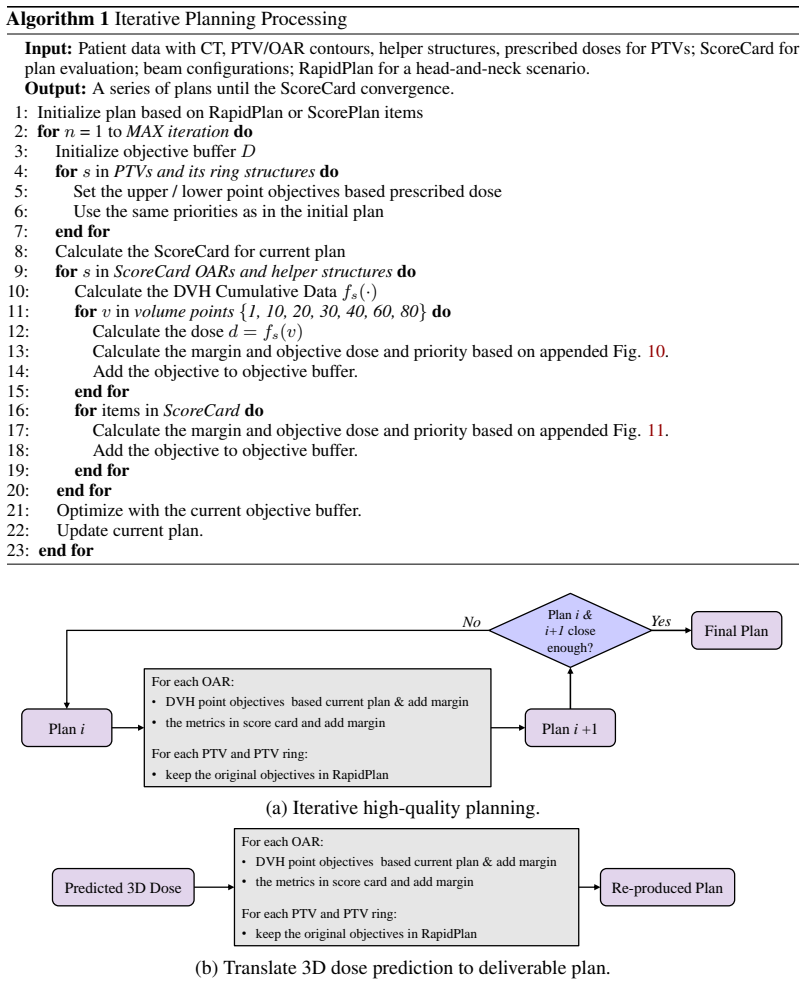
The load-bearing mechanism is Algorithm 1, the iterative objective-refinement loop. For each organ at risk, the pipeline samples the dose-volume histogram at multiple volume points, computes a target dose and priority from hand-tuned rules, adds scorecard-derived objectives with margins, and re-optimizes until successive plans are close. This loop converts the qualitative notion of plan quality into explicit dose objectives, making convergence toward a high scorecard score an automated process.
What would settle it
Run the pipeline on a held-out set of patients from an institution with different contouring conventions and count the plans that fail the scorecard after iteration; if the failure rate is high, or if a blinded dosimetrist review judges the automated plans clinically unacceptable despite high scores, the comparability claim would fall.
Extended reading notes
Core claim
The central claim is that dosimetrist-style iterative planning can be encoded as a closed loop: auto-contour organs, script beam setup, seed objectives from knowledge-based planning, then repeatedly read dose-volume histogram points and scorecard metrics from the current plan and convert each point into a tightened optimization objective with a safety margin, re-optimizing until the plan converges. Running this loop at scale produced 3,730 deliverable IMRT and VMAT plans across head-and-neck and lung cohorts, with DVHs comparable to clinical plans. The same loop, with objectives derived only from a predicted 3D dose, reproduces a reference plan closely enough to turn dose predictions into deliverable plans.
Load-bearing premise
The central claim rests on the assumption that the hand-tuned margin rules and the dosimetric scorecard are a valid proxy for clinical quality, so that iterative convergence to high scorecard scores means convergence to clinically good plans; the paper does not report how many plans failed the scorecard and were discarded or re-planned.
Editorial extensions
If this is right
- AI dose-prediction models can be trained on a standardized corpus an order of magnitude larger than existing public benchmarks, with plans produced by one consistent pipeline.
- The pipeline can re-plan legacy clinical cohorts using current treatment-planning technology, removing the bias of older, lower-quality plans from AI training data.
- Dose-prediction models can be evaluated by downstream deliverability: predicted dose is converted into a deliverable plan and compared by DVH, not only by voxel error.
- Researchers can generate arbitrarily many plans by varying beam configurations, prescriptions, and structures, enabling controlled studies of model generalization across treatment sites and protocols.
Reading between the lines
- Beyond the paper: if the dosimetric scorecard is a valid proxy for clinical quality, the same iterative loop could be reused as an automated plan-refinement tool inside planning software, not just as a data-generation pipeline.
- Beyond the paper: the hand-tuned margin and priority rules are the most manual part of the loop, so a natural extension is to learn those mapping functions from paired manual-plan data, which would remove the remaining human step.
- Beyond the paper: the released dataset could test whether larger, more standardized corpora actually improve out-of-distribution dose prediction, a hypothesis the paper motivates but does not itself evaluate.
Signed reviews
Editorial analysis
A structured set of objections, weighed in public.
Referee Report
Summary. The manuscript introduces the Automated Iterative RT Planning (AIRTP) pipeline, which combines AI-based OAR contouring, scripted Eclipse ESAPI-based beam setup and optimization, RapidPlan-based objectives, and an iterative scorecard-guided refinement loop to generate deliverable radiotherapy plans at scale. The authors release the HMM-RT dataset (3,730 plans from 1,622 patients across nine head-and-neck and lung cohorts) to support an AAPM 2025 challenge, and report a five-fold reduction in planning time (0.1-1 hour vs. 3-6 hours manual). The central claims are that AIRTP produces treatment plans of quality comparable to manually generated plans and that HMM-RT contains more than ten times the number of plans of OpenKBP, the largest previous well-curated public dataset.
Significance. If the quality and scale claims hold, this work addresses a real bottleneck in radiotherapy AI research: the scarcity of large, standardized, deliverable plan data. The public release of DICOM and processed numpy data, the challenge infrastructure, the baseline model, and the pretrained weights are concrete community resources. The scale advantage (3,730 vs. 340 plans) is well supported by Table 1, and the multi-cohort, multi-institution design with variable prescription doses is a substantive step beyond OpenKBP. However, the load-bearing claim of comparability to manual plans currently rests on circular and anecdotal evidence; the paper itself concedes in Sec. 4.2 and Sec. 5 that definitive comparison is not established. Additional independent validation would be needed to convert this from a useful dataset contribution into a demonstrated clinically comparable plan-generation method.
major comments (4)
- [Sec. 4.2, Table 3; Algorithm 1 (lines 8-19)] The evidence for 'quality comparable to manual plans' is circular: the Varian scorecard is both the optimization objective in the iterative refinement (Algorithm 1, lines 8-19, and Step 3 in Sec. 3) and the quality metric reported in Table 3. High scores under scorecard-guided optimization are expected and do not by themselves establish clinical acceptability or comparability to manual plans. The paper should compare the scorecard scores of the clinical/manual plans in the same cohorts, or add an independent evaluation (e.g., blinded dosimetrist scoring, or external plan-quality metrics that were not used during optimization).
- [Sec. 4.2, Fig. 5] The direct comparison to clinical plans is limited to two randomly selected head-and-neck cases with qualitative DVH overlays; no lung cases, no quantitative paired DVH statistics, and no blinded review are reported. The manuscript's own statements—'we cannot definitively claim that the AIRTP plan is superior... based solely on DVHs or scorecards' (Sec. 4.2) and the comparison 'may not be entirely fair, as the AIRTP and clinical plans follow different guidelines' (Sec. 5)—are more cautious than the abstract's claim of quality 'comparable to those generated manually.' Please provide a quantitative comparison across a larger matched set (e.g., paired DVH metrics or blinded clinical review) or soften the abstract claim to match the evidence.
- [Table 1] Table 1 states that 'corner cases' are 'remove or re-plan' to make plans 'more aligned to scorecard,' but the number and characteristics of excluded or re-planned cases are not disclosed. Without this information, the released 3,730 plans may represent a favorable selection rather than the pipeline's steady-state output. Please report the pass rate at each pipeline stage, the number of plans re-planned or discarded per cohort, the criteria used, and a sensitivity analysis of the released dataset to these filtering decisions.
- [Sec. 3, Step 3; Algorithm 1] The convergence of the iterative refinement is supported only by the statement that 'when the parameters are properly tuned, empirical evidence shows that plan quality tends to converge toward a high score' (Sec. 3, Step 3). No convergence curves, no formal stopping criterion (Algorithm 1 leaves 'MAX iteration' and the 'close enough' condition undefined), and no sensitivity analysis for the hand-tuned margins and priorities in Figs. 10 and 11 are provided. Since the scalable-quality claim depends on this convergence, please show score-versus-iteration curves for a representative set of cases and quantify sensitivity to the Dose2Obj and Scorecard2Dose constants.
minor comments (4)
- [Throughout] There are several typographical errors, including 'an novel' (Sec. 1), 'Miscorsoft' (Sec. 4.1), 'V olumetric' (Sec. 2), 'featuresmore than 10 timesnumber' (Abstract), 'coustomized' (Appendix C), and 'T otal Lung-GTV' (Fig. 6b).
- [Sec. 3, Step 2; Fig. 4] The text states that head-and-neck VMAT plans use 'four arcs,' while the Fig. 4 caption and Fig. 6b label show 'two arcs'; please clarify whether this is two full arcs or four partial arcs, and ensure consistency across the text and figures.
- [Algorithm 1] The stopping criterion is described qualitatively ('Plan i & i+1 close enough?'); please state the exact quantitative condition used in the actual runs (e.g., score difference threshold, dose difference threshold, or fixed iteration count).
- [Table 3] The footnote says the validation/testing plan quality scores are based on subsets of 41 and 50 plans, respectively; please report the mean and standard deviation of the score distribution over these subsets, and clarify whether the same subset is used for all phases.
Circularity Check
The scorecard is used both as the optimization objective and as the quality metric, so the plan-quality claim is partly self-confirmatory; the dataset-scale and challenge results remain independent.
-
self definitional
[Algorithm 1 (Step 3, lines 8–18); Table 1; Sec. 4.2]
""Calculate the ScoreCard for current plan" ... "for items in ScoreCard: Calculate the margin and objective dose and priority based on appended Fig. 11. Add the objective to objective buffer." ... "We use the quality score card to evaluate the plan quality and remove or re-plan corner cases, make plans more aligned to scorecard.""
The Varian scorecard is not an independent arbiter of quality: Algorithm 1 iteratively converts scorecard DVH points and metrics into optimization objectives with margins, so the optimizer is explicitly driven toward high scorecard scores. Table 1 then uses the same scorecard as an acceptance filter, removing or re-planning corner cases to make plans more aligned to it. When Sec. 4.2 reports that plan quality is high, the support includes scorecard convergence and scorecard-based assessment, which are consequences of optimizing toward and selecting on the very same metric rather than independent evidence of clinical comparability.
full rationale
The paper is largely self-contained: the AIRTP pipeline, dataset construction, and GDP-HMM challenge baseline are described in algorithmic detail, and the 10x scale claim is a direct plan-count comparison against OpenKBP. No load-bearing uniqueness theorem or self-citation chain is used; the RapidPlan model is sourced from Varian's public repository, and co-authored citations such as [35] point to that external model rather than to an unverified result of this paper. The only material circularity is the dual role of the scorecard. Algorithm 1 builds optimization objectives from scorecard DVH points, Table 1 states that corner cases are removed or re-planned to make plans more aligned to the scorecard, and Sec. 4.2 then treats high plan quality as established, with the paper itself conceding that scorecards and DVHs cannot definitively show superiority and that the comparison with clinical plans may be unfair. Thus the scorecard-based portion of the quality claim is partly self-confirmatory, but the dataset scale and challenge results stand independently, so the overall circularity is moderate rather than total.
Assumptions & free parameters
free parameters (5)
- Dose2Obj margin and weight constants =
value*0.95, value-3, value-2, value-1; weights 80/120
- Scorecard2Dose conversion constants =
0.85, -7, priority base 60, slope terms 20/7/3
- Lung laterality beam-angle threshold =
5 cm
- Iteration convergence stopping rule =
not stated; loop until plans are 'close enough'
- Beam configuration templates =
HaN VMAT 4 arcs, collimators 30/330; HaN IMRT 9 or 15 fields; lung VMAT 2 arcs, IMRT 7 or 9 fields
assumptions (5)
- domain assumption Eclipse/TrueBeam with AXB dose calculation produces clinically accurate doses.
- domain assumption AI Rad Companion auto-contouring produces OAR contours accurate enough for planning.
- domain assumption The Varian RapidPlan model and scorecard are valid, standardized planning guidelines.
- domain assumption Clinical PTVs and prescription doses from TCIA cohorts preserve original clinical intent.
- ad hoc to paper Iterative scorecard-guided optimization converges to high-quality plans when parameters are tuned.
Cite this review
Pith. "Pith review of Automating RT Planning at Scale: High Quality Data For AI Training." pith.science (2026). https://pith.science/paper/4VAQM3TH
@misc{pith2026250111803,
  author       = {Pith},
  title        = {Pith review of: Automating RT Planning at Scale: High Quality Data For AI Training},
  year         = {2026},
  howpublished = {\url{https://pith.science/paper/4VAQM3TH}},
  note         = {Machine review of arXiv:2501.11803}
}
read the original abstract
Radiotherapy (RT) planning is complex, subjective, and time-intensive. Advances with artificial intelligence (AI) promise to improve its precision and efficiency, but progress is often limited by the scarcity of large, standardized datasets. To address this, we introduce the Automated Iterative RT Planning (AIRTP) system, a scalable solution for generating high-quality treatment plans. This scalable solution is designed to generate substantial volumes of consistently high-quality treatment plans, overcoming a key obstacle in the advancement of AI-driven RT planning. Our AIRTP pipeline adheres to clinical guidelines and automates essential steps, including organ-at-risk (OAR) contouring, helper structure creation, beam setup, optimization, and plan quality improvement, using AI integrated with RT planning software like Varian Eclipse. Furthermore, a novel approach for determining optimization parameters to reproduce 3D dose distributions, i.e. a method to convert dose predictions to deliverable treatment plans constrained by machine limitations is proposed. A comparative analysis of plan quality reveals that our automated pipeline produces treatment plans of quality comparable to those generated manually, which traditionally require several hours of labor per plan. Committed to public research, the first data release of our AIRTP pipeline includes nine cohorts covering head-and-neck and lung cancer sites to support an AAPM 2025 challenge. To our best knowledge, this dataset features more than 10 times number of plans compared to the largest existing well-curated public dataset. Repo: https://github.com/RiqiangGao/GDP-HMM_AAPMChallenge.
Figures


Figures from the paper (19 more)


Forward citations
Cited by 2 Pith papers
-
Grids Often Outperform Implicit Neural Representations at Compressing Dense Signals
Simple interpolated grids beat tested INRs at equal parameter count on dense 2D and 3D signals, while INRs retain an edge on sparse, lower-dimensional signals.
-
A Beam's Eye View to Fluence Maps 3D Network for Ultra Fast VMAT Radiotherapy Planning
A 3D MedNeXt network predicts all 180 VMAT fluence maps from beam's-eye-view projections of a 3D dose map, with DVHs close to the target dose and inference under 20 ms.
Reference graph
Works this paper leans on
- [1]
-
[2]
V . M. Affairs. Bilateral head&neck 70/63/56gy (hn-sib-bpi) [rapidplan]. https: //medicalaffairs.varian.com/hn-sib-bpi-rapidplan-vmat2 , 2024. Ac- cessed: 2024-10-19. 5, 16
work page 2024
-
[3]
V . M. Affairs. Lung - conventional 60gy (nrg lu-004 / atkins km 2021). https:// medicalaffairs.varian.com/lung-conventional-vmat2, 2024. Accessed: 2024-10-19. 5
work page 2021
-
[4]
V . M. Affairs. Python interface to eclipse scripting api. https://github.com/ VarianAPIs/PyESAPI, 2024. Accessed: 2024-12-10. 6
work page 2024
-
[5]
V . M. Affairs. Rapidplan knowledge-based planning. https://medicalaffairs. varian.com/halcyon-case-studies, 2024. Accessed: 2024-09-19. 2
work page 2024
-
[6]
S. Arberet, F. C. Ghesu, R. Gao, M. Kraus, J. Sackett, E. Kuusela, and A. Kamen. Beam’s eye view to fluence maps 3d network for ultra fast vmat radiotherapy planning.Medical Physics,
-
[7]
R. Azad, E. K. Aghdam, A. Rauland, Y . Jia, A. H. Avval, A. Bozorgpour, S. Karimijafarbigloo, J. P. Cohen, E. Adeli, and D. Merhof. Medical image segmentation review: The success of u-net.IEEE Transactions on Pattern Analysis and Machine Intelligence, 2024. 2
work page 2024
-
[8]
A. Babier, R. Mahmood, B. Zhang, V . G. L. Alves, A. M. Barrag ´an, B. Barrag ´an-Montero, J. Beaudry, C. E. Cardenas, Y . Chang, Z. Chen, J. Chun, K. Diaz, H. David Eraso, E. Faustmann, S. Gaj, S. Gay, M. Gronberg, B. Guo, J. He, G. Heilemann, S. Hira, Y . Huang, F. Ji, D. Jiang, J. Carlo, J. Giraldo, H. Lee, J. Lian, S. Liu, K.-C. Liu, J. Jos´, J. Marru...
work page 2022
Show all 55 references
-
[9]
Babier, B
A. Babier, B. Zhang, R. Mahmood, K. L. Moore, T. G. Purdie, A. L. McNiven, and T. C. Y . Chan. OpenKBP: The open-access knowledge-based planning grand challenge.Medical Physics,
-
[10]
P. R. Bassi, W. Li, Y . Tang, F. Isensee, Z. Wang, J. Chen, Y .-C. Chou, Y . Kirchhoff, M. R. Rokuss, Z. Huang, et al. Touchstone benchmark: Are we on the right way for evaluating ai algorithms for medical segmentation?Advances in Neural Information Processing Systems,
-
[11]
Bejarano, M
T. Bejarano, M. Ornelas-Couto, and I. Mihaylov. Head-and-neck squamous cell carcinoma patients with ct taken during pre-treatment, mid-treatment, and post-treatment (hnscc-3dct- rt)[dataset], 2018. 6
2018
-
[12]
Biston, C
M.-C. Biston, C. Khamphan, T. Marghani, J. Mazurier, V . Bodez, L. Fezzani, P. Rigaud, G. Sidorski, L. Simon, et al. Automation in radiotherapy treatment planning: Examples of use in clinical practice and future trends for a complete automated workflow.Cancer/Radioth ´erapie,
-
[13]
Bosch, W
W. Bosch, W. Straube, J. Matthews, and J. Purdy. Head-neck cetuximab-the cancer imaging archive.The Cancer Imaging Archive, 2015. 6
2015
-
[14]
Bradley and K
J. Bradley and K. Forster. Data from nsclc-cetuximab. the cancer imaging archive, 2018. 6
2018
-
[15]
Buatti, C
J. Buatti, C. Kabat, R. Li, S. Sivabhaskar, M. de Oliveira, N. Papanikolaou, S. Stathakis, N. Paragios, and N. Kirby. Ct-rtstruct-rtdose-rtplan sets of head and neck cancers treated with identical prescriptions using imrt: An open dataset for deep learning in treatment plannin...
2024
-
[16]
R. E. Drzymala, . R. Mohan, L. Brewster, J. Chu, M. Goitein, W. Harms, B. S. ’ And, and M. Urie. DOSE-VOLUME HISTOGRAMS.Inr. J. Radrarion Oncology Biol. Phys, 1991. 6 10
1991
-
[17]
J. Fan, J. Wang, Z. Chen, C. Hu, Z. Zhang, and W. Hu. Automatic treatment planning based on three-dimensional dose distribution predicted from deep learning technique.Medical physics,
-
[18]
L. Fu, X. Li, X. Cai, X. Wang, Y . Shen, and Y . Yao. Md-dose: A diffusion model based on the mamba for radiation dose prediction. In2024 IEEE International Conference on Bioinformatics and Biomedicine (BIBM). IEEE, 2024. 14
2024
-
[19]
Gao, F.-C
R. Gao, F.-C. Ghesu, S. Arberet, S. Basiri, E. Kuusela, M. Kraus, D. Comaniciu, and A. Kamen. Multi-agent reinforcement learning meets leaf sequencing in radiotherapy. InInternational Conference on Machine Learning, 2024. 1, 4, 8, 14
2024
-
[20]
R. Gao, B. Lou, Z. Xu, D. Comaniciu, and A. Kamen. Flexible-cm gan: Towards precise 3d dose prediction in radiotherapy. InProceedings of the IEEE/CVF Conference on Computer Vision and Pattern Recognition, 2023. 1, 4, 7, 8, 14, 21, 24
2023
-
[21]
M. P. Gronberg, B. M. Beadle, A. S. Garden, H. Skinner, S. Gay, T. Netherton, W. Cao, C. E. Cardenas, C. Chung, D. T. Fuentes, C. D. Fuller, R. M. Howell, A. Jhingran, T. Y . Lim, B. Marquez, R. Mumme, A. M. Olanrewaju, C. B. Peterson, I. Vazquez, T. J. Whitaker, Z. Wooten, M....
2023
-
[22]
M. P. Gronberg, A. Jhingran, T. J. Netherton, S. S. Gay, C. E. Cardenas, C. Chung, D. Fuentes, C. D. Fuller, R. M. Howell, M. Khan, T. Y . Lim, B. Marquez, A. M. Olanrewaju, C. B. Peterson, I. Vazquez, T. J. Whitaker, Z. Wooten, M. Yang, and L. E. Court. Deep learning–based do...
2023
-
[23]
Grossberg, H
A. Grossberg, H. Elhalawani, A. Mohamed, S. Mulder, B. Williams, A. L. White, J. Zafereo, A. J. Wong, J. E. Berends, S. AboHashem, et al. Hnscc.The Cancer Imaging Archive, 2020. 6
2020
-
[24]
P. Guo, C. Zhao, D. Yang, Z. Xu, V . Nath, Y . Tang, B. Simon, M. Belue, S. Harmon, B. Turkbey, et al. Maisi: Medical ai for synthetic imaging.arXiv preprint arXiv:2409.11169, 2024. 14
2024
-
[25]
Healthineers
S. Healthineers. Ai-rad companion. https://www.siemens-healthineers. com/en-us/digital-health-solutions/ai-rad-companion , 2024. Accessed: 2024-09-19. 4, 6
2024
-
[26]
W. T. Hrinivich, M. Bhattacharya, L. Mekki, T. McNutt, X. Jia, H. Li, D. Y . Song, and J. Lee. Clinical vmat machine parameter optimization for localized prostate cancer using deep reinforcement learning.Medical physics, 2024. 1, 8, 14
2024
-
[27]
Huynh, A
E. Huynh, A. Hosny, C. Guthier, D. S. Bitterman, S. F. Petit, D. A. Haas-Kogan, B. Kann, H. J. Aerts, and R. H. Mak. Artificial intelligence in radiation oncology.Nature Reviews Clinical Oncology, 2020. 3
2020
-
[28]
Hyt ¨onen, R
R. Hyt ¨onen, R. Vanderstraeten, M. Dahele, and W. F. Verbakel. Influence of beam angle on normal tissue complication probability of knowledge-based head and neck cancer proton planning.Cancers, 2022. 4
2022
-
[29]
Isensee, T
F. Isensee, T. Wald, C. Ulrich, M. Baumgartner, S. Roy, K. Maier-Hein, and P. F. Jaeger. nnu-net revisited: A call for rigorous validation in 3d medical image segmentation. InInternational Conference on Medical Image Computing and Computer-Assisted Intervention. Springer, 2024. 8
2024
-
[30]
Kearney, J
V . Kearney, J. W. Chan, S. Haaf, M. Descovich, and T. D. Solberg. Dosenet: a volumetric dose prediction algorithm using 3d fully-convolutional neural networks.Physics in Medicine & Biology, 2018. 14
2018
-
[31]
Kirillov, E
A. Kirillov, E. Mintun, N. Ravi, H. Mao, C. Rolland, L. Gustafson, T. Xiao, S. Whitehead, A. C. Berg, W.-Y . Lo, et al. Segment anything. InProceedings of the IEEE/CVF international conference on computer vision, 2023. 14
2023
-
[32]
X. Kui, F. Liu, M. Yang, H. Wang, C. Liu, D. Huang, Q. Li, L. Chen, and B. Zou. A review of dose prediction methods for tumor radiation therapy.Meta-Radiology, 2024. 1
2024
-
[33]
H. Lee, H. Kim, J. Kwak, Y . S. Kim, S. W. Lee, S. Cho, and B. Cho. Fluence-map generation for prostate intensity-modulated radiotherapy planning using a deep-neural-network.Scientific reports, 2019. 14 11
2019
-
[34]
J. Ma, Y . He, F. Li, L. Han, C. You, and B. Wang. Segment anything in medical images.Nature Communications, 2024. 14
2024
-
[35]
Magliari, R
A. Magliari, R. Clark, L. Rosa, and S. Beriwal. Hn-sib-bpi: A single click, sub-site specific, dosimetric scorecard tuned rapidplan model created from a foundation model for treating head and neck with bilateral neck.Medical Dosimetry, 2024. 4, 5, 16
2024
-
[36]
McIntosh, M
C. McIntosh, M. Welch, A. McNiven, D. A. Jaffray, and T. G. Purdie. Fully automated treatment planning for head and neck radiotherapy using a voxel-based dose prediction and dose mimicking method.Physics in Medicine & Biology, 2017. 4
2017
-
[37]
Rombach, A
R. Rombach, A. Blattmann, D. Lorenz, P. Esser, and B. Ommer. High-resolution image synthesis with latent diffusion models. InProceedings of the IEEE/CVF conference on computer vision and pattern recognition, 2022. 14
2022
-
[38]
S. Roy, G. Koehler, C. Ulrich, M. Baumgartner, J. Petersen, F. Isensee, P. F. Jaeger, and K. H. Maier-Hein. Mednext: transformer-driven scaling of convnets for medical image segmentation. InInternational Conference on Medical Image Computing and Computer-Assisted Intervention....
2023
-
[39]
J. P. Tol, P. Doornaert, B. I. Witte, M. Dahele, B. J. Slotman, and W. F. Verbakel. A longitudinal evaluation of improvements in radiotherapy treatment plan quality for head and neck cancer patients.Radiotherapy and Oncology, 2016. 2
2016
-
[40]
Vallieres, E
M. Vallieres, E. Kay-Rivest, L. J. Perrin, X. Liem, C. Furstoss, N. Khaouam, P. F. Nguyen-Tan, C.-S. Wang, and K. Sultanem. Data from head-neck-pet-ct the cancer imaging archive, 2017. 6
2017
-
[41]
M. J. van Duren-Koopman, J. P. Tol, M. Dahele, E. Bucko, P. Meijnen, B. J. Slotman, and W. F. Verbakel. Personalized automated treatment planning for breast plus locoregional lymph nodes using hybrid rapidarc.Practical radiation oncology, 2018. 4
2018
-
[42]
Eclipse scripting apis
Varian. Eclipse scripting apis. https://tpswiki.com/eclipse: scripts-eclipse/, 2024. Accessed: 2024-09-19. 2
2024
-
[43]
Rapidplan knowledge-based planning
Varian. Rapidplan knowledge-based planning. https://www. varian.com/products/radiotherapy/treatment-planning/ rapidplan-knowledge-based-planning , 2024. Accessed: 2024-09-19. 2, 4
2024
-
[44]
W. F. Verbakel, P. A. Doornaert, C. P. Raaijmakers, L. J. Bos, M. Essers, J. B. Van de Kamer, M. Dahele, C. H. Terhaard, and J. H. Kaanders. Targeted intervention to improve the quality of head and neck radiation therapy treatment planning in the netherlands: Short and long-te...
2019
-
[45]
W. Wang, Y . Sheng, C. Wang, J. Zhang, X. Li, M. Palta, B. Czito, C. G. Willett, Q. Wu, Y . Ge, F. F. Yin, and Q. J. Wu. Fluence Map Prediction Using Deep Learning Models – Direct Plan Generation for Pancreas Stereotactic Body Radiation Therapy.Frontiers in Artificial Intellig...
2020
-
[46]
F. Xiao, J. Cai, X. Zhou, L. Zhou, T. Song, and Y . Li. Transdose: a transformer-based unet model for fast and accurate dose calculation for mr-linacs.Physics in Medicine & Biology,
-
[47]
Y . Xing, D. Nguyen, W. Lu, M. Yang, and S. Jiang. A feasibility study on deep learning-based radiotherapy dose calculation.Medical physics, 2020. 1, 8
2020
-
[48]
Zhang, C
Y . Zhang, C. Li, L. Zhong, Z. Chen, W. Yang, and X. Wang. Dosediff: distance-aware diffusion model for dose prediction in radiotherapy.IEEE Transactions on Medical Imaging, 2024. 1
2024
-
[49]
Y . Zhou, M. A. Chia, S. K. Wagner, M. S. Ayhan, D. J. Williamson, R. R. Struyven, T. Liu, M. Xu, M. G. Lozano, P. Woodward-Court, et al. A foundation model for generalizable disease detection from retinal images.Nature, 2023. 14
2023
-
[50]
Zuley, R
M. Zuley, R. Jarosz, S. Kirk, Y . Lee, R. Colen, K. Garcia, D. Delbeke, M. Pham, P. Nagy, and G. Sevinc. The cancer genome atlas head-neck squamous cell carcinoma collection (tcga-hnsc). Cancer Imaging Archive website, 2016. 6 12 Appendix Table of Contents A Data Scale of Popu...
2016
-
[51]
Load STRUCTs as binary masks
-
[52]
Resample CT, STRUCTs, Dose as same spacing/coordination
-
[53]
Extract meta information (angles, isocenter, imrt or vmat, etc.)
-
[54]
Create beam plate or/and angle plate
-
[55]
The complete data curation pipeline is illustrated in Fig
Crop data in z dimension, make the z-isocenter as volume z-center AI Modeling + helper structures + filter clinical PTVs AIRTP (Step 1) Figure 9: Overview of the data curation pipeline, from raw data processing to AI model training, highlighting where AIRTP integrates into the...
2022
Reviewed August 10, 2026 · model on record in the stance chip above.
Discussion (0). Continue with ORCID to comment.