REVIEW 3 major objections 4 minor 2 cited by
A quantum algorithm for Khovanov homology
T0 review · 3 major / 4 minor · reviewed 2026-08-10 · deepseek-v4-flash
Pith's one-line read A quantum algorithm could compute Khovanov homology, a knot invariant richer than the Jones polynomial.
desk verdict A conditional quantum algorithm for Khovanov homology with a solid boundary-operator construction and clean hardness reductions; the efficiency claim hinges on an unproven thermalization step, so it deserves peer review but not acceptance as a proven speedup. read the letter →
The pith
A machine-rendered reading of the paper's core claim, the machinery that carries it, and where it could break.
The reading
What carries the argument
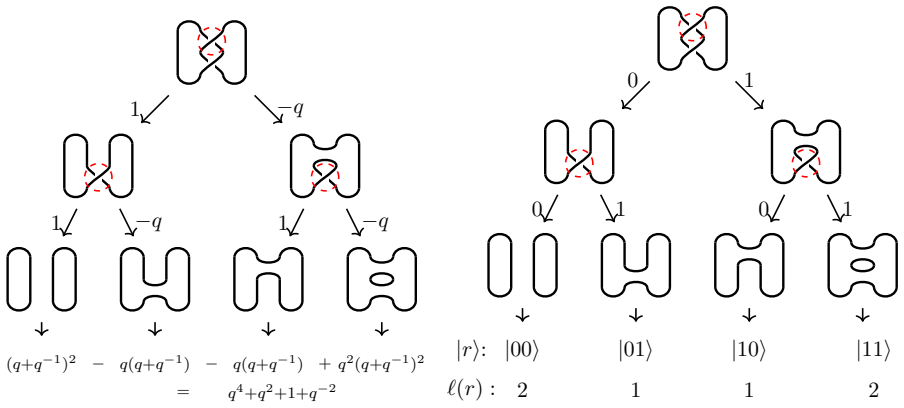
The load-bearing object is the Hodge Laplacian $\Delta_{(i,j)}$ of the Khovanov chain complex, whose kernel is isomorphic to the Khovanov homology group $\mathrm{Kh}^{i,j}(K)$; the algorithm exponentiates the Hermitian operator $B = d + d^\dagger$ via quantum signal processing, since $B^2 = \Delta$. The boundary operator is implemented with Jordan–Wigner creation operators that automatically generate the alternating signs, acting on a resolution register and an enhanced-state register for loop labelings. To handle small Betti numbers, the algorithm replaces uniform sampling with a Gibbs-state preparation step followed by quantum phase estimation and a SWAP test, so that a smaller kernel makes the estimate easier rather than harder. For the spectral-gap condition, the paper identifies the degree-zero Khovanov Laplacian $\Delta_{(0,q)}$ with the signless Laplacian $Q = D + A$ of a weighted graph $G_{n,k}(K)$ built from the all-zero resolution, and applies known bounds on the smallest eigenvalue of $Q$ to control the gap.
What would settle it
Compute the exact spectral gap of the Khovanov Hodge Laplacian for a sequence of knots (e.g., 3-strand pretzels with growing twist lengths) in all bidegrees; if the minimum gap decays faster than any inverse polynomial in crossing number, the numerical evidence underlying the algorithm's efficiency is refuted. Alternatively, exhibit a knot for which preparing the low-temperature Gibbs state provably requires exponential time.
Extended reading notes
Core claim
The central claim is that the ranks $\beta_{i,j}(K) = \dim \mathrm{Kh}^{i,j}(K)$ of Khovanov homology can be approximated on a quantum computer by encoding the Khovanov chain complex of a knot diagram into qubits, expressing the boundary operator as a Jordan–Wigner-style fermionic operator, and treating the Hodge Laplacian $\Delta = d^\dagger d + d d^\dagger$ as a Hamiltonian whose kernel is exactly $\mathrm{Kh}^{i,j}(K)$. The algorithm prepares a low-temperature Gibbs state of $\Delta$ (pre-thermalization), projects onto the kernel via quantum phase estimation, and estimates the kernel dimension with a SWAP test; this replaces the uniform-sampling step of earlier quantum homology algorithms and works when Betti numbers are small. The efficiency statement is conditional: the runtime is $O(m^4 \beta^4 t_{\mathrm{therm}} / \delta^{1/2})$, and the paper does not prove that $t_{\mathrm{therm}}$ (the thermalization time) is polynomial, identifying it as the key open question. As corollaries the authors prove that estimating the Betti numbers is DQC1-hard, BQP-hard, and #P-hard at increasing accuracy, and they establish analytic lower bounds on the spectral gap in homological degree zero by showing the Laplacian there coincides with the signless Laplacian of an associated weighted graph.
Load-bearing premise
The algorithm is only efficient if the Khovanov Hodge Laplacian can be cooled to a Gibbs state with inverse-polynomial overlap with its kernel in polynomial time, and the paper does not prove this can be done for any knot.
Editorial extensions
If this is right
- If the algorithm is efficient, Khovanov homology joins the short list of concrete topological invariants with a proposed exponential quantum speedup, and the unknotting problem becomes a plausible target because Khovanov homology detects the unknot.
- The algorithm approximates the Jones polynomial at arbitrary values of the variable, extending known quantum algorithms that only work at roots of unity, although not always efficiently.
- The hardness results imply that efficient thermalization cannot hold for every knot unless #P collapses into BQP, so the pre-thermalization step must be analyzed as an average-case or restricted-instance subroutine.
- The analytic gap bounds guarantee that at least for twisted unknots in homological degree zero the gap is inverse-polynomial, supporting the spectral-gap hypothesis where enumeration alone cannot reach.
- The preprocessing simplification of long twist sequences (replacing them by homotopy-equivalent short complexes) can raise the spectral gap above 1, suggesting a classical preprocessing step that improves the quantum runtime.
Reading between the lines
- The density-of-states numerics suggest a concrete testable threshold: if the exponent in $N(dE) \sim e^{\alpha E}$ continues to grow with crossing number, the required Gibbs temperature will eventually become exponentially small, and the algorithm's efficiency would degrade even for average knots.
- The signless-Laplacian correspondence in degree zero is likely to extend to other extremal homological degrees by symmetry, and possibly to Lee homology, offering a graph-theoretic route to gap bounds for filtered Khovanov invariants.
- A natural extension is to run the algorithm's preparation subroutine on unknot diagrams with many twists: if cooling to the two-dimensional kernel is efficient, it yields a quantum certificate of unknottedness that avoids the full Betti-number readout.
- One could test the thermalization assumption directly on small knots by simulating the proposed Lindblad evolution classically, checking whether the convergence time scales polynomially in crossing number before any quantum hardware is needed.
Editorial analysis
A structured set of objections, weighed in public.
Referee Report
Summary. The paper proposes a quantum algorithm that additively approximates the bigraded Betti numbers of Khovanov homology of a knot. The algorithm encodes the Khovanov complex using resolution, resolved-knot, loop-enumeration, and enhanced-state registers; implements the boundary operator as a sparse Jordan-Wigner-type Hamiltonian; and estimates Betti numbers by preparing a low-temperature Gibbs state of the Hodge Laplacian, projecting onto the kernel by quantum phase estimation, and applying SWAP tests. The runtime bound in Eq. (4.20) is polynomial provided two conditions hold: the Hodge Laplacian has an inverse-polynomial spectral gap, and a thermalizing Lindbladian prepares a Gibbs state with inverse-polynomial kernel overlap in polynomial time. The paper also proves DQC1-, BQP-, and #P-hardness for increasingly accurate additive approximations to the Betti numbers, develops an analysis of spectral gaps via homological perturbation theory, introduces graph-theoretic encodings of homological-degree-zero Khovanov Laplacians as signless Laplacians, and reports numerical gap data for knots and links up to 10--11 crossings.
Significance. If the two efficiency conditions are eventually established, this would be the first quantum algorithm for a non-simplicial homology theory, and it would give a concrete route toward the unknotting problem because Khovanov homology detects the unknot. The paper has several genuine strengths: the reversible encoding of the Khovanov complex is explicit; the boundary operator is shown to be sparse and efficiently exponentiating; the hardness theorems are clean corollaries of known Jones-polynomial results; and the connection between homological-degree-zero Khovanov Laplacians and signless Laplacians of associated graphs is new and potentially useful. The authors are also unusually candid about what is not proved: Section 9.3 explicitly identifies efficient thermalization as a key open question, and the spectral-gap evidence, while substantial, is analytic only in homological degree zero for twisted unknots and numerical elsewhere. As it stands, the central contribution is a well-motivated conditional reduction together with supporting evidence, rather than a complete efficient algorithm with all subroutines specified.
major comments (3)
- [4.5, 4.6, 9.3] The central efficiency claim is dominated by the undefined quantity t_therm. In §4.5 the algorithm assumes 'the ability to implement arbitrary sparse thermalizing Lindbladians', and the performance analysis in §4.6, Eq. (4.20), multiplies the runtime by t_therm without giving any Lindbladian, quantum Metropolis step, or spectral-filtering construction for the specific operator Δ=B². Section 9.3 then concedes that efficient thermalization is a key open question. The cited Gibbs-sampling results [37-42] do not automatically apply, because their mixing-time and detailed-balance hypotheses have not been verified for this nonlocal sparse Laplacian. Please either supply a concrete pre-thermalization subroutine with stated assumptions, or reformulate the main result explicitly as a conditional reduction whose theorem statement separates the unconditional encodings and hardness results from the unproven thermalization assumption.
- [6.3, Proposition 18] The proof of Proposition 18 is incomplete. The statement that the adjoint F1† is a chain map is justified only by the remark that the source is a one-term complex, but for an inclusion F1 : C → D with C one-term and D two-term one must separately verify both d_D F1 = 0 (the chain-map condition) and F1† d_D = 0 (the adjoint chain-map condition). The second condition is not automatic and generally fails when the target differential acts nontrivially on the complement of the image of F1. Since Proposition 18 is the basis for the claim that Reidemeister-one moves never increase the spectral gap, please write out the explicit differentials and verify both identities, or revise the proposition and its consequences.
- [7, 8, Conjecture 20] The spectral-gap assumption that enters Eq. (4.20) is not established in the required generality. Section 8 proves lower bounds only in homological degree zero, and the sharp identification of the minimal gap for twisted unknots remains Conjecture 20, verified numerically only up to n=10. The numerical evidence in Section 7 covers all knots through 10 crossings but only 8 of 552 eleven-crossing knots, and the Lorentzian/cubic fits involve free parameters that are not predictive beyond the fitted range. Please state clearly, in the abstract and in the main theorems, that the inverse-polynomial global gap is a conjecture, and distinguish unconditional results (encoding, Hamiltonian simulation, hardness reductions) from conditional algorithmic claims.
minor comments (4)
- [4.3] The enhanced-state register is first described as a 2m-qutrit register but the relevant degrees of freedom are only the ℓ(r) loop labels; please clarify the physical encoding and state which registers are uncomputed before the boundary operator is applied.
- [7] The sentence that the twisted-unknot data 'perfectly follows a Lorentzian fit' overstates the evidence; please report the number of data points, fit parameter uncertainties, and residuals rather than relying on a visual statement.
- [References] Several references contain malformed identifiers or incomplete author lists, for example the arXiv identifiers '2405.2404.05998' in [42] and [70], and the citation formatting of [40] and [41]; these should be corrected before publication.
- [Throughout] There are inconsistencies in spelling ('Kauffmann' vs 'Kauffman') and a few garbled displayed equations (for example, the bracket notation around Eq. (2.12)); a careful proofreading pass is needed.
Circularity Check
No material circularity: the algorithm's correctness chain is self-contained, efficiency rests on two explicitly flagged assumptions (Gibbs-state thermalization time and spectral gap), and the hardness and spectral-gap results reduce to external mathematics (Jones hardness, Hodge theory, Desai–Rao) rather than to the paper's own fitted values.
full rationale
This paper's three central claims — a conditional quantum algorithm for additively approximating Khovanov Betti numbers, hardness theorems for increasingly accurate approximations, and partial spectral-gap evidence — do not reduce to their own inputs. The algorithm's correctness chain is self-contained and built on external mathematics: the |r⟩|s⟩ encoding reproduces the Khovanov chain complex by direct transcription of the Section 2 definitions; B = ϑ + ϑ† satisfies Δ = B² (Section 4.4); Hodge theory (Theorem 9, citing the external Friedman result [79]) identifies ker Δ with Kh^{i,j}(K); and the SWAP test extracts β from Tr(ρ²) = 1/β with no self-reference. Efficiency is conditional on two assumptions the paper explicitly declines to prove: the Gibbs-preparation time t_therm dominates eq. (4.20), and the paper states in Section 9.3 that characterizing efficient thermalization 'is a key open question' and in Section 10 that it does 'not prove that these two conditions are satisfied in general.' No fitted parameter is renamed as a prediction: the numerical fits of Section 7 are presented, with explicit hedging, as evidence for inverse-polynomial gap scaling, while the analytic lower bounds (Corollaries 37 and 41) derive from the external Desai–Rao theorem [89] applied to graphs whose signless Laplacian is shown by direct computation (Theorem 28) to equal Δ_{0,q}. The hardness theorems (Theorems 7–8) are one-way reductions from external results [36, 5] via the graded Euler characteristic (eqs. 5.1–5.2); the direction (Betti numbers determine the Kauffman bracket) is Khovanov's external categorification theorem, not a renamed tautology. Self-citations exist ([22] base algorithm being generalized, [28] on clique-homology hardness, [69, 71] QPE tools, [56] background) but none is load-bearing: the Khovanov-specific correctness argument is re-derived in Sections 3, 4, and 9 rather than imported, and [22] is a published, peer-reviewed result whose correctness is independent of this paper. The genuine weaknesses — t_therm is not instantiated by any concrete Lindbladian, and the inverse-polynomial gap is proven only in homological degree zero with the rest resting on numerics — are completeness/correctness risks that the paper itself flags, not circularity.
Assumptions & free parameters
free parameters (2)
- Lorentzian fit parameters for twisted unknot spectral gap =
a≈10.3732, b≈-1.98306, c≈0.974362
- Density-of-states growth exponents for Gibbs cooling =
~0.19 (7 crossings), ~0.24 (8), ~0.27 (9), ~0.36 (10)
assumptions (7)
- standard math Standard Hamiltonian simulation (Low-Chuang) and quantum phase estimation are reliable and applicable to sparse matrices.
- domain assumption Khovanov homology is a well-defined knot invariant that categorifies the Jones polynomial and detects the unknot (Kronheimer-Mrowka).
- domain assumption The Desai-Rao bound (Theorem 24) correctly bounds the smallest eigenvalue of signless Laplacians of weighted graphs.
- ad hoc to paper Efficient thermalization of the Khovanov Hodge Laplacian to a Gibbs state at temperature O(gap) with inverse-polynomial kernel overlap is achievable for the knots considered.
- ad hoc to paper The spectral gap of the Khovanov Hodge Laplacian is at least inverse-polynomial in the crossing number for the relevant instances.
- ad hoc to paper Conjecture 20: the smallest spectral gap for the twisted unknot TU_n occurs in bidegree (0, 3-n).
- domain assumption The Betti numbers of Khovanov homology are not exponentially large for knots up to 11 crossings (empirical observation).
invented entities (1)
-
0-homology knot graphs G_{n,k}(K)
Cite this review
Pith. "Pith review of A quantum algorithm for Khovanov homology." pith.science (2026). https://pith.science/paper/INSUBGJY
@misc{pith2026250112378,
  author       = {Pith},
  title        = {Pith review of: A quantum algorithm for Khovanov homology},
  year         = {2026},
  howpublished = {\url{https://pith.science/paper/INSUBGJY}},
  note         = {Machine review of arXiv:2501.12378}
}
abstract
Khovanov homology is a topological knot invariant that categorifies the Jones polynomial, recognizes the unknot, and is conjectured to appear as an observable in $4D$ supersymmetric Yang--Mills theory. Despite its rich mathematical and physical significance, the computational complexity of Khovanov homology remains largely unknown. To address this challenge, this work initiates the study of efficient quantum algorithms for Khovanov homology. We provide simple proofs that increasingly accurate additive approximations to the ranks of Khovanov homology are DQC1-hard, BQP-hard, and #P-hard, respectively. For the first two approximation regimes, we propose a novel quantum algorithm. Our algorithm is efficient provided the corresponding Hodge Laplacian thermalizes in polynomial time and has a sufficiently large spectral gap, for which we give numerical and analytical evidence. Our approach introduces a pre-thermalization procedure that allows our quantum algorithm to succeed even if the Betti numbers of Khovanov homology are much smaller than the dimensions of the corresponding chain spaces, overcoming a limitation of prior quantum homology algorithms. We introduce novel connections between Khovanov homology and graph theory to derive analytic lower bounds on the spectral gap.
Figures


Figures from the paper (7 more)


Forward citations
Cited by 2 Pith papers
-
Parkes transient events: II. Pulsar single pulses database containing raw data segment
PTD II is a compact 1.5 GB sqlite3 database of 165,592 pulsar single pulses, each with its raw data segment, drawn from 1997-2001 Parkes observations, plus analysis tools.
-
Khovanov homology of tangles: algorithm and computation
An algorithmic procedure, with code promised, for computing tangle Khovanov homology from the authors' own TQFT construction.
Reference graph
Works this paper leans on
-
[1]
A polynomial invariant for knots via von Neumann algebras
Vaughan FR Jones. “A polynomial invariant for knots via von Neumann algebras”. In: Fields Medallists’ Lectures. World Scientific, 1997, pp. 448–458 (cit. on pp. 4, 9)
1997
-
[2]
How hard is it to approximate the Jones polynomial?
Greg Kuperberg. “How hard is it to approximate the Jones polynomial?” In: Theory of Computing 11.1 (2015), pp. 183–219 (cit. on pp. 4, 6, 8, 30, 31). 60
2015
-
[3]
A polynomial quantum algorithm for approximating the Jones polynomial
Dorit Aharonov, Vaughan Jones, and Zeph Landau. “A polynomial quantum algorithm for approximating the Jones polynomial”. In: Algorithmica 55.3 (2009), pp. 395–421. issn: 0178-
2009
-
[4]
Simulation of topological field theories by quantum computers
Michael H Freedman, Alexei Kitaev, and Zhenghan Wang. “Simulation of topological field theories by quantum computers”. In: Communications in Mathematical Physics 227 (2002), pp. 587–603 (cit. on pp. 4, 6, 8, 30, 60)
2002
-
[5]
The BQP-hardness of approximating the Jones polynomial
Dorit Aharonov and Itai Arad. “The BQP-hardness of approximating the Jones polynomial”. In: New Journal of Physics 13.3 (2011), p. 035019 (cit. on pp. 4, 6, 8, 30)
2011
-
[6]
Quantum field theory and the Jones polynomial
Edward Witten. “Quantum field theory and the Jones polynomial”. In: Comm. Math. Phys. 121.3 (1989), pp. 351–399. issn: 0010-3616,1432-0916. url: http://projecteuclid.org/ euclid.cmp/1104178138 (cit. on pp. 4, 9)
arXiv 1989
-
[7]
Invariants of 3-manifolds via link polynomials and quan- tum groups
N. Reshetikhin and V.G. Turaev. “Invariants of 3-manifolds via link polynomials and quan- tum groups”. In: Invent. Math. 103.3 (1991), pp. 547–597. issn: 0020-9910,1432-1297. doi: 10.1007/BF01239527. url: https://doi.org/10.1007/BF01239527 (cit. on p. 4)
-
[8]
State models and the Jones polynomial
Louis H. Kauffman. “State models and the Jones polynomial”. In: Topology 26.3 (1987), pp. 395–407. issn: 0040-9383. doi: 10.1016/0040-9383(87)90009-7 . url: https://doi. org/10.1016/0040-9383(87)90009-7 (cit. on pp. 4, 9)
Show all 108 references
-
[9]
On knot invariants related to some statistical mechanical models
V. F. R. Jones. “On knot invariants related to some statistical mechanical models”. In: Pacific J. Math. 137.2 (1989), pp. 311–334. issn: 0030-8730,1945-5844. url: http : / / projecteuclid.org/euclid.pjm/1102650387 (cit. on pp. 4, 9)
1989
-
[10]
Topological Quantum Computation
M.H. Freedman et al. “Topological Quantum Computation”. In: Bull. Amer. Math. Soc. (N.S.) 40.1 (2003). arXiv:quant-ph/0101025, pp. 31–38. issn: 0273-0979. doi: 10 . 1090 / S0273- 0979- 02- 00964- 3. url: https://doi.org/10.1090/S0273- 0979- 02- 00964- 3 (cit. on p. 4)
2003 arXiv
-
[11]
Fault-tolerant quantum computation by anyons
A. Kitaev. “Fault-tolerant quantum computation by anyons”. In: Ann. Physics 303.1 (2003). arXiv:quant-ph/9707021, pp. 2–30. issn: 0003-4916. doi: 10.1016/S0003-4916(02)00018-
2003 arXiv
-
[12]
A categorification of the Jones polynomial
M. Khovanov. “A categorification of the Jones polynomial”. In: Duke Math. J. 101.3 (2000). arXiv:9908171, pp. 359–426 (cit. on pp. 4, 13–15, 17)
2000
-
[13]
url: https://doi.org/10.1016/S0003-4916(02)00018-0 (cit. on p. 4)
-
[14]
Fast Khovanov homology computations
D. Bar-Natan. “Fast Khovanov homology computations”. In: Journal of Knot Theory and Its Ramifications 16.03 (2007), pp. 243–255. doi: 10 . 1142 / S0218216507005294. eprint: https : / / doi . org / 10 . 1142 / S0218216507005294. url: https : / / doi . org / 10 . 1142 / S0218216...
2007
-
[15]
On Khovanov’s categorification of the Jones polynomial
D. Bar-Natan. “On Khovanov’s categorification of the Jones polynomial”. In: Algebr. Geom. Topol. 2 (2002). arXiv:0201043, 337–370 (electronic) (cit. on pp. 4, 8, 14, 20)
2002
-
[16]
Khovanov homology and gauge theory
Edward Witten. “Khovanov homology and gauge theory”. In: Proceedings of the Freedman Fest 18 (2012), pp. 291–308 (cit. on p. 5)
2012
-
[17]
Fivebranes and knots
Edward Witten. “Fivebranes and knots”. In: Quantum Topol. 3.1 (2012), pp. 1–137. issn: 1663-487X,1664-073X. doi: 10 . 4171 / QT / 26. url: https : / / doi . org / 10 . 4171 / QT / 26 (cit. on p. 5)
2012
-
[18]
Khovanov-Rozansky Homology and Topological Strings
Sergei Gukov, Albert Schwarz, and Cumrun Vafa. “Khovanov-Rozansky Homology and Topological Strings”. In: Letters in Mathematical Physics 74.1 (Oct. 2005), pp. 53–74. issn: 1573-0530. doi: 10 . 1007 / s11005 - 005 - 0008 - 8. url: http : / / dx . doi . org / 10 . 1007 / s11005-...
2005
-
[19]
Knot invariants from four-dimensional gauge theory
Davide Gaiotto and Edward Witten. “Knot invariants from four-dimensional gauge theory”. In: Adv. Theor. Math. Phys. 16.3 (2012), pp. 935–1086. issn: 1095-0761,1095-0753. url: http://projecteuclid.org/euclid.atmp/1363792009 (cit. on p. 5). 61
2012
-
[20]
BPS spectra and 3-manifold invariants
Sergei Gukov et al. “BPS spectra and 3-manifold invariants”. In: Journal of Knot Theory and Its Ramifications 29.02 (2020), p. 2040003. doi: 10.1142/S0218216520400039. eprint: https : / / doi . org / 10 . 1142 / S0218216520400039. url: https : / / doi . org / 10 . 1142 / S0218...
2020 doi
-
[21]
Knot homology and refined Chern-Simons index
Mina Aganagic and Shamil Shakirov. “Knot homology and refined Chern-Simons index”. In: Comm. Math. Phys. 333.1 (2015), pp. 187–228. issn: 0010-3616,1432-0916. doi: 10.1007/ s00220-014-2197-4. url: https://doi.org/10.1007/s00220-014-2197-4 (cit. on p. 5)
2015 doi
-
[22]
Quantum algorithms for topological and geometric analysis of data
Seth Lloyd, Silvano Garnerone, and Paolo Zanardi. “Quantum algorithms for topological and geometric analysis of data”. In: Nature communications 7.1 (2016), p. 10138 (cit. on pp. 5–8, 18, 20, 27, 57)
2016
-
[23]
Knot categorification from mirror symmetry part I: Coherent sheaves
Mina Aganagic. “Knot categorification from mirror symmetry part I: Coherent sheaves”. In: Advances in Theoretical and Mathematical Physics 28.4 (2024), pp. 1151–1239. issn: 1095-0753. doi: 10.4310/atmp.241029013633. url: http://dx.doi.org/10.4310/ATMP. 241029013633 (cit. on p. 5)
2024 doi
-
[24]
Towards quantum advantage via topo- logical data analysis
Casper Gyurik, Chris Cade, and Vedran Dunjko. “Towards quantum advantage via topo- logical data analysis”. In: arXiv preprint arXiv:2005.02607 (2020) (cit. on pp. 5, 18, 31, 57)
2020 arXiv
-
[25]
Quantum computing and persistence in topological data analysis
Casper Gyurik et al. “Quantum computing and persistence in topological data analysis”. In: arXiv preprint arXiv:2410.21258 (2024) (cit. on pp. 5, 18, 32)
2024 arXiv
-
[26]
Quantifying quantum advantage in topological data analysis
Dominic W Berry et al. “Quantifying quantum advantage in topological data analysis”. In: arXiv preprint arXiv:2209.13581 (2022) (cit. on pp. 5, 18, 57)
2022 arXiv
-
[27]
Quantum algorithm for persistent Betti numbers and topological data analysis
Ryu Hayakawa. “Quantum algorithm for persistent Betti numbers and topological data analysis”. In: arXiv preprint arXiv:2111.00433 (2021) (cit. on pp. 5, 18, 57)
2021 arXiv
-
[28]
Complexity-theoretic limitations on quantum al- gorithms for topological data analysis
Alexander Schmidhuber and Seth Lloyd. “Complexity-theoretic limitations on quantum al- gorithms for topological data analysis”. In: PRX Quantum 4.4 (2023), p. 040349 (cit. on pp. 5, 18, 31, 57)
2023
-
[29]
A streamlined quantum algorithm for topo- logical data analysis with exponentially fewer qubits
Sam McArdle, Andr´ as Gily´ en, and Mario Berta. “A streamlined quantum algorithm for topo- logical data analysis with exponentially fewer qubits”. In: arXiv preprint arXiv:2209.12887 (2022) (cit. on pp. 5, 18, 57)
2022 arXiv
-
[30]
Promise Clique Homology on weighted graphs is QMA1- hard and contained in QMA
Robbie King and Tamara Kohler. “Promise Clique Homology on weighted graphs is QMA1- hard and contained in QMA”. In: arXiv preprint arXiv:2311.17234 (2023) (cit. on pp. 5, 18, 31, 60)
2023 arXiv
-
[31]
Clique Homology is QMA1-hard
Marcos Crichigno and Tamara Kohler. “Clique Homology is QMA1-hard”. In: arXiv preprint arXiv:2209.11793 (2022) (cit. on pp. 5, 18, 31)
2022 arXiv
-
[32]
Supersymmetry and Morse theory
Edward Witten. “Supersymmetry and Morse theory”. In: J. Diff. Geom. 17.4 (1982), pp. 661– 692 (cit. on p. 5). 62
1982
-
[33]
Quantum Walks on Simplicial Com- plexes and Harmonic Homology: Application to Topological Data Analysis with Superpoly- nomial Speedups
Ryu Hayakawa, Kuo-Chin Chen, and Min-Hsiu Hsieh. “Quantum Walks on Simplicial Com- plexes and Harmonic Homology: Application to Topological Data Analysis with Superpoly- nomial Speedups”. In: arXiv preprint arXiv:2404.15407 (2024) (cit. on pp. 5, 18)
2024 arXiv
-
[34]
Khovanov homology is an unknot-detector
P. B. Kronheimer and T. S. Mrowka. “Khovanov homology is an unknot-detector”. In: Publ. Math. Inst. Hautes ´Etudes Sci. 113 (2011), pp. 97–208. issn: 0073-8301. doi: 10 . 1007 / s10240-010-0030-y. url: https://doi.org/10.1007/s10240-010-0030-y (cit. on pp. 5, 14, 18)
2011 doi
-
[35]
Complexity of supersymmetric systems and the co- homology problem
Chris Cade and P Marcos Crichigno. “Complexity of supersymmetric systems and the co- homology problem”. In: arXiv preprint arXiv:2107.00011 (2021) (cit. on pp. 5, 18, 31, 57)
2021 arXiv
-
[36]
Estimating Jones polynomials is a complete problem for one clean qubit
Peter W Shor and Stephen P Jordan. “Estimating Jones polynomials is a complete problem for one clean qubit”. In: arXiv preprint arXiv:0707.2831 (2007) (cit. on pp. 6, 8, 30)
2007 arXiv
-
[37]
Quantum measurements and the Abelian stabilizer problem
A Yu Kitaev. “Quantum measurements and the Abelian stabilizer problem”. In: arXiv preprint quant-ph/9511026 (1995) (cit. on pp. 6, 27, 58)
1995 arXiv
-
[38]
Quantum algorithms from fluctua- tion theorems: Thermal-state preparation
Yigit Subasi Rolando D. Somma and Burak Sahinoglu. “Quantum algorithms from fluctua- tion theorems: Thermal-state preparation”. In: Quantum 6 (2022), p. 825 (cit. on pp. 7, 27, 58)
2022
-
[39]
Fast thermalization from the eigenstate thermalization hypothesis
Chi-Fang Chen and Fernando G. S. L. Brand˜ ao. “Fast thermalization from the eigenstate thermalization hypothesis”. In: arXiv preprint (2021). url: https : / / arxiv . org / abs / 2112.07646 (cit. on pp. 7, 27, 58)
2021 arXiv
-
[40]
An efficient and exact noncommu- tative quantum Gibbs sampler
Andr´ as Gily´ en Chi-Fang Chen Michael J. Kastoryano. “An efficient and exact noncommu- tative quantum Gibbs sampler”. In: arXiv preprint (2023). url: https://arxiv.org/abs/ 2311.09207 (cit. on pp. 7, 27, 58)
2023
-
[41]
Quantum Thermal State Preparation
Chi-Fang Chen, Michael J. Kastoryano, and Andr´ as Gily´ en Fernando G. S. L. Brand˜ ao. “Quantum Thermal State Preparation”. In: arXiv preprint (2023). url: https://arxiv. org/abs/2303.18224 (cit. on pp. 7, 27, 58)
2023 arXiv
-
[42]
Efficient quantum gibbs samplers with Kubo–Martin–Schwinger detailed balance condition
Bowen Li Zhiyan Ding and Lin Lin. “Efficient quantum gibbs samplers with Kubo–Martin–Schwinger detailed balance condition”. In:arXiv preprint (2024). url: https://arxiv.org/abs/2405. 2404.05998 (cit. on pp. 7, 27, 58)
2024 arXiv
-
[43]
Quantum generalizations of Glauber and Metropolis dynamics
Andr´ as Gily´ en et al. “Quantum generalizations of Glauber and Metropolis dynamics”. In: arXiv preprint (2024). url: arXiv:2405.20322%20https://arxiv.org/abs/2405.20322 (cit. on pp. 7, 27, 58)
2024
-
[44]
Polynomial quantum algorithms for additive approximations of the Potts model and other points of the Tutte plane
Dorit Aharonov et al. “Polynomial quantum algorithms for additive approximations of the Potts model and other points of the Tutte plane”. In: arXiv preprint quant-ph/0702008 (2007) (cit. on p. 8)
2007 arXiv
-
[45]
The topology of data hides in quantum thermal states
Stefano Scali, Chukwudubem Umeano, and Oleksandr Kyriienko. “The topology of data hides in quantum thermal states”. In: arXiv preprint arXiv:2402.15633 (2024) (cit. on pp. 7, 20, 58)
2024 arXiv
-
[46]
Kauffman
Louis H. Kauffman. Topological Quantum Information, Khovanov Homology and the Jones Polynomial. 2010. arXiv: 1001.0354 [math.GT]. url: https://arxiv.org/abs/1001.0354 (cit. on p. 8)
2010 arXiv
-
[47]
Estimating Jones and HOMFLY polynomials with one clean qubit
Stephen P Jordan and Pawel Wocjan. “Estimating Jones and HOMFLY polynomials with one clean qubit”. In: arXiv preprint arXiv:0807.4688 (2008) (cit. on p. 8)
2008 arXiv
-
[48]
Khovanov homology and quantum error-correcting codes
Milena Harned et al. “Khovanov homology and quantum error-correcting codes”. In: arXiv preprint arXiv:2410.11252 (2024) (cit. on p. 8). 63
2024
-
[49]
An application of Khovanov homology to quantum codes
Benjamin Audoux. “An application of Khovanov homology to quantum codes”. In: Annales de l’Institut Henri Poincar´ e D1.2 (2014), pp. 185–223 (cit. on p. 8)
2014
-
[50]
Kauffman
Louis H. Kauffman. On knots. Vol. 115. Annals of Mathematics Studies. Princeton University Press, Princeton, NJ, 1987, pp. xvi+481. isbn: 0-691-08434-3; 0-691-08435-1 (cit. on p. 9)
1987
-
[51]
W. B. Raymond Lickorish. An introduction to knot theory . Vol. 175. Graduate Texts in Mathematics. Springer-Verlag, New York, 1997, pp. x+201. isbn: 0-387-98254-X. doi: 10. 1007/978-1-4612-0691-0 . url: https://doi.org/10.1007/978-1-4612-0691-0 (cit. on p. 9)
1997 doi
-
[52]
A spanning tree expansion of the Jones polynomial
Morwen B. Thistlethwaite. “A spanning tree expansion of the Jones polynomial”. In: Topol- ogy 26.3 (1987), pp. 297–309. issn: 0040-9383. doi: 10.1016/0040-9383(87)90003-6. url: https://doi.org/10.1016/0040-9383(87)90003-6 (cit. on p. 9)
1987 doi
-
[53]
Jones polynomials and classical conjectures in knot theory
Kunio Murasugi. “Jones polynomials and classical conjectures in knot theory”. In: Topology 26.2 (1987), pp. 187–194. issn: 0040-9383. doi: 10.1016/0040- 9383(87)90058- 9 . url: https://doi.org/10.1016/0040-9383(87)90058-9 (cit. on p. 9)
1987 doi
-
[54]
Categorification
John C. Baez and James Dolan. “Categorification”. In: Higher category theory (Evanston, IL, 1997) . Vol. 230. Contemp. Math. Amer. Math. Soc., Providence, RI, 1998, pp. 1–36. isbn: 0-8218-1056-1. doi: 10.1090/conm/230/03336 . url: https://doi.org/10.1090/ conm/230/03336 (cit. ...
1997 doi
-
[55]
Four-dimensional topological quantum field theory, Hopf categories, and the canonical bases
Louis Crane and Igor B. Frenkel. “Four-dimensional topological quantum field theory, Hopf categories, and the canonical bases”. In: J. Math. Phys. 35.10 (1994). Topology and physics, pp. 5136–5154. issn: 0022-2488,1089-7658. doi: 10.1063/1.530746 . url: https://doi. org/10.106...
1994 doi
-
[56]
An Invitation to Categorification
Aaron D. Lauda and Joshua Sussan. “An Invitation to Categorification”. In: Notices of the American Mathematical Society (2022). url: https://api .semanticscholar.org/ CorpusID:245293083 (cit. on p. 11)
2022
-
[57]
A brief review of abelian categorifications
Mikhail Khovanov, Volodymyr Mazorchuk, and Catharina Stroppel. “A brief review of abelian categorifications”. In: Theory Appl. Categ. 22 (2009), No. 19, 479–508. issn: 1201- 561X (cit. on p. 11)
2009
-
[58]
Khovanov module and the detection of unlinks
Matthew Hedden and Yi Ni. “Khovanov module and the detection of unlinks”. In: Geom. Topol. 17.5 (2013), pp. 3027–3076. issn: 1465-3060,1364-0380. doi: 10.2140/gt.2013.17
2013 doi
-
[59]
Trace as an alternative decategorification functor
Anna Beliakova et al. “Trace as an alternative decategorification functor”. In: Acta Math. Vietnam. 39.4 (2014), pp. 425–480. issn: 0251-4184,2315-4144. doi: 10.1007/s40306-014- 0092-x. url: https://doi.org/10.1007/s40306-014-0092-x (cit. on p. 13)
2014 doi
-
[60]
Khovanov homology detects the Hopf links
John A. Baldwin, Steven Sivek, and Yi Xie. “Khovanov homology detects the Hopf links”. In: Math. Res. Lett. 26.5 (2019), pp. 1281–1290. issn: 1073-2780,1945-001X. doi: 10.4310/ MRL.2019.v26.n5.a2 . url: https://doi.org/10.4310/MRL.2019.v26.n5.a2 (cit. on p. 14)
2019 doi
-
[61]
Khovanov homology detects the figure-eight knot
John A. Baldwin et al. “Khovanov homology detects the figure-eight knot”. In: Bull. Lond. Math. Soc. 53.3 (2021), pp. 871–876. issn: 0024-6093,1469-2120. doi: 10.1112/blms.12467. url: https://doi.org/10.1112/blms.12467 (cit. on p. 14). 64
2021 doi
-
[62]
Khovanov homology detects the trefoils
John A. Baldwin and Steven Sivek. “Khovanov homology detects the trefoils”. In: Duke Math. J. 171.4 (2022), pp. 885–956. issn: 0012-7094,1547-7398. doi: 10.1215/00127094- 2021-0034. url: https://doi.org/10.1215/00127094-2021-0034 (cit. on p. 14)
2022 doi
-
[63]
Khovanov homology and exotic 4-manifolds
Qiuyu Ren and Michael Willis. Khovanov homology and exotic 4-manifolds. 2024. arXiv: 2402.10452 [math.GT]. url: https://arxiv.org/abs/2402.10452 (cit. on pp. 14, 60)
2024
-
[64]
Theorie der Normalfl¨ achen
Wolfgang Haken. “Theorie der Normalfl¨ achen”. In:Acta Mathematica 105.3 (1961), pp. 245– 375 (cit. on p. 18)
1961
-
[65]
Khovanov homology and the slice genus
Jacob Rasmussen. “Khovanov homology and the slice genus”. In: Invent. Math. 182.2 (2010), pp. 419–447. issn: 0020-9910,1432-1297. doi: 10.1007/s00222-010-0275-6 . url: https: //doi.org/10.1007/s00222-010-0275-6 (cit. on pp. 14, 60)
2010 doi
-
[66]
Knottedness is in NP, modulo GRH
Greg Kuperberg. “Knottedness is in NP, modulo GRH”. In: Advances in Mathematics 256 (2014), pp. 493–506 (cit. on p. 18)
2014
-
[67]
A polynomial upper bound on Reidemeister moves
Marc Lackenby. “A polynomial upper bound on Reidemeister moves”. In: Annals of Math- ematics (2015), pp. 491–564 (cit. on p. 18)
2015
-
[68]
The computational complexity of knot and link problems
Joel Hass, Jeffrey C. Lagarias, and Nicholas Pippenger. “The computational complexity of knot and link problems”. In: J. ACM 46.2 (1999), pp. 185–211. issn: 0004-5411. doi: 10.1145/301970.301971. url: https://doi.org/10.1145/301970.301971 (cit. on p. 18)
1999
-
[69]
Quantum algorithm providing exponential speed increase for finding eigenvalues and eigenvectors
Daniel S Abrams and Seth Lloyd. “Quantum algorithm providing exponential speed increase for finding eigenvalues and eigenvectors”. In: Physical Review Letters 83.24 (1999), p. 5162 (cit. on pp. 20, 58)
1999
-
[70]
Slow Mixing of Quantum Gibbs Samplers
Alexander Zlokapa David Gamarnik Bobak T. Kiani. “Slow Mixing of Quantum Gibbs Samplers”. In: arXiv preprint (2024). url: https://arxiv.org/abs/2405.2404.05998 (cit. on p. 27)
2024
-
[71]
Topological data analysis on noisy quantum computers
Ismail Yunus Akhalwaya et al. Topological data analysis on noisy quantum computers. 2024. arXiv: 2209.09371 [quant-ph]. url: https://arxiv.org/abs/2209.09371 (cit. on pp. 18, 26, 29)
2024 arXiv
-
[72]
Optimal Hamiltonian Simulation by Quantum Signal Processing
Guang Hao Low and Isaac L. Chuang. “Optimal Hamiltonian Simulation by Quantum Signal Processing”. In: Physical Review Letters 118 (2017), p. 010501 (cit. on p. 28)
2017
-
[73]
Quantum complexity theory
Ethan Bernstein and Umesh Vazirani. “Quantum complexity theory”. In: Proceedings of the twenty-fifth annual ACM symposium on Theory of computing . 1993, pp. 11–20 (cit. on p. 29)
1993
-
[74]
Quantum Algorithm for Linear Systems of Equations
Avinatan Hassidim Aram W. Harrow and Seth Lloyd. “Quantum Algorithm for Linear Systems of Equations”. In: Physical Review Letters 103 (2009), p. 150502 (cit. on p. 28)
2009
-
[75]
Complexity of simplicial homology and independence complexes of chordal graphs
Micha l Adamaszek and Juraj Stacho. “Complexity of simplicial homology and independence complexes of chordal graphs”. In: Computational Geometry 57 (2016), pp. 8–18 (cit. on p. 31)
2016
-
[76]
Classical and quantum computa- tion
Alexei Yu Kitaev, Alexander Shen, and Mikhail N Vyalyi. Classical and quantum computa- tion. 47. American Mathematical Soc., 2002 (cit. on p. 31)
2002
-
[77]
Quantum Computational Complexity
John Watrous. “Quantum Computational Complexity”. In: Encyclopedia of Complexity and Systems Science (2009), pp. 7174–7201 (cit. on p. 29)
2009
-
[78]
Persistent Khovanov homology of tangles
Jian Liu, Li Shen, and Guo-Wei Wei. “Persistent Khovanov homology of tangles”. In: arXiv preprint arXiv:2409.18312 (2024) (cit. on p. 32). 65
2024
-
[79]
Computing Betti numbers via combinatorial Laplacians
J. Friedman. “Computing Betti numbers via combinatorial Laplacians”. In: Algorithmica 21.4 (1998), pp. 331–346. issn: 0178-4617,1432-0541. doi: 10 . 1007 / PL00009218. url: https://doi.org/10.1007/PL00009218 (cit. on pp. 33, 34)
1998 doi
-
[80]
QMA-complete problems
Adam D Bookatz. “QMA-complete problems”. In: arXiv preprint arXiv:1212.6312 (2012) (cit. on p. 31)
2012 arXiv
-
[81]
Khovanov’s homology for tangles and cobordisms
D. Bar-Natan. “Khovanov’s homology for tangles and cobordisms”. In: Geom. Topol. 9 (2005), pp. 1443–1499. issn: 1465-3060,1364-0380. doi: 10.2140/gt.2005.9.1443 . url: https://doi.org/10.2140/gt.2005.9.1443 (cit. on pp. 36, 39)
2005 doi
-
[82]
Categorification of the Jones-Wenzl projec- tors
Benjamin Cooper and Vyacheslav Krushkal. “Categorification of the Jones-Wenzl projec- tors”. In: Quantum Topol. 3.2 (2012), pp. 139–180. issn: 1663-487X,1664-073X. doi: 10. 4171/QT/27. url: https://doi.org/10.4171/QT/27 (cit. on p. 39)
2012 doi
-
[83]
The algebraic stability for persistent Laplacians
Jian Liu, Jingyan Li, and Jie Wu. “The algebraic stability for persistent Laplacians”. In: Homology, Homotopy and Applications 26.2 (2024), pp. 297–323. issn: 1532-0081. doi: 10. 4310/hha.2024.v26.n2.a15 . url: http://dx.doi.org/10.4310/hha.2024.v26.n2.a15 (cit. on pp. 34, 35)
2024 doi
-
[84]
Charles Livingston and Allison H. Moore. LinkInfo: Table of Link Invariants. URL: linkinfo. math.indiana.edu. Oct. 2024 (cit. on p. 42)
2024
-
[85]
KnotInfo: Table of Knot Invariants
Charles Livingston and Allison Moore. KnotInfo: Table of Knot Invariants . Accessed: 2025- 01-20. 2025. url: https : / / knotinfo . math . indiana . edu / results . php ? searchmode = selectknot&desktopmode=0&mobilemode=0&singleknotprev=&submittype=selectknot& category%5B%5D=l...
2025
-
[86]
URL: https://katlas.org/wiki/The_Mathematica_Package_KnotTheory
The Knot Atlas. URL: https://katlas.org/wiki/The_Mathematica_Package_KnotTheory. Oct. 2024 (cit. on pp. 40, 42)
2024
-
[87]
The first 1,701,936 knots
Jim Hoste, Morwen Thistlethwaite, and Jeff Weeks. “The first 1,701,936 knots”. In: Math. Intelligencer 20.4 (1998), pp. 33–48. issn: 0343-6993,1866-7414. doi: 10.1007/BF03025227. url: https://doi.org/10.1007/BF03025227 (cit. on p. 44)
1998 doi
-
[88]
Enumeration of cospectral graphs
Willem H. Haemers and Edward Spence. “Enumeration of cospectral graphs”. In: European Journal of Combinatorics 25.2 (2004). In memory of Jaap Seidel, pp. 199–211. issn: 0195-
2004
-
[89]
[Online; accessed 1
The Rolfsen Knot Table - Knot Atlas . [Online; accessed 1. Nov. 2024]. Apr. 2024. url: https://katlas.org/wiki/The_Rolfsen_Knot_Table (cit. on p. 42)
2024
-
[90]
Brouwer and Willem H
Andries E. Brouwer and Willem H. Haemers. Spectra of graphs. Universitext. Springer, New York, 2012, pp. xiv+250. isbn: 978-1-4614-1938-9. doi: 10 . 1007 / 978 - 1 - 4614 - 1939 - 6. url: https://doi.org/10.1007/978-1-4614-1939-6 (cit. on p. 54)
2012 doi
-
[91]
The complexity of computing the permanent
Leslie G Valiant. “The complexity of computing the permanent”. In: Theoretical computer science 8.2 (1979), pp. 189–201 (cit. on p. 57). 66
1979
-
[92]
Sampling from the Thermal Quantum Gibbs State and Evaluating Partition Functions with a Quantum Computer
David Poulin and Pawel Wocjan. “Sampling from the Thermal Quantum Gibbs State and Evaluating Partition Functions with a Quantum Computer”. In: Physical Review Letters 103 (2009), p. 220502. doi: 10.1103/PhysRevLett.103.220502 (cit. on p. 58)
2009 doi
-
[93]
A characterization of the smallest eigenvalue of a graph
Madhav Desai and Vasant Rao. “A characterization of the smallest eigenvalue of a graph”. In: Journal of Graph Theory 18.2 (1994), pp. 181–194. doi: https://doi.org/10.1002/ jgt . 3190180210. eprint: https : / / onlinelibrary . wiley . com / doi / pdf / 10 . 1002 / jgt . 319018...
1994
-
[94]
Quantum Metropolis Sampling
K. Temme et al. “Quantum Metropolis Sampling”. In: Nature 471 (2011), pp. 87–90. doi: 10.1038/nature09770 (cit. on p. 58)
2011 doi
-
[95]
Finite Correlation Length Implies Efficient Preparation of Quantum Thermal States
Fernando G. S. L. Brand˜ ao and Michael J. Kastoryano. “Finite Correlation Length Implies Efficient Preparation of Quantum Thermal States”. In: Communications in Mathematical Physics 365 (2019), pp. 1–16. doi: 10.1007/s00220-018-3150-8 (cit. on p. 58)
2019 doi
-
[96]
Polynomial-Time Classical Simulation of Quantum Fer- romagnets
Sergey Bravyi and David Gosset. “Polynomial-Time Classical Simulation of Quantum Fer- romagnets”. In: Physical Review Letters 116 (2016), p. 250501. doi: 10.1103/PhysRevLett. 116.250501 (cit. on p. 58)
2016 doi
-
[97]
Quantum Computation and Quantum-State Engineering Driven by Dissipation
Frank Verstraete, Michael M. Wolf, and J. Ignacio Cirac. “Quantum Computation and Quantum-State Engineering Driven by Dissipation”. In: Nature Physics 5 (2009), pp. 633–
2009
-
[98]
Man and machine thinking about the smooth 4-dimensional Poincar´ e conjecture
Michael Freedman et al. “Man and machine thinking about the smooth 4-dimensional Poincar´ e conjecture”. In:Quantum Topol. 1.2 (2010), pp. 171–208. issn: 1663-487X,1664- 073X. doi: 10.4171/QT/5. url: https://doi.org/10.4171/QT/5 (cit. on p. 60)
2010 doi
-
[99]
From zero surgeries to candidates for exotic definite 4-manifolds
Ciprian Manolescu and Lisa Piccirillo. “From zero surgeries to candidates for exotic definite 4-manifolds”. In: J. Lond. Math. Soc. (2) 108.5 (2023), pp. 2001–2036. issn: 0024-6107,1469-
2023
-
[100]
Hopfological algebra and categorification at a root of unity: the first steps
Mikhail Khovanov. Hopfological algebra and categorification at a root of unity: the first steps
-
[101]
On some p-differential graded link homologies
You Qi and Joshua Sussan. “On some p-differential graded link homologies”. In: Forum of Mathematics, Pi 10 (2022). issn: 2050-5086. doi: 10.1017/fmp.2022.19 . url: http: //dx.doi.org/10.1017/fmp.2022.19 (cit. on p. 60). 67
2022 doi
-
[102]
An endomorphism of the Khovanov invariant
Eun Soo Lee. “An endomorphism of the Khovanov invariant”. In: Advances in Mathemat- ics 197.2 (2005), pp. 554–586. issn: 0001-8708. doi: https : / / doi . org / 10 . 1016 / j . aim . 2004 . 10 . 015. url: https : / / www . sciencedirect . com / science / article / pii / S00018...
2005
-
[636]
doi: 10.1038/nphys1342 (cit. on p. 58)
-
[2006]
url: https://arxiv.org/abs/math/0509083 (cit
arXiv: math/0509083 [math.QA]. url: https://arxiv.org/abs/math/0509083 (cit. on p. 60)
-
[3027]
url: https://doi.org/10.2140/gt.2013.17.3027 (cit. on p. 14)
2013 doi
-
[4617]
url: https://doi.org/10.1007/s00453-008- 9168-0 (cit
doi: 10.1007/s00453-008-9168-0 . url: https://doi.org/10.1007/s00453-008- 9168-0 (cit. on pp. 4, 6, 8, 30, 31, 58)
-
[6698]
url: https://www
doi: https://doi.org/10.1016/S0195- 6698(03)00100- 8 . url: https://www. sciencedirect.com/science/article/pii/S0195669803001008 (cit. on p. 45)
-
[7750]
url: https://doi.org/10.1112/jlms.12800 (cit
doi: 10.1112/jlms.12800 . url: https://doi.org/10.1112/jlms.12800 (cit. on p. 60)
Reviewed August 10, 2026 · model on record in the stance chip above.
Discussion (0). Continue with ORCID to comment.