REVIEW 4 major objections 5 minor 65 references
Analyzing and Exploiting Branch Mispredictions in Microcode
T0 review · 4 major / 5 minor · reviewed 2026-08-10 · deepseek-v4-flash
Pith's one-line read Mispredicted branches inside Intel microcode can bypass privilege checks and leak secrets.
desk verdict The Goldmont result is real and important, but the cross-core scope and the reclassification of known attacks are inferences, not demonstrations; referee it with that distinction enforced. read the letter →
The pith
A machine-rendered reading of the paper's core claim, the machinery that carries it, and where it could break.
The reading
What carries the argument
The central object is the conditional microcode branch (µbranch), a branch inside an MSROM microprogram whose direction depends on runtime data and which Intel statically predicts not-taken on all tested cores. Misprediction of a µbranch opens a transient window that spans many macro-ops because correction happens in-order at retirement while the microsequencer stops issuing along the wrong path only on detection. The paper's other machinery is µSLH, a defense that places SELECTcc micro-ops after each vulnerable µbranch so that any register holding possibly invalid or privileged data is zeroed unless the branch's predicate resolved to the not-taken prediction.
What would settle it
Run the paper's std; lfence; cld microbenchmark on a microarchitecture whose microcode can be inspected; if the issued micro-op count equals the retired count while the branch's predicate resolves taken, then conditional µbranches are not statically predicted not-taken on that core and the reclassification collapses for it.
Extended reading notes
Core claim
On every Intel microarchitecture tested (Goldmont, Goldmont Plus, Haswell, Kaby Lake, Golden Cove), conditional microcode branches are statically predicted not-taken, even when the correct direction is taken. When such a branch is mispredicted, the core transiently executes the not-taken remainder of the microprogram and then up to 12 macro-ops (or more, depending on the predicate latency) before correcting at retirement. This turns any microcoded instruction whose microprogram checks a condition by branching to an exception routine into a potential exception bypass: rdfsbase/rdgsbase, xgetbv, rdpmc, bound, and into on Goldmont all transiently skip their checks. The paper reclassifies Rogue System Register Read, Meltdown-BND, Zero Dividend Injection, and String Comparison Overrun as µSpectre variants, and discloses µSpectre-MEB-PCIDX, which leaks all 256 control registers in the 0x2200–0x2300 range, including registers that correspond to no architectural state. It also proposes µSLH, which inserts conditional-select micro-ops that zero registers that could hold unauthorized data after a mispredicted branch.
Load-bearing premise
The load-bearing premise is that the static not-taken prediction and the multi-macro-op transient windows measured on Goldmont, together with inferences from performance-counter counts on other cores, hold across all modern Intel microarchitectures, even though the paper has a microcode dump only for Goldmont.
Editorial extensions
If this is right
- Rogue System Register Read, previously classified as Meltdown, is on Goldmont a µSpectre-MEB exception bypass in rdfsbase, xgetbv, and rdpmc, so fixing it requires hardening microcode branches rather than fault-delay mitigation.
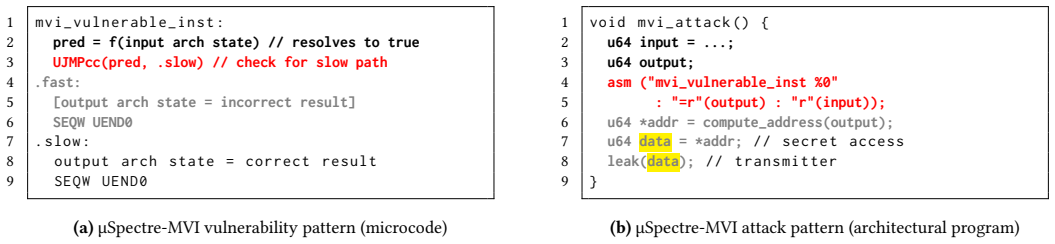
- Zero Dividend Injection and String Comparison Overrun, previously attributed to value prediction and speculative string overrun, are reclassified as µSpectre-MVI and µSpectre-MIL respectively, changing where mitigations must be inserted.
- µSpectre-MEB-PCIDX shows that an unprivileged program can read all 256 control registers in the 0x2200–0x2300 range on Goldmont, including registers with no architectural meaning, and the paper argues one different micro-op would have exposed a vastly larger control-register space.
- µSLH, deployed by microcode update, fully closes the µSpectre-MEB attacks reported and gives all MVI attacks a uniform transient zero value; µSpectre-MIL requires avoiding the vulnerable instructions.
- No CVE or microcode update has been released in response to disclosure, and non-Goldmont microcode remains opaque, so the same vulnerability class may persist in other Intel cores.
Reading between the lines
- A natural next step is to turn the paper's issue/retire nanobenchmark into a black-box oracle: run it on every Intel and AMD core, and a nonzero issue/retire gap after std; lfence; cld would signal a statically predicted not-taken µbranch even without a microcode dump.
- The µSLH pattern generalizes beyond the reported bugs: any microcode branch whose not-taken path touches privileged state is a candidate for the same conditional-select hardening, effectively defining a compiler-like pass over microcode.
- If the lack of a CVE or patch reflects a disclosure policy gap, the paper implies that vulnerability researchers should treat microcode updates as a primary disclosure channel rather than relying on hardware errata.
- The undocumented-instruction analysis suggests that other undocumented or privilege-gated microcode may contain similar not-taken transient paths, making microcode transparency itself a security property.
Editorial analysis
A structured set of objections, weighed in public.
Referee Report
Summary. The paper introduces µSpectre, a class of transient execution attacks that exploit conditional microcode branch mispredictions on Intel processors. The central claim is that a conditional µbranch can be statically mispredicted not-taken, creating a transient execution window that spans several macro-ops and can leak sensitive architectural or microarchitectural state. The authors provide microcode-level analyses for Goldmont (cld, bound, rdpmc), a demonstrated exploit (µSpectre-MEB-PCIDX) that leaks control registers in the range 0x2200–0x2300 on Goldmont, reclassifications of known attacks (Rogue System Register Read, Meltdown-BND, Zero Dividend Injection, String Comparison Overrun) as µSpectre variants, and a proposed microcode-level defense called µSLH.
Significance. If the central claims hold, this is a genuinely new class of transient execution attacks distinct from Spectre and Meltdown, with the notable property that it can leak internal microarchitectural state that is not architecturally accessible at any privilege level. The paper's strengths are its use of publicly available Goldmont microcode disassembly, targeted nanobenchmarks, and a proof-of-concept for µSpectre-MEB-PCIDX. The authors are transparent about several limitations, including the lack of demonstrated leaks for µSpectre-MEB-OF and the µSpectre-MVI-DF/ARPL/ENTER primitives. However, the paper's scope-level claims—particularly Observation 1 as a statement about all Intel cores and the reclassification of ZDI on Haswell—rest on inferences from only one or two microcoded instructions on non-Goldmont cores. The Goldmont demonstrations can stand on their own, but the broader claims need to be either supported with additional evidence or explicitly reframed as hypotheses.
major comments (4)
- [§3.3.1, Observation 1] The claim that 'Intel cores statically predict that conditional microcode branches are not-taken' is load-bearing for the paper's scope, but the evidence outside Goldmont is an inference from the cld nanobenchmark. The paper itself concedes 'We cannot be certain that this is also the case for the other cores' and justifies the universal claim with 'we see no reason why Intel would make this opposite design choice.' The 17/13 vs 7/7 issue/retire delta on non-Goldmont cores is consistent with a statically not-taken µbranch, but it is also consistent with other microarchitectural explanations, such as a different fast-path length, extra serialization, or a taken-predicted branch with a shorter slow path. Since Observation 1 is used to reclassify ZDI in §5.3 and to frame µSpectre as a class-wide phenomenon, the authors should either restrict the class-level claims to Goldmont or provide independent cross-core evidence for the prediction policy, e.g., several microcoded instructions with known fast/slow path lengths or direct microcode disclosure.
- [§5.3, Figure 11] The ZDI reclassification rests on a hypothesized microprogram structure. The nanobenchmark data (39/39 vs 61/49 issued/retired micro-ops) show that more micro-ops are issued than retired when rdx is nonzero, but they do not establish that the extra transient micro-ops arise from a conditional µbranch that is statically predicted not-taken. The authors infer the entire div microprogram structure from these counts by analogy to Observation 1. If Observation 1 does not hold on Haswell, or if the extra issued micro-ops come from value prediction or another transient mechanism, the claim that ZDI is 'an instance of µSpectre-MVI' is unsupported. Please mark this reclassification as a hypothesis or provide direct evidence, such as microcode tracing or additional discriminating experiments.
- [§3.4, Observation 2] The claim that Goldmont Plus 'may transiently execute up to 22 macro-ops' is reported without supporting traces or a described measurement procedure. This is one of the two observations that motivate the attack model. Please provide the raw data, the nanobenchmark used, and the method for counting macro-ops in the transient window, or downgrade the claim to a preliminary observation.
- [§6.1 and §6.3] Two of the claimed new vulnerabilities are not demonstrated. For µSpectre-MEB-OF (§6.1), no proof-of-concept is given; for the new MVI instances (§6.3), the text says 'we have so for not been able to demonstrate attacks exploiting this fact to transiently leak sensitive data.' The contributions list and Figure 5 present these as new vulnerabilities, which overstates the evidence. Please relabel them as candidate vulnerabilities or provide demonstrations.
minor comments (5)
- [§4.4] The sentence 'In §4.4, we provide an example of a microcode-internal leak' is incorrect: the example appears in §5.4 (µSpectre-MIL-SCO), not §4.4.
- [Throughout] There are several typos: 'microseqeuncer' in §2.3, 'so for' in §6.3, 'occurence' in §7, 'phyiscal' in §6.4, and 'µSpectre-MEC-PCIDX' in §6.2.4.
- [§5.1.1] The text says 'we find that three instructions are vulnerable' and then 'we find that three of these implement privilege checks'; since the list has exactly three items, 'three of these' should be 'all three'.
- [Figure 5] It is unclear which entries are demonstrated versus inconclusive. The legend says demonstrated attacks are red and inconclusive results are gray, but the new MVI candidates from §6.3 appear in bold without a color, and µSpectre-MEB-OF is listed without a demonstrated leak.
- [References] References [54] and [55] are identical (same title, authors, and venue); one should be removed or the numbering corrected.
Circularity Check
No significant circularity: the Goldmont results are derived from public microcode and direct performance-counter measurements, and the cross-core generalizations are hedged empirical inferences rather than definitional reductions.
full rationale
The paper's central derivation chain is self-contained. The existence claims for µSpectre on Goldmont rest on (i) Ermolov et al.'s externally published MSROM disassembly, (ii) the authors' own performance-counter nanobenchmarks (e.g., the cld experiments reporting 7/7 vs 17/13 issued/retired µops), and (iii) reproduced microprogram listings that show vulnerable UJMPcc branches guarding exception paths. None of these steps fits a parameter to the target result and then reports it as a prediction; the observed issue/retire deltas are independent measurements used to infer branch direction, not outputs of a fitted model. The reclassification of Rogue System Register Read, Meltdown-BND, ZDI, and SCO is an interpretive argument supported by microcode inspection on Goldmont and by instrumentation on other cores; it is not a definitional identity. The only load-bearing weakness is the generalization of Observation 1 beyond Goldmont from a single inferred cld µbranch, which the paper explicitly hedges ('We cannot be certain that this is also the case for the other cores... However, we see no reason why Intel would make this opposite design choice'). That is an evidentiary limitation (correctness risk), not circularity. No self-citation chain is load-bearing; the cited prior work on Goldmont microcode is external and independently published, and no uniqueness theorem or ansatz is imported from the authors' own prior work. Accordingly, no step reduces by construction to its inputs, and the circularity score is 0.
Assumptions & free parameters
assumptions (4)
- domain assumption The public Goldmont microcode disassembly by Ermolov et al. is accurate and representative of other Intel efficiency cores.
- domain assumption Conditional microcode branches are statically predicted not-taken on Intel microarchitectures beyond the five tested.
- domain assumption Performance-counter issue and retire counts unambiguously distinguish transiently issued micro-ops and reveal microcode branch structure.
- domain assumption Intel's microcode patch for rdpmc, identified by comparing patched and unpatched firmware, is the effective cause of the PCIDX fix.
Cite this review
Pith. "Pith review of Analyzing and Exploiting Branch Mispredictions in Microcode." pith.science (2026). https://pith.science/paper/ET7LK6LJ
@misc{pith2026250112890,
  author       = {Pith},
  title        = {Pith review of: Analyzing and Exploiting Branch Mispredictions in Microcode},
  year         = {2026},
  howpublished = {\url{https://pith.science/paper/ET7LK6LJ}},
  note         = {Machine review of arXiv:2501.12890}
}
read the original abstract
We present uSpectre, a new class of transient execution attacks that exploit microcode branch mispredictions to transiently leak sensitive data. We find that many long-known and recently-discovered transient execution attacks, which were previously categorized as Spectre or Meltdown variants, are actually instances of uSpectre on some Intel microarchitectures. Based on our observations, we discover multiple new uSpectre attacks and present a defense against uSpectre vulnerabilities, called uSLH.
Figures


Figures from the paper (13 more)


Reference graph
Works this paper leans on
-
[1]
https://www.amd.com/system/files/documents/security-analysis- predictive-store-forwarding.pdf , 2021
Security analysis of amd predictive store forwarding. https://www.amd.com/system/files/documents/security-analysis- predictive-store-forwarding.pdf , 2021. Accessed: 2022-10-18
work page 2021
-
[2]
Andreas Abel and Jan Reineke. uops.info: Characterizing latency, throughput, and port usage of instructions on intel microarchitectures. In ASPLOS, ASPLOS ’19, pages 673–686, New York, NY, USA, 2019. ACM
work page 2019
-
[3]
nanobench: A low-overhead tool for running microbenchmarks on x86 systems
Andreas Abel and Jan Reineke. nanobench: A low-overhead tool for running microbenchmarks on x86 systems. In 2020 IEEE International Symposium on Performance Analysis of Systems and Software (ISPASS) , August 2020
work page 2020
-
[4]
Predicting secret keys via branch prediction
Onur Aciicmez, Jean-Pierre Seifert, and Cetin Kaya Koc. Predicting secret keys via branch prediction. IACR’06, 2006
work page 2006
-
[5]
Port contention for fun and profit
Alejandro Cabrera Aldaya, Billy Bob Brumley, Sohaib ul Hassan, Ce- sar Pereida García, and Nicola Tuveri. Port contention for fun and profit. IACR’18, 2018
work page 2018
-
[6]
Security analysis of amd predictive store forwarding
AMD. Security analysis of amd predictive store forwarding. Whitepa- per, AMD, March 2021
work page 2021
-
[7]
Techincal guidance for mitigating branch type confusion
AMD. Techincal guidance for mitigating branch type confusion. Whitepaper, AMD, November 2022
work page 2022
-
[8]
M. Andrysco, D. Kohlbrenner, K. Mowery, R. Jhala, S. Lerner, and H. Shacham. On subnormal floating point and abnormal timing. In 2015 IEEE Symposium on Security and Privacy , 2015
work page 2015
Show all 65 references
-
[9]
Straight-Line Speculation
Arm. Straight-Line Speculation. Technical report, Arm, 2020. Ac- cessed: October 29, 2024
2020
-
[10]
Acoustic side-channel attacks on printers
Michael Backes, Markus Dürmuth, Sebastian Gerling, Manfred Pinkal, and Caroline Sporleder. Acoustic side-channel attacks on printers. 19th USENIX Security Symposium , 2010
2010
-
[11]
Bernstein
Daniel J. Bernstein. Cache-timing attacks on aes. Technical report, The University of Illinois at Chicago, 2005.https://cr.yp.to/antiforgery/ cachetiming-20050414.pdf
2005
-
[12]
Customprocessingunit: Reverse engineering and customization of intel microcode
Pietro Borrello, Catherine Easdon, Martin Schwarzl, Roland Czerny, and Michael Schwarz. Customprocessingunit: Reverse engineering and customization of intel microcode. In2023 IEEE Security and Privacy Workshops (SPW), pages 285–297. IEEE, 2023
2023
-
[13]
Wenisch, Yu- val Yarom, and Raoul Strackx
Jo Van Bulck, Marina Minkin, Ofir Weisse, Daniel Genkin, Baris Kasikci, Frank Piessens, Mark Silberstein, Thomas F. Wenisch, Yu- val Yarom, and Raoul Strackx. Foreshadow: Extracting the keys to the Intel SGX kingdom with transient out-of-order execution. 27th USENIX Security S...
2018
-
[14]
A systematic evaluation of transient execution attacks and defenses
Claudio Canella, Jo Van Bulck, Michael Schwarz, Moritz Lipp, Ben- jamin Von Berg, Philipp Ortner, Frank Piessens, Dmitry Evtyushkin, and Daniel Gruss. A systematic evaluation of transient execution attacks and defenses. In 28th USENIX Security Symposium (USENIX Security 19), p...
2019
-
[15]
Speculative load hardening
Chandler Carruth. Speculative load hardening. https://llvm.org/docs/ SpeculativeLoadHardening.html. Accessed: 2024-05-15
2024
-
[16]
Intel® 64 and IA-32 Architectures Software Devel- oper’s Manual, 2024
Intel Corporation. Intel® 64 and IA-32 Architectures Software Devel- oper’s Manual, 2024
2024
-
[17]
glm-ucode
Mark Ermolov, Maxim Goryachy, and Dmitry Sklyarov. glm-ucode. https://github.com/chip-red-pill/glm-ucode , 2020
2020
-
[18]
ucodedisasm
Mark Ermolov, Maxim Goryachy, and Dmitry Sklyarov. ucodedisasm. https://github.com/chip-red-pill/uCodeDisasm, 2024. Accessed: 2024- 05-18
2024
-
[19]
Undocu- mented x86 instructions to control the cpu at the microarchitecture level in modern intel processors
Mark Ermolov, Dmitry Sklyarov, and Maxim Goryachy. Undocu- mented x86 instructions to control the cpu at the microarchitecture level in modern intel processors. Journal of Computer Virology and Hacking Techniques, 19(3):351–365, 2023
2023
-
[20]
Branchscope: A new side-channel attack on direc- tional branch predictor
Dmitry Evtyushkin, Ryan Riley, Nael CSE Abu-Ghazaleh, ECE, and Dmitry Ponomarev. Branchscope: A new side-channel attack on direc- tional branch predictor. 23rd International Conference on Architectural Support for Programming Languages and Operating Systems (ASPLOS) , 2018
2018
-
[21]
Trans- lation Leak-aside Buffer: Defeating Cache Side-channel Protections with TLB Attacks
Ben Gras, Kaveh Razavi, Herbert Bos, and Cristiano Giuffrida. Trans- lation Leak-aside Buffer: Defeating Cache Side-channel Protections with TLB Attacks. In USENIX Security’18, 2018. 19
2018
-
[22]
Side-channel analysis of cryptographic software via early-terminating multiplications
Johann Großschädl, Elisabeth Oswald, Dan Page, and Michael Tunstall. Side-channel analysis of cryptographic software via early-terminating multiplications. In ICISC’09, 2009
2009
-
[23]
Cache games— bringing access-based cache attacks on AES to practice
David Gullasch, Endre Bangerter, and Stephan Krenn. Cache games— bringing access-based cache attacks on AES to practice. 2011 IEEE Symposium on Security and Privacy (S&P) , 2011
2011
-
[24]
Homma, T
N. Homma, T. Aoki, and A. Satoh. Electromagnetic information leak- age for side-channel analysis of cryptographic modules. 2010 IEEE In- ternational Symposium on Electromagnetic Compatibility (EMC) , 2010
2010
-
[25]
Speculative execution, variant 4: Speculative store by- pass, 2018
Jann Horn. Speculative execution, variant 4: Speculative store by- pass, 2018. https://bugs.chromium.org/p/project-zero/issues/detail? id=1528
2018
-
[26]
Rogue system register read / cve-2018-3640 / intel-sa-00115
Intel Corporation. Rogue system register read / cve-2018-3640 / intel-sa-00115. https://www.intel.com/content/www/us/en/ developer/articles/technical/software-security-guidance/advisory- guidance/rogue-system-register-read.html , 2018. Accessed: 2024-05-14
2018
-
[27]
Intel® 64 and IA-32 Architectures Optimization Reference Manual, 2021
Intel Corporation. Intel® 64 and IA-32 Architectures Optimization Reference Manual, 2021. Available at: https://www.intel.com/content/ www/us/en/developer/articles/technical/intel-sdm.html
2021
-
[28]
Earlier Generations of Intel ® 64 and IA-32 Processor Architectures, Throughput, and Latency, 2024
Intel Corporation. Earlier Generations of Intel ® 64 and IA-32 Processor Architectures, Throughput, and Latency, 2024. Accessed: 2024-06-09
2024
-
[29]
Instructions affected by rogue system register read
Intel Corporation. Instructions affected by rogue system register read. https://www.intel.com/content/www/us/en/developer/articles/ technical/software-security-guidance/resources/instructions- affected-rogue-system-register-read.html , 2024. Accessed: 2024-05- 18
2024
-
[30]
Dawg: A defense against cache timing attacks in speculative execution processors
Vladimir Kiriansky, Ilia Lebedev, Saman Amarasinghe, Srinivas De- vadas, and Joel Emer. Dawg: A defense against cache timing attacks in speculative execution processors. In 2018 51st Annual IEEE/ACM International Symposium on Microarchitecture (MICRO) , 2018
2018
-
[31]
Speculative buffer over- flows: Attacks and defenses
Vladimir Kiriansky and Carl Waldspurger. Speculative buffer over- flows: Attacks and defenses. CoRR, abs/1807.03757, 2018. http: //arxiv.org/abs/1807.03757
2018 arXiv
-
[32]
Spectre attacks: Exploiting speculative execution
Paul Kocher, Jann Horn, Anders Fogh, Daniel Genkin, Daniel Gruss, Werner Haas, Mike Hamburg, Moritz Lipp, Stefan Mangard, Thomas Prescher, et al. Spectre attacks: Exploiting speculative execution. Communications of the ACM, 63(7):93–101, 2020
2020
-
[33]
Kocher, Joshua Jaffe, and Benjamin Jun
Paul C. Kocher, Joshua Jaffe, and Benjamin Jun. Differential power analysis. In CRYPTO’99, 1999
1999
-
[34]
Khasawneh, Chengyu Song, and Nael B
Esmaeil Mohammadian Koruyeh, Khaled N. Khasawneh, Chengyu Song, and Nael B. Abu-Ghazaleh. Spectre returns! Speculation attacks using the return stack buffer. 12th USENIX Workshop on Offensive Technologies (WOOT), 2018
2018
-
[35]
Meltdown
Moritz Lipp, Michael Schwarz, Daniel Gruss, Thomas Prescher, Werner Haas, Stefan Mangard, Paul Kocher, Daniel Genkin, Yuval Yarom, and Mike Hamburg. Meltdown. arXiv preprint arXiv:1801.01207, 2018
2018 arXiv
-
[36]
A simple power-analysis (SPA) attack on imple- mentations of the aes key expansion
Stefan Mangard. A simple power-analysis (SPA) attack on imple- mentations of the aes key expansion. 5th International Conference on Information Security and Cryptology (ICISC) , 2003
2003
-
[37]
Fallout: Reading kernel writes from user space
Marina Minkin, Daniel Moghimi, Moritz Lipp, Michael Schwarz, Jo Van Bulck, Daniel Genkin, Daniel Gruss, Frank Piessens, Berk Sunar, and Yuval Yarom. Fallout: Reading kernel writes from user space. arXiv preprint arXiv:1905.12701, 2019
1905 arXiv
-
[38]
MemJam: A False Dependency Attack Against Constant-Time Crypto Implementations
Ahmad Moghimi, Jan Wichelmann, Thomas Eisenbarth, and Berk Sunar. MemJam: A False Dependency Attack Against Constant-Time Crypto Implementations. International Journal of Parallel Program- ming, 47(4), 2019
2019
-
[39]
Revizor: testing black-box cpus against speculation contracts
Oleksii Oleksenko, Christof Fetzer, Boris Köpf, and Mark Silberstein. Revizor: testing black-box cpus against speculation contracts. In ASP- LOS ’22: 27th ACM International Conference on Architectural Support for Programming Languages and Operating Systems, Lausanne, Switzer- ...
2022
-
[40]
Hide and seek with spectres: Efficient discovery of speculative infor- mation leaks with random testing
Oleksii Oleksenko, Marco Guarnieri, Boris Köpf, and Mark Silberstein. Hide and seek with spectres: Efficient discovery of speculative infor- mation leaks with random testing. In2023 IEEE Symposium on Security and Privacy (SP), pages 1737–1752. IEEE, 2023
2023
-
[41]
Cache attacks and countermeasures: The case of AES
Dag Arne Osvik, Adi Shamir, and Eran Tromer. Cache attacks and countermeasures: The case of AES. 2006 The Cryptographers’ Track at the RSA Conference on Topics in Cryptology (CT-RSA) , 2006
2006
-
[42]
DRAMA: Exploiting DRAM Addressing for Cross- CPU Attacks
Peter Pessl, Daniel Gruss, Clémentine Maurice, Michael Schwarz, and Stefan Mangard. DRAMA: Exploiting DRAM Addressing for Cross- CPU Attacks. In USENIX Security’16, 2016
2016
-
[43]
Rage against the machine clear: A systematic analysis of machine clears and their implications for transient execution attacks
Hany Ragab, Enrico Barberis, Herbert Bos, and Cristiano Giuffrida. Rage against the machine clear: A systematic analysis of machine clears and their implications for transient execution attacks. In 30th USENIX Security Symposium (USENIX Security 21) , pages 1451–1468, 2021
2021
-
[44]
I see dead 𝜇ops: Leaking secrets via intel/amd micro-op caches
Xida Ren, Logan Moody, Mohammadkazem Taram, Matthew Jordan, Dean M Tullsen, and Ashish Venkat. I see dead 𝜇ops: Leaking secrets via intel/amd micro-op caches. In 2021 ACM/IEEE 48th Annual Inter- national Symposium on Computer Architecture (ISCA) , pages 361–374. IEEE, 2021
2021
-
[45]
Sayakkara, Nhien-An Le-Khac, and Mark Scanlon
Asanka P. Sayakkara, Nhien-An Le-Khac, and Mark Scanlon. A survey of electromagnetic side-channel attacks and discussion on their case- progressing potential for digital forensics. CoRR, abs/1903.07703, 2019
1903 arXiv
-
[46]
Zombieload: Cross- privilege-boundary data sampling
Michael Schwarz, Moritz Lipp, Daniel Moghimi, Jo Van Bulck, Julian Stecklina, Thomas Prescher, and Daniel Gruss. Zombieload: Cross- privilege-boundary data sampling. In Proceedings of the 2019 ACM SIGSAC Conference on Computer and Communications Security , pages 753–768, 2019
2019
-
[47]
Spectre declassified: Reading from the right place at the wrong time
Basavesh Ammanaghatta Shivakumar, Jack Barnes, Gilles Barthe, Sunjay Cauligi, Chitchanok Chuengsatiansup, Daniel Genkin, Sioli O’Connell, Peter Schwabe, Rui Qi Sim, and Yuval Yarom. Spectre declassified: Reading from the right place at the wrong time. In 2023 IEEE Symposium on...
2023
-
[49]
Inception: Expos- ing new attack surfaces with training in transient execution
Daniël Trujillo, Johannes Wikner, and Kaveh Razavi. Inception: Expos- ing new attack surfaces with training in transient execution. In 32nd USENIX Security Symposium (USENIX Security 23) , pages 7303–7320, 2023
2023
-
[50]
Uhsadel, A
L. Uhsadel, A. Georges, and I. Verbauwhede. Exploiting hardware performance counters. In 2008 5th Workshop on Fault Diagnosis and Tolerance in Cryptography, 2008
2008
-
[51]
Lvi: Hijacking transient execution through microar- chitectural load value injection
Jo Van Bulck, Daniel Moghimi, Michael Schwarz, Moritz Lippi, Marina Minkin, Daniel Genkin, Yuval Yarom, Berk Sunar, Daniel Gruss, and Frank Piessens. Lvi: Hijacking transient execution through microar- chitectural load value injection. In 2020 IEEE Symposium on Security and Pr...
2020
-
[52]
Ridl: Rogue in-flight data load
Stephan Van Schaik, Alyssa Milburn, Sebastian Österlund, Pietro Frigo, Giorgi Maisuradze, Kaveh Razavi, Herbert Bos, and Cristiano Giuffrida. Ridl: Rogue in-flight data load. In 2019 IEEE Symposium on Security and Privacy (SP), pages 88–105. IEEE, 2019
2019
-
[53]
Fletcher, and David Kohlbrenner
Jose Rodrigo Sanchez Vicarte, Michael Flanders, Riccardo Paccagnella, Grant Garrett-Grossman, Adam Morrison, Christopher W. Fletcher, and David Kohlbrenner. Augury: Using data memory-dependent prefetchers to leak data at rest. In IEEE Symposium on Security and Privacy (SP). IE...
2022
-
[54]
Opening pandora’s box: A systematic study of new ways microarchitecture can leak private data
Jose Rodrigo Sanchez Vicarte, Pradyumna Shome, Nandeeka Nayak, Caroline Trippel, Adam Morrison, David Kohlbrenner, and Christo- pher W Fletcher. Opening pandora’s box: A systematic study of new ways microarchitecture can leak private data. In 2021 ACM/IEEE 48th Annual Internat...
2021
-
[55]
Opening pandora’s box: A systematic study of new ways microarchitecture can leak private data
Jose Rodrigo Sanchez Vicarte, Pradyumna Shome, Nandeeka Nayak, Caroline Trippel, Adam Morrison, David Kohlbrenner, and Christo- pher W Fletcher. Opening pandora’s box: A systematic study of new ways microarchitecture can leak private data. In 2021 ACM/IEEE 48th Annual Internat...
2021
-
[56]
Wenhao Wang, Guoxing Chen, Xiaorui Pan, Yinqian Zhang, XiaoFeng Wang, Vincent Bindschaedler, Haixu Tang, and Carl A. Gunter. Leaky Cauldron on the Dark Land: Understanding Memory Side-Channel Hazards in SGX. In CCS ’17, 2017
2017
-
[57]
In31st USENIX Security Symposium (USENIX Security 22) , pages 3825–3842, 2022
Johannes Wikner and Kaveh Razavi.{RETBLEED}: Arbitrary specu- lative code execution with return instructions. In31st USENIX Security Symposium (USENIX Security 22) , pages 3825–3842, 2022
2022
-
[58]
Phantom: Ex- ploiting decoder-detectable mispredictions
Johannes Wikner, Daniël Trujillo, and Kaveh Razavi. Phantom: Ex- ploiting decoder-detectable mispredictions. In Proceedings of the 56th Annual IEEE/ACM International Symposium on Microarchitecture, pages 49–61, 2023
2023
-
[59]
Y. Xu, W. Cui, and M. Peinado. Controlled-channel attacks: Deter- ministic side channels for untrusted operating systems. 2015 IEEE Symposium on Security and Privacy (S&P) , 2015
2015
-
[60]
Attack Directories, Not Caches: Side Channel Attacks in a Non-Inclusive World
Mengjia Yan, Read Sprabery, Bhargava Gopireddy, Christopher Fletcher, Roy Campbell, and Josep Torrellas. Attack Directories, Not Caches: Side Channel Attacks in a Non-Inclusive World. In IEEE S&P, 2019
2019
-
[61]
In 23rd USENIX security symposium (USENIX security 14) , pages 719–732, 2014
Yuval Yarom and Katrina Falkner.{FLUSH+ RELOAD}: A high res- olution, low noise, l3 cache{Side-Channel} attack. In 23rd USENIX security symposium (USENIX security 14) , pages 719–732, 2014
2014
-
[62]
FLUSH+RELOAD: A high resolu- tion, low noise, L3 cache side-channel attack
Yuval Yarom and Katrina Falkner. FLUSH+RELOAD: A high resolu- tion, low noise, L3 cache side-channel attack. 23rd USENIX Security Symposium, 2014
2014
-
[63]
CacheBleed: A Timing Attack on OpenSSL Constant Time RSA
Yuval Yarom, Daniel Genkin, and Nadia Heninger. CacheBleed: A Timing Attack on OpenSSL Constant Time RSA. IACR’16, 2016
2016
-
[64]
Speculative taint tracking (stt) a comprehensive protection for speculatively accessed data
Jiyong Yu, Mengjia Yan, Artem Khyzha, Adam Morrison, Josep Tor- rellas, and Christopher W Fletcher. Speculative taint tracking (stt) a comprehensive protection for speculatively accessed data. In Pro- ceedings of the 52nd Annual IEEE/ACM International Symposium on Microarchite...
2019
-
[65]
Ultimate{SLH}: Taking speculative load hardening to the next level
Zhiyuan Zhang, Gilles Barthe, Chitchanok Chuengsatiansup, Peter Schwabe, and Yuval Yarom. Ultimate{SLH}: Taking speculative load hardening to the next level. In 32nd USENIX Security Symposium (USENIX Security 23), pages 7125–7142, 2023. 21
2023
-
[2018]
http://arxiv.org/abs/1806.07480
Reviewed August 10, 2026 · model on record in the stance chip above.
Discussion (0). Continue with ORCID to comment.