REVIEW 3 major objections 5 minor 25 references
Galaxy infall models for arbitrary velocity directions
T0 review · 3 major / 5 minor · reviewed 2026-08-10 · deepseek-v4-flash
Pith's one-line read Infall-model velocities misestimate individual radial velocities for most galaxies, yet the dispersions they yield systematically bracket the true velocity dispersion, predicting the M81 group's at 99–180 km/s.
desk verdict Solid kinematic generalization and a useful dispersion-bracketing result, but the M81 application is internally inconsistent and the quoted numbers don't follow from the stated fits. read the letter →
The pith
A machine-rendered reading of the paper's core claim, the machinery that carries it, and where it could break.
The reading
What carries the argument
The load-bearing object is the exact relative-velocity decomposition of two galaxies into radial and tangential parts: projecting $\mathbf{v}_2 - \mathbf{v}_1$ onto the connection line $\hat{\mathbf{r}}_{21}$ gives Eq. (22), which contains the observable line-of-sight components, the angular separation $\theta$, the distances $r_1, r_2$, and the unobservable perpendicular speeds $|v_{\perp 1}|$ and $|v_{\perp 2}|$. Two derived conditions carry the argument. First, the fine-tuning condition $|v_{\perp 1}|/|v_{\perp 2}| = |r_1|/|r_2|$ is the only generic situation in which the perpendicular terms vanish, and it fixes whether the minor and major models over- or underestimate the true radial velocity. Second, the small-angle identity $|v_r| \approx |v_{l2}| - |v_{l1}|$ (Eq. 46) makes all models coincide for small $\theta$, and in the simulation it reproduces the true velocity dispersion almost exactly for distant halos, converting a kinematic approximation into a practical dispersion estimator.
What would settle it
Measure the full three-dimensional velocities of M81-group members, for instance proper motions of its dwarf galaxies from high-precision astrometry, compute the true radial velocity dispersion of the group, and check whether it falls inside the predicted 142–180 km/s bracket and near the $(99 \pm 36)$ km/s line-of-sight-difference estimate. A cheaper falsification is to rerun the dispersion calibration on a higher-resolution simulation, such as Illustris-1 or TNG, with the same M81-like selection: if the fitted slopes and intercepts move by more than their stated $1\sigma$ confidence bounds, the M81 prediction loses its calibration anchor.
Extended reading notes
Core claim
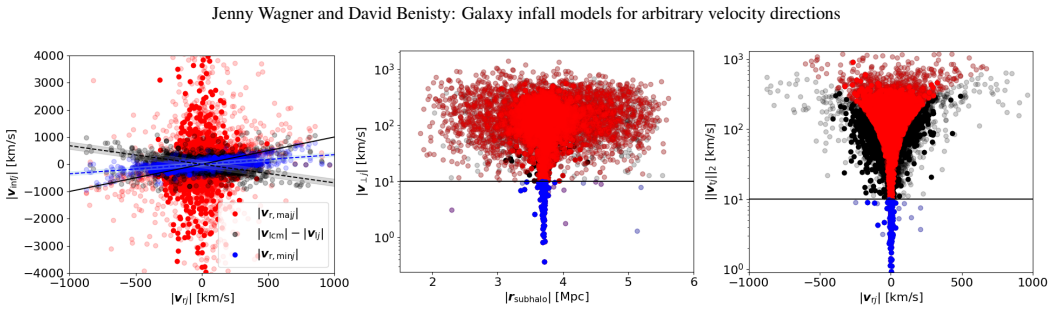
The paper's central claim is that the minor and major infall models are not rival physical pictures of galaxy motion but two projections of a single, cosmology-independent kinematics identity for the relative velocity $\mathbf{v}_2 - \mathbf{v}_1$ of two galaxies: the minor model projects the line-of-sight velocity components onto the connection line $\hat{\mathbf{r}}_{21}$, while the major model projects onto one galaxy's line of sight and divides by a distance factor. Because the exact radial-velocity expression contains the unobservable perpendicular components $|v_{\perp 1}|$ and $|v_{\perp 2}|$, each model is accurate only under the fine-tuned ratio condition $|v_{\perp 1}|/|v_{\perp 2}| = |r_1|/|r_2|$, which real subhalos essentially never satisfy: in Illustris-3, more than 90% of the 5036 subhalos have non-negligible perpendicular or tangential velocity, and only 34% have their true radial velocity bracketed by the two model estimates. The constructive part of the claim is that the velocity dispersions built from the model velocities are systematically related to the true dispersion — the minor model underestimates it, the major model overestimates it, and the small-angle difference of line-of-sight velocities, $|v_{l2}| - |v_{l1}|$, matches it almost one-to-one for halos beyond 18 Mpc — so that linear calibrations yield reliable brackets on the true dispersion. Applied to M81-group observations, the calibrated relations give a radial velocity dispersion of $(180 \pm 42)$ km/s from the minor model, $(142 \pm 64)$ km/s from the major model, and $(99 \pm 36)$ km/s from the line-of-sight difference, with the last identified as the most likely value because the M81 group satisfies the small-angle condition.
Load-bearing premise
The load-bearing premise is that the 281 Illustris-3 halos selected to mimic the M81 group — matched in mass, distance, subhalo count, and observer geometry — are representative enough of the real, actively merging M81 group that the simulated linear calibration between infall-model dispersion and true dispersion carries over to the observed M81 velocities.
Editorial extensions
If this is right
- Minor- and major-model velocity dispersions bracket the true velocity dispersion for most simulated halos, so dispersion-based quantities such as virial masses can be bounded even where individual infall velocities are untrustworthy.
- For structures far enough from the observer that $\theta < 10^\circ$, the velocity dispersion inferred from the difference of line-of-sight velocities alone coincides with the true dispersion, justifying this shortcut for high-redshift groups and clusters.
- The M81-group's radial velocity dispersion is predicted at $(99 \pm 36)$ km/s from the line-of-sight difference, with the two infall models providing a conservative bracket of roughly 142–180 km/s.
- Selecting galaxies at large distances or along the line of sight in front of and behind a cluster centre does not suppress the perpendicular and tangential velocity components, so individual infall-model velocities cannot be used for precise radial-velocity work.
- The major infall model's motivation from a vanishing total angular momentum fails for individual halos; the model retains its value as a dispersion-bounding estimator rather than an exact velocity predictor.
Reading between the lines
- A decisive external test is available: for any nearby group whose member velocities can be measured in three dimensions, whether by proper-motion surveys or high-resolution zoom simulations, one can check that the dispersion-bracket property holds outside Illustris-3 and that the M81 prediction of roughly 99–180 km/s contains the measured dispersion.
- Because the fitted dispersion calibrations come from one simulation suite and one halo-selection recipe, their transfer to real groups is a testable hypothesis; rerunning the calibration with a higher-resolution simulation or a different halo finder would show whether the slopes and intercepts are stable or selection-dependent.
- The paper's kinematics-only treatment suggests the bracket property is cosmology-independent; a natural check is whether the same dispersion brackets appear in simulations with modified gravity or different expansion histories, where the Hubble-flow term the models assume would differ.
- If the line-of-sight-difference dispersion remains unbiased for all small-angle systems, virial masses of high-redshift clusters derived from single-spectroscopy surveys would rest on firmer footing; a comparison against X-ray or Sunyaev-Zeldovich mass estimates could test this directly.
Editorial analysis
A structured set of objections, weighed in public.
Referee Report
Summary. This paper generalizes the minor and major infall models of Karachentsev & Kashibadze (2006) to arbitrary velocity directions, deriving exact geometric expressions for the radial and tangential components of the relative velocity between two galaxies in terms of observable line-of-sight components, distances, and angular separation. The authors test the models on Illustris-3 simulated halos, finding that the infall-model velocities themselves reproduce the true radial velocity only for a minority (~34%) of subhalos, whereas the velocity dispersions computed from the infall-model velocities bracket the true dispersion for most halos. They then apply the models to the M81 group, quoting debiased radial-velocity dispersions of (180±42), (142±64), and (99±36) km/s from the minor, major, and line-of-sight-difference estimators.
Significance. The purely kinematical derivation in Sect. 2 is a valuable contribution: it shows that the two classical infall models correspond to different projections of the same relative-velocity vector and that they are cosmology-independent. The simulation analysis provides a concrete, quantitative warning that perpendicular and tangential velocity components cannot be neglected even at small angular separations, and the demonstration that the infall-model dispersions bracket the true dispersion is a practically useful result for group/cluster studies. The paper also makes a falsifiable prediction for the M81 group. However, the M81 prediction is currently presented with internally inconsistent bound labels and non-reproducible numbers, so a revision is needed before the headline claim can be accepted.
major comments (3)
- [Abstract and Sect. 5.2] The abstract labels the minor-infall estimate as an 'upper bound' and the major-infall estimate as a 'lower bound' on the M81 radial-velocity dispersion, but Sect. 4 and Fig. 7 establish the opposite bias: the minor infall model systematically underestimates the true dispersion and the major infall model systematically overestimates it. If the raw infall-model dispersions are to serve as bounds, the minor model provides the lower bound and the major model the upper bound. This reversal must be corrected in the abstract and in the conclusions.
- [Sect. 5.2, Eqs. (63)-(65)] The quoted debiased dispersions (180±42, 142±64, 99±36 km/s) are not derivable from the stated linear fits in Fig. 10 (centre). Using the natural inversion sigma_true = (sigma_obs - b)/m with the given fits (minor: m=0.53, b=22.21 km/s; major: m=4.01, b=254.60 km/s; Eq. (46): m=1.03, b=37.31 km/s) yields approximate values of 139, 77, and 63 km/s, not 180, 142, and 99. The quoted values are close to sigma_obs/m, which ignores the intercept b; if that is the intended bias correction, it should be stated explicitly with proper error propagation from both m and b. As written, the M81 prediction is not reproducible from the presented fits.
- [Sect. 5.2, Bayesian estimates] The Bayesian re-analysis in the same section gives different central values (150, 88, 100 km/s for minor, major, and Delta-v models) from the abstract's (180, 142, 99). The paper does not explain which set of numbers is the final prediction, nor does it reconcile the two. This ambiguity affects the headline claim and needs to be resolved.
minor comments (5)
- [Sect. 4, linear fit description] The description of the linear fit '|v_inf| = m |v_r| ... with its 1-sigma confidence bounds b_v' is ambiguous: are the b_v values (81.06 km/s etc.) intercepts or scatter bounds? If intercepts, include them in the equation; if bounds, report them differently. This ambiguity propagates to the calibration fits in Sect. 5.
- [Fig. 5 (left)] The text reports a major-infall fit (m_v=1.01, b_v=5578.32 km/s) but states the fit is not shown because its confidence bound covers the entire plot; this should be clarified, since the reported numbers are otherwise untestable.
- [Sect. 5.1] The M81-like halo selection does not explicitly select for merging groups with strong interactions like M81/M82/NGC 3077; the authors note that the simulated structures may not fully represent the M81 group, but a more quantitative discussion of this extrapolation (e.g., using the 100 kpc offset criterion as a proxy for the merging state) would strengthen the application.
- [Abstract] The phrase 'for more than 90% of all, more than 5000 infalling subhalos' is grammatically awkward and should be rephrased for clarity.
- [Sect. 2.1] The statement 'Amplitudes |.| can be negative' is confusing because the notation |.| is normally reserved for non-negative magnitudes; the paper already uses ||.||_2 for the latter, so consider using a different symbol for the signed amplitude.
Circularity Check
No circularity: the infall-model equations are vector-projection identities, the Illustris simulation is an independent test/calibration, and the self-citations are not load-bearing; the M81 numeric/label inconsistencies are reproducibility issues, not circularity.
full rationale
The paper's central derivation (Sect. 2, Eqs. 22-46) is a direct vector-projection identity: the true radial velocity is Eq. (22), the minor infall model is the same expression with the perpendicular terms dropped (Eq. 34), and the major infall model is the projection onto one line of sight (Eqs. 37-38). No quantity in these equations is defined in terms of the quantity it claims to predict, so there is no self-definitional reduction. The Illustris-3 application (Sects. 4-5) provides an external, independent benchmark: the fit parameters m_sigma and b_sigma are fitted to simulated halos and then applied to observed M81 dispersions; the M81 observations were not used to fit those parameters, so the calibration is not a fitted input disguised as a prediction. The self-citations (Benisty et al. 2022, 2025a, 2025b) are pointers to related binaries work, a known Local Group system, and a Coma-cluster confirmation; none carries a central premise or imports a uniqueness theorem, so they are not load-bearing. A non-circular reproducibility concern should be flagged: the abstract labels the minor-infall estimate an 'upper bound' and the major-infall estimate a 'lower bound,' which reverses the Sect. 4 statement that minor systematically underestimates and major overestimates the true dispersion, and the quoted debiased M81 values (180, 142, 99 km/s; Eqs. 63-65) do not follow from the stated m_sigma,b_sigma fits applied to the raw dispersions (96, 564, 102 km/s; Eqs. 60-62). This is an internal consistency/correctness problem, not a circularity, because the claimed values are not equivalent by construction to the fitted inputs.
Assumptions & free parameters
free parameters (5)
- m_sigma_minor, b_sigma_minor =
0.53, 22.21 km/s
- m_sigma_major, b_sigma_major =
4.01, 254.60 km/s
- m_sigma_delta, b_sigma_delta =
1.03, 37.31 km/s
- major-infall velocity cutoff =
3000 km/s
- M81-like halo selection thresholds =
m_halo in [0.5,5.0]e12 M_sun, at least 6 subhalos, offset up to 100 kpc, observer distance 3.7 Mpc, relative velocity…
assumptions (5)
- standard math Euclidean vector geometry and standard trigonometric projections are valid for the relative positions and velocities of galaxies.
- domain assumption Galaxies and subhalos move non-relativistically, so the group center-of-mass velocity can be defined as in Eq. (47).
- domain assumption The Illustris-3 simulation at z=0 is a representative sample of cosmic structures for quantifying the perpendicular and tangential velocity components.
- domain assumption The observer can be placed at the origin of the Illustris-3 snapshot as a random position.
- ad hoc to paper The selected M81-like halos are representative of the real M81 group despite its merging nature.
Cite this review
Pith. "Pith review of Galaxy infall models for arbitrary velocity directions." pith.science (2026). https://pith.science/paper/Z4ZUNG3W
@misc{pith2026250113149,
  author       = {Pith},
  title        = {Pith review of: Galaxy infall models for arbitrary velocity directions},
  year         = {2026},
  howpublished = {\url{https://pith.science/paper/Z4ZUNG3W}},
  note         = {Machine review of arXiv:2501.13149}
}
abstract
For most galaxies in the cosmos, our knowledge of their motion is limited to line-of-sight velocities from redshift observations. To determine the radial velocity between two galaxies the minor and major infall models were established by Karachentsev & Kashibadze (2006). Regardless of the background cosmology, our derivations reveal that these infall models approximate the total radial velocity between two galaxies by two different projections employing different information about the system. For galaxies having small angular separations $\theta$, all infall models agree that the radial velocity is the difference of their line-of-sight components. Applying these models to ca. $500$ halos of the Illustris-3 simulation, we find the perpendicular and tangential velocity parts to be non-negligible for more than 90% of all, more than 5000 infalling subhalos. Thus, even for $\theta < 10$ deg, the infall-model velocities deviate from the true radial velocity. Only for 30% we found the true one lay between the minor and major infall velocity. However, the infall models yield robust upper and lower bounds to the true radial velocity dispersion. Observed under $\theta < 10$ deg the velocity dispersion inferred from the sole difference of line-of-sight velocity components even coincides with the true one, justifying this approach for high-redshift groups and clusters. Based on these findings, we predict the radial velocity dispersion of the M81-group from the minor infall model (upper bound) $\sigma_{\mathrm{r,min}} = (180 \pm 42)~\mbox{km}/\mbox{s}$, from the major infall model (lower bound) $\sigma_{\mathrm{r,maj}} = (142 \pm 64) ~\mbox{km}/\mbox{s}$ and $\sigma_\mathrm{r,\Delta v} = (99 \pm 36)~\mbox{km}/\mbox{s}$ from the line-of-sight-velocity difference.
Figures


Figures from the paper (8 more)




Reference graph
Works this paper leans on
-
[1]
k., Cea, P., Chingangbam, P., et al
Aluri, P. k., Cea, P., Chingangbam, P., et al. 2023, Classical and Quantum Grav- ity, 40, 094001
work page 2023
-
[2]
Line-of-Sight Velocity Projection Impact on the Local Group Mass
Benisty, D. & Mota, D. 2025, forthcoming in A&A, arXiv:2504.16991
work page Pith review arXiv 2025
-
[3]
W., et al
Benisty, D., Vasiliev, E., Evans, N. W., et al. 2022, ApJ, 928, L5
2022
-
[4]
2025b, submitted to ApJ, arXiv:2504.04135
Benisty, D., Wagner, J., Haridasu, S., & Salucci, P. 2025b, submitted to ApJ, arXiv:2504.04135
-
[5]
Chiboucas, K., Jacobs, B. A., Tully, R. B., & Karachentsev, I. D. 2013, AJ, 146, 126 DESI Collaboration. 2024, AJ, 168, 58
work page 2013
-
[6]
Diaz, J. D., Koposov, S. E., Irwin, M., Belokurov, V ., & Evans, N. W. 2014, MNRAS, 443, 1688
work page 2014
-
[7]
Ellis, G. F. R., Nel, S. D., Maartens, R., Stoeger, W. R., & Whitman, A. P. 1985, Phys. Rep., 124, 315
work page 1985
- [8]
Show all 25 references
-
[9]
Karachentsev, I. D. & Kashibadze, O. G. 2006, Astrophysics, 49, 3
2006
-
[10]
D., Kashibadze, O
Karachentsev, I. D., Kashibadze, O. G., Makarov, D. I., & Tully, R. B. 2009, Mon. Not. Roy. Astron. Soc., 393, 1265
2009
-
[11]
Karachentsev, I. D. & Makarov, D. A. 1996, AJ, 111, 794
1996
-
[12]
D., Makarov, D
Karachentsev, I. D., Makarov, D. I., & Kaisina, E. I. 2013, AJ, 145, 101
2013
-
[13]
Karachentsev, I. D. & Nasonova, O. G. 2010, MNRAS, 405, 1075
2010
-
[14]
J., Kang, J., Lee, M
Kim, Y . J., Kang, J., Lee, M. G., & Jang, I. S. 2020, ApJ, 905, 104
2020
-
[15]
Maartens, R., Santiago, J., Clarkson, C., Kalbouneh, B., & Marinoni, C. 2024, J. Cosmology Astropart. Phys., 2024, 070 Müller, O., Heesters, N., Pawlowski, M. S., et al. 2024, A&A, 683, A250
2024
-
[16]
2015, Astronomy and Computing, 13, 12 Peñarrubia, J., Ma, Y .-Z., Walker, M
Nelson, D., Pillepich, A., Genel, S., et al. 2015, Astronomy and Computing, 13, 12 Peñarrubia, J., Ma, Y .-Z., Walker, M. G., & McConnachie, A. 2014, MNRAS, 443, 2204
2015
-
[17]
& de Freitas Pacheco, J
Peirani, S. & de Freitas Pacheco, J. A. 2006, New A, 11, 325
2006
-
[18]
M., Pontzen, A., Peiris, H
Saadeh, D., Feeney, S. M., Pontzen, A., Peiris, H. V ., & McEwen, J. D. 2016, Phys. Rev. Lett., 117, 131302
2016
-
[19]
2024, arXiv e-prints, arXiv:2408.13842
Said, K., Howlett, C., Davis, T., et al. 2024, arXiv e-prints, arXiv:2408.13842
2024 arXiv
-
[20]
B., Ibata, R., Reylé, C., et al
Salomon, J. B., Ibata, R., Reylé, C., et al. 2021, MNRAS, 507, 2592
2021
-
[21]
T., Anderson, J., & van der Marel, R
Sohn, S. T., Anderson, J., & van der Marel, R. P. 2012, ApJ, 753, 7
2012
-
[22]
G., Gottlöber, S., Hoffman, Y ., & Yepes, G
Sorce, J. G., Gottlöber, S., Hoffman, Y ., & Yepes, G. 2016, MNRAS, 460, 2015
2016
-
[23]
B., Kourkchi, E., Courtois, H
Tully, R. B., Kourkchi, E., Courtois, H. M., et al. 2023, ApJ, 944, 94
2023
-
[24]
I., Pomarède, D., et al
Valade, A., Libeskind, N. I., Pomarède, D., et al. 2024, Nature Astronomy van der Marel, R. P., Fardal, M., Besla, G., et al. 2012, ApJ, 753, 8 van der Marel, R. P., Fardal, M. A., Sohn, S. T., et al. 2019, ApJ, 872, 24 V ogelsberger, M., Genel, S., Springel, V ., et al. 2014,...
2024
-
[25]
& Springel, V
Zjupa, J. & Springel, V . 2017, MNRAS, 466, 1625 Article number, page 12 Jenny Wagner and David Benisty: Galaxy infall models for arbitrary velocity directions Appendix A: Observational data set The data shown in Table A.1 is taken from Müller et al. (2024) except for the entr...
2024
Reviewed August 10, 2026 · model on record in the stance chip above.
Discussion (0). Continue with ORCID to comment.