REVIEW 2 major objections 5 minor 1 cited by
Properties of Free Floating Planets Ejected through Planet-Planet Scattering
T0 review · 2 major / 5 minor · reviewed 2026-08-10 · deepseek-v4-flash
Pith's one-line read Planet-planet scattering can eject 40-80% of a planetary system's planets, and matching the observed free-floating planet count requires that 5-10 planets form around each star.
desk verdict Systematic N-body parameter study of scattering-ejected FFPs, useful, but the headline '5-10 planets per star' is not what their own Eq. (3) computes. read the letter →
The pith
A machine-rendered reading of the paper's core claim, the machinery that carries it, and where it could break.
The reading
What carries the argument
The argument is carried by ensemble N-body simulations using the MERCURIUS integrator in the REBOUND package. Each run places 3-10 Jupiter-mass or log-uniform-mass planets on near-circular, near-coplanar orbits and follows them for up to 1e9 years, removing planets as ejected when they reach a prescribed distance D that is varied between 1e2 and 1e5 AU. The key output is the ejection fraction f_eject, which feeds the population equation N_free/N_stars = sum_Np f_giant f_unstable f_eject, together with the observed free-floating planet abundance and the assumed fraction of unstable systems.
What would settle it
Measure the intrinsic fraction of planetary systems that experience scattering instability, for example from the fraction of systems showing high-eccentricity or high-inclination architectures; if that fraction is well below 50%, the required formation rate of 5-10 planets per star would exceed the 8-10 planets that core-accretion models typically allow. Alternatively, if future microlensing surveys find a free-floating planet abundance significantly below the 1.8 per star adopted from Sumi et al. (2011), the inference weakens.
Extended reading notes
Core claim
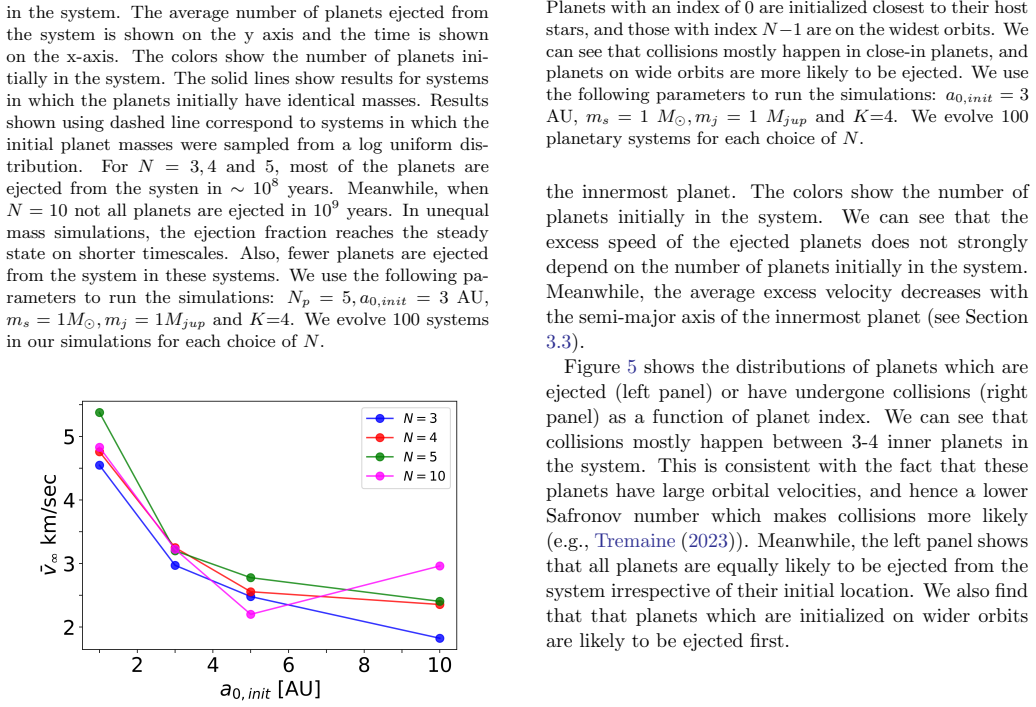
The central claim is that planet-planet scattering alone can produce a large share of the observed free-floating planets. In ensembles of N-body systems with 3-10 planets on initially near-circular, coplanar orbits, the fraction of planets ejected over 1e9 years ranges from about 40% to 80%, increasing with the number of planets initially present. Ejections occur predominantly within 1e8-1e9 years, and the mean excess velocity of ejected planets is 2-6 km/s relative to the host star, depending most strongly on the semi-major axis of the innermost planet. Systems with unequal-mass planets eject fewer planets and show a clear mass segregation: lighter planets are preferentially ejected while heavier planets stay bound. When these ejection fractions are inserted into the accounting equation used for the observed free-floating planet population, with the fraction of unstable systems set to either 0.5 or 1, the authors conclude that 5-10 planets must form per star, a number within reach of current formation models.
Load-bearing premise
The 5-10 planets-per-star conclusion assumes that either half or all planetary systems undergo the kind of instability simulated here, a fraction the paper explicitly states is unconstrained.
Editorial extensions
If this is right
- If scattering is the dominant ejection channel, a large share of observed free-floating planets, especially low-mass ones, are ejected members of formerly more-populous planetary systems.
- The required 5-10 planets per star implies that observed exoplanet multiplicities are depleted remnants of initially richer systems, so planet formation must routinely build systems more massive than those seen today.
- Ejected planets should arrive in the field with excess velocities of 2-6 km/s, mostly within about 30 degrees of their original system's plane, providing a kinematic signature for future surveys.
- Bound planets left after scattering have broad eccentricity and inclination distributions, consistent with the observed eccentric exoplanet population and reinforcing scattering as a driver of those architectures.
Reading between the lines
- If 5-10 planets form per star, the star-formation channel for free-floating planets may be less dominant than sometimes assumed, and formation models that cap planet yields near 8-10 would be stretched, motivating models that build more planets.
- The near-planar ejection pattern suggests that wide-separation free-floating planets in young clusters should show a preferred orientation correlated with the cluster's angular momentum if they were scattered out, a prediction distinct from the core-collapse formation channel.
- The mass-segregation result implies that the mass function of free-floating planets from microlensing should be bottom-heavy relative to the initial planet mass function, and comparing the two could directly test the scattering origin.
- Extending the simulations to include the galactic tide or stellar flybys in dense cluster environments would likely convert some bound wide-orbit planets into free-floating planets, potentially raising the scattering contribution in star-forming regions beyond the present estimate.
Editorial analysis
A structured set of objections, weighed in public.
Referee Report
Summary. The manuscript presents an ensemble of N-body simulations of planet-planet scattering in systems with 3-10 giant planets, varying planet masses, radii, initial spacing, inner semi-major axis, and the distance at which planets are deemed ejected. The main results are that 40-80% of planets are ejected over timescales up to ~1e9 years, with mean excess speeds of 2-6 km/s, that ejection probability is roughly independent of initial orbital radius, that bound planets tend to be more massive than ejected planets, and that the ejection fraction is insensitive to the adopted ejection distance. The authors then combine their ejection fractions with the observed free-floating planet census to infer that 5-10 planets must form per star.
Significance. The parameter study is systematic and useful, and the long integration time (1e9 yr) is a strength compared to earlier work. The simulations are standard and the output quantities (ejection fractions, timescales, velocity distributions) are likely robust. The paper explicitly uses a forward-modeling approach without fitting parameters to the observed FFP count, so the inference is not circular. However, the headline '5-10 planets per star' is not supported by the paper's own Eq. (3), and the v_inf definition in Eq. (1) is missing a factor of 2. These issues affect the quantitative conclusions, particularly the observational comparison.
major comments (2)
- [Section 4.1, Eq. (3) and the abstract/conclusion] The paper defines f^Np_giant,crit as the critical fraction of systems that must contain Np planets, but then interprets the result as 'on average 5-10 planets should form around each star.' The per-star average number of planets formed is Np times f^Np_giant,crit. With the paper's nominal values (N_free/N_stars = 1.8, f_unstable = 1, f_eject ~ 0.7-0.8 for Np = 5-10), this average is approximately 2.3-2.6 planets per star, and even for f_unstable = 0.5 and Np = 10 it is about 4.5. Thus the stated conclusion is not what Eq. (3) yields; the text conflates the required initial multiplicity in unstable systems with the per-star average. The authors should correct the wording and the derived numbers, or explicitly state the assumed interpretation.
- [Section 2, Eq. (1)] The excess speed is defined as v_inf = sqrt(v^2 - G*ms/D), but the correct expression from energy conservation is v_inf = sqrt(v^2 - 2*G*ms/D). The missing factor of 2 is not negligible for small ejection distances; for D = 100 AU, the term G*ms/D is of the same order as the kinetic energy, so the reported excess velocities for those runs are overestimated. While the fiducial D = 10^5 AU makes the correction tiny, the definition is incorrect and should be fixed, and the D-dependence results in Section 3.6 should be re-examined.
minor comments (5)
- [Throughout] There are several typos: 'raii' in Section 3.5, 'systen' in Section 3.2, 'corelation' in Section 4.2, and 'galatic' in Section 3.6; a careful proofread is needed.
- [Section 3.1, Figure 2] The mean excess speed is given as 2.1 km/sec in the caption of Figure 2 but 2.2 km/sec in the text of Section 3.1; please harmonize the numbers.
- [References] The references Veras & Raymond (2012a) and (2012b) appear to refer to the same paper (MNRAS 421, L117); please use a single citation for both the introduction and Section 4.1.
- [Section 4.1] The nominal observational value is taken from Sumi et al. (2011); more recent microlensing constraints (e.g., Mroz et al. 2019; Sumi et al. 2023) give different estimates and could be used to bracket the uncertainty in the observational normalization.
- [Sections 3.2 and 4.1, Figures 3 and 14] The text in Section 3.2 reports an ejection fraction of 70% for N = 10, while Section 4.1 quotes 80% for Np = 10 at 10^9 years; please clarify which ensemble the figure is based on and ensure the values are consistent.
Circularity Check
No significant circularity: ejection properties are direct N-body simulation outputs, and the FFP comparison is an algebraic inversion with externally sourced observations, not a fitted parameter recycled as a prediction.
full rationale
The paper's central products—ejection fractions, excess velocities, timescales, and bound/ejected mass distributions—are direct outputs of N-body integrations with stated initial conditions (Section 2, Figures 1–14). No simulation parameter is fitted to the observed free-floating planet abundance. The comparison with observations in Section 4.1 uses an external census value (N_free/N_stars = 1.8 from Sumi et al. 2011) and external constraints on the fraction of systems with giant planets (Gould et al. 2010; Mayor et al. 2011). Equation (3) is an algebraic rearrangement of Equation (2), defining the critical fraction of systems that must contain Np planets; it is explicitly labeled as a required fraction, not a prediction, and it is not used to re-derive the simulated ejection fractions. The parameter f_unstable is honestly stated to be unconstrained and is bracketed by two assumed values (0.5 and 1.0), which is an input assumption rather than a circular step. Self-citations (Perets & Kouwenhoven 2012; Rozner & Perets 2023) appear only as alternative formation channels for wide-orbit planets and do not carry the load of the ejection-fraction result; there is no uniqueness theorem, fitted-input-renamed-as-prediction, or ansatz-smuggled-via-citation pattern. The abstract's '5-10 planets per star' wording is arguably an overstatement of the f_giant,crit fraction in Eq. (3) and may conflict with the paper's own f_total_giant < 0.5 constraint, but that is a quantitative/interpretation concern, not circularity: the inference does not assume what it purports to derive.
Assumptions & free parameters
free parameters (1)
- f_unstable =
0.5 or 1.0
assumptions (5)
- domain assumption External perturbations such as stellar flybys and the galactic tide do not affect ejections before planets reach 1e5 AU.
- domain assumption The simulated initial conditions (near-circular, near-coplanar orbits with 3-10 planets, spacing 2-5 Hill radii, inner semi-major axis 1-10 AU) are representative of post-formation planetary systems.
- domain assumption Sticky-sphere collisions with radii from the adopted mass-radius relation approximate real collisions; tidal effects may increase effective radii by up to a factor of 2.
- domain assumption The observed free-floating planet abundance (N_free/N_stars ~ 1.8) and the giant-planet occurrence limits from Gould et al. and Mayor et al. are adopted as external inputs.
- domain assumption The empirical instability timescale relation of Chatterjee et al. (2008) is used to guide expectations for simulation stopping times.
Cite this review
Pith. "Pith review of Properties of Free Floating Planets Ejected through Planet-Planet Scattering." pith.science (2026). https://pith.science/paper/J4TB7IBU
@misc{pith2026250113166,
  author       = {Pith},
  title        = {Pith review of: Properties of Free Floating Planets Ejected through Planet-Planet Scattering},
  year         = {2026},
  howpublished = {\url{https://pith.science/paper/J4TB7IBU}},
  note         = {Machine review of arXiv:2501.13166}
}
abstract
Multiple studies have shown that planet-planet scattering plays an important role in the dynamical evolution of planetary systems. For instance, it has been shown that planet-planet scattering can reproduce the eccentricity distribution of exoplanets. It can also contribute to the current census of free floating planets. In this work we run an ensemble of N-body simulations of planetary systems, and record the properties of planets which are ejected from the system. In our simulations we sample a wide range of orbital and physical properties of the planets. We find that in general $40-80\%$ of the planets are ejected from the system depending on the number of planets initially in the system. Most of the planets are ejected over a timescale of $\sim 10^8-10^9$ years. The ejected planets have a mean excess velocity in the range of 2-6 km/sec with respect to the host star. The excess velocities of the planets ejected from the system strongly depends on the semi-major axis of the inner most planet. We find that irrespective of their initial location in the planetary system, all planets are equally likely to be ejected from the system. Also, bound and ejected planets have distinct mass distributions, with bound planets being more massive than ejected planets. In addition, increasing the radii of the planets reduces the ejection fraction. The properties of the ejected planets do not strongly depend on the initial spacing between the planets. The timescale over which ejections happen does increase with the initial separation between the planets. We also find that the ejection fraction does not strongly depend on the distance from the host star beyond which the planets are considered unbound. Finally, we compared our results with observed populations of free floating planets. We conclude that on average 5-10 planets should form around each star to reproduce the observations.
Figures


Figures from the paper (9 more)


Forward citations
Cited by 1 Pith paper
-
Free Floating or Merely Detached?
Planet-planet scattering can leave 'detached' planets at hundreds of AU, and these may account for about half of the free-floating Neptunes detected by microlensing.
Reference graph
Works this paper leans on
-
[1]
Antoniadou, K. I., & Veras, D. 2019, Astronomy and Astrophysics, 629, A126, doi: 10.1051/0004-6361/201935996
-
[2]
2022, Astronomy & Astrophysics, 664, A136, doi: 10.1051/0004-6361/202140351
Bachelet, E., Specht, D., Penny, M., et al. 2022, Astronomy & Astrophysics, 664, A136, doi: 10.1051/0004-6361/202140351
-
[3]
Beauge, C., & Nesvorny, D. 2011, Multiple-Planet Scattering and the Origin of Hot Jupiters, arXiv, doi: 10.48550/arXiv.1110.4392
-
[4]
Boley, A. C. 2009, The Astrophysical Journal, 695, L53, doi: 10.1088/0004-637X/695/1/L53
-
[5]
C., Hayfield, T., Mayer, L., & Durisen, R
Boley, A. C., Hayfield, T., Mayer, L., & Durisen, R. H. 2010, Icarus, 207, 509, doi: 10.1016/j.icarus.2010.01.015
-
[6]
Boss, A. P. 2006, The Astrophysical Journal, 637, L137, doi: 10.1086/500613 —. 2011, The Astrophysical Journal, 731, 74, doi: 10.1088/0004-637X/731/1/74
doi:10.1086/500613 2006
-
[7]
2022, Astronomy & Astrophysics, 664, A111, doi: 10.1051/0004-6361/202243850
Bouy, H., Tamura, M., Barrado, D., et al. 2022, Astronomy & Astrophysics, 664, A111, doi: 10.1051/0004-6361/202243850
-
[8]
Caballero, J. A. 2007, Astronomy & Astrophysics, 466, 917, doi: 10.1051/0004-6361:20066652
Show all 47 references
-
[9]
N., & Davies, M
Carrera, D., Raymond, S. N., & Davies, M. B. 2019, 629, L7, doi: 10.1051/0004-6361/201935744
2019 doi
-
[10]
B., Matsumura, S., & Rasio, F
Chatterjee, S., Ford, E. B., Matsumura, S., & Rasio, F. A. 2008, The Astrophysical Journal, 686, 580, doi: 10.1086/590227
2008 doi
-
[11]
B., & Rasio, F
Chatterjee, S., Ford, E. B., & Rasio, F. A. 2011, in IAU
2011
-
[12]
276, The Astrophysics of Planetary Systems: Formation, Structure, and Dynamical Evolution, ed
Symposium, Vol. 276, The Astrophysics of Planetary Systems: Formation, Structure, and Dynamical Evolution, ed. A. Sozzetti, M. G. Lattanzi, & A. P. Boss, 225–229, doi: 10.1017/S1743921311020229
-
[13]
Clanton, C., & Gaudi, B. S. 2016, The Astrophysical Journal, 834, 46, doi: 10.3847/1538-4357/834/1/46
2016 doi
- [14]
- [15]
-
[16]
Beichman, C. A. 2009, The Astrophysical Journal, 707, 79, doi: 10.1088/0004-637X/707/1/79
2009 doi
-
[17]
B., & Rasio, F
Ford, E. B., & Rasio, F. A. 2008, The Astrophysical Journal, 686, 621, doi: 10.1086/590926
2008 doi
-
[18]
S., et al
Gould, A., Dong, S., Gaudi, B. S., et al. 2010, The Astrophysical Journal, 720, 1073, doi: 10.1088/0004-637X/720/2/1073
2010 doi
-
[19]
1986, Icarus, 65, 13, doi: 10.1016/0019-1035(86)90060-6
Heisler, J., & Tremaine, S. 1986, Icarus, 65, 13, doi: 10.1016/0019-1035(86)90060-6
1986 doi
-
[20]
A., Penny, M., Gaudi, B
Johnson, S. A., Penny, M., Gaudi, B. S., et al. 2020, The Astronomical Journal, 160, 123, doi: 10.3847/1538-3881/aba75b
2020 doi
-
[21]
2017, Astronomy and Astrophysics, 599, A14, doi: 10.1051/0004-6361/201629398 Juri´ c, M., & Tremaine, S
Joncour, I., Duchˆ ene, G., & Moraux, E. 2017, Astronomy and Astrophysics, 599, A14, doi: 10.1051/0004-6361/201629398 Juri´ c, M., & Tremaine, S. 2008, 686, 603, doi: 10.1086/590047
2017 doi
-
[22]
R., & Pu, B
Li, J., Lai, D., Anderson, K. R., & Pu, B. 2021, 501, 1621, doi: 10.1093/mnras/staa3779
2021 doi
-
[23]
Lin, D. N. C., & Ida, S. 1997, The Astrophysical Journal, 477, 781, doi: 10.1086/303738
1997 doi
- [24]
-
[25]
Ma, S., Mao, S., Ida, S., Zhu, W., & Lin, D. N. C. 2016, Monthly Notices of the Royal Astronomical Society: Letters, 461, L107, doi: 10.1093/mnrasl/slw110
2016 doi
-
[26]
2011, The HARPS search for southern extra-solar planets XXXIV
Mayor, M., Marmier, M., Lovis, C., et al. 2011, The HARPS search for southern extra-solar planets XXXIV. Occurrence, mass distribution and orbital properties of super-Earths and Neptune-mass planets, doi: 10.48550/arXiv.1109.2497
-
[27]
N., et al
Miret-Roig, N., Bouy, H., Raymond, S. N., et al. 2021, Nature Astronomy, 6, 89, doi: 10.1038/s41550-021-01513-x
2021 doi
-
[28]
V., & Adams, F
Moorhead, A. V., & Adams, F. C. 2005, Icarus, 178, 517, doi: 10.1016/j.icarus.2005.05.005 Mr´ oz, P., Udalski, A., Bennett, D. P., et al. 2019, Astronomy and Astrophysics, 622, A201, doi: 10.1051/0004-6361/201834557 M¨ uller, S., Baron, J., Helled, R., Bouchy, F., & Parc, L. 2...
2005 doi
-
[29]
2002, The Astrophysical Journal, 576, 870, doi: 10.1086/341790
Padoan, P., & Nordlund, A. 2002, The Astrophysical Journal, 576, 870, doi: 10.1086/341790
2002 doi
-
[30]
B., & Kouwenhoven, M
Perets, H. B., & Kouwenhoven, M. B. N. 2012, The Astrophysical Journal, 750, 83, doi: 10.1088/0004-637X/750/1/83
2012 doi
-
[31]
2014, The Astrophysical Journal, 786, 101, doi: 10.1088/0004-637X/786/2/101 Portegies Zwart, S., & Hochart, E
Petrovich, C., Tremaine, S., & Rafikov, R. 2014, The Astrophysical Journal, 786, 101, doi: 10.1088/0004-637X/786/2/101 Portegies Zwart, S., & Hochart, E. 2024, SciPost Astronomy, 3, 001, doi: 10.21468/SciPostAstro.3.1.001
2014 doi
-
[32]
A., & Ford, E
Rasio, F. A., & Ford, E. B. 1996, Science, 274, 954, doi: 10.1126/science.274.5289.954
1996 doi
-
[33]
N., & Armitage, P
Raymond, S. N., & Armitage, P. J. 2013, 429, L99, doi: 10.1093/mnrasl/sls033
2013 doi
-
[34]
N., Armitage, P
Raymond, S. N., Armitage, P. J., & Gorelick, N. 2009, 699, L88, doi: 10.1088/0004-637X/699/2/L88 —. 2010, 711, 772, doi: 10.1088/0004-637X/711/2/772
2009 doi
-
[35]
Rein, H., & Liu, S. F. 2012, Astronomy and Astrophysics, 537, A128, doi: 10.1051/0004-6361/201118085
2012 doi
-
[36]
2001, The Astronomical Journal, 122, 432, doi: 10.1086/321121
Reipurth, B., & Clarke, C. 2001, The Astronomical Journal, 122, 432, doi: 10.1086/321121
2001 doi
-
[37]
Rozner, M., & Perets, H. B. 2023, The Astrophysical Journal, 955, 134, doi: 10.3847/1538-4357/ace2c6
2023 doi
-
[38]
P., et al
Sumi, T., Kamiya, K., Bennett, D. P., et al. 2011, Nature, 473, 349, doi: 10.1038/nature10092
2011 doi
-
[39]
P., et al
Sumi, T., Koshimoto, N., Bennett, D. P., et al. 2023, The Astronomical Journal, 166, 108, doi: 10.3847/1538-3881/ace688
2023 doi
-
[40]
2023, Dynamics of Planetary Systems
Tremaine, S. 2023, Dynamics of Planetary Systems
2023
-
[41]
Veras, D., & Raymond, S. N. 2012a, Monthly Notices of the Royal Astronomical Society: Letters, 421, L117, doi: 10.1111/j.1745-3933.2012.01218.x —. 2012b, Monthly Notices of the Royal Astronomical Society: Letters, 421, L117, doi: 10.1111/j.1745-3933.2012.01218.x
2012
-
[42]
Veras, D., & Rosengren, A. J. 2023, Monthly Notices of the Royal Astronomical Society, 519, 6257, doi: 10.1093/mnras/stad130
2023 doi
-
[43]
J., & Marzari, F
Weidenschilling, S. J., & Marzari, F. 1996, Nature, 384, 619, doi: 10.1038/384619a0
1996 doi
-
[44]
P., & Zinnecker, H
Whitworth, A. P., & Zinnecker, H. 2004, Astronomy & Astrophysics, 427, 299, doi: 10.1051/0004-6361:20041131
2004 doi
-
[45]
2024, The Astrophysical Journal, 970, 97, doi: 10.3847/1538-4357/ad4f81
Yu, F., & Lai, D. 2024, The Astrophysical Journal, 970, 97, doi: 10.3847/1538-4357/ad4f81
2024 doi
-
[46]
2022, The Astronomical Journal, 164, 5, doi: 10.3847/1538-3881/ac6f59
Zhu, W. 2022, The Astronomical Journal, 164, 5, doi: 10.3847/1538-3881/ac6f59
2022 doi
-
[47]
K., Christiansen, J
Zink, J. K., Christiansen, J. L., & Hansen, B. M. S. 2019, Monthly Notices of the Royal Astronomical Society, 483, 4479, doi: 10.1093/mnras/sty3463
2019 doi
Reviewed August 10, 2026 · model on record in the stance chip above.
Discussion (0). Continue with ORCID to comment.