REVIEW 4 major objections 6 minor 99 references
The neutrino luminosity and energy spectrum of nova outburst
T0 review · 4 major / 6 minor · reviewed 2026-08-10 · deepseek-v4-flash
Pith's one-line read During a nova's thermonuclear runaway, low-energy neutrinos, mainly from the CNO cycle and photon-neutrino scattering, carry away more energy than light, and the next T CrB eruption is predicted to flare at $2.7\times10^8\,L_{\nu,\odot}$…
desk verdict A solid MESA study of low-energy nova neutrinos with a timely T CrB forecast, but the headline numbers need a sensitivity study before I'd trust them. read the letter →
The pith
A machine-rendered reading of the paper's core claim, the machinery that carries it, and where it could break.
The reading
What carries the argument
The core of the study is a grid of multicycle nova models constructed with a stellar-evolution code, each cycle spanning accretion, thermonuclear runaway, and post-eruption cooling, with white-dwarf masses from 0.6 to 1.3 solar masses, accretion rates from $10^{-10}$ to $10^{-8}$ solar masses per year, core temperatures of $10^7$, $2\times10^7$, and $3\times10^7$ K, and with or without mixing of white-dwarf material into the accreted envelope. Neutrino losses are separated into nuclear channels (weak decays in the pp chain and CNO cycle) and thermal channels (pair annihilation, photon-neutrino, plasma decay, and bremsstrahlung), following the emission rates used in the cited stellar-evolution literature. The evolution of each model is displayed on a neutrino Hertzsprung-Russell diagram, which plots neutrino luminosity against effective temperature and makes the moment where the neutrino-to-photon luminosity ratio crosses unity visually explicit. The T CrB prediction is obtained by selecting the model that reproduces the observed $\sim\!80$-year recurrence interval.
What would settle it
If a future MeV-scale neutrino detector monitors the next T CrB outburst and does not see a low-energy neutrino flare with peak luminosity near $2.7\times10^8\,L_{\nu,\odot}$ and duration near 88 days, the paper's central claim that nuclear neutrinos dominate the energy loss at the nova peak would be falsified. A less direct test would be observing that the next eruption occurs much earlier or later than the model's recurrence prediction.
Extended reading notes
Core claim
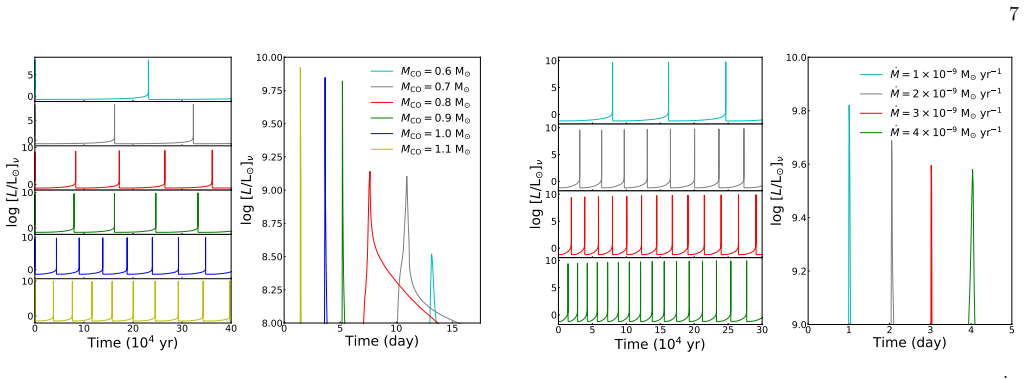
During the accretion phase that precedes the runaway, the model finds that low-energy neutrinos come mainly from the pp chains and from plasma decay, and the photon luminosity still exceeds the neutrino luminosity. Once thermonuclear runaway begins and the hydrogen-burning layer is heated above roughly $7\times10^7$ K, the neutrino production switches to the CNO cycle (the $\beta$-decays of $^{13}$N, $^{15}$O, $^{17}$F, and $^{18}$F) and to the photon-neutrino interaction, and the low-energy nuclear and thermal neutrino luminosity rises by orders of magnitude while the photon luminosity remains nearly constant. As a result, neutrinos become the dominant energy-loss channel during the TNR. Applying the grid to T CrB, with a $1.3\,M_\odot$ white dwarf and an accretion rate of $1.72\times10^{-8}\,M_\odot\,\mathrm{yr}^{-1}$ chosen to match the observed 80-year cycle, the model predicts a peak low-energy nuclear neutrino luminosity of $2.7\times10^8\,L_{\nu,\odot}$ and a neutrino outburst duration of 88 days. The accompanying hadronic muon-neutrino flux from the forward shock is predicted to fall below the current IceCube sensitivity.
Load-bearing premise
The T CrB prediction stands on the assumption that the white dwarf mass (1.3 solar masses) and accretion rate ($1.72\times10^{-8}$ solar masses per year) chosen to reproduce the observed roughly 80-year recurrence interval are the true values; if the actual accretion rate is higher, the accumulated fuel and peak burning temperature, and therefore the predicted luminosity and duration, would be smaller.
Editorial extensions
If this is right
- At the peak of a nova outburst, neutrinos rather than photons carry away most of the energy, so any complete energy budget of the eruption must include the neutrino luminosity.
- More massive white dwarfs produce shorter recurrence cycles and higher low-energy nuclear neutrino luminosities, making the heaviest CO and ONeMg white dwarfs the most promising targets for low-energy neutrino searches.
- The next T CrB outburst should be accompanied by a low-energy neutrino peak at $2.7\times10^8\,L_{\nu,\odot}$ lasting about 88 days, a concrete signature that a future MeV-scale neutrino observatory could search for.
- The hadronic neutrino flux from T CrB's forward shock is predicted to be below IceCube's sensitivity, so a non-detection by IceCube would be consistent with the model rather than evidence against it.
Reading between the lines
- Because the predicted flare is timed to an expected eruption, successful detection would turn a nova into a known-time neutrino source, useful for testing neutrino propagation and for calibrating the nuclear reaction rates that drive the CNO cycle.
- The prediction is sensitive to the assumed accretion history; if the actual accretion rate is at the upper end of the observed range ($4\times10^{-8}\,M_\odot\,\mathrm{yr}^{-1}$), the accumulated fuel would be smaller and the predicted peak luminosity and duration would likely be lower, so the incoming T CrB outburst is effectively a test of its mass-accretion history.
- The same modeling logic could be applied to other recurrent novae and to white dwarfs approaching the Chandrasekhar limit, where the neutrino luminosity is expected to be even higher, linking neutrino output to the nucleosynthesis yields of novae.
Signed reviews
Editorial analysis
A structured set of objections, weighed in public.
Referee Report
Summary. This paper uses the MESA stellar evolution code to compute low-energy nuclear and thermal neutrino luminosities for nova models with CO white dwarfs of 0.6–1.1 Msun (plus one ONeMg 1.1 Msun model), varying accretion rate, core temperature, and mixing. It reports that during the thermonuclear runaway (TNR) the CNO cycle and photon-neutrino processes dominate, and that the low-energy nuclear and thermal neutrino luminosity far exceeds the surface photon luminosity. For the upcoming eruption of T CrB the paper predicts a low-energy nuclear neutrino peak luminosity of 2.7e8 L_nu,sun and a duration of 88 days, and argues that the high-energy hadronic neutrino flux from T CrB is below the sensitivity of current IceCube.
Significance. If correct, this paper would establish that nuclear neutrinos are a dominant energy-loss channel during nova TNR and would provide a concrete, falsifiable prediction for the next T CrB outburst. The use of a public stellar evolution code with standard reaction rates and Itoh thermal loss rates is a strength, as is the systematic parameter study over white-dwarf mass, accretion rate, core temperature, and mixing. The qualitative ordering of neutrino production mechanisms (pp chains and plasma decay during accretion; CNO cycle and photon-neutrino during TNR) is physically plausible. The main weaknesses are that the headline T CrB numbers rest on a single (MWD, Mdot) point without a sensitivity study, and that the hadronic model validation relies on a chosen cutoff E0 rather than a derived one.
major comments (4)
- [Sec. III C, Fig. 8] The T CrB prediction is anchored to a single model with MWD=1.3 Msun and Mdot=1.72e-8 Msun/yr, selected to reproduce the ~80 yr recurrence. The observational constraints are ranges (MWD=1.2±0.2 Msun; Mdot average 2e-8, maximum 4e-8 Msun/yr), and Figs. 4 and 5 show that the peak low-energy nuclear neutrino luminosity increases with MWD and decreases with Mdot. Because other parameter combinations within the observed ranges can plausibly satisfy the recurrence constraint, the quoted peak luminosity and duration may shift substantially. Please add a sensitivity study (e.g., a grid in MWD and Mdot with the recurrence fixed near 80 yr) and report the resulting range of peak luminosity and duration; also specify the core temperature and mixing prescription used for the T CrB model.
- [Sec. III D 2, Fig. 10] The RS Oph hadronic validation uses E0=400 GeV as a fixed input, while for T CrB the proton cutoff E0=330 GeV is derived from the timescale argument in Eq. (16). The paper does not derive E0 for RS Oph with the same method, so the validation does not independently test the model applied to T CrB. Since the predicted IceCube non-observation depends on the assumed E0 and on the 10% acceleration efficiency, please either derive E0 for RS Oph consistently or demonstrate that the T CrB neutrino flux conclusion is insensitive to E0 within a plausible range (e.g., 300–500 GeV).
- [Sec. III C, Fig. 8 (left)] The three T CrB bursts shown have peak luminosities of 1.06e8, 2.05e8, and 2.70e8 L_nu,sun, indicating a strong secular increase. The paper does not demonstrate that the model has converged to a periodic state, nor does it discuss why the third burst is the appropriate prediction for the upcoming outburst. Please show a longer evolution or quantify the late-time convergence, and state explicitly how the 'next outburst' is identified in the simulation.
- [Sec. III D 1, Eq. (17), Fig. 9] The nuclear neutrino spectrum is assumed to be a supernova-like spectrum with alpha=2.5 and <E>=2 MeV, justified only by the statement that both supernova electron-neutrino bursts and CNO beta decays are beta decays. This is not a sufficient basis: the CNO neutrino emission is a superposition of discrete beta-decay spectra (13N, 15O, 17F, 18F), not a thermal Fermi-Dirac distribution. The predicted electron neutrino flux and the comparison with Super-Kamiokande depend on this assumption. Please provide the neutrino energy distribution from the MESA reaction rates, or at least show that the Super-K non-detection conclusion is robust to plausible choices of <E> (e.g., 1–2.5 MeV) and spectral shape.
minor comments (6)
- [Sec. II, Eq. (14)] The text gives kB = 1.380649e-23 J/K, but to obtain B = 0.11 G from Eq. (14) with nRG=9.9e8 cm^-3 and TRG=1000 K, the Boltzmann constant must be in erg/K (1.38e-16). Please correct the units or state the conversion explicitly.
- [Sec. II, after Eq. (12)] There is a stray 's' at the end of the expression for tau_acc in the sentence following Eq. (12); this appears to be a typo.
- [Sec. III C] The T CrB model description does not specify the core temperature TC or the mixing fraction used in the MESA run, making the setup incomplete given the parameter dependences shown in Figs. 6 and 7.
- [Fig. 11] The IceCube upper limit is labeled 'IceCube Preliminary' without a bibliographic reference; please provide the source or the exact data set used.
- [Sec. III A, Fig. 2] The paper states that low-energy nuclear and thermal neutrino luminosity far exceeds photon luminosity but gives the peak nuclear neutrino luminosity in L_gamma,sun units; the unit conversion L_nu,sun = 0.02398 L_gamma,sun is only defined in Sec. II and should be repeated where the quantitative comparison is made.
- [Data Availability] The data availability statement says the data are not public; given that the models are MESA-based, providing inlists or a repository would improve reproducibility.
Circularity Check
No significant circularity: central neutrino luminosities are MESA outputs with external rates; the T CrB calibration does not fit the predicted neutrino quantities.
full rationale
The paper's derivation chain is self-contained in the relevant sense: the low-energy nuclear and thermal neutrino luminosities are computed by MESA (version 23.05) using standard NACRE/JINA nuclear rates, Chugunov screening, and Itoh et al. thermal-loss rates, with no neutrino observable used as a fitting target. The parameter survey varying MWD, Mdot, TC, and mixing, and the resulting trends, are simulation outputs. For T CrB, the choices MWD=1.3 Msun and Mdot=1.72e-8 Msun/yr are an input calibration chosen to reproduce the observed roughly 80 yr recurrence interval, which is an independent constraint; the predicted 2.7e8 L_nu,⊙ peak and 88-day duration follow from the resulting model light curve. The 88-day figure is simply the model's stated onset/end definition (L>10^4 Lsun and L<10^3 Lsun), not a recovered input. The RS Oph gamma-ray comparison is a validation of the hadronic model against external H.E.S.S./MAGIC data, and the high-energy neutrino conclusion is an output of the Kelner et al. pp formalism with a stated E0. The self-citations present (e.g., refs. [3], [53], [55], [64]) are peripheral: they support conventions such as the TNR threshold, background neutrino losses, general MESA-nova capability, or the mixing treatment, and they are not used in place of an independent derivation of the central result. No quoted equation reduces by construction to an input, and no 'prediction' is a renamed fitted parameter. The sensitivity of the T CrB prediction to the chosen single model point is a legitimate model-uncertainty concern, but it is not circularity.
Assumptions & free parameters
free parameters (8)
- T CrB accretion rate Mdot =
1.72e-8 Msun/yr
- RS Oph proton cutoff energy E0 =
400 GeV
- Shock kinetic-to-proton efficiency =
10%
- Acceleration parameter xi =
2e-4 (=(vsh/c)^2)
- Nuclear neutrino spectral shape alpha =
2.5
- Nuclear neutrino mean energy <E_nu> =
2 MeV
- Hadronic proton spectral index alpha =
2.2
- Accretion mixing fraction =
25% WD + 75% solar
assumptions (8)
- domain assumption MESA stellar evolution equations and input physics accurately model nova accretion and TNR.
- domain assumption The nuclear reaction network pp-and-cno-extras.net includes all neutrino-producing reactions relevant to novae, with NACRE and JINA REACLIB rates.
- domain assumption Thermal neutrino energy loss rates from Itoh et al. are accurate in the nova temperature and density regime.
- ad hoc to paper The neutrino spectrum from nova CNO nuclear reactions is similar to supernova neutrino spectra described by Eq. (17) with alpha=2.5 and <E>=2 MeV.
- domain assumption The T CrB forward shock is spherical and the RG wind is spherically symmetric with constant Mdot_RG and vRG.
- domain assumption Bohm diffusion with xi=(vsh/c)^2 applies to particle acceleration at the T CrB shock.
- domain assumption 10% of shock kinetic energy is transferred to accelerated protons.
- ad hoc to paper The T CrB WD mass is 1.3 Msun and the accretion rate 1.72e-8 Msun/yr reproduces the observed 80-year recurrence.
Cite this review
Pith. "Pith review of The neutrino luminosity and energy spectrum of nova outburst." pith.science (2026). https://pith.science/paper/6KF3ZOZR
@misc{pith2026250113259,
  author       = {Pith},
  title        = {Pith review of: The neutrino luminosity and energy spectrum of nova outburst},
  year         = {2026},
  howpublished = {\url{https://pith.science/paper/6KF3ZOZR}},
  note         = {Machine review of arXiv:2501.13259}
}
abstract
The nova outburst can produce a large number of neutrinos, whether it is the nuclear reaction process during the explosion or the shock wave acceleration proton process. We study the low-energy nuclear and thermal neutrino luminosity of novae with CO white dwarf (WD) mass ranging from 0.6 to 1.1 $\rm M_{\odot}$ with different accretion rates $\dot{M}$, core temperatures $(T_{\mathrm{C}})$, and mixing degrees. We find that during the accretion phase, low-energy neutrinos are mainly produced by pp chains and plasma decay, and photon luminosity is greater than low-energy nuclear and thermal neutrino luminosity. During the thermonuclear runaway (TNR) phase, low-energy neutrinos are mainly produced by the CNO cycle and photon-neutrino, and the low-energy nuclear and thermal neutrino luminosity far exceeds the photon luminosity. We find that the more massive the WD, the shorter the cycle time and the higher the low-energy nuclear neutrino luminosity. The higher the accretion rate, the lower the low-energy nuclear neutrino luminosity. If the accretion mixing effect is not taken into account, the outburst interval becomes longer, the low-energy nuclear neutrino luminosity will be increased. And for the cooler nova model $(T_{\mathrm{C}}=1\times10^{7}\rm K)$, the low-energy nuclear neutrino luminosity will be lower during the accretion phase and higher at the TNR. We also predict the neutrino luminosity and energy spectrum of the upcoming recurrent nova T Coronae Borealis (T CrB). We estimate that the next T CrB outburst has a low-energy nuclear neutrino peak luminosity of $2.7\times10^{8}\ \rm L_{\nu,\odot}$ and a low-energy nuclear neutrino outburst duration of 88 days. In addition, we predict that the high-energy hadronic neutrino flux produced by T CrB nova can not be observed by the current-generation IceCube.
Figures


Figures from the paper (6 more)


Reference graph
Works this paper leans on
-
[1]
Nuclear reaction Consider that the scene of the nova outburst is similar to that of supernovae explosion. The CNO cycle that dominates nova outbursts and the fast electron-neutrino bursts (p + e− − →n + ve) in supernovae are both β de- cay, so we think that the neutrino spectrum produced by the nova nuclear reaction is similar to the supernova neu- trino ...
-
[2]
The flux of muon neutrinos reaching Earth from the T CrB is calculated using the semiana- lytical formulation developed in Kelner et al
Shock speed Protons accelerated by the shock of the nova interact with ambient particles in the RG wind can produce high- energy neutrinos. The flux of muon neutrinos reaching Earth from the T CrB is calculated using the semiana- lytical formulation developed in Kelner et al. [94], Φν (Eν) = cnRG 4πD2 TE Z 1 0 σinel (Eν/x) Jp (Eν/x) Fν (x, Eν/x) dx x , (1...
-
[3]
Pandey, Recent progress in low energy neutrino scat- tering physics and its implications for the standard and beyond the standard model physics, Progr
V. Pandey, Recent progress in low energy neutrino scat- tering physics and its implications for the standard and beyond the standard model physics, Progr. Part. Nucl. Phys. 134, 104078 (2024)
2024
-
[4]
Catelan, J
M. Catelan, J. A. de Freitas Pacheco, and J. E. Horvath, The helium-core mass at the helium flash in low-mass red giant stars: Observations and theory, Astrophys. J. 461, 231 (1996)
1996
-
[5]
Y. Shi, X. Xue, C.-H. Zhu, Z.-J. Wang, H.-L. Liu, L. Li, and G.-L. L¨ u, Neutrino luminosity of stars with different masses, Res. Astron. Astrophys 20, 005 (2020)
2020
-
[6]
Fontaine, P
G. Fontaine, P. Brassard, and P. Bergeron, The potential of white dwarf cosmochronology, Publ. Astron. Soc. Pac. 113, 409 (2001)
2001
-
[7]
S. E. Woosley, A. Heger, and T. A. Weaver, The evolution and explosion of massive stars, Rev. Mod. Phys. 74, 1015 (2002)
2002
-
[8]
Janka, Neutrino-driven explosions, in Handbook of Supernovae, edited by A
H.-T. Janka, Neutrino-driven explosions, in Handbook of Supernovae, edited by A. W. Alsabti and P. Murdin (Springer, Berlin, 2017) p. 1095
2017
Show all 99 references
-
[9]
Nomoto and S
K. Nomoto and S. Tsuruta, Cooling of young neutron stars and Einstein X-ray observartions, Astrophys. J. Lett. 250, L19 (1981)
1981
-
[10]
M. H. Reno, High-energy to ultrahigh-energy neutrino interactions, Annu. Rev. Nucl. Part. Sci. 73, 181 (2023)
2023
-
[11]
S. R. Klein, Probing high-energy interactions of atmo- spheric and astrophysical neutrinos, in Probing Particle Physics with Neutrino Telescopes(World Scientific, Sin- gapore, 2020)
2020
-
[12]
Song, On the “Loose” constraint from IceCube neutrino nondetection of GRB 230307A, Astrophys
X.-Y. Song, On the “Loose” constraint from IceCube neutrino nondetection of GRB 230307A, Astrophys. J. 958, 133 (2023)
2023
-
[13]
Popov and A
A. Popov and A. Studenikin, High-energy neutrinos flavour composition as a probe of neutrino magnetic mo- ments (2024), arXiv:2404.02027
2024 arXiv
-
[14]
Sahakyan, G
N. Sahakyan, G. Piano, and M. Tavani, Hadronic gamma-ray and neutrino emission from Cygnus X-3, As- trophys. J. 780, 29 (2014)
2014
-
[15]
Fukuda, Y
S. Fukuda, Y. Fukuda, T. Hayakawa, E. Ichihara, M. Ishitsuka, Y. Itow, et al., The Super-Kamiokande de- tector, Nucl. Instrum. Methods Phys. Res. Sect. A 501, 418 (2003)
2003
-
[16]
K. Abe, Y. Haga, Y. Hayato, M. Ikeda, K. Iyogi, et al., Solar neutrino measurements in Super-Kamiokande-IV, Phys. Rev. D 94, 052010 (2016)
2016
-
[17]
M. Mori, K. Abe, Y. Hayato, K. Hiraide, K. Ieki, et al., Searching for supernova bursts in Super-Kamiokande IV, Astrophys. J. 938, 35 (2022)
2022
-
[18]
Achterberg, M
A. Achterberg, M. Ackermann, J. Adams, J. Ahrens, et al. (IceCube Collaboration), First year performance of the IceCube neutrino telescope, Astropart. Phys. 26, 155 (2006)
2006
-
[19]
IceCube, MAGIC, AGILE, ASAS-SN, HA WC, HESS, IN- TEGRAL, Kanata, Kiso, and Kapteyn Collaborations, Multimessenger observations of a flaring blazar coinci- dent with high-energy neutrino icecube-170922a, Science 361, eaat1378 (2018)
2018
-
[20]
Tavecchio, High-energy neutrinos from blazars, in AGN13: Beauty and the Beast (2018), Vol
F. Tavecchio, High-energy neutrinos from blazars, in AGN13: Beauty and the Beast (2018), Vol. 13, p. 19
2018
-
[21]
Oikonomou, K
F. Oikonomou, K. Murase, and M. Petropoulou, High- energy neutrinos from blazar flares and implications of TXS 0506+056, Eur. Phys. J. Web of Conf. 210, 03006 (2019)
2019
-
[22]
G. Cao, X. Geng, J. Wang, and X. Yang, Progress in multi-messenger observations and emission models of blazars, New Astron. Rev. 98, 101693 (2024)
2024
-
[23]
Biehl, D
D. Biehl, D. Boncioli, A. Fedynitch, and W. Winter, Cos- mic ray and neutrino emission from gamma-ray bursts with a nuclear cascade, Astron. Astrophys. 611, A101 (2018)
2018
-
[24]
Ma and K
Z.-P. Ma and K. Wang, High-energy neutrinos from out- flows powered by kicked remnants of binary black hole mergers in AGN accretion disks, Astrophys. J. 970, 127 (2024)
2024
-
[25]
van Velzen et al., Establishing accretion flares from supermassive black holes as a source of high-energy neu- 12 trinos, Mon
S. van Velzen et al., Establishing accretion flares from supermassive black holes as a source of high-energy neu- 12 trinos, Mon. Not. R. Astron. Soc. 529, 2559 (2024)
2024
-
[26]
Kurahashi, K
N. Kurahashi, K. Murase, and M. Santander, High- energy extragalactic neutrino astrophysics, Annu. Rev. of Nucl. Part. Sci. 72, 365 (2022)
2022
-
[27]
Winter and C
W. Winter and C. Lunardini, A concordance scenario for the observed neutrino from a tidal disruption event, Nat. Astron. 5, 472 (2021)
2021
-
[28]
Razzaque, P
S. Razzaque, P. Jean, and O. Mena, High energy neutri- nos from novae in symbiotic binaries: The case of V407 Cygni, Phys. Rev. D 82, 123012 (2010)
2010
-
[29]
Warner, Cataclysmic Variable Stars (1995), Vol
B. Warner, Cataclysmic Variable Stars (1995), Vol. 28 (Cambridge University Press, Cambridge)
1995
-
[30]
Hernanz, Classical nova explosions, ASP Conf
M. Hernanz, Classical nova explosions, ASP Conf. Ser. 330, 265 (2005)
2005
-
[31]
Gomez-Gomar, M
J. Gomez-Gomar, M. Hernanz, J. Jose, and J. Isern, Gamma-ray emission from individual classical novae, Mon. Not. R. Astron. Soc. 296, 913 (1998)
1998
-
[32]
Hellier, Cataclysmic Variable Stars (2001)(Springer, Berlin)
C. Hellier, Cataclysmic Variable Stars (2001)(Springer, Berlin)
2001
-
[33]
Knigge, I
C. Knigge, I. Baraffe, and J. Patterson, The evolution of cataclysmic variables as revealed by their donor stars, Astrophys. J. Suppl. Ser. 194, 28 (2011)
2011
-
[34]
B. D. Metzger, T. Finzell, I. Vurm, R. Hasco¨ et, A. M. Be- loborodov, and L. Chomiuk, Gamma-ray novae as probes of relativistic particle acceleration at non-relativistic shocks, Mon. Not. R. Astron. Soc. 450, 2739 (2015)
2015
-
[35]
G. L¨ u, C. Zhu, Z. Wang, W. Huo, and Y. Yang, Gamma- ray sources like V407 Cygni in symbiotic stars, Mon. Not. R. Astron. Soc. 413, L11 (2011)
2011
-
[36]
Martin and G
P. Martin and G. Dubus, Particle acceleration and non- thermal emission during the V407 Cygni nova outburst, Astron. Astrophys. 551, A37 (2013)
2013
-
[37]
Ackermann, M
M. Ackermann, M. Ajello, A. Albert, L. Baldini, J. Bal- let, et al., Fermi establishes classical novae as a distinct class of gamma-ray sources, Science 345, 554 (2014)
2014
-
[38]
C. C. Cheung, P. Jean, S. N. Shore, L. Stawarz, R. H. D. Corbet, J. Kn¨ odlseder, S. Starrfield, D. L. Wood, R. De- siante, F. Longo, G. Pivato, and K. S. Wood, Fermi-LAT gamma-ray detections of classical novae V1369 centauri 2013 and V5668 Sagittarii 2015, Astrophys. J. 826, ...
2016
-
[39]
Franckowiak, P
A. Franckowiak, P. Jean, M. Wood, C. C. Cheung, and S. Buson, Search for gamma-ray emission from Galac- tic novae with the Fermi -LAT, Astron. Astrophys. 609, A120 (2018)
2018
-
[40]
Abbasi, M
R. Abbasi, M. Ackermann, J. Adams, J. A. Aguilar, M. Ahlers, et al., Searches for neutrinos from gamma-ray bursts using the IceCube Neutrino Observatory, Astro- phys. J. 939, 116 (2022)
2022
-
[41]
V. A. Acciari, S. Ansoldi, L. A. Antonelli, A. Arbet En- gels, M. Artero, et al., Proton acceleration in thermonu- clear nova explosions revealed by gamma rays, Nat. As- tron. 6, 689 (2022)
2022
-
[42]
De Sarkar, A
A. De Sarkar, A. J. Nayana, N. Roy, S. Razzaque, and G. C. Anupama, Lepto-hadronic Interpretation of 2021 RS Ophiuchi nova outburst, Astrophys. J. 951, 62 (2023)
2023
-
[43]
I lkiewicz, J
K. I lkiewicz, J. Miko lajewska, and K. A. Stoyanov, Sym- biotic star T CrB as an extreme SU UMa-type dwarf nova, Astrophys. J. Lett. 953, L7 (2023)
2023
-
[44]
Kato, Theoretical light curve for the recurrent nova RS Ophiuchi—determination of the white dwarf mass, composition, and distance, Astrophys
M. Kato, Theoretical light curve for the recurrent nova RS Ophiuchi—determination of the white dwarf mass, composition, and distance, Astrophys. J. 369, 471 (1991)
1991
-
[45]
Zamanov, S
R. Zamanov, S. Boeva, G. Y. Latev, E. Semkov, M. Minev, A. Kostov, M. F. Bode, V. Marchev, and D. Marchev, Accretion in the recurrent nova T CrB: Linking the superactive state to the predicted outburst, Astron. Astrophys. 680, L18 (2023)
2023
-
[46]
B. E. Schaefer, The recurrent nova t crb had prior erup- tions observed near december 1787 and october 1217 ad (2023), arXiv:2308.13668
2023 arXiv
-
[47]
N. A. Maslennikova, A. M. Tatarnikov, A. A. Tatarnikova, A. V. Dodin, V. I. Shenavrin, M. A. Burlak, S. G. Zheltoukhov, and I. A. Strakhov, Recurrent sym- biotic nova T coronae borealis before outburst, Astron. Lett. 49, 501 (2023)
2023
-
[48]
Paxton, L
B. Paxton, L. Bildsten, A. Dotter, F. Herwig, P. Lesaf- fre, and F. Timmes, Modules for experiments in stellar astrophysics (MESA), Astrophys. J. Suppl. Ser. 192, 3 (2011)
2011
-
[49]
Paxton, M
B. Paxton, M. Cantiello, P. Arras, L. Bildsten, E. F. Brown, A. Dotter, C. Mankovich, M. H. Montgomery, D. Stello, F. X. Timmes, and R. Townsend, Modules for experiments in stellar astrophysics (MESA): Planets, oscillations, rotation, and massive stars, Astrophys. J. Suppl. Se...
2013
-
[50]
Paxton, P
B. Paxton, P. Marchant, J. Schwab, E. B. Bauer, L. Bild- sten, M. Cantiello, L. Dessart, R. Farmer, H. Hu, N. Langer, R. H. D. Townsend, D. M. Townsley, and F. X. Timmes, Modules for experiments in stellar as- trophysics (MESA): Binaries, pulsations, and explosions, Astrophys....
2015
-
[51]
Paxton, J
B. Paxton, J. Schwab, E. B. Bauer, L. Bildsten, S. Blinnikov, P. Duffell, R. Farmer, J. A. Goldberg, P. Marchant, E. Sorokina, A. Thoul, R. H. D. Townsend, and F. X. Timmes, Modules for experiments in stellar as- trophysics (MESA): Convective boundaries, element dif- fusion, a...
2018
-
[52]
Paxton, Modules for experiments in stellar astrophysics (mesa), Astrophys
B. Paxton, Modules for experiments in stellar astrophysics (mesa), Astrophys. J. Suppl. Ser. https://doi.org/10.5281/zenodo.2665077 (2019)
2019 doi
-
[53]
A. S. Jermyn et al., Modules for experiments in stellar as- trophysics (MESA): Time-dependent convection, energy conservation, automatic differentiation, and infrastruc- ture, Astrophys. J. Suppl. Ser. 265, 15 (2023)
2023
-
[54]
P. A. Denissenkov, F. Herwig, L. Bildsten, and B. Pax- ton, MESA models of classical nova outbursts: The mul- ticycle evolution and effects of convective boundary mix- ing, Astrophys. J. 762, 8 (2013)
2013
-
[55]
C. Zhu, H. Liu, Z. Wang, and G. L¨ u, Formation, diffu- sion, and accreting pollution of DB white dwarfs, Astron. Astrophys. 654, A57 (2021)
2021
-
[56]
G. L¨ u, C. Zhu, Z. Wang, H. Liu, L. Li, D. Xie, and J. Liu, Possible formation scenarios of ZTF J153932.16+502738.8—A gravitational source close to the peak of LISA’s sensitivity, Astrophys. J. 890, 69 (2020)
2020
-
[57]
J. Gao, C. Zhu, G. L¨ u, J. Yu, L. Li, H. Liu, and S. Guo, Novae: An important source of lithium in the galaxy, Astrophys. J. 971, 4 (2024)
2024
-
[58]
C. A. Iglesias and F. J. Rogers, Updated opal opacities, Astrophys. J. 464, 943 (1996)
1996
-
[59]
M. M. Shara, D. Prialnik, and G. Shaviv, What deter- mines the speed class of novae ?, Astrophys. J. 239, 586 (1980). 13
1980
-
[60]
Prialnik and A
D. Prialnik and A. Kovetz, An extended grid of multicy- cle nova evolution models, Astrophys. J.445, 789 (1995)
1995
-
[61]
Starrfield, M
S. Starrfield, M. Bose, C. Iliadis, W. R. Hix, C. E. Wood- ward, and R. M. Wagner, Carbon-oxygen classical novae are galactic 7Li producers as well as potential supernova Ia progenitors, Astrophys. J. 895, 70 (2020)
2020
-
[62]
Prialnik, M
D. Prialnik, M. Livio, G. Shaviv, and A. Kovetz, On the role of the accretion rate in nova outbursts, Astrophys. J. 257, 312 (1982)
1982
-
[63]
Schwartzman, A
E. Schwartzman, A. Kovetz, and D. Prialnik, The effect of the white dwarf temperature on nova outburst char- acteristics., Mon. Not. R. Astron. Soc. 269, 323 (1994)
1994
-
[64]
Patterson, The evolution of cataclysmic and low-mass X-ray binaries, Astrophys
J. Patterson, The evolution of cataclysmic and low-mass X-ray binaries, Astrophys. J. Suppl. Ser. 54, 443 (1984)
1984
-
[65]
Starrfield, C
S. Starrfield, C. Iliadis, and W. R. Hix, The thermonu- clear runaway and the classical nova outburst, Publ. As- tron. Soc. Pac. 128, 051001 (2016)
2016
-
[66]
Rukeya, G
R. Rukeya, G. L¨ u, Z. Wang, and C. Zhu, Novae contribu- tion to the galactic lithium enhancement, Publ. Astron. Soc. Pac. 129, 074201 (2017)
2017
-
[67]
Lodders, H
K. Lodders, H. Palme, and H. P. Gail, Abundances of the elements in the solar system, Landolt-B¨ ornstein4B, 712 (2009)
2009
-
[68]
P. A. Denissenkov, J. W. Truran, M. Pignatari, R. Trap- pitsch, C. Ritter, F. Herwig, U. Battino, K. Setoodehnia, and B. Paxton, MESA and NuGrid simulations of classi- cal novae: CO and ONe nova nucleosynthesis, Mon. Not. R. Astron. Soc. 442, 2058 (2014)
2014
-
[69]
Farag, F
E. Farag, F. X. Timmes, M. Taylor, K. M. Patton, and R. Farmer, On stellar evolution in a neutrino Hertzsprung-Russell diagram, Astrophys. J. 893, 133 (2020)
2020
-
[70]
C. Kato, K. Ishidoshiro, and T. Yoshida, Theoretical pre- diction of presupernova neutrinos and their detection, Annu. Rev. Nucl. Part. Sci. 70, 121 (2020)
2020
-
[71]
N. Itoh, H. Hayashi, A. Nishikawa, and Y. Kohyama, Neutrino energy loss in stellar interiors. VII. Pair, photo- , plasma, bremsstrahlung, and recombination neutrino processes, Astrophys. J. Suppl. Ser. 102, 411 (1996)
1996
-
[72]
Angulo et al., A compilation of charged-particle in- duced thermonuclear reaction rates, Nucl
C. Angulo et al., A compilation of charged-particle in- duced thermonuclear reaction rates, Nucl. Phys. AA656, 3 (1999)
1999
-
[73]
R. H. Cyburt, A. M. Amthor, R. Ferguson, Z. Meisel, K. Smith, S. Warren, A. Heger, R. D. Hoffman, T. Rauscher, A. Sakharuk, H. Schatz, F. K. Thielemann, and M. Wiescher, The JINA REACLIB database: Its recent updates and impact on type-I X-ray bursts, As- trophys. J. Suppl. Ser...
2010
-
[74]
A. I. Chugunov, H. E. Dewitt, and D. G. Yakovlev, Coulomb tunneling for fusion reactions in dense matter: Path integral MonteCarlo versus mean field, Phys. Rev. D 76, 025028 (2007)
2007
-
[75]
Langanke and G
K. Langanke and G. Mart ´ ınez-Pinedo, Shell-model cal- culations of stellar weak interaction rates: II. Weak rates for nuclei in the mass range /A=45-65 in supernovae en- vironments, Nucl. Phys. A673, 481 (2000)
2000
-
[76]
T. Oda, M. Hino, K. Muto, M. Takahara, and K. Sato, Rate tables for the weak processes of sd-shell nuclei in stellar matter, At. Data Nucl. Data Tables 56, 231 (1994)
1994
-
[77]
G. M. Fuller, W. A. Fowler, and M. J. Newman, Stel- lar weak interaction rates for intermediate-mass nuclei. IV - Interpolation procedures for rapidly varying lepton capture rates using effective log (ft)-values, Astrophys. J. 293, 1 (1985)
1985
-
[78]
Evans, Y
A. Evans, Y. V. Pavlenko, D. P. K. Banerjee, U. Munari, R. D. Gehrz, C. E. Woodward, S. Starrfield, L. A. Helton, M. Shahbandeh, S. Davis, S. Dallaporta, and G. Cherini, Gas phase SiO in the circumstellar environment of the recurrent nova T coronae borealis, Mon. Not. R. Astro...
2019
-
[79]
Zheng, Y.-Y
J.-H. Zheng, Y.-Y. Huang, Z.-L. Zhang, H.-M. Zhang, R.- Y. Liu, and X.-Y. Wang, Interpretation of the light curve of gamma-ray emission from the 2021 outburst of the recurrent nova RS Ophiuchi, Phys. Rev. D 106, 103011 (2022)
2022
-
[80]
Aharonian, F
F. Aharonian, F. Ait Benkhali, E. O. Ang¨ uner, H. Ashkar, M. Backes, et al., Time-resolved hadronic particle acceleration in the recurrent nova RS Ophiuchi, Science 376, 77 (2022)
2022
-
[81]
Zheng, R.-Y
J.-H. Zheng, R.-Y. Liu, M. Zha, and X.-Y. Wang, Prob- ing the nova shock physics with future gamma-ray obser- vations of the upcoming outburst from T coronae bore- alis, J. High Energy Astrophys. 43, 171 (2024)
2024
-
[82]
Y. V. Pavlenko, A. Evans, D. P. K. Banerjee, T. R. Geballe, U. Munari, R. D. Gehrz, C. E. Woodward, and S. Starrfield, Isotopic ratios in the red giant component of the recurrent nova T coronae borealis, Mon. Not. R. Astron. Soc. 498, 4853 (2020)
2020
-
[83]
A. S. Ferrarotti and H. P. Gail, Composition and quanti- ties of dust produced by AGB-stars and returned to the interstellar medium, Astron. Astrophys. 447, 553 (2006)
2006
-
[84]
Bednarek and J
W. Bednarek and J. Pabich, High-energy radiation from the massive binary system Eta Carinae, Astron. Astro- phys. 530, A49 (2011)
2011
-
[85]
Marcowith, V
A. Marcowith, V. V. Dwarkadas, M. Renaud, V. Tatis- cheff, and G. Giacinti, Core-collapse supernovae as cos- mic ray sources, Mon. Not. R. Astron. Soc. 479, 4470 (2018)
2018
-
[86]
Chomiuk, M
L. Chomiuk, M. I. Krauss, M. P. Rupen, T. Nelson, N. Roy, J. L. Sokoloski, K. Mukai, U. Munari, A. Mio- duszewski, J. Weston, T. J. O’Brien, S. P. S. Eyres, and M. F. Bode, The radio light curve of the gamma-ray nova in V407 CYG: Thermal emission from the ionized sym- biotic e...
2012
-
[87]
Stanishev, R
V. Stanishev, R. Zamanov, N. Tomov, and P. Marziani, Hα variability of the recurrent nova T coronae borealis, Astron. Astrophys. 415, 609 (2004)
2004
-
[88]
Diesing, B
R. Diesing, B. D. Metzger, E. Aydi, L. Chomiuk, I. Vurm, S. Gupta, and D. Caprioli, Evidence for multiple shocks from the γ-ray emission of RS Ophiuchi, Astrophys. J. 947, 70 (2023)
2023
-
[89]
Caprioli, Particle acceleration at shocks: An introduc- tion, Proc
D. Caprioli, Particle acceleration at shocks: An introduc- tion, Proc. Int. Sch. Phys. Fermi 208, 143 (2024)
2024
-
[90]
Caprioli, H
D. Caprioli, H. Kang, A. E. Vladimirov, and T. W. Jones, Comparison of different methods for non-linear diffusive shock acceleration, Mon. Not. R. Astron. Soc. 407, 1773 (2010)
2010
-
[91]
Starrfield, J
S. Starrfield, J. W. Truran, M. C. Wiescher, and W. M. Sparks, Evolutionary sequences for nova V1974 Cygni us- ing new nuclear reaction rates and opacities, Mon. Not. R. Astron. Soc. 296, 502 (1998)
1998
-
[92]
A. L. Baxter et al. (SNEWS Collaboration), SNEWPY: A data pipeline from supernova simulations to neutrino signals, Astrophys. J. 925, 107 (2022)
2022
-
[93]
Agostini, K
M. Agostini, K. Altenm¨ uller, S. Appel, V. Atroshchenko, Z. Bagdasarian, D. Basilico, et al. (Borexino Collabora- 14 tion), Experimental evidence of neutrinos produced in the CNO fusion cycle in the Sun, Nature (London) 587, 577 (2020)
2020
-
[94]
M. T. Keil, G. G. Raffelt, and H.-T. Janka, Monte Carlo study of supernova neutrino spectra formation, Astro- phys. J. 590, 971 (2003)
2003
-
[95]
Suzuki, The Super-Kamiokande experiment, Eur
Y. Suzuki, The Super-Kamiokande experiment, Eur. Phys. J. C 79, 298 (2019)
2019
-
[96]
S. R. Kelner, F. A. Aharonian, and V. V. Bugayov, En- ergy spectra of gamma rays, electrons, and neutrinos pro- duced at proton-proton interactions in the very high en- ergy regime, Phys. Rev. D 74, 034018 (2006)
2006
-
[97]
Caprioli and A
D. Caprioli and A. Spitkovsky, Simulations of Ion acceler- ation at non-relativistic shocks. I. Acceleration efficiency, Astrophys. J. 783, 91 (2014)
2014
-
[98]
Gagliardini, A
S. Gagliardini, A. Langella, D. Guetta, and A. Capone, Neutrino fluxes from different classes of galactic sources, Astrophys. J. 969, 161 (2024)
2024
-
[99]
Pizzuto, J
A. Pizzuto, J. Vandenbroucke, and M. Santander (Ice- Cube Collaboration), Nova RS Oph: Upper limits from a search for coincident neutrinos with IceCube, Astron. Telegram 14851, 1 (2021)
2021
Reviewed August 10, 2026 · model on record in the stance chip above.
Discussion (0). Continue with ORCID to comment.