REVIEW 4 major objections 6 minor 1 cited by
One-Prompt-One-Story: Free-Lunch Consistent Text-to-Image Generation Using a Single Prompt
T0 review · 4 major / 6 minor · reviewed 2026-08-10 · deepseek-v4-flash
Pith's one-line read One consolidated prompt, singular-value reweighting, and identity-only cross-attention give consistent characters without training.
desk verdict A genuinely simple training-free idea (prompt consolidation plus SVD reweighting and cross-attention) with released code and solid ablations, but its headline identity numbers are confounded by a shared-noise initialization protocol that the baselines may not have received. read the letter →
The pith
A machine-rendered reading of the paper's core claim, the machinery that carries it, and where it could break.
The reading
What carries the argument
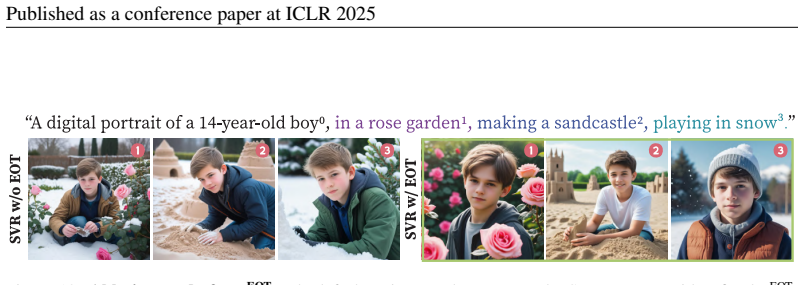
Three components carry the argument. Prompt Consolidation turns $N$ separate frame generations into one text embedding $C=\tau_\xi([P_0;P_1;\dots;P_N])$, relying on the self-attention of Transformer-based text encoders to bind all references to the same identity. Singular-Value Reweighting (SVR) decomposes the token matrix of the frame to express and the EOT token, $X_{\mathrm{exp}}=[c_{P_j},c_{\mathrm{EOT}}]$, as $U\Sigma V^\top$, applies $\hat\sigma=\beta e^{\alpha\sigma}\sigma$ to that frame and $\tilde\sigma=\beta'e^{-\alpha'\hat\sigma}\hat\sigma$ to each suppressed frame, then rebuilds the embedding; its job is to make the current frame's semantics dominant without retraining. Identity-Preserving Cross-Attention (IPCA) zeros out the keys and values of all non-identity frame tokens, concatenates the filtered identity-only keys and values with the original ones, and recomputes the cross-attention map, strengthening subject identity while preserving layout information carried by self-attention.
What would settle it
Build a story where two frames differ only in a rare attribute, such as 'red scarf' versus 'blue scarf', so the distinguishing word is a small singular component of the token matrix; if 1Prompt1Story still renders the rare attribute while keeping identity, the dominant-singular-value premise survives, and if the attribute vanishes from that frame, the premise fails.
Extended reading notes
Core claim
The central discovery is that context consistency, the same mechanism that lets a reader resolve a repeated subject across sentences, operates inside the text encoder's self-attention and can be exploited directly. If the identity prompt and every frame prompt are concatenated into one embedding, the frame tokens cluster more tightly in embedding space and the generated images of the subject stay closer in image-feature space. That observation alone already gives identity consistency, but it blends backgrounds and scenes. The paper then adds Singular-Value Reweighting, which assumes the top singular directions of the current frame token matrix carry the frame's essential meaning and exponentially boosts or shrinks them, and Identity-Preserving Cross-Attention, which concatenates identity-only keys and values with the original ones. The combined pipeline reports CLIP-T 0.8942, CLIP-I 0.9117, and DreamSim 0.1993 on ConsiStory+, the best text-alignment and identity numbers among training-free methods.
Load-bearing premise
The method assumes that the largest singular values of a frame token embedding (together with the EOT token) encode that frame's essential meaning, so that exponentially scaling them brings the frame through and shrinking them removes it; if a frame's distinguishing semantics live in small singular components, SVR would distort rather than clarify.
Editorial extensions
If this is right
- Any diffusion model that accepts a text prompt can gain story-level identity consistency without changing weights, so existing community checkpoints remain usable.
- Frame descriptions are expressed individually, so prompt alignment need not be sacrificed for identity: CLIP-T stays near the vanilla backbone while DreamSim improves over other training-free methods.
- The method composes with existing controls: spatial control gives pose-consistent stories, and a photo-based personalizer can tighten identity to a real reference.
- A sliding window over the consolidated prompt allows stories of arbitrary length, at the cost of gradual identity drift in very long generations.
- Multiple subjects can be kept consistent in one story if the identity prompt lists them, with the trade-off that every generated frame then includes every listed subject.
Reading between the lines
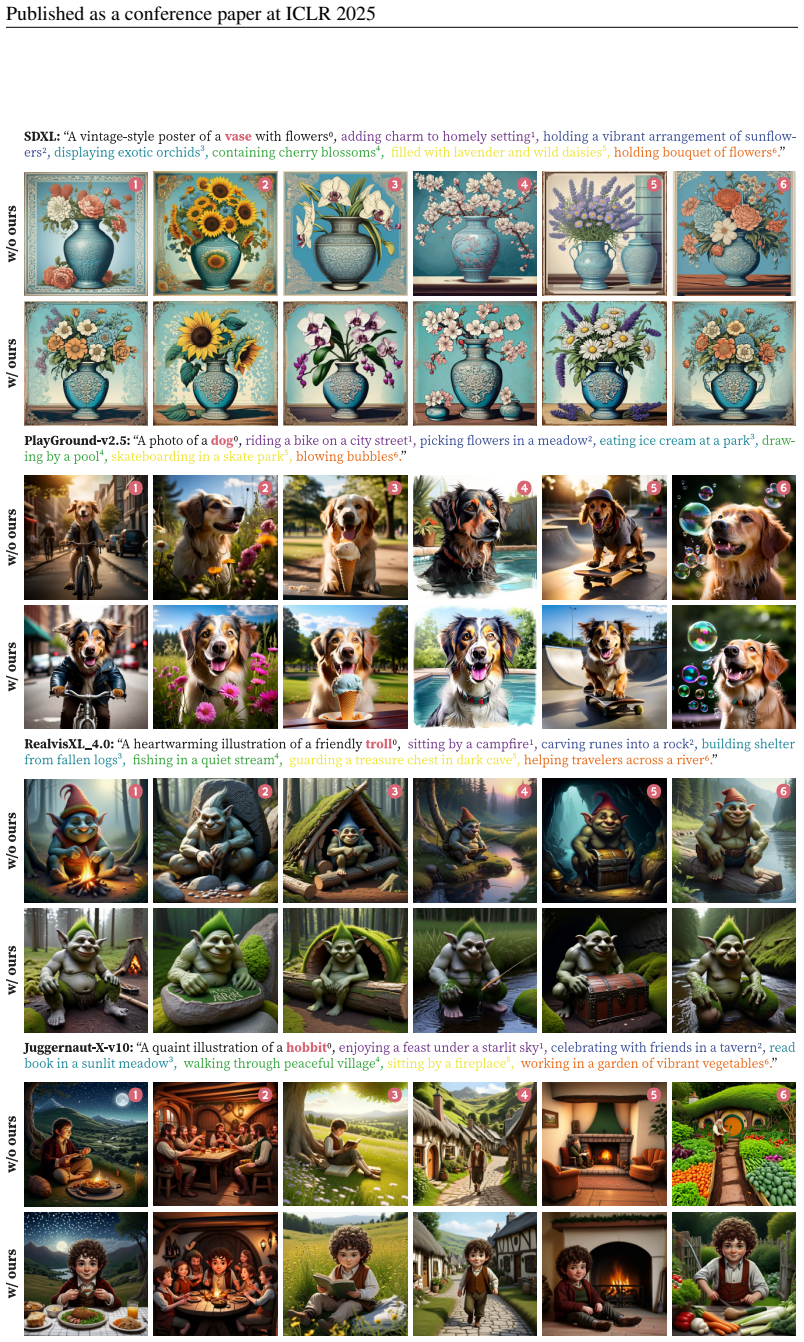
- Beyond the paper: the same prompt-embedding surgery should transfer to any text-conditioned generative model with a Transformer-based text encoder, because SVR touches only text embeddings and attention, not the image denoiser.
- Beyond the paper: the hand-set hyperparameters ($\alpha=0.01$, $\beta=0.05$, $\alpha'=0.01$, $\beta'=1.0$) are not shown to be optimal across styles or encoder sizes; a calibration study per checkpoint could make the method more robust.
- Beyond the paper: IPCA's choice to zero out all non-identity tokens is a strong inductive bias that likely trades pose and layout diversity for identity; keeping a controllable fraction of frame tokens would let users dial that trade-off.
- Beyond the paper: the sliding-window long-story mode re-reads the identity through overlapping windows, so identity drift over long stories can be measured as a function of window position and window overlap.
Editorial analysis
A structured set of objections, weighed in public.
Referee Report
Summary. The paper proposes 1Prompt1Story, a training-free method for consistent text-to-image generation. It concatenates an identity prompt and all frame prompts into a single text prompt (Prompt Consolidation), then applies Singular-Value Reweighting (SVR) to the text embeddings to strengthen the current frame's description while suppressing the others, and Identity-Preserving Cross-Attention (IPCA) to reinforce identity information during denoising. The authors introduce an extended benchmark, ConsiStory+, and report quantitative results (CLIP-T, CLIP-I, DreamSim, DSG, VQAScore, FID), a user study, and qualitative comparisons against both training-based and training-free baselines, claiming state-of-the-art among training-free methods. The core claim is that a single consolidated prompt can leverage the language model's context consistency to preserve identity across frames without any training or architectural change.
Significance. If the claims hold, the paper makes a useful contribution by showing that identity consistency can be obtained by simple prompt concatenation and embedding/post-hoc attention interventions, avoiding the training overhead of most personalization methods. The observation of 'context consistency' in text encoders is interesting and potentially generalizable. The method is compatible with existing SDXL-based models, and the code is released, which supports reproducibility. The paper also provides a larger benchmark (ConsiStory+) that may be a resource for the community. However, the significance is moderated by the evaluation protocol, which currently does not rule out a strong confound from shared-noise initialization, and by the absence of statistical uncertainty in the reported numbers.
major comments (4)
- [Appendix B.1 / Table 1 / Table 2] The statement 'we initialize all frames with the same noise' in Appendix B.1 is a load-bearing experimental choice that is not controlled across baselines. In latent diffusion, the initial latent z_T largely determines coarse structure (pose, layout, composition). Sharing it across frames artificially increases visual similarity among the generated frames, directly inflating the background-removed identity metrics (CLIP-I, DreamSim) used in Table 1 and influencing the user study (Table 2). The paper does not report whether any baseline (ConsiStory, StoryDiffusion, IP-Adapter, etc.) also uses the same initial latent per frame; the default implementations typically use independent or differently-seeded latents. Without either (a) confirming that all methods were run under the same shared-noise protocol, (b) adding an ablation of 1Prompt1Story with per-frame independent noise to show the margins still hold, or (c) re-running the comparison with baselines given the same initial latent, the central claim that SVR and IPCA provide a state-of-the-art identity-consistency improvement is not supported. This is not a minor detail; it is a confound that can independently produce the observed identity consistency.
- [Tables 1, 3, 4 and Section 4.2] All quantitative results are reported as single point estimates without variance, confidence intervals, or significance tests. The differences between the proposed method and the closest training-free baselines are small on some metrics (e.g., CLIP-T 0.8942 vs. 0.8877 for StoryDiffusion in Table 1), and the stochastic nature of diffusion sampling means these differences may be within run-to-run variation. The paper should report means and standard deviations over at least three to five seeds and, ideally, a significance test (e.g., paired bootstrap) for the key comparisons. Without this, the claim of 'outperforms existing training-free methods' (Section 4.2) is not statistically grounded.
- [Section 3.2, Eqs. (2) and (3)] The Singular-Value Reweighting relies on four hand-set hyperparameters (alpha=0.01, beta=0.05, alpha'=0.01, beta'=1.0) whose values are not justified or tested for sensitivity. The paper states that the dominant singular values of X_exp correspond to the 'fundamental information' of the frame prompt, but this is an assumption, not a derivation. Since SVR+ and SVR- are the mechanisms that separate frame semantics, the authors should provide a sensitivity analysis (e.g., sweeping alpha and beta over a range and reporting the effect on CLIP-T/CLIP-I/DreamSim) or a principled criterion for choosing them. Otherwise, the method's performance could be tuned to the specific benchmark and may not transfer to other prompt distributions or backbone models.
- [Section 3.2 and Appendix C.2] The paper does not validate the core SVD assumption directly beyond qualitative examples. It would strengthen the paper to include a more controlled experiment: for a set of frame prompts, measure whether the SVR-modified embedding actually causes the generated image to have higher semantic similarity to the intended frame prompt and lower similarity to suppressed prompts, compared to the unmodified consolidated embedding. The current ablation (Table 3) shows aggregate metric changes but does not isolate whether the improvements come from the intended semantic separation or from a generic embedding distortion that happens to improve the chosen metrics.
minor comments (6)
- [Appendix B.1] The dropout rate of 0.5 applied to the identity token features in \bar{K} is a free parameter not mentioned in the main method description (Section 3.2). It should be reported and discussed in the main text, and its effect should be ablated.
- [Table 1 and Section 4.2] The claim that 1Prompt1Story is 'second when including training-required methods' is ambiguous because IP-Adapter is placed in the training-required group and beats the proposed method on CLIP-I (0.9429 vs. 0.9117) and DreamSim (0.1462 vs. 0.1993). The ranking depends on which metric is prioritized; the sentence should be reworded to avoid implying a clear overall second place.
- [Section 4.1 / Appendix B.2] The ConsiStory+ benchmark is generated by the same team using ChatGPT-4.0-turbo. While this is not circular, the paper should state this more transparently in the main text and discuss any potential bias in prompt selection or superclass distribution.
- [Abstract and Section 1] The term 'free-lunch' is overstated. The method has extra inference-time computations (memory and time as shown in Table 1), requires all prompts in advance, and depends on a shared-noise initialization and a hand-tuned set of hyperparameters. A more measured phrasing would be 'training-free' without implying zero cost.
- [Eqs. (2) and (3), Section 3.2] The notation for the SVR steps is confusing: \hat{X}_{sup} is defined differently in the text and in Algorithm 1, and the superscript/subscript in \tilde{X}_{sup}^k is not clear from the displayed equations. Please align the notation between the main text and the appendix.
- [Section 1 and Figure 1] In Figure 1, the text refers to 'the 6th column' as an example of naive prompt reweighting, but the figure appears to have a different layout; please correct the reference.
Circularity Check
No circular derivation: SVR and IPCA are heuristic post-hoc refinements validated with external metrics; only minor non-load-bearing self-reference exists via the self-extended benchmark and co-authored StoryDiffusion baseline.
full rationale
The paper's claimed derivation chain is not circular. The central claim is that concatenating all frame prompts into a single prompt (Prompt Consolidation) exploits the context consistency of the CLIP text encoder, and that Singular-Value Reweighting plus Identity-Preserving Cross-Attention improve frame alignment and identity. These components are not defined in terms of the target metrics. SVR is stated to be 'Inspired by' external works (Gu et al. 2014; Li et al. 2023a), and the assumption that dominant singular values correspond to fundamental prompt information is explicitly presented as an assumption, not derived from the evaluation metrics. IPCA is inspired by an external cross-attention analysis (Liu et al. 2024). Evaluation uses external metrics (CLIP-T, CLIP-I, DreamSim, VQAScore, DSG) and a benchmark (ConsiStory+) extended by the authors from the public ConsiStory benchmark; metrics are not fitted, and the SVR parameters (alpha, beta, alpha-prime, beta-prime) are hand-set rather than optimized against the reported numbers. There is minor self-reference: StoryDiffusion, a comparison baseline, has overlapping authorship with this paper, and ConsiStory is reimplemented by the authors because it is not open-source; however, neither citation is load-bearing for the derivation, and no prediction reduces by construction to an input. The shared-noise initialization across frames noted in Appendix B.1 is a potential experimental confound for the comparison, but it is a fairness and controllability issue, not a circularity of the kind where a claimed prediction is equivalent to its own inputs. Accordingly, no circular step can be quoted with a specific equation-level reduction, and the score is low.
Assumptions & free parameters
free parameters (5)
- alpha (SVR+ exponent scale) =
0.01
- beta (SVR+ multiplier) =
0.05
- alpha_prime (SVR- exponent scale) =
0.01
- beta_prime (SVR- multiplier) =
1.0
- dropout_rate (identity token mask) =
0.5
assumptions (6)
- standard math SVD of a token embedding matrix exists and reconstructs the matrix when singular values are reweighted.
- domain assumption The dominant singular values of X_exp = [c_Pj, c_EOT] correspond to the fundamental semantic information of the express frame prompt.
- domain assumption The [EOT] token carries significant semantic content that should be amplified or suppressed together with the frame.
- domain assumption Cross-attention maps encode token-wise characteristic information while self-attention encodes layout and shape, so modifying cross-attention keys/values can transfer identity.
- ad hoc to paper Exponentially scaling singular values (Eqs. 2, 3) monotonically enhances or suppresses the corresponding frame semantics without corrupting identity.
- ad hoc to paper Setting token features of frame prompts to zero in keys/values and concatenating with identity-only features preserves identity and prompt alignment.
Cite this review
Pith. "Pith review of One-Prompt-One-Story: Free-Lunch Consistent Text-to-Image Generation Using a Single Prompt." pith.science (2026). https://pith.science/paper/MSIGUZSA
@misc{pith2026250113554,
  author       = {Pith},
  title        = {Pith review of: One-Prompt-One-Story: Free-Lunch Consistent Text-to-Image Generation Using a Single Prompt},
  year         = {2026},
  howpublished = {\url{https://pith.science/paper/MSIGUZSA}},
  note         = {Machine review of arXiv:2501.13554}
}
read the original abstract
Text-to-image generation models can create high-quality images from input prompts. However, they struggle to support the consistent generation of identity-preserving requirements for storytelling. Existing approaches to this problem typically require extensive training in large datasets or additional modifications to the original model architectures. This limits their applicability across different domains and diverse diffusion model configurations. In this paper, we first observe the inherent capability of language models, coined context consistency, to comprehend identity through context with a single prompt. Drawing inspiration from the inherent context consistency, we propose a novel training-free method for consistent text-to-image (T2I) generation, termed "One-Prompt-One-Story" (1Prompt1Story). Our approach 1Prompt1Story concatenates all prompts into a single input for T2I diffusion models, initially preserving character identities. We then refine the generation process using two novel techniques: Singular-Value Reweighting and Identity-Preserving Cross-Attention, ensuring better alignment with the input description for each frame. In our experiments, we compare our method against various existing consistent T2I generation approaches to demonstrate its effectiveness through quantitative metrics and qualitative assessments. Code is available at https://github.com/byliutao/1Prompt1Story.
Figures


Figures from the paper (19 more)






Forward citations
Cited by 1 Pith paper
-
StorySync: Training-Free Subject Consistency in Text-to-Image Generation via Region Harmonization
A training-free inference-time pipeline uses masked cross-image attention sharing and region harmonization to keep subjects consistent across generated story images.
Reference graph
Works this paper leans on
-
[1]
Kiymet Akdemir and Pinar Yanardag. Oracle: Leveraging mutual information for consistent char- acter generation with loras in diffusion models. arXiv preprint arXiv:2406.02820,
-
[3]
The chosen one: Consistent characters in text-to-image diffusion models
Omri Avrahami, Amir Hertz, Yael Vinker, Moab Arar, Shlomi Fruchter, Ohad Fried, Daniel Cohen- Or, and Dani Lischinski. The chosen one: Consistent characters in text-to-image diffusion models. arXiv preprint arXiv:2311.10093,
-
[5]
Reproducible scaling laws for contrastive language-image learning
Mehdi Cherti, Romain Beaumont, Ross Wightman, Mitchell Wortsman, Gabriel Ilharco, Cade Gor- don, Christoph Schuhmann, Ludwig Schmidt, and Jenia Jitsev. Reproducible scaling laws for contrastive language-image learning. In 2023 IEEE/CVF Conference on Computer Vision and Pattern Recognition (CVPR), pp. 2818–2829,
work page 2023
-
[6]
doi: 10.1109/CVPR52729.2023.00276. Jaemin Cho, Yushi Hu, Roopal Garg, Peter Anderson, Ranjay Krishna, Jason Baldridge, Mohit Bansal, Jordi Pont-Tuset, and Su Wang. Davidsonian scene graph: Improving reliability in fine- grained evaluation for text-image generation. arXiv preprint arXiv:2310.18235,
-
[7]
Dreamartist: Towards controllable one-shot text-to-image generation via contrastive prompt-tuning
Ziyi Dong, Pengxu Wei, and Liang Lin. Dreamartist: Towards controllable one-shot text-to-image generation via contrastive prompt-tuning. arXiv preprint arXiv:2211.11337,
-
[9]
An image is worth one word: Personalizing text-to-image generation using textual inversion
Rinon Gal, Yuval Alaluf, Yuval Atzmon, Or Patashnik, Amit H Bermano, Gal Chechik, and Daniel Cohen-Or. An image is worth one word: Personalizing text-to-image generation using textual inversion. International Conference on Learning Representations , 2023a. 11 Published as a conference paper at ICLR 2025 Rinon Gal, Moab Arar, Yuval Atzmon, Amit H Bermano, ...
arXiv 2025
-
[10]
Inhwa Han, Serin Yang, Taesung Kwon, and Jong Chul Ye
URL https://openreview.net/forum?id=Fx2SbBgcte. Inhwa Han, Serin Yang, Taesung Kwon, and Jong Chul Ye. Highly personalized text embedding for image manipulation by stable diffusion. arXiv preprint arXiv:2303.08767, 2023a. Ligong Han, Yinxiao Li, Han Zhang, Peyman Milanfar, Dimitris Metaxas, and Feng Yang. Svdiff: Compact parameter space for diffusion fine...
-
[11]
Clipscore: A reference-free evaluation metric for image captioning
Jack Hessel, Ari Holtzman, Maxwell Forbes, Ronan Le Bras, and Yejin Choi. Clipscore: A reference-free evaluation metric for image captioning. In Proceedings of the 2021 Conference on Empirical Methods in Natural Language Processing , pp. 7514–7528,
work page 2021
Show all 39 references
-
[12]
Mitigating catastrophic forgetting in large language models with self-synthesized rehearsal
Jianheng Huang, Leyang Cui, Ante Wang, Chengyi Yang, Xinting Liao, Linfeng Song, Junfeng Yao, and Jinsong Su. Mitigating catastrophic forgetting in large language models with self-synthesized rehearsal. arXiv preprint arXiv:2403.01244,
-
[13]
Get what you want, not what you don’t: Image content suppression for text-to-image diffusion models
12 Published as a conference paper at ICLR 2025 Senmao Li, Joost van de Weijer, Fahad Khan, Qibin Hou, Yaxing Wang, et al. Get what you want, not what you don’t: Image content suppression for text-to-image diffusion models. InThe Twelfth International Conference on Learning Re...
2025
-
[15]
Knowledge pursuit prompting for zero-shot multimodal synthesis
Jinqi Luo, Kwan Ho Ryan Chan, Dimitris Dimos, and Ren ´e Vidal. Knowledge pursuit prompting for zero-shot multimodal synthesis. arXiv preprint arXiv:2311.17898,
-
[16]
Improving generation and evaluation of vi- sual stories via semantic consistency
Adyasha Maharana, Darryl Hannan, and Mohit Bansal. Improving generation and evaluation of vi- sual stories via semantic consistency. In Proceedings of the 2021 Conference of the North Amer- ican Chapter of the Association for Computational Linguistics: Human Language Technolog...
2021
-
[17]
Sdxl: improving latent diffusion models for high-resolution image synthesis
Dustin Podell, Zion English, Kyle Lacey, Andreas Blattmann, Tim Dockhorn, Jonas M ¨uller, Joe Penna, and Robin Rombach. Sdxl: improving latent diffusion models for high-resolution image synthesis. arXiv preprint arXiv:2307.01952,
-
[18]
Hierarchical text- conditional image generation with clip latents
Aditya Ramesh, Prafulla Dhariwal, Alex Nichol, Casey Chu, and Mark Chen. Hierarchical text- conditional image generation with clip latents. arXiv preprint arXiv:2204.06125,
-
[19]
Dreambooth: Fine tuning text-to-image diffusion models for subject-driven generation
13 Published as a conference paper at ICLR 2025 Nataniel Ruiz, Yuanzhen Li, Varun Jampani, Yael Pritch, Michael Rubinstein, and Kfir Aberman. Dreambooth: Fine tuning text-to-image diffusion models for subject-driven generation. Proceed- ings of the IEEE Conference on Computer ...
2025
-
[20]
Photorealistic text- to-image diffusion models with deep language understanding
Chitwan Saharia, William Chan, Saurabh Saxena, Lala Li, Jay Whang, Emily Denton, Seyed Kam- yar Seyed Ghasemipour, Burcu Karagol Ayan, S Sara Mahdavi, Rapha Gontijo Lopes, Tim Sali- mans, Tim Salimans, Jonathan Ho, David J Fleet, and Mohammad Norouzi. Photorealistic text- to-i...
-
[21]
Instantbooth: Personalized text-to-image generation without test-time finetuning
Jing Shi, Wei Xiong, Zhe Lin, and Hyun Joon Jung. Instantbooth: Personalized text-to-image generation without test-time finetuning. arXiv preprint arXiv:2304.03411,
-
[22]
Storyimager: A uni- fied and efficient framework for coherent story visualization and completion
Ming Tao, Bing-Kun Bao, Hao Tang, Yaowei Wang, and Changsheng Xu. Storyimager: A uni- fied and efficient framework for coherent story visualization and completion. arXiv preprint arXiv:2404.05979,
-
[23]
Training-free consistent text-to-image generation
Yoad Tewel, Omri Kaduri, Rinon Gal, Yoni Kasten, Lior Wolf, Gal Chechik, and Yuval Atzmon. Training-free consistent text-to-image generation. arXiv preprint arXiv:2402.03286,
-
[25]
Magicscroll: Nontypical aspect-ratio image generation for visual storytelling via multi-layered semantic-aware denoising
Bingyuan Wang, Hengyu Meng, Zeyu Cai, Lanjiong Li, Yue Ma, Qifeng Chen, and Zeyu Wang. Magicscroll: Nontypical aspect-ratio image generation for visual storytelling via multi-layered semantic-aware denoising. arXiv preprint arXiv:2312.10899,
-
[26]
Char- acterfactory: Sampling consistent characters with gans for diffusion models
Qinghe Wang, Baolu Li, Xiaomin Li, Bing Cao, Liqian Ma, Huchuan Lu, and Xu Jia. Char- acterfactory: Sampling consistent characters with gans for diffusion models. arXiv preprint arXiv:2404.15677, 2024a. Qixun Wang, Xu Bai, Haofan Wang, Zekui Qin, and Anthony Chen. Instantid: Z...
2025 arXiv
-
[27]
Hu Ye, Jun Zhang, Sibo Liu, Xiao Han, and Wei Yang
URL https:// arxiv.org/abs/2407.08683. Hu Ye, Jun Zhang, Sibo Liu, Xiao Han, and Wei Yang. Ip-adapter: Text compatible image prompt adapter for text-to-image diffusion models. arXiv preprint arXiv:2308.06721,
-
[28]
Storydiffu- sion: Consistent self-attention for long-range image and video generation
Yupeng Zhou, Daquan Zhou, Ming-Ming Cheng, Jiashi Feng, and Qibin Hou. Storydiffu- sion: Consistent self-attention for long-range image and video generation. arXiv preprint arXiv:2405.01434,
-
[29]
15 Published as a conference paper at ICLR 2025 APPENDIX A B OARDER IMPACTS AND LIMITATIONS Boarder Impacts. The application of T2I models in consistent image generation offers exten- sive potential for various downstream applications, enabling the adaptation of images to diff...
2025
-
[31]
Following (Tewel et al., 2024; Alaluf et al., 2024; Luo et al., 2023), we use Free-U (Si et al.,
2024
-
[32]
All generated images based on SDXL are produced at a resolution of 1024 × 1024 using a Quadro RTX 3090 GPU with 24GB VRAM
to enhance the generation quality. All generated images based on SDXL are produced at a resolution of 1024 × 1024 using a Quadro RTX 3090 GPU with 24GB VRAM. B.2 B ENCHMARK DETAILS To evaluate the effectiveness of our method, we developedConsiStory+, an extended prompt bench- ...
2024
-
[33]
• The official implementation of PhotoMaker (Li et al., 2023b) at https://github.com/ TencentARC/PhotoMaker
at https://github.com/ tencent-ailab/IP-Adapter. • The official implementation of PhotoMaker (Li et al., 2023b) at https://github.com/ TencentARC/PhotoMaker. 5https://huggingface.co/runwayml/stable-diffusion-v1-5 17 Published as a conference paper at ICLR 2025 Figure 9: (Left)...
2025
-
[34]
a photo of a beautiful girl walking on the street
is not open-source, we reimplemented it ourselves. During the inference time, BLIP-Diffusion (Li et al., 2024), IP-Adapter (Ye et al., 2023), and PhotoMaker (Li et al., 2023b) all require a reference image as the additional input. To generate the reference image, we use their ...
2024
-
[35]
Specifically, we kept the cEOT part of the text embedding unchanged during the SVR process and used this text embedding to generate images
Furthermore, to demonstrate the role of the cEOT in SVR, we conducted an ablation study on the cEOT component. Specifically, we kept the cEOT part of the text embedding unchanged during the SVR process and used this text embedding to generate images. As shown in Fig. 13, the r...
2025
-
[36]
By using different seeds, our method 1Prompt1Story can generate images with diverse backgrounds while maintaining a consistent identity
21 Published as a conference paper at ICLR 2025 Figure 15: Seed variation. By using different seeds, our method 1Prompt1Story can generate images with diverse backgrounds while maintaining a consistent identity. D A DDITIONAL RESULTS OF OUR METHOD 1Prompt1Story D.1 C ONSISTENT...
2025
-
[37]
By defining multiple subjects in the identity prompt, our method generates images featuring multiple characters, each maintaining good identity consistency
22 Published as a conference paper at ICLR 2025 Figure 16: Multi-subject story generation. By defining multiple subjects in the identity prompt, our method generates images featuring multiple characters, each maintaining good identity consistency. Figure 17: Additional result ...
2025
-
[38]
indicate that these models can also achieve image generation with enhanced identity consistency when employing our method 1Prompt1Story. 6https://huggingface.co/playgroundai/playground-v2.5-1024px-aesthetic 7https://huggingface.co/SG161222/RealVisXL V4.0 8https://huggingface.c...
2025
-
[39]
sliding window
and VQAScore(Lin et al., 2025). Both DSG and VQA are metrics that measure the consistency between images and text by evaluating questions and their corresponding answers. These metrics have been shown to provide more reliable strengths in fine- grained diagnosis and align clos...
2025
-
[2017]
Andrey V oynov, Qinghao Chu, Daniel Cohen-Or, and Kfir Aberman
URL https://proceedings.neurips.cc/paper_files/paper/2017/ file/3f5ee243547dee91fbd053c1c4a845aa-Paper.pdf. Andrey V oynov, Qinghao Chu, Daniel Cohen-Or, and Kfir Aberman. p+: Extended textual condi- tioning in text-to-image generation. arXiv preprint arXiv:2303.09522,
2017 arXiv
-
[2019]
Pho- tomaker: Customizing realistic human photos via stacked id embedding
Zhen Li, Mingdeng Cao, Xintao Wang, Zhongang Qi, Ming-Ming Cheng, and Ying Shan. Pho- tomaker: Customizing realistic human photos via stacked id embedding. arXiv preprint arXiv:2312.04461, 2023b. Zhiqiu Lin, Deepak Pathak, Baiqi Li, Jiayao Li, Xide Xia, Graham Neubig, Pengchua...
-
[2021]
We separately update the text embeddings produced by each encoder
and the OpenCLIP bigG/14 encoder (Cherti et al., 2023). We separately update the text embeddings produced by each encoder. For Naive Prompt Reweighting , we multiply the text embedding corresponding to the frame prompt that needs to be expressed by a factor of 2, while the tex...
2023
-
[2022]
Dreamsim: Learning new dimensions of human visual similarity using synthetic data
Stephanie Fu, Netanel Tamir, Shobhita Sundaram, Lucy Chai, Richard Zhang, Tali Dekel, and Phillip Isola. Dreamsim: Learning new dimensions of human visual similarity using synthetic data. arXiv preprint arXiv:2306.09344,
-
[2023]
Autostudio: Crafting consistent subjects in multi-turn interactive image generation
Junhao Cheng, Xi Lu, Hanhui Li, Khun Loun Zai, Baiqiao Yin, Yuhao Cheng, Yiqiang Yan, and Xi- aodan Liang. Autostudio: Crafting consistent subjects in multi-turn interactive image generation. arXiv preprint arXiv:2406.01388,
-
[2024]
Cross- image attention for zero-shot appearance transfer
Yuval Alaluf, Daniel Garibi, Or Patashnik, Hadar Averbuch-Elor, and Daniel Cohen-Or. Cross- image attention for zero-shot appearance transfer. In ACM SIGGRAPH 2024 Conference Papers, pp. 1–12,
2024
Reviewed August 10, 2026 · model on record in the stance chip above.
Discussion (0). Continue with ORCID to comment.