REVIEW 3 major objections 7 minor 2 cited by
WFCRL: A Multi-Agent Reinforcement Learning Benchmark for Wind Farm Control
T0 review · 3 major / 7 minor · reviewed 2026-08-10 · deepseek-v4-flash
Pith's one-line read WFCRL is the first open multi-agent reinforcement learning benchmark for wind farm control.
desk verdict A genuinely useful open MARL benchmark for wind farm control, with a real code release, but the load-penalty proxy in the reward is the one piece that needs scrutiny before the benchmark results should be taken at face value. read the letter →
The pith
A machine-rendered reading of the paper's core claim, the machinery that carries it, and where it could break.
The reading
What carries the argument
The load-bearing mechanism is the WFCRL environment wrapper, which converts two existing wind farm simulators into standard single- and multi-agent RL interfaces with a common observation, action, and reward structure. In the multi-agent setting the problem is a Dec-POMDP: local observation $o_i=(u_i,\phi_i,\theta_i)$, global observation $o_g=(o_1,\dots,o_M,u_\infty,\phi_\infty)$, and actions as bounded increments $[\Delta y_i]$ (plus $\Delta p_i$ and $\Delta\tau_i$ in the dynamic simulator). The shared reward is $r_k = \frac{1}{M}\sum_i \frac{\hat P^i_k}{(u_{\infty,k})^3} - \alpha\, r^L_k$, with the load penalty $r^L_k$ computed from turbulence and velocity variance on rotor-plane grids in the static case and from in-plane and out-of-plane blade bending moments in the dynamic case. A second mechanism is the fidelity gap itself: the benchmark's transfer task trains on the cheap static simulator and then fine-tunes on the dynamic one, scoring policies by a weighted sum over wind conditions, so that the suite measures not only raw performance but also robustness to unseen dynamics.
What would settle it
Take a yaw policy fine-tuned on the dynamic simulator for the three-turbine row layout, deploy it on a real wind farm or a scaled wind-tunnel model, and compare the measured power gain over greedy operation with the simulator's prediction; if the gain is not reproduced within the simulator's stated accuracy (power errors up to 18% on downstream turbines at low wind speed), the benchmark's sim-to-real transfer premise is unsupported.
Extended reading notes
Core claim
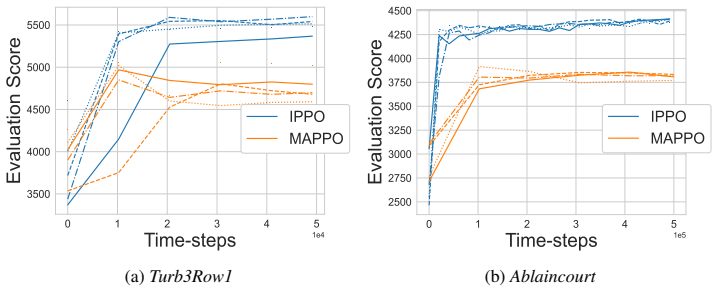
The central object is WFCRL, an open, customizable suite of reinforcement learning environments for wind farm control. The paper formalizes the problem as a cooperative Dec-POMDP: each of $M$ turbines is an agent receiving local observations of wind speed, wind direction, and its actuator setpoints, while a global observation concatenates all local states with free-stream wind measurements. Actions are increments to yaw (and, in the dynamic simulator, pitch and torque), constrained by an actuation-rate limit, and every agent shares a reward $r_k = r^P_k - \alpha r^L_k$ that combines power production normalized by the cube of the free-stream wind speed with a load penalty derived either from rotor-plane turbulence statistics or from blade bending moments. The suite ships ten layouts ranging from 3 to 91 turbines, five of them mirroring real wind farms, and includes implementations of two continuous-action actor-critic baselines and two discrete-action value-based baselines. The accompanying benchmark example trains these baselines on the wake-steering task under constant and varying wind, evaluates them on both simulators, and demonstrates that a straightforward fine-tuning transfer from the static to the dynamic simulator does not improve on the greedy baseline, which the paper interprets as evidence that robust transfer methods are an open problem this benchmark is built to study.
Load-bearing premise
The load-bearing assumption is that the dynamic simulator predicts how yaw policies change power and loads on a real wind farm closely enough to stand in for it; the paper itself notes that no test of yaw-optimization transfer from that simulator to a real farm has been published.
Editorial extensions
If this is right
- Researchers get a shared testbed with ten layouts, two simulator fidelities, and ready-made baselines, so wind farm control results become reproducible and comparable across papers.
- The included reward couples power capture and fatigue, letting future work optimize the trade-off between farm output and turbine lifetime rather than power alone.
- The transfer protocol gives a concrete way to measure whether policies trained on a cheap static model remain effective on a dynamic simulator, which is a necessary step before field deployment.
- The baseline results show both continuous-action algorithms learn wake-steering yaws on a row layout, with the shared-critic variant becoming relatively more useful as turbine count and wind variability increase.
- The paper's transfer experiment shows naive fine-tuning can destroy the gains of a pre-trained policy, so the benchmark will push the community toward more robust sim-to-sim and sim-to-real transfer algorithms.
Reading between the lines
- An unstated consequence of the reward design is a family of power-versus-fatigue trade-offs indexed by $\alpha$; sweeping $\alpha$ would produce a Pareto frontier that the paper does not compute.
- The appendix's representation of wake interactions as a time-varying directed acyclic graph suggests a natural follow-up: test whether graph-based or communication-aware MARL policies outperform the independent learners on large layouts.
- Because the dynamic simulator's largest reported errors occur at low free-stream wind speeds, the load rewards may be least reliable in precisely the regimes where wake steering is most valuable; a per-wind-regime robustness analysis would clarify this.
- The two-simulator design is implicitly a general sim-to-real testbed: the dynamic simulator can stand in for an unknown real plant, and the suite could host benchmarks for adaptive and meta-learning transfer methods beyond fine-tuning.
Editorial analysis
A structured set of objections, weighed in public.
Referee Report
Summary. This paper introduces WFCRL, an open-source suite of multi-agent reinforcement learning environments for wind farm control. Each turbine is modeled as an agent that can adjust yaw (and, on FAST.Farm, pitch and torque), with local and global observations, common rewards, and Gymnasium/PettingZoo interfaces. The suite is interfaced with two NREL simulators, the static wake model FLORIS and the dynamic simulator FAST.Farm (via MPI), and ships ten predefined layouts, including five real wind farm geometries and procedurally generated rows, together with three wind-condition scenarios. The authors implement IPPO, MAPPO, QMIX, and independent DQN baselines, and demonstrate the suite through a wake-steering benchmark example that maximizes total power production minus a load penalty, training on FLORIS under constant and distributional wind scenarios and reporting five-seed statistics. A transfer experiment fine-tunes a FLORIS-trained IPPO policy on a three-turbine FAST.Farm layout; the naive fine-tuning degrades performance, which the authors present as evidence of the difficulty of cross-simulator transfer. The paper claims to be the first open MARL environment suite for the general wind farm control problem and provides code and reproduction URLs.
Significance. If the issues below are addressed, this is a valuable shared resource for the RL and wind-energy communities: it is the first open, general MARL testbed for wind farm control that the authors could locate, with permissive licensing (Apache-2.0), standard interfaces, five-seed baseline statistics, explicitly reported compute budgets, and a built-in FLORIS-to-FAST.Farm transfer task that is hard to reproduce otherwise because FAST.Farm is slow and not natively exposed through Python. The paper is honestly hedged where it matters most: Section 4 explicitly concedes that FAST.Farm-to-real transfer of yaw policies is unvalidated, and the negative naive-fine-tuning result in Appendix F.1 is reported rather than hidden; the reader's weakest assumption about sim2real validity therefore does not undermine the internal validity of the suite. The main weakness is the load-aware reward used in the benchmark example: the FLORIS load proxy in Eq. (5) is unvalidated, and the tabulated reward decomposition is internally inconsistent, so the load-related results (contribution 4 and the abstract's 'limiting turbine structural damages') are not supportable as published.
major comments (3)
- [Section 3.1, Eq. (5)] The FLORIS load penalty rL_k,S defined in Eq. (5) is embedded in the benchmark reward rk = rP_k - alpha*rL_k, and the abstract and contribution list present the load-aware objective as a central feature ('optimize the farm performance while limiting turbine structural damages'; contribution 4). The paper provides no validation of this proxy against the FAST.Farm bending-moment loads of Eq. (6) or against measured fatigue data, and no citation of prior validation for this specific sum of turbulence intensity and velocity standard deviations; the sentence in Section 2.1 that FLORIS models 'do not compute any estimate of fatigues' only motivates the proxy and does not validate it. The downscaling factor that is supposed to bring rL to the same magnitude as rP is never reported, and no sensitivity analysis for alpha is given. Because Tables 8-9 and Fig. 8 draw load-aware conclusions from this proxy, the load-aware results are not yet supported; I request either a validation (e.g., on Turb3Row1, compare the ranking of policies by the Eq. (5) proxy with their ranking by the Eq. (6) FAST.Farm loads) or a restriction of the load-aware claims to the FAST.Farm experiments, together with the numerical downscaling factor and an alpha sensitivity study.
- [Section 3.2 / Appendix F.2, Tables 7-9] The evaluation score in Table 7, the power sum in Table 8, and the load sum in Table 9 are mutually inconsistent under the stated reward rk = rP_k - alpha*rL_k, and no positive scaling of the components can reconcile them. For Ablaincourt under Sc. 1 on FLORIS, IPPO reports (score, power, load) = (351.0, 222.6, 82.3) and MAPPO reports (351.7, 218.6, 82.9); if both scores were of the form c*power - d*load with the same positive constants c and d in the same environment, subtracting the two rows would give 4.0c + 0.6d = -0.7, which is impossible. The score-to-power ratios also differ across rows (1.22 to 1.61), so a per-environment normalization of rP cannot explain the discrepancy. Since Tables 8-9 are described as decompositions of the same evaluation episodes used for Table 7, the benchmark reward cannot be reconstructed as published; the authors should report the exact normalization and downscaling factors used per simulator, state which quantity each table reports (reward contribution versus raw indicator), and recompute the three sums from identical evaluation episodes.
- [Section 3.2 and Appendix F.1] The benchmark results are never calibrated against the greedy baseline they are said to improve upon. Appendix F.1 states that FLORIS-learned IPPO policies deployed on FAST.Farm 'achieve an increase of 15% in power production over the baseline' and that a policy from reference [28] reaches 21%, but no table or figure reports the greedy baseline power or load values, and no greedy horizontal line appears in Figs. 2-3, 8-9. The load and power sums in Tables 7-9 are therefore uninterpretable without knowing the greedy values. Because the benchmark example is the paper's demonstration of the suite (contribution 4), I request that greedy-baseline rows and curves be added to the tables and figures, and ideally a simple model-based yaw-optimization baseline (e.g., a FLORIS gradient search) on at least the Turb3Row1 and Ablaincourt layouts.
minor comments (7)
- [Section 2.1] The sentence 'The choice of the wind farm simulators included in WFRCL relies on three criteria' uses the misspelling 'WFRCL' for WFCRL.
- [Section 3.1, Eq. (4)] The normalization described as 'divided by the number of agents and normalized by the free-stream wind velocity' actually divides farm power by M and by u-infinity^3, which does not yield a dimensionless coefficient and leaves the units of rP unstated; please state explicitly that this is a heuristic normalization or use a power-coefficient form (e.g., divide by 0.5*rho*u-infinity^3), and note that the resulting objective is the per-turbine mean power, not the total production as the section title states.
- [Abstract and Section 2.3.3] The abstract says 'Two state-of-the-art online MARL algorithms are implemented,' the contributions list says 'three,' and Section 2.3.3 with Appendix F actually evaluate IPPO, MAPPO, QMIX, IDQN, and IDRQN; please align these counts.
- [Table 2 and Abstract] Load measurements are not listed among the default observations (FLORIS: ui, phi_i, yi; FAST.Farm: ui, phi_i, yi, pi, tau_i), yet the abstract says WFCRL 'offers turbine load observations'; clarify whether loads are available to the policies as observations or only as inputs to the reward.
- [Section 3.1, Eq. (5)] The notation in Eq. (5) is ambiguous: the sum over j runs over the 9 grid points of each rotor i, but the terms sigma(u_k), sigma(v_k), sigma(w_k) carry no turbine index, so it is unclear whether they are computed per rotor plane or globally over the whole velocity field; please specify the domain of each standard deviation.
- [Appendix F.1 and Table 7 caption] There are several proofreading errors: 'we simulate a900 steps episode' and 'correponding to28800 steps' in Appendix F.1, and 'the firts Wind Scenario' in the Table 7 caption.
- [Author checklist] The author checklist points to 'Section 3.2' for the discussion of limitations, but the limitations are discussed in Section 4; the pointer should be updated.
Circularity Check
No significant circularity: WFCRL is an empirically measured benchmark suite; the unvalidated load proxy is a validation concern, not a circular derivation.
full rationale
This paper is a benchmark and environment suite rather than a derivation chain, so the main circularity patterns do not apply. The central contributions—FLORIS/FAST.Farm interfaces, the ten layouts, the MARL algorithm implementations, and the benchmark example—are empirical artifacts. The reported results (Tables 7-9, Figures 2-3 and 7-9) are measurements of standard algorithms (IPPO, MAPPO, QMIX, IDRQN) on the environments, not predictions constructed from fitted parameters or from the paper's own definitions. The reward structure r = rP - alpha*rL is an explicit design choice; the FLORIS load proxy (Eq. 5) and the FAST.Farm bending-moment load estimate (Eq. 6) are independently defined from different simulator quantities, so neither is defined in terms of the other or in terms of the benchmark's outcomes. The lack of validation of the load proxy is a legitimate correctness and reward-misspecification concern, but it is not circularity: no claim is reduced to its own input by construction. The transfer task treats FAST.Farm as a proxy for a real wind farm, and the paper explicitly discloses in Section 4 that 'there has been to the best of our knowledge no explicit investigation of the transfer of yaw optimization results from FAST.Farm simulations to a real wind farm,' so the scope is honestly stated. The self-citations ([5] and [28]) are contextual: [5] is cited among prior multi-agent RL approaches, and [28] is used in Appendix F.1 to cite a prior transfer method and a 21% power-increase result on Turb3Row1 for comparison. These citations are not load-bearing inputs to any derivation in this paper; they are external empirical results from the authors' prior work used for context and comparison. No step in the paper, by its own equations or by a self-citation chain, reduces to its inputs, so the appropriate finding is no significant circularity.
Assumptions & free parameters
free parameters (2)
- reward weighting alpha =
1 (default)
- load penalty downscaling factor =
not specified
assumptions (3)
- domain assumption Local wind measurements at each turbine plus a free-stream estimate are a sufficient observation for a Markovian control policy.
- domain assumption FLORIS and FAST.Farm provide valid approximations of real wind farm physics.
- domain assumption Wind farm control can be framed as a cooperative Dec-POMDP with a common reward.
invented entities (1)
-
FLORIS load proxy (Eq. 5)
Cite this review
Pith. "Pith review of WFCRL: A Multi-Agent Reinforcement Learning Benchmark for Wind Farm Control." pith.science (2026). https://pith.science/paper/TZQWGAH4
@misc{pith2026250113592,
  author       = {Pith},
  title        = {Pith review of: WFCRL: A Multi-Agent Reinforcement Learning Benchmark for Wind Farm Control},
  year         = {2026},
  howpublished = {\url{https://pith.science/paper/TZQWGAH4}},
  note         = {Machine review of arXiv:2501.13592}
}
abstract
The wind farm control problem is challenging, since conventional model-based control strategies require tractable models of complex aerodynamical interactions between the turbines and suffer from the curse of dimension when the number of turbines increases. Recently, model-free and multi-agent reinforcement learning approaches have been used to address this challenge. In this article, we introduce WFCRL (Wind Farm Control with Reinforcement Learning), the first open suite of multi-agent reinforcement learning environments for the wind farm control problem. WFCRL frames a cooperative Multi-Agent Reinforcement Learning (MARL) problem: each turbine is an agent and can learn to adjust its yaw, pitch or torque to maximize the common objective (e.g. the total power production of the farm). WFCRL also offers turbine load observations that will allow to optimize the farm performance while limiting turbine structural damages. Interfaces with two state-of-the-art farm simulators are implemented in WFCRL: a static simulator (FLORIS) and a dynamic simulator (FAST.Farm). For each simulator, $10$ wind layouts are provided, including $5$ real wind farms. Two state-of-the-art online MARL algorithms are implemented to illustrate the scaling challenges. As learning online on FAST.Farm is highly time-consuming, WFCRL offers the possibility of designing transfer learning strategies from FLORIS to FAST.Farm.
Figures


Figures from the paper (9 more)


Forward citations
Cited by 2 Pith papers
-
Reinforcement Learning Increases Wind Farm Power Production by Enabling Closed-Loop Collaborative Control
A closed-loop RL controller dynamically yaws turbines in LES and raises wind farm power by 4.30%, nearly doubling the 2.19% gain of static Bayesian-optimized yaw angles.
-
Toward Adaptable Multi-Agent Reinforcement Learning: An Assumption-Aware Review
A survey proposing adaptability as a three-part taxonomy (learning, policy, scenario-driven) for organizing and evaluating MARL under changing conditions.
Reference graph
Works this paper leans on
-
[28]
Towards fine tuning wake steering policies in the field: an imitation-based approach
C Bizon Monroc, A Buši´c, D Dubuc, and J Zhu. Towards fine tuning wake steering policies in the field: an imitation-based approach. In Journal of Physics: Conference Series, volume 2767, page 032017. IOP Publishing, 2024
work page 2024
-
[1]
Reinforcement learning for wind-farm flow control: Current state and future actions
Mahdi Abkar, Navid Zehtabiyan-Rezaie, and Alexandros Iosifidis. Reinforcement learning for wind-farm flow control: Current state and future actions. Theoretical and Applied Mechanics Letters, 13(6):100475, 2023
work page 2023
-
[2]
Ramon Abritta. Wind power plants layouts according to arbitrary reference points, Thanet, West of Duddon Sands, Ormonde, Westermost Rough, Horns Rev 1 & 2, Anholt, and London Array [Data set]. Zenodo. https://zenodo.org/records/10927983, 2023
-
[3]
Archer, Ahmadreza Vasel-Be-Hagh, Chi Yan, Sicheng Wu, Yang Pan, Joseph F
Cristina L. Archer, Ahmadreza Vasel-Be-Hagh, Chi Yan, Sicheng Wu, Yang Pan, Joseph F. Brodie, and A. Eoghan Maguire. Review and evaluation of wake loss models for wind energy applications. Applied Energy, 226:1187–1207, 9 2018
work page 2018
-
[4]
R. J. Barthelmie, S. C. Pryor, S. T. Frandsen, K. S. Hansen, J. G. Schepers, K. Rados, W. Schlez, A. Neubert, L. E. Jensen, and S. Neckelmann. Quantifying the impact of wind turbine wakes on power output at offshore wind farms. Journal of Atmospheric and Oceanic Technology, 27(8):1302 – 1317, 2010
work page 2010
-
[5]
Actor critic agents for wind farm control
Claire Bizon Monroc, Ana Buši ´c, Donatien Dubuc, and Jiamin Zhu. Actor critic agents for wind farm control. In 2023 American Control Conference (ACC), pages 177–183, 2023
work page 2023
-
[6]
A tutorial on control-oriented modeling and control of wind farms
Sjoerd Boersma, Bart M Doekemeijer, Pieter MO Gebraad, Paul A Fleming, Jennifer Annoni, Andrew K Scholbrock, Joeri Alexis Frederik, and Jan-Willem van Wingerden. A tutorial on control-oriented modeling and control of wind farms. In 2017 American control conference (ACC), pages 1–18. IEEE, 2017
work page 2017
-
[7]
Greg Brockman, Vicki Cheung, Ludwig Pettersson, Jonas Schneider, John Schulman, Jie Tang, and Wojciech Zaremba. Openai gym. arXiv preprint arXiv:1606.01540, 2016
arXiv 2016
Show all 53 references
-
[8]
Is independent learning all you need in the starcraft multi-agent challenge? 2020
Christian Schroeder de Witt, Tarun Gupta, Denys Makoviichuk, Viktor Makoviychuk, Philip HS Torr, Mingfei Sun, and Shimon Whiteson. Is independent learning all you need in the starcraft multi-agent challenge? 2020
2020
-
[9]
Decentralized yaw optimization for maximizing wind farm production based on deep reinforcement learning
Zhiwen Deng, Chang Xu, Xingxing Han, Zhe Cheng, and Feifei Xue. Decentralized yaw optimization for maximizing wind farm production based on deep reinforcement learning. Energy Conversion and Management, 286:117031, 2023
2023
-
[10]
Intelligent wind farm control via deep reinforcement learning and high-fidelity simulations
Hongyang Dong, Jincheng Zhang, and Xiaowei Zhao. Intelligent wind farm control via deep reinforcement learning and high-fidelity simulations. Applied Energy, 292(C), 2021
2021
-
[11]
Reinforcement learning-based wind farm control: Toward large farm applications via automatic grouping and transfer learning
Hongyang Dong and Xiaowei Zhao. Reinforcement learning-based wind farm control: Toward large farm applications via automatic grouping and transfer learning. IEEE Transactions on Industrial Informatics, 19(12):11833–11845, 2023
2023
-
[12]
Local turbulence parameterization improves the jensen wake model and its implementation for power optimization of an operating wind farm
Thomas Duc, Olivier Coupiac, Nicolas Girard, Gregor Giebel, and Tuhfe Göçmen. Local turbulence parameterization improves the jensen wake model and its implementation for power optimization of an operating wind farm. Wind Energy Science, 4(2):287–302, 5 2019
2019
-
[13]
Wind plant power optimization through yaw control using a parametric model for wake effects - a cfd simulation study
PMO Gebraad, FW Teeuwisse, JW van Wingerden, PA Fleming, SD Ruben, JR Marden, and L.Y Pao. Wind plant power optimization through yaw control using a parametric model for wake effects - a cfd simulation study. Wind Energy, 19(1):95 – 114, 2016
2016
-
[14]
Göçmen, F
T. Göçmen, F. Campagnolo, T. Duc, I. Eguinoa, S. J. Andersen, V . Petrovi ´c, L. Imširovi ´c, R. Braunbehrens, J. Liew, M. Baungaard, M. P. van der Laan, G. Qian, M. Aparicio-Sanchez, R. González-Lope, V . V . Dighe, M. Becker, M. J. van den Broek, J.-W. van Wingerden, A. Stoc...
2022
-
[15]
Sim2real in robotics and automation: Applications and challenges
Sebastian Höfer, Kostas Bekris, Ankur Handa, Juan Camilo Gamboa, Melissa Mozifian, Florian Golemo, Chris Atkeson, Dieter Fox, Ken Goldberg, John Leonard, et al. Sim2real in robotics and automation: Applications and challenges. IEEE transactions on automation science and engine...
2021
-
[16]
Review of wake management techniques for wind turbines
Daniel R Houck. Review of wake management techniques for wind turbines. Wind Energy, 25(2):195–220, 2022
2022
-
[17]
Howland, Sanjiva K
Michael F. Howland, Sanjiva K. Lele, and John O. Dabiri. Wind farm power optimization through wake steering. Proceedings of the National Academy of Sciences, 116(29):14495–14500, 2019
2019
-
[18]
Shengyi Huang, Rousslan Fernand Julien Dossa, Chang Ye, Jeff Braga, Dipam Chakraborty, Kinal Mehta, and João G.M. Araújo. Cleanrl: High-quality single-file implementations of deep reinforcement learning algorithms. Journal of Machine Learning Research, 23(274):1–18, 2022
2022
-
[19]
Validation of FAST.farm against large-eddy simulations
J Jonkman, P Doubrawa, N Hamilton, J Annoni, and P Fleming. Validation of FAST.farm against large-eddy simulations. Journal of Physics: Conference Series, 1037:062005, 6 2018
2018
-
[20]
Definition of a 5-mw reference wind turbine for offshore system development
Jason Jonkman, Sandy Butterfield, Walter Musial, and George Scott. Definition of a 5-mw reference wind turbine for offshore system development. Technical report, National Renewable Energy Lab.(NREL), 2009
2009
-
[21]
Development of fast
Jason M Jonkman, Jennifer Annoni, Greg Hayman, Bonnie Jonkman, and Avi Purkayastha. Development of fast. farm: A new multi-physics engineering tool for wind-farm design and analysis. In 35th wind energy symposium, page 0454, 2017
2017
-
[22]
Marlyc: Multi-agent reinforcement learning yaw control
Elie Kadoche, Sébastien Gourvénec, Maxime Pallud, and Tanguy Levent. Marlyc: Multi-agent reinforcement learning yaw control. Renewable Energy, 217:119129, 2023
2023
-
[23]
Kheirabadi and Ryozo Nagamune
Ali C. Kheirabadi and Ryozo Nagamune. A quantitative review of wind farm control with the objective of wind farm power maximization. Journal of Wind Engineering and Industrial Aerodynamics, 192:45–73, 2019
2019
-
[24]
Matthias Kretschmer, Jason Jonkman, Vasilis Pettas, and Po Wen Cheng. Fast. farm load validation for single wake situations at alpha ventus. Wind Energy Science Discussions, 2021:1– 20, 2021
2021
-
[25]
Jaime Liew, Tuhfe Göçmen, Wai Hou Lio, and Gunner Chr. Larsen. Model-free closed-loop wind farm control using reinforcement learning with recursive least squares. Wind Energy, 2023
2023
-
[26]
Miller and Kara Clark
Nicholas W. Miller and Kara Clark. Advanced controls enable wind plants to provide ancillary services. In IEEE PES General Meeting, pages 1–6, 2010
2010
-
[27]
Human-level control through deep reinforcement learning
V olodymyr Mnih, Koray Kavukcuoglu, David Silver, Andrei A Rusu, Joel Veness, Marc G Bellemare, Alex Graves, Martin Riedmiller, Andreas K Fidjeland, Georg Ostrovski, et al. Human-level control through deep reinforcement learning. Nature, 518(7540):529–533, 2015
2015
-
[29]
Deep reinforcement learning for active wake control
Grigory Neustroev, Sytze PE Andringa, Remco A Verzijlbergh, and Mathijs M De Weerdt. Deep reinforcement learning for active wake control. In Proceedings of the 21st International Conference on Autonomous Agents and Multiagent Systems, pages 944–953, 2022
2022
-
[30]
Openfast documentation, 2022
NREL. Openfast documentation, 2022
2022
-
[31]
Falcon-farm level control for wind turbines using multi-agent deep reinforcement learning
Venkata Ramakrishna Padullaparthi, Srinarayana Nagarathinam, Arunchandar Vasan, Vishnu Menon, and Depak Sudarsanam. Falcon-farm level control for wind turbines using multi-agent deep reinforcement learning. Renewable Energy, 181:445–456, 2022
2022
-
[32]
Wind power production from very large offshore wind farms
Sara C Pryor, Rebecca J Barthelmie, and Tristan J Shepherd. Wind power production from very large offshore wind farms. Joule, 5(10):2663–2686, 2021
2021
-
[33]
An improved yaw control algorithm for wind turbines via reinforcement learning
Alban Puech and Jesse Read. An improved yaw control algorithm for wind turbines via reinforcement learning. In Joint European Conference on Machine Learning and Knowledge Discovery in Databases, pages 614–630. Springer, 2022
2022
-
[34]
Monotonic value function factorisation for deep multi-agent reinforcement learning
Tabish Rashid, Mikayel Samvelyan, Christian Schroeder De Witt, Gregory Farquhar, Jakob Foerster, and Shimon Whiteson. Monotonic value function factorisation for deep multi-agent reinforcement learning. Journal of Machine Learning Research, 21(178):1–51, 2020
2020
-
[35]
Proximal policy optimization algorithms
John Schulman, Filip Wolski, Prafulla Dhariwal, Alec Radford, and Oleg Klimov. Proximal policy optimization algorithms. arXiv preprint arXiv:1707.06347, 2017. 12
2017 arXiv
-
[36]
Validation of fast
Kelsey Shaler, Mithu Debnath, and Jason Jonkman. Validation of fast. farm against full-scale turbine scada data for a small wind farm. In Journal of Physics: Conference Series, volume 1618, page 062061. IOP Publishing, 2020
2020
-
[37]
Kelsey Shaler and Jason Jonkman. Fast. farm development and validation of structural load prediction against large eddy simulations. Wind Energy, 24(5):428–449, 2021
2021
-
[38]
A fast.farm and matlab/simulink interface for wind farm control design
Coen-Jan Smits, Jean Gonzalez Silva, Valentin Chabaud, and Riccardo Ferrari. A fast.farm and matlab/simulink interface for wind farm control design. Journal of Physics: Conference Series, 2626(1):012069, 2023
2023
-
[39]
Bay, and Jennifer King
Paul Stanfel, Kathryn Johnson, Christopher J. Bay, and Jennifer King. A distributed reinforce- ment learning yaw control approach for wind farm energy capture maximization. In 2020 American Control Conference (ACC), pages 4065–4070, 2020
2020
-
[40]
Bay, and Jennifer King
Paul Stanfel, Kathryn Johnson, Christopher J. Bay, and Jennifer King. Proof-of-concept of a reinforcement learning framework for wind farm energy capture maximization in time-varying wind. Journal of Renewable and Sustainable Energy, 13(4), 8 2021
2021
-
[41]
A. P. J. Stanley, J. King, C. Bay, and A. Ning. A model to calculate fatigue damage caused by partial waking during wind farm optimization. Wind Energy Science, 7(1):433–454, 2022
2022
-
[42]
Pettingzoo: Gym for multi-agent reinforcement learning
J Terry, Benjamin Black, Nathaniel Grammel, Mario Jayakumar, Ananth Hari, Ryan Sullivan, Luis S Santos, Clemens Dieffendahl, Caroline Horsch, Rodrigo Perez-Vicente, et al. Pettingzoo: Gym for multi-agent reinforcement learning. Advances in Neural Information Processing Systems...
2021
-
[43]
Fatigue loads for wind turbines operating in wakes
Kenneth Thomsen and Poul Sørensen. Fatigue loads for wind turbines operating in wakes. Journal of Wind Engineering and Industrial Aerodynamics, 80(1):121–136, 1999
1999
-
[44]
Veers, K
P. Veers, K. Dykes, S. Basu, A. Bianchini, A. Clifton, P. Green, H. Holttinen, L. Kitzing, B. Kosovic, J. K. Lundquist, J. Meyers, M. O’Malley, W. J. Shaw, and B. Straw. Grand challenges: wind energy research needs for a global energy transition. Wind Energy Science, 7(6):2491...
2022
-
[45]
Roijers, Pieter J.K
Timothy Verstraeten, Pieter-Jan Daems, Eugenio Bargiacchi, Diederik M. Roijers, Pieter J.K. Libin, and Jan Helsen. Scalable optimization for wind farm control using coordination graphs. In Proceedings of the 20th International Conference on Autonomous Agents and MultiAgent Sys...
2021
-
[46]
Fleet control using coregionalized gaussian process policy iteration
Timothy Verstraeten, Pieter JK Libin, and Ann Nowé. Fleet control using coregionalized gaussian process policy iteration. 24th European Conference on Artificial Intelligence - ECAI 2020, 2020
2020
-
[47]
The surprising effectiveness of ppo in cooperative multi-agent games
Chao Yu, Akash Velu, Eugene Vinitsky, Jiaxuan Gao, Yu Wang, Alexandre Bayen, and Yi Wu. The surprising effectiveness of ppo in cooperative multi-agent games. Advances in Neural Information Processing Systems, 35:24611–24624, 2022
2022
-
[48]
Transfer learning in deep reinforce- ment learning: A survey
Zhuangdi Zhu, Kaixiang Lin, Anil K Jain, and Jiayu Zhou. Transfer learning in deep reinforce- ment learning: A survey. IEEE Transactions on Pattern Analysis and Machine Intelligence, 2023. 13 Checklist
2023
-
[49]
For all authors... (a) Do the main claims made in the abstract and introduction accurately reflect the paper’s contributions and scope? [Yes] (b) Did you describe the limitations of your work? [Yes] See Section 3.2 for a Discussion of the limitations of our work (c) Did you di...
-
[50]
If you are including theoretical results... (a) Did you state the full set of assumptions of all theoretical results? [N/A] We have not included theoretical results (b) Did you include complete proofs of all theoretical results? [N/A] We have not included theoretical result
-
[51]
for benchmarks)
If you ran experiments (e.g. for benchmarks)... (a) Did you include the code, data, and instructions needed to reproduce the main ex- perimental results (either in the supplemental material or as a URL)? [Yes] Yes, all code and instructions needed to reproduce the experimental...
-
[52]
If you are using existing assets (e.g., code, data, models) or curating/releasing new assets... (a) If your work uses existing assets, did you cite the creators? [Yes] Of course, for both simulators in Section 2.1 and base RL algorithms implementations in Section 2.3.3 (b) Did...
-
[53]
D e c _ A b l a i n c o u r t _ F l o r i s
If you used crowdsourcing or conducted research with human subjects... (a) Did you include the full text of instructions given to participants and screenshots, if applicable? [N/A] We have not used crowdsourcing or conducted research with human subjects (b) Did you describe an...
2021
Reviewed August 10, 2026 · model on record in the stance chip above.
Discussion (0). Continue with ORCID to comment.