REVIEW 4 major objections 5 minor 156 references
On the multi-$\mathbf{q}$ characteristics of magnetic ground states of honeycomb cobalt oxides
T0 review · 4 major / 5 minor · reviewed 2026-08-10 · deepseek-v4-flash
Pith's one-line read Two honeycomb cobalt oxides long treated as simple zigzag magnets are argued to order in triple-q and double-q spin textures.
desk verdict A useful, honest review of the multi-q case for the cobaltates, but the key Na3Co2SbO6 training result does not actually discriminate between single-q and multi-q. read the letter →
The pith
A machine-rendered reading of the paper's core claim, the machinery that carries it, and where it could break.
The reading
What carries the argument
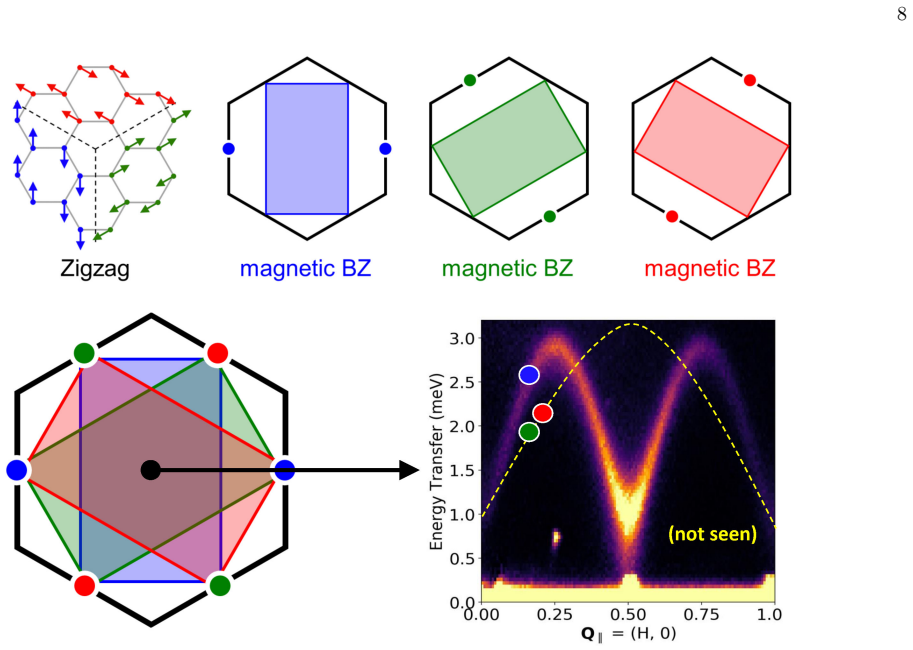
The argument is carried by three coupled pieces of machinery. First, the crystallographic symmetry analysis of the magnetic propagation vectors at the $M$-point of the (pseudo)hexagonal Brillouin zone: in these cobaltates the symmetry operations do not leave a single ordering vector invariant, so single-q order would break lattice rotational symmetry while a vector sum of all equivalent components, the multi-q order, preserves it. Second, the field-training experiment, which uses an in-plane magnetic field to try to repopulate single-q orientational domains: a genuine single-q order should respond to the training, while a coherent multi-q order should be insensitive. Third, the inelastic-neutron-scattering magnetic Brillouin zone argument, where a multi-q state's smaller zone predicts a single spin-wave dispersion branch. Higher-order spin interactions (six-spin ring exchange) are the theoretical mechanism proposed to select the multi-q ground state near a hidden SU(2)-symmetric point of the extended Heisenberg-Kitaev-Gamma model.
What would settle it
A controlled uniaxial-stress training experiment on Na2Co2TeO6 would settle the question: if single-q domains exist, changing the stress direction should rebalance the relative intensities of the three magnetic Bragg peaks related by the crystal's threefold rotation, while a triple-q state should stay insensitive; detecting the predicted higher-order harmonic peaks would likewise confirm a coherent superposition rather than random domains.
Extended reading notes
Core claim
The central claim is that the ordered states of Na2Co2TeO6 and Na3Co2SbO6 should be understood as coherent superpositions of symmetry-equivalent zigzag components, not as single-q zigzag domains: a triple-q state in hexagonal Na2Co2TeO6 and a double-q state in monoclinic Na3Co2SbO6. In these multi-q states the magnetic moment pattern is non-collinear, contains sites with reduced ordered moment, and in the triple-q case carries spin vorticity. The review assembles the supporting evidence: a 10 T in-plane field cannot detwin the presumed single-q domains in Na2Co2TeO6; in Na3Co2SbO6 the diffraction signal at an unfavored wave vector recovers after the field is removed, pointing to a component of a double-q order parameter; inelastic neutron scattering on Na2Co2TeO6 sees only one spin-wave branch, which is consistent with a triple-q magnetic Brillouin zone; and a model with six-spin ring exchange stabilizes the triple-q state near a hidden SU(2)-symmetric point.
Load-bearing premise
The inference to multi-q order assumes that the applied magnetic fields are strong enough to reorient and repopulate single-q orientational domains if they existed; if randomly distributed frozen-in strains pin those domains instead, the same training data would be produced without multi-q order.
Editorial extensions
If this is right
- Magnetic structure refinements that imposed a single-q zigzag ansatz on Na2Co2TeO6 and Na3Co2SbO6 should be revisited, because the diffraction data are compatible with coherent multi-q order and the fitted moment sizes are not uniform.
- Microscopic models need to go beyond bilinear Heisenberg-Kitaev interactions; higher-order terms such as six-spin ring exchange are needed to stabilize the observed triple-q ground state.
- The existence of multi-q order in these insulating oxides extends a phenomenon long studied in itinerant magnets to Mott insulators, where electron hopping still matters.
- A triple-q ground state with spin canting provides a natural account of the ferrimagnetic net moment observed in Na2Co2TeO6.
- The intermediate vestigial phase observed in Na2Co2TeO6 before three-dimensional order sets in is naturally explained by ring-exchange models as a Z4 spin-current density wave, not by conventional single-q order.
Reading between the lines
- A direct extension would be to apply the same field-training protocol to other high-symmetry honeycomb magnets, such as BaCo2(AsO4)2 or the monoclinic polymorph of Na2Co2TeO6, and predict training-resistant multi-q order wherever the ordering wave vectors come in symmetry-related sets.
- If multi-q order is a general feature, then spin-wave fits and exchange-parameter extractions performed under single-q assumptions elsewhere may be systematically biased, not just in these two compounds.
- The reduced-moment sites predicted by multi-q order give a testable local signature: spin-polarized neutron diffraction or nuclear hyperfine probes should resolve a bimodal distribution of ordered moment magnitudes, whereas a single-q zigzag state has uniform local moments.
- The symmetry criterion used here—whether the magnetic propagation vector is invariant under lattice rotations—could serve as a screening rule for other candidate spin-liquid materials before detailed Hamiltonians are settled.
Editorial analysis
A structured set of objections, weighed in public.
Referee Report
Summary. This paper is a mini-review arguing that the magnetic ground states of the honeycomb cobaltates Na2Co2TeO6 and Na3Co2SbO6 are multi-q variants of zigzag order rather than the single-q zigzag states assumed in many previous studies. The review lays out crystallographic symmetry conditions under which single-q M-point order can or cannot have multi-q variants, surveys examples of multi-q order in other materials (skyrmion lattices, SrFeO3, CeRh2Si2, iron pnictides), and then discusses field-training neutron diffraction experiments, inelastic neutron scattering symmetry arguments, and theoretical support from ring-exchange interactions. The central claim is that field-training results in these two cobaltates discriminate multi-q from single-q domain states, implying that microscopic models must include higher-order spin interactions.
Significance. The paper provides a useful and accessible synthesis of experimental strategies for identifying multi-q magnetic order, and it places the cobaltate problem in the broader context of itinerant and insulating magnets. The crystallographic comparison among Na2IrO3, alpha-RuCl3, and the cobaltates is clearly presented, and the authors are careful to note several caveats, including the J3-only degeneracy caveat for the INS argument and the generic possibility that disorder and lattice dynamics account for seemingly novel observations. If the multi-q claim is correct, the standard single-q zigzag interpretation for two prominent Kitaev-candidate materials would need revision, making this a significant claim for the field. However, the principal experimental evidence derives from the authors' own earlier publications, and one of the two key training experiments (Na3Co2SbO6) has a logical gap that weakens the central conclusion.
major comments (4)
- [Section 4, Na3Co2SbO6 field-training experiment] Section 4, Na2Co2TeO6 field-training experiment: The review correctly flags the alternative of frozen-in uniaxial strain pinning single-q domains, but the dismissal of this alternative rests on Ref. [121], a Faraday-rotation study from the same group. That study is not independent of the original neutron diffraction experiments, so the pinning scenario remains open. The review would need quantitative arguments, such as the expected strain-induced detwinning magnitude versus the observed insensitivity of the M2 intensity, or training results on multiple crystals, to substantiate the claim that the Na2Co2TeO6 data favor a triple-q ground state.
- [Section 4, Na3Co2SbO6 field-training experiment] The argument that recovery of the unfavored M-point peak after removing the training field supports a double-q ground state is not logically secure as written. The text states that the field was strong enough to fully suppress the magnetic order; if the order is destroyed, removing the field allows the system to renucleate from a state with no directional bias, and two degenerate single-q M-domains would naturally repopulate, producing a recovered peak at the unfavored position. This is exactly the expected single-q behavior, not evidence for a double-q order parameter. The review should either provide data or arguments that exclude this renucleation scenario (for example, in-field intensity ratios during controlled field sweeps, or domain statistics that differ from equal repopulation) or explicitly weaken the claim that the recovered signal is necessarily a component of a double-q order.
- [Section 4, Na2Co2TeO6 field-training experiment] The review correctly flags the alternative of frozen-in uniaxial strain pinning single-q domains, but the dismissal of this alternative rests on Ref. [121], a Faraday-rotation study from the same group. That study is not independent of the original neutron diffraction experiments, so the pinning scenario remains open. The review would need quantitative arguments, such as the expected strain-induced detwinning magnitude versus the observed insensitivity of the M2 intensity, or training results on multiple crystals, to substantiate the claim that the Na2Co2TeO6 data favor a triple-q ground state.
- [Section 6 and Table II] Given the two concerns above, the summary and Table II overstate the present evidence. Table II lists Na2Co2TeO6 and Na3Co2SbO6 in the same category as materials with established multi-q states, while the text itself documents the J3-only degeneracy caveat for the INS argument and the pinning/renucleation alternatives for the training experiments. The review should grade the evidence—e.g., by distinguishing 'proposed' from 'established'—and should state in the summary that the multi-q scenario is strongly suggested but not yet definitively established.
minor comments (5)
- [Abstract and Section 1] The phrase 'surveys on experimental strategies' is ungrammatical; 'surveys' should be used with a direct object or 'provides a survey of' would be clearer.
- [Section 5] The sentence 'The significance of hopping be indicated by the dimensionless quantity t/U' contains a typo; 'be' should be 'is'.
- [Table II] The entries 'N.A.' under the 'Stabilized by' column are not defined; consider replacing them with 'not discussed' or a fuller explanation.
- [Section 2 and Table I] The notation for the wave vector of alpha-RuCl3 is given in monoclinic notation, but the table does not make clear how the rhombohedral R3 phase would affect the M-point classification; a brief note would help readers.
- [Figure 1 caption] The caption mentions 'first 2D hexagonal Brillouin zone' but the figure itself is adapted from elsewhere; please ensure that the color coding of the three M points is legible in the printed version.
Circularity Check
No significant circularity: the multi-q claims rest on raw-data experiments and comparative fits, not on equations that reduce to their own inputs.
full rationale
This paper is a review, not a derivation paper. Its central claim that Na2Co2TeO6 and Na3Co2SbO6 host multi-q variants of zigzag order is supported by field-trained neutron diffraction (Refs. 39, 40), inelastic neutron scattering (Ref. 36), and Faraday rotation (Ref. 121) from the present group, together with independent theory (Refs. 136, 137). Under the review rules, cited raw-diffraction and excitation data are independent support because they are externally falsifiable and are not parameters fitted within this review. No equation in the paper is shown to be equivalent to an input by construction, and no fitted quantity is renamed as a prediction. The weakest step is the Na3Co2SbO6 field-training inference: the review argues that recovery of the unfavored peak after the field, which fully suppressed the order, was removed favors double-q, but in a single-q scenario renucleation after field removal would also repopulate both orientational domains. This is a logical or interpretive weakness, not a circularity of the self-definitional or fitted-input kind. The review explicitly flags the structural-pinning alternative for Na2Co2TeO6 ('The only remaining alternative possibility was that there existed unidentified structural pinning effects...') and closes it by citing a same-group Faraday study; that is self-citation, but it is an independent measurement rather than a restatement of the conclusion. The self-citation density is high, but it does not meet the evidentiary bar for load-bearing circularity.
Assumptions & free parameters
assumptions (4)
- domain assumption The crystallographic space groups and magnetic propagation wave vectors in Table I are accurate.
- domain assumption The multi-q variant of the magnetic structure preserves all crystallographic rotational symmetries.
- domain assumption In models with only bilinear spin interactions, single-q and multi-q orders have degenerate semiclassical energy.
- domain assumption Higher-order spin interactions (e.g., ring exchange) emerge from the Hubbard model and can stabilize multi-q order.
Cite this review
Pith. "Pith review of On the multi-$\mathbf{q}$ characteristics of magnetic ground states of honeycomb cobalt oxides." pith.science (2026). https://pith.science/paper/JGSTRXCK
@misc{pith2026250114229,
  author       = {Pith},
  title        = {Pith review of: On the multi-$\mathbfq$ characteristics of magnetic ground states of honeycomb cobalt oxides},
  year         = {2026},
  howpublished = {\url{https://pith.science/paper/JGSTRXCK}},
  note         = {Machine review of arXiv:2501.14229}
}
abstract
The Kitaev honeycomb model has received significant attention for its exactly solvable quantum spin liquid ground states and fractionalized excitations. For realizing the model, layered cobalt oxides have been considered a promising platform. Yet, in contrast to the conventional wisdom about single-$\mathbf{q}$ zigzag magnetic order inferred from previous studies of the Na$_2$IrO$_3$ and $\alpha$-RuCl$_3$ candidate materials, recent experiments on two of the representative honeycomb cobalt oxides, hexagonal Na$_2$Co$_2$TeO$_6$ and monoclinic Na$_3$Co$_2$SbO$_6$, have uncovered evidence for more complex multi-$\mathbf{q}$ variants of the zigzag order. This review surveys on experimental strategies to distinguish between single- and multi-$\mathbf{q}$ orders, along with the crystallographic symmetries of the cobalt oxides in comparison to the previously studied systems. General formation mechanism of multi-$\mathbf{q}$ order is also briefly discussed. The goal is to provide some rationales for examining the relevance of multi-$\mathbf{q}$ order in the honeycomb cobalt oxides, along with its implications on the microscopic model of these intriguing quantum magnets.
Figures


Figures from the paper (4 more)



Reference graph
Works this paper leans on
- [121]
-
[1]
Originating from the idea of the resonating valence bond concept [3], QSL has garnered widespread interest partly due to the suggestion of P
INTRODUCTION Quantum spin liquid (QSL) is a novel phase of mat- ter in an interacting quantum many-body system [1, 2]. Originating from the idea of the resonating valence bond concept [3], QSL has garnered widespread interest partly due to the suggestion of P. W. Anderson that resonat- ing valence bonds may be the essence of superconduct- ing pairing in t...
-
[2]
On the multi-$\mathbf{q}$ characteristics of magnetic ground states of honeycomb cobalt oxides
SINGLE-Q ORDER UNDER LA TTICE ROT A TIONAL SYMMETR Y The formation of magnetic order leads to spontaneous symmetry breaking from the paramagnetic phase. Accu- rate information about the crystallographic symmetry is thus crucial for understanding the symmetry of the mag- netic ground state. It is particularly important to ex- arXiv:2501.14229v1 [cond-mat.s...
work page Pith review arXiv 2025
-
[3]
training
MUL TI-Q ORDER: PREVIOUS EXAMPLES In crystals with sufficiently high rotational symme- try, conventional single-q magnetic order can break the original rotational symmetry when the symmetry oper- ations do not leave the ordering wave vector invariant. In these cases, a natural way to restore the symmetry is to conceptualize a multi-q variant of the magnet...
-
[4]
1, the crystallographic symmetries of Na 2Co2TeO6 and Na3Co2SbO6 are compatible with M -point magnetic or- der in either single- or multi- q form
EVIDENCE FOR MUL TI-Q ORDER IN HONEYCOMB COBAL T OXIDES As discussed in Section 2 and illustrated in Fig. 1, the crystallographic symmetries of Na 2Co2TeO6 and Na3Co2SbO6 are compatible with M -point magnetic or- der in either single- or multi- q form. To tell which of these scenarios is more likely to be correct, single-crystal neutron diffraction experi...
-
[5]
blue” domain, but only twice (plus zone corner once) in the “green
IMPLICA TIONS FOR THEORETICAL MODELS Information about the magnetic ground state imposes strong constraints on microscopic magnetic model con- struction, providing critical insights into the underlying interactions. As discussed in Section. 3, the multi-q order in centrosymmetric itinerant magnets highlights the sig- nificant role of long-range and higher...
-
[6]
This can be done either with reciprocal-space methods such as diffraction under ex- ternal fields, with real-space methods such as NMR and STM
SUMMAR Y & OUTLOOK To summarize, we have reviewed how the possible ex- istence of multi-q order in magnetic materials can be ex- perimentally addressed. This can be done either with reciprocal-space methods such as diffraction under ex- ternal fields, with real-space methods such as NMR and STM. Current experimental evidence for such multi- q magnetic ord...
-
[7]
Kitaev, Anyons in an exactly solved model and be- yond, Ann
A. Kitaev, Anyons in an exactly solved model and be- yond, Ann. Phys. 321, 2 (2006)
2006
Show all 156 references
-
[8]
Broholm, R
C. Broholm, R. Cava, S. Kivelson, D. Nocera, M. Nor- man, and T. Senthil, Quantum spin liquids, Science367, eaay0668 (2020)
2020
-
[9]
Balents, Spin liquids in frustrated magnets, Nature 464, 199 (2010)
L. Balents, Spin liquids in frustrated magnets, Nature 464, 199 (2010)
2010
-
[10]
P. W. Anderson, Resonating valence bonds: A new kind of insulator?, Materials Research Bulletin 8, 153 (1973)
1973
-
[11]
P. W. Anderson, The resonating valence bond state in La 2CuO4 and superconductivity, science 235, 1196 (1987)
1987
-
[12]
Wen, S.-L
J. Wen, S.-L. Yu, S. Li, W. Yu, and J.-X. Li, Experimen- tal identification of quantum spin liquids, npj Quantum Materials 4, 12 (2019)
2019
-
[13]
Y. Zhou, K. Kanoda, and T.-K. Ng, Quantum spin liq- uid states, Rev. Mod. Phys. 89, 025003 (2017)
2017
-
[14]
Liu and G
H. Liu and G. Khaliullin, Pseudospin exchange inter- actions in d7 cobalt compounds: Possible realization of the Kitaev model, Phys. Rev. B 97, 014407 (2018)
2018
-
[15]
Jackeli and G
G. Jackeli and G. Khaliullin, Mott Insulators in the Strong Spin-Orbit Coupling Limit: From Heisenberg to a Quantum Compass and Kitaev Models, Phys. Rev. Lett. 102, 017205 (2009)
2009
-
[16]
Takagi, T
H. Takagi, T. Takayama, G. Jackeli, G. Khaliullin, and S. E. Nagler, Concept and realization of Kitaev quantum spin liquids, Nat. Rev. Phys. 1, 264 (2019)
2019
-
[17]
Motome, R
Y. Motome, R. Sano, S. Jang, Y. Sugita, and Y. Kato, Materials design of Kitaev spin liquids beyond the Jack- eli–Khaliullin mechanism, Journal of Physics: Con- densed Matter 32, 404001 (2020)
2020
-
[18]
Trebst and C
S. Trebst and C. Hickey, Kitaev materials, Physics Re- ports 950, 1 (2022)
2022
-
[19]
Chaloupka, G
J. Chaloupka, G. Jackeli, and G. Khaliullin, Kitaev- Heisenberg Model on a Honeycomb Lattice: Possible Exotic Phases in Iridium Oxides A2IrO3, Phys. Rev. Lett. 105, 027204 (2010)
2010
-
[20]
K. W. Plumb, J. P. Clancy, L. J. Sandilands, V. V. Shankar, Y. F. Hu, K. S. Burch, H.-Y. Kee, and Y.-J. Kim, α−RuCl3: A spin-orbit assisted Mott insulator on a honeycomb lattice, Phys. Rev. B 90, 041112 (2014)
2014
-
[21]
J.-Q. Yan, S. Okamoto, Y. Wu, Q. Zheng, H. D. Zhou, H. B. Cao, and M. A. McGuire, Magnetic order in single crystals of Na3Co2SbO6 with a honeycomb arrangement of 3d7 Co2+ ions, Phys. Rev. Mater. 3, 074405 (2019)
2019
-
[22]
R. Sano, Y. Kato, and Y. Motome, Kitaev-Heisenberg Hamiltonian for high-spin d7 Mott insulators, Phys. Rev. B 97, 014408 (2018)
2018
-
[23]
H. Liu, J. Chaloupka, and G. Khaliullin, Kitaev Spin Liquid in 3 d Transition Metal Compounds, Phys. Rev. Lett. 125, 047201 (2020)
2020
-
[24]
Kim, H.-S
C. Kim, H.-S. Kim, and J.-G. Park, Spin-orbital entan- gled state and realization of Kitaev physics in 3 d cobalt compounds: a progress report, Journal of Physics: Con- densed Matter 34, 023001 (2021)
2021
-
[25]
Liu, Towards Kitaev spin liquid in 3 d transition metal compounds, Int
H. Liu, Towards Kitaev spin liquid in 3 d transition metal compounds, Int. J. Mod. Phys. B 35, 2130006 (2021)
2021
-
[26]
Lefran¸ cois, M
E. Lefran¸ cois, M. Songvilay, J. Robert, G. Nataf, E. Jor- dan, L. Chaix, C. V. Colin, P. Lejay, A. Hadj-Azzem, R. Ballou, and V. Simonet, Magnetic properties of the honeycomb oxide Na 2Co2TeO6, Phys. Rev. B 94, 214416 (2016)
2016
-
[27]
A. K. Bera, S. M. Yusuf, A. Kumar, and C. Ritter, Zigzag antiferromagnetic ground state with anisotropic correlation lengths in the quasi-two-dimensional honey- comb lattice compound Na2Co2TeO6, Phys. Rev. B 95, 094424 (2017)
2017
-
[28]
Rousochatzakis, J
I. Rousochatzakis, J. Reuther, R. Thomale, S. Rachel, and N. B. Perkins, Phase diagram and quantum order by disorder in the kitaev K1 − K2 honeycomb magnet, Phys. Rev. X 5, 041035 (2015)
2015
-
[29]
Chaloupka, G
J. Chaloupka, G. Jackeli, and G. Khaliullin, Zigzag Magnetic Order in the Iridium Oxide Na 2IrO3, Phys. Rev. Lett. 110, 097204 (2013)
2013
-
[30]
Kimchi and Y.-Z
I. Kimchi and Y.-Z. You, Kitaev-Heisenberg- J2-J3 model for the iridates A2IrO3, Phys. Rev. B 84, 180407 (2011)
2011
-
[31]
Sizyuk, C
Y. Sizyuk, C. Price, P. W¨ olfle, and N. B. Perkins, Impor- tance of anisotropic exchange interactions in honeycomb iridates: Minimal model for zigzag antiferromagnetic or- der in Na 2IrO3, Phys. Rev. B 90, 155126 (2014)
2014
-
[32]
J. G. Rau, E. K.-H. Lee, and H.-Y. Kee, Generic spin model for the honeycomb iridates beyond the kitaev limit, Phys. Rev. Lett. 112, 077204 (2014)
2014
-
[33]
Chaloupka and G
J. Chaloupka and G. Khaliullin, Magnetic anisotropy in the Kitaev model systems Na 2IrO3 and RuCl 3, Phys. Rev. B 94, 064435 (2016)
2016
-
[34]
S. M. Winter, Y. Li, H. O. Jeschke, and R. Valent ´ ı, Challenges in design of kitaev materials: Magnetic in- teractions from competing energy scales, Phys. Rev. B 93, 214431 (2016)
2016
-
[35]
A. M. Samarakoon, Q. Chen, H. Zhou, and V. O. Gar- lea, Static and dynamic magnetic properties of honey- comb lattice antiferromagnets Na 2M2TeO6, M = Co and Ni, Phys. Rev. B 104, 184415 (2021)
2021
-
[36]
Yadav, N
R. Yadav, N. A. Bogdanov, V. M. Katukuri, S. Nishi- moto, J. Van Den Brink, and L. Hozoi, Kitaev exchange and field-induced quantum spin-liquid states in honey- comb α-RuCl3, Scientific reports 6, 37925 (2016)
2016
-
[37]
Hickey and S
C. Hickey and S. Trebst, Emergence of a field-driven U (1) spin liquid in the Kitaev honeycomb model, Nat. Commun. 10, 530 (2019)
2019
-
[38]
H. B. Cao, A. Banerjee, J.-Q. Yan, C. A. Bridges, M. D. Lumsden, D. G. Mandrus, D. A. Tennant, B. C. Chak- oumakos, and S. E. Nagler, Low-temperature crystal and magnetic structure of α − RuCl3, Phys. Rev. B 93, 134423 (2016)
2016
-
[39]
vortices
and Na 3Co2SbO6 [40]. Here we only focus on the training effects of the fields on the magnetic domains, as have been discussed in the previous Section. In Na 2Co2TeO6, the single- q magnetic structure (or single-q component in a multi-q structure) has been con- strained [19, 2...
-
[40]
X. Liu, T. Berlijn, W.-G. Yin, W. Ku, A. Tsvelik, Y.-J. Kim, H. Gretarsson, Y. Singh, P. Gegenwart, and J. P. Hill, Long-range magnetic ordering in Na 2IrO3, Phys. Rev. B 83, 220403 (2011)
2011
-
[41]
F. Ye, S. Chi, H. Cao, B. C. Chakoumakos, J. A. Fernandez-Baca, R. Custelcean, T. F. Qi, O. B. Kor- neta, and G. Cao, Direct evidence of a zigzag spin-chain structure in the honeycomb lattice: A neutron and x- ray diffraction investigation of single-crystal Na 2IrO3, Phys. Rev...
2012
-
[42]
Songvilay, J
M. Songvilay, J. Robert, S. Petit, J. A. Rodriguez- Rivera, W. D. Ratcliff, F. Damay, V. Bal´ edent, M. Jim´ enez-Ruiz, P. Lejay, E. Pachoud, A. Hadj- Azzem, V. Simonet, and C. Stock, Kitaev interactions in 11 the Co honeycomb antiferromagnets Na 3Co2SbO6 and Na2Co2TeO6, Phys....
2020
-
[43]
W. Chen, X. Li, Z. Hu, Z. Hu, L. Yue, R. Sutarto, F. He, K. Iida, K. Kamazawa, W. Yu, X. Lin, and Y. Li, Spin- orbit phase behavior of Na 2Co2TeO6 at low tempera- tures, Phys. Rev. B 103, L180404 (2021)
2021
-
[44]
C. H. Lee, S. Lee, Y. S. Choi, Z. H. Jang, R. Kalaivanan, R. Sankar, and K.-Y. Choi, Multistage development of anisotropic magnetic correlations in the Co-based hon- eycomb lattice Na2Co2TeO6, Phys. Rev. B 103, 214447 (2021)
2021
-
[45]
W. G. F. Kr¨ uger, W. Chen, X. Jin, Y. Li, and L. Janssen, Triple-q Order in Na 2Co2TeO6 from Prox- imity to Hidden-SU(2)-Symmetric Point, Phys. Rev. Lett. 131, 146702 (2023)
2023
-
[46]
W. Yao, Y. Zhao, Y. Qiu, C. Balz, J. R. Stewart, J. W. Lynn, and Y. Li, Magnetic ground state of the Kitaev Na2Co2TeO6 spin liquid candidate, Phys. Rev. Res. 5, L022045 (2023)
2023
-
[47]
Y. Gu, X. Li, Y. Chen, K. Iida, A. Nakao, K. Mu- nakata, V. O. Garlea, Y. Li, G. Deng, I. A. Zaliznyak, J. M. Tranquada, and Y. Li, In-plane multi-q mag- netic ground state of Na 3Co2SbO6, Phys. Rev. B 109, L060410 (2024)
2024
-
[48]
Z. Hu, Y. Chen, Y. Cui, S. Li, C. Li, X. Xu, Y. Chen, X. Li, Y. Gu, R. Yu, R. Zhou, Y. Li, and W. Yu, Field- induced phase transitions and quantum criticality in the honeycomb antiferromagnet Na3Co2SbO6, Phys. Rev. B 109, 054411 (2024)
2024
-
[49]
V. O. Garlea and C. L. Sarkis, Review of honeycomb- based kitaev materials with zigzag magnetic ordering (2024), arXiv:2410.11083 [cond-mat.str-el]
2024 arXiv
-
[50]
Singh and P
Y. Singh and P. Gegenwart, Antiferromagnetic Mott in- sulating state in single crystals of the honeycomb lattice material Na2IrO3, Phys. Rev. B 82, 064412 (2010)
2010
-
[51]
S. K. Choi, R. Coldea, A. N. Kolmogorov, T. Lancaster, I. I. Mazin, S. J. Blundell, P. G. Radaelli, Y. Singh, P. Gegenwart, K. R. Choi, S.-W. Cheong, P. J. Baker, C. Stock, and J. Taylor, Spin Waves and Revised Crystal Structure of Honeycomb Iridate Na 2IrO3, Phys. Rev. Lett. ...
2012
-
[52]
R. D. Johnson, S. C. Williams, A. A. Haghighirad, J. Singleton, V. Zapf, P. Manuel, I. I. Mazin, Y. Li, H. O. Jeschke, R. Valent ´ ı, and R. Coldea, Monoclinic crystal structure of α-RuCl3 and the zigzag antiferromagnetic ground state, Phys. Rev. B 92, 235119 (2015)
2015
-
[53]
S. Mu, K. D. Dixit, X. Wang, D. L. Abernathy, H. Cao, S. E. Nagler, J. Yan, P. Lampen-Kelley, D. Mandrus, C. A. Polanco, L. Liang, G. B. Hal´ asz, Y. Cheng, A. Banerjee, and T. Berlijn, Role of the third dimen- sion in searching for Majorana fermions in α−RuCl3 via phonons, Ph...
2022
-
[54]
Zhang, M
H. Zhang, M. A. McGuire, A. F. May, H.-Y. Chao, Q. Zheng, M. Chi, B. C. Sales, D. G. Mandrus, S. E. Na- gler, H. Miao, F. Ye, and J. Yan, Stacking disorder and thermal transport properties of α−RuCl3, Phys. Rev. Mater. 8, 014402 (2024)
2024
-
[55]
S. Park, S. Do, K.-Y. Choi, D. Jang, T. Jang, J. Schefer, C.-M. Wu, J. S. Gardner, S. Park, J.-H. Park, and S. Ji, Emergence of the Isotropic Kitaev Honeycomb Lattice α−RuCl3 and its magnetic properties, Journal of Physics: Condensed Matter (2024)
2024
-
[56]
S. Kim, E. Horsley, C. Nelson, J. Ruff, and Y.-J. Kim, Re-investigation of Moment Direction in a Kitaev Mate- rial α-RuCl3, (2024), arXiv:2403.04176 [cond-mat.str- el]
2024 arXiv
-
[57]
Regnault, P
L. Regnault, P. Burlet, and J. Rossat-Mignod, Magnetic ordering in a planar X-Y model: BaCo 2(AsO4)2, Phys- ica B+ C 86, 660 (1977)
1977
-
[58]
Halloran, F
T. Halloran, F. Desrochers, E. Z. Zhang, T. Chen, L. E. Chern, Z. Xu, B. Winn, M. Graves-Brook, M. B. Stone, A. I. Kolesnikov, Y. Qiu, R. Zhong, R. Cava, Y. B. Kim, and C. Broholm, Geometrical frustration versus Kitaev interactions in BaCo 2(AsO4)2, Proceedings of the Na- tion...
2023
-
[59]
Dufault, F
E. Dufault, F. Bahrami, A. Streeter, X. Yao, E. Gonza- lez, Q. Zhang, and F. Tafti, Introducing the monoclinic polymorph of the honeycomb magnet Na 2Co2TeO6, Phys. Rev. B 108, 064405 (2023)
2023
-
[60]
Zhong, T
R. Zhong, T. Gao, N. P. Ong, and R. J. Cava, Weak-field induced nonmagnetic state in a Co-based honeycomb, Science Advances 6, eaay6953 (2020)
2020
-
[61]
Viciu, Q
L. Viciu, Q. Huang, E. Morosan, H. Zandbergen, N. Greenbaum, T. McQueen, and R. Cava, Structure and basic magnetic properties of the honeycomb lat- tice compounds Na2Co2TeO6 and Na3Co2SbO6, J. Solid State Chem. 180, 1060 (2007)
2007
-
[62]
Regnault, C
L.-P. Regnault, C. Boullier, and J. Lorenzo, Polarized- neutron investigation of magnetic ordering and spin dy- namics in BaCo 2(AsO4)2 frustrated honeycomb-lattice magnet, Heliyon 4, e00507 (2018)
2018
-
[63]
X. Li, Y. Gu, Y. Chen, V. O. Garlea, K. Iida, K. Ka- mazawa, Y. Li, G. Deng, Q. Xiao, X. Zheng, Z. Ye, Y. Peng, I. A. Zaliznyak, J. M. Tranquada, and Y. Li, Giant Magnetic In-Plane Anisotropy and Competing In- stabilities in Na 3Co2SbO6, Phys. Rev. X 12, 041024 (2022)
2022
-
[64]
I. I. Mazin, H. O. Jeschke, K. Foyevtsova, R. Valent ´ ı, and D. I. Khomskii, Na 2IrO3 as a Molecular Orbital Crystal, Phys. Rev. Lett. 109, 197201 (2012)
2012
-
[65]
Foyevtsova, H
K. Foyevtsova, H. O. Jeschke, I. I. Mazin, D. I. Khomskii, and R. Valent ´ ı, Ab initio analysis of the tight-binding parameters and magnetic interactions in Na2IrO3, Phys. Rev. B 88, 035107 (2013)
2013
-
[66]
Streltsov, I
S. Streltsov, I. I. Mazin, and K. Foyevtsova, Localized itinerant electrons and unique magnetic properties of SrRu2O6, Phys. Rev. B 92, 134408 (2015)
2015
-
[67]
Gretarsson, J
H. Gretarsson, J. P. Clancy, X. Liu, J. P. Hill, E. Bozin, Y. Singh, S. Manni, P. Gegenwart, J. Kim, A. H. Said, D. Casa, T. Gog, M. H. Upton, H.-S. Kim, J. Yu, V. M. Katukuri, L. Hozoi, J. van den Brink, and Y.-J. Kim, Crystal-Field Splitting and Correlation Effect on the Ele...
2013
-
[68]
I. I. Mazin, S. Manni, K. Foyevtsova, H. O. Jeschke, P. Gegenwart, and R. Valent ´ ı, Origin of the insulating state in honeycomb iridates and rhodates, Phys. Rev. B 88, 035115 (2013)
2013
-
[69]
B. H. Kim, T. Shirakawa, and S. Yunoki, From a quasi- molecular band insulator to a relativistic mott insulator in t5 2g systems with a honeycomb lattice structure, Phys. Rev. Lett. 117, 187201 (2016)
2016
-
[70]
B. H. Kim, G. Khaliullin, and B. I. Min, Electronic ex- citations in the edge-shared relativistic Mott insulator: 12 Na2IrO3, Phys. Rev. B 89, 081109 (2014)
2014
-
[71]
Igarashi and T
J.-I. Igarashi and T. Nagao, Collective excitations in Na2IrO3, Journal of Physics: Condensed Matter 28, 026006 (2015)
2015
-
[72]
Suzuki, H
H. Suzuki, H. Gretarsson, H. Ishikawa, K. Ueda, Z. Yang, H. Liu, H. Kim, D. Kukusta, A. Yaresko, M. Minola, et al., Spin waves and spin-state transitions in a ruthenate high-temperature antiferromagnet, Na- ture materials 18, 563 (2019)
2019
-
[73]
B. W. Lebert, S. Kim, B. H. Kim, S. H. Chun, D. Casa, J. Choi, S. Agrestini, K. Zhou, M. Garcia-Fernandez, and Y.-J. Kim, Nonlocal features of the spin-orbit ex- citon in Kitaev materials, Phys. Rev. B 108, 155122 (2023)
2023
-
[74]
S.-S. Diop, G. Jackeli, and L. Savary, Anisotropic ex- change and noncollinear antiferromagnets on a noncen- trosymmetric fcc half-heusler structure, Phys. Rev. B 105, 144431 (2022)
2022
-
[75]
C. L. Henley, Ordering due to disorder in a frus- trated vector antiferromagnet, Phys. Rev. Lett.62, 2056 (1989)
1989
-
[76]
Sheng and C
Q. Sheng and C. L. Henley, Ordering due to disorder in a triangular heisenberg antiferromagnet with exchange anisotropy, Journal of Physics: Condensed Matter 4, 2937 (1992)
1992
-
[77]
Schick, T
R. Schick, T. Ziman, and M. E. Zhitomirsky, Quantum versus thermal fluctuations in the fcc antiferromagnet: Alternative routes to order by disorder, Phys. Rev. B 102, 220405 (2020)
2020
-
[78]
C. Liu, R. Yu, and X. Wang, Semiclassical ground-state phase diagram and multi-q phase of a spin-orbit-coupled model on triangular lattice, Phys. Rev. B 94, 174424 (2016)
2016
-
[79]
Seabra, P
L. Seabra, P. Sindzingre, T. Momoi, and N. Shannon, Novel phases in a square-lattice frustrated ferromagnet : 1 3 -magnetization plateau, helicoidal spin liquid, and vortex crystal, Phys. Rev. B 93, 085132 (2016)
2016
-
[80]
M¨ uhlbauer, B
S. M¨ uhlbauer, B. Binz, F. Jonietz, C. Pflei- derer, A. Rosch, A. Neubauer, R. Georgii, and P. B¨ oni, Skyrmion lattice in a chi- ral magnet, Science 323, 915 (2009), https://www.science.org/doi/pdf/10.1126/science.1166767
2009 doi
-
[81]
Bogdanov and A
A. Bogdanov and A. Hubert, Thermodynamically stable magnetic vortex states in magnetic crystals, Journal of Magnetism and Magnetic Materials 138, 255 (1994)
1994
-
[82]
Kanazawa, Y
N. Kanazawa, Y. Onose, T. Arima, D. Okuyama, K. Ohoyama, S. Wakimoto, K. Kakurai, S. Ishiwata, and Y. Tokura, Large topological hall effect in a short- period helimagnet mnge, Phys. Rev. Lett. 106, 156603 (2011)
2011
-
[83]
Nakatsuji, N
S. Nakatsuji, N. Kiyohara, and T. Higo, Large anoma- lous hall effect in a non-collinear antiferromagnet at room temperature, Nature 527, 212 (2015)
2015
-
[84]
Takagi, J
R. Takagi, J. S. White, S. Hayami, R. Arita, D. Ho- necker, H. M. Rønnow, Y. Tokura, and S. Seki, Multiple- q noncollinear magnetism in an itinerant hexagonal magnet, Science Advances 4, eaau3402 (2018)
2018
-
[85]
U. K. Roessler, A. Bogdanov, and C. Pfleiderer, Sponta- neous skyrmion ground states in magnetic metals, Na- ture 442, 797 (2006)
2006
-
[86]
Ishiwata, T
S. Ishiwata, T. Nakajima, J.-H. Kim, D. S. Inosov, N. Kanazawa, J. S. White, J. L. Gavilano, R. Georgii, K. M. Seemann, G. Brandl, P. Manuel, D. D. Khalyavin, S. Seki, Y. Tokunaga, M. Kinoshita, Y. W. Long, Y. Kaneko, Y. Taguchi, T. Arima, B. Keimer, and Y. Tokura, Emergent to...
2020
-
[87]
J. A. Paddison, H. Zhang, J. Yan, M. J. Cliffe, M. A. McGuire, S.-H. Do, S. Gao, M. B. Stone, D. Dahlbom, K. Barros, et al., Cubic double perovskites host non- coplanar spin textures, npj Quantum Materials 9, 48 (2024)
2024
-
[88]
J. M. Allred, K. M. Taddei, D. E. Bugaris, M. J. Krogstad, S. H. Lapidus, D. Y. Chung, H. Claus, M. G. Kanatzidis, D. E. Brown, J. Kang, R. M. Fernandes, I. Eremin, S. Rosenkranz, O. Chmaissem, and R. Os- born, Double-q spin-density wave in iron arsenide su- perconductors, Nat...
-
[89]
J. M. Allred, S. Avci, D. Y. Chung, H. Claus, D. D. Khalyavin, P. Manuel, K. M. Taddei, M. G. Kanatzidis, S. Rosenkranz, R. Osborn, and O. Chmaissem, Tetrag- onal magnetic phase in Ba 1−xKxFe2As2 from x-ray and neutron diffraction, Phys. Rev. B 92, 094515 (2015)
2015
-
[90]
K. M. Taddei, J. M. Allred, D. E. Bugaris, S. Lapidus, M. J. Krogstad, R. Stadel, H. Claus, D. Y. Chung, M. G. Kanatzidis, S. Rosenkranz, R. Osborn, and O. Chmais- sem, Detailed magnetic and structural analysis mapping a robust magnetic C4 dome in Sr 1−xNaxFe2As2, Phys. Rev. B...
2016
-
[91]
Kawarazaki, M
S. Kawarazaki, M. Sato, Y. Miyako, N. Chigusa, K. Watanabe, N. Metoki, Y. Koike, and M. Nishi, Ground-state magnetic structure of CeRh 2Si2 and the response to hydrostatic pressure as studied by neutron diffraction, Phys. Rev. B 61, 4167 (2000)
2000
-
[92]
N. D. Khanh, T. Nakajima, S. Hayami, S. Gao, Y. Ya- masaki, H. Sagayama, H. Nakao, R. Takagi, Y. Motome, Y. Tokura, et al., Zoology of multiple-q spin textures in a centrosymmetric tetragonal magnet with itinerant electrons, Advanced Science 9, 2105452 (2022)
2022
-
[93]
G. D. A. Wood, D. D. Khalyavin, D. A. Mayoh, J. Bouaziz, A. E. Hall, S. J. R. Holt, F. Orlandi, P. Manuel, S. Bl¨ ugel, J. B. Staunton, O. A. Petrenko, M. R. Lees, and G. Balakrishnan, Double- Q ground state with topological charge stripes in the centrosym- metric skyrmion can...
2023
-
[94]
Saito, F
H. Saito, F. Kon, H. Hidaka, H. Amitsuka, C. Kwanghee, M. Hagihala, T. Kamiyama, S. Itoh, and T. Nakajima, In-plane anisotropy of single- q and multiple-q ordered phases in the antiferromagnetic metal CeRh2Si2, Phys. Rev. B 108, 094440 (2023)
2023
-
[95]
Okubo, T
T. Okubo, T. H. Nguyen, and H. Kawamura, Cubic and noncubic multiple- q states in the heisenberg anti- ferromagnet on the pyrochlore lattice, Phys. Rev. B 84, 144432 (2011)
2011
-
[96]
Okubo, S
T. Okubo, S. Chung, and H. Kawamura, Multiple- q states and the skyrmion lattice of the triangular-lattice heisenberg antiferromagnet under magnetic fields, Phys. Rev. Lett. 108, 017206 (2012)
2012
-
[97]
Kamiya and C
Y. Kamiya and C. D. Batista, Magnetic vortex crystals in frustrated mott insulator, Phys. Rev. X 4, 011023 (2014)
2014
-
[98]
Hayami, S.-Z
S. Hayami, S.-Z. Lin, and C. D. Batista, Bubble and skyrmion crystals in frustrated magnets with easy-axis anisotropy, Phys. Rev. B 93, 184413 (2016)
2016
-
[99]
Hayami and Y
S. Hayami and Y. Motome, Effect of magnetic anisotropy on skyrmions with a high topological number 13 in itinerant magnets, Phys. Rev. B 99, 094420 (2019)
2019
-
[100]
Hayami and Y
S. Hayami and Y. Motome, Noncoplanar multiple- Q spin textures by itinerant frustration: Effects of single- ion anisotropy and bond-dependent anisotropy, Phys. Rev. B 103, 054422 (2021)
2021
-
[101]
Yambe and S
R. Yambe and S. Hayami, Anisotropic spin model and multiple-q states in cubic systems, Phys. Rev. B 107, 174408 (2023)
2023
- [102]
-
[103]
Hayami, R
S. Hayami, R. Ozawa, and Y. Motome, Effective bilinear-biquadratic model for noncoplanar ordering in itinerant magnets, Phys. Rev. B 95, 224424 (2017)
2017
-
[104]
Y.-W. Fang, R. Yang, and H. Chen, The complex non-collinear magnetic orderings in Ba 2YOsO6: a new approach to tuning spin-lattice interactions and con- trolling magnetic orderings in frustrated complex ox- ides, Journal of Physics: Condensed Matter 31, 445803 (2019)
2019
-
[105]
S. Paul, S. Haldar, S. von Malottki, and S. Heinze, Role of higher-order exchange interactions for skyrmion sta- bility, Nature Communications 11, 4756 (2020)
2020
-
[106]
Kato and Y
Y. Kato and Y. Motome, Magnetic field–temperature phase diagrams for multiple- Q magnetic ordering: Ex- act steepest descent approach to long-range interacting spin systems, Phys. Rev. B 105, 174413 (2022)
2022
-
[107]
Hayami, Checkerboard bubble lattice formed by octuple-period quadruple- Q spin density waves, Phys
S. Hayami, Checkerboard bubble lattice formed by octuple-period quadruple- Q spin density waves, Phys. Rev. B 108, 094415 (2023)
2023
-
[108]
Hayami and R
S. Hayami and R. Yambe, Stabilization mechanisms of magnetic skyrmion crystal and multiple-q states based on momentum-resolved spin interactions, Materials To- day Quantum 3, 100010 (2024)
2024
-
[109]
Pohle, N
R. Pohle, N. Shannon, and Y. Motome, Spin nematics meet spin liquids: Exotic quantum phases in the spin- 1 bilinear-biquadratic model with Kitaev interactions, Phys. Rev. B 107, L140403 (2023)
2023
-
[110]
Martin and C
I. Martin and C. D. Batista, Itinerant electron-driven chiral magnetic ordering and spontaneous quantum hall effect in triangular lattice models, Phys. Rev. Lett. 101, 156402 (2008)
2008
-
[111]
Y. Kato, I. Martin, and C. D. Batista, Stability of the spontaneous quantum hall state in the triangular kondo- lattice model, Phys. Rev. Lett. 105, 266405 (2010)
2010
-
[112]
Ozawa, S
R. Ozawa, S. Hayami, and Y. Motome, Zero-field skyrmions with a high topological number in itinerant magnets, Phys. Rev. Lett. 118, 147205 (2017)
2017
-
[113]
H.-Y. Yang, A. F. Albuquerque, S. Capponi, A. M. L¨ auchli, and K. P. Schmidt, Effective spin couplings in the Mott insulator of the honeycomb lattice Hubbard model, New Journal of Physics 14, 115027 (2012)
2012
-
[114]
Swain, R
N. Swain, R. Tiwari, and P. Majumdar, Mott-hubbard transition and spin-liquid state on the pyrochlore lat- tice, Phys. Rev. B 94, 155119 (2016)
2016
-
[115]
Kawarazaki, K
S. Kawarazaki, K. Fujita, K. Yasuda, Y. Sasaki, T. Mizusaki, and A. Hirai, Direct Evidence for Triple- Q Spin-Density Wave in fcc Antiferromagnetic Mn-Ni Alloy, Phys. Rev. Lett. 61, 471 (1988)
1988
-
[116]
E. M. Forgan, B. D. Rainford, S. L. Lee, J. S. Abell, and Y. Bi, The magnetic structure of CeAl 2 is a non-chiral spiral, Journal of Physics: Condensed Matter 2, 10211 (1990)
1990
-
[117]
P. S. Normile, W. G. Stirling, D. Mannix, G. H. Lan- der, F. Wastin, J. Rebizant, F. Boudarot, P. Burlet, B. Lebech, and S. Coburn, (U1−xPux)Sb solid solutions. I. Magnetic configurations, Phys. Rev. B 66, 014405 (2002)
2002
-
[118]
E. M. Forgan, E. P. Gibbons, K. A. McEwen, and D. Fort, Observation of a Quadruple-q Magnetic Struc- ture in Neodymium, Phys. Rev. Lett. 62, 470 (1989)
1989
-
[119]
L. Yue, X. Ren, T. Han, J. Guo, Z. Wu, Y. Zhang, and Y. Li, Raman scattering study of the tetragonal mag- netic phase in Sr 1−xNaxFe2As2: Structural symmetry and electronic gap, Phys. Rev. B 96, 180505 (2017)
2017
-
[120]
Jensen and P
J. Jensen and P. Bak, Spin waves in triple- → q structures. Application to USb, Phys. Rev. B 23, 6180 (1981)
1981
-
[122]
P. Park, W. Cho, C. Kim, Y. An, Y.-G. Kang, M. Avdeev, R. Sibille, K. Iida, R. Kajimoto, K. H. Lee, et al., Tetrahedral triple-q magnetic ordering and large spontaneous hall conductivity in the metallic tri- angular antiferromagnet Co 1/3TaS2, Nature Communi- cations 14, 8346 (2023)
2023
-
[123]
P. Park, W. Cho, C. Kim, Y. An, K. Iida, R. Kajimoto, S. Matin, S.-S. Zhang, C. D. Batista, and J.-G. Park, Contrasting dynamical properties of single-q and triple- q magnetic orderings in a triangular lattice antiferro- magnet, (2024), arXiv:2410.02180 [cond-mat.str-el]
2024 arXiv
-
[124]
Y. Dong, B. Zhang, Y. Cao, H. Guo, W. Ren, A. Zhang, Z. Li, Z. Wei, H. Liu, L. Tang, H. Pang, F. Li, and Z. Li, Simple yet clear local evidence for the tetrahe- dral triple- Q magnetic ground state in the triangular antiferromagnet Co1/3NbS2, Phys. Rev. B 109, 094401 (2024)
2024
-
[125]
M. N. Gastiasoro, I. Eremin, R. M. Fernandes, and B. M. Andersen, Scanning tunnelling spectroscopy as a probe of multi-Q magnetic states of itinerant magnets, Nature communications 8, 14317 (2017)
2017
-
[126]
Spethmann, S
J. Spethmann, S. Meyer, K. von Bergmann, R. Wiesen- danger, S. Heinze, and A. Kubetzka, Discovery of Mag- netic Single- and Triple-q States in Mn/Re(0001), Phys. Rev. Lett. 124, 227203 (2020)
2020
-
[127]
Tokunaga, Y
Y. Tokunaga, Y. Homma, S. Kambe, D. Aoki, H. Sakai, E. Yamamoto, A. Nakamura, Y. Shiokawa, R. E. Walst- edt, and H. Yasuoka, NMR Evidence for Triple- → q Mul- tipole Structure in NpO 2, Phys. Rev. Lett. 94, 137209 (2005)
2005
-
[128]
X. Jin, M. Geng, F. Orlandi, D. Khalyavin, P. Manuel, Y. Liu, and Y. Li, Robust triple-q magnetic order with trainable spin vorticity in Na 2Co2TeO6 (2025), arXiv:2501.07843 [cond-mat.str-el]
2025
-
[129]
Wang and Z.-X
J. Wang and Z.-X. Liu, Effect of ring-exchange interac- tions in the extended kitaev honeycomb model, Phys. Rev. B 108, 014437 (2023)
2023
-
[130]
Shimokawa, T
T. Shimokawa, T. Okubo, and H. Kawamura, Multiple-q states of the J1 − J2 classical honeycomb-lattice heisen- berg antiferromagnet under a magnetic field, Phys. Rev. B 100, 224404 (2019)
2019
-
[131]
Yao and Y
W. Yao and Y. Li, Ferrimagnetism and Anisotropic Phase Tunability by Magnetic Fields in Na 2Co2TeO6, Phys. Rev. B 101, 085120 (2020)
2020
-
[132]
P. Miao, X. Jin, W. Yao, Y. Chen, A. Koda, Z. Tan, W. Xie, W. Ji, T. Kamiyama, and Y. Li, Persistent spin 14 dynamics in magnetically ordered honeycomb-lattice cobalt oxides, Phys. Rev. B 109, 134431 (2024)
2024
-
[133]
W. Yao, K. Iida, K. Kamazawa, and Y. Li, Excitations in the Ordered and Paramagnetic States of Honeycomb Magnet Na 2Co2TeO6, Phys. Rev. Lett. 129, 147202 (2022)
2022
-
[134]
G. Lin, J. Jeong, C. Kim, Y. Wang, Q. Huang, T. Ma- suda, S. Asai, S. Itoh, G. G¨ unther, M. Russina, et al., Field-induced quantum spin disordered state in spin-1/2 honeycomb magnet Na 2Co2TeO6, Nature communica- tions 12, 5559 (2021)
2021
-
[135]
C. Kim, J. Jeong, G. Lin, P. Park, T. Masuda, S. Asai, S. Itoh, H.-S. Kim, H. Zhou, J. Ma, and J.-G. Park, An- tiferromagnetic Kitaev interaction in Jeff = 1/2 cobalt honeycomb materials Na 3Co2SbO6 and Na 2Co2TeO6, Journal of Physics: Condensed Matter 34, 045802 (2021)
2021
-
[136]
Singh, S
Y. Singh, S. Manni, J. Reuther, T. Berlijn, R. Thomale, W. Ku, S. Trebst, and P. Gegenwart, Relevance of the Heisenberg-Kitaev Model for the Honeycomb Lattice Iridates A2IrO3, Phys. Rev. Lett. 108, 127203 (2012)
2012
-
[137]
Janssen, E
L. Janssen, E. C. Andrade, and M. Vojta, Honeycomb- Lattice Heisenberg-Kitaev Model in a Magnetic Field: Spin Canting, Metamagnetism, and Vortex Crystals, Phys. Rev. Lett. 117, 277202 (2016)
2016
-
[138]
Chern, Y
G.-W. Chern, Y. Sizyuk, C. Price, and N. B. Perkins, Kitaev-heisenberg model in a magnetic field: Order- by-disorder and commensurate-incommensurate transi- tions, Phys. Rev. B 95, 144427 (2017)
2017
-
[139]
S. M. Winter, Magnetic couplings in edge-sharing high- spin d7 compounds, Journal of Physics: Materials 5, 045003 (2022)
2022
-
[140]
Wellm, W
C. Wellm, W. Roscher, J. Zeisner, A. Alfonsov, R. Zhong, R. J. Cava, A. Savoyant, R. Hayn, J. van den Brink, B. B¨ uchner, O. Janson, and V. Kataev, Frustra- tion enhanced by Kitaev exchange in a ˜ jeff = 1 2 triangu- lar antiferromagnet, Phys. Rev. B 104, L100420 (2021)
2021
-
[141]
H. S. Nair, J. M. Brown, E. Coldren, G. Hester, M. P. Gelfand, A. Podlesnyak, Q. Huang, and K. A. Ross, Short-range order in the quantum XXZ honeycomb lat- tice material BaCo 2(PO4)2, Phys. Rev. B 97, 134409 (2018)
2018
-
[142]
P. A. Maksimov, A. V. Ushakov, Z. V. Pchelkina, Y. Li, S. M. Winter, and S. V. Streltsov, Ab initio guided min- imal model for the “Kitaev” material BaCo 2(AsO4)2: Importance of direct hopping, third-neighbor exchange, and quantum fluctuations, Phys. Rev. B 106, 165131 (2022)
2022
-
[143]
Francini and L
N. Francini and L. Janssen, Spin vestigial orders in extended Heisenberg-Kitaev models near hidden SU(2) points: Application to Na 2Co2TeO6, Phys. Rev. B 109, 075104 (2024)
2024
-
[144]
Francini and L
N. Francini and L. Janssen, Ferrimagnetism from triple- q order in Na 2Co2TeO6, Phys. Rev. B 110, 235118 (2024)
2024
-
[145]
Merino and A
J. Merino and A. Ralko, Role of quantum fluctuations on spin liquids and ordered phases in the heisenberg model on the honeycomb lattice, Phys. Rev. B 97, 205112 (2018)
2018
-
[146]
Zhu and S
Z. Zhu and S. R. White, Quantum phases of the frus- trated xy models on the honeycomb lattice, Modern Physics Letters B 28, 1430016 (2014)
2014
-
[147]
R. F. Bishop, P. H. Y. Li, D. J. J. Farnell, and C. E. Campbell, The frustrated Heisenberg antiferromagnet on the honeycomb lattice: J1 − J2 model, Journal of Physics: Condensed Matter 24, 236002 (2012)
2012
-
[148]
A. Bose, M. Routh, S. Voleti, S. K. Saha, M. Ku- mar, T. Saha-Dasgupta, and A. Paramekanti, Proxi- mate Dirac spin liquid in the honeycomb lattice J1−J3 XXZ model: Numerical study and application to cobal- tates, Phys. Rev. B 108, 174422 (2023)
2023
-
[149]
L. Y. Shi, X. M. Wang, R. D. Zhong, Z. X. Wang, T. C. Hu, S. J. Zhang, Q. M. Liu, T. Dong, F. Wang, and N. L. Wang, Magnetic excitations of the field-induced states in BaCo 2(AsO4)2 probed by time-domain tera- hertz spectroscopy, Phys. Rev. B 104, 144408 (2021)
2021
-
[150]
Zhang, Y
X. Zhang, Y. Xu, T. Halloran, R. Zhong, C. Bro- holm, R. Cava, N. Drichko, and N. Armitage, A mag- netic continuum in the cobalt-based honeycomb magnet BaCo2(AsO4)2, Nature Materials 22, 58 (2023)
2023
-
[151]
J. Jiao, X. Li, G. Lin, M. Shu, W. Xu, O. Zaharko, T. Shiroka, T. Hong, A. I. Kolesnikov, G. Deng, et al., Static magnetic order with strong quantum fluctuations in spin-1/2 honeycomb magnet Na 2Co2TeO6, Commu- nications Materials 5, 159 (2024)
2024
-
[152]
Lefran¸ cois, G
E. Lefran¸ cois, G. Grissonnanche, J. Baglo, P. Lampen- Kelley, J.-Q. Yan, C. Balz, D. Mandrus, S. E. Nagler, S. Kim, Y.-J. Kim, N. Doiron-Leyraud, and L. Taillefer, Evidence of a Phonon Hall Effect in the Kitaev Spin Liquid Candidate α−RuCl3, Phys. Rev. X 12, 021025 (2022)
2022
-
[153]
Lefran¸ cois, J
E. Lefran¸ cois, J. Baglo, Q. Barth´ elemy, S. Kim, Y.-J. Kim, and L. Taillefer, Oscillations in the magnetother- mal conductivity of α − RuCl3: Evidence of transition anomalies, Phys. Rev. B 107, 064408 (2023)
2023
-
[154]
Sears, Y
J. Sears, Y. Shen, M. J. Krogstad, H. Miao, J. Yan, S. Kim, W. He, E. S. Bozin, I. K. Robinson, R. Os- born, S. Rosenkranz, Y.-J. Kim, and M. P. M. Dean, Stacking disorder in α−RuCl3 investigated via x-ray three-dimensional difference pair distribution function analysis, Phys....
2023
-
[155]
X. Hong, M. Gillig, W. Yao, L. Janssen, V. Kocsis, S. Gass, Y. Li, A. U. Wolter, B. B¨ uchner, and C. Hess, Phonon thermal transport shaped by strong spin- phonon scattering in a Kitaev material Na 2Co2TeO6, npj Quantum Materials 9, 18 (2024)
2024
-
[156]
Takeda, J
H. Takeda, J. Mai, M. Akazawa, K. Tamura, J. Yan, K. Moovendaran, K. Raju, R. Sankar, K.-Y. Choi, and M. Yamashita, Planar thermal Hall effects in the Kitaev spin liquid candidate Na 2Co2TeO6, Phys. Rev. Res. 4, L042035 (2022)
2022
Reviewed August 10, 2026 · model on record in the stance chip above.
Discussion (0). Continue with ORCID to comment.