REVIEW 2 major objections 4 minor 56 references
On Design Choices in Similarity-Preserving Sparse Randomized Embeddings
T0 review · 2 major / 4 minor · reviewed 2026-08-11 · deepseek-v4-flash
Pith's one-line read FlyHash similarity-search quality depends heavily on three design choices, and block sparse codes matched for bits outperform binary kWTA at equal storage cost.
desk verdict Useful empirical map of FlyHash design choices, but the headline 'matching bits' comparison is undefined for most of the tested range. read the letter →
The pith
A machine-rendered reading of the paper's core claim, the machinery that carries it, and where it could break.
The reading
What carries the argument
The central object is the FlyHash embedding pipeline y = Mx followed by sparsification. The load-bearing identity is Eq. (13), k′ log2(D/k′) = k log2(D), which equates the storage cost in bits of binary kWTA, k log2(D), with that of block sparse codes, where each of k′ blocks contributes log2(D/k′) bits. This identity lets the authors compare kWTA and block sparse codes at equal memory cost rather than equal k.
What would settle it
Re-run the same MAP comparisons at expansion ratios such as D = 5k and D = 100k, holding bit budgets matched; if binary kWTA outperforms matched-bit block sparse codes at any of these ratios, the claimed uniform advantage fails. A simpler check: on the same datasets, vary D continuously and plot where the MAP curves cross.
Extended reading notes
Core claim
On the paper's own terms, the central discovery is that the design choices surrounding FlyHash are not interchangeable: matching the right preprocessing (mean centering and normalization with binary kWTA) and the right projection distribution (hypergeometric for dense inputs) substantially changes search quality. The key quantitative claim is that replacing unconstrained kWTA with k-block sparse codes, and increasing the number of blocks k′ so that k′ log2(D/k′) = k log2(D), yields embeddings that use the same number of bits to store as binary kWTA yet achieve higher MAP on all three datasets.
Load-bearing premise
The main experiments fix the expansion ratio at D = 20k; if the advantage of one design choice over another depends on this ratio, the paper's conclusions about which choices are best may not hold at other expansion levels.
Editorial extensions
If this is right
- Practitioners building similarity-search systems with FlyHash should treat preprocessing and projection sampling as performance-critical, not cosmetic.
- Block sparse codes with matched bit budgets offer a strict memory-accuracy improvement over binary kWTA on the tested datasets.
- For dense inputs such as GloVe, the hypergeometric projection distribution gives a substantial gain over the binomial distribution.
- Sequential processing of block sparse codes reaches the same accuracy as processing the full code after fewer blocks, which can speed up early-exit search.
Reading between the lines
- If the D = 20k expansion ratio is not special, the matched-bit block sparse advantage should persist at other expansion ratios; a sweep over D would tell.
- The bit-matching identity suggests a general recipe for comparing sparse codes of different structures: equalize information content, then measure accuracy.
- The sequential-processing result hints that block sparse codes could be used in progressive retrieval, returning approximate answers before all blocks are processed.
Editorial analysis
A structured set of objections, weighed in public.
Referee Report
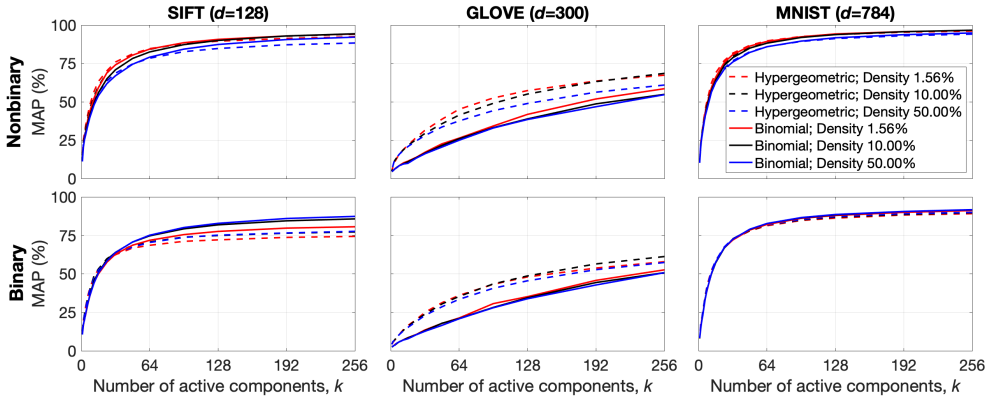
Summary. The paper presents an empirical study of design choices in FlyHash-style expand-and-sparsify embeddings: preprocessing of input vectors (original FlyHash preprocessing, mean centering, normalization, and combinations), the distribution and density of the random projection matrix (binomial vs. hypergeometric, three density levels), and the sparsifying nonlinearity (nonbinary kWTA, binary kWTA, and two forms of k-block sparse codes). The evaluation uses MAP at K=200 on 10^4 vectors from SIFT, GLOVE, and MNIST, with 10 random initializations and 10^3 queries per matrix. The main findings are that preprocessing and the choice of ranking measure interact strongly with the embedding type, that the hypergeometric projection distribution helps substantially for the dense GLOVE vectors, and that block sparse codes with a number of blocks matched to the bit budget of binary kWTA outperform binary kWTA at supposedly equal storage cost. The paper also reports a null result for optimizing column densities with a genetic algorithm.
Significance. If the results hold, the paper provides useful practical guidance for designing FlyHash embeddings in hyperdimensional computing and similarity search, and the idea of comparing embeddings on a per-bit storage budget is a valuable addition to the literature. The experimental protocol is described carefully, with fixed dataset sizes, query counts, and numbers of random initializations, and the findings are broadly consistent across three datasets. The manuscript is, however, primarily an empirical design study rather than a theoretical contribution, and its central novelty—the 'matching bits' block-sparse comparison—is undermined by a technical flaw in Eq. (13) that makes the comparison undefined for most of the parameter values used in the experiments.
major comments (2)
- [Section III-C1, Eq. (13)] The 'matching bits' comparison is not well-defined for the parameter settings used in the paper. With D=20k, the function k' log2(D/k') on the left-hand side of Eq. (13) is maximized at k' = D/e ≈ 7.36k, where its value is (20k/e) log2 e ≈ 10.61k bits. The right-hand side is k log2(20k), which exceeds this maximum whenever log2(20k) > 10.61, i.e., for k ≳ 78. Concretely, for k=128 (D=2560) the right-hand side is about 1449 bits while the maximum left-hand side is about 1358 bits; for k=256 (D=5120, the setup used in Fig. 4) the right-hand side is about 3154 bits versus a maximum of about 2717 bits. Thus no k' solves Eq. (13) for these values. The 'block sparse; matching bits' curves in Fig. 3 therefore cannot represent embeddings at exactly the same storage cost as binary kWTA; either they use fewer bits, contradicting the 'equal storage cost' claim, or they were computed with a different, undocumented budget. This is load-bearing because the paper's strongest sub-claim is that block sparse codes with matched bit budgets outperform binary kWTA per stored bit. Please correct the comparison, for example by restricting to k where a solution exists, or by reporting actual bit counts and using a rounded or explicitly budgeted k' with the exact storage costs for both curves.
- [Section III (Figs. 1-3)] All main experiments fix the expansion ratio to D = 20k, i.e., embedding density k/D = 0.05, and no sensitivity analysis over the expansion ratio is provided. The conclusions about which preprocessing, projection distribution, and sparsifier perform best are therefore demonstrated at a single operating point. If the ranking of these design choices depends on D/k—which is plausible given that the behavior of kWTA and of block sparsification changes with relative expansion—the paper's central claim that 'the right combination of design choices can lead to drastic difference' may not transfer to other expansion settings. Please add experiments at at least a few additional expansion ratios (e.g., D = 5k, 10k, 50k), or explicitly restrict the conclusions to the tested density and discuss the likely dependence on D/k.
minor comments (4)
- [Section III-B2] The genetic algorithm used to optimize column densities is described only as 'set to optimize the density of individual columns of M'; no population size, number of generations, mutation/crossover operators, fitness function, or number of independent runs is given. This makes the reported null result irreproducible. Please provide these details or rephrase the claim as preliminary.
- [Figures 1-3] Results are reported as averages over 10 random initializations without error bars, standard deviations, or significance tests. This makes it difficult to assess whether differences such as those in Fig. 3 are reliable, especially for the claim that the 'matching bits' variant 'consistently outperformed' the alternatives. Please add variability information or state explicitly that the differences exceed the observed variation across initializations.
- [Fig. 4 and surrounding text] The term 'iWTA embedding' appears to be a typographical or notational error for the kWTA embedding formed by processing i blocks; please clarify the notation so that it is distinct from the kWTA parameter k used elsewhere.
- [Section II-A] The statement that block sparse codes reduce the information entropy from log2(D choose k) to k log2(D/k) uses an approximation for the binomial coefficient; please clarify that this is an asymptotic or approximate comparison rather than an exact equality, and likewise note that Eqs. (11)-(12) are fixed-length encoding costs rather than exact entropies.
Circularity Check
No significant circularity: the design choices are empirical independent variables and benchmark performance is measured externally.
full rationale
The paper's chain of reasoning is an empirical ablation, not a derivation from fitted quantities. The design choices (preprocessing, random-projection distribution and density, sparsifying nonlinearity) are independent variables, and the MAP scores in Figs. 1–4 are computed against the external SIFT, GLOVE, and MNIST benchmarks using ranking overlap, so the central "drastic differences" claim is not obtained by re-inserting the same data. Eq. (13) defines the k' needed to equalize the bit budget between block-sparse and binary kWTA codes; it is a bookkeeping identity, and the subsequent "matching bits" comparison is a controlled experiment, not a prediction derived from a fit. Self-citations ([7], [9], [19]–[21], [52]) appear only as background on random projections and hyperdimensional computing, and the baseline FlyHash algorithm is the external work [22]; no load-bearing theorem is imported from the authors' own prior papers. The acknowledged limitation (only ranking preservation was studied) and the footnote that computation cost was excluded are honest scope statements, not circular dependencies. A possible infeasibility of Eq. (13) at D=20k for large k would be an experimental-design or correctness problem, not a circularity.
Assumptions & free parameters
free parameters (6)
- Expansion ratio (D/k) =
20
- MAP truncation K =
200
- Preprocessing mean target r =
100
- Number of RP matrix initializations =
10
- RP matrix density p =
0.1 (default); 0.0156; 0.5
- Block size in sequential processing =
20
assumptions (5)
- standard math Linear random projections preserve Euclidean distances, inner products, and angles when the same measure is computed on the embeddings (JL-type results).
- standard math The entropy of unconstrained kWTA codes is log2(C(D,k)) bits, whereas block sparse codes have k log2(D/k) bits.
- domain assumption MAP at K=200 on SIFT, GLOVE, and MNIST is a valid and representative measure of similarity search performance.
- domain assumption The three datasets (SIFT, GLOVE, MNIST) are representative of real-world inputs for FlyHash embeddings.
- domain assumption The equations (6)-(7) accurately reproduce the original FlyHash preprocessing from [22].
Cite this review
Pith. "Pith review of On Design Choices in Similarity-Preserving Sparse Randomized Embeddings." pith.science (2026). https://pith.science/paper/UMAHEZTX
@misc{pith2026250114741,
  author       = {Pith},
  title        = {Pith review of: On Design Choices in Similarity-Preserving Sparse Randomized Embeddings},
  year         = {2026},
  howpublished = {\url{https://pith.science/paper/UMAHEZTX}},
  note         = {Machine review of arXiv:2501.14741}
}
read the original abstract
Expand & Sparsify is a principle that is observed in anatomically similar neural circuits found in the mushroom body (insects) and the cerebellum (mammals). Sensory data are projected randomly to much higher-dimensionality (expand part) where only few the most strongly excited neurons are activated (sparsify part). This principle has been leveraged to design a FlyHash algorithm that forms similarity-preserving sparse embeddings, which have been found useful for such tasks as novelty detection, pattern recognition, and similarity search. Despite its simplicity, FlyHash has a number of design choices to be set such as preprocessing of the input data, choice of sparsifying activation function, and formation of the random projection matrix. In this paper, we explore the effect of these choices on the performance of similarity search with FlyHash embeddings. We find that the right combination of design choices can lead to drastic difference in the search performance.
Figures


Figures from the paper (1 more)

Reference graph
Works this paper leans on
-
[1]
Extensions of Lipschitz mappings into a Hilbert space,
W. B. Johnson and J. Lindenstrauss, “Extensions of Lipschitz mappings into a Hilbert space,” in Conference in Modern Analysis and Probability, ser. Contemporary Mathematics, vol. 26, 1984, pp. 189–206
work page 1984
-
[2]
Approximate nearest neighbors: Towards removing the curse of dimensionality,
P. Indyk and R. Motwani, “Approximate nearest neighbors: Towards removing the curse of dimensionality,” in Annual ACM Symposium on Theory of Computing (STOC) , 1998, pp. 604–613
work page 1998
-
[3]
Latent semantic indexing: A probabilistic analysis,
C. H. Papadimitriou et al. , “Latent semantic indexing: A probabilistic analysis,” J. Comput. Syst. Sci. , vol. 61, no. 2, pp. 217–235, 2000
work page 2000
-
[4]
S. S. Vempala, The random projection method . AMS, 2005, vol. 65
work page 2005
-
[5]
Holographic reduced representations,
T. A. Plate, “Holographic reduced representations,” IEEE Trans. Neural Netw., vol. 6, no. 3, pp. 623–641, 1995
work page 1995
-
[6]
Fully distributed representation,
P. Kanerva, “Fully distributed representation,” in Real World Computing Symposium (RWC), 1997, pp. 358–365
work page 1997
-
[7]
D. Kleyko et al., “A survey on hyperdimensional computing aka vector symbolic architectures, Part I: Models and data transformations,” ACM Computing Surveys, vol. 55, no. 6, pp. 1–40, 2022
work page 2022
-
[8]
Vector symbolic architectures answer Jackendoff’s chal- lenges for cognitive neuroscience,
R. W. Gayler, “Vector symbolic architectures answer Jackendoff’s chal- lenges for cognitive neuroscience,” in Joint International Conference on Cognitive Science (ICCS/ASCS) , 2003, pp. 133–138
work page 2003
Show all 56 references
-
[9]
A survey on hyperdimensional computing aka vector symbolic architectures, Part II: Applications, cognitive models, and challenges,
D. Kleyko et al., “A survey on hyperdimensional computing aka vector symbolic architectures, Part II: Applications, cognitive models, and challenges,” ACM Computing Surveys , vol. 55, no. 9, pp. 1–52, 2023
2023
-
[10]
A survey of dimensionality reduction techniques based on random projection,
H. Xie et al. , “A survey of dimensionality reduction techniques based on random projection,” arXiv:1706.04371, 2017
2017 arXiv
-
[11]
Database-friendly random proj.: Johnson-Lindenstrauss with binary coins,
D. Achlioptas, “Database-friendly random proj.: Johnson-Lindenstrauss with binary coins,” J. Comput. Syst. Sci. , vol. 66, pp. 671–687, 2003
2003
-
[12]
Very sparse random projections,
P. Li et al. , “Very sparse random projections,” in ACM Int. Conf. on Knowledge Discovery and Data Mining (SIGKDD) , 2006, pp. 287–296
2006
-
[13]
Sparser Johnson-Lindenstrauss transforms,
D. M. Kane and J. Nelson, “Sparser Johnson-Lindenstrauss transforms,” Journal of the ACM , vol. 61, no. 1, pp. 1–23, 2014
2014
-
[14]
Random indexing of text samples for latent semantic analysis,
P. Kanerva et al., “Random indexing of text samples for latent semantic analysis,” in Ann. Mtg. of Cognitive Sci. Soc. (CogSci) , 2000, p. 1036
2000
-
[15]
Vector-based semantic analysis: Representing word mean- ings based on random labels,
M. Sahlgren, “Vector-based semantic analysis: Representing word mean- ings based on random labels,” in ESSLI Workshop on Semantic Knowl- edge Acquisition and Categorization , 2001, pp. 1–21
2001
-
[16]
Vector and distributed representations reflecting semantic relatedness of words,
I. S. Misuno et al. , “Vector and distributed representations reflecting semantic relatedness of words,” Math. Mach. and Syst. , vol. 3, pp. 50– 66, 2005
2005
-
[17]
Similarity estimation techniques from rounding algo- rithms,
M. S. Charikar, “Similarity estimation techniques from rounding algo- rithms,” in Ann. ACM Symp. on Theory of Comp. (STOC) , 2002
2002
-
[18]
Searching for text information with the help of vector representations,
I. S. Misuno et al. , “Searching for text information with the help of vector representations,” Probl. of Progr., vol. 4, pp. 50–59, 2005
2005
-
[19]
Formation of similarity-reflecting binary vectors with random binary projections,
D. A. Rachkovskij, “Formation of similarity-reflecting binary vectors with random binary projections,” Cybern. Syst. Anal., vol. 51, no. 2, pp. 313–323, 2015
2015
-
[20]
Randomized projective methods for the construction of binary sparse vector representations,
D. A. Rachkovskij et al. , “Randomized projective methods for the construction of binary sparse vector representations,” Cybern. Syst. Anal., vol. 48, no. 1, pp. 146–156, 2012
2012
-
[21]
Estimation of vectors similarity by their randomized binary projections,
D. A. Rachkovskij, “Estimation of vectors similarity by their randomized binary projections,” Cybern. Syst. Anal. , vol. 51, pp. 808–818, 2015
2015
-
[22]
A neural algorithm for a fundamental computing problem,
S. Dasgupta et al. , “A neural algorithm for a fundamental computing problem,” Science, vol. 358, no. 6364, pp. 793–796, 2017
2017
-
[23]
The Drosophila mushroom body: from architecture to algorithm in a learning circuit,
M. N. Modi et al., “The Drosophila mushroom body: from architecture to algorithm in a learning circuit,” Annual Review of Neuroscience , vol. 43, pp. 465–484, 2020
2020
-
[24]
Kanerva, Sparse distributed memory
P. Kanerva, Sparse distributed memory . The MIT Press, 1988
1988
-
[25]
High-dimensional computing with sparse vectors,
M. Laiho et al., “High-dimensional computing with sparse vectors,” in IEEE Biomedical Circuits and Systems Conf. (BioCAS) , 2015, pp. 1–4
2015
-
[26]
Neural distributed autoassociative memories: A survey,
V . I. Gritsenko et al. , “Neural distributed autoassociative memories: A survey,” Cybern. and Comput. Eng. , vol. 2, no. 188, pp. 5–35, 2017
2017
-
[27]
Variable binding for sparse distributed representa- tions: Theory and applications,
E. P. Frady et al. , “Variable binding for sparse distributed representa- tions: Theory and applications,” IEEE Trans. Neural Netw. and Learning Systems, vol. 34, no. 5, pp. 2191–2204, 2023
2023
-
[28]
Product quantization for nearest neighbor search,
H. Jegou et al., “Product quantization for nearest neighbor search,” IEEE Transactions on Pattern Analysis and Machine Intelligence , vol. 33, no. 1, pp. 117–128, 2011
2011
-
[29]
GloVe: Global vectors for word representation,
J. Pennington et al., “GloVe: Global vectors for word representation,” in Conf. on Empir. Met. Nat. Lang. Proc. (EMNLP) , 2014, pp. 1532–1543
2014
-
[30]
Gradient-based learning applied to document recogni- tion,
Y . LeCun et al., “Gradient-based learning applied to document recogni- tion,” Proceedings of the IEEE , vol. 86, no. 11, pp. 2278–2324, 1998
1998
-
[31]
Compressed hashing,
Y . Lin et al., “Compressed hashing,” in Conf. on Computer Vision and Pattern Recogn. (CVPR), 2013, pp. 446–451
2013
-
[32]
Random convergence of olfactory inputs in the Drosophila mushroom body,
S. J. C. Caron et al. , “Random convergence of olfactory inputs in the Drosophila mushroom body,” Nature, vol. 497, pp. 113–117, 2013
2013
-
[33]
Expansion of inf. in the binary autoencoder with random binary weights,
V . M. Osaulenko, “Expansion of inf. in the binary autoencoder with random binary weights,” Neur. Comput., vol. 33, pp. 3073–3101, 2021
2021
-
[34]
Can a fruit fly learn word embeddings?
Y . Liang et al., “Can a fruit fly learn word embeddings?” in Int. Conf. on Learning Representations (ICLR) , 2021, pp. 1–17
2021
-
[35]
Attention approximates sparse distributed memory,
T. Bricken and C. Pehlevan, “Attention approximates sparse distributed memory,” in Adv. Neural. Inf. Process. Syst. (NeurIPS) , 2021, pp. 1–15
2021
-
[36]
Reducing catastrophic forgetting with assoc. learning: A lesson from fruit flies,
Y . Shen et al. , “Reducing catastrophic forgetting with assoc. learning: A lesson from fruit flies,” Neur. Comput., vol. 35, pp. 1797–1819, 2023
2023
-
[37]
Discrete key-value bottleneck,
F. Tr ¨auble et al. , “Discrete key-value bottleneck,” in Int. Conf. on Machine Learning (ICML) , 2023, pp. 34 431–34 455
2023
-
[38]
Sparse distributed memory is a continual learner,
T. Bricken et al., “Sparse distributed memory is a continual learner,” in Int. Conf. on Learning Representations (ICLR) , 2023, pp. 1–57
2023
-
[39]
Random features for large-scale kernel machines,
A. Rahimi and B. Recht, “Random features for large-scale kernel machines,” in Adv. Neural. Inf. Process. Syst. (NeurIPS) , 2007, pp. 1–8
2007
-
[40]
Computing on functions using randomized vector representations (in brief),
E. P. Frady et al. , “Computing on functions using randomized vector representations (in brief),” in Neuro-Inspired Computational Elements Conference, 2022, pp. 115–122
2022
-
[41]
Streaming encoding algorithms for scalable hyper- dimensional computing,
A. Thomas et al. , “Streaming encoding algorithms for scalable hyper- dimensional computing,” arXiv:2209.09868, 2022
2022 arXiv
-
[42]
Bio-inspired hashing for unsupervised similarity search,
C. Ryali et al., “Bio-inspired hashing for unsupervised similarity search,” in Int. Conf. on Machine Learning (ICML) , 2020, pp. 8295–8306
2020
-
[43]
Laplace-HDC: Understanding the geometry of binary hyperdimensional computing,
S. Pourmand et al. , “Laplace-HDC: Understanding the geometry of binary hyperdimensional computing,” arXiv:2404.10759, 2024
2024 arXiv
-
[44]
Sparse neural networks with large learning diversity,
V . Gripon and C. Berrou, “Sparse neural networks with large learning diversity,” IEEE Trans. Neural Netw. , vol. 22, pp. 1087–1096, 2011
2011
-
[45]
Iter. retrieval and block coding in auto- and hetero-assoc. memory,
G. E. Knoblauch and G. Palm, “Iter. retrieval and block coding in auto- and hetero-assoc. memory,” Neur. Comput., vol. 32, pp. 205–260, 2020
2020
-
[46]
Expressivity of expand-and-sparsify repre- sentations,
S. Dasgupta and C. Tosh, “Expressivity of expand-and-sparsify repre- sentations,” arXiv:2006.03741, 2020
2006 arXiv
-
[47]
A theory of sequence indexing and working memory in recurrent neural networks,
E. P. Frady et al., “A theory of sequence indexing and working memory in recurrent neural networks,” Neur. Comput., vol. 30, no. 6, pp. 1449– 1513, 2018
2018
-
[48]
A comparison of vector symbolic architectures,
K. Schlegel et al. , “A comparison of vector symbolic architectures,” Artificial Intelligence Review , vol. 55, pp. 4523–4555, 2022
2022
-
[49]
Near-channel classifier: Symbiotic communication and classification in high-dimensional space,
M. Hersche et al. , “Near-channel classifier: Symbiotic communication and classification in high-dimensional space,” Brain Inform. , vol. 8, 2021
2021
-
[50]
A theoretical perspective on hyperdimensional computing,
A. Thomas et al. , “A theoretical perspective on hyperdimensional computing,” J. Artif. Intell. Res. , vol. 72, pp. 215–249, 2021
2021
-
[51]
Capacity analysis of vector symbolic architec- tures,
K. L. Clarkson et al. , “Capacity analysis of vector symbolic architec- tures,” arXiv:2301.10352, 2023
2023 arXiv
-
[52]
Efficient decoding of compositional structure in holistic representations,
D. Kleyko et al. , “Efficient decoding of compositional structure in holistic representations,” Neur. Comput., vol. 35, pp. 1159–1186, 2023
2023
-
[53]
Hyperdimensional computing as a frame- work for systematic aggregation of image descriptors,
P. Neubert and S. Schubert, “Hyperdimensional computing as a frame- work for systematic aggregation of image descriptors,” in Conf. on Computer Vision and Pattern Recogn. (CVPR), 2021, pp. 16 938–16 947
2021
-
[54]
Modification of holographic graph neuron using sparse distributed representations,
D. Kleyko et al., “Modification of holographic graph neuron using sparse distributed representations,” Procedia Comput., vol. 88, pp. 39–45, 2016
2016
-
[55]
Classification using hyperdimensional comput- ing: A review,
L. Ge and K. K. Parhi, “Classification using hyperdimensional comput- ing: A review,” IEEE Circuits Syst. Mag. , vol. 20, pp. 30–47, 2020
2020
-
[56]
UCI machine learning repository,
D. Dua and C. Graff, “UCI machine learning repository,” 2017. [Online]. Available: http://archive.ics.uci.edu/ml
2017
Reviewed August 11, 2026 · model on record in the stance chip above.
Discussion (0). Continue with ORCID to comment.